Financial Operations
What Is Cash Flow Forecasting and Why You Need It
What Is Cash Flow Forecasting. Master cash flow forecasting for your growing business. Learn methods, tools, and step-by-step guidance
ByJumpstart Partners, CPA, QuickBooks ProAdvisor
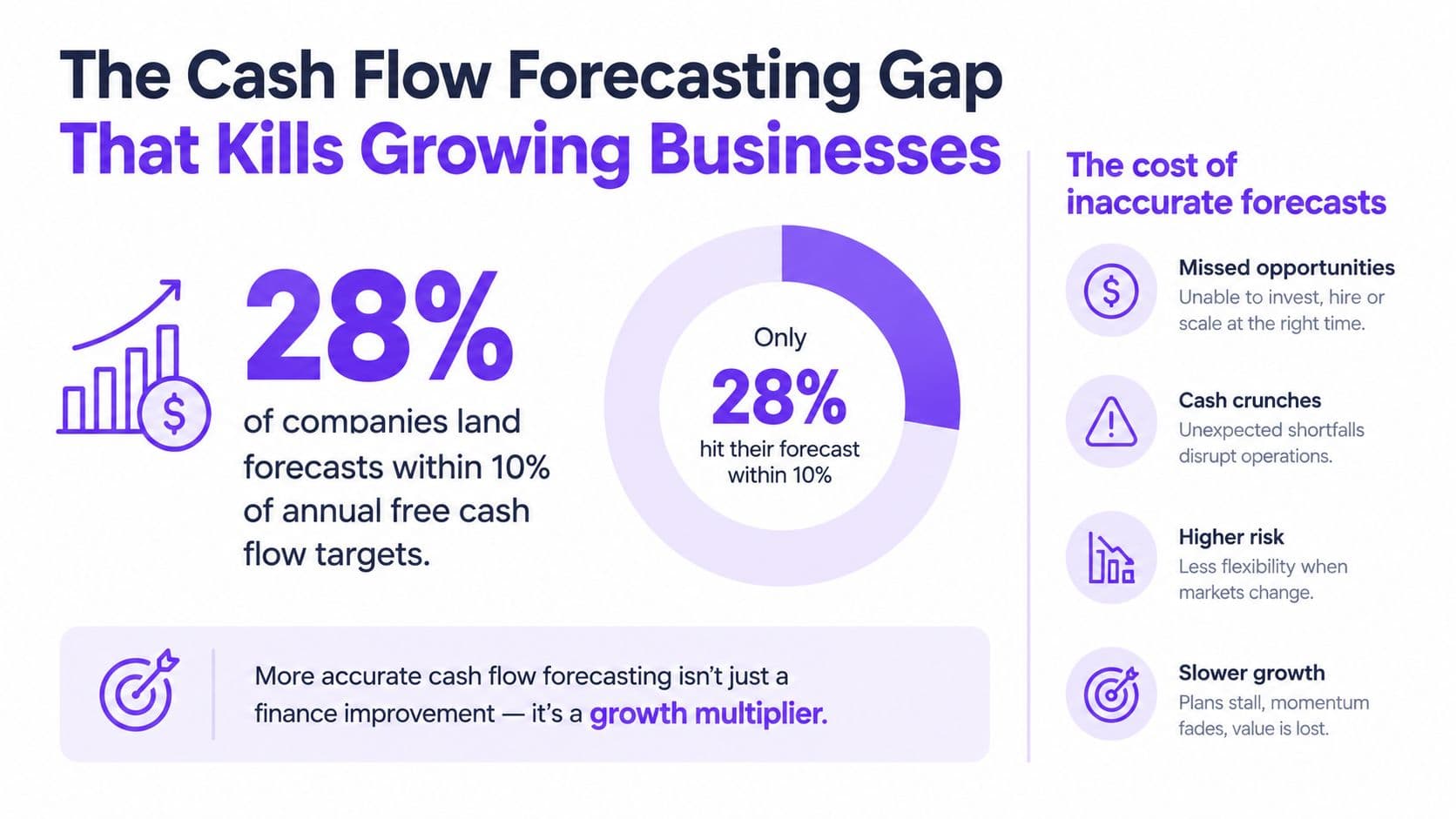
··16 min readOnly 28% of companies' cash forecasts land within 10% of their annual free cash flow targets. Cash flow forecasting is the disciplined process of estimating when money will enter and leave your business so you can see future cash balances before decisions become emergencies.
For a founder, the formula is simple:
Ending cash = Opening cash + Expected inflows − Expected outflows
The difficult part is getting reliable inputs. Your bank may show cleared transactions, Stripe may hold customer receipts, QuickBooks may show invoices, and Gusto may contain payroll obligations. If those systems disagree or update at different times, a technically correct formula still produces a dangerously wrong answer.
Table of Contents
- The Cash Flow Forecasting Gap That Kills Growing Businesses
- Understanding Cash Flow Forecasting Fundamentals
- Direct Versus Indirect Methods for Your Business Size
- Building a 13-Week Rolling Cash Flow Forecast
- Forecast Accuracy Benchmarks and Method Comparison
- Essential Tools and Platform Integrations
- Real-World Impact, Runway Extension and Fundraising Readiness
- Your 30-Day Implementation Checklist
The Cash Flow Forecasting Gap That Kills Growing Businesses
A 2026 EY-Parthenon analysis of 2,400 of the largest global companies found that only 28% of cash forecasts were within 10% of annual free cash flow targets over a one-year horizon, even though about 80% of revenue guidance reports were within 10% of target. EY-Parthenon's cash forecasting analysis exposes the central problem: companies often understand revenue better than they understand cash timing.
Growing businesses feel this gap sharply. A SaaS company can report strong recurring revenue while customers pay late. An agency can sign a large project while payroll and contractor costs arrive before the client deposit. A professional services firm can show profit while tax, software renewals, and vendor invoices drain the bank account in the same week.
The formula isn't the failure point
Most founders can understand the mechanics. Add expected receipts, subtract expected payments, and carry the closing balance into the next period. Execution fails because the underlying data is fragmented across banks, payment processors, accounting platforms, payroll systems, invoice records, and spreadsheets.
A spreadsheet usually captures what someone remembered to enter. It doesn't automatically know that a payment processor will settle on a different date, that an invoice was disputed, or that payroll includes a new hire. As transaction volume grows, the founder becomes the integration layer, and that isn't a scalable control.
Practical rule: A forecast is only as trustworthy as its least reliable input. Fix the data flow before you add model complexity.
The shift beyond smaller-scale operations makes this more urgent. You need a forecast that answers operational questions, not just accounting questions: Can payroll clear? Which invoices need collection attention? Can you approve the hiring plan? Should you delay a purchase?
For a broader explanation of why liquidity matters to business resilience, see this guide to why cash flow is important. If you're preparing for a transaction, this resource on cash flow forecast confidence for buyers is useful because buyers scrutinize the connection between reported performance and usable cash.
Understanding Cash Flow Forecasting Fundamentals
Cash flow forecasting is not a prediction of revenue. It's a schedule of when cash arrives and when your business pays it out. Revenue recognition can tell you when a sale belongs in the accounts. A cash forecast tells you when the money reaches the bank.
Consider a SaaS company with $2 million in annual recurring revenue. Its average monthly recurring revenue is:
$2,000,000 ÷ 12 = $166,666.67
That monthly figure doesn't mean $166,666.67 arrives in the bank during the month. If customers pay annually upfront, cash may arrive in large deposits. If they pay on terms, the invoice can count as receivable revenue while cash remains outstanding. If a customer churns before renewal, the expected receipt disappears even though the prior period looked healthy.

Three input categories control the result
| Input | What you need to know | Worked example |
|---|---|---|
| Accounts receivable | Invoice amount, expected collection date, payment risk | $50,000 invoice collected this month adds $50,000 |
| Accounts payable | Supplier amount, due date, planned payment date | $12,000 vendor bill paid this month reduces cash by $12,000 |
| Fixed obligations | Payroll, subscriptions, rent, taxes, debt payments | $80,000 payroll plus $6,000 subscriptions reduces cash by $86,000 |
Suppose the company begins the month with $240,000, collects $166,666.67, and receives an additional $50,000 customer payment. Its inflows total $216,666.67. It pays $80,000 in payroll, $12,000 to vendors, and $6,000 for subscriptions, producing outflows of $98,000.
The calculation is:
$240,000 + $216,666.67 − $98,000 = $358,666.67 ending cash
That result is useful only if the collection date is realistic and the outflows include every known obligation. A forecast that treats an invoice as cash on the issue date will overstate liquidity. A forecast that omits payroll taxes or annual renewals will understate upcoming payments.
Your cash flow statement records what already happened. Your forecast organizes what you expect to happen next. This cash flow statement explanation helps separate those two jobs. Retail businesses face a different mix of receipts, inventory payments, and settlement timing, so these cash flow strategies for retailers provide useful context.
Direct Versus Indirect Methods for Your Business Size
Choose the method based on the decision you need to make, not on what sounds more impressive. The direct method starts with expected cash receipts and disbursements. The indirect method starts with expected net income and adjusts for non-cash items and working-capital movements.
| Decision factor | Direct method | Indirect method |
|---|---|---|
| Starting point | Customer receipts and actual payments | Net income and financial statements |
| Best use | Near-term liquidity management | Longer-range planning |
| Detail level | Transaction and payment-date detail | Account and assumption level |
| Strong fit | Smaller teams, SaaS, agencies, service firms | Complex operations with inventory or multiple entities |
| Main burden | Maintaining payment timing | Maintaining accounting assumptions |
| Main risk | Missing a transaction or obligation | Hiding timing problems inside broad estimates |
For a digital agency preparing for next month's payroll, use the direct method. List expected client collections by date, then enter payroll, contractors, software, rent, taxes, and debt payments by payment date. The resulting weekly balance answers the question that matters: when does cash get tight?
For a larger business with inventory, depreciation, multiple revenue streams, or substantial working-capital movements, the indirect method gives management a more useful strategic view. It connects expected profitability to expected cash generation, but it shouldn't replace a direct short-term schedule when payroll or supplier timing is at risk.
A practical decision matrix
| Your operating reality | Recommended approach |
|---|---|
| Few bank accounts and predictable customer payments | Direct forecast in a controlled spreadsheet |
| High payment volume through Stripe or PayPal | Direct forecast fed by settlement data |
| Inventory and substantial supplier timing | Indirect planning view plus direct liquidity view |
| Multiple entities and complex reporting | Indirect consolidated model plus entity-level cash schedules |
| Limited finance capacity | Start direct, automate collection, add complexity only when needed |
A simple model that gets refreshed consistently beats an elaborate model nobody maintains. Treasury guidance makes the same operational point: a model with about 90% reliability and low maintenance can be more valuable than a slightly more accurate model that is difficult to sustain. This guidance on AI cash flow forecasting also emphasizes that data quality and refresh frequency determine practical usefulness.
Building a 13-Week Rolling Cash Flow Forecast
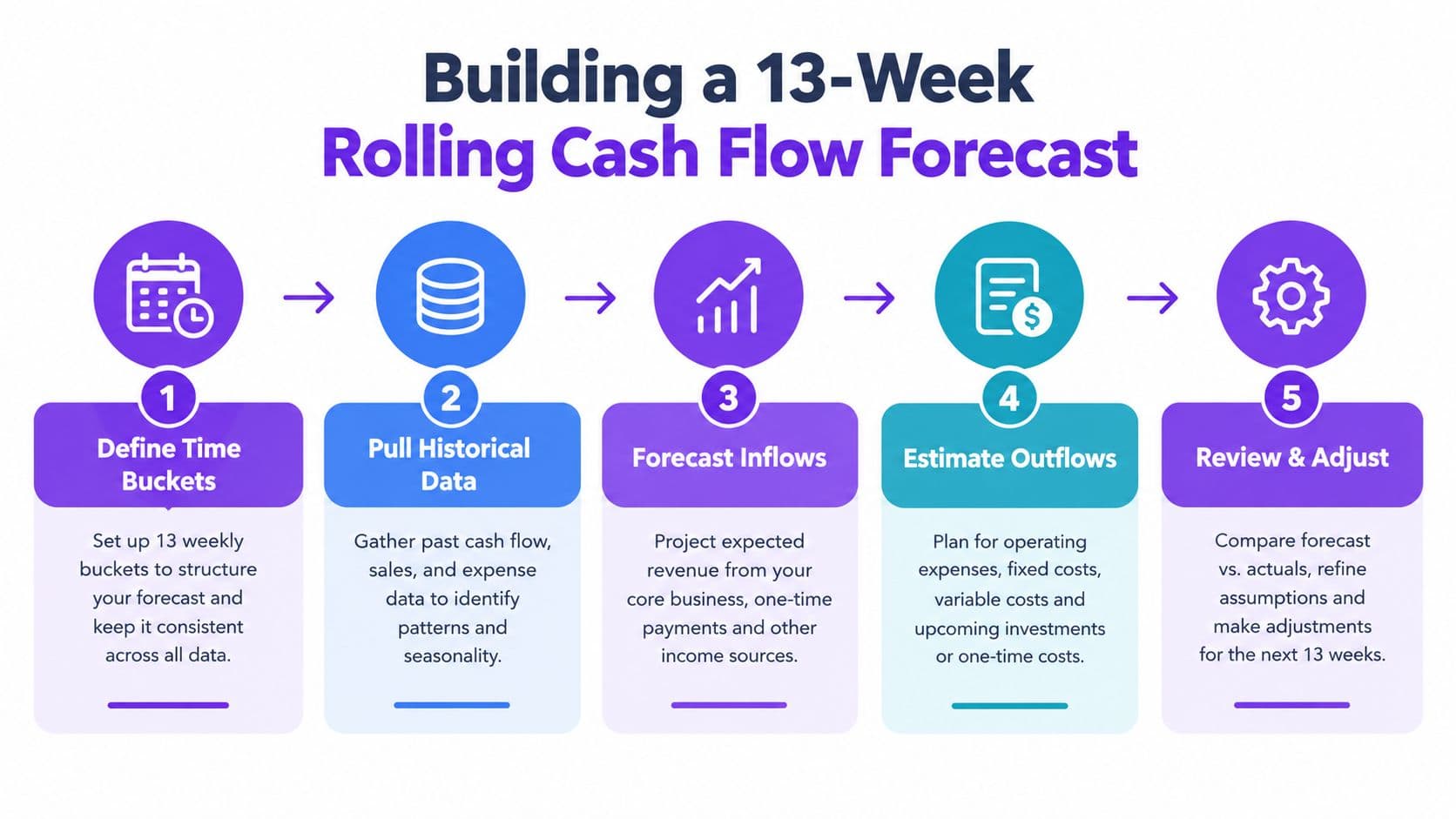
A 13-week rolling forecast gives you a weekly view of liquidity across a full quarter. It's detailed enough to expose a bad cash week and manageable enough for a founder, controller, or finance lead to review regularly.
Build the schedule in five steps
-
Define time buckets. Create columns for Week 1 through Week 13. Use the actual week ending dates, not vague labels, so payroll, tax, and settlement dates line up correctly.
-
Pull historical data. Export bank activity, open invoices, accounts payable, payroll commitments, loan schedules, and payment processor settlements. Reconcile the opening cash balance to the bank before projecting anything.
-
Forecast inflows. Separate committed receipts from expected receipts. Include customer payments, loan proceeds, and equity injections only when the timing has a credible basis. Don't treat an unsigned proposal as cash.
-
Estimate outflows. Add payroll, vendor payments, contractor invoices, taxes, debt repayments, subscriptions, and planned purchases. Enter the week cash leaves the account, not the date an expense was recorded.
-
Review and adjust. Compare each completed week with actual results. Explain every material variance, change the assumption that caused it, and extend the schedule by one new week.
Use this 13-week rolling cash flow template as a structural reference. A useful schedule separates opening cash, customer receipts, other inflows, payroll, vendors, taxes, debt, discretionary spending, net cash flow, and closing cash.
Consider a business with $500,000 in annual revenue and an opening cash balance of $75,000. In one forecast week, it expects $22,000 of customer collections and $4,000 from other receipts. It expects $18,000 in payroll, $7,000 in vendor payments, and $3,000 in taxes.
$75,000 + $26,000 − $28,000 = $73,000 closing cash
The next week starts at $73,000. If collections fall to $10,000 while outflows remain $28,000, the closing balance becomes:
$73,000 + $10,000 − $28,000 = $55,000
That drop is not automatically a crisis. It is a signal to investigate collection timing, planned spending, and the remaining weekly balances. Quarterly tax payments and irregular vendor bills belong in the schedule even when they don't occur every week.
The following video provides a visual walkthrough of the rolling process:
Forecast Accuracy Benchmarks and Method Comparison
You need to define accuracy by forecast horizon and compare projections with actual cash results. A forecast that works for next week may not remain reliable for the thirteenth week, because customer behavior, hiring decisions, and discretionary spending become less certain over time.
Published benchmark data reports 88% to 94% directional accuracy for four-week AI cash forecasts and 88% to 92% for 13-week AI forecasts. The same benchmark reports 60% to 78% average accuracy for traditional manual or spreadsheet methods. The published cash flow benchmark also reports that a traditional working-capital forecast had 68% variance against actuals, while a machine-learning model using the same data reduced variance to 17%.
Those figures don't mean automation can rescue bad inputs. A model trained on incomplete invoices, stale bank data, or incorrectly categorized payments will produce a polished version of the wrong answer. Automation improves the process when it connects reliable sources and refreshes them consistently.
| Forecast approach | Appropriate expectation | Management use |
|---|---|---|
| Manual spreadsheet | Useful starting point with active oversight | Basic liquidity planning |
| Automated short-term forecast | Stronger directional visibility when inputs are clean | Weekly cash decisions |
| Indirect strategic model | Broad view of future cash generation | Hiring, investment, and financing plans |
| Variance review | Measures forecast against actual outcomes | Model improvement and accountability |
Measure the error that changes decisions
Don't ask only, “Was the forecast accurate?” Ask:
- Which week had the largest variance?
- Was the error caused by amount, timing, or categorization?
- Did a customer pay late, or did the team record the receipt in the wrong period?
- Did an omitted obligation change the minimum cash balance?
A forecast is good enough when it gives you time to act. If it identifies a cash dip early enough to accelerate collections, defer a discretionary purchase, or negotiate vendor terms, it has created operational value even if the final balance isn't exact.
Essential Tools and Platform Integrations
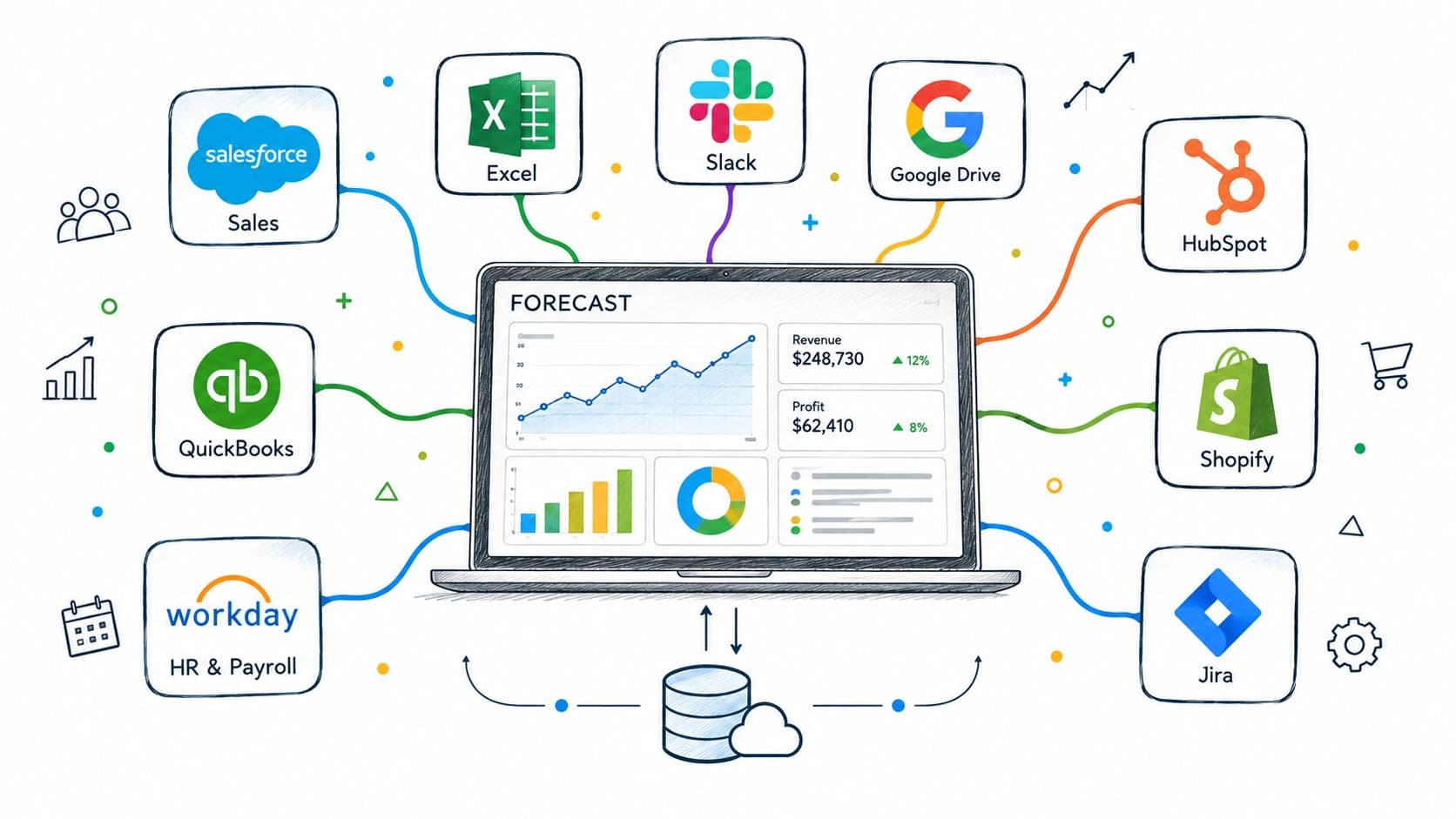
Integration is not a software preference. It is a control. If QuickBooks contains one invoice balance, Stripe contains another settlement status, and the bank shows a third cash reality, your forecast needs a defined process for reconciling those differences.
Connect the systems that create cash events
QuickBooks or Xero should provide the accounting backbone, including open receivables, payables, recurring expenses, and reconciled bank activity. Stripe or PayPal should contribute payment status, processing deductions, refunds, and settlement dates. Gusto or ADP should supply payroll timing and expected payroll-related obligations.
As the business becomes more complex, platforms such as NetSuite can support multi-entity reporting and broader operational data. The point isn't to collect every integration available. Connect the systems that originate or control material cash movements.
This guide to cash flow forecasting in QuickBooks is relevant if QuickBooks is your accounting source and your forecast still depends on manual exports.
Pick the operating model, not the fashionable tool
| Operating model | Works well when | Main weakness |
|---|---|---|
| Controlled spreadsheet | Transaction volume is manageable and one person owns review | Manual updates and version risk |
| Accounting-platform feature | The forecast needs are straightforward | Limited visibility across external systems |
| Dedicated forecasting software | You need automated feeds and scenarios | Requires implementation discipline |
| Outsourced controller support | The founder needs an owned process and finance oversight | Requires clear access, responsibilities, and review cadence |
For businesses between $5 million and $10 million in revenue, outsourcing becomes a serious option when the founder or bookkeeper is spending too much time consolidating systems instead of managing decisions. The right provider should document data ownership, reconcile source systems, explain assumptions, and give management a repeatable review process.
Jumpstart Partners offers a fixed-fee Cash Flow Clarity Sprint with a 13-week rolling forecast, scenario planning, payroll runway calculations, burn rate analysis, and cash flow KPI setup. Treat that type of engagement as a process implementation, not a substitute for clean records.
Real-World Impact, Runway Extension and Fundraising Readiness
Cash forecasting earns its place when it changes a decision before the cash leaves the bank. A SaaS company may discover that a renewal-heavy month looks strong on paper but contains a thin collection week. An agency may see that contractor payments precede a client milestone by enough time to create a financing need.
The operating response is straightforward. The finance lead flags the week, the account owner contacts customers with overdue invoices, the founder reviews discretionary spending, and the operations team confirms every scheduled payment. The forecast turns a vague concern into an ordered list of actions.
What investors and lenders want to see
Investors don't need a forecast that pretends uncertainty doesn't exist. They need to see that you understand the drivers behind your cash position and can explain changes from one version to the next.
| Review area | Strong evidence |
|---|---|
| Cash balance | Reconciled opening balance tied to bank records |
| Collections | Receipts linked to customer invoices and payment timing |
| Spending | Payroll, vendors, taxes, and one-time costs shown separately |
| Scenarios | Clear assumptions for expected and adverse outcomes |
| Governance | Regular forecast-to-actual review with documented variances |
A clean forecast also supports runway analysis. If opening cash is $300,000 and planned monthly net cash outflow is $50,000, the simple runway calculation is:
$300,000 ÷ $50,000 = 6 months
That calculation is only useful if the burn figure includes the obligations you expect to pay. Use this burn rate and runway calculation guide to structure the analysis, then test whether the monthly burn changes across the 13-week schedule.
Your 30-Day Implementation Checklist
Don't spend the first month searching for a perfect forecasting platform. Build ownership, establish a clean baseline, and create a process that your team can maintain.
| Timing | Action | Deliverable |
|---|---|---|
| Week 1 | Gather bank, accounting, receivables, payables, payroll, and payment processor data | Reconciled opening cash balance and source inventory |
| Week 2 | Categorize transactions and document collection and payment timing | Cash driver map and written assumptions |
| Week 3 | Build the 13-week schedule with weekly inflows, outflows, and closing balances | First rolling forecast with expected and adverse views |
| Week 4 | Connect priority systems and set the review cadence | Named owner, integration plan, and weekly variance review |
Your first forecast doesn't need to predict every transaction perfectly. It needs to expose the next cash decision. Start with the direct method, separate committed receipts from assumptions, and add every fixed obligation before you model growth spending.
Keep the process internal when one capable owner can reconcile the data and explain variances without delaying operations. Bring in controller support when systems remain disconnected, the founder still maintains the spreadsheet, or leadership can't agree on the cash position. In either case, assign one person responsibility for the forecast and one meeting for reviewing it.
The first review should answer four questions:
- What changed from the prior forecast?
- Which receipts are late or uncertain?
- Which payments can be moved without damaging operations?
- What action will protect the lowest projected cash balance?
A forecast becomes a management system when those questions produce decisions every week.
Jumpstart Partners helps SaaS, agency, and professional services businesses build integrated cash visibility through controller support, bookkeeping, and fixed-fee 13-week cash flow projects. Visit Jumpstart Partners to discuss your systems, forecast gaps, and the next practical step.