Financial Operations
13 Week Rolling Cash Flow Template and How to Use It
Download a 13 week rolling cash flow template and learn to populate it, customize it for SaaS, agencies, and ecommerce, and run best/worst scenarios.
ByJumpstart Partners, CPA, QuickBooks ProAdvisor
··15 min readYour P&L says the quarter is profitable. Your bank balance says Friday's payroll is a problem. That gap usually isn't caused by bad arithmetic. It comes from treating accounting dates as cash dates, then reviewing liquidity monthly while payroll, supplier payments, taxes, and debt service arrive on specific days.
A 13-week rolling cash flow template gives you a direct view of the next 91 days, with enough weekly detail to manage solvency and enough structure for a small finance team to maintain. The value isn't the spreadsheet itself. It's the discipline of converting ledger data into expected bank movements, refreshing actuals, and acting before a shortfall becomes urgent.
Table of Contents
- Why Profitable Companies Still Run Out of Cash
- Inside the Template Structure and Core Formula
- Turning Ledger Balances Into Real Cash Dates
- Customizing the Model for SaaS, Agencies, and Ecommerce
- Running Best Case and Worst Case Scenarios
- Using the Forecast for Fundraising and Your Next Move
Why Profitable Companies Still Run Out of Cash
Accrual accounting tells you when revenue is earned and expenses are incurred. Your bank account cares when customers pay and when your team, vendors, lenders, and tax authorities receive money. A profitable agency can issue a large invoice today, record revenue, and still have no cash from that work when payroll clears.
Quarterly budgets hide this timing problem. They may show enough revenue and margin across the period, but they don't tell you whether cash arrives before a payroll run or after a supplier payment. Weekly granularity exposes those pressure points because payroll, supplier payments, loan service, and tax obligations can shift quickly inside a single quarter. Intuit's overview of the 13-week cash flow forecast describes the format as a 91-day short-term liquidity tool for exactly this reason.
Why 13 weeks is the operating horizon
The horizon is long enough to identify a financing need, renegotiate a major payment, or delay discretionary spending. It's short enough that your team can make credible assumptions about specific customer receipts and planned disbursements.
The rolling design matters more than the number of columns. Each week, you replace the completed forecast with actual bank activity, remove the oldest week, and add a new week at the end. The model stays focused on the next quarter instead of becoming an abandoned budget.
Practical rule: A cash problem discovered in week six is a management decision. The same problem discovered in week twelve is often a forced decision.
For a founder managing a $500K to $20M business, that difference affects whether you can collect an overdue invoice, move a vendor payment, pause a hiring plan, or arrange financing on reasonable terms. A monthly report may confirm that cash is tight. A weekly model shows which week breaks, which line causes it, and what action has time to work.
The right response isn't to build a more elaborate annual model. It's to create a simple direct-method forecast and maintain it every week. The practical guidance in this cash flow improvement resource is useful alongside the forecast because liquidity improves through operational decisions, not reporting alone.
By the end, you'll have a structure for the 13 Week Rolling Cash Flow Template, a method for re-dating AR and AP, an industry-specific set of assumptions, and a scenario process that turns the spreadsheet into a weekly decision tool.
Inside the Template Structure and Core Formula
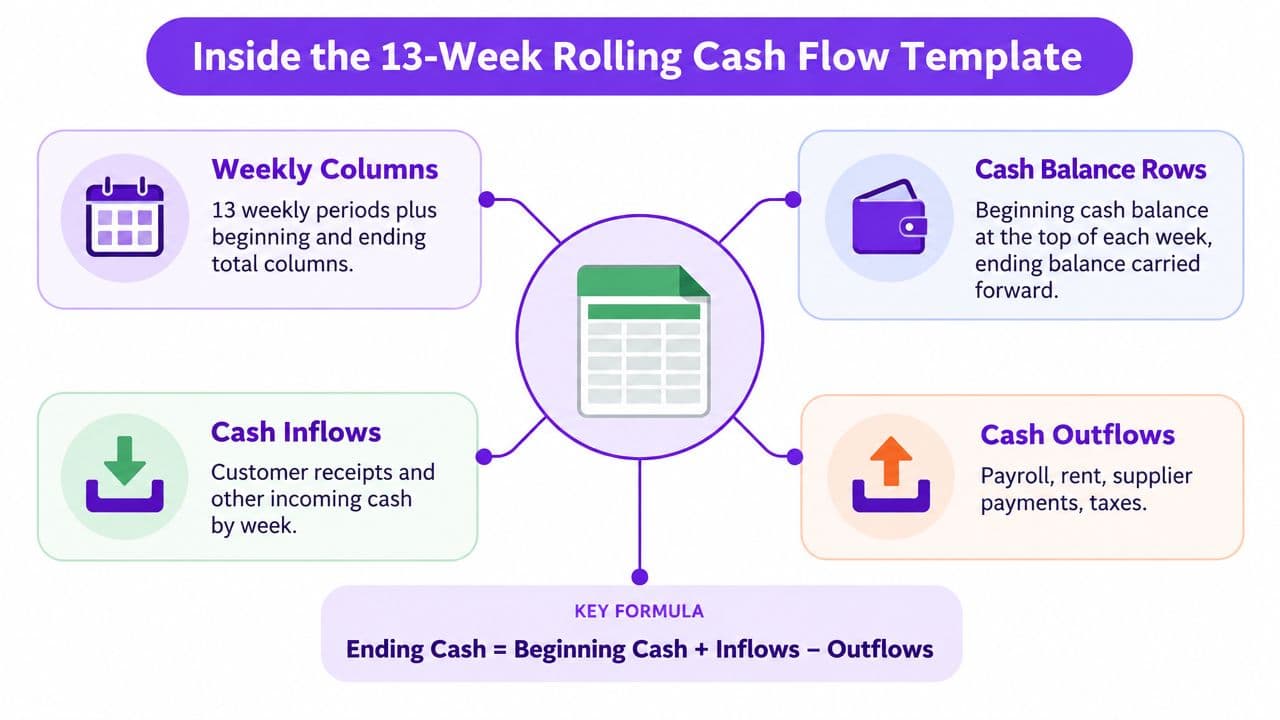
A founder opens the bank account on Monday and sees enough cash for payroll, then notices supplier payments and tax debits landing in the same week. The template should expose that collision before the bank does. Build one worksheet with 13 weekly columns, followed by a total or summary column where it helps review. Place opening cash at the top, receipts next, disbursements below, and the projected closing balance at the bottom.
The core calculation is:
Beginning cash balance + receipts − disbursements = ending cash balance
The formula is simple. The work sits in deciding which receipts and payments will reach the bank in each week. Ripple's explanation of cash flow forecasts and templates also covers a minimum cash balance and a line showing cash above or below that threshold.
The rows your team will actually maintain
Keep the operating model to roughly 8 to 12 line items, a practical range discussed in Accordion's 13-week forecasting guide. A workable layout is:
| Section | Essential rows |
|---|---|
| Opening position | Beginning cash balance |
| Receipts | Customer collections, other receipts |
| Disbursements | Payroll, suppliers, taxes, debt service, rent and recurring costs |
| Result | Net cash movement, ending cash balance |
| Control | Minimum cash balance, cash above or below minimum |
Keep immaterial expense categories combined. Preserve separate rows wherever payment timing could change a decision. If updating the model takes an hour, the forecast will fall behind actual cash activity.
The following example shows how the rows connect:
| Cash flow line | Week 1 | Week 2 |
|---|---|---|
| Beginning cash balance | $120,000 | $105,000 |
| Customer receipts | $35,000 | $60,000 |
| Other receipts | $5,000 | $0 |
| Total receipts | $40,000 | $60,000 |
| Total disbursements | $55,000 | $48,000 |
| Net cash movement | -$15,000 | $12,000 |
| Ending cash balance | $105,000 | $117,000 |
| Minimum cash balance | $80,000 | $80,000 |
| Cash above minimum | $25,000 | $37,000 |
Week 1 calculates as $120,000 + $40,000 − $55,000 = $105,000. Week 2 starts with Week 1's ending balance, giving $105,000 + $60,000 − $48,000 = $117,000.
If you are starting with a blank workbook, a practical founder's guide to cash flow can help establish the basic rows. Jumpstart Partners' cash flow statement template in Excel provides another starting structure, but adapt its categories to the company's actual payment calendar and approval process.
Treat the minimum cash line as a management boundary you set to protect payroll, supplier commitments, and debt obligations. Flag every week below it, then assign an owner and corrective action before the shortfall reaches the bank.
Turning Ledger Balances Into Real Cash Dates
A profitable company can still miss payroll when its forecast treats ledger balances as cash. Accounting records show invoices, bills, and transaction dates. The forecast needs expected settlement dates. An invoice issued today is not today's receipt, and a bill due next week may be paid later or earlier.
Start with accounts receivable. Review each material open invoice and assign an expected collection date using contractual terms, customer payment history, disputes, and current promises to pay. A $40,000 agency invoice issued today by a client that usually pays in 45 days belongs in week 7, not week 1. The amount stays the same. The available liquidity changes.
Re-date every major cash category
Keep a short assumptions register beside the forecast. Record the accounting source, the rule used to convert it into a cash date, and the person responsible for confirming that assumption. This register is the control layer that keeps the model from becoming a static export.
| Ledger category | Cash-date conversion | What to verify |
|---|---|---|
| Accounts receivable | Expected collection date | Customer behavior, disputes, promised payment |
| Accounts payable | Intended payment date | Approval status, cash priorities, vendor terms |
| Payroll | Actual payroll debit date | Pay cycle, bonuses, commissions, employer taxes |
| Taxes | Required remittance date | Sales tax, payroll tax, income tax obligations |
| Loans | Scheduled debit date | Principal, interest, fees, covenant requirements |
| Capex | Expected vendor payment date | Purchase approval, delivery, staged billing |
For payables, do not copy due dates without checking operating behavior. If approved suppliers are normally paid on the due date, use that date. If invoices wait for a scheduled payment run, use the run date. If a vendor has stopped work until payment clears, place the invoice in the week required to keep operations running.
Payroll needs a separate review because the bank debit may not match the period employees worked. Put wages, commissions, bonuses, and employer taxes in the weeks when cash leaves the account. Track sales taxes, loan repayments, dividends, and capital purchases separately whenever their timing could affect a decision.
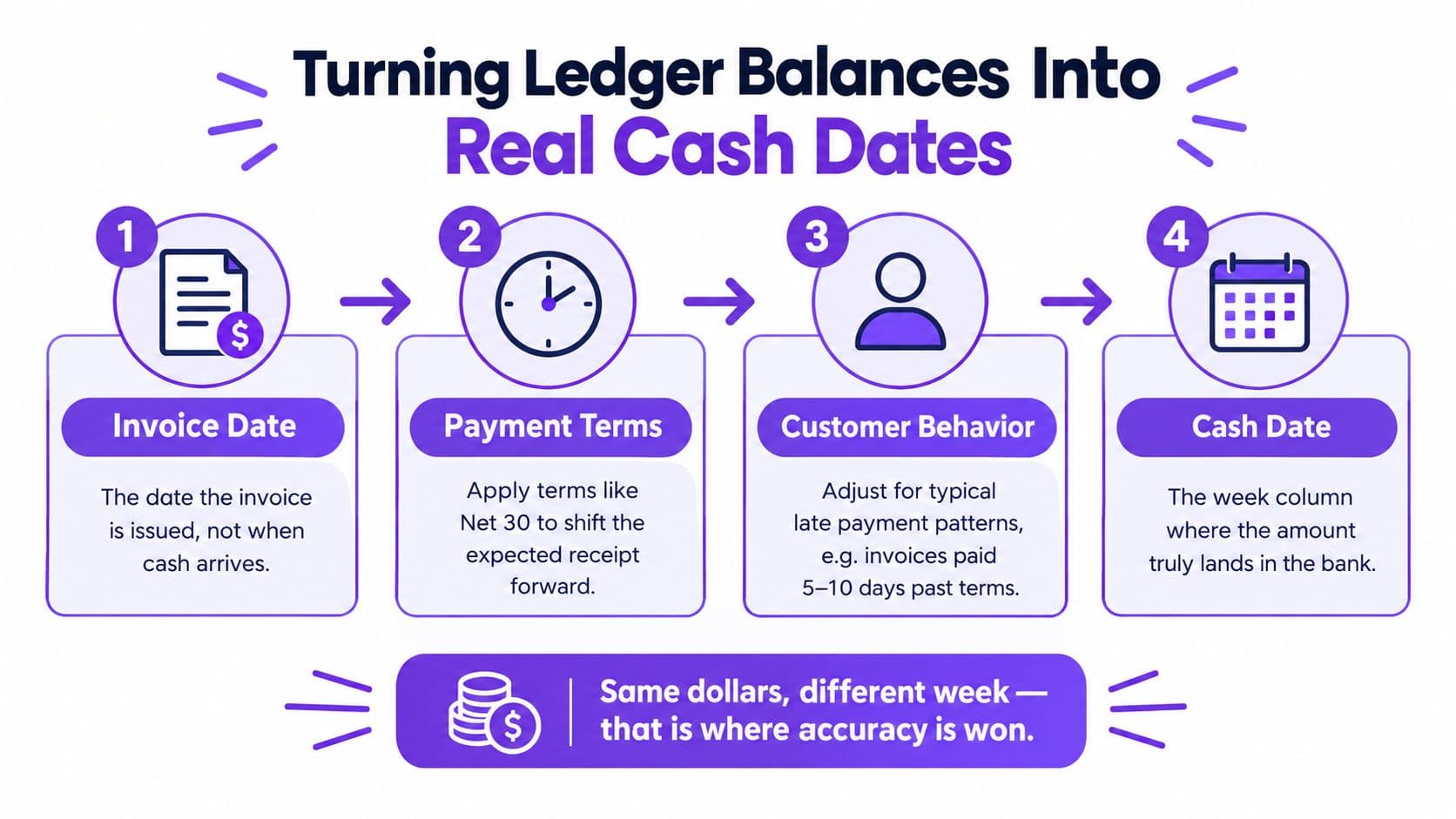
Run the weekly update as a controlled routine:
- Replace the completed forecast week with bank and accounting actuals.
- Compare forecast and actual amounts line by line.
- Record the cause of each material variance.
- Remove the oldest week and add a new Week 13.
- Re-date open AR, AP, payroll, taxes, and financing items.
Consistent maintenance improves forecast accuracy because every miss becomes a rule to review. Do not change inputs just to make the forecast look better. Log whether the miss came from a delayed customer, an early supplier payment, an omitted obligation, or a faulty timing assumption, then update the assumptions engine.
Reviewing an accounts receivable aging report separates invoices with a credible collection path from balances that only appear available on paper. The forecast should show what customers are likely to pay and when, not merely what the ledger says they owe.
Customizing the Model for SaaS, Agencies, and Ecommerce
A generic cash flow model produces generic answers. Your business model determines which receipts are predictable, which outflows cluster, and which assumption deserves the most scrutiny.
SaaS companies usually have a recurring billing base, but the timing still varies. Monthly subscriptions spread receipts across the quarter, while annual prepayments create larger renewal weeks. Dunning activity and churn affect later weeks because failed payments aren't always visible in the opening ledger balance.
Agencies and professional services firms face a different problem. Revenue often arrives in project invoices, retainers, milestone bills, or final acceptance payments. A full pipeline doesn't equal cash, and project payroll can arrive before the client pays.
Ecommerce models need a payout and inventory view. Shopify, Stripe, and similar platforms may generate frequent settlements, while inventory purchases create large outflows before the related sales arrive. The forecast must reflect payout timing, refunds, chargebacks, freight, and purchase orders rather than just applying a margin to projected sales.
| Business Model | Dominant Inflows | Dominant Outflows | Most Critical Timing Assumption |
|---|---|---|---|
| SaaS | Monthly subscriptions, annual renewals, implementation receipts | Payroll, cloud infrastructure, commissions | Renewal dates, failed-payment recovery, and billing settlement |
| Agency or professional services | Retainers, milestone invoices, project collections | Payroll, contractors, subcontractors, software | Client collection behavior and project payment milestones |
| Ecommerce | Shopify, Stripe, and marketplace payouts | Inventory, freight, fulfillment, refunds | Payout dates and the lead time between inventory payment and sales |
Keep the same discipline, change the weights
Keep the model within roughly 8 to 12 rows, but rename those rows around the cash drivers that matter. A SaaS company may need separate renewal receipts and monthly subscription receipts. An agency may need retainers, milestone collections, and contractor payments. An ecommerce operator may need inventory deposits, fulfillment, and platform payouts.
Don't force subscription concepts into a services model. Subscription accounting guidance can help SaaS leaders distinguish billing and revenue workflows, but the cash forecast still needs the actual bank settlement date. Accounting classification and liquidity timing answer different questions.
Running Best Case and Worst Case Scenarios
A single forecast is a prediction. Three scenarios give you a response plan.
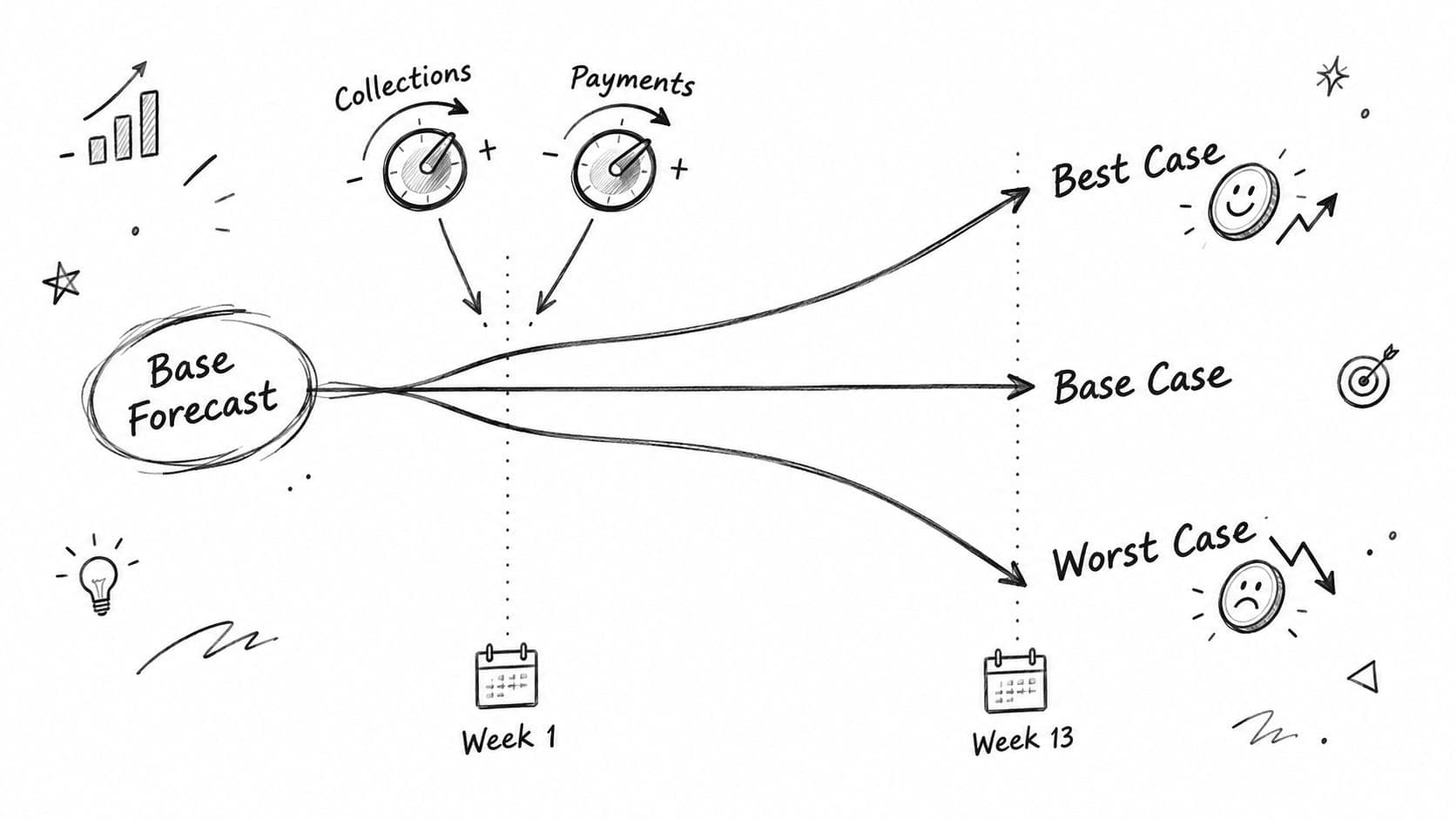
Build a base case from the best information available today. Then change the two assumptions with the most impact: collection timing and payment timing. Keep revenue and expense totals unchanged initially so you can isolate the effect of timing rather than burying every uncertainty inside a vague percentage adjustment.
Suppose your base case shows an ending cash balance of $95,000 in Week 13, with a minimum cash floor of $70,000. In the worst case, collections slip by 15 days. If that delay moves enough receipts out of the earlier weeks, the model can breach the $70,000 floor in Week 9 even though the ending Week 13 balance later recovers to $80,000.
That temporary breach still matters. Payroll and supplier payments occur during the gap, not at the end of the horizon.
Turn each scenario into a trigger
| Scenario | Assumption | Trigger | Management response |
|---|---|---|---|
| Best case | Customers pay earlier and planned vendor payments hold | Cash remains comfortably above the floor | Fund approved growth spending or rebuild reserves |
| Base case | Current customer and vendor behavior continues | No breach, but limited headroom | Maintain collections and review weekly variances |
| Worst case | Collections slip by 15 days and selected payments remain fixed | Floor breached in Week 9 | Accelerate invoicing, negotiate terms, delay non-critical spending |
The scenario isn't useful if nobody owns the response. Assign a person to each action. The AR lead owns overdue collections and promise-to-pay confirmations. The finance lead owns vendor negotiations and payment sequencing. The CEO decides which discretionary spending pauses when the floor is threatened.
Red flags that invalidate the forecast
The biggest failures are timing failures, not algebra. Zone's guidance on 13-week cash flow forecasting identifies the recurring problems:
- Invoice-date receipts: You record AR when the invoice is issued instead of when the customer is expected to pay.
- Due-date AP assumptions: You assume every bill clears exactly on its contractual due date.
- Missing payroll timing: You omit the debit date for wages, commissions, bonuses, or employer taxes.
- Stale actuals: You fail to replace forecast values with bank results each week.
- Unchallenged collection assumptions: You treat disputed or historically late invoices as immediately available cash.
Forecasts not refreshed with actuals can become useless within two weeks, according to the same guidance. If your Friday review produces no changes, no variance log, and no new Week 13, you aren't running a rolling forecast. You're preserving an old spreadsheet.
Using the Forecast for Fundraising and Your Next Move
A clean 13-week forecast gives lenders, investors, and management a near-term view of solvency, covenant exposure, and working-capital needs. It also shows whether the finance team knows the difference between a booked transaction and an expected bank movement. Bookkeeping Flow's coverage of rolling cash flow forecasting notes that this discipline is relevant to lenders, investors, and management teams, while finance teams increasingly connect forecasts to live bank feeds and automation.
Put the model in your data room with three supporting elements:
- Weekly actuals versus forecast, with material variances explained.
- A documented assumptions register, including collection dates, payment dates, payroll dates, and financing events.
- A liquidity floor and trigger plan, showing what management does before cash falls below the boundary.
A lender doesn't need a visually elaborate workbook. They need to understand the opening cash position, the receipts they can believe, the payments you must make, and the decisions available if the base case deteriorates. If you're preparing for an SBA financing process, a resource on the benefits of an SBA broker can help you think through the financing side, but the forecast still needs to stand on its own.
A spreadsheet is only the visible layer
Excel is adequate for a smaller business with stable inputs. It becomes fragile when AR changes daily, multiple bank accounts need reconciliation, or the same assumptions are copied across disconnected files. A live bank feed can reduce manual entry, but automation doesn't fix a wrong collection date or an unapproved payment assumption.
The core value lies in the assumptions engine. If you tie each material receipt and disbursement to an expected cash date, review the variance weekly, and keep the model concise, the spreadsheet remains useful. If you don't, a polished workbook can still miss the liquidity crunch.
For founders who need a repeatable process, financial forecasting for startups provides additional context on turning finance data into operating decisions. Jumpstart Partners offers a 13-week Cash Flow Clarity Sprint with forecast setup, bank and QuickBooks connections, and a founder-friendly dashboard. Its CPA-certified team also offers a 5-day close and cash flow work designed for growing businesses, but the service should be judged by the quality of its dates, assumptions, reconciliations, and weekly decisions.
Start today with four actions:
- Download or create the 13-week workbook.
- Re-date the first week of receipts and disbursements to actual expected cash dates.
- Set your minimum cash floor and define the breach response.
- Schedule your first Friday forecast review with the owners of AR, AP, payroll, and finance.
Jumpstart Partners can build and maintain a 13-week rolling cash flow forecast, connect your bank and accounting data, and turn weekly variance reviews into clear operating actions. If your team needs that cash-date discipline without adding a full-time controller, visit Jumpstart Partners to discuss a focused cash flow sprint.