Financial Operations
Subscription Accounting for SaaS: The Complete Guide
Master subscription accounting for SaaS and recurring-revenue firms. Learn ASC 606, deferred revenue, journal entries, KPIs, and audit-ready workflows.
ByJumpstart Partners, CPA, QuickBooks ProAdvisor
··16 min readA full year of customer access can be paid for on day one, yet your income statement may recognize only one month of that contract in the first reporting period. That accounting treatment can feel counterintuitive, but it's the operational reality of subscription accounting under ASC 606. A public company filing describes subscription revenue recognized on a straight-line basis over the service term, beginning when the solution becomes available to the customer, rather than when cash arrives. SEC filing on straight-line subscription revenue recognition
For a SaaS company, that distinction affects more than bookkeeping. It shapes reported revenue, deferred revenue, cash-flow interpretation, investor diligence, audit support, and the reliability of metrics used to make pricing and hiring decisions. The mechanics become especially important for businesses between $1M-$5M ARR, where founders often still rely on billing exports, spreadsheets, and accounting software that wasn't designed to interpret every contract term.
Table of Contents
- Why Subscription Accounting Determines Your SaaS Valuation
- How ASC 606 Transforms Subscription Revenue Recognition
- Deferred Revenue Mechanics and Journal Entries
- Integrating Your Tech Stack for Automated Revenue Recognition
- Connecting Subscription Accounting to SaaS Unit Economics
- Red Flags and Common Subscription Accounting Mistakes
- Your Subscription Accounting Implementation Checklist
Why Subscription Accounting Determines Your SaaS Valuation
Founders often treat revenue recognition as a cleanup project for later. That's expensive thinking. If you book an annual prepayment as revenue immediately, your reported performance no longer reflects the service you've delivered. The balance sheet also fails to show the remaining obligation to provide access, support, implementation, or other promised services.
That mismatch creates friction when an investor or buyer tests your revenue. A diligence team will trace contracts to invoices, cash receipts, deferred revenue schedules, and the general ledger. If those records disagree, the buyer doesn't simply question one journal entry. They question the reliability of your revenue trend, forecast, controls, and management reporting. A business that can't explain when it earned revenue has a harder time defending its valuation.
The standard's purpose is straightforward. ASC 606 replaced older industry-specific guidance through a converged framework issued by the FASB and IASB in 2014, and it became mandatory for U.S. public entities for annual periods beginning after December 15, 2017. Nonpublic entities generally adopted it for annual periods beginning after December 15, 2018, so calendar-year private companies first applied it in 2019. Overview of ASC 606 and adoption timing
What clean books tell a buyer
Clean subscription accounting gives an investor confidence in several areas:
- Reported revenue: The income statement reflects delivery, not merely collections.
- Deferred revenue: The balance sheet shows cash received for services you still owe.
- Contract visibility: The finance team can explain upgrades, renewals, discounts, usage charges, and cancellations.
- Forecast quality: Management can separate booked cash from revenue that will be recognized over time.
- Control maturity: The company has an audit trail from contract terms to billing event to recognition schedule.
This is why accounting quality becomes a commercial advantage during fundraising or acquisition discussions. You're not asking a buyer to accept an opaque spreadsheet. You're showing a repeatable process that ties customer activity to financial statements.
The same discipline improves planning before a transaction is on the table. When your books distinguish cash collections from earned revenue, you can evaluate growth without confusing prepayments with current-period performance. For broader context on how accounting quality feeds valuation analysis, review this guide to startup company valuation.
Practical rule: If you can't reproduce a month's revenue from contract terms and billing records, you don't have a reporting process. You have a number that happens to be in the ledger.
SaaS teams also need accurate commercial materials when selling or demonstrating products. Pricing and packaging decisions should reflect the service term, implementation work, and customer commitments that your accounting workflow must ultimately interpret. A resource such as SaaS interactive demo pricing can help teams evaluate how interactive product experiences fit into a broader go-to-market and subscription model.
How ASC 606 Transforms Subscription Revenue Recognition
ASC 606 uses a five-step model. The model sounds technical, but the operating question is simple: what did you promise, what did the customer pay, and when did you satisfy each promise?
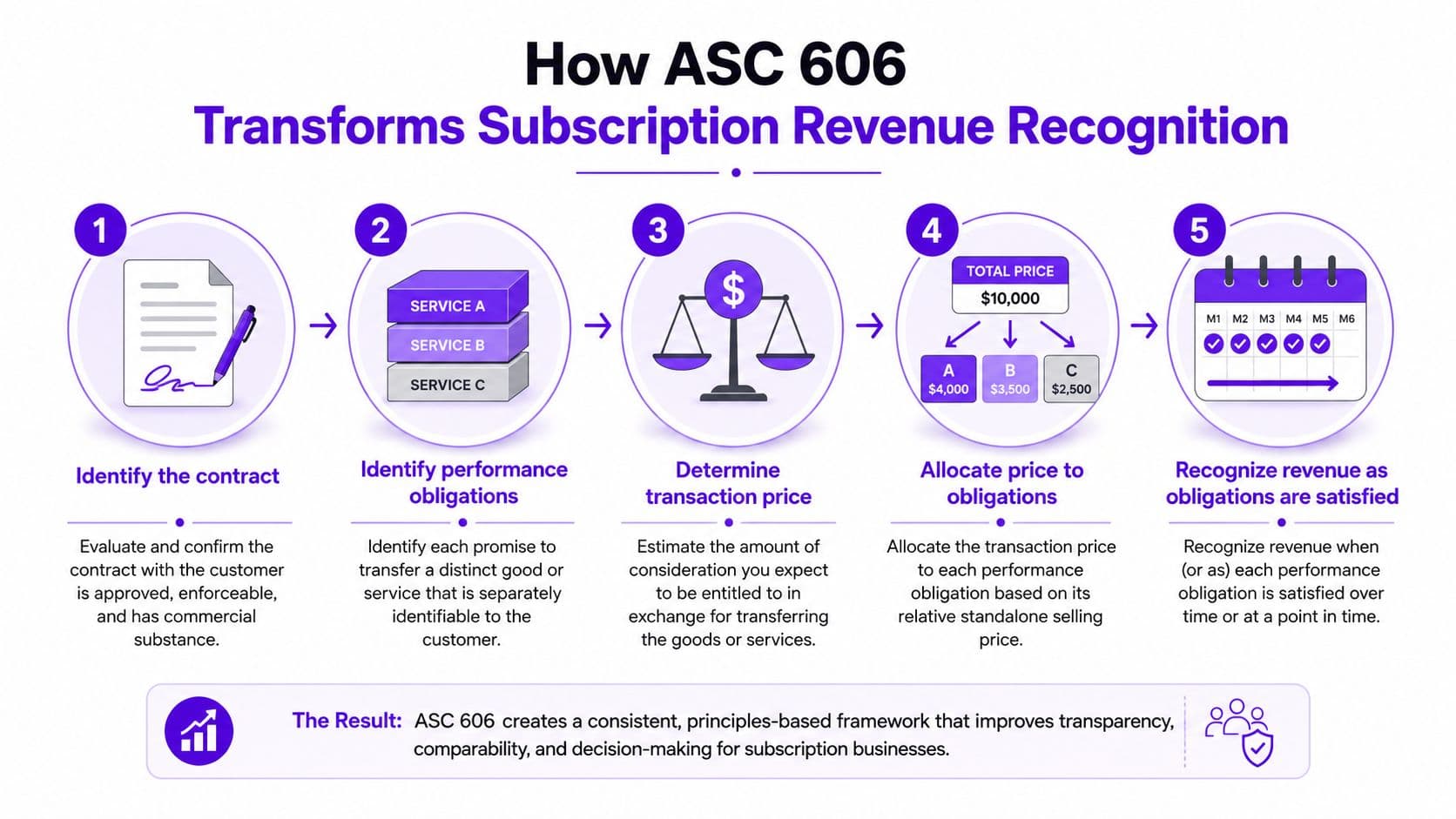
Take a SaaS customer that prepays $12,000 for an annual subscription. Assuming the subscription is one performance obligation and the service is delivered evenly, the accounting schedule recognizes $1,000 per month, calculated as $12,000 divided by 12 months. The cash receipt doesn't create $12,000 of current-period revenue. It creates cash and a liability for the service you still need to provide.
The five decisions your team must make
-
Identify the contract. Confirm that an enforceable arrangement exists, identify the customer, and determine the rights and payment terms.
-
Identify performance obligations. Separate the promised goods or services. A hosted subscription, implementation, training, support, or professional service may require separate analysis.
-
Determine the transaction price. Start with the stated consideration, then assess discounts, credits, usage charges, penalties, refunds, and other variable terms.
-
Allocate the transaction price. Assign consideration to each performance obligation using the relative standalone selling prices when a contract contains multiple obligations.
-
Recognize revenue as obligations are satisfied. Recognize subscription revenue over the period the customer receives access. Recognize other obligations according to the pattern in which you deliver them.
The result prevents premature revenue booking. A customer's annual prepayment improves liquidity, but it doesn't mean you've earned the full amount on receipt. KPMG's software and SaaS revenue recognition handbook describes the five-step model and explains why SaaS arrangements commonly use ratable recognition over the service term.
For a plain-English review of the framework, see this guide to ASC 606 revenue recognition. Your accounting policy should then translate that framework into contract fields, schedule logic, review controls, and journal entries.
The common objection is, “The customer paid us, so why isn't it revenue?” Cash and revenue answer different questions. Cash tells you when money moved. Revenue tells you when you delivered what you promised. Subscription accounting keeps those questions separate so the income statement follows service delivery rather than collection timing.
Deferred Revenue Mechanics and Journal Entries
Deferred revenue is a liability, not a bookkeeping nuisance. It represents consideration you've received for services you haven't fully delivered. Your subledger should turn each billing event into a schedule that reduces that liability as you satisfy the related obligation.
For the $12,000 annual subscription, assume the customer pays before service begins. The initial entry increases cash and deferred revenue. Each month, the close process moves $1,000 from deferred revenue to subscription revenue.
Sample Journal Entries for Annual Subscription
| Date | Account | Debit | Credit |
|---|---|---|---|
| Contract start | Cash | $12,000 | |
| Contract start | Deferred revenue | $12,000 | |
| Month 1 end | Deferred revenue | $1,000 | |
| Month 1 end | Subscription revenue | $1,000 | |
| Month 2 end | Deferred revenue | $1,000 | |
| Month 2 end | Subscription revenue | $1,000 |
The same monthly entry continues through the service term. After the full term, the original deferred revenue balance has been released into revenue, assuming no changes, refunds, credits, or other obligations affect the schedule.
What the waterfall should show
An audit-ready waterfall begins with the opening deferred revenue balance and explains every movement:
- Opening balance: Deferred revenue carried forward from the prior close.
- New billings: Amounts invoiced or collected for future service.
- Revenue recognized: The portion earned during the reporting period.
- Credits and refunds: Adjustments that reduce the customer obligation or consideration.
- Contract changes: Upgrades, downgrades, renewals, and modifications affecting the schedule.
- Ending balance: The liability that should agree to the general ledger.
The subledger must reconcile to both billing activity and the ledger. A spreadsheet that only lists invoice dates and monthly releases isn't enough if it can't preserve the original contract terms, modification history, and approval trail.
A monthly customer upgrade illustrates where basic schedules break. If a customer adds seats partway through a term, you need to determine whether the change creates a separate contract, modifies the existing contract, or changes the allocation and recognition pattern. Usage-based fees add another layer because the amount may not be known until consumption data is received and validated.
The right workflow captures the billing event first, calculates the contractual effect, updates the recognition schedule, and posts a controlled journal entry. The wrong workflow overwrites the old spreadsheet row and leaves no clear explanation for why the balance changed. For more examples of the debit and credit mechanics, use this reference on revenue recognition journal entries.
Integrating Your Tech Stack for Automated Revenue Recognition
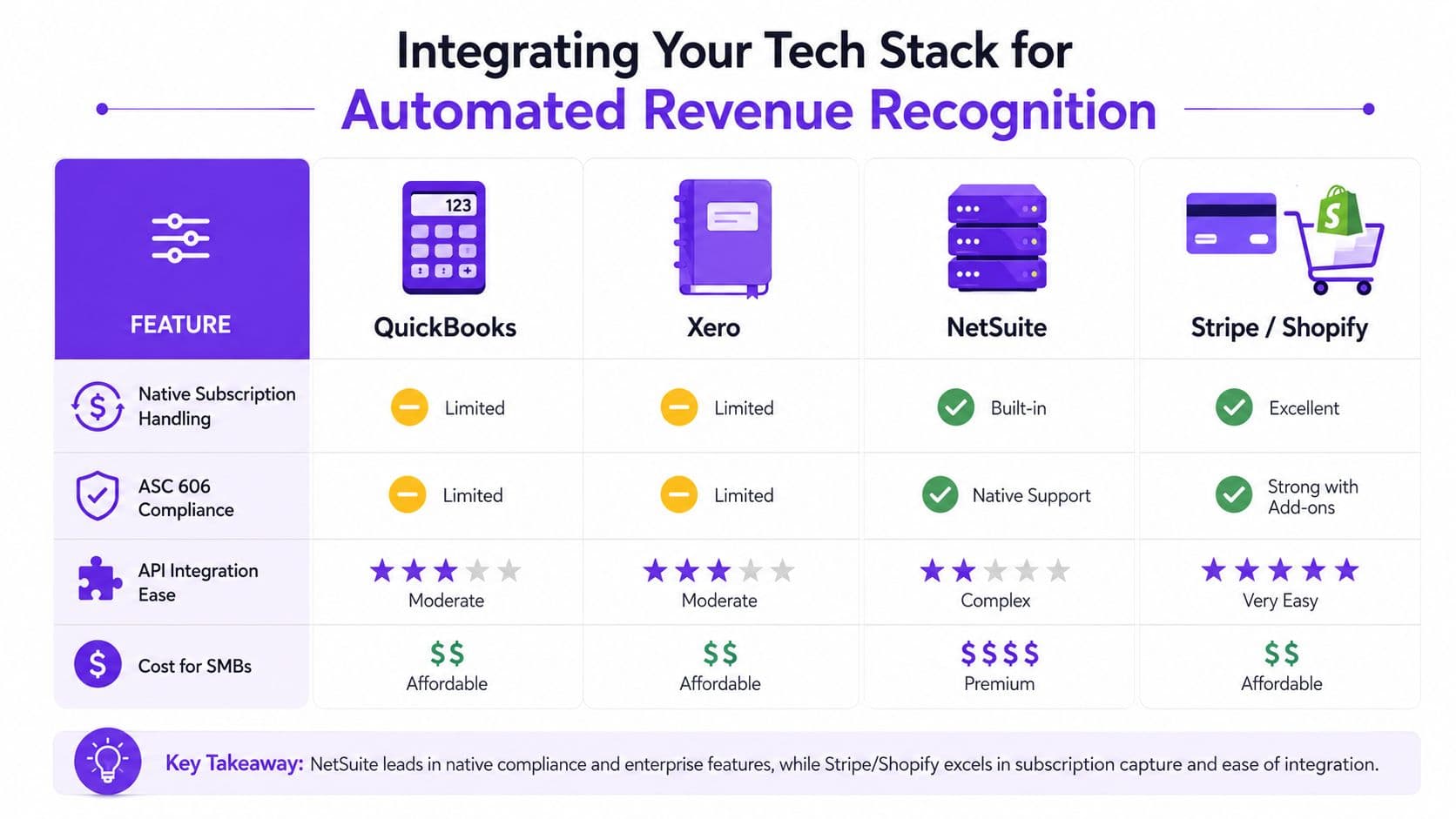
Your accounting platform doesn't automatically become ASC 606 compliant because it receives a Stripe deposit. The system needs contract data, service dates, obligation logic, modification handling, and a controlled path from billing events to recognition schedules.
The practical question is not which platform has the longest feature list. It's whether your stack can produce a defensible subledger and reconcile it to the general ledger without relying on unexplained manual adjustments.
Platform trade-offs
| Platform or source system | Practical role | Where it works | Where it breaks |
|---|---|---|---|
| QuickBooks | General ledger and financial reporting | Small and growing teams with controlled schedules and straightforward contracts | Complex schedules often require an add-on, integration, or carefully maintained journal process |
| Xero | General ledger and bank reconciliation | Businesses that need accessible cloud accounting and disciplined supporting schedules | Contract modifications and detailed waterfalls typically need supporting systems |
| NetSuite | Integrated ERP and revenue workflows | Companies with more complex entities, controls, billing, and reporting requirements | Configuration, data governance, and implementation discipline become critical |
| Stripe and Shopify | Billing, payments, and order data | Capturing transactions, collections, refunds, and customer activity | Payment data alone doesn't establish performance obligations or earned revenue |
A clean architecture usually has four layers. The billing system records the commercial event. A revenue subledger interprets dates, obligations, allocation, and modifications. The accounting platform receives summarized or controlled entries. The close checklist reconciles the subledger to cash, receivables, deferred revenue, and revenue.
That subledger should support daily or straight-line recognition, multi-period subscriptions, usage accruals, and contract modifications. It should also track whether a significant financing component exists. An SEC-filed company disclosed that none of its contracts contained a significant financing component in the reported quarter, illustrating that the central operational challenge is often timing and allocation rather than discounting cash flows. SEC filing discussing revenue recognition and significant financing components
The best automation doesn't eliminate review. It makes review focused. Finance should inspect exceptions, unusual terms, missing service dates, negative balances, and changes to expected recognition, rather than manually rebuild every customer schedule.
For teams using Stripe, the accounting design matters as much as the connector. This overview of Stripe revenue recognition addresses the bridge between payment activity and financial reporting.
Connecting Subscription Accounting to SaaS Unit Economics
Revenue recognition doesn't define every SaaS metric, but it gives those metrics a reliable financial foundation. Your MRR and ARR calculations should come from consistent contract data, while recognized revenue should explain what you delivered during the period. When those sources disagree, your board package can show growth that finance can't reconcile.
The distinction matters for customer economics. A customer's annual prepayment improves cash availability immediately, but the related revenue is earned across the service term. If you treat the cash receipt as current revenue, you distort period performance and make customer acquisition payback appear shorter than the underlying delivery economics support.
Use separate lenses for separate decisions
| Metric or view | What it answers | Accounting connection |
|---|---|---|
| MRR | What recurring contracted value is active on a monthly basis? | Requires clean contract status, recurring pricing, start dates, and cancellations |
| ARR | What recurring annualized value does the active subscription base represent? | Requires consistent treatment of upgrades, downgrades, and nonrecurring services |
| Recognized revenue | What service has been delivered during the period? | Comes from performance obligations and recognition schedules |
| CAC payback | How quickly does customer contribution recover acquisition cost? | Depends on reliable revenue or gross-margin inputs and consistent period treatment |
| Cash collections | When did money enter the business? | Reconciles to invoices, payment processors, receivables, and deferred revenue |
Usage-based pricing requires tighter coordination between product telemetry, billing, and accounting. The finance team needs a defined cutoff, a method for estimating or accruing usage, and a process for replacing estimates with actuals. A flat subscription schedule cannot be directly copied into a contract where consideration changes with consumption.
Clean data also helps you separate recurring subscription value from implementation, consulting, training, and other nonrecurring work. That separation improves pricing analysis and prevents a services-heavy contract from appearing identical to a pure software subscription. For a broader explanation of the relationship between customer acquisition, retention, and financial measurement, review this guide to unit economics.
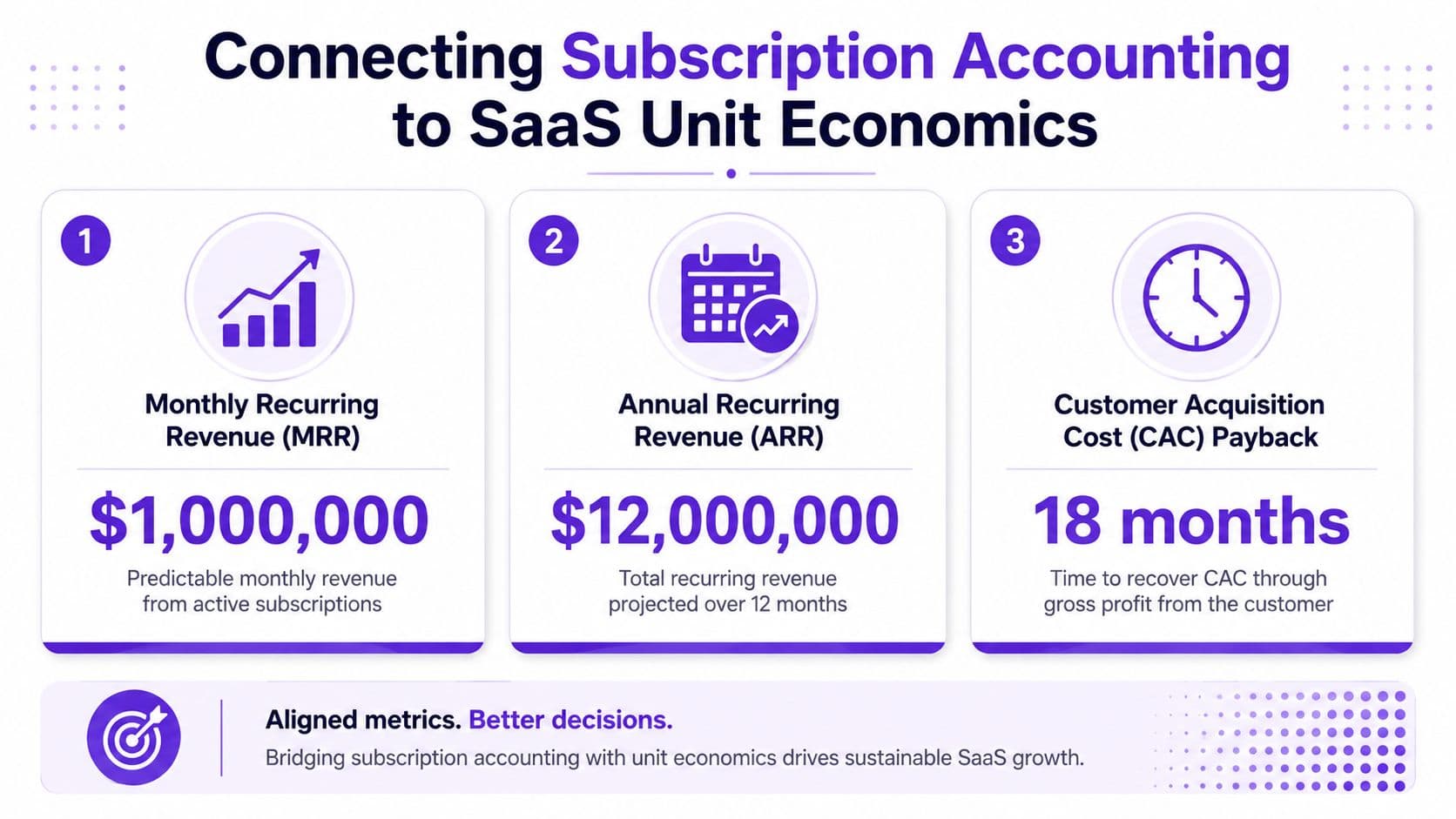
The management takeaway is direct. Don't use recognized revenue as a substitute for MRR, and don't use cash collections as a substitute for either. Maintain definitions, source systems, and reconciliations for each view.
Red Flags and Common Subscription Accounting Mistakes
The most dangerous errors are rarely dramatic at first. They begin as a shortcut, a missing contract field, or a billing integration that posts deposits without preserving service dates. By the time an auditor or buyer finds the issue, the company has to reconstruct prior periods while defending numbers that were used for hiring, fundraising, and forecasting.
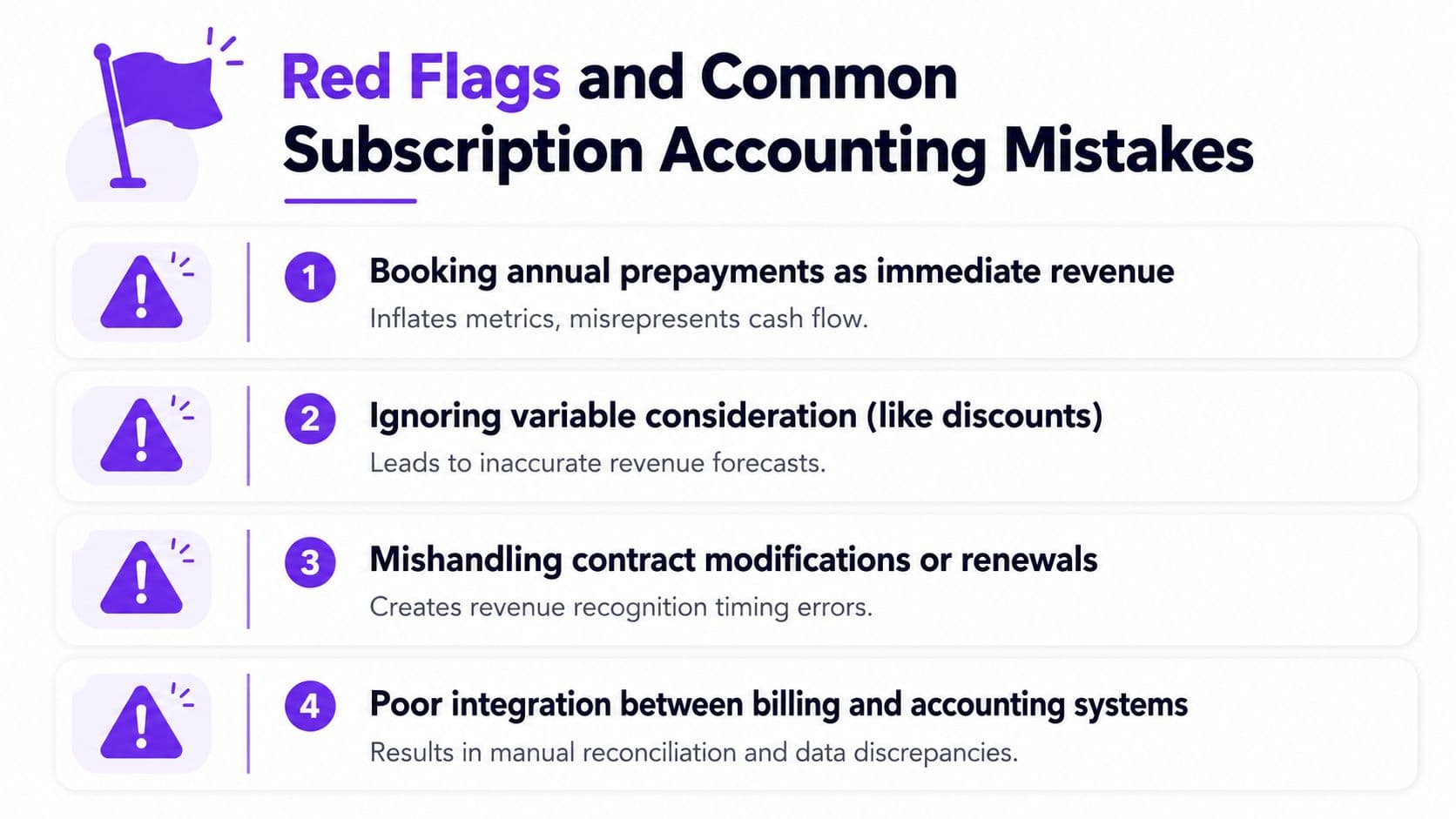
Watch for these warning signs:
- Annual prepayments posted directly to revenue: This inflates current-period revenue and hides the liability for future service.
- No deferred revenue reconciliation: The balance sheet account has no customer-level rollforward that explains opening balance, additions, releases, credits, and ending balance.
- Spreadsheet-only schedules: Manual files rely on fragile formulas, create version-control problems, and rarely preserve a complete modification history.
- Billing and accounting disagree: Stripe, Shopify, or another billing source shows transactions that don't reconcile to receivables, cash, revenue, or deferred revenue.
- Contract terms sit outside finance: Sales teams approve discounts, credits, usage rights, or service commitments without a controlled handoff to accounting.
Edge cases that deserve escalation
Hybrid contracts create the hardest judgments. Research on subscription contracts found high outcome dispersion and low judgment consensus, with difficult clauses involving service upgrades, usage-based penalties, and bundled rights. The same research identified performance obligation identification and variable consideration estimation as major judgment failure points. EY research on difficult subscription contract judgments
Customer incentives create a newer risk area. In 2025, the FASB issued ASU 2025-04 to clarify awards granted to customers as consideration under ASC 606 and ASC 718. The update states that the variable consideration constraint in ASC 606 doesn't apply to share-based consideration payable to a customer, and it becomes effective for annual periods beginning after December 15, 2026. Deloitte summary of the revenue recognition update
That matters for SaaS businesses offering equity-like incentives to encourage adoption or reduce churn. Finance should review the contract design, transaction price analysis, accounting conclusion, and disclosure workflow before these arrangements become embedded in the sales process.
Use this video as a supplementary visual explanation of common revenue recognition risks:
Outsourcing becomes sensible when contract judgment exceeds your team's experience, the close depends on one spreadsheet owner, fundraising or diligence is approaching, or billing volume makes customer-level review unmanageable. A controller partner should not merely post entries. They should document the policy, build the schedule, reconcile the subledger, review exceptions, and leave you with an audit trail.
Your Subscription Accounting Implementation Checklist
Start with the accounting foundation, then connect systems:
- Define the chart of accounts. Separate subscription revenue, services revenue, deferred revenue, credits, refunds, and relevant contract costs.
- Document the policy. State how you identify obligations, allocate consideration, handle usage, and approve modifications.
- Build the waterfall. Track every customer contract from opening balance through billings, releases, adjustments, and ending liability.
- Connect billing to the ledger. Preserve invoice dates, service periods, payment status, refunds, and contract identifiers.
- Reconcile monthly. Tie the subledger to the general ledger, bank activity, receivables, and billing reports.
- Create an audit package. Retain contracts, calculations, approvals, exception reports, and journal-entry support.
- Escalate early. Bring in specialized controller support before a raise, audit, acquisition, or major pricing change forces a rushed reconstruction.
Choose an outsourced partner when your contracts are hybrid, your team lacks ASC 606 experience, or the close relies on manual work that no longer scales. Jumpstart Partners provides outsourced controller and bookkeeping support for SaaS, agencies, and growing businesses, including QuickBooks, Xero, NetSuite, Stripe, and Shopify workflows.
Jumpstart Partners can help you design ASC 606 schedules, reconcile billing systems to the general ledger, and produce investor-ready reporting for a growing subscription business. Visit Jumpstart Partners to discuss a practical cleanup, implementation, or ongoing controller engagement.