Financial Operations
What Is a Cash Flow Statement and Why It Matters
Learn what is a cash flow statement, its 3 sections, direct vs indirect methods, and how to read it to improve cash flow visibility.
ByJumpstart Partners, CPA, QuickBooks ProAdvisor
··19 min readA cash flow statement tracks the historical movement of cash and cash equivalents across operating, investing, and financing activities to show where cash came from and went. That structure became the reporting standard after major rule changes including FASB Statement No. 95 in 1987 in the United States and the reissued IAS 7 Cash Flow Statements in December 1992, effective for periods beginning on or after 1 January 1994 internationally.
You've probably felt the problem already. Your P&L says the month was solid, revenue is up, and yet you're still staring at the bank balance before payroll, contractor payouts, or a big software renewal. That gap is exactly why founders need to understand what is a cash flow statement, not as an accounting formality, but as an early warning system for working-capital pressure and financing dependence.
Table of Contents
- Why Profit Does Not Equal Cash in Your Business
- What a Cash Flow Statement Actually Shows
- The Three Sections That Explain Where Cash Comes From and Goes
- Direct vs Indirect Method and How to Choose
- Worked Example That Turns Profit Into Cash
- How to Read Your Cash Flow Statement and Spot Red Flags
- Build Investor Ready Cash Flow Statements Without the Busywork
Why Profit Does Not Equal Cash in Your Business
A SaaS founder closes a strong month on paper. Revenue is recognized, margins look decent, and the team starts discussing a new hire. Then customer collections slip, annual software bills hit, and cash tightens fast.
An agency founder runs into the same wall from a different direction. You invoice a large project, book the revenue under accrual accounting, and still wait weeks for the client to pay while payroll and contractors go out on schedule.

The timing gap that catches founders
Your income statement answers, “Did the business earn a profit?” Your cash flow statement answers, “Did cash arrive before cash had to leave?”
That difference matters more than most founders expect. A booked sale doesn't fund payroll until the customer pays. An expense like depreciation lowers profit without using cash. A loan payment affects cash even if only part of it hits the P&L.
Practical rule: If you manage the business from the bank balance alone, you're already late.
Here's a simple founder-level example:
| Scenario | What your P&L shows | What your bank feels |
|---|---|---|
| SaaS annual contract billed now, collected later | Revenue recognized under your accounting policy | No cash yet if the invoice is still unpaid |
| Agency project invoiced at milestone | Revenue recorded when earned | Cash delay until the client remits |
| Depreciation on equipment or software setup costs | Expense reduces profit | No current-period cash outflow |
If you want a practical walkthrough of this timing gap, this guide on understanding cash vs accrual with AmbitionCFO does a good job showing why reported profit and available cash often split apart.
What the cash flow statement reveals that your other reports don't
The cash flow statement gives you something the P&L and balance sheet don't show cleanly on their own. It reveals whether your operations are producing cash, whether investments are consuming it, and whether financing is filling the hole.
That's why it should sit next to your weekly cash review and board pack, not buried in your close folder. If you want a stronger foundation on the stakes, this explanation of why cash flow is important is worth keeping in your finance playbook.
What a Cash Flow Statement Actually Shows
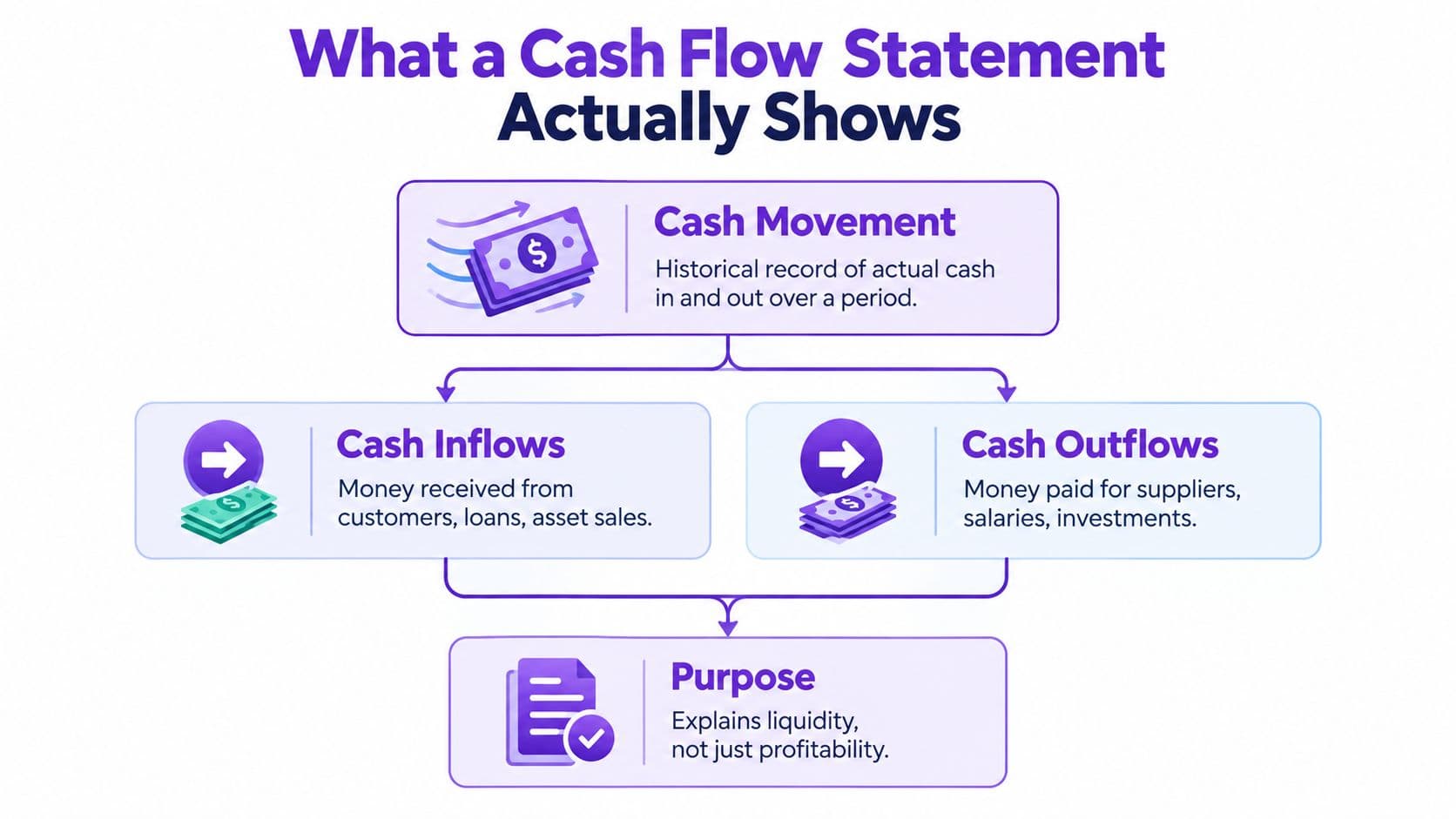
A cash flow statement is a historical record of actual cash movement. It doesn't estimate. It doesn't smooth timing. It records cash and cash equivalents that came in and went out during a period.
That's also why the statement is so useful when a founder asks, “Are we funding growth from the business, or from timing tricks, debt, or owner capital?”
Think of it like a three-lane traffic report
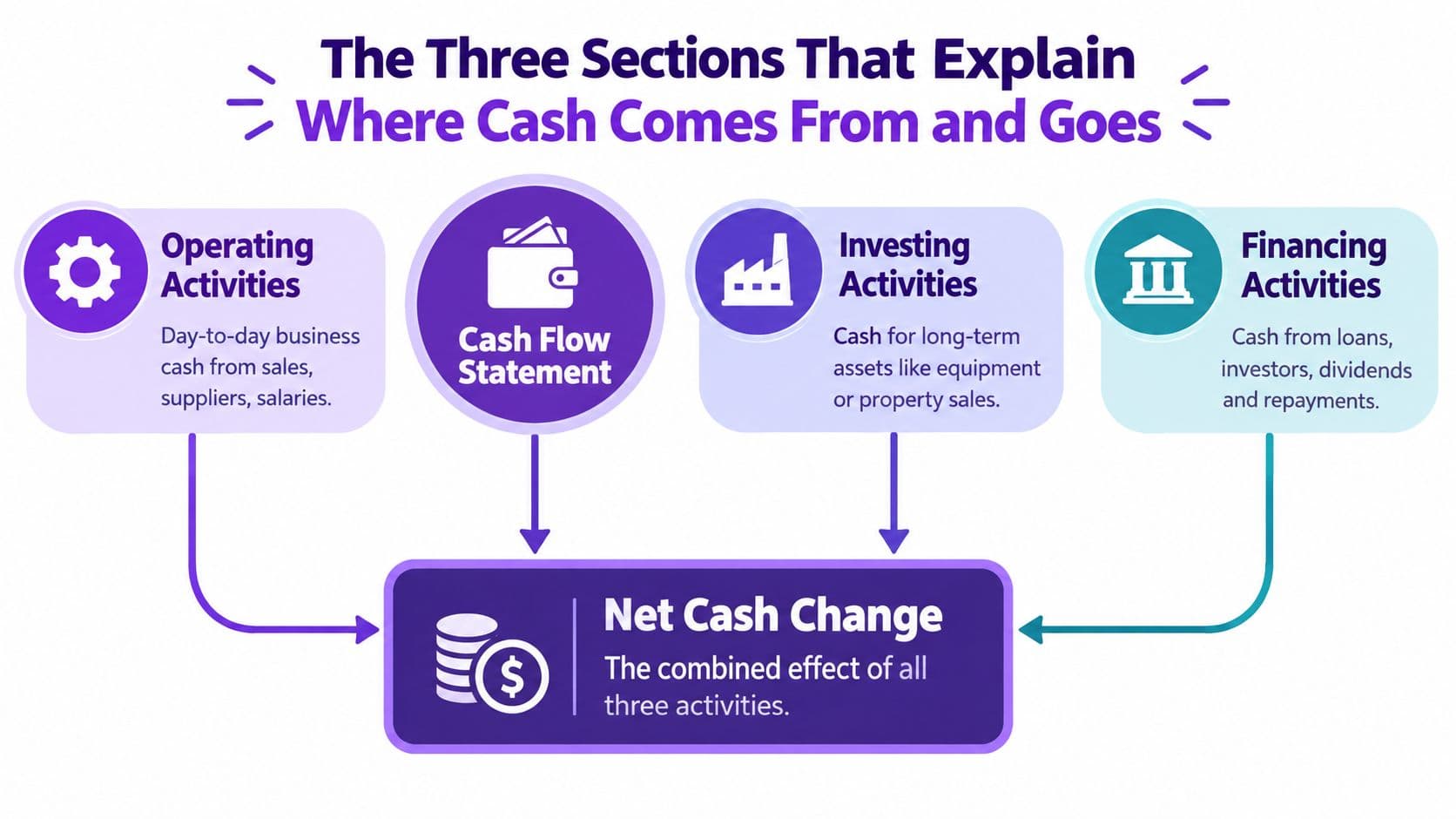
The easiest way to understand what is a cash flow statement is to picture your company's cash moving through three lanes:
- Operating lane: Cash tied to your core business activity.
- Investing lane: Cash used for long-term assets or received from selling them.
- Financing lane: Cash raised from or returned to lenders and owners.
Under IFRS, a complete set of financial statements includes a cash flow statement, and cash movements must be classified into operating, investing, and financing activities. IFRS also allows operating cash flow to be presented using either the direct method or the indirect method, with the direct method showing major classes of gross cash receipts and payments, as summarized by IASPlus on IAS 7.
Why the three-part structure matters
This structure is standard for a reason. It lets you separate healthy operating cash from other sources that can look helpful in the short term but don't prove the business model works.
A few examples make that clear:
| Cash movement | Section | What it tells you |
|---|---|---|
| Customer payments and payroll | Operating | Whether day-to-day activity generates cash |
| Buying equipment or long-term software assets | Investing | Whether you're reinvesting for future capacity |
| Loan proceeds, debt repayment, stock issuance, dividends | Financing | Whether outside capital is supporting the business |
That last point is where many founders get tripped up. A higher ending cash balance sounds good, but if that increase came from debt or owner funding rather than operations, the signal is very different.
A healthy cash story starts with operations. Financing can support strategy, but it shouldn't hide weak collections or chronic operating burn.
If you're tightening your monthly review process, this primer on cash flow management strategies is a useful companion to the statement itself.
For a narrower operating lens, I also recommend reviewing your statement alongside a focused guide to operating cash flow, because that's usually where founder decisions on hiring, pricing, and payment terms need the most attention.
The Three Sections That Explain Where Cash Comes From and Goes
You can end the month with $180,000 in the bank and still miss the story.
Say your SaaS company collected annual contracts upfront, bought new equipment, and also drew $250,000 on a credit line. Cash went up. That sounds good until you ask the founder question that matters: did the business produce cash, or did financing cover the gap?
That is why the cash flow statement is an early-warning system, not just a financial report. It separates cash from operations, cash used for long-term investments, and cash tied to debt or equity so you can spot working-capital pressure before it becomes a payroll problem.
Operating activities
Under IAS 7, operating activities are your main revenue-producing activities and the cash effects of running the business day to day.
For a SaaS company, this usually means customer cash receipts, payroll, hosting, software subscriptions, commissions, and vendor payments tied to delivery. For an agency, it usually means client collections, employee payroll, contractor payouts, rent, and other operating overhead.
This section deserves your first pass every month. If revenue is growing but operating cash is thin or negative, the problem often sits in accounts receivable, billing terms, upfront vendor payments, or a buildup in deferred implementation costs. In plain English, you may be selling more while waiting longer to get paid.
A quick example makes that visible. Suppose your agency shows $90,000 of monthly profit, but clients are paying on 60-day terms and receivables increased by $140,000. You can report profit and still be short on cash because the income statement recorded revenue before the money arrived.
Investing activities
Investing activities track cash used for long-term assets and cash received from selling them.
In a SaaS business, that might include equipment, capitalized internal-use software, or leasehold improvements. In an agency, it could include studio equipment, office buildout, or proceeds from selling older gear.
Negative cash flow here is often normal. If you spend $40,000 on implementation hardware or office improvements that support future delivery, cash drops now even though the spend may help revenue later. The useful question is coverage. Are these investments funded by operating cash, or are you stretching payables and pulling on a credit line to make them happen?
Financing activities
Financing activities show cash coming from lenders and owners, and cash going back to them. That includes loan proceeds, debt repayments, owner contributions, distributions, dividends, and some lease-related cash payments depending on reporting policy.
For founders, this is the pressure gauge for financing dependence.
Here is a common pattern. Your SaaS company reports an ending cash increase of $120,000. Operating cash flow was negative $80,000 because receivables and prepaid expenses rose. Investing used another $50,000 for equipment. Financing added $250,000 from a term loan. Your bank balance improved, but the business itself did not generate that cash. The lender did.
That difference matters because financing can buy time, but it does not fix weak collections, underpriced work, or high delivery costs.
Accounting standard setters have pushed for better disclosure in this area. IAS 7 also requires more visibility into financing-related liabilities and supplier finance arrangements, which helps readers see whether cash is being supported by normal operations or by structure around payables and debt.
Here's a founder cheat sheet that works well in monthly reviews:
| Section | Typical SaaS items | Typical agency or services items | Red flag to watch |
|---|---|---|---|
| Operating | Customer collections, payroll, cloud tools | Client receipts, payroll, contractor payments | Revenue up, but receivables rise faster and operating cash stays weak |
| Investing | Equipment, capitalized software, asset sales | Studio equipment, office buildout, asset sales | Long-term spend funded by slowing vendor payments or short-term debt |
| Financing | Loan draws, debt repayment, owner funding | Credit line activity, distributions, loan payments | Ending cash rises mainly because of borrowing or owner cash injections |
A basic teaching video can help if you want the visual version before reviewing your own statement:
Direct and indirect are not the same thing as the three sections
Founders often mix up statement sections with preparation methods. Keep them separate. Every cash flow statement still sorts activity into operating, investing, and financing. The direct and indirect methods only change how the operating section is shown.
Direct vs Indirect Method and How to Choose
Smart operators usually ask the right question. “Is the indirect method just accounting formatting?” No. It changes how fast you can diagnose why profit and cash moved apart.
KPMG's handbook notes that the indirect method is especially useful because it starts with net income and adjusts for non-cash items and working-capital changes to reconcile accounting profit to actual cash generated from operations. That's why controllers and investors use it to analyze collections timing, supplier payments, and non-cash expenses through the KPMG statement of cash flows handbook.
Direct vs Indirect Method Comparison
| Feature | Direct Method | Indirect Method |
|---|---|---|
| Starting point | Actual cash receipts and cash payments | Net income, then adjustments |
| Best for | Operational visibility into cash collected and cash paid | Explaining why profit differs from cash |
| What you see clearly | Gross customer receipts, supplier payments, payroll cash | Non-cash expenses and working-capital changes |
| Founder use case | Daily or weekly treasury-style visibility | Monthly close, board reporting, lender and investor analysis |
| IFRS treatment | Allowed | Allowed |
Why most growing companies rely on the indirect method
If you're running a SaaS company or agency between $500K and $20M in revenue, the indirect method usually gives you more decision value during close. You can tie the result directly to the P&L and balance sheet, then see exactly what consumed or released cash.
Use the direct method when you want a clean cash receipts and disbursements view for operations. Use the indirect method when you need to explain cash movement to a board, buyer, lender, or yourself.
Controller's view: When cash gets tight, the indirect method tells you whether the problem came from unpaid invoices, prepaid spend, inventory build, or non-cash accounting noise.
A short indirect walk-through
Here's the logic:
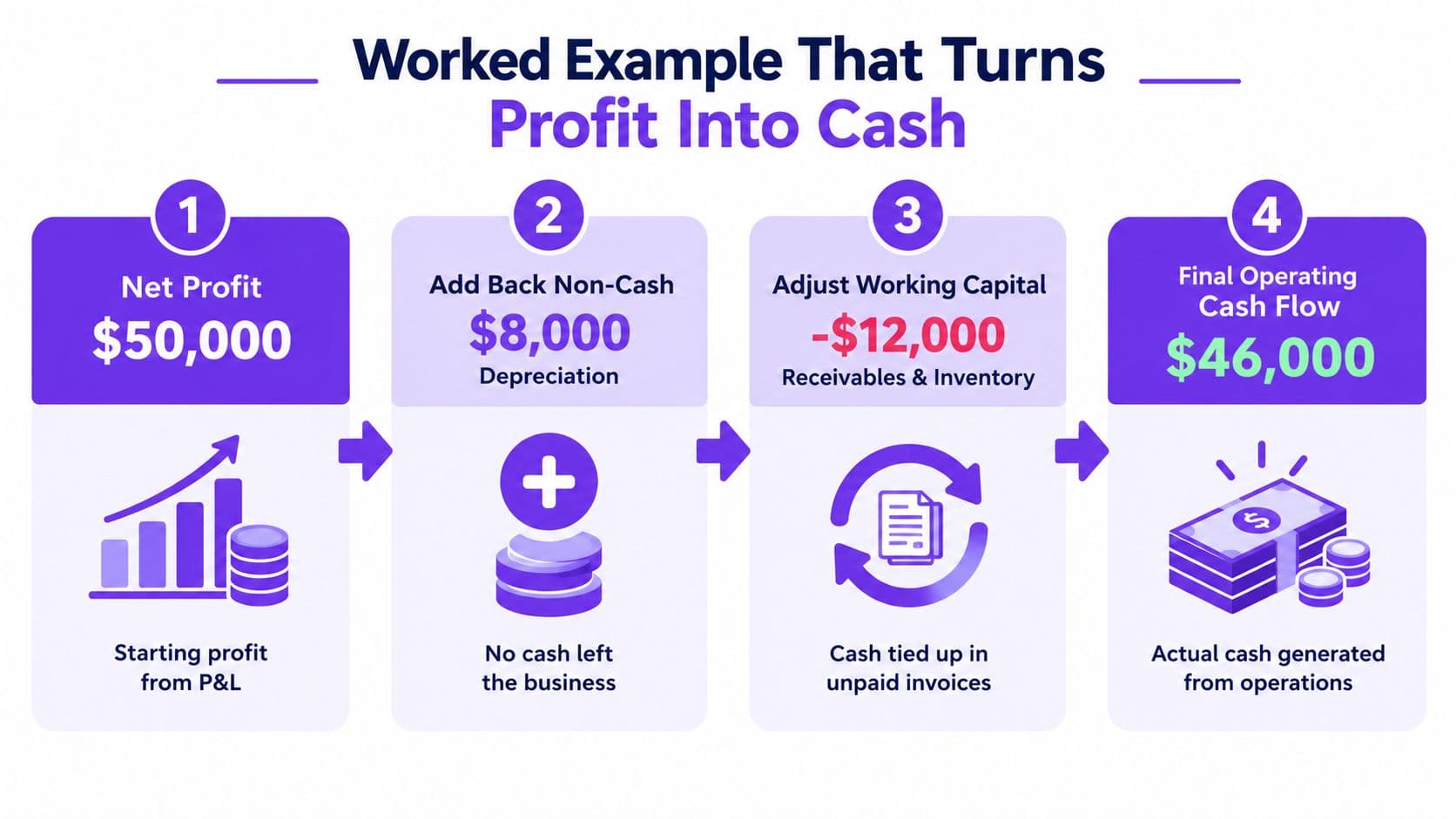
- Start with net income. That's accrual profit, not cash.
- Add back non-cash expenses. Depreciation, amortization, impairment, and stock-based compensation reduce accounting profit without using cash, as explained in this indirect-method overview.
- Adjust for working capital. Increases in current assets generally reduce cash. Decreases generally increase it. Increases in payables usually support cash temporarily.
- Land on operating cash flow. Now you know what operations produced in cash.
One more forward-looking point matters if you report under IFRS. A 2025 IASB update notes that related IAS 7 amendments for classification take effect for annual periods beginning on or after 1 January 2026, and IFRS 18 cash-flow changes take effect for periods beginning on or after 1 January 2027, moving toward more comparability in classification and in the indirect starting point, according to the IASB December 2025 update.
If you're building a forward-looking process around monthly review, pair your historical statement with one of these cash flow forecasting techniques. That's how you turn reporting into decision support.
Worked Example That Turns Profit Into Cash
Numbers make this click. So let's walk the indirect method all the way through using a real worked example.
Example one with full calculation
A practical example published by Coraa shows this indirect-method setup:
- Profit before tax: ₹480 lakh
- Depreciation: ₹95 lakh
- Finance cost: ₹60 lakh
- Receivables increase: ₹70 lakh
- Inventory increase: ₹40 lakh
- Payables increase: ₹35 lakh
- Taxes paid: ₹110 lakh
Source: worked cash flow statement example from Coraa
Now calculate operating cash flow step by step:
| Step | Calculation | Running total |
|---|---|---|
| Start with profit before tax | ₹480 lakh | ₹480 lakh |
| Add back depreciation | +₹95 lakh | ₹575 lakh |
| Add back finance cost | +₹60 lakh | ₹635 lakh |
| Subtract increase in receivables | -₹70 lakh | ₹565 lakh |
| Subtract increase in inventory | -₹40 lakh | ₹525 lakh |
| Add increase in payables | +₹35 lakh | ₹560 lakh |
| Subtract taxes paid | -₹110 lakh | ₹450 lakh |
So operating cash flow is ₹450 lakh.
Why each adjustment matters
This is the part founders need to internalize:
- Depreciation and finance cost added back: These reduced accounting profit in this example's starting point, but they don't reflect the same cash movement in the operating line.
- Receivables increase subtracted: You recognized revenue, but customers haven't paid all of it yet.
- Inventory increase subtracted: Cash got tied up in stock.
- Payables increase added: You held onto cash longer by not paying suppliers yet.
- Taxes paid subtracted: Cash left the business.
Profit is the score under accrual accounting. Operating cash flow is what your business actually put in the bank from operations.
Example two for a SaaS or agency founder
Say your agency closes the month with strong accrual profit, but you've got more cash tied up in unpaid client invoices and work-in-progress billing lag than last month. Or your SaaS company signs annual contracts, but collections trail bookings and deferred revenue timing creates noise in the P&L.
That's where this reconciliation becomes practical. You're not asking, “Did we sell?” You're asking, “Did our sales convert into cash fast enough to fund payroll and delivery?”
If you want to build this monthly without starting from scratch, use a structured cash flow statement template in Excel and tie it directly to your close package.
How to Read Your Cash Flow Statement and Spot Red Flags
Once the statement is built, value is interpretation. The fastest read is this: compare operating cash flow to net income, then check whether financing is carrying the business.
Investopedia makes the overlooked point clearly. Profit and cash can diverge sharply because the cash flow statement is built from cash movements, not accrual earnings, and users should read it alongside the income statement to spot working-capital pressure, deferred collections, and financing dependence. It also notes that under IFRS 18, the indirect-method starting point will shift to operating profit beginning in 2027, as discussed in this cash flow statement explainer.
Benchmarks that help founders read the pressure
For many service businesses, the cash conversion cycle is one of the best operating warning lights. It's defined as Days Inventory Outstanding + Days Sales Outstanding - Days Payable Outstanding.
A 2026 benchmark set reports median cash conversion cycles of 43 days for technology services, 74 days for professional services, and 91 days for construction, according to small business cash conversion cycle benchmarks.
For SaaS, agencies, and consulting firms, that tells you something practical. Even in businesses without heavy physical inventory, cash still gets trapped in billing delays, slow approvals, and weak collections discipline.
Red flags founders should act on
| Red flag | What it usually means | What to do next |
|---|---|---|
| Profit rises while operating cash weakens | Receivables, prepaids, or billing timing are absorbing cash | Review AR aging, invoice timing, and contract terms |
| Positive ending cash driven by financing | Debt or owner funding is covering operating pressure | Separate growth financing from survival financing |
| Repeated working-capital swings | Collections and payment timing are unstable | Build weekly cash review with AR and AP detail |
| Investing outflows with weak operations | You're spending ahead of cash capacity | Re-sequence capex or long-term commitments |
Here's the misconception I hear most often: “We're profitable, so cash will catch up.” Sometimes it does. Often it doesn't fast enough.
“The statement of cash flows” became standardized because older sources-and-uses reporting varied widely across companies. That consistency is why the operating, investing, and financing structure is now the baseline in major markets, per the IFRS history of IAS 7.
That history matters because comparability gives you a cleaner read on dependence. If your operating section stays soft while financing inflows stay high, you don't have a formatting issue. You have a business-model or working-capital issue.
For teams that want tighter forecast discipline, especially with automation layered into receivables and planning, this piece on implementazione AI per flusso di cassa offers a useful perspective.
Build Investor Ready Cash Flow Statements Without the Busywork
If your close still depends on spreadsheet patches and one person remembering how last month's adjustments worked, your cash flow statement will stay slower and less trustworthy than it should be.
A clean process is straightforward. It just needs discipline.
Your monthly checklist
- Reconcile cash first: Tie bank and credit accounts before you build the statement.
- Lock classification rules: Decide what belongs in operating, investing, and financing, then apply it consistently.
- Review working capital accounts: Focus on receivables, payables, prepaids, deferred revenue, and any asset balances that move with billing or delivery timing.
- Compare profit to operating cash: Don't stop at the net change in cash.
- Add a founder summary: Note whether cash strength came from operations, asset moves, or financing.
Common mistakes that distort the story
Some errors are simple but expensive in decision terms.
- Misclassification: Interest, dividends, debt activity, and owner transactions can muddy the picture if they're posted inconsistently.
- Ignoring timing effects: A strong revenue month can still weaken cash if invoices go out late or collection terms slip.
- Skipping forecast linkage: Historical cash flow without a rolling forecast leaves you reactive.
- Overcomplicating tooling: If your process can't be repeated during every close, it won't help management consistently.
One practical option is to connect your reporting process with financial reporting automation so reconciliations, classifications, and review steps happen with less manual cleanup.
If you need outside help, keep the bar simple. Look for a controller or outsourced finance partner that can produce a repeatable monthly cash flow statement, explain the drivers in plain English, and connect the report to working-capital decisions. Jumpstart Partners is one example. It offers outsourced controller and bookkeeping support for growing businesses, including cash flow reporting and close support, alongside other operational finance processes.
The right next step this month is not abstract:
- Pull your last three monthly cash flow statements.
- Compare operating cash flow against net income each month.
- List the top drivers of the gap.
- Fix one working-capital issue first. Usually collections timing.
- Build the same review into every monthly close.
If you do that consistently, your cash flow statement stops being a backward-looking report and starts functioning like it should. As your earliest warning light.
If you want cleaner monthly cash flow reporting without rebuilding your finance stack yourself, Jumpstart Partners provides outsourced controller and bookkeeping support for SaaS, agencies, and other growing businesses. They can help you turn messy close data into investor-ready cash flow statements, tighter working-capital visibility, and a reporting process you can use to make decisions.