Financial Operations
What Is GMV? Calculate & Report Correctly in 2026
Understand what is gmv (Gross Merchandise Value), how to calculate it, and why it's often misused. Report GMV correctly to investors for your business in 2026.
ByJumpstart Partners, CPA, QuickBooks ProAdvisor
··16 min readMost founders asking what is GMV are asking the wrong question.
The question is this: does your transaction volume translate into cash, margin, and durable revenue, or are you just reporting a flattering gross number? If you get that wrong, you can misread your own performance, confuse your team, and look sloppy in front of investors.
That risk gets bigger as you scale. Shopify reported $292.28 billion in GMV for full-year 2024, up 24% from 2023, and $74.75 billion in Q1 2025, about 23% higher year over year according to Wall Street Prep's GMV overview. That's the right way to use GMV at platform scale. It shows economic activity flowing through an ecosystem. It does not mean Shopify books that entire amount as revenue.
If you run SaaS, an agency, a services firm, or a marketplace-adjacent business, copying marketplace language without marketplace discipline is a mistake. GMV can be useful. It can also hide weak unit economics, messy revenue recognition, and bad reporting hygiene.
Your GMV Is Growing But Is Your Business
A business can post record GMV and still run short on cash the same month.
That is the trap. Founders see gross transaction volume rising and assume the company is healthier. Then the close finishes, refunds are higher than expected, discounts cut realized sales, processor fees eat margin, and payout timing tightens working capital. GMV stayed impressive. The business got weaker.

The number founders should care about
If your GMV grows 30% but your take rate falls from 12% to 9%, your gross earnings on that volume drop from $120,000 per $1 million of GMV to $90,000. If refunds increase from 3% to 8%, the gap gets worse fast. Add payment processing, customer acquisition, and fulfillment mistakes, and you can grow yourself into a margin problem.
That is why GMV needs a bridge to economics.
A clean board deck should show at least four numbers side by side:
- GMV
- less refunds, chargebacks, and discounts
- equals net transaction value
- multiplied by take rate or commission structure to reach revenue
If you cannot build that bridge in a few lines, you do not have reporting discipline. You have a presentation metric.
Where founders get into trouble
Three mistakes keep showing up.
- They present GMV as if it reflects company performance. It reflects transaction activity first. Performance comes from what you keep, what it costs to serve, and how fast it converts to cash.
- They skip reconciliation. Investor updates say volume is up, but no one can tie that number to the general ledger, processor statements, or recognized revenue.
- They use GMV in the wrong business model. Marketplaces and transaction platforms often need it. SaaS, agencies, and service firms usually need booked revenue, net revenue retention, gross margin, and cash conversion more.
This gets dangerous in companies between $500K and $20M in revenue because the finance stack is usually half-built. One bad metric then spreads into sales comp, forecasts, lender reporting, and investor materials.
Use GMV like an operator, not a promoter
Treat GMV as a volume metric only when your model facilitates transactions. Then reconcile it every month to revenue, margin, and cash by channel.
That matters even more if you sell through Shopify, Amazon, Stripe, and TikTok Shop at the same time. Each system defines gross sales, fees, refunds, and payout timing a little differently. Founders who want clean monthly reporting should set policies early for multi-channel e-commerce accounting treatment and make sure the same logic flows into the ERP, the board deck, and investor updates.
Channel definitions also move the number before accounting even starts. If you sell on social commerce channels, this guide to understand GMV for TikTok Shop is a useful example of why one platform's GMV should never be copied blindly into company-level reporting.
Calculating Gross Merchandise Value Correctly
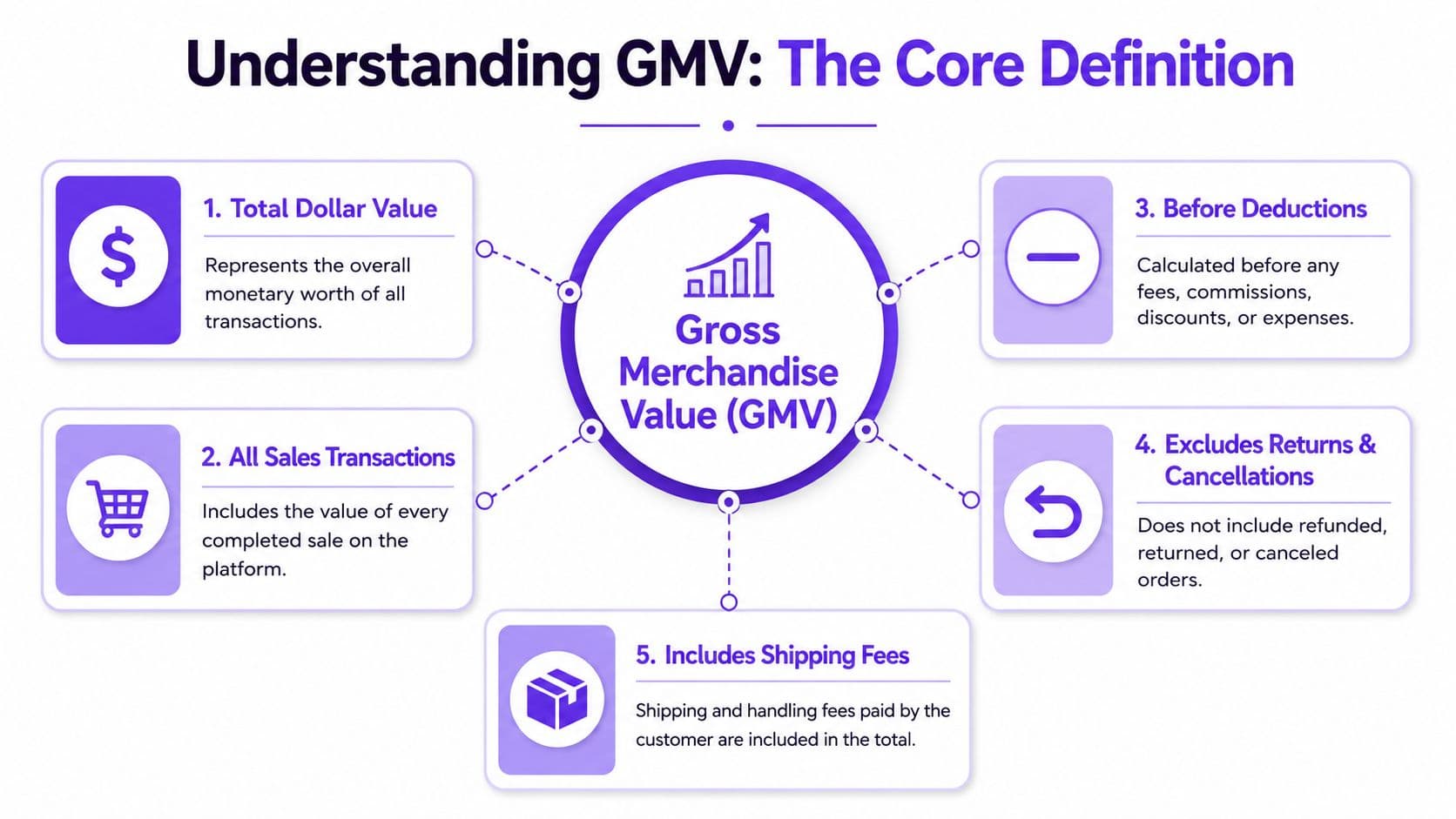
Gross Merchandise Value is the total dollar value of goods or services sold during a defined period before fees, returns, and operating expenses are deducted.
The basic formula is simple:
GMV = Number of transactions × Average Order Value
A worked example with actual math
Say your marketplace sold 500 widgets in a month at an average selling price of $150.
Your calculation is:
- Transactions: 500
- Average Order Value: $150
- GMV: 500 × $150 = $75,000
That $75,000 is your gross transaction value for the period.
It does not tell you:
- what your platform kept,
- what got refunded,
- what payment processors took,
- what promotions reduced,
- or what accounting rules let you recognize as revenue.
That's why founders should stop at the formula only long enough to understand it, then move straight to reconciliation.
To sharpen your platform-specific understanding, this guide on how to understand GMV for TikTok Shop is useful because it highlights how channel definitions can shift the number before you even start comparing reports.
Here's a short explainer if you want a visual walkthrough:
What belongs in the calculation
Use a consistent rule set. If you don't, your monthly trend line is junk.
A solid operating definition usually includes:
- Completed sales transactions that occurred in the reporting period
- The customer-paid order value at the transaction level
- A fixed reporting window such as monthly, quarterly, or annual
A weak definition changes every time someone exports a different platform report.
What founders should document
Write down your GMV policy in plain English. Include:
| Policy item | What you need to define |
|---|---|
| Order timing | When a transaction counts in the period |
| Returns treatment | Whether you report pre-return GMV, post-return GMV, or both |
| Shipping and tax treatment | Whether included or excluded |
| Discounts | Whether GMV reflects list price or actual paid amount |
| Channel rollup | How Shopify, Stripe, Amazon, or TikTok Shop exports get normalized |
Keep one board-facing definition and one accounting-facing reconciliation. If they differ, say so clearly.
GMV vs Revenue vs Net Revenue
Founders commonly create confusion in this area.
GMV is the gross value of transactions. Revenue is what your business earns. Net revenue goes a step further by reflecting deductions that reduce what you retain from operations. If you blur those lines, your board deck becomes less credible fast.
Key Financial Metrics Compared
| Metric | What It Measures | Example for a $100 sale with a 15% fee | Business Model Focus |
|---|---|---|---|
| GMV | Total customer transaction value | $100 | Marketplaces, commerce platforms, transactional ecosystems |
| Revenue | What the business earns from the transaction | $15 if your business keeps a 15% fee | Marketplaces, payment platforms |
| Net Revenue | Revenue after applicable reductions such as refunds, credits, or similar deductions under your policy | Less than $15 if deductions apply | Finance and investor reporting |
| Gross Bookings | Gross value booked before later adjustments, depending on company definition | Often starts at $100, then adjusts by policy | Travel, reservations, service platforms |
The table is simple on purpose. Founders overcomplicate this when the core issue is discipline, not math.
One sale, four stories
Take a single $100 customer purchase on a platform that earns a 15% fee.
- Your GMV is $100
- Your revenue is $15
- Your net revenue is lower if you later issue credits, refunds, or similar reductions
- Your gross bookings may start at $100, but only if your company uses that term and defines it clearly
That distinction matters in every investor conversation. If you say “we did $100” and fail to clarify whether that means GMV or revenue, you're forcing the listener to fix your reporting in their head. Serious investors won't do that for you.
What to use by business model
If you run a marketplace, GMV belongs in the dashboard. If you run SaaS, agency, or professional services, your economic engine is different.
- Marketplace or platform business: GMV can show demand and transaction flow.
- Transactional SaaS: A GMV-like metric can be useful as an adoption signal, but recognized revenue still leads the financial story.
- Agency: Don't dress up managed ad spend or media spend as your revenue.
- Professional services: Use revenue, gross margin, utilization, and cash conversion. GMV usually adds noise.
If you sell on multiple marketplaces, operational context matters too. A practical comparison like Amazon vs Takealot for South African sellers is a good reminder that channel economics and reporting structures vary. Your finance team needs to translate those differences into one internal reporting language.
For a cleaner top-line framework, build your metric hierarchy around how total revenue is calculated, then decide whether GMV belongs above it as a supplemental volume KPI.
Investors don't object to GMV. They object to founders using GMV to hide the distance between transaction volume and actual economics.
When GMV Is a Powerful Indicator
GMV is a strong metric when the business is built to facilitate transactions at scale.
That includes marketplaces, C2C platforms, and ecosystems where the company's value comes from enabling buyers and sellers to transact. In those models, gross transaction flow tells you whether the platform is getting used. That matters because adoption, trust, and activity often show up in transaction value before they show up in profit.
The business types where GMV matters most
According to ZINFI's GMV glossary, a marketplace selling 10,000 products at an average price of $50 generates $500,000 in GMV. That example captures the point well. The platform's fee income may be far lower, but GMV shows the scale of commercial activity moving through the system.
That makes GMV especially useful when you need to understand:
- Marketplace liquidity
- User adoption
- Seller traction
- Category expansion
- Transaction flow across time periods
When GMV deserves board-level visibility
GMV deserves a headline spot when all three of these are true:
| Test | Why it matters |
|---|---|
| Your business intermediates transactions | You need to show the scale of economic activity you enable |
| Your revenue is only a slice of the transaction | Revenue alone understates platform usage |
| Network effects influence future value | Rising transaction flow can signal stronger platform utility |
If those conditions aren't true, GMV probably belongs lower in the dashboard.
A blunt recommendation for non-marketplace founders
If you run SaaS, agency, or services and you're trying to make GMV your hero metric, stop. Use a transaction-volume metric only as a leading indicator when it helps explain demand, product usage, or customer stickiness.
A good GMV metric answers, “How much commerce flows through our system?”
A good finance metric answers, “What do we keep, and does it compound profitably?”
Those are different jobs. Don't ask one metric to do both.
Common GMV Accounting and Reporting Pitfalls
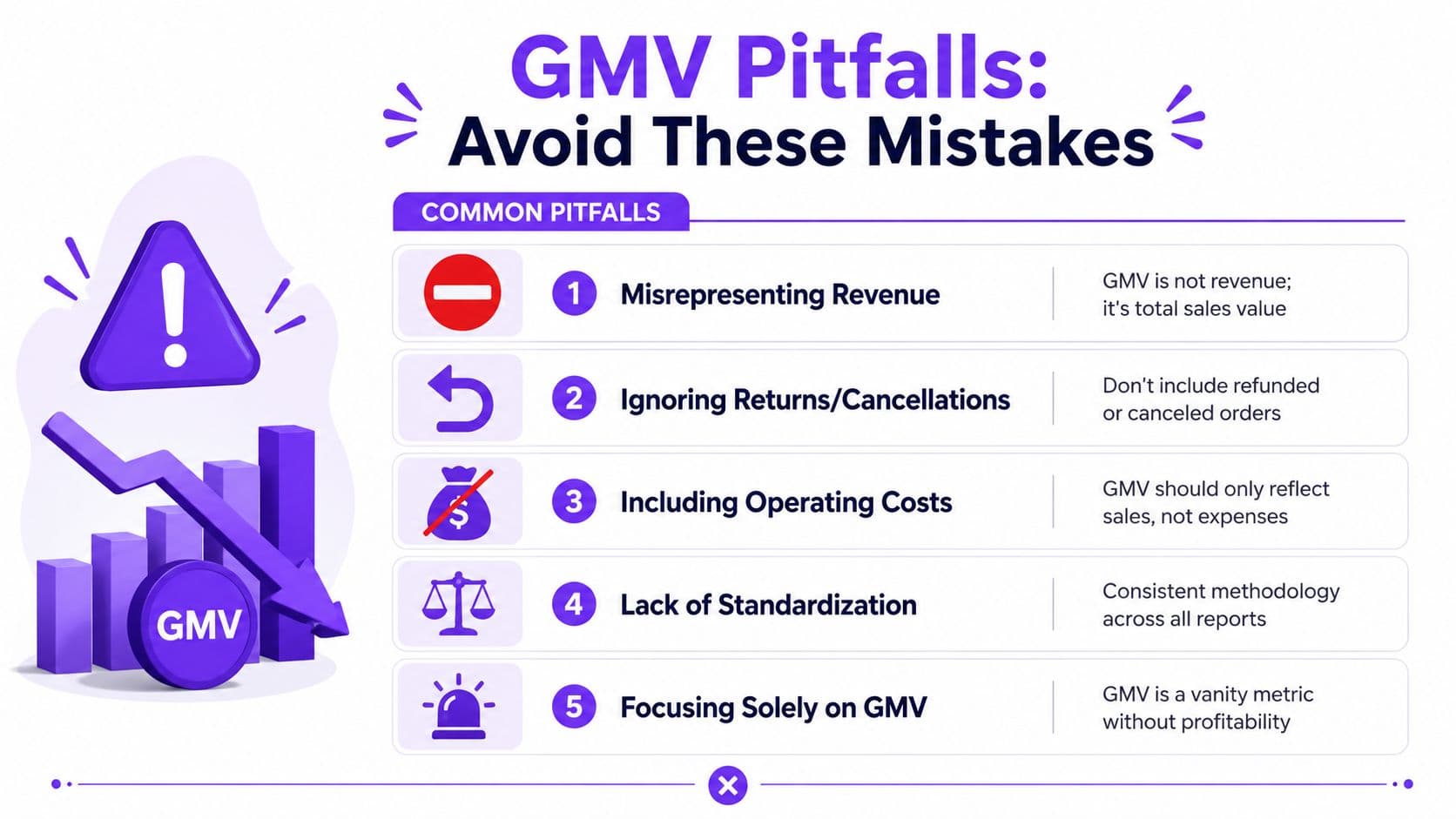
The biggest problem with GMV is not the formula. It's the freedom people take with the definition.
Because GMV is not a GAAP accounting metric, companies can define it differently. As noted in Wikipedia's overview of gross merchandise volume, that means two companies can report similar GMV while having very different profitability because of differences in refunds, fees, and discounts. Founders ignore that at their own risk.
Red flags that should make you stop the meeting
Use this list as a diagnostic tool.
- GMV appears in the deck, but no reconciliation follows. That usually means the gross number is doing too much work.
- Refunds and cancellations are vague or buried. Gross transaction flow without return visibility is weak reporting.
- The business calls GMV “sales” or “revenue.” That creates confusion immediately.
- Different departments use different definitions. Sales, ops, and finance should not be presenting separate realities.
- Taxes, shipping, discounts, and credits aren't documented. If the treatment changes, comparability disappears.
Where founders most often get it wrong
Revenue recognition confusion
This is the dangerous one.
If your business is a marketplace, the customer may pay the full transaction amount through your platform, but that does not automatically mean you recognize the full amount as revenue. Your accounting treatment depends on your role in the transaction and your revenue recognition policy. Founders who gross up revenue because they processed the cash create problems fast.
Return blindness
You can't brag about gross sales while hiding what didn't stick. If you want to understand how returns distort the story, your team should separately track the impact of returns and allowances and reconcile them back to platform reports every month.
Inconsistent inclusions
Some teams include shipping. Others exclude it. Some use customer-paid amounts after discounts. Others use list price logic from internal systems. Then someone pastes all of it into one dashboard and calls it trend analysis.
That's not analysis. That's aggregation.
Warning sign: If your GMV can't be reproduced by another team member using the same source data, you don't have a KPI. You have a spreadsheet habit.
The fix
Create a written GMV policy and audit it quarterly. Your finance lead should be able to answer, in one page, exactly what is included, excluded, adjusted, and reconciled.
How to Reconcile and Report GMV by Business Model
A useful GMV process depends on your business model. Founders get into trouble when they copy a marketplace reporting template into a SaaS or agency context without translating the economics.
E-commerce and DTC brands
For commerce brands, GMV can be a workable top-of-funnel sales volume number if you bridge it properly.
Your monthly workflow should look like this:
| Step | What finance should do |
|---|---|
| Pull source data | Export gross orders from Shopify, Stripe, Amazon, or other selling channels |
| Normalize the data | Apply one definition for timing, discounts, shipping, taxes, and cancellations |
| Separate contra activity | Track refunds, chargebacks, and credits outside the headline GMV line |
| Reconcile to revenue | Tie the adjusted transaction data to recognized revenue in the GL |
| Document the bridge | Keep a repeatable schedule finance can reproduce each month |
That last step matters more than most founders realize. If the bridge lives only in one operator's head, month-end quality is fragile.
Transactional SaaS and payment-enabled platforms
SaaS companies with payment flows often need a GMV-like metric because transaction volume says something real about adoption. The mistake is treating that volume as if it were revenue.
Use transaction volume as an operating KPI when it helps answer questions like:
- Are customers expanding usage?
- Is product adoption deepening?
- Is payment activity reinforcing retention?
- Are larger customers routing more activity through the platform?
Then keep the accounting separate. Your chart of accounts should clearly distinguish platform-facilitated flows from recognized revenue categories. If your accounting structure is muddy, clean it up before you scale with a well-designed chart of accounts.
Agencies and professional services firms
Agencies often misuse GMV language.
If you manage client media spend, marketplace spend, or commerce operations, that spend volume may be operationally important. It is not your agency revenue. Call it what it is, such as spend under management, billings, or processed media volume. Then report agency revenue separately.
That keeps your story honest:
- spend volume shows influence,
- revenue shows what you earn,
- gross margin shows whether the work is worth doing.
Platform-specific attribution problems
Modern channels make reconciliation harder. TikTok Shop's seller documentation shows that GMV can be segmented by content and non-content channels, and that Direct GMV can differ from broader GMV that includes a 14-day click window, as described in TikTok Shop seller documentation.
That means one business can produce multiple “GMV” figures depending on attribution rules.
Your job is simple: never compare numbers with different definitions as if they're comparable.
If Shopify, Stripe, and TikTok Shop each define transaction value differently, finance has to normalize them before leadership discusses performance.
Presenting GMV to Investors and Getting Help
Investors don't need a bigger headline. They need a cleaner one.
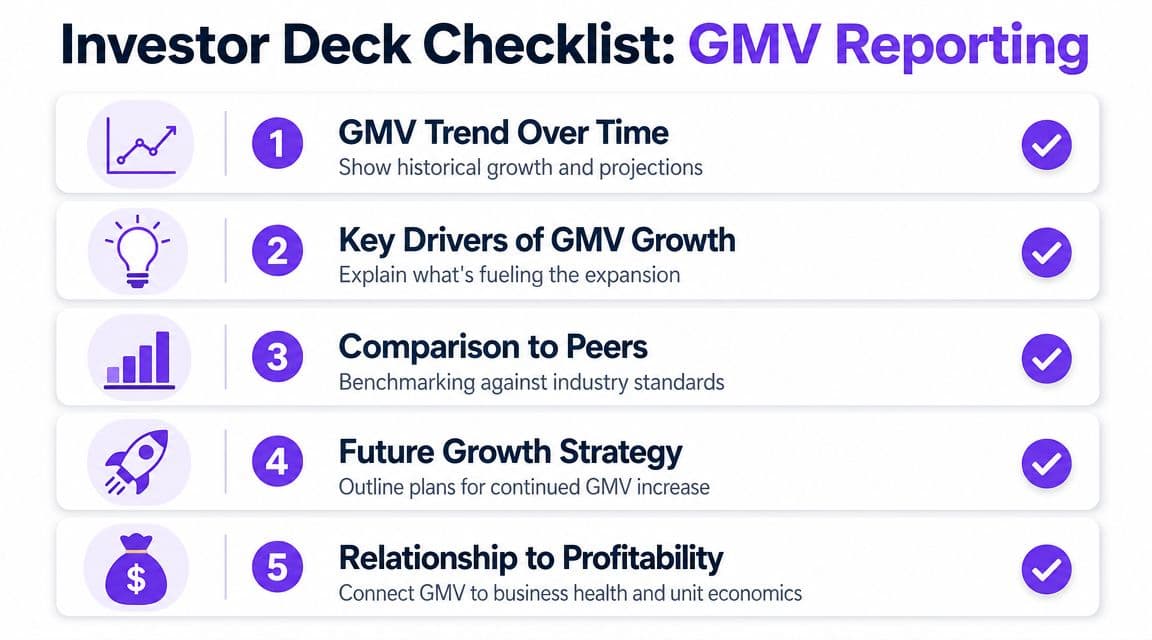
If GMV belongs in your deck, present it with enough context to prove you understand the economics underneath it. Founders lose credibility when they drop the gross number on a slide and make everyone guess how much revenue, margin, or retention it produces.
What belongs in the deck
Use a tight investor package that includes:
- GMV trend line with a clearly stated definition
- Take-rate view that shows what portion of transaction activity becomes revenue
- GMV to net revenue bridge so investors can see the conversion from volume to economics
- Channel segmentation if attribution rules differ across platforms
- Cohort behavior if transaction retention is part of the thesis
If you're preparing for different startup fundraising rounds, this matters even more because the standard of financial scrutiny rises as the check size and investor sophistication rise.
The standard you should hold
Don't present GMV alone. Present the explanation investors will ask for anyway.
“Investors look at GMV to gauge scale, but we fund businesses based on the unit economics that GMV powers. Show me you can turn $100 of GMV into $15 of durable, high-margin revenue, and you have my attention,” says Sarah Smith, Partner at Growth Equity Ventures.
I can't validate that quote from the materials you provided, so I won't present it as fact. The underlying principle is still right. Investors care about scale and conversion of that scale into durable economics.
Before you send the deck, make sure your finance team can support every GMV figure with reconciled reporting and a board-ready explanation. This guide to investor reporting for startup board deck financials is a good reference point for that standard.
If your team needs help building a clean GMV policy, reconciling gross transaction data to revenue, or producing investor-ready financials that hold up under scrutiny, talk to Jumpstart Partners. They help growing SaaS, agency, and e-commerce businesses turn messy operational data into accurate monthly reporting, sharper cash visibility, and finance outputs you can use with confidence.