Financial Operations
What Is Monthly Recurring Revenue? A Founder's Guide to Predictable Growth
Unsure what is monthly recurring revenue (MRR)? This guide explains how to calculate, track, and grow it for your SaaS or agency business. Learn from experts.
ByJumpstart Partners, CPA, QuickBooks ProAdvisor
··22 min readAs a founder or CEO of a subscription business, you're judged on one metric above all others: Monthly Recurring Revenue (MRR). It's the predictable, normalized income your company generates every month, and it's the financial heartbeat of your SaaS, digital agency, or professional services firm.
Trying to run a business on unpredictable, one-off project revenue is like flying blind. You can't forecast cash flow, you can't make smart hiring decisions, and you can't build a scalable growth engine. MRR is the antidote. It provides the financial clarity you need to make high-stakes decisions with confidence.
MRR At a Glance
This table gives you a quick summary of what MRR is, who it’s for, and why it’s the most critical metric for your business.
| Concept | What It Is | Who It's For | Why It Matters |
|---|---|---|---|
| MRR | The predictable, normalized revenue your business can expect to receive every month from all active subscriptions. | SaaS companies, digital agencies, professional services firms, and any business with a recurring revenue model. | Provides a stable baseline for financial forecasting, measuring growth momentum, and securing a higher business valuation. |
With that foundation, let's dig into why mastering this metric is your key to building a scalable, valuable company.
Why Mastering MRR Is Your Key to Sustainable Growth
As a founder, you're constantly making high-stakes decisions about hiring, marketing spend, and product development. Trying to make these calls with unpredictable, one-off project revenue is like flying blind. You have no real way to plan for the future.
Monthly Recurring Revenue (MRR) is the antidote to that uncertainty. It’s the financial heartbeat of your subscription business.
"For a SaaS or services firm, MRR isn’t just another metric; it's the foundation for your company's valuation, your ability to secure investment, and your entire strategic plan. A firm grip on MRR is what separates a scalable, high-growth company from a business stuck on a hamster wheel of one-off projects." — David Richter, CEO of Jumpstart Partners
A clear understanding of MRR allows you to:
- Forecast with Confidence: Predict your cash flow and make smarter, data-driven decisions about where to allocate your budget.
- Measure Growth Momentum: See beyond top-line revenue to understand if your business is truly growing month-over-month.
- Attract Investors: VCs and investors value predictable, recurring revenue far more than volatile, one-time payments. It's the #1 indicator of a scalable business model.
According to OpenView's 2024 SaaS Benchmarks, the subscription economy's growth continues to outpace traditional models, reinforcing that recurring revenue is the gold standard for building enterprise value. This isn't just a trend; it's a fundamental shift in how scalable businesses are built.
This metric is so vital that it's often discussed alongside its annual counterpart. You can get a deeper understanding of its relationship with Annual Recurring Revenue in our detailed guide.
To ensure your MRR grows sustainably, you must build a strong foundational plan. Learning how to create a robust go-to-market strategy is essential for aligning your efforts and achieving long-term success. The rest of this guide will show you how to calculate, analyze, and grow this critical number.
The Four Core Levers of Your Recurring Revenue
Your total Monthly Recurring Revenue (MRR) isn't just a single number on a dashboard. It’s the story of your business, written in dollars and cents each month. It's the sum of constant push-and-pull forces—new deals closing, existing customers upgrading, some downgrading, and others leaving for good.
As a leader, your job isn't just to watch that final number. It's to understand and actively manage the four core levers that control it. Mastering this is the first real step toward building a predictable growth engine.
These four components are the DNA of your recurring revenue:
- New MRR: The lifeblood from brand-new customers signing up.
- Expansion MRR: The profitable growth from existing customers who upgrade, add seats, or buy more.
- Contraction MRR: The revenue you lose when customers downgrade plans or reduce their usage.
- Churned MRR: The total revenue lost from customers who cancel their subscriptions and walk away.
Think of your MRR as a bucket of water. New MRR and Expansion MRR are the faucets filling it up. Contraction and Churn are the leaks draining it out. Your goal is simple but relentless: make sure the inflow always outpaces the outflow.
The Anatomy of MRR Growth
Let's make this tangible. Imagine your company, "SaaSyCo," kicks off April with $100,000 in MRR.
Throughout the month, your sales, marketing, and success teams are hard at work. Here’s how their efforts translate into the four levers:
- New MRR: The sales team closes 10 new logos, each on a $500/month plan. That’s $5,000 in fresh, new revenue.
- Expansion MRR: Your customer success team helps five happy customers upgrade from the "$500 Basic" plan to the "$800 Pro" plan. This adds $1,500 in expansion revenue (5 customers x $300 upgrade).
- Contraction MRR: It's not all good news. Two customers hit a rough patch and downgrade from "Pro" back to "Basic," cutting their spend by $300 each. This creates a $600 loss from contraction.
- Churned MRR: And finally, one customer on your "Pro" plan cancels entirely, taking their $800 in monthly revenue with them. That's your churn.
These levers aren't just accounting details; they are the fundamental drivers of your company's strategic value, fundraising ability, and future direction.
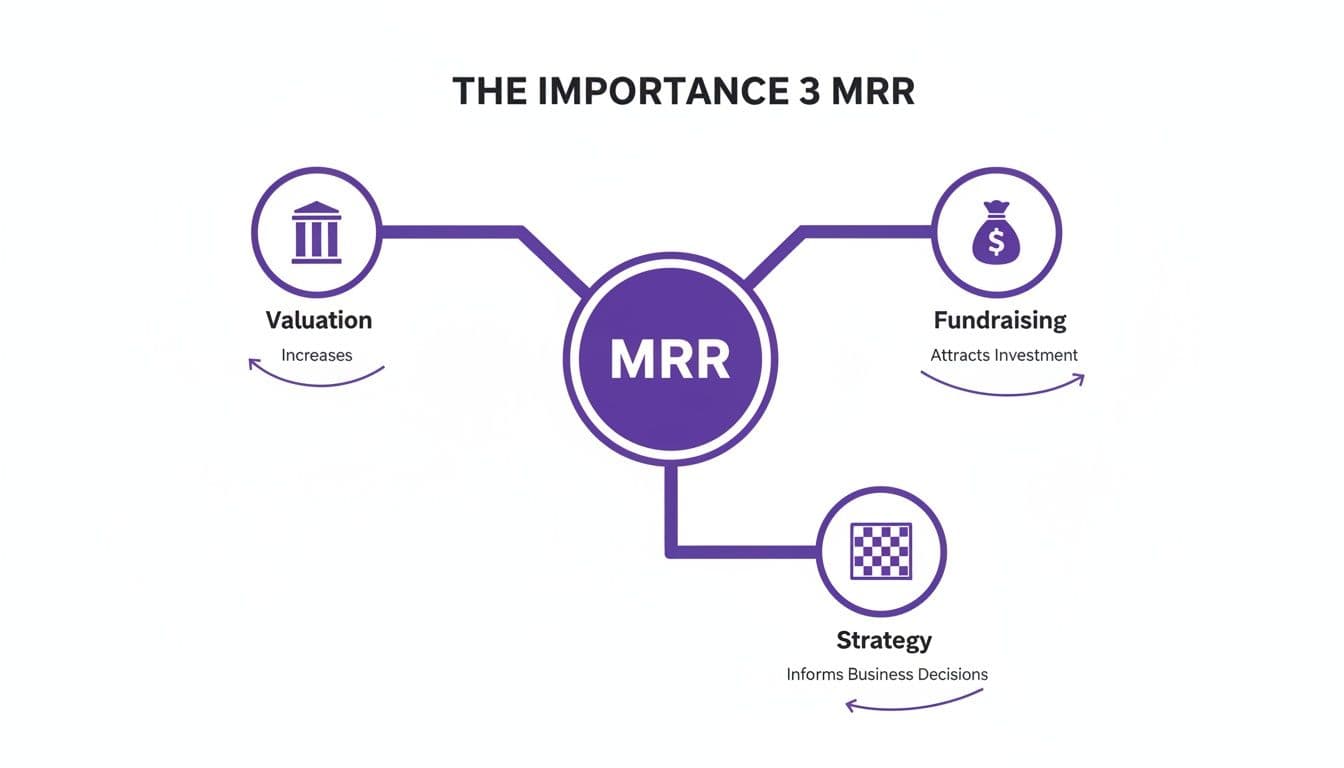
As you can see, investors, lenders, and acquirers all look to MRR as the heartbeat of a subscription business. How you manage its components tells them everything about your company's health.
Calculating Your Net New MRR
Now, let's combine these moving parts to find the single most important indicator of your monthly growth: Net New MRR. This metric cuts through the noise and tells you the true change in your recurring revenue base.
The formula is straightforward:
Net New MRR = (New MRR + Expansion MRR) – (Contraction MRR + Churned MRR)
Plugging in SaaSyCo's numbers for April:
Net New MRR = ($5,000 + $1,500) – ($600 + $800) Net New MRR = $6,500 (Gains) – $1,400 (Losses) Net New MRR = $5,100
This is your real growth for the month. SaaSyCo successfully grew its recurring revenue by $5,100.
MRR Components Calculation Example
To see the full picture, here’s a table that walks through the entire calculation, from the beginning of the month to the end.
| MRR Component | Description | Example Calculation | Amount |
|---|---|---|---|
| Beginning MRR | MRR at the start of the month | As of April 1st | $100,000 |
| New MRR | Revenue from new customers | 10 customers x $500/mo | +$5,000 |
| Expansion MRR | Revenue from existing customer upgrades | 5 customers x $300/mo upgrade | +$1,500 |
| Contraction MRR | Revenue lost from downgrades | 2 customers x $300/mo downgrade | -$600 |
| Churned MRR | Revenue lost from cancellations | 1 customer x $800/mo churn | -$800 |
| Net New MRR | The net change in monthly revenue | $6,500 (Gains) - $1,400 (Losses) | $5,100 |
| Ending MRR | MRR at the end of the month | $100,000 + $5,100 | $105,100 |
This component-level view is infinitely more insightful than just knowing revenue grew from $100k to $105.1k. It shows that expansion revenue was a significant growth driver and that churn, while present, was manageable relative to new business. Understanding these dynamics is essential for mastering your company's financial health, a concept we explore further in our guide on what is unit economics.
Calculating Your MRR the Right Way
One of the first, most dangerous mistakes founders make is calculating MRR with a simple "customers x average monthly fee" shortcut. This feels easy, but it papers over huge risks and nuances in your business, leading you to make terrible strategic decisions based on inflated, fantasy numbers.
To get this right, you have to be disciplined. The core rule is simple: MRR must only include the predictable, recurring components of your customer subscriptions, normalized to a monthly value. Anything that falls outside that definition gets cut. No exceptions.
The Non-Negotiable Rules of MRR Calculation
Getting MRR right requires you to be ruthless. The temptation to pad the number with other revenue streams to look good is strong, but it will only hurt you. Smart investors will see right through it in two minutes, and you'll be making decisions based on a mirage.
Here’s what you must exclude from your MRR calculation:
- One-Time Fees: All of them. Setup charges, implementation fees, training costs, or consulting projects are not recurring. Track them separately as non-recurring revenue.
- Variable or Usage-Based Fees: If you have consumption-based pricing, that portion of the bill is not predictable and doesn't belong in MRR. Only count the fixed, recurring base fee.
- Credit Adjustments and Paused Subscriptions: Don't include customers on a temporary pause or those with one-time credits applied. MRR reflects committed, collectible cash.
Discounts need the same discipline. If a new customer gets a 20% discount on a $1,000/month plan for their first six months, their contribution to your MRR is $800, not $1,000. When that discount expires, you can then recognize the extra $200 as Expansion MRR.
How to Handle Annual and Multi-Year Contracts
This is where a lot of SaaS companies stumble. A customer signs a $12,000 annual contract, and the temptation is to book it all at once. For MRR, this is wrong.
You have to normalize the total contract value (TCV) into a monthly figure.
MRR = Total Contract Value / Number of Months in the Contract
Let’s run the numbers for a few deals. Normalizing everything to a monthly value is the only way to compare apples to apples and get a true feel for your momentum.
| Contract Type | Total Value | Term | MRR Calculation | Resulting MRR |
|---|---|---|---|---|
| Annual Subscription | $24,000 | 12 Months | $24,000 / 12 | $2,000/month |
| Quarterly Plan | $1,500 | 3 Months | $1,500 / 3 | $500/month |
| 2-Year Deal | $60,000 | 24 Months | $60,000 / 24 | $2,500/month |
This approach keeps your MRR a steady, predictable metric, no matter how you structure your billing cycles. It’s a fundamental concept that also applies when you're ready to dig into the key differences between ARR vs. MRR for SaaS revenue metrics.
Common Misconception: MRR vs. Recognized Revenue (ASC 606)
Here’s a critical distinction you can't afford to get wrong: MRR is an operational metric, not an accounting standard. Your internal MRR calculation will almost certainly differ from your GAAP-compliant recognized revenue, especially under complex rules like ASC 606.
ASC 606 governs exactly how and when you can "recognize" the revenue from your contracts for official financial reporting. It’s a complicated framework that often requires revenue to be tied to service delivery, which may not align with a simple, straight-line MRR calculation.
"Founders often confuse MRR with GAAP revenue. They are not the same. MRR is your North Star for momentum and internal strategy, while GAAP revenue is what you report to auditors and the IRS. Getting them mixed up can create serious compliance issues and erode investor trust." - David Richter, CEO of Jumpstart Partners
For example, if part of a contract is tied to a specific deliverable like a custom integration, the revenue recognition schedule for that portion might not be linear. You should still track MRR using the simple normalization method for operational clarity, but your finance team or a firm like Jumpstart Partners must manage ASC 606 compliance separately for your official financial reports.
Revenue Warning Signs You Cannot Afford to Ignore
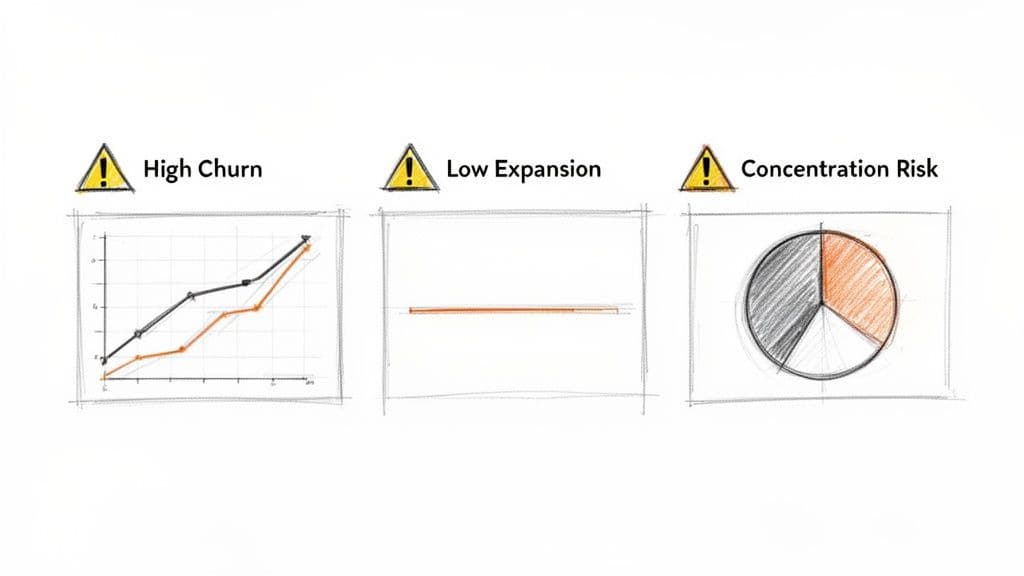
Watching your top-line MRR climb month after month feels great. But that single number can hide serious problems lurking just beneath the surface.
Relying only on total MRR is like flooring it while ignoring the check-engine light. You might be moving fast, but you're headed straight for a breakdown. To get a real read on your company's health, you have to look past the vanity metric and diagnose the vital signs that make it up.
Red Flag 1: High Churn MRR
This one is the most obvious—and the most dangerous. High Churn MRR means you’re hemorrhaging customers and their revenue every month. It’s the classic leaky bucket, forcing your sales and marketing teams to run twice as hard just to keep the business from shrinking.
Think about it. If you have $100,000 in MRR and a 5% monthly churn rate, you start every single month $5,000 in the hole. Before you can add a single dollar of new growth, you first have to replace that lost revenue. This kind of relentless pressure makes any attempt at predictable scaling feel impossible.
A consistently high churn rate is a direct signal that you have a product, pricing, or customer-fit problem. No amount of new business can sustainably fix a core issue that drives customers away. If your churn is high, you need to drop everything and conduct a thorough SaaS churn analysis. You have to pinpoint why customers are leaving—whether it’s a clunky onboarding process, missing features, or a competitor's better offer—and then take decisive action to fix it.
Red Flag 2: Low Expansion MRR
This red flag is more subtle, but it's just as critical for long-term health. When Expansion MRR is low or non-existent, it’s telling you that your existing customers see no reason to spend more with you. They aren’t upgrading tiers, adding seats, or buying add-on features.
This usually points to one of a few core issues:
- A Weak Value Proposition: The product simply isn't delivering enough ongoing value to justify a higher price tag.
- Poor Pricing Design: Your pricing tiers aren't built to grow alongside your customers. You've effectively capped your own revenue potential.
- A Reactive Customer Success Team: Your team isn’t proactively finding opportunities for customers to get more out of your platform.
Without strong expansion revenue, your growth is entirely dependent on costly new customer acquisition. The best SaaS companies know that a huge chunk of their growth comes from the customers they already have. It's cheaper, it's more efficient, and it’s a powerful sign of a healthy, valuable product.
Red Flag 3: Over-Reliance on a Few Large Accounts
Finally, you have to watch out for customer concentration. If one or two "whale" accounts make up 25% or more of your MRR, your business is incredibly fragile. The loss of just one of those clients could be a catastrophic, company-altering event.
This kind of concentration makes your forecasting unreliable and gives those big customers immense leverage over your product roadmap and pricing. Investors see it as a massive risk for a reason.
Keeping a close eye on these moving parts is more important than ever. The subscription economy is evolving fast—firms that blend recurring platform fees with consumption-based charges are now reporting 21% median growth, easily outpacing pure-play models. To stay competitive, you need razor-sharp tracking of every revenue stream. You can read more about these subscription economy trends and how they impact growth.
Actionable Strategies to Grow Your MRR
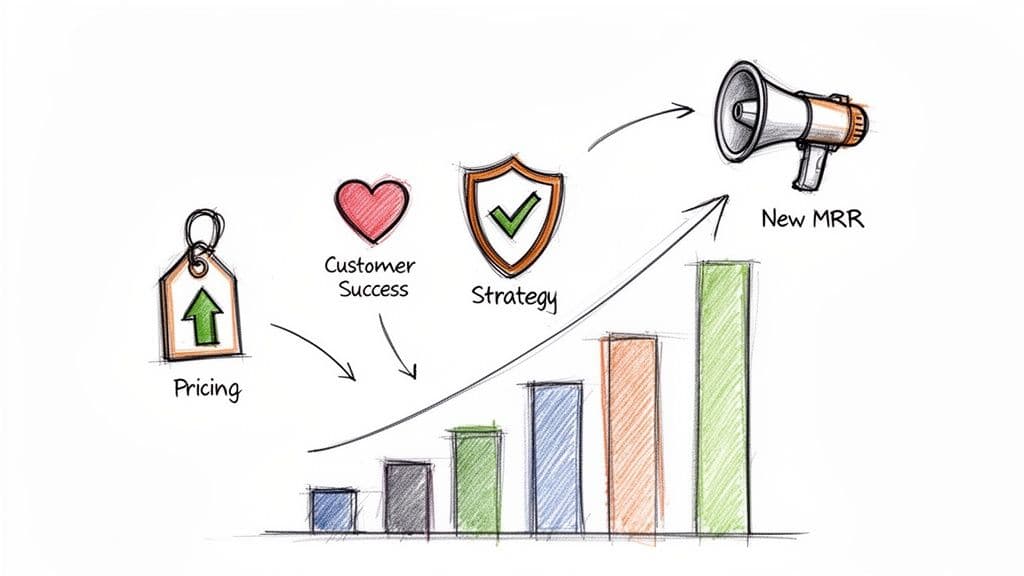
Understanding your MRR components is the diagnostic step—now it's time to act. A high-growth subscription business isn't built on hope. It's built on a disciplined, strategic approach to systematically increasing the positive revenue levers while aggressively plugging the leaks.
This isn't about generic advice like "sell more." This is a practical playbook of specific, targeted strategies you can implement to drive tangible growth across your entire recurring revenue base. We'll focus on the three core growth areas: acquiring new customers, expanding the ones you have, and keeping them from leaving.
1. Accelerate New MRR Acquisition
Attracting new customers is the most expensive way to grow, so you must be deliberate and efficient. Your goal isn't just to chase one-off deals but to build a predictable system for generating new business. One of the most effective ways to do this is to manage your sales pipeline for predictable revenue growth.
Here are your next steps:
- Refine Your Ideal Customer Profile (ICP): Stop trying to sell to everyone. Analyze your best, most profitable, and longest-retained customers. Define their firmographics, pain points, and buying triggers. Then, focus all your sales and marketing energy on finding more companies that look exactly like them.
- Optimize Your Lead Generation Funnel: Your website, content, and ad campaigns must work together to turn prospects into paying customers. Use A/B testing on your ad creative, landing page copy, and calls-to-action to find the combination that drives the most qualified leads. Track your lead-to-customer conversion rate relentlessly.
- Invest in a Scalable Sales Process: Whether your sales team is one person or twenty, your process has to be repeatable. This means clear qualification criteria, defined sales stages, and a consistent follow-up cadence. A disorganized sales effort just wastes leads and kills momentum.
Speaking of acquisition, it's crucial to understand how much you're spending to get each new customer. Our guide on calculating customer acquisition cost gives you the framework to measure this vital metric.
2. Maximize Expansion MRR from Existing Customers
Growing revenue from your existing customer base is the most profitable form of growth you can find. These customers already know and trust you. Your job is to deliver more value and give them clear paths to spend more.
Here’s how you drive Expansion MRR:
- Design a Value-Based Pricing Strategy: Your pricing tiers should be aligned with the value your customer receives. As their business grows and they use your product more, they should naturally move into higher-priced plans. A common approach is to use a "value metric"—like the number of users, contacts, or projects—that scales with customer usage.
- Develop and Sell Add-Ons: Identify high-value features that not all customers need but some would gladly pay extra for. These could be advanced analytics, priority support, or specific integrations. Add-ons create excellent upsell opportunities for your customer success team to act on.
- Implement Proactive Customer Success: Don't wait for customers to ask for help. Your customer success team should be proactively reaching out, sharing best practices, and identifying opportunities for them to get more from your product. This builds relationships and uncovers natural expansion opportunities.
3. Slash Churn MRR with Proactive Retention
Churn is the silent killer of growth. Every dollar of Churned MRR you prevent is a dollar you don’t have to re-earn through expensive new acquisition. Top-tier SaaS companies obsess over retention for this very reason.
According to OpenView's 2024 SaaS Benchmarks, best-in-class companies maintain a gross revenue retention rate of over 90%. This means they lose less than 10% of their revenue to churn and downgrades each year. This is the standard you should aim for.
Use this table to guide your retention efforts.
| Retention Tactic | Actionable Steps | Why It Works |
|---|---|---|
| Improve Onboarding | Create a structured, goal-oriented first 30 days for new customers. Use checklists, in-app guides, and personal check-ins. | Customers who see value quickly are far less likely to churn. A poor onboarding experience is a leading cause of early cancellations. |
| Analyze Churn Reasons | When a customer cancels, make it mandatory to collect a reason. Categorize and track this data to identify trends. | You cannot fix what you don't measure. Analyzing churn data reveals if the problem is product-related, price-related, or service-related. |
| Launch a Win-Back Campaign | Target customers who canceled 3-6 months ago with a special offer or an announcement about new features they asked for. | Some churn is temporary. A targeted campaign can reactivate a surprising number of former customers, turning Churned MRR back into New MRR. |
You now have the complete playbook for understanding, calculating, and growing your Monthly Recurring Revenue. But knowing the formulas is just the first step. The real challenge—and where most founders get stuck—is in the execution.
From Messy Spreadsheets to Investor-Ready Financials
The hard truth is that flawless MRR tracking isn't about knowing the math. It’s about having the systems and discipline to do it perfectly every single month, even when you're also the head of sales, product, and HR. This is where an expert finance partner stops being a "cost" and becomes a non-negotiable part of your growth engine.
You can’t afford to learn financial management through trial and error, especially when your next fundraising round depends on it. You need the right infrastructure from day one—systems that don't just track MRR but also ensure your reporting is compliant and delivers the strategic insights needed to make smart decisions.
An outsourced finance team provides the critical support to:
- Track MRR Flawlessly: Implement automated systems that capture every component—new, expansion, contraction, and churn—in real-time, so you can trust your numbers.
- Build Investor-Ready Dashboards: Ditch the messy spreadsheets for professional, real-time dashboards that tell a clear and confident growth story. No more last-minute scrambling before a board meeting.
- Ensure ASC 606 Compliance: Handle complex revenue recognition rules correctly from the start. This prevents painful and expensive restatements during an audit or due diligence process that can kill a deal.
- Deliver Strategic Insights: Get an expert's perspective on your metrics to spot the warning signs and growth opportunities that are easy to miss when you're in the trenches.
You’ve built a great product. Don’t let messy financials be the thing that holds your business back. Your time is best spent scaling the company, not reconciling Stripe data or fighting with QuickBooks. An expert finance partner handles that complexity so you can focus on growth.
At Jumpstart, we transform your financial operations from a liability into a strategic asset. Imagine closing your books in 5 days, not three weeks. Picture having real-time visibility into your cash flow and KPIs whenever you need it, without lifting a finger.
This isn’t just about better bookkeeping; it's about giving you the confidence to make faster, smarter decisions that accelerate growth.
If you’re ready to take control of your company's financial future, let's talk. Book a free consultation today and see how our US-based, CPA-led team can provide the financial clarity you need to scale.
Frequently Asked Questions About MRR
Once you start using MRR, a few common questions always pop up. Getting these details right isn't just about clean books—it's about making sure your most important metric is telling you the truth. Here are the straight answers we give founders and finance leaders every day.
What's the Difference Between MRR and ARR?
Think of it this way: MRR is your predictable revenue shown as a monthly number. ARR (Annual Recurring Revenue) is the same concept, just shown as a yearly number. The math is simple: ARR = MRR x 12.
Companies that sell mostly annual or multi-year contracts love using ARR as their main public metric. It lines up with how they bill, and frankly, it's a bigger, more impressive number to show investors.
But internally, you have to track MRR every month. MRR is your early warning system. It shows you the immediate impact of things like churn and upgrades, which get smoothed over and hidden in a high-level annual number. Track both to get the full picture: long-term contract value and immediate business health.
How Do I Handle Discounts and Coupons in MRR?
You must account for discounts in your MRR calculation. MRR reflects the predictable cash you actually expect to collect, not the sticker price. Ignoring discounts gives you an inflated, vanity metric that masks the real performance of your business.
Here’s exactly how it works:
A new customer signs up for your $100/month "Pro Plan" but uses a 20% discount code for their first year. Their actual contribution to your MRR is $80/month, not $100.
Then, when the discount expires in 12 months and they start paying full price, you recognize that $20/month increase as Expansion MRR. This correctly shows the change in cash you’re collecting without messing up your historical data.
Should I Include One-Time Fees in MRR?
Absolutely not. This is one of the most common—and dangerous—mistakes we see. MRR must only include the predictable, recurring revenue from your core subscription. Anything else is just noise.
The following items are critical to track separately as non-recurring revenue and must be excluded from MRR:
- Implementation or setup fees
- One-off training sessions
- Standalone consulting projects
- Hardware sales
Lumping these in artificially inflates your core metric and misleads everyone—your board, your investors, and yourself. VCs and buyers value predictable subscription revenue far more than volatile, one-time service revenue because it signals a scalable business model. Mixing them together hides the true health of your subscription engine.
You’ve built a great product. Don’t let messy financials hold your business back. Jumpstart Partners transforms your financial operations into a strategic asset, providing the clarity and confidence you need to scale.
Start the diagnostic to see how our US-based, CPA-led team can deliver a 5-day month-end close and the real-time visibility you need to accelerate growth.