Financial Operations
Access Control Policies for SaaS Finance Teams
Build access control policies for SaaS finance teams. Covers RBAC, ABAC, drafting, approval, enforcement, monitoring, and SOC2 audit steps.
ByJumpstart Partners, CPA, QuickBooks ProAdvisor
··15 min readTwo weeks before a SOC2 audit, the finance lead at an $8M ARR SaaS company gets one question: who approved a $42,000 manual journal entry posted last quarter? The team searches email, Slack, and the accounting system. Nobody can produce the approval. The transaction enters the audit sample, and the audit runs a week over schedule.
That failure isn't an accounting problem alone. It's an access control policy problem. Without a written rule connecting each permission to a role, approver, review cadence, and evidence trail, finance teams operate on tribal knowledge. That knowledge disappears when a controller takes leave, an outsourced bookkeeper gets added, or a fintech integration is given administrator access.
This guide treats access control policies as living operating controls, not documents that sit in a compliance folder. You'll see how to connect policy language to QuickBooks, Stripe, NetSuite, BambooHR, and the monthly close so you can prove who did what without slowing the business. For broader context on the relationship between finance operations and security readiness, review this data security and compliance guidance.
Table of Contents
- Why SaaS Finance Teams Need a Real Access Control Policy
- What an Access Control Policy Actually Is
- Choosing Between RBAC, ABAC, and Hybrid Models
- Mapping Roles to Your Finance and HR Systems
- Implementing the Policy From Draft to Review
- Red Flags Auditors Look for in Access Controls
- Your 30-Day Access Control Starter Plan
Why SaaS Finance Teams Need a Real Access Control Policy
A finance team without a real access control policy creates avoidable audit exposure. The issue isn't that your employees are untrustworthy. The issue is that your systems don't know your informal arrangements, and auditors won't accept “everyone knows who handles that” as control evidence.
NIST defines access control policies as high-level requirements specifying how access is managed and who may access information under what circumstances. The NIST SP 800-53 control family places responsibility on organizations to develop, document, disseminate, and periodically review formal access control policies, with assigned roles, responsibilities, compliance obligations, and procedures. NIST SP 800-53 treats this as a foundational governance requirement, not an optional security enhancement.
The finance risks are concrete
Look at the systems your team uses every day:
- QuickBooks: shared credentials make journal-entry attribution impossible.
- Stripe: stale API keys or excessive refund permissions create payment risk.
- NetSuite: controller-level superuser access often exceeds the role's actual needs.
- BambooHR: terminated contractors may retain access to sensitive employee records.
- Fintech add-ons: connected applications can inherit privileges nobody reviewed.
A policy fixes the operating gap by stating who can create, approve, post, export, or merely view each category of transaction. It also defines what happens when someone changes roles, leaves the company, becomes inactive, or needs temporary access.
Practical rule: If a permission can't be tied to a named role, an accountable approver, and a review date, it isn't controlled. It's an assumption.
The 2023-24 ASIS International access control research report frames access control failures as recurring operational incidents across physical and logical environments. NIST also requires policy consistency with applicable laws, directives, regulations, standards, and guidelines. For a growing SaaS company, that makes access control part of audit readiness, incident reduction, and financial governance.
What an Access Control Policy Actually Is
An access control policy is the formal document that answers four questions:
- Who receives access?
- What can that person do?
- Under what conditions can they do it?
- Who approves and reviews the access?
That definition matters because teams routinely confuse the policy with the tools used to execute it.
Keep the four artifacts separate
The policy states the governing requirements. It says, for example, that an AP clerk may prepare a bill but can't release its payment, and that access gets reviewed on a defined cadence.
The procedure explains the steps. It tells an administrator how to submit an access request, configure the role, capture approval, remove access during offboarding, and retain evidence.
The access control matrix records the actual permissions. It may be a spreadsheet or an identity-management table showing that the controller can post journal entries in QuickBooks while the AR clerk can view reports but can't alter the chart of accounts.
Enforcement happens inside Okta, Google Workspace, QuickBooks, Stripe, NetSuite, and other platforms. Those settings block or permit real actions. NIST's cloud guidance warns that policy needs enforcement mechanisms such as access-control lists, matrices, and cryptographic controls. A policy that isn't enforced is paperwork, not protection. NIST SP 800-210 also recommends evaluating administration, enforcement, performance, and support with established metrics.
For a finance team, write the policy before configuring roles. Put these items in scope:
- Systems: QuickBooks, Stripe, NetSuite, Bill.com, Ramp or Brex, BambooHR, the data warehouse, and payroll.
- Roles: CFO, controller, staff accountant, AR specialist, AP clerk, FP&A, RevOps, payroll administrator, and read-only executive.
- Permissions: create, approve, post, edit, export, refund, administer, view, or no access.
- Governance: MFA, provisioning, deprovisioning, emergency access, review cadence, evidence retention, and remediation.
A useful audit-trail primer is available from Nimbio, especially if you're separating the governing policy from the records that prove system activity. That distinction is central to understanding an audit trail.
Choosing Between RBAC, ABAC, and Hybrid Models
Most finance teams don't need an elaborate authorization architecture on day one. They need a model that mirrors how work is divided, produces understandable evidence, and doesn't require constant manual interpretation.
Role-Based Access Control, or RBAC, assigns permissions to roles such as AP Clerk or Controller, then assigns employees to those roles. NIST describes RBAC as restricting access through authorized roles, which makes it a natural fit for finance org charts. Attribute-Based Access Control, or ABAC, evaluates attributes such as entity, department, geography, device posture, or transaction size. Policy-Based Access Control, or PBAC, expresses those rules in readable policy statements and often combines role and attribute logic.
| Dimension | RBAC | ABAC | PBAC, hybrid |
|---|---|---|---|
| Auditability | High, roles are easy to explain | Moderate, attributes require context | High when policies are readable and versioned |
| Ease of rollout | Strong for small teams | More demanding | Moderate |
| Scalability | Good until roles become too broad | Strong across entities and conditions | Strong with disciplined governance |
| Policy-as-code readiness | Moderate | Strong | Strong |
| Time-to-evidence during SOC2 sampling | Fast | Slower unless tooling exports decisions | Fast when rules and logs connect |
My recommendation
For finance teams under $15M ARR, use RBAC as the default. It maps cleanly to job responsibilities and gives an auditor a straightforward answer to “why does this person have this permission?”
Add ABAC conditions to sensitive workflows. A wire approval might require the correct legal entity, a managed device, and a transaction attribute. Revenue-recognition assignments may need an entity or department condition. PBAC works well when you want those rules documented in language that both finance and security reviewers can understand.
The Cloud Security Alliance's 2026 analysis highlights why human-only role design is becoming incomplete. It reports that 33% of organizations don't know how often AI-agent credentials rotate, 32% are unsure how long authentication and credential handling takes for a typical AI agent, and only 22% say access frameworks are applied very consistently to AI agents. Cloud Security Alliance reporting shows the policy needs to cover non-human identities, tool access, purpose binding, short-lived credentials, and kill-switch revocation.
Start with RBAC, then layer attributes wherever one role can't safely cover one person or one transaction context.
Mapping Roles to Your Finance and HR Systems
Role mapping is where otherwise polished access control policies fail. Teams name the roles but never connect them to the transactions those roles perform. The result is a matrix full of vague “standard access” labels and permissions that nobody can test.
Start with an inventory of every platform touching revenue, spend, payroll, or employee data. Include QuickBooks Online, Stripe, NetSuite, Bill.com, Ramp, Brex, BambooHR, Rippling, and Gusto, even if another department owns the contract. Then identify the person who creates, reviews, approves, posts, exports, or administers each transaction type.
For a 25-person SaaS company at roughly $8M ARR, a practical starting role set includes CFO, controller, staff accountant, AR specialist, AP clerk, RevOps lead, payroll administrator, and read-only executive. The matrix should use clear values such as create, approve, view, or no access, not ambiguous labels.
| Role | QuickBooks Online | Stripe | NetSuite | Bill.com | BambooHR |
|---|---|---|---|---|---|
| CFO | Approve, administer | View, approve refunds | Approve, executive reporting | Approve payments | View executive reports |
| Controller | Create, post, review | View, investigate | Create, post, close | Approve bills | View finance-relevant data |
| Staff accountant | Create, view | View reports | Create entries, no final approval | Prepare bills | No access |
| AR specialist | Create invoices, view | Reconcile, view | Create receivables records | View | No access |
| AP clerk | View, prepare bills | No access | Enter vendor bills | Create bills, no payment release | No access |
| RevOps lead | View approved revenue data | View subscription data | View reports | No access | No access |
| Payroll administrator | No access or view payroll accounts | No access | View payroll postings | No access | Administer payroll records |
| Read-only executive | View reports | View dashboards | View reports | View status | View permitted summaries |
The important segregation isn't the table itself. It's the separation of vendor-master edits, wire approvals, and journal-entry posting. A single user shouldn't own the full create-to-approve chain for a sensitive record. NIST's guidance on least privilege and separation of duties supports allowing only the access needed for assigned tasks and separating duties that protect critical processes. NIST SP 800-171r3 makes privilege review and removal part of the operating requirement.
Tie BambooHR or Rippling lifecycle events to your access process. A termination should trigger revocation across the stack within 24 hours, with the ticket, timestamp, and system confirmation retained as evidence. For a broader explanation of the controller's operating responsibilities, see what a controller does in a business.
Implementing the Policy From Draft to Review
Implementation needs a chain of artifacts. If an auditor asks how you control access, you should be able to show the approved policy, the role matrix, the request and removal procedures, system configurations, review exports, and remediation tickets without reconstructing the story from memory.
Five stages that produce evidence
Draft. Write the policy in plain English. Cover scope, role definitions, provisioning, deprovisioning, MFA, password standards, emergency access, segregation of duties, review frequency, evidence retention, and violation remediation. Use a Google Doc with tracked changes so reviewers can see what changed and why.
Approve. Route the document to the CFO, head of IT or managed service provider, and legal reviewer. Store the approval email or workflow record in the SOC2 evidence folder. NIST's AC-1 control language also calls for a senior management owner, defined responsibilities, periodic review, and procedures that implement the policy.
Enforce. Assign roles in each system. Use Okta or Google Workspace for SSO where supported, enforce MFA, eliminate shared logins, and enable native audit logs in QuickBooks, Stripe, and NetSuite. Check the resulting configuration against the matrix. Don't mark a control complete because the policy says it exists.
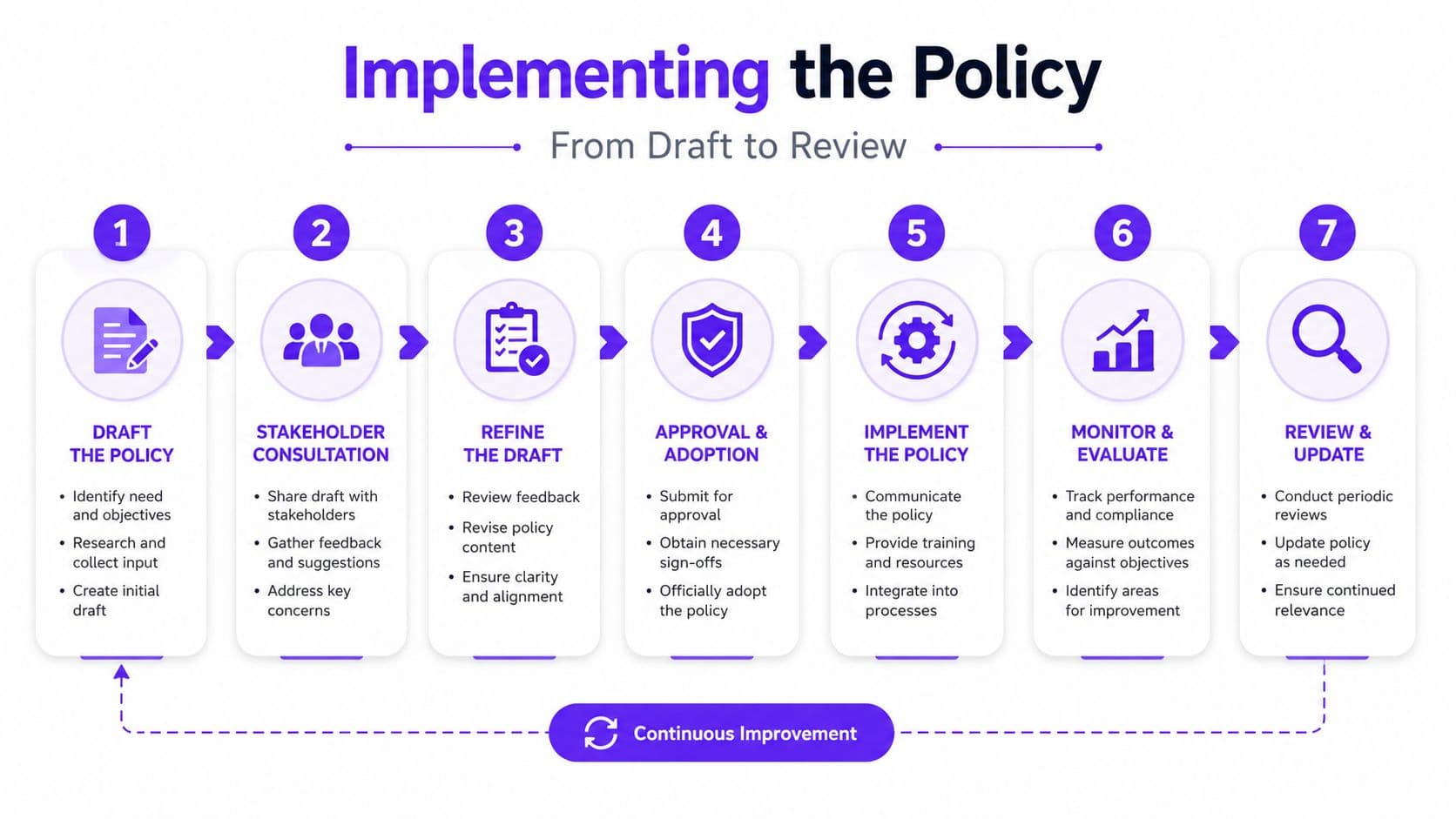
Monitor. On the first business day of each month, export the user list from every in-scope application. Compare each list with the active employee roster from BambooHR or Rippling. Flag terminated users, dormant accounts over 30 days, accounts with unexplained administrator rights, and roles that combine creation and approval for the same record.
Review. Hold a quarterly policy review meeting. Record proposed changes, approve the new version, and re-test enforcement. Create a Linear, Jira, or Asana ticket for every gap, then attach the closure evidence. That turns “we fixed it” into a traceable remediation record.
The practical drafting standard
A policy should state who reviews access, what population they review, how often they review it, what evidence they retain, and what happens when a violation appears. A 2026 analysis of compliance findings identifies vague reviewers, scope, frequency, evidence, and remediation as recurring weaknesses. The access review policy gap analysis is useful because it focuses on auditability rather than polished wording.
If your team lacks the capacity to draft this properly, use a specialist resource such as UK SME IT policy drafting as a reference point for structuring policies and procedures. The document still needs to match your finance systems, approval paths, and evidence workflow.
Red Flags Auditors Look for in Access Controls
Auditors for SOC2 Type II, ISO 27001, and financial statement audits tend to find the same weaknesses. Finance systems expose them quickly because they contain payment rights, vendor data, payroll records, revenue information, and journal-entry authority.
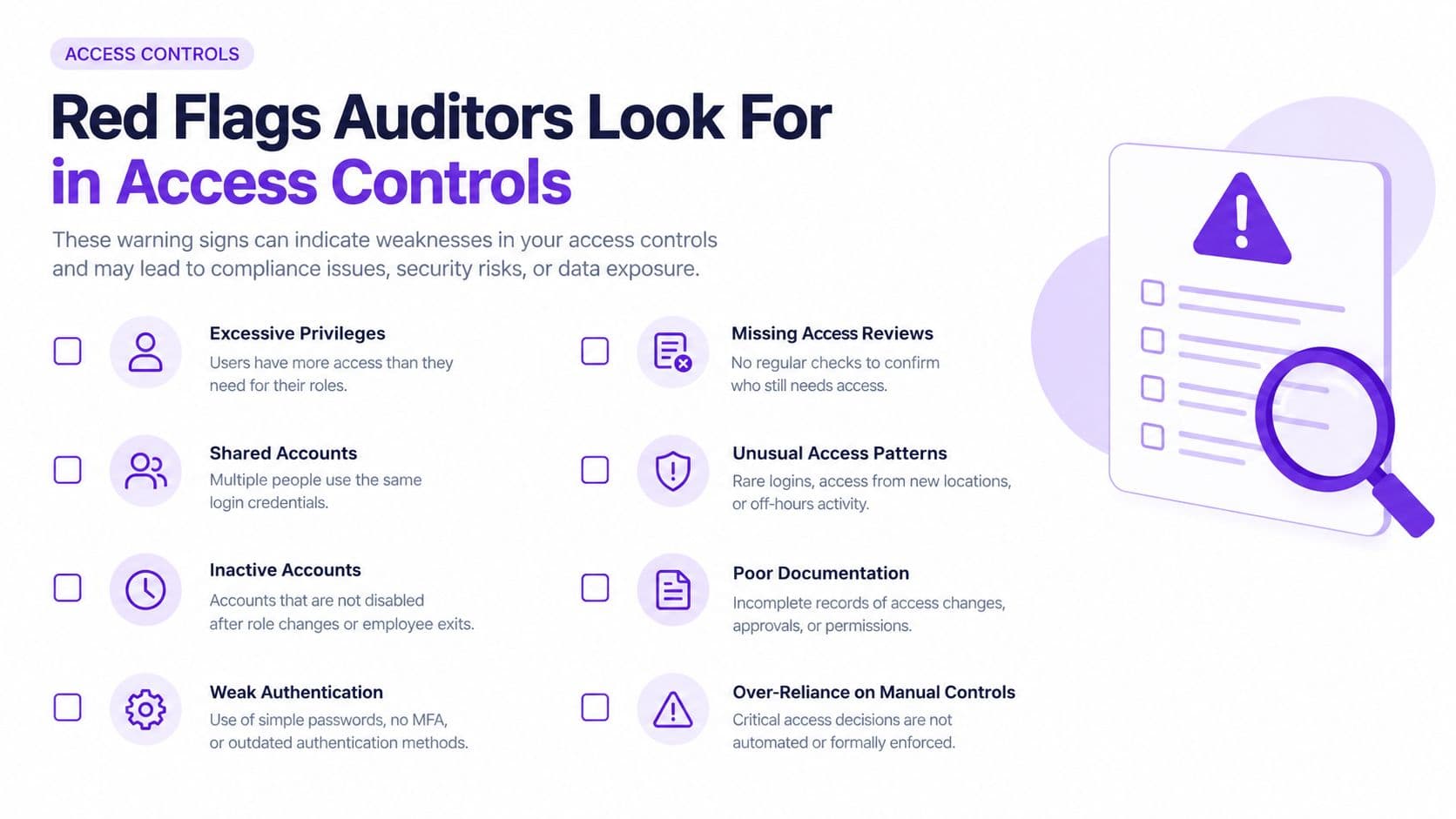
The monthly detection checklist
- Shared credentials: Replace shared Stripe, NetSuite, and QuickBooks logins with named accounts. Shared access destroys attribution.
- Stale users: Compare every application user against the active BambooHR roster. Former employees, contractors, and sales representatives often retain access after their business need ends.
- Missing approvals: Sample journal entries, vendor additions, refunds, and wire templates. Require an attached ticket, workflow record, or approver email.
- Excessive privileges: Identify staff accountants who can both create and post journal entries, AP clerks who can edit vendors and release payments, and RevOps users with refund rights in Stripe.
- Uncontrolled master data: Require dual control for vendor and customer master changes. A user who can alter payment details shouldn't independently approve the resulting payment.
The first-business-day export is simple and effective. Join each system's user list to the active employee roster, investigate every unmatched account, and remediate within five business days. Document the removal or approved exception, then attach the evidence to the audit folder.
Audit standard: A control isn't complete when access is removed. It's complete when removal, review, approval, and remediation are all evidenced.
NIST SP 800-53r5 explicitly requires documented separation of duties and least privilege. It also separates access-control administration from audit functions, preventing the same security personnel from administering access and controlling the audit process. NIST SP 800-53r5 provides a useful benchmark for translating those principles into role restrictions.
Finance leaders who also oversee broader governance can use this overview of COSO for SOX and FTC compliance to connect access controls with internal-control responsibilities. For the wider audit workstream, keep an audit preparation checklist alongside the access review evidence.
A short visual explanation can help train managers before the first review:
Your 30-Day Access Control Starter Plan
You don't need a six-month compliance program to establish a credible operating baseline. You need a focused rollout with a deliverable every week and an owner for each unresolved issue.
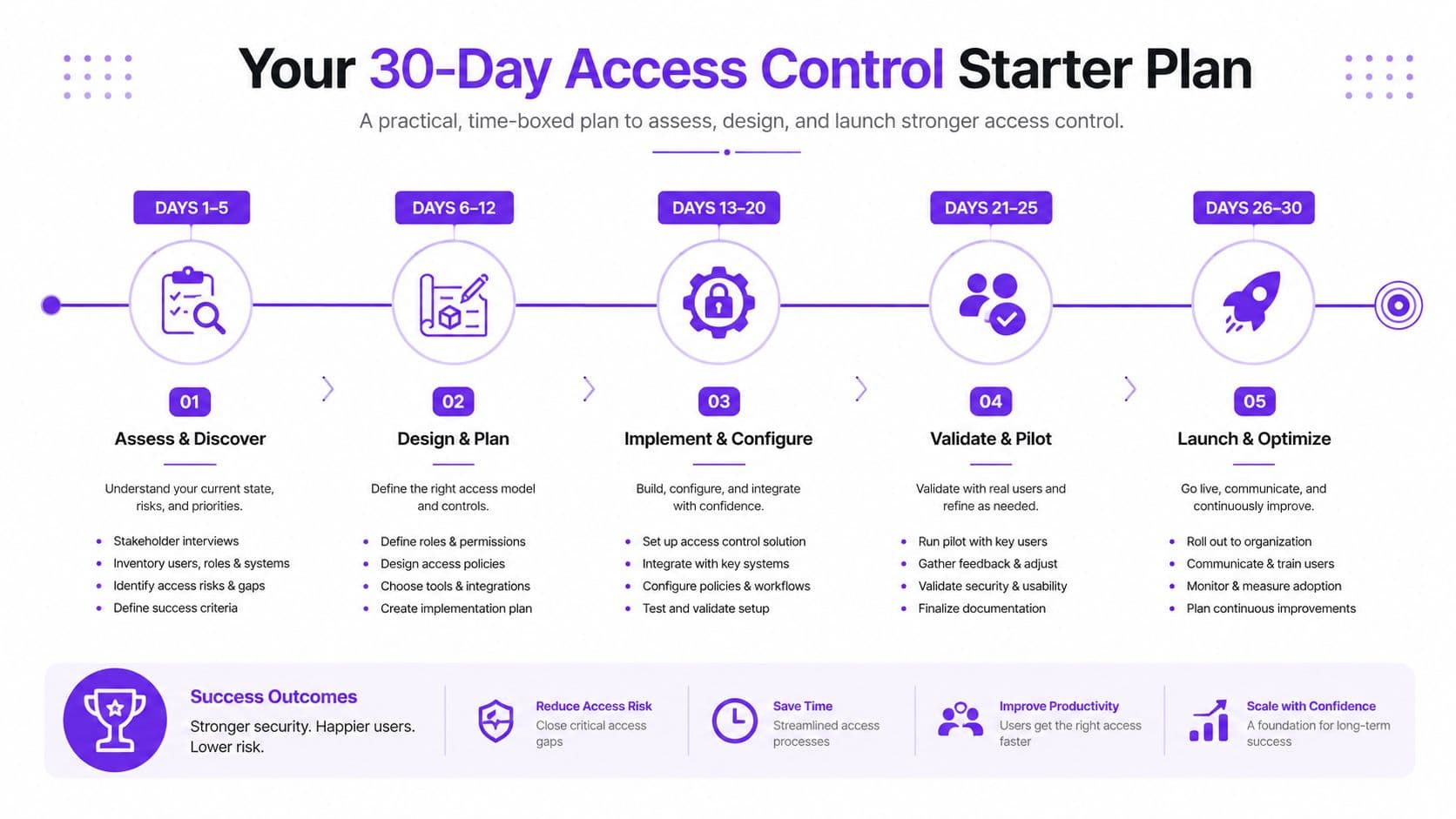
| Timing | Focus | Deliverables |
|---|---|---|
| Week 1 | Inventory | Export users from QuickBooks, Stripe, NetSuite, BambooHR, payroll, card, and billing platforms. Identify owners and shared accounts. |
| Week 2 | Draft | Write the one-page policy, role definitions, approval rules, MFA requirements, offboarding steps, and review cadence. Build the initial matrix. |
| Week 3 | Configure | Apply RBAC in QuickBooks and Stripe, remove shared logins, enable MFA, confirm audit logs, and document exceptions. |
| Week 4 | Test | Run the first access review, compare accounts with the HR roster, test a termination workflow, and complete an audit dry run. |
The operating model is straightforward: policy defines the rule, procedures explain the work, and enforcement blocks or permits the action. Your monthly close should generate evidence naturally, including approval records, user exports, role changes, and remediation tickets. Use the segregation of duties framework to keep creation, approval, posting, and payment authority separate where the risk warrants it.
Don't wait for an auditor to discover the gaps. Put an owner and due date on every exception, review the matrix as roles change, and make access evidence part of close management rather than a last-minute compliance scramble.
Jumpstart Partners provides outsourced controller and bookkeeping support for growing SaaS, agency, and professional services businesses, including access-control workflows that fit into the monthly close. Visit Jumpstart Partners to discuss role mapping, audit evidence, QuickBooks and NetSuite controls, and a finance operating model built for your next audit.