Financial Operations
Accounts Payable Outsourcing: A Founder's Complete Guide
Accounts payable outsourcing explained for growing B2B companies. Learn costs, benefits, vendor selection, KPIs, and a transition checklist.
ByJumpstart Partners, CPA, QuickBooks ProAdvisor
··13 min readYou're staring at a stack of vendor invoices, the close is already slipping, and someone on your team is still rekeying bill data into QuickBooks at 6:40 p.m. That's not a process problem in the abstract. It's founder attention, cash timing, and control leaking out of the business one invoice at a time.
Accounts payable outsourcing is the decision to hand some or all of that invoice-to-payment workflow to a third party. Used properly, it's not just a labor swap. It's a way to reduce exceptions, tighten approvals, and stop AP from becoming the bottleneck that slows month-end, creates payment mistakes, and distracts your finance lead from actual finance work.
Table of Contents
- The Month-End Bottleneck Every Growing Company Hits
- What Accounts Payable Outsourcing Actually Covers
- Cost Savings, Accuracy Gains, and Cash Flow Benefits
- Engagement Models and Pricing Structures Compared
- Why AP Automation Often Beats AP Outsourcing in 2026
- Security, Compliance, and Technology Integration Requirements
- KPIs to Track and a 30-60-90 Day Transition Plan
- Your Decision Framework and Next Steps
The Month-End Bottleneck Every Growing Company Hits
The pattern is familiar. Vendor bills arrive in five places, email, portal, Slack, paper, and someone's “I'll handle it later” folder. Your team knows the bills are real, but every one of them needs a check for coding, approval, duplicate status, and timing, so the close drifts while the inbox grows.
That's where the DIY model breaks. At small revenue levels, AP feels manageable because a founder or office manager can keep up with it between other tasks. Once the business starts adding more vendors, more approvers, and more entities, the work doesn't rise in a straight line. It gets messy fast because every exception pulls in more people, more follow-up, and more context switching.
Accounts payable outsourcing is the deliberate choice to move that operating burden outside the company. In this guide, I'm using it to mean a third party handling invoice intake, coding, matching, approvals support, payment execution, and reconciliation, not just “paying the bills.” That matters because the primary pain isn't the payment itself. It's everything that happens before the payment is allowed to leave the bank.
The business impact is bigger than admin time. Poor AP handling slows cash visibility, increases fraud exposure, and leaves the founder answering invoice questions that should never reach them. If you've been living with a month-end close that starts late and ends tired, that's the signal. The question is no longer whether AP is painful. It's whether you want to keep owning the pain internally or design it out of the workflow. For a broader finance cadence context, see month-end close best practices.
What Accounts Payable Outsourcing Actually Covers
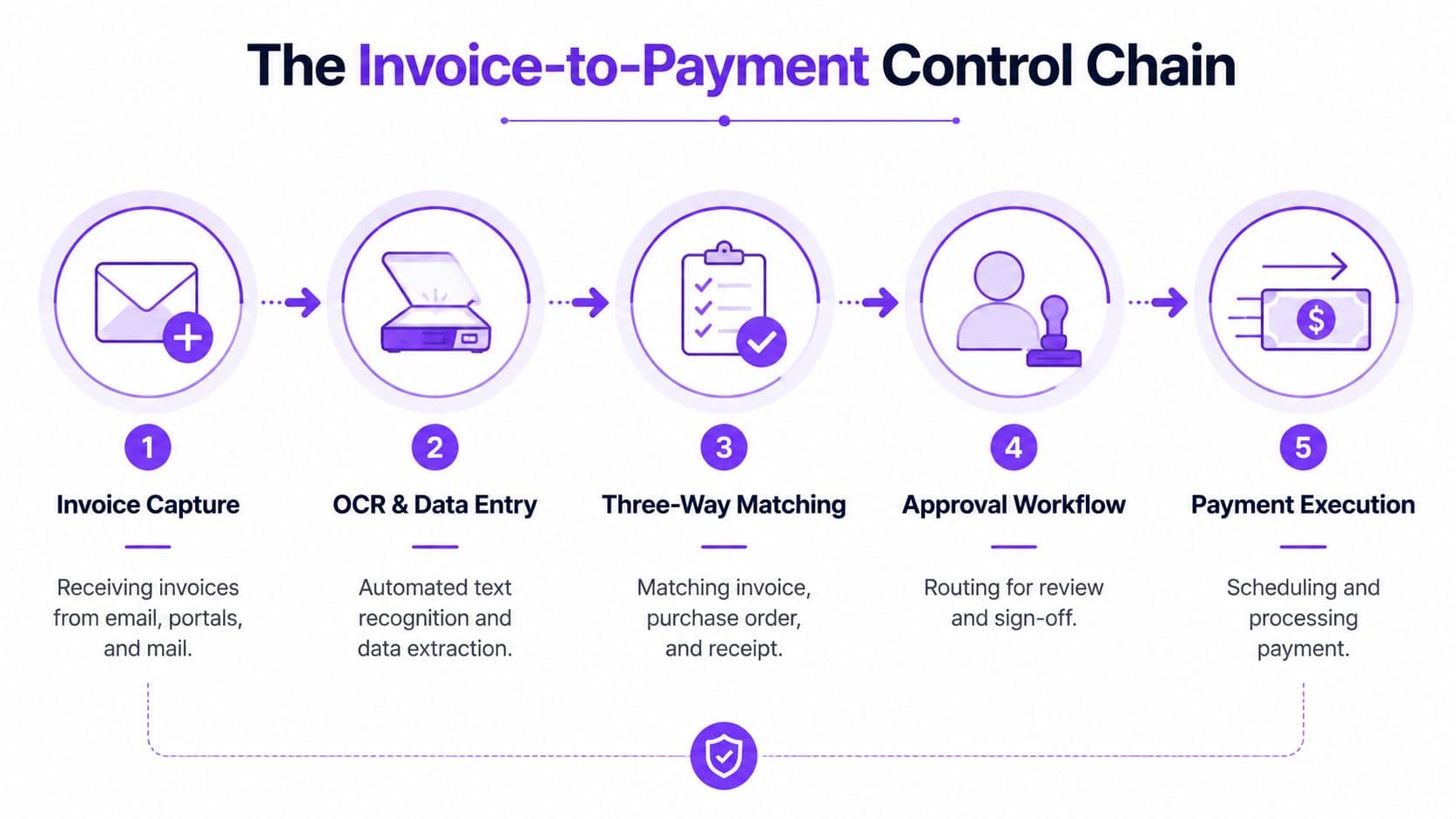
The cleanest way to think about AP outsourcing is as a control chain. You're not buying a person to click “pay.” You're buying a managed workflow that starts when the invoice arrives and ends when the transaction is reconciled.
The workflow you actually hand off
Invoice capture comes first. Invoices land by email, supplier portal, paper scan, or EDI, then move into a structured queue. From there, the provider uses OCR or digitization to pull out the details, which cuts down on manual typing and the errors that come with it.
Next comes three-way matching. The invoice gets checked against the purchase order and goods receipt so bad charges don't move forward just because someone is busy. If the numbers don't line up, the item goes to exception handling, which is where real AP discipline lives.
Practical rule: if your provider can't explain how they handle exceptions, they're not selling AP operations, they're selling invoice intake.
After that, invoices move through approval routing based on delegation-of-authority thresholds. A strong provider protects you from over-approvals and invisible shortcuts. Then comes payment execution, followed by vendor-statement reconciliation and reporting on liabilities, aging, and cash outflows.
The important point is scope. Some companies only want capture and coding. Others want the full process, including payment scheduling and reconciliation. The scope you choose drives the SLA, the pricing model, and the amount of control you keep. For a finance-function framing, see finance and accounts outsourcing.
Cost Savings, Accuracy Gains, and Cash Flow Benefits
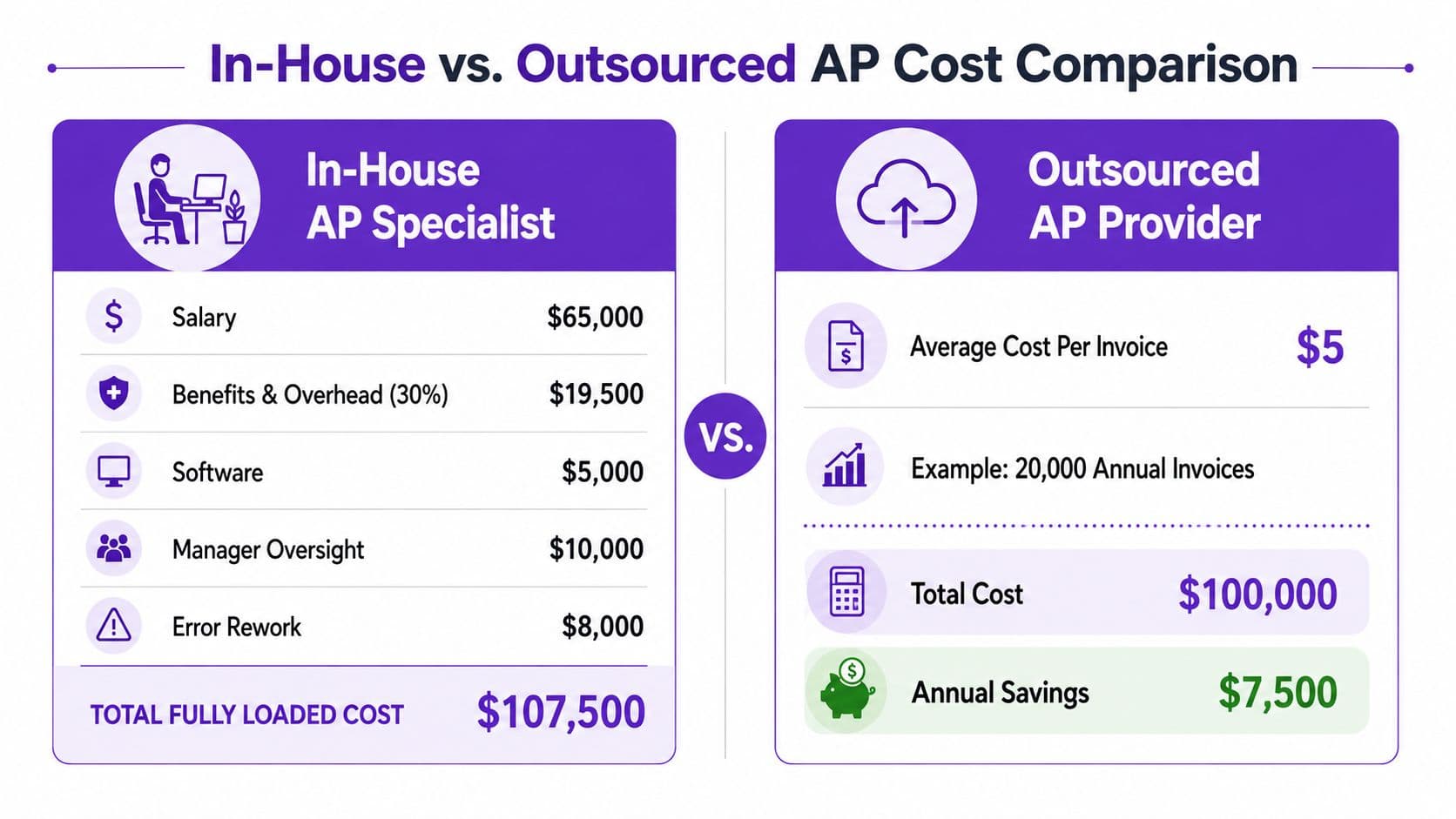
The cost case for AP outsourcing is strongest when you stop pretending the in-house role is just salary. A real AP hire brings payroll cost, benefits, software, manager time, and rework. When you run the numbers, the fully loaded cost is higher than the base wage.
Here's a simple worked example. Suppose an AP specialist earns $65,000. Add $19,500 for benefits and overhead, $5,000 for software, $10,000 for manager oversight, and $8,000 for error rework. That totals $107,500 a year. Against that, an outsourced provider charging $5 per invoice would cost $100,000 for 20,000 annual invoices, which leaves $7,500 in annual savings before you account for the control benefits.
The economics get better when manual work is the bottleneck
The manual workload is why buyers keep looking at this category. In a 2025 report summarized by Shortlister, 63% of AP teams spend more than 10 hours per week on invoice processing, up from 52% in 2024, and 66% manually enter invoice data into ERP systems, a 6% year-over-year increase (Shortlister AP outsourcing report). That doesn't just burn payroll. It steals time from accruals, forecasting, and vendor management.
Accuracy matters just as much. Every duplicate or unauthorized payment is a direct cash leak, and AP control points exist to prevent exactly that. A structured workflow that forces matching, approvals, and reconciliation gives you fewer surprises at month-end and a cleaner path to cash planning. For a practical aging lens, see accounts payable aging.
Cash flow gets better when AP stops being reactive. If your team knows what's approved, what's pending, and what's scheduled, you stop guessing at liabilities.
My view is simple. If your AP process is still driven by inbox triage and human memory, the cost is bigger than the invoice fee. You're paying in rework, delay, and management attention. Outsourcing wins when it turns that mess into a controlled process.
Engagement Models and Pricing Structures Compared
Not every AP outsourcing arrangement looks the same. The wrong model creates confusion fast, so you need to buy the structure that matches your stage, not the one that sounds cheapest in a sales call.
The four models that actually show up in the market
| Model | Typical Pricing | Best Fit | Main Tradeoff |
|---|---|---|---|
| Full-process outsourcing | Per-invoice fee or monthly retainer | Smaller teams that want the whole workflow off their plate | Less day-to-day control |
| Co-managed AP | Monthly fee with split responsibilities | Growing firms that want internal approval control | You still own some process discipline |
| AP automation plus offshore exception support | Software subscription plus service fee | Teams that want internal visibility and scalable review | Requires stronger internal ownership |
| Project-based cleanup or migration work | Fixed-fee project | Companies with backlog, cleanup, or system change | Not a durable operating model |
A good resource on payment workflow tradeoffs is pay smarter not slower bill strategies. The key insight there lines up with what I see in practice, you don't want to pay for speed if you're giving up control in the process.
For a $500K business, I'd usually start with cleanup or co-managed AP if the books are unstable. Around the middle of the range, a full-process model makes sense only if the transaction volume is noisy and the team is thin. At the higher end, automation plus a lean internal AP owner often beats a fully outsourced model because the company needs visibility more than labor relief. For broader service comparisons, see best outsourced accounting services.
Buy the operating model, not the invoice fee. A cheaper quote is expensive if it leaves approvals vague, exceptions unresolved, or reporting late.
Why AP Automation Often Beats AP Outsourcing in 2026
This is the part most vendors don't lead with. In 2026, for many growing companies, AP automation beats outsourcing because software keeps control inside the business while still removing the manual burden.
When software wins
If you're using tools with strong capture, approval routing, and ERP integration, you don't need to give away the whole function. You need better workflow design. That's why automation keeps gaining ground, especially for teams that want auditability, faster internal visibility, and fewer handoffs. It also fits companies that already know who approves what and want the system to enforce it.
The source material points in the same direction. A recent comparison of outsourcing and automation notes that outsourcing reduces headcount burden but transfers daily control to an external team, while automation keeps the function internal and is increasingly positioned as the alternative for firms that want scalability without surrendering operational visibility (Ramp AP outsourcing comparison). That's the right framing.
Outsourcing still wins in a few narrow cases. Very low transaction volumes make software ROI hard to justify. Complex multi-entity or multi-currency operations can overwhelm a lean internal setup. A company with no internal AP owner also needs help quickly. And when exceptions dominate the workload, human service beats a pure software stack.
The decision I make for clients
If the invoices are predictable and the approval path is stable, I push automation first. If the workflow is messy, the team lacks capacity, and nobody is ready to own the process, outsourcing can be the bridge. If you want a deeper control-oriented software lens, read accounts payable automation benefits.
The mistake is treating outsourcing as the default answer. In 2026, the default should be, “Can software plus a capable internal owner handle this better?”
Security, Compliance, and Technology Integration Requirements
I don't care how slick the demo looks if the vendor can't prove control. AP touches bank data, vendor details, approval authority, and audit trails, so you need to evaluate the provider like you would any other finance system with access to money.
What to verify before you sign
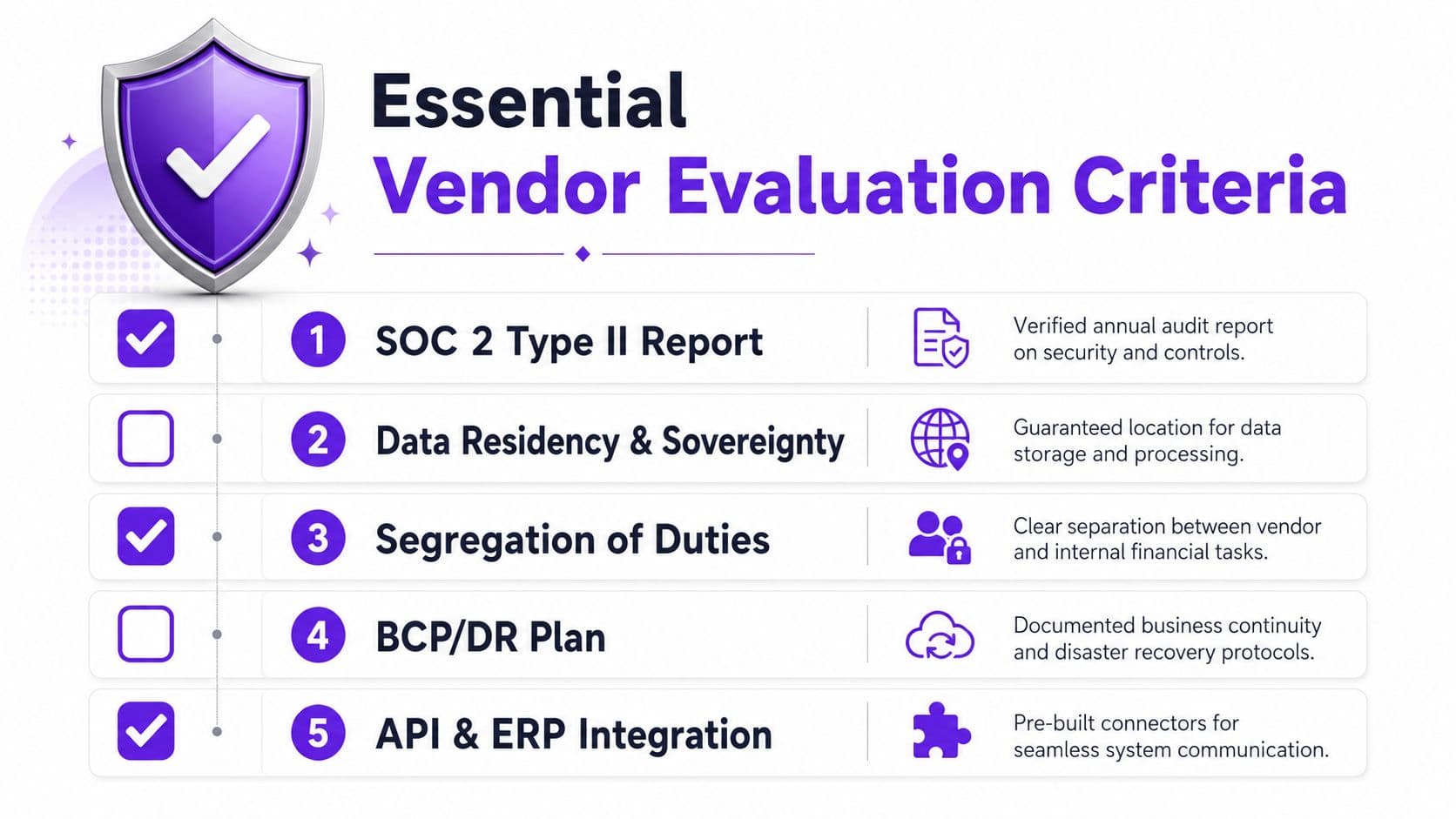
Ask for a SOC 2 Type II report. If they can't produce one, keep moving. Confirm data residency and sovereignty, especially if your business handles regulated or cross-border information. Make sure there's segregation of duties between the vendor and your internal approvers so one person can't create, approve, and release the same payment.
You also need a documented BCP/DR plan, because payment workflows cannot stop when someone takes a week off or a system fails. Finally, inspect the API and ERP integration path. Clean handoff matters more than the sales deck.
Red flags that tell you to walk
- Vague approvals: If the vendor can't show how it enforces approval-matrix rules, you'll lose control fast.
- Weak integration story: If they only “support” QuickBooks, Xero, NetSuite, Stripe, or Shopify in theory, the onboarding will be painful.
- Hidden fee language: Rush payments, exceptions, and cleanup should be clearly priced, not buried in a proposal.
- No audit-trail demo: If they can't show logs, timestamps, and reviewer history, the process won't stand up under scrutiny.
- Security answers that stay generic: You want documents, not reassurances.
For a broader vendor-selection lens, the same discipline applies outside finance too. A useful parallel is ARPHost on vendor selection for IT outsourcing, because the evaluation logic is similar, prove control, prove continuity, prove fit.
If a provider can't show how the system passes work cleanly between software, vendor, and internal approver, don't buy the service.
KPIs to Track and a 30-60-90 Day Transition Plan
Once AP outsourcing is live, the relationship lives or dies on metrics. If you don't track the right numbers, you'll only notice problems when a vendor complains or a payment goes missing.
The KPIs that matter
Track invoice processing cycle time, exception rate, first-pass match rate, cost per invoice, duplicate-payment incidence, early-payment discount capture, and aging-AP accuracy. Those metrics tell you whether the provider is reducing friction or just moving it around.
A simple rollout sequence
- Days 1 to 30: run a pilot on one entity or one vendor segment, confirm routing logic, and test the payment path.
- Days 31 to 60: document SOPs and approval matrices, then expand volume only after exceptions are stable.
- Days 61 to 90: move to full volume, lock in formal SLAs, and hold quarterly business reviews.
The failure point is unmanaged edge cases. A vendor can process clean invoices all day and still fail if no one owns dispute handling, approval escalation, or backlog cleanup. That's why I like a phased rollout with written escalation rules. If you need a related payroll process reference, the structure in the Umbrella Company payroll guide is a useful reminder that service design beats optimistic assumptions.
Practical rule: don't scale volume until the exception queue is boring.
If cycle time improves but exception handling gets sloppier, you didn't outsource AP well. You just hid the mess.
Your Decision Framework and Next Steps
Use this rule set. Outsource when volumes are low enough to fit a service model, exceptions are frequent, internal capacity is missing, or multi-entity complexity is eating your team alive. Automate when volumes are predictable, exceptions are simple, and you want day-to-day control. Co-manage when you're scaling fast and need both structure and oversight.
The next move is practical, not theoretical. Ask for a SOC 2 Type II report, run a 30-day pilot on one entity, and benchmark cost per invoice against your fully loaded in-house cost. If you need an outsourced controller or bookkeeping partner who can also map AP into the broader close process, Jumpstart Partners is one option to scope alongside other providers.
Jumpstart Partners helps growing businesses tighten the whole finance stack, including AP automation, bookkeeping, and controller support, so invoices stop dragging on the close. If you want a scoped proposal and a clearer view of whether outsourcing, automation, or a hybrid model fits your business, visit Jumpstart Partners and start the conversation.