Financial Operations
Accounts Receivable Aging: A SaaS Guide
Master accounts receivable aging to improve cash flow. Learn key metrics, best practices, and automation tips for SaaS and service firms in 2026.
ByJumpstart Partners, CPA, QuickBooks ProAdvisor
··16 min readAfter 90 days, 26% of receivables become uncollectible, so accounts receivable aging is a risk-management tool, not just a reporting requirement. The older an invoice gets, the less likely you are to convert booked revenue into cash.
That distinction matters most for SaaS companies, digital agencies, and professional services firms. Your P&L can show recurring revenue, signed contracts, and a healthy gross margin while your bank account tells a different story. If customers pay late, you fund payroll, delivery, software, and growth before collecting the revenue that supposedly supports them.
An aging report exposes that gap. It shows which invoices are current, which customers are consuming collection capacity, and where today's sales are becoming tomorrow's bad debt.
Table of Contents
- The Real Cost of Uncollected Invoices
- How to Read and Generate an AR Aging Report
- Industry Benchmarks and Red Flags
- Aging Strategies for QuickBooks, Xero, and NetSuite
- Remediation Strategies for Aging Receivables
- Common Misconceptions and Next Steps
The Real Cost of Uncollected Invoices
U.S. Census Bureau data indicates that 26% of receivables are uncollectible after 90 days, rising to 70% after 180 days and 90% after one year, as reported in Sage's accounts receivable management guide. Those figures change how you should view an aging schedule. A receivable is not equally valuable just because it appears on your balance sheet.

Revenue creates the promise of cash. Accounts receivable aging measures the probability and timing of that cash arriving. For a SaaS company, a new annual contract can increase reported revenue while adding implementation costs, support obligations, and commission expense before the customer pays. For an agency, the team may complete the work and pay contractors long before the client clears the invoice.
That creates a cash conversion problem. If your customers take longer to pay, you either slow delivery, use cash reserves, delay hiring, or borrow against future collections. None of those choices fixes the underlying issue. They only give late invoices more time to age.
Why gross revenue can mislead you
Suppose your business invoices $100,000 in a month and collects $70,000. The income statement may still reflect the full amount under your accounting method, but your bank account has only received $70,000. The remaining $30,000 becomes a management question:
- Current invoices: Cash is expected, but you still need to monitor due dates.
- Early overdue invoices: The customer needs a prompt reminder and a clear payment path.
- Older balances: You need an owner, a documented reason for nonpayment, and an escalation date.
- Severely aged invoices: You need to assess collectability, commercial concessions, legal action, or an allowance.
The report turns a total receivable balance into a ranked risk list. That makes it more useful for cash forecasting than a revenue number alone.
Practical rule: Treat every invoice that crosses 90 days as a decision, not a follow-up task.
The working-capital consequence
Late collection forces you to finance delivery twice. You first spend money to provide the service, then spend more money to keep operating while waiting for payment. If the customer ultimately pays, the delay still increases pressure on working capital. If the customer doesn't pay, the cost includes the original delivery expense and the lost opportunity to use that cash elsewhere.
Review your aging report alongside your cash forecast and operating plan. The cash-flow improvement framework is useful here because collections, payment timing, hiring, and spending decisions belong in the same operating conversation.
The right question isn't, “How much revenue did we book?” Ask, “How much of our outstanding revenue remains realistically collectible, and when will it reach the bank?”
How to Read and Generate an AR Aging Report
An accounts receivable aging report groups unpaid invoices according to how long they have remained outstanding. The standard structure includes current, 1–30 days, 31–60 days, 61–90 days, and 90+ days overdue. The report should show the customer, invoice number, issue date, due date, original amount, remaining balance, and aging bucket.
Build the report from clean inputs
Start inside your accounting platform and confirm that every open invoice has a valid due date. An invoice without a correct due date can land in the wrong bucket and distort your collection priorities.
Then run the report as of a specific date. Avoid changing the report date while reviewing it. You need a consistent snapshot so you can compare movement over time and see whether balances are progressing toward payment or drifting into older categories.
Use this workflow:
- Export open invoices: Include customer, invoice, due date, amount, payment status, and notes.
- Group by customer: Multiple small invoices can represent a material exposure when combined.
- Assign aging buckets: Classify each balance according to days outstanding.
- Total each bucket: Review both the dollar value and the share of total receivables.
- Assign ownership: Every overdue account needs a named person and a next action.
- Record disputes separately: A disputed invoice isn't the same as a forgotten invoice, even though both reduce cash.
Automation reduces the risk of missed payments and stale spreadsheets. Your invoicing process should connect invoice creation, payment reminders, customer records, and reconciliation rather than leaving those tasks in separate files. Teams evaluating invoice processing automation should prioritize clean due dates and payment status data before adding more workflow rules.
Read the mix, not just the total
Industry guidance describes a healthy profile as 80% or more of receivables in the current and 1–30 day buckets, with less than 10% in the 61–90 and 90+ buckets, according to Xero's AR aging guidance. Use that as a directional control, not a universal target. A business with milestone billing, long procurement cycles, or unusual contract terms needs to interpret the buckets against its actual payment agreements.
| Bucket | Management question | Immediate action |
|---|---|---|
| Current | Is the customer likely to pay on the agreed date? | Send a pre-due reminder and confirm payment details. |
| 1–30 days | Is the delay administrative, behavioral, or disputed? | Contact the customer and document the response. |
| 31–60 days | Has someone accepted responsibility for payment? | Escalate to the account owner and finance lead. |
| 61–90 days | What prevents collection before the high-risk boundary? | Set a firm resolution date and restrict additional exposure. |
| 90+ days | Is this balance collectible at its recorded value? | Escalate commercially, legally, or through an allowance review. |
Run the report at least weekly when cash is tight, customer concentration is high, or overdue balances are growing. A monthly report can tell you what happened. A frequent report gives you time to change what happens next.
Industry Benchmarks and Red Flags
A healthy aging profile isn't defined by one universal number. It depends on payment terms, customer concentration, contract structure, billing frequency, and the cost of delivering before payment. Still, market data shows why older buckets deserve disproportionate attention.
Dun & Bradstreet reported that 15 of 203 U.S. industry segments had 10% or more of aging dollars 91+ days past due in Q2 2026, with technology and business services among the affected segments, according to its U.S. Accounts Receivable Industry Report. The data shows that severe delinquency isn't limited to one business model, and it shouldn't be dismissed as a temporary nuisance.
Red flags that deserve executive attention
Watch the direction of balances, not only the current snapshot. A business can appear stable while invoices steadily migrate from current to 31–60, then from 31–60 to 61–90.
| Red flag | What it usually indicates | Management response |
|---|---|---|
| Current balances shrink while 31–60 grows | Reminders, billing, or customer approvals are failing | Audit the invoice-to-payment process. |
| One customer dominates 90+ | Concentration and relationship risk | Escalate with the commercial owner and reassess credit exposure. |
| Disputed invoices remain open | Delivery, scope, or documentation problems | Separate valid disputes from collection delays and assign deadlines. |
| New invoices age quickly | The customer or terms are unsuitable | Review onboarding, deposits, limits, and contract language. |
| Collections depend on one person | The process isn't documented or repeatable | Create shared workflows, templates, and escalation rules. |
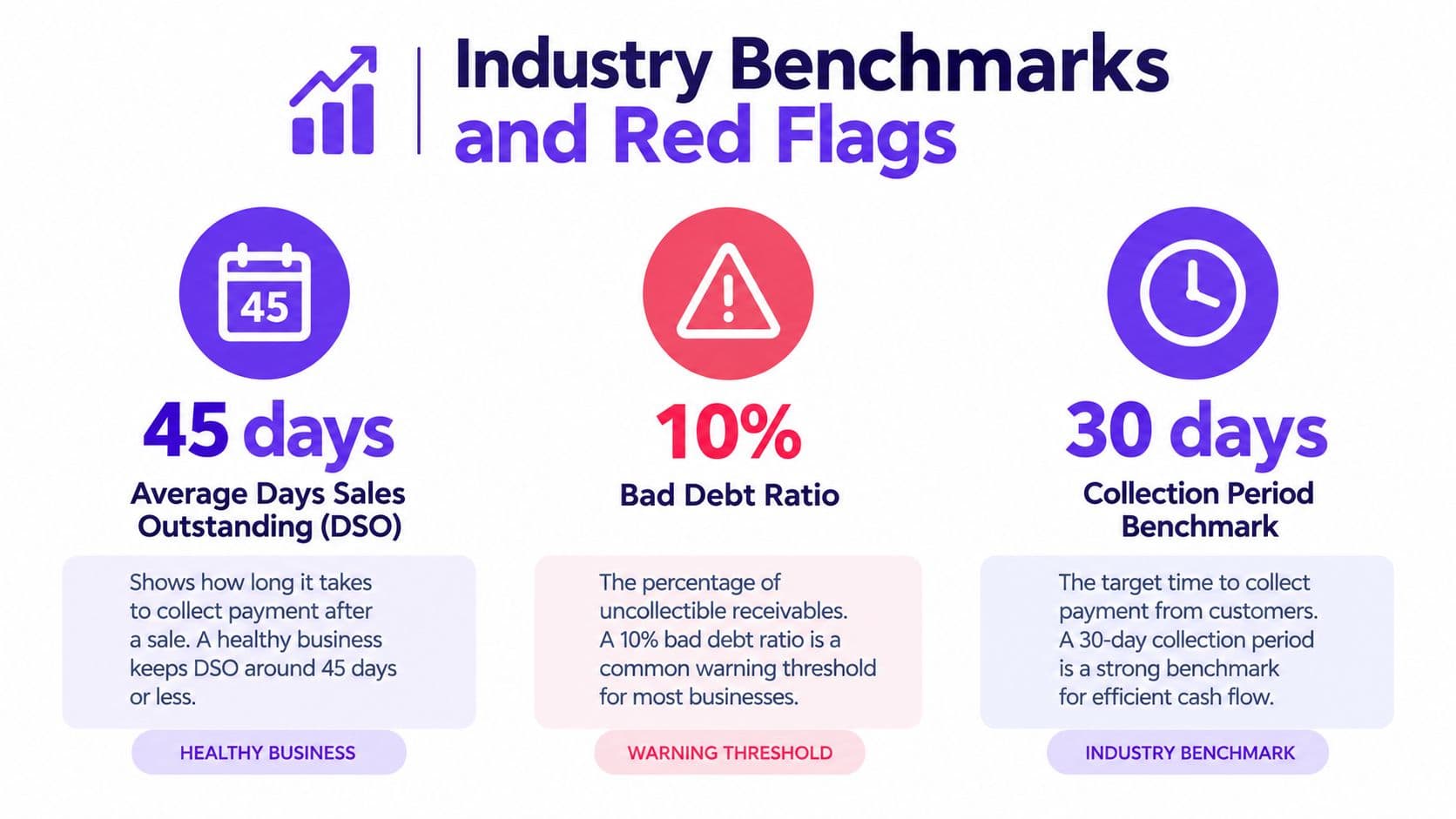
DSO gives you a useful companion metric because it measures the average time required to collect receivables. Industry guidance generally treats DSO below 30 days as excellent and 30–45 days as a healthy range for Net 30 businesses, although the appropriate target depends on your terms, as explained in NetSuite's DSO and aging guidance.
Separate normal timing from systemic failure
A customer paying near the end of agreed terms isn't automatically a problem. A customer paying later every month, ignoring reminders, or disputing invoices after delivery is a problem. The same distinction applies across your customer base.
Use customer-level trends to find the cause:
- A single late payer points toward account-specific risk.
- Many late payers point toward weak terms, billing friction, or an ineffective dunning cadence.
- Late payments after scope changes point toward sales and delivery misalignment.
- Late payments after implementation point toward onboarding, approval, or value-realization issues.
For more context on how receivables efficiency connects with operating performance, review accounts receivable turnover. The key decision is whether your aging report shows a temporary exception or a process that repeatedly produces late cash.
Aging Strategies for QuickBooks, Xero, and NetSuite
A 2022 analysis of 250,000 invoices found that collection probability fell from roughly 85–90% at 31–60 days past due to only 20–30% beyond 120 days without intervention, according to Crestmont Capital's accounts receivable aging analysis. Your accounting platform cannot collect an invoice on its own, but it can put the right account in front of the right person before the probability of payment drops sharply.
QuickBooks
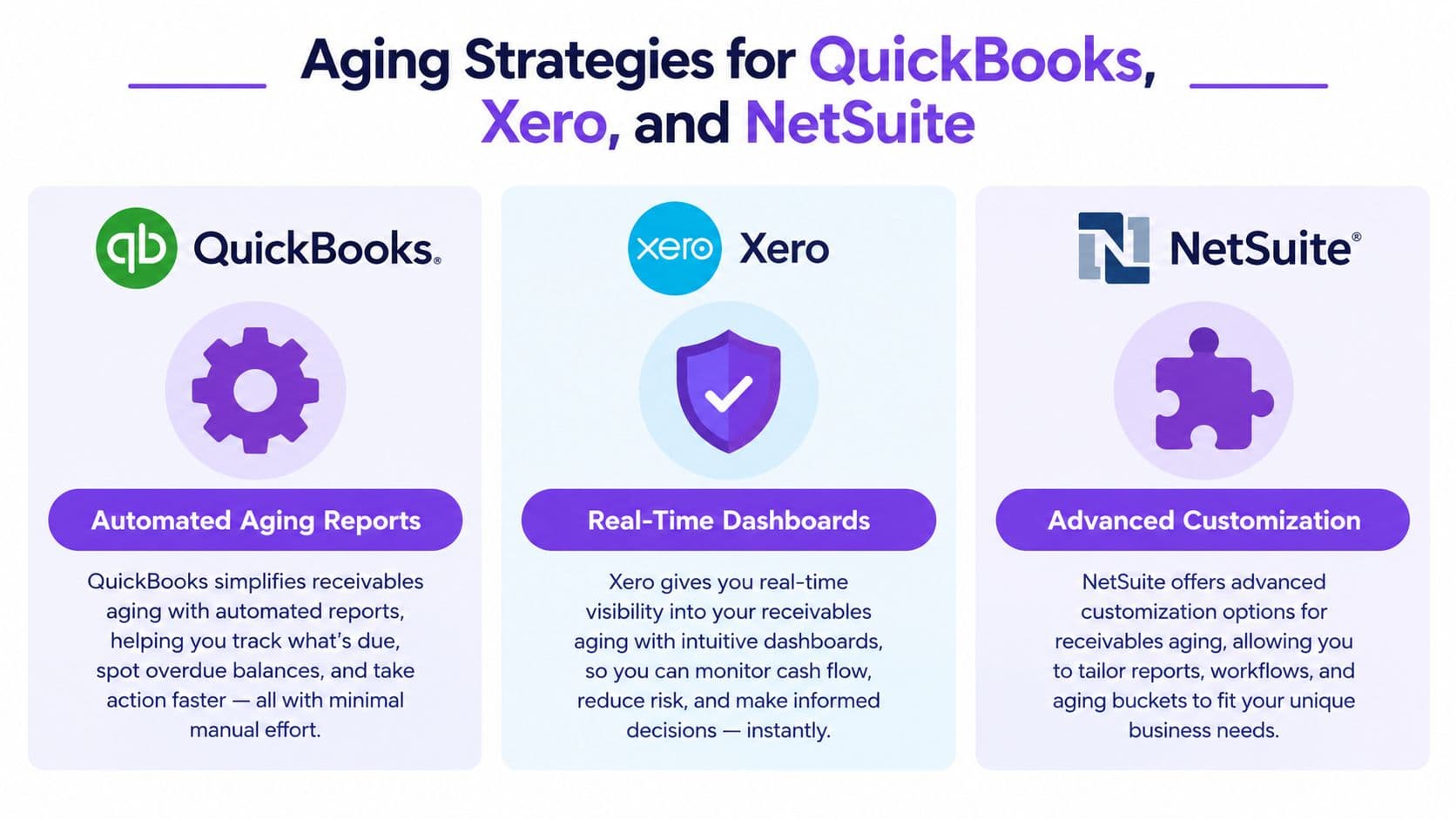
QuickBooks suits teams that need clear aging reports, customer balances, invoice reminders, and a manageable approval process. Standardize payment terms, activate reminders, and schedule a weekly review of 61–90 and 90+ balances. Assign an owner to every overdue account so the report produces action instead of another unread export.
SaaS companies should connect their billing source to QuickBooks with reliable customer and invoice references. Stripe or another payment processor can send payment data into the ledger, but missing identifiers create reconciliation errors. A paid invoice can then remain marked overdue, wasting collection time and damaging the customer relationship.
For agencies, require the project or account owner to record the reason for every disputed invoice. “Client hasn't paid” gives finance no usable next step. “Awaiting procurement vendor setup” identifies the blocker and tells the team where to focus.
Xero
Xero fits teams that want accessible dashboards, online invoicing, bank feeds, and recurring review routines. Use customer groups or tracking fields to separate recurring subscriptions, retainers, projects, and one-time work. That segmentation lets finance compare aging by revenue type and spot a billing process that creates avoidable delays.
Set reminders before and after the due date, then change the message as the balance ages. Early notices can confirm receipt and payment details. Later notices should request a response, identify the overdue amount, and route disputes to a person. Strategic accounts and disputed invoices need a human review rather than another automated email.
NetSuite
NetSuite supports multiple entities, complex revenue processes, advanced workflows, and detailed reporting dimensions. Its flexibility only helps when someone governs the configuration. Give an owner to every custom status, saved search, approval rule, and reminder, and remove fields that no longer support a decision.
Create saved searches that group aging by subsidiary, customer segment, account manager, service line, and dispute status. A search filtering 61–90 and 90+ balances by account manager gives the weekly review list without manual export. Add an exposure check so sales and delivery teams can see when a customer is approaching an approved limit before expanding the balance.
| Platform | Best operating use | Main control |
|---|---|---|
| QuickBooks | Simple reporting and repeatable reminders | Standardize terms, owners, and reconciliation. |
| Xero | Accessible dashboards and online collection workflows | Segment customers and vary reminder messages. |
| NetSuite | Complex entities, workflows, and reporting | Govern custom fields, searches, and approvals. |
Choose the platform your team can operate consistently, not the one with the longest feature list. Compare workflow complexity, integration needs, reporting requirements, and administrative workload with this accounting software selection guide for growing businesses. The right configuration should shorten the path from an aging report to a documented collection action.
Remediation Strategies for Aging Receivables
When invoices are already overdue, don't launch a vague “collections push.” Create a controlled response that moves each balance toward payment, resolution, or a documented loss assessment.

Start by sorting the report by age, value, customer importance, and dispute status. Contact the oldest high-value invoices first, but don't ignore smaller balances if they reveal a repeated billing or payment problem.
A practical recovery sequence
- Validate the balance. Confirm the invoice, contract, delivery evidence, tax treatment, payment instructions, and unapplied cash. Finance shouldn't chase a customer for an amount already paid or incorrectly billed.
- Name the blocker. Ask whether the issue is approval, procurement setup, missing documentation, dissatisfaction, cash shortage, or deliberate delay.
- Set a payment commitment. Get a specific date and amount in writing. Replace “we're looking into it” with a recorded commitment that someone can track.
- Offer structure without surrendering control. A payment plan can preserve the relationship when the customer acknowledges the debt and pays according to an agreed schedule. Put dates, amounts, consequences, and service conditions in writing.
- Control new exposure. Pause new work, require a deposit, reduce the credit limit, or move the customer to prepaid terms when continued delivery increases your risk.
- Escalate deliberately. Involve a senior commercial owner, collections specialist, or attorney when the customer misses commitments or refuses to engage.
Your DSO target should match your commercial terms. DSO below 30 days is generally excellent, while 30–45 days is considered healthy for Net 30 businesses, according to the previously cited NetSuite guidance on accounts receivable aging. Use the measure to detect deterioration, not to pressure teams into unrealistic collection behavior.
Collection discipline: A payment plan without a missed-payment consequence is only a promise.
Before legal escalation, review the contract, notice requirements, venue, interest provisions, and documentation. Kons Law's guidance on invoice collections provides useful context for organizing that process. Legal action isn't always the best commercial choice, but an undefined escalation path guarantees delay.
Automation prevents the next balance from becoming a crisis. Configure reminders, payment links, customer portals, approval alerts, dispute queues, and reconciliation rules. A focused accounts receivable automation workflow should route routine reminders to software and reserve human time for negotiations, disputes, and high-risk accounts.
Use a 13-week cash forecast to model the expected payment date, not merely the invoice due date. If the forecast depends on a 90+ day balance, mark that cash as uncertain and prepare a spending response before the shortfall reaches payroll.
Common Misconceptions and Next Steps
Misconception one: aging is only for distressed businesses. Healthy companies use it to preserve cash visibility while they grow. Rapid sales can hide collection weakness because new invoices make the total receivable balance look productive even as older invoices become harder to collect.
Misconception two: the finance team owns collections alone. Finance owns the report and controls, but sales owns commercial expectations, customer success sees dissatisfaction early, delivery confirms completion, and executives decide when to restrict exposure. If those teams don't share information, finance receives the problem after the customer has already lost payment urgency.
Misconception three: every overdue invoice deserves the same treatment. A clean invoice awaiting a routine approval needs a different message from a disputed milestone invoice or a customer that has stopped responding. Segment your actions by cause, value, and age.
Misconception four: automation replaces judgment. Automated reminders improve consistency, but they can't decide whether a customer is disputing scope, whether a strategic account needs executive involvement, or whether more delivery increases unacceptable risk. Use automation for timing and routing, then use people for decisions.
Your next operating review
Take these actions in order:
- Run the report: Pull current, 1–30, 31–60, 61–90, and 90+ balances from your accounting system.
- Reconcile the exceptions: Remove unapplied cash, duplicates, credit memos, and invoices with incorrect due dates.
- Assign every overdue balance: Record the owner, cause, next action, and commitment date.
- Review the migration: Compare recent reports to identify balances moving into older buckets.
- Automate the routine: Schedule reminders, payment links, approval alerts, and reconciliation rules.
- Set an escalation policy: Define when to pause work, change terms, request a deposit, or seek legal advice.
- Connect aging to cash: Put expected collections into your operating cash forecast and mark uncertain balances clearly.
Aging isn't a spreadsheet exercise. It's the operating control that tells you whether booked revenue is becoming usable cash before your business commits to more payroll, delivery, and growth.
Jumpstart Partners provides outsourced controller and bookkeeping support for SaaS, agencies, and other growing businesses, including AR workflows, reconciliations, cash-flow visibility, and reporting across QuickBooks, Xero, and NetSuite. Visit Jumpstart Partners to review your aging process and decide whether your business needs a cleaner report, stronger collection controls, or hands-on finance support.