Financial Operations
What Is Accounts Receivable Automation
Learn what is accounts receivable automation, how it cuts DSO, and the exact ROI for growing SaaS and agencies. Includes implementation steps and red flags.
ByJumpstart Partners, CPA, QuickBooks ProAdvisor
··15 min readAccounts receivable automation is software that digitizes and orchestrates invoicing, payment collection, cash application, and collections workflows. The category reached USD 4.79 billion in 2025 and is forecast to reach USD 12.86 billion by 2033, with a projected 13.2% CAGR from 2026 to 2033, according to Grand View Research's accounts receivable automation market analysis.
You recognize the problem even if you don't call it AR automation. Revenue is growing, but cash remains trapped in net-30 or net-60 invoices. Your finance team checks spreadsheets, searches email threads for remittance details, sends follow-ups from memory, and manually reconciles bank activity against open invoices.
That process doesn't scale from $500K to $20M in revenue. It creates delayed cash, avoidable errors, inconsistent customer communication, and weak visibility into what you will collect. AR automation replaces that fragmented work with integrated, rule-based finance operations. The important point is simple: you're not buying a button that sends invoices. You're redesigning how your business turns earned revenue into cash.
Table of Contents
- The Cash Flow Bottleneck and the Automation Solution
- Core Components of an Automated AR Workflow
- Calculating the Real ROI for Growing Businesses
- Implementation Red Flags and Common Misconceptions
- Your Phased Rollout Strategy for AR Automation
- Essential KPIs and Security Compliance Standards
- Next Steps to Transform Your Cash Flow Operations
The Cash Flow Bottleneck and the Automation Solution
A $5M SaaS company can have a healthy income statement and still feel underfunded. New contracts increase monthly recurring revenue, but enterprise customers pay slowly. The collections manager maintains a spreadsheet, the account executive knows which customer is “almost ready,” and the controller spends close week asking why a wire hasn't been applied.
An agency faces a different version of the same problem. A project reaches a milestone, but billing depends on someone notifying finance. The invoice goes out late, payment terms vary by contract, and a customer disputes a line item after the team has already moved on to the next project. Revenue recognition may be correct, yet the cash conversion process remains unreliable.
Accounts receivable automation connects the full order-to-cash workflow:
- Invoice creation: The system generates invoices from approved contract, subscription, project, or milestone data.
- Payment collection: Customers receive digital payment options and self-service access to invoices and account details.
- Cash application: Incoming payments are matched to open invoices using remittance information and transaction data.
- Collections management: Automated reminders and escalation rules guide follow-up based on due dates, customer history, and exceptions.
Manual AR behaves like a toll booth. Every payment stops for human review, someone checks the license plate, and an employee records the transaction before the next vehicle moves. Automated AR works more like an electronic toll pass. The system reads the payment information, matches it to the right obligation, and sends only exceptions to a person.
Practical rule: Automate the handoffs first. If billing data doesn't move cleanly from your CRM or billing platform into accounting, reminders won't solve the underlying cash problem.
A useful starting point is this overview of accounts receivable management, particularly for separating the broader management discipline from the automation layer. Management defines credit policies, terms, ownership, and escalation. Automation executes those decisions consistently.
The historical shift matters. The market is now large enough to be tracked as a multi-billion-dollar finance technology category, but adoption remains incomplete. A 2025 survey found that 80% of finance executives rated AR automation as important, high priority, or critical, while only 3% of companies reported fully automated AR processes, according to the BlackLine survey white paper. Your opportunity isn't to replace judgment. It's to remove repetitive work so your finance team can manage risk, disputes, and customer relationships proactively.
Core Components of an Automated AR Workflow
A credible AR platform should move data through four connected layers. Treat vendors that offer only invoice reminders as partial solutions, not complete AR automation.
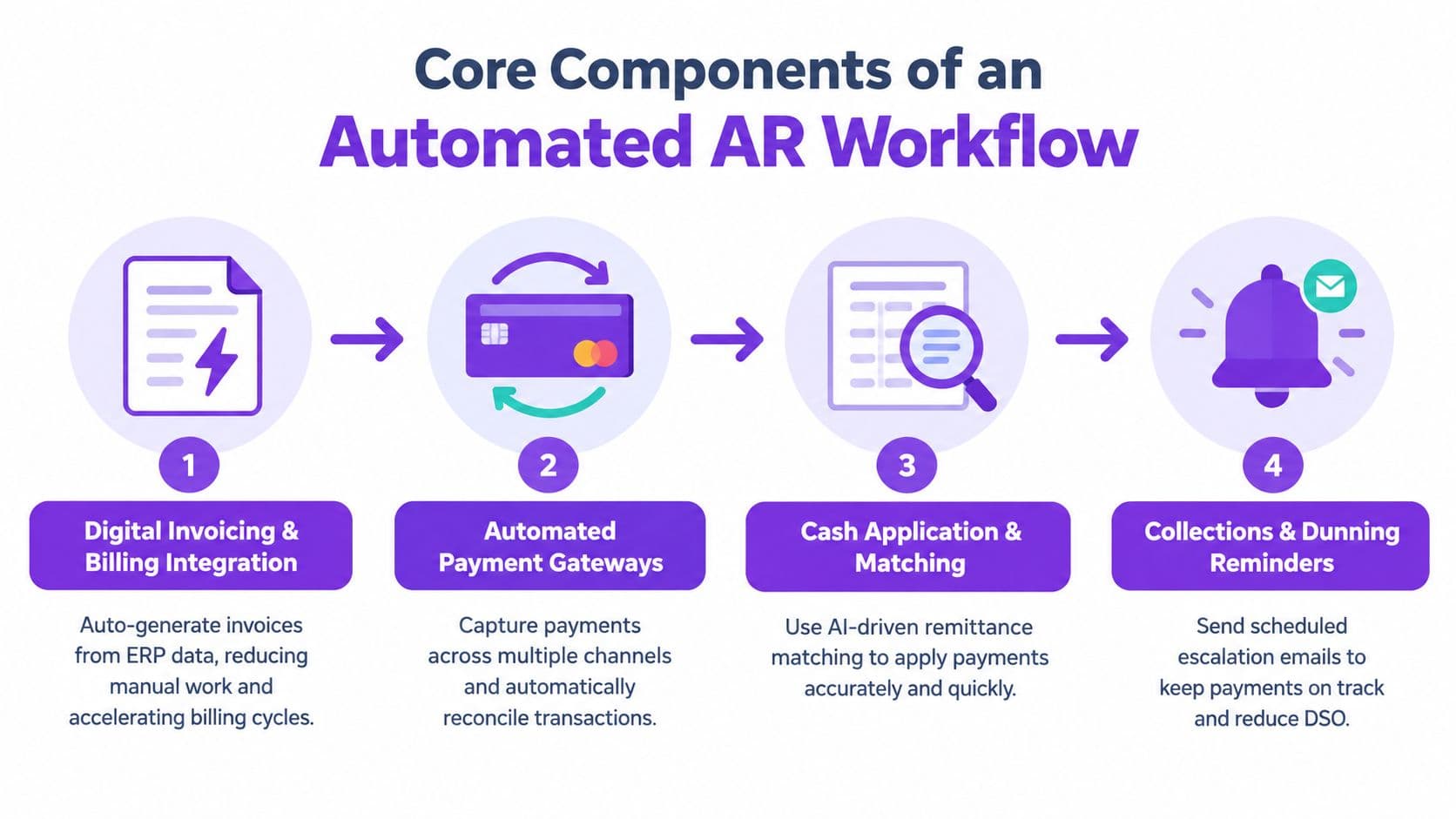
Digital invoicing and billing integration
The workflow starts with accurate billing data. A subscription platform, CRM, project system, or contract record should pass customer details, pricing, usage, tax treatment, payment terms, and invoice timing into the accounting system. QuickBooks, Xero, NetSuite, and Stripe can each sit within this broader flow, but the integration design determines whether the handoff is reliable.
For SaaS, that may mean generating invoices from subscription events or approved usage. For professional services, it may mean billing from signed milestones and approved time. The system should validate required fields before issuing the invoice, rather than allowing errors to reach the customer.
Automated payment gateways and customer portals
Customers need a straightforward way to review invoices, access statements, choose payment methods, and submit remittance information. Payment gateways capture the transaction, while the portal gives customers visibility without requiring your AR team to answer routine questions.
A payment link alone isn't enough. The transaction must return meaningful data to your accounting workflow, including customer identity, invoice references, payment status, and exceptions. That connection is why invoice processing automation should be evaluated as part of the full process, not as an isolated document task.
Cash application and matching
Cash application matches incoming payments against open receivables. A strong system uses invoice numbers, customer identifiers, amount patterns, remittance files, bank data, and historical matching rules. AI assistance can handle likely matches, while ambiguous or incomplete payments go to a review queue.
Many teams discover that “automation” doesn't mean every transaction disappears from human oversight. The right design makes exceptions visible and keeps routine payments moving without forcing staff to inspect every line.
Collections and dunning workflows
Collections automation creates a controlled cadence. It can issue reminders before an invoice is due, follow up after the due date, route high-risk accounts to an owner, and pause communication when a dispute is active. The finance leader sets the policy. The system applies it consistently.
When you evaluate a platform, ask to see the data path from invoice creation to bank reconciliation. If the vendor can't explain how QuickBooks, Xero, NetSuite, or Stripe data enters, updates, and exits the system, you're evaluating a notification tool rather than an operating workflow.
Calculating the Real ROI for Growing Businesses
The strongest ROI argument is working capital, not vague time savings. For a business with annual revenue of $5M, reducing DSO from 45 days to 39 days releases cash without a loan, equity raise, or pricing change. Those benchmark values appear in the 2026 Billtrust AR benchmark report.
The calculation is direct:
- Annual revenue: $5,000,000
- Revenue per day: $5,000,000 ÷ 365 = $13,698.63
- DSO reduction: 45 - 39 = 6 days
- Working capital released: $13,698.63 × 6 = $82,191.78
That means a six-day improvement frees approximately $82,192 from receivables. It doesn't create new revenue, but it moves money you already earned from customer balances into your bank account. You can use that cash to fund payroll, reduce reliance on a credit facility, support product investment, or increase operating resilience.
The same benchmark reports touchless payments rising to 92.35% alongside DSO moving from 45 to 39 days. It also cites automated invoice workflows reducing processing time from 17.4 days to 3.1 days, while error rates fall from roughly 2% in manual processing to under 1%. Those figures show why the payoff comes from two directions: faster collection and fewer defects that delay payment.
Manual versus automated AR impact
| Metric | Manual AR Baseline | Automated AR Outcome | Business Impact |
|---|---|---|---|
| Annual revenue | $5,000,000 | $5,000,000 | Same revenue base, better cash conversion |
| DSO | 45 days | 39 days | Approximately $82,192 released from receivables |
| Touchless payments | Manual review is common | 92.35% | Fewer routine payment applications |
| Invoice processing time | 17.4 days | 3.1 days | Faster movement from billing to collection |
| Processing error rate | Roughly 2% | Under 1% | Fewer corrections, disputes, and payment delays |
The business case becomes stronger when you include staff capacity. If your team currently spends hours downloading bank files, looking for remittance details, copying invoice numbers, and sending repetitive reminders, the system should reduce those touchpoints. Don't promise your board that automation eliminates the finance team. Promise that it directs human attention toward disputes, credit decisions, and high-value customer conversations.
For companies with complex workflows, accounts receivable outsourcing can also provide a useful comparison point. Calculate the cash released, the internal capacity recovered, and the cost of unresolved errors before selecting software or a managed service.
Implementation Red Flags and Common Misconceptions
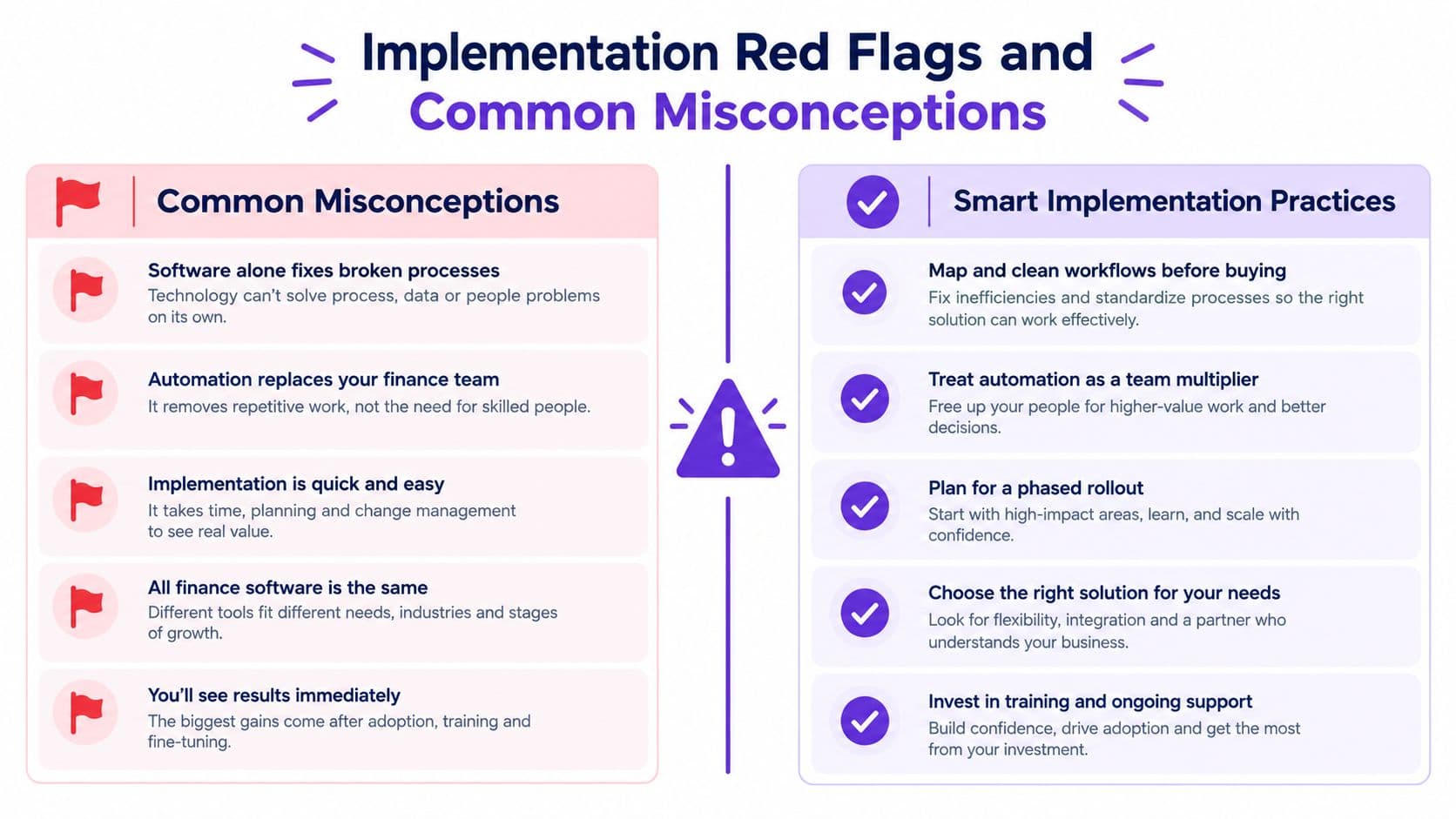
Buying an AR platform won't repair inconsistent contracts, incomplete customer records, or unreliable billing rules. It will process those problems faster and distribute them more consistently. That makes process readiness the first investment.
The evidence is clear. Organizations cite operational and process change as the largest barrier at 52%, ahead of cost at 45% and IT resource demands at 41%, according to Billtrust's ERP and AR transformation white paper. A separate 2026 industry study identified CRM and ERP integration as the top challenge at 55%, as reported in the same benchmark context. The software purchase is often easier than agreeing how your company bills, approves credits, handles disputes, and assigns collection ownership.
Red flags that should stop a rollout
- Inconsistent pricing: The same customer segment receives different rates, discounts, or renewal logic without documented rules.
- Unclear contract terms: Payment terms, billing dates, acceptance criteria, and renewal triggers aren't stored in a usable system.
- Weak CRM-to-ERP hygiene: Customer names, legal entities, billing contacts, and identifiers don't match across platforms.
- Unowned disputes: No one is accountable for resolving short payments, rejected invoices, or service objections.
- Spreadsheet dependency: The spreadsheet contains the only reliable record of collection status or promised payment dates.
A common objection is that automation will replace your finance team. That isn't the right operating model. Automation replaces repetitive data movement and scheduled follow-up. Your people still decide whether to extend terms, approve a credit memo, negotiate a dispute, or protect a strategic customer relationship.
Another misconception is that AI should come first. It shouldn't. AI cash application depends on clean invoices, consistent customer identifiers, and usable remittance data. If those inputs are unreliable, advanced matching creates confident-looking errors. Start with rules, clean data, and exception management, then add AI where the workflow has enough structure to support it.
Accounts payable automation belongs in the wider finance architecture, but don't confuse the two cycles. AP controls money leaving the business. AR controls money entering it. Integrating both improves cash planning, yet each process requires its own ownership, policies, and controls.
Your Phased Rollout Strategy for AR Automation
Roll out AR automation in phases. A controlled implementation protects current collections while giving your team time to validate data, train users, and correct workflow defects.
Phase 1, data cleanup and process standardization
Start with an audit of the chart of accounts, customer master data, open invoices, credit memos, payment terms, and dispute categories. Document how a contract becomes an invoice, how an invoice reaches the customer, how payments arrive, and who resolves exceptions.
Standardize payment terms by customer segment where commercial agreements allow it. Define the required fields for billing, establish ownership for approvals, and remove duplicate customer records. Don't configure software until these decisions exist in writing.
Phase 2, core integration and invoicing automation
Map every data handoff between your CRM, billing platform, payment processor, and accounting system. Confirm which system owns each field. Connect the core systems, then run a limited pilot using a controlled customer group or invoice type.
Your pilot should test invoice generation, delivery, payment capture, posting, credit memos, partial payments, failed payments, and dispute handling. Keep the old process available as a fallback until the new workflow reconciles cleanly.
Phase 3, advanced collections and AI cash application
Once billing and payment data flow reliably, introduce segmented dunning rules, collection queues, escalation paths, and AI-assisted matching. Route exceptions to named owners. Measure match quality, review volume, unresolved disputes, and customer complaints.
| Phase | Primary deliverable | Leadership checkpoint |
|---|---|---|
| Phase 1 | Clean data and documented workflows | Finance signs off on billing rules |
| Phase 2 | Tested integrations and pilot workflow | Controller approves reconciliation results |
| Phase 3 | Scaled collections and assisted matching | CFO reviews performance and control evidence |
Use this AR automation implementation video as a visual supplement while your team documents the current state and future workflow.
Don't measure success by whether the project went live. Measure whether invoices go out accurately, payments apply faster, exceptions have owners, and your cash forecast becomes more dependable.
Essential KPIs and Security Compliance Standards
A live AR platform needs an operating scorecard. Track the metrics that connect activity to cash, not just the number of reminders sent.
Days Sales Outstanding measures how long revenue remains uncollected. Use it with aging by customer segment, contract type, and payment method so you can identify where the delay starts.
Collection Effectiveness Index shows how much collectible receivables your team converts into cash during a period. A declining CEI can signal weak follow-up, unresolved disputes, credit problems, or inaccurate promise-to-pay tracking.
Bad debt ratio measures the portion of receivables that you don't expect to collect. Review it alongside credit approvals, dispute reasons, and customer concentration. Automation won't replace credit discipline.
Cost per invoice processed helps you assess whether the workflow is scaling efficiently. Include software, payment costs, internal review time, exception handling, and external support in the calculation.
Security belongs in the same conversation because AR platforms handle financial records and customer payment information. Ask vendors and implementation partners how they protect data, restrict access, log changes, manage vendors, and support audit requests.
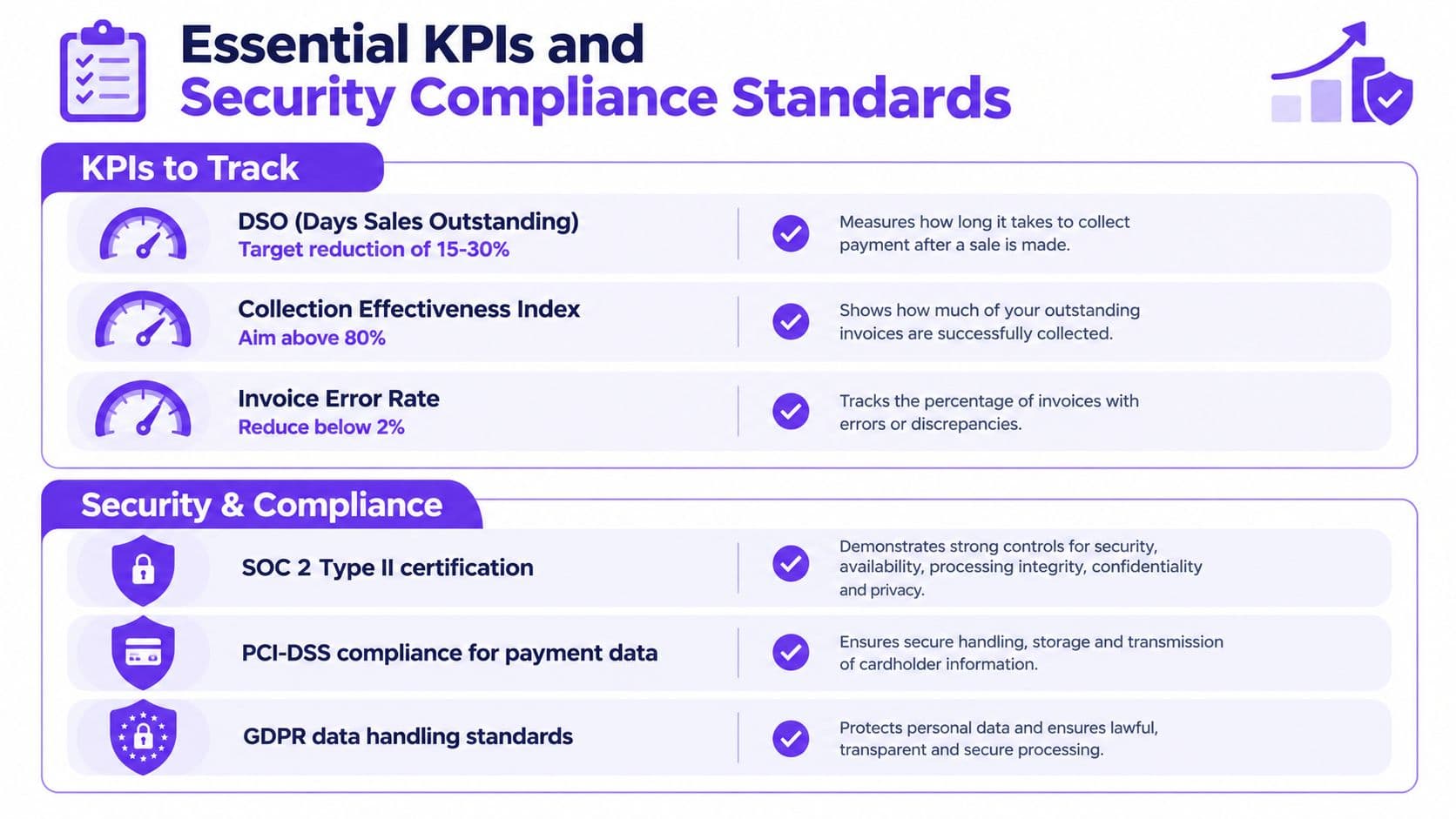
At minimum, require bank-level security practices, strict role-based access, encryption, backup controls, and audit trails. For a SaaS company preparing for fundraising or acquisition, SOC 2 Type II evidence matters because investors and buyers will examine how your systems protect financial and customer data. Review SOC 2 Type II compliance considerations as part of vendor diligence, not after implementation.
Control principle: Every automated action needs an owner, an approval rule, and a record of what happened.
Your system should also support segregation of duties. The person who configures billing rules shouldn't have unrestricted authority to approve credits and alter payment records. Automation improves control only when you design permissions deliberately.
Next Steps to Transform Your Cash Flow Operations
Start with an AR audit, not a software demo. Pull your aging report, list every billing and payment system, trace several invoices from contract to cash, and identify where human intervention delays collection. Then calculate your current DSO, error sources, unresolved dispute volume, and cost per invoice processed.
Next, create a one-page target operating model:
- Define ownership: Assign responsibility for billing, collections, cash application, disputes, approvals, and reporting.
- Standardize terms: Document payment terms, invoice timing, acceptance requirements, and escalation rules by customer segment.
- Clean the data: Reconcile customer records and identifiers across CRM, billing, payment, and accounting systems.
- Select the workflow: Choose the smallest automation scope that addresses your largest cash bottleneck.
- Build the business case: Use your revenue base and DSO improvement scenario to quantify working capital impact.
For SaaS, agencies, and professional services firms between $500K and $20M in revenue, Jumpstart Partners provides outsourced controller and bookkeeping support, AR and AP workflow setup, and integrations with QuickBooks, Xero, NetSuite, and Stripe. Its US-based, CPA-certified team supports a five-day month-end close, ASC 606 workflows, investor-ready reporting, and cash flow visibility.
You don't need to automate every finance process at once. You do need a reliable baseline, clean handoffs, clear controls, and a rollout owner who can keep billing and collections running during the transition. Treat AR automation as an operating model redesign, and the technology becomes easier to evaluate.
Jumpstart Partners can audit your current AR workflow, clean the underlying finance data, and design an automation roadmap around QuickBooks, Xero, NetSuite, or Stripe. Visit Jumpstart Partners to book a consultation and turn your receivables process into a controlled, cash-focused operation.