Financial Operations
Accounts Receivable Outsourcing: The 2026 Founder Playbook
Accounts receivable outsourcing explained for $500K-$20M founders. ROI math, vendor checklists, SOC 2 must-haves, and a 90-day implementation plan.
ByJumpstart Partners, CPA, QuickBooks ProAdvisor
··15 min readYou're staring at a clean P&L and a messy bank balance. Revenue is coming in, sales keeps selling, and yet cash feels tighter than it should because invoices sit unpaid while your team keeps pretending collections is “fine.” That's the core problem with accounts receivable outsourcing. It isn't about offloading annoying admin, it's about fixing a cash-conversion bottleneck that's limiting growth.
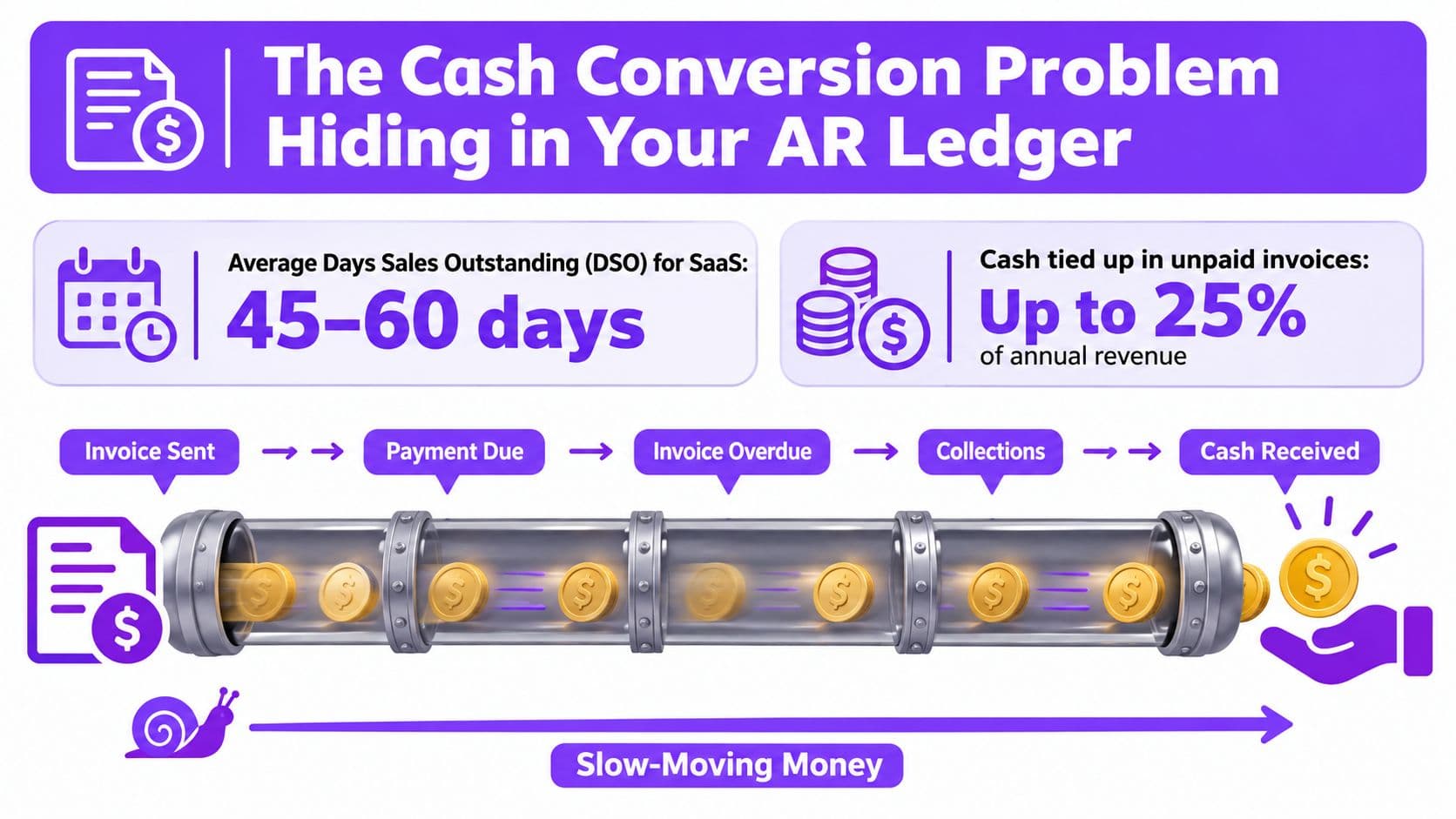
The right test is simple. If AR is slowing cash, forcing you to lean on credit, or pulling your best finance people into endless follow-up work, it's a finance problem, not a bookkeeping task. If you want a quick primer on the mechanics behind the bottleneck, start with this guide on improve tour cash flow automation, then come back and look at your own ledger with colder eyes.
For founders who want the operational version of this, pull your accounts receivable aging report and look at where the money is sitting. If your oldest balances keep growing, the issue isn't “more reminders.” It's a broken collections system.
Table of Contents
- The Cash Conversion Problem Hiding in Your AR Ledger
- What Accounts Receivable Outsourcing Actually Is
- The ROI of Accounts Receivable Outsourcing in Real Numbers
- In-House AR vs Outsourced AR by Stage of Growth
- The Vendor Evaluation Checklist Founders Actually Use
- Red Flags and Brand Risk Most AR Guides Skip
- Implementation Roadmap for a SaaS or Agency
- Your Decision Framework and Next Step This Week
The Cash Conversion Problem Hiding in Your AR Ledger
A lot of SaaS and agency founders treat AR like a nuisance because the business is still growing. That's exactly how the problem gets worse. Sales can be strong, but if invoices aren't converting to cash, growth starts funding itself with stress instead of operating cash.
The market is already telling you this is a real operating category, not a back-office side task. The global accounts receivable outsourcing service market was estimated at USD 3,049.12 million in 2024 and is projected to grow at 8.50% CAGR during the forecast period, which shows this work has become a sizable, expanding service line inside finance and accounting outsourcing (market estimate). Broader finance-and-accounting outsourcing data also puts the market at $58.4 billion in 2025 and $78.9 billion by 2029, with accounts payable and receivable cited as the largest segment at 28% share (broader market estimate).
Why the pain shows up in operations first
The controller sees it in aging. The CEO feels it in runway. The founder feels it when payroll, vendor payments, and tax reserves all compete with receivables that should've converted weeks ago. Late cash doesn't just slow hiring, it raises the cost of every decision you make.
Practical rule: if AR is delaying payroll planning, spend less time debating process and more time fixing collections discipline.
The operational reality is simple. Professional AR management is reported to reduce DSO by 20–30% within the first few months (AR outsourcing guide). That matters because DSO is a cash tie-up metric, not an accounting curiosity. If cash keeps sitting in aged invoices, the business is effectively financing customers.
What Accounts Receivable Outsourcing Actually Is
Accounts receivable outsourcing is the handoff of the full invoice-to-cash workflow to a specialist team that works inside your accounting stack. It acts as a fractional controller for billing, except the focus is not only reporting, it's getting money in the door with less drag and fewer missed follow-ups.
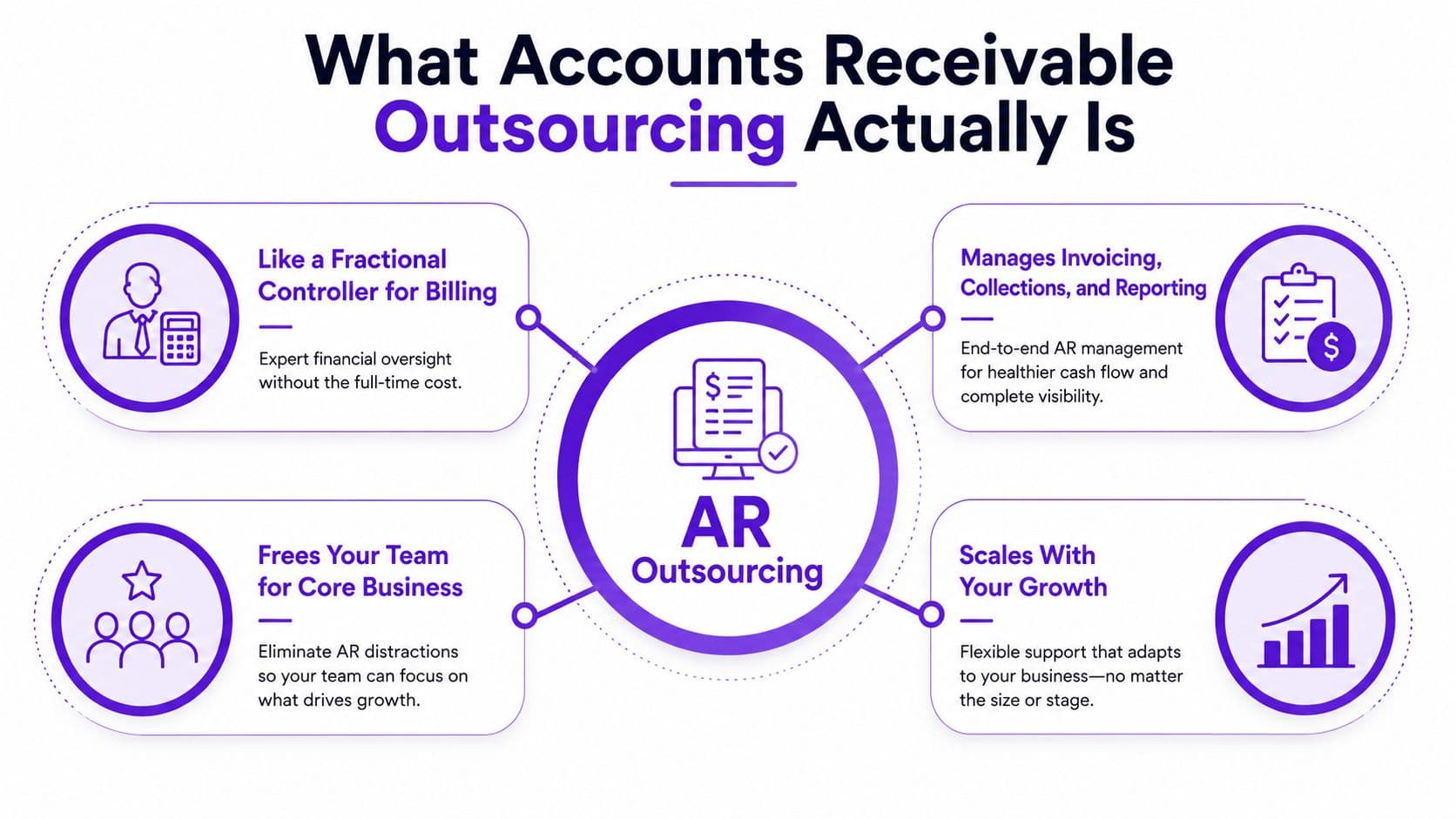
The provider usually handles invoice generation, payment follow-up, cash application, dispute resolution, and reporting. That's the difference between a collection agency and a real AR partner. A collection agency often shows up late, after the account is already ugly. A proper AR outsourcing team keeps the workflow moving before the account turns into a write-off problem.
If you want a tighter framing for board conversations, use this: you are not buying “someone to chase invoices.” You are buying process control around the money lifecycle. That means the provider should sit on top of your existing systems, not force you into a disconnected side channel. For a broader view of the service model, this overview of finance and accounts outsourcing is useful context.
What stays in-house
You should still own policy, approvals, customer escalation rules, and credit decisions for strategic accounts. The outsourced team executes the cadence, logs the work, and keeps the ledger moving. Your job is governance, not call-chasing.
AR outsourcing works when the vendor operates like a disciplined extension of finance, not like a separate collection shop with its own habits.
That distinction matters. A lazy vendor can send reminders. A serious one can manage aging buckets, route disputes, and keep reporting tight enough that you know exactly what's stuck and why.
The ROI of Accounts Receivable Outsourcing in Real Numbers
Stop treating AR outsourcing like a vague efficiency play. If AR is slowing cash, the ROI shows up fast. If AR is merely annoying, outsourcing usually just adds another vendor bill and another handoff.
The cleanest test is cash conversion. A technically important benchmark in AR outsourcing is the 20–30% reduction in DSO companies typically see within the first few months (neowork guide). Since DSO measures how long cash sits trapped after a sale, even a small improvement changes working capital in a way founders can feel in payroll, hiring, and credit usage.
At $10 million in annual revenue, every extra day of DSO traps about $27,400 in receivables, so a 10-day improvement frees roughly $274,000 in cash (same guide). That is real money, not a spreadsheet fantasy. If your AR team is letting cash sit because follow-up is inconsistent, that trapped balance is costing you more than the vendor fee ever will.
The cost side is plain too. Outsourced AR for a small-to-mid-sized business typically costs $12,000–$30,000 per year, with pricing sometimes structured at $3–$8 per invoice or a 10–25% share of collected amounts for collection-focused work. For a more detailed breakdown of outsourced accounting service pricing, see a detailed breakdown of outsourced accounting service pricing (pricing benchmark). If the vendor is reducing DSO and tightening follow-up, those fees are usually easy to defend. If they are just sending polite reminders, the math turns ugly fast.
In-House vs Outsourced AR at $10M Revenue
| Metric | In-House AR | Outsourced AR |
|---|---|---|
| Cash conversion speed | Slower follow-up, more variance | More disciplined follow-up and escalation |
| DSO impact | Often flat if the team is overloaded | 20–30% reduction in the first few months (neowork guide) |
| Direct cash recovered | Depends on internal bandwidth | Better focus on aging buckets and disputes |
| Typical annual cost | Salaried time plus tools | $12,000–$30,000 annually, or usage-based pricing (pricing benchmark) |
| Working-capital effect | Cash stays trapped longer | Faster conversion and lower financing pressure |
The comparison is not headcount versus vendor spend. It is trapped cash versus released cash. A strong outsourced team keeps aging buckets moving, pushes disputed invoices to resolution faster, and forces escalation before receivables turn stale. A weak internal process usually does none of that well because AR gets squeezed between billing questions, month-end close, and whatever else landed on the finance desk that week.
A second lens matters even more. Sage, citing Atradius and U.S. Census Bureau data, says 39% of invoices are paid late in the U.S., average DSO is 67 days against typical 28-day credit terms, and 26% of receivables become uncollectible after 90 days, 70% after 180 days, and 90% after one year (Sage AR management article). At a $10M business, Sage's example says writing off 4% of accounts receivable equals $400,000 in annual loss (same source). That is why AR is not clerical work. It is a cash-control function, and bad AR discipline shows up directly in the P&L and the bank balance.
In-House AR vs Outsourced AR by Stage of Growth
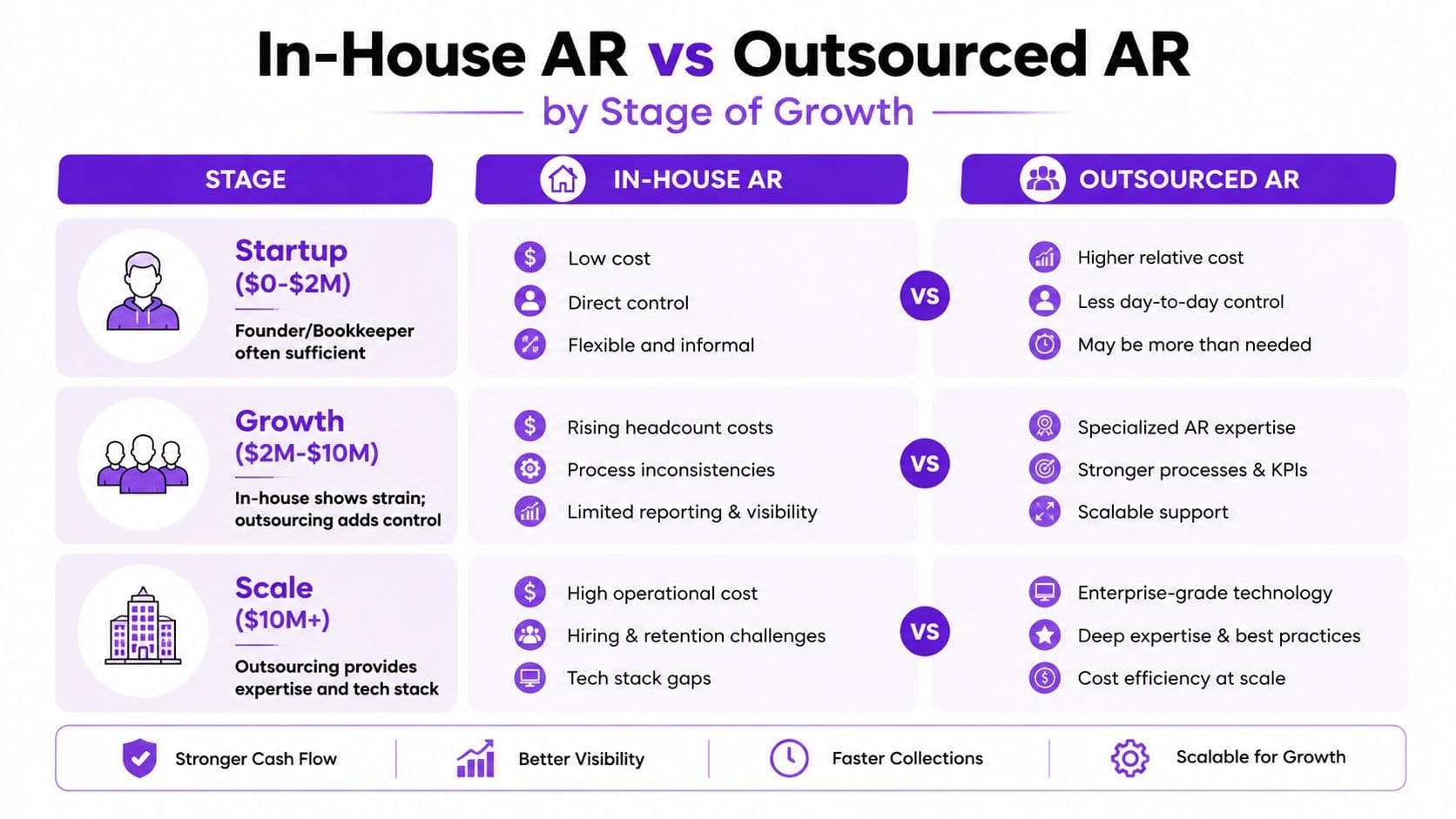
The right model changes with scale. Early on, personal relationships cover a lot of operational weakness. Later, growth punishes inconsistency, and collections become a system problem.
Stage-by-stage call
| Revenue stage | What usually works | My recommendation |
|---|---|---|
| Startup, $0–$2M | Founder or bookkeeper manages AR directly | Keep it in-house unless invoices are already slipping |
| Growth, $2M–$10M | Internal AR starts to strain under volume | Use a hybrid model, with tighter process and outside help where needed |
| Scale, $10M+ | Too much volume, too much aging, too much controller burnout | Move to full-cycle outsourced AR with controller oversight |
For a startup, the point is speed and personal attention. You don't need a complex AR operation if you have a small invoice count and the founder still knows every customer by name. The risk here is overengineering.
Between $2M and $10M, the weak point is usually consistency. Someone is doing AR, but they're also handling billing questions, month-end support, and random fire drills. That's where late nights start, and where collections become whatever time is left over.
At $10M+, stop pretending this is a side duty. Your controller should not be living inside follow-up emails. For a practical comparison of finance roles, this breakdown of bookkeeper vs controller is worth a read before you decide who owns what.
If you're spending more time sorting collections than reviewing cash strategy, your AR process is too small for your revenue.
The rule is blunt. If collections are consuming executive attention, outsource. If they're still light, keep them close and tighten the process first.
The Vendor Evaluation Checklist Founders Actually Use
A weak vendor will promise “visibility” and deliver email reminders with a dashboard. That's not enough. You need a provider that can operate inside your systems, protect customer relationships, and explain exactly how cash moves from invoice to bank.
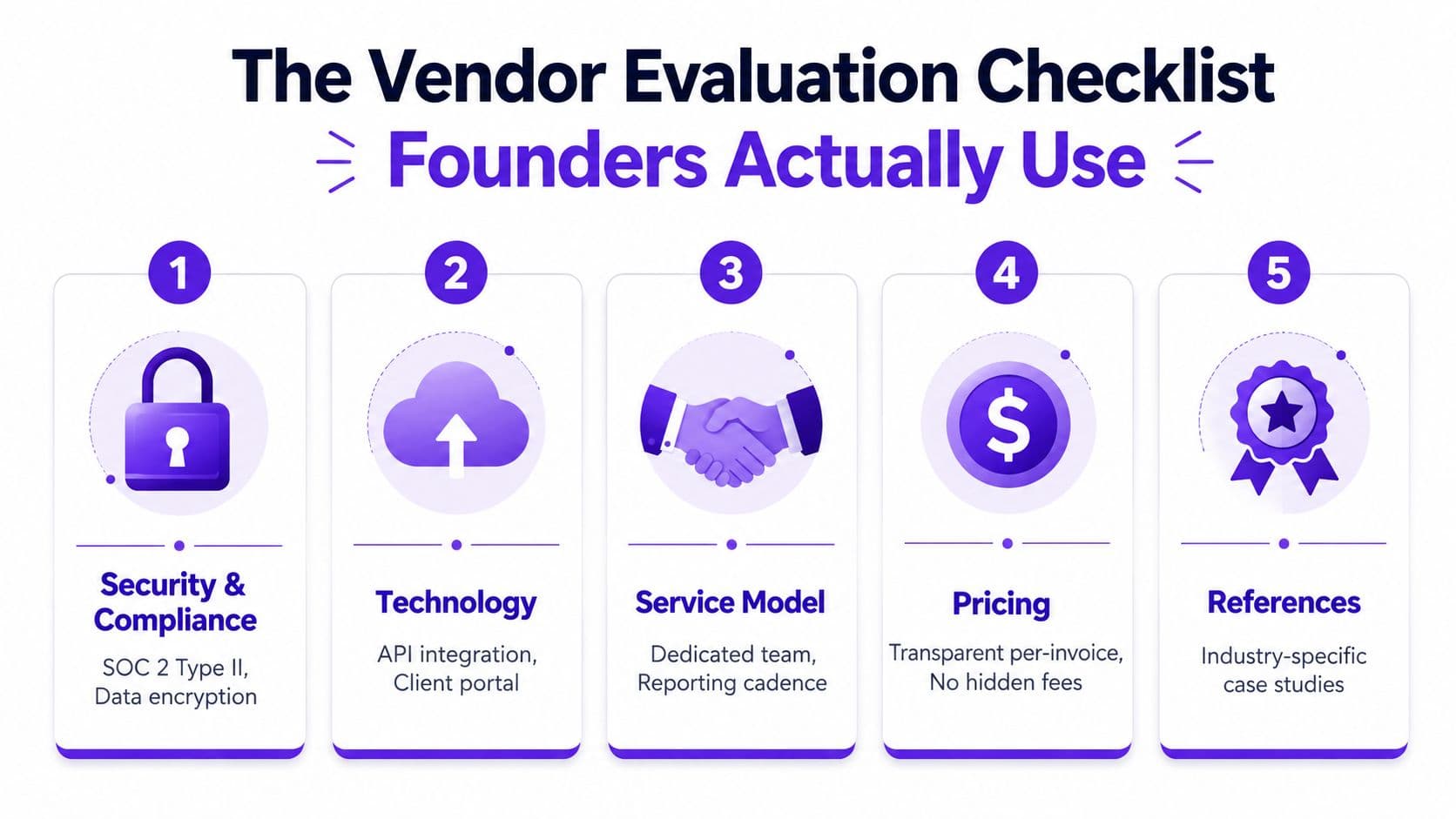
1. Security and compliance
Ask for SOC 2 Type II evidence, data-handling procedures, and a clear answer on who touches customer information. If the team is offshore, you need to know how access is restricted and how audit logs are maintained. For a deeper look at the control side, this note on data security compliance is the right companion piece.
2. Integrations
The vendor should connect cleanly to QuickBooks, Xero, NetSuite, Stripe, and Shopify where relevant. Ask whether the connection is via API, SFTP, or direct sync, because that changes how quickly data moves and how ugly reconciliations get later. If the vendor can't explain the plumbing, they're not ready.
3. Pricing model
Per-invoice pricing is easier to forecast. Percentage-of-collections pricing can push the vendor toward harder outreach, which is fine only if that's what you want. Monthly retainer pricing gives predictability, but you need explicit service scope so it doesn't become a vague catch-all.
4. Reporting
Demand real-time dashboards, aging reports, and Collection Effectiveness Index (CEI) reporting. CEI matters because it tells you how much collectible AR was recovered over a period. DSO alone won't tell you whether the team is improving collections discipline or just benefiting from cleaner billing.
5. Contract terms
Get SLAs in writing. Include escalation rules, termination rights, audit access, and complaint handling. If the contract doesn't protect your right to intervene on strategic accounts, the vendor has too much freedom.
Vendor question to ask out loud: “Show me the exact workflow for a disputed invoice, from first notice to final resolution.”
That one question reveals more than a polished sales deck. A serious AR partner can answer it step by step. A weak one talks in generalities.
Red Flags and Brand Risk Most AR Guides Skip
Faster collections are useless if the vendor burns a customer you want to keep. Most guides talk about DSO and stop there. That's lazy. AR touches renewals, trust, and the tone of every financial conversation you have with a buyer.
The first red flag is aggressive outreach without brand rules. If the vendor uses hard scripts, vague threats, or repetitive calls without escalation logic, your customers will notice. That matters most with strategic accounts, where one sloppy interaction can damage a renewal or trigger an unnecessary dispute.
The second red flag is a missing dispute protocol. A good AR team doesn't just “follow up.” It should log the issue, gather evidence, route it internally, and pause collections when the invoice is disputed. Without that structure, your team will keep chasing invoices that should've been paused three calls ago.
The third red flag is opaque complaint reporting. If a vendor can't tell you which accounts are frustrated, which invoices are disputed, and which contacts need a softer approach, you're not getting control. You're getting noise.
Practical rule: any vendor that won't let you set tone guidelines by account tier is a vendor you shouldn't sign.
The cleanest model is simple. Require written escalation rules for strategic accounts, mandate evidence before any collection call after a dispute, and ask for audit-ready activity logs. If the vendor can't behave professionally under those rules, they're not a partner, they're a liability.
Implementation Roadmap for a SaaS or Agency
A good rollout doesn't start with a contract. It starts with clean data and a hard look at the backlog. I'd use a 30-60-90 day plan, because anything slower drifts into status meetings and excuses.
Days 1 to 30
Clean the AR ledger, sort open invoices by aging bucket, and identify the customers that matter to retention. Then choose the operating stack, whether that's QuickBooks, Xero, or NetSuite, and map how invoices, reminders, and cash application will move.
Days 31 to 60
Run a pilot on one customer segment or one aging bucket. Baseline CEI, DSO, and AR turnover before the vendor touches anything meaningful. At this stage, you also calibrate tone. The provider should know which customers need a softer hand and which accounts require firmer escalation.
Days 61 to 90
Expand scope only after the pilot proves clean. Lock the reporting cadence, set the monthly AR review meeting, and decide which escalations stay with the founder or controller. The founder should not be involved in routine chasing once the system is stable.
For a concrete example, think of a $6M ARR SaaS company moving from Xero to a NetSuite-backed outsourced AR workflow. The wrong move is trying to outsource everything before integrations are tested. The right move is to confirm SOC 2 Type II evidence, validate whether data exchange happens through API or SFTP, and insist on real-time reporting if the team needs live cash visibility.
Jumpstart Partners fits this model as one option among others for founders who want outsourced controller and bookkeeping support that includes AR as part of the finance stack. That only works if the AR workflow is treated as part of the close, reporting, and cash process, not as a disconnected collection function.
Your Decision Framework and Next Step This Week
Use a hard test. If DSO is over 50 days, write-offs exceed 2% of revenue, or your controller spends more than 10 hours a week on collections, accounts receivable outsourcing should be on the table now. If none of those are true, keep AR in-house and clean up the process before you add another vendor.
Do three things this week. Pull the aging report, benchmark your current DSO against what your team can realistically improve, and book two vendor demos with SOC 2 Type II evidence in hand. If a vendor can't answer direct questions about workflow, escalation, and reporting, they're not serious enough for your books.
The best decision is the one tied to cash, not comfort. When AR is hurting liquidity, outsource it. When it's just annoying, fix the process first.
If you want a finance partner that can tighten the close, improve cash visibility, and help you decide whether AR belongs in-house or in a managed workflow, visit Jumpstart Partners. Their outsourced controller and bookkeeping services are built for growing SaaS, agency, and professional services businesses that need cleaner numbers and faster cash decisions.