Financial Operations
Outsourced Accounting Services Pricing Guide for Founders
Discover outsourced accounting services pricing for SaaS, agencies, and e-commerce. Learn pricing models, benchmarks, ROI calculations, and negotiation tips.
ByJumpstart Partners, CPA, QuickBooks ProAdvisor
··15 min readA founder who budgets $3,000 a month for outsourced accounting and ends up closer to $7,500 has already learned the hard lesson: pricing isn't the whole story, scope is. The bill jumps when the provider starts charging for extra close work, cleanup, and controller support that the original proposal never spelled out. That gap is exactly why outsourced accounting services pricing deserves the same discipline you'd apply to payroll, sales compensation, or your cloud stack.
For a business at $500K to $20M in revenue, accounting spend is a control lever, not a nuisance line item. The right plan keeps your books clean, your close predictable, and your board or investors confident. The wrong one turns finance into a recurring fire drill.
Table of Contents
- Why Pricing Strategy Matters
- Understanding Pricing Models
- Benchmark Pricing by Revenue and Business Type
- Identifying Cost Drivers and Calculating ROI
- Choosing the Right Plan for Your Company
- Sample Pricing Scenarios and Negotiation Tips
- Contract Considerations and Warning Signs
- Next Steps and Call to Action
Why Pricing Strategy Matters
A cheap retainer is expensive the moment your provider starts billing every exception. That's what happens when founders buy accounting like it's a utility and not an operating system. The initial number looks manageable, then the hidden cleanup, close support, and controller work show up, and cash flow tightens fast.
You should treat accounting pricing as a business design decision. The right structure protects margin, speeds month-end close, and gives you reliable numbers for fundraising, tax planning, and hiring. The wrong structure creates stale reports and surprise invoices, which is exactly how finance teams lose credibility with the CEO and the board.
Practical rule: if the proposal doesn't spell out what happens when transaction volume rises, assume your invoice will rise too.
The most important shift is this, stop asking only what the monthly fee is, and ask what level of finance capacity it buys you. A bookkeeping-only engagement solves a different problem from controller oversight, and the market prices those differently. If you need a broad overview of cost categories before you compare vendors, this cost of accounting guide is a useful reference point.
Founders often delay this decision because accounting feels like back office work. It isn't. Your close quality affects investor confidence, your forecast quality affects hiring, and your tax posture affects how much cash stays in the business. When pricing is handled badly, you don't just overpay, you also make worse decisions with worse data.
Understanding Pricing Models
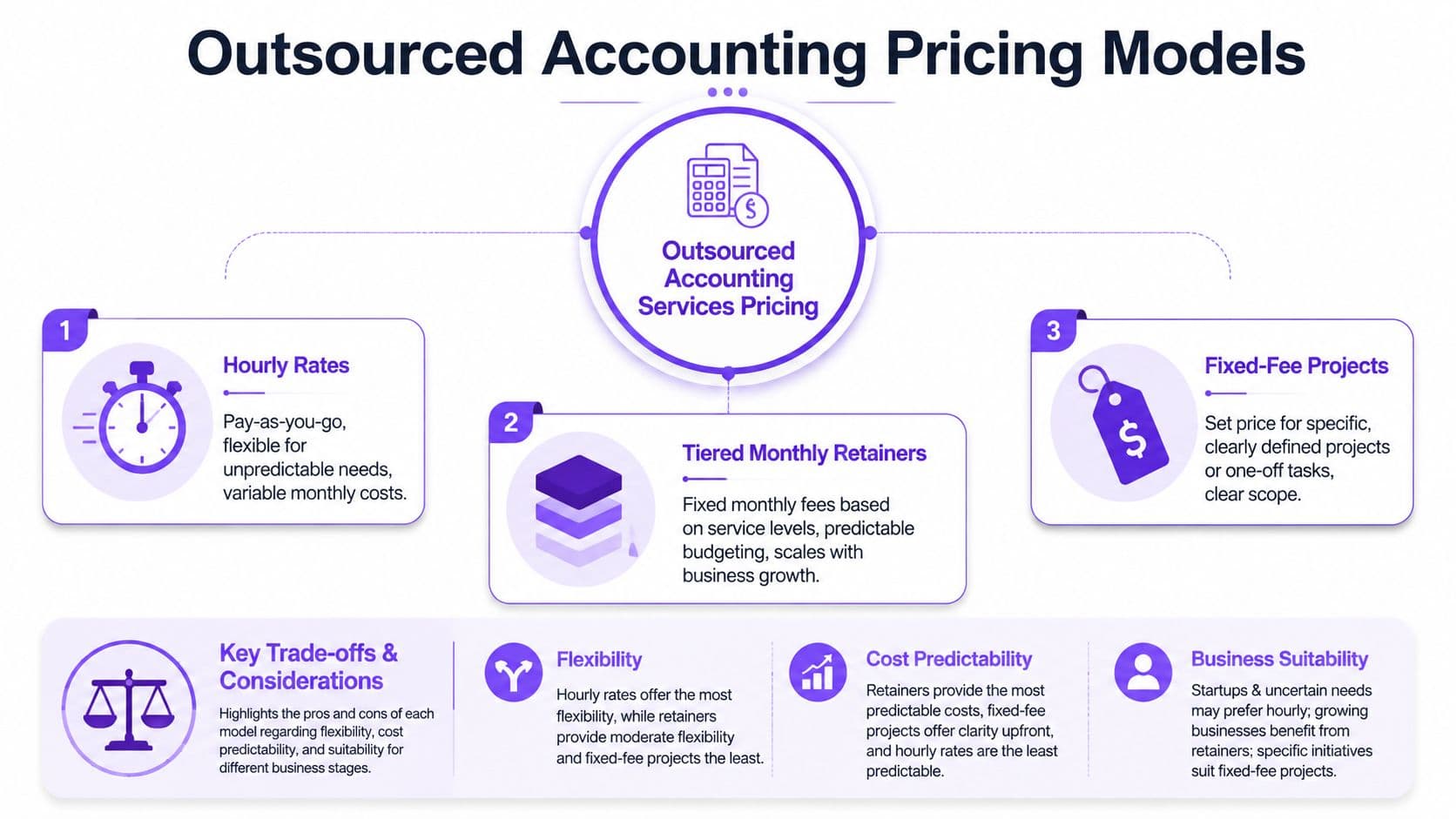
Hourly, retainer, and fixed-fee are not interchangeable. They transfer risk differently, which is why the cheapest-looking option is often the worst fit for a growing company. A $5M SaaS business with recurring close work has a very different pricing need from a founder who just needs a one-time cleanup.
Hourly rates
Hourly billing is flexible, but it puts cost control on you. Wiss reports hourly outsourced accounting rates of $75 to $250 per hour and notes that at $150 per hour, just 20 hours of work costs $3,000 Wiss cost of outsourcing accounting services. That's why hourly pricing works best for short bursts, unusual issues, or work where the scope is completely unknown.
For a $2M digital agency, hourly pricing becomes dangerous if monthly close tasks expand. At $150 per hour, 35 hours is $5,250, before you add cleanup, AP support, or payroll coordination. If your workload changes month to month, the invoice will change too.
Monthly retainers
Monthly retainers give you budget certainty. Independent 2026 cost guides place standard bookkeeping retainer work at $500 to $1,500 per month, full outsourced accounting with AP, AR, and payroll coordination at $1,500 to $3,500 per month, and controller-level support with CFO oversight at $3,500 to $7,500 per month SdoCPA outsourced accounting cost. This is the model I recommend for most founders, because it aligns cost with ongoing capacity.
For a $5M SaaS business, a retainer usually makes more sense than pure hourly billing because you need recurring close, revenue review, and reporting discipline. If the provider also handles global vendors or cross-border payments, benchmark the finance stack against the broader Cost of global payment solutions so you don't underbudget the operational layer around accounting.
Fixed-fee projects
Fixed-fee projects work for cleanup, migrations, and clearly defined deliverables. They cap risk on both sides, but they're a bad fit for open-ended advisory or close support. A $10,000 cleanup project makes sense when the books are messy and the scope is finite. It does not make sense as the only structure for a company that needs monthly reporting discipline.
The right model depends on whether you're buying a task or buying capacity.
If you want predictability and you're still growing, use a retainer for ongoing work and a fixed fee for exceptions. That combination is cleaner than trying to force everything into hours.
Benchmark Pricing by Revenue and Business Type
The market prices accounting by complexity, not by what founders hope to pay. A business at $900K in revenue and a business at $9M do not belong in the same pricing band, even if both say they “just need bookkeeping.” Revenue usually tracks transaction volume, entity count, payroll load, and reporting expectations, so the fee moves up for a clear reason.
Typical monthly fees by revenue band
| Revenue Band | Monthly Fee Range | Service Scope |
|---|---|---|
| Under $1M | $500 to $1,500 | Basic bookkeeping and light support |
| $1M to $3M | $1,500 to $3,000 | Bookkeeping plus growing operational support |
| $5M to $10M | $4,000 to $8,000 | Full accounting plus controller oversight |
| $10M to $25M | $7,000 to $15,000 | Complete outsourced finance office |
| $25M to $50M | $12,000 to $25,000 | Larger outsourced finance office with deeper reporting |
Those ranges line up with a 2026 benchmark that ties pricing to revenue and complexity Eagle Rock CFO outsourced accounting report 2026. The same pattern also shows up in transaction-based pricing. Basic engagements sit at $2,000 to $3,500 per month under 100 transactions, moderate work sits at $3,500 to $5,500 for 100 to 300 transactions, and complex controller-level work reaches $5,500 to $8,000+ for 300+ transactions. That is the pricing logic GetExact outsourced accounting firm guide points to, and it matches what founders see when volume starts pushing bookkeeping into finance work.
For a $3M SaaS business, I would expect the quote to land in the lower-to-middle band because the business needs monthly close and revenue discipline, but not a full finance department. For a $10M e-commerce business, the bill usually lands higher because inventory, returns, and merchant settlement all add reconciliation work. A company at that size asking for a $1,500 retainer is buying the wrong scope.
Revenue also hides business-model complexity. A SaaS company with clean subscriptions can look simpler than a lower-revenue e-commerce brand with messy payouts, while a services firm may need less transaction work but more project-level reporting and collections follow-up. That is why founders should compare quotes by operating model, not only by top line.
If you are comparing options for a smaller business and want a benchmark outside your own quote stack, this accountant for small business cost resource helps anchor what is normal at lower revenue bands.
My recommendation: reject any proposal that ignores revenue band, transaction count, and reporting scope. Those are the pricing inputs that matter.
Identifying Cost Drivers and Calculating ROI
The monthly fee is a result, not a starting point. Providers charge more when your books demand more labor, more judgment, or more senior review. That's why transaction volume, entity count, payroll complexity, revenue recognition, and reporting expectations all push the price upward.

What actually drives the fee
A provider spends more time reconciling when your transaction count rises. A second legal entity means separate books and consolidation work. Multi-state payroll brings tax and compliance wrinkles, and SaaS revenue recognition adds technical accounting work that basic bookkeeping never covers.
The clean way to think about pricing is to compare the cost of the outsourced team against the cost of bad internal process. Basis365 puts a practical benchmark at 1% to 3% of revenue for outsourced accounting, with lighter bookkeeping near 1% and controller-level scope moving toward 3% Basis365 cost to outsource accounting and bookkeeping. That frame is useful because it forces you to ask whether you need transactional support or finance leadership.
A worked ROI example
Use real money, not vague efficiency language. If you pay $6,000 per month, your annual cost is $72,000. Now assume the provider catches $47K in errors, and your management team gets back 40 hours a month that would otherwise go to finance firefighting.
If those 40 hours are spent on sales, delivery, or fundraising prep, the value climbs quickly. Add a tighter close, fewer missed issues, and better board reporting, and the payback becomes obvious. The math is simple, the decision is strategic.
Bottom line: don't buy accounting on price alone. Buy it on error reduction, decision speed, and leadership time recovered.
If you need a framework for linking accounting spend to close quality and finance output, use the controller services ROI analysis as your internal model. You want an outsourced team that reduces chaos, not one that merely processes transactions.
Choosing the Right Plan for Your Company
Start with the work you need done. If you only need bookkeeping, don't pay for controller oversight. If you need investor-ready reporting, don't pretend a basic ledger service will save money. The cheapest plan is expensive when it forces your team to clean up gaps every month.
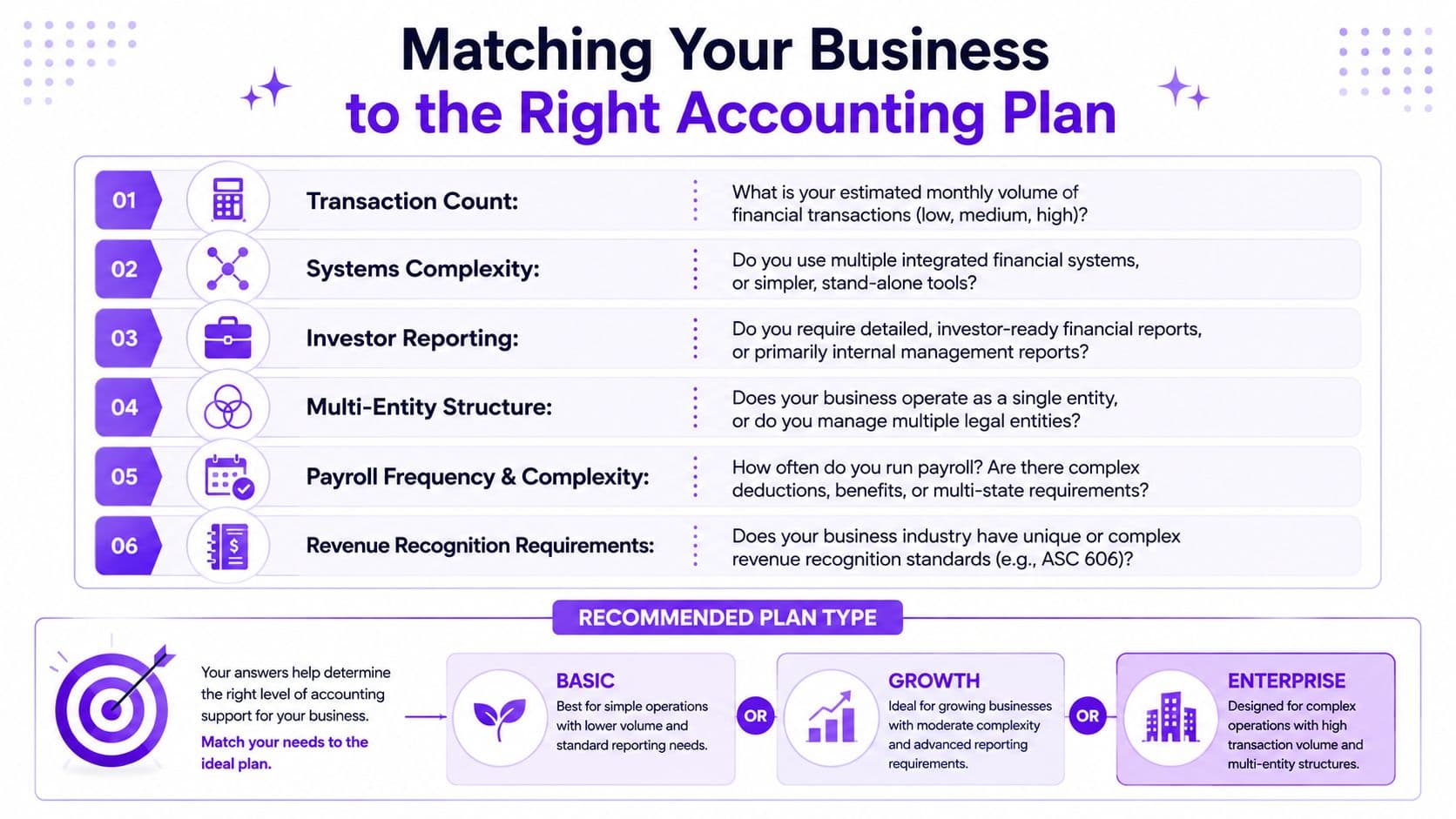
The six questions that decide the tier
Use these questions to sort your needs before you compare quotes:
- Transaction count. Low volume belongs in a basic plan. High volume belongs in a growth or enterprise tier.
- Systems complexity. One clean stack is easier to support than multiple integrated tools.
- Investor reporting. If you need board packs or fundraising support, basic bookkeeping is not enough.
- Multi-entity structure. More entities mean more reconciliation, more controls, and more review time.
- Payroll frequency and complexity. More runs, more exceptions, and more coordination.
- Revenue recognition requirements. SaaS and other technical models need more than cash-basis bookkeeping.
How I'd map the plan
A solo founder with simple books belongs in a basic tier. A growing SaaS business with monthly close, invoices, and board reporting belongs in a growth tier. A multi-entity company with investors, payroll complexity, and technical accounting belongs in enterprise support.
GetExact says companies in the $5M to $20M revenue range with multiple entities or locations and investor reporting requirements typically pay $3,000 to $8,000 per month for controller-level outsourced accounting GetExact outsourced accounting services cost. That's the right benchmark for companies that have outgrown bookkeeping-only support.
If you're deciding whether you need a bookkeeper or a controller, this bookkeeper vs controller guide makes the difference clear without wasting your time. The right move is usually to buy enough finance leadership to keep the books useful, not just current.
Recommendation: choose the lowest tier that still gives you clean close, accurate reporting, and a predictable month-end process.
Sample Pricing Scenarios and Negotiation Tips
A founder who understands pricing can negotiate from strength. A founder who only asks for the monthly fee gets whatever package the provider wants to sell. The gap becomes obvious once the engagement begins.
Three common scenarios
A $1.2M agency with under 100 transactions should expect a basic engagement in the $2,000 to $3,500 per month range, which lines up with the lower end of transaction-based pricing noted earlier. If a quote lands above that, ask what extra work is included. If it lands below that, ask what is missing.
A $4M SaaS startup needs more than simple bookkeeping once monthly close, invoices, and investor reporting enter the picture. Push for a growth plan with controller review, because SaaS revenue recognition and reporting discipline add complexity that a basic retainer will not handle cleanly.
An $8M e-commerce brand should expect controller-level pricing if it runs multiple channels, carries inventory, and has settlement reconciliation work every month. That company should negotiate a hard cap on add-on work, especially for monthly close, merchant account cleanup, and any extra reconciliation tied to payment processors.
The right pricing model depends on revenue band and business model. A service firm with straightforward billing can stay lean longer than a software company or an inventory-heavy operator. If your provider prices every exception separately, the monthly bill will drift fast.
How to negotiate without wasting time
- Anchor on scope, not vanity discounts. Ask what is included in close, reporting, payroll, and AP.
- Push for price caps on exceptions. If cleanup, extra entities, or new reporting packages are outside scope, define the ceiling in writing.
- Ask for tier migration rules. You want to know exactly when you move from one plan to the next.
- Use competing bids to test assumptions. If one provider's quote is far above the others, ask which deliverables justify the premium.
- Lock the retainer before growth ramps. Pricing is easier to hold steady before transaction volume jumps.
“If a vendor won't define scope, they're giving themselves permission to bill you later.”
One practical example: a $150 per hour provider that bills 25 hours a month already lands at $3,750. If the same work can be structured into a retainer near that level, you cut budget volatility and keep the scope under control. You also get a better shot at steady service because the provider is not constantly re-scoping the job.
For a clearer breakdown of service scope and outsourcing structure, the finance and accounts outsourcing guide is a useful follow-up. If you want to pressure-test the proposal before you sign, compare the deliverables line by line with protecting your startup with contracts.
Contract Considerations and Warning Signs
A clean proposal can still hide a bad contract. Founders get hurt when the scope is vague, the exit terms are one-sided, or the service levels are loose enough to excuse mediocre work. That's where money leaks out.
Watch this closely: if the contract doesn't define deliverables and timing, you're not buying accounting, you're buying ambiguity.
Five red flags deserve immediate attention:
- Vague scope language. If the contract says “general accounting support” without listing tasks, expect scope creep.
- Unclear month-end deadlines. If your close date matters, it must be written into the agreement.
- Auto-renew without review rights. That traps you in a bad fit longer than necessary.
- Hidden setup or cleanup fees. Onboarding costs belong in the proposal, not buried in the invoice.
- Unbalanced liability and exit terms. If the provider can walk away easily but you can't, renegotiate.
For contract hygiene, a good general reference on protecting your startup with contracts is worth your time because the same discipline applies to finance vendors. You want the agreement to say what happens, when it happens, and what counts as acceptable work.
If you need more context on service scope and outsourcing structure, the finance and accounts outsourcing guide helps you pressure-test the proposal before you sign. My recommendation is simple: insist on deliverables, timing, and price caps in writing before money changes hands.
Next Steps and Call to Action
You now have a real framework for reading outsourced accounting services pricing the right way. Use revenue band, transaction count, service scope, and contract terms to judge every proposal. If a quote is too cheap, it usually means the provider is leaving work out. If a quote is too high, it usually means you're buying more capacity than you need.
Audit your current engagement or RFP against the benchmarks above. Compare what you're paying to what you're getting, then decide whether you need bookkeeping, controller support, or a broader finance office. The goal is not to minimize cost at all costs. The goal is to buy the right level of finance control for your stage.
If you want a second set of eyes on your scope, pricing, or close process, schedule a conversation with Jumpstart Partners. Their outsourced controller and bookkeeping team works with growing SaaS, agency, and professional services businesses that need cleaner books, faster closes, and investor-ready financials.
If you're ready to stop guessing at accounting spend, visit Jumpstart Partners and review their outsourced bookkeeping and controller plans against your current quote. You'll see exactly how pricing should map to your revenue, complexity, and reporting needs, then you can decide whether your current setup is serving the business.