Financial Operations
Administration Fee Definition: A Founder's Guide for 2026
Get a clear administration fee definition for SaaS and agency founders. Learn how to account for, price, and disclose admin fees for audits and fundraising.
ByJumpstart Partners, CPA, QuickBooks ProAdvisor
··16 min readAn administration fee is a charge for operational and back-office work, and in staffing it's often built as a markup between pay rate and bill rate, such as $27/hour billed against $18/hour paid, where the $9 difference equals a 50% markup. If you run a SaaS company or agency, getting that definition right matters because the way you price, label, and book this fee affects revenue clarity, audit readiness, and client trust.
You're probably dealing with one of two problems right now. Either your contracts include vague charges that no one can explain cleanly, or you're absorbing real onboarding, billing, compliance, and coordination costs without a clear pricing mechanism. Both problems show up fast in diligence.
Investors and auditors don't get nervous because a business charges fees. They get nervous when management can't explain what the fee covers, when it's earned, whether it's refundable, and where it sits in the financials. That's where a solid administration fee definition becomes useful. It gives you a disciplined way to recover support costs and present cleaner numbers.
Why Your Admin Fee Is a Strategic Tool Not a Junk Drawer
A sloppy admin fee usually starts as a shortcut. Someone adds a charge to a proposal to cover “extra setup” or “ops time,” then accounting books it into miscellaneous income, and six months later nobody can tie the invoice language to the P&L. That's not a pricing strategy. It's a documentation problem waiting to surface in diligence.
A proper administration fee definition is narrower and more useful. It's a charge for administrative work that supports the transaction or client relationship but isn't the core deliverable itself. Used well, it helps you recover costs that are real, recurring in nature, and easy to overlook if you bury them inside broad service pricing.
What mature finance teams do differently
Advanced financial products already treat administration fees as normal operating charges. In venture debt and investment services, administration fees are used to cover documentation, compliance, financial reporting, and ongoing account servicing, and they're built into the overall product rather than treated as an optional side charge, as explained by Kruze Consulting's overview of administration fees.
That matters because founders often assume admin fees look amateurish. They don't. Poor disclosure looks amateurish. Vague accounting looks amateurish. A clearly defined fee tied to actual operating work signals discipline.
Practical rule: If you can't explain the fee in one sentence on an invoice and one sentence in your revenue memo, you're not ready to charge it.
Why this affects profitability and reporting
When you throw fees into a generic bucket, you lose the ability to answer basic questions:
- What are you recovering: Onboarding coordination, billing setup, compliance review, client reporting support, or something else entirely?
- What is core revenue: Subscription, project fees, retainers, or pass-through charges?
- What is profitable: Your gross margin and project margin both get distorted when admin work is hidden inside labor or scattered through overhead.
- What will diligence ask: Whether the fee is recurring, contractually stated, consistently invoiced, and recognized in the right period.
For SaaS and agency operators, the advantage isn't the fee itself. It's the clarity it creates. Once you separate administrative recovery from core delivery, you can price better, forecast better, and defend your numbers under scrutiny.
Admin Fee vs Service Processing and Handling Fees
Most fee disputes start with bad labeling. You call something an admin fee, your client thinks it's a payment processing charge, and your bookkeeper posts it like service revenue. That confusion is avoidable if you define each fee by function instead of by habit.
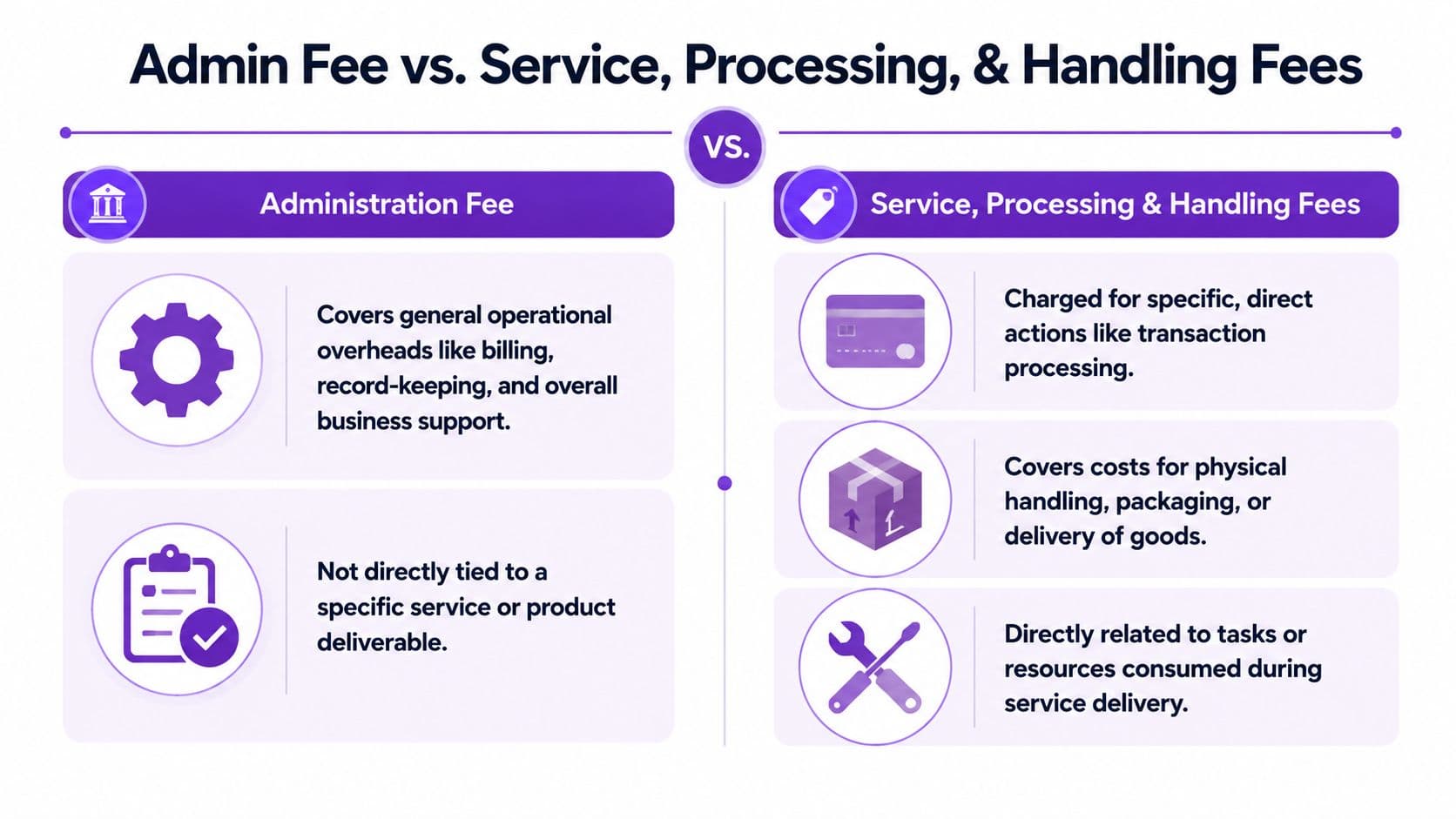
Fee type comparison
| Fee Type | Primary Purpose | Common Pricing Model | Example Use Case |
|---|---|---|---|
| Administration fee | Covers operational and back-office work tied to setting up, supporting, or maintaining the client relationship | Flat fee or markup | Client onboarding coordination, contract setup, billing configuration |
| Service fee | Covers the actual delivery of the service itself | Flat fee, retainer, or usage-based charge | Monthly management fee for campaign execution or advisory work |
| Processing fee | Covers a direct transaction activity | Per transaction or percentage-based | Card payment processing or ACH handling |
| Handling fee | Covers physical or task-specific handling work | Flat fee | Packaging, shipment preparation, or materials coordination |
The cleanest way to choose the right label
Use administration fee when the cost relates to internal support work around the engagement. Think account setup, internal documentation, vendor onboarding, reporting workflows, approval routing, or contract administration.
Use service fee when the charge is for the deliverable itself. If your team is managing ads, producing deliverables, writing code, or providing strategy, that's service revenue.
Use processing fee only when a direct transaction is being processed. If you accept card payments and want to understand how those direct charges affect pricing, it helps to calculate your Stripe costs before deciding whether to absorb or pass them through.
Use handling fee when the charge is tied to physical handling or a narrow operational task. Most SaaS businesses won't use this often. Agencies and productized service firms may.
If the fee exists because your team had to do administrative work before or around delivery, call it administrative. If the fee exists because the client is buying the deliverable, call it service revenue.
Where SaaS founders get tripped up
The biggest mistake I see is using “admin fee” as a catchall for anything non-recurring. Non-recurring doesn't automatically mean administrative. A one-time implementation project can still be service revenue. A contract setup fee can be administrative. The distinction depends on what the customer is paying for.
That's also why the label has accounting consequences. If you're already tightening your contract language under ASC 606, this is a good time to revisit how these charges map into your performance obligations and disclosures. The ASC 606 revenue recognition guide is a useful reference point before you standardize invoicing language.
What doesn't work
Three approaches usually fail:
- Bundling everything into one vague setup line: Easy to invoice, hard to defend.
- Passing through every internal inefficiency: Clients will push back if you charge for disorganization instead of real administrative work.
- Using different labels for the same charge: Sales says setup fee, finance says admin fee, legal says onboarding fee. That inconsistency creates audit noise.
The fix is straightforward. Pick one fee name, define its purpose in the contract, and use the same label in the proposal, invoice, and chart of accounts.
Real-World Examples for SaaS and Agency Models
Definitions matter less than implementation. If you can't tie the fee to a real invoice, a real contract clause, and a real workflow, it won't hold up when a client asks questions or an investor reviews your numbers.
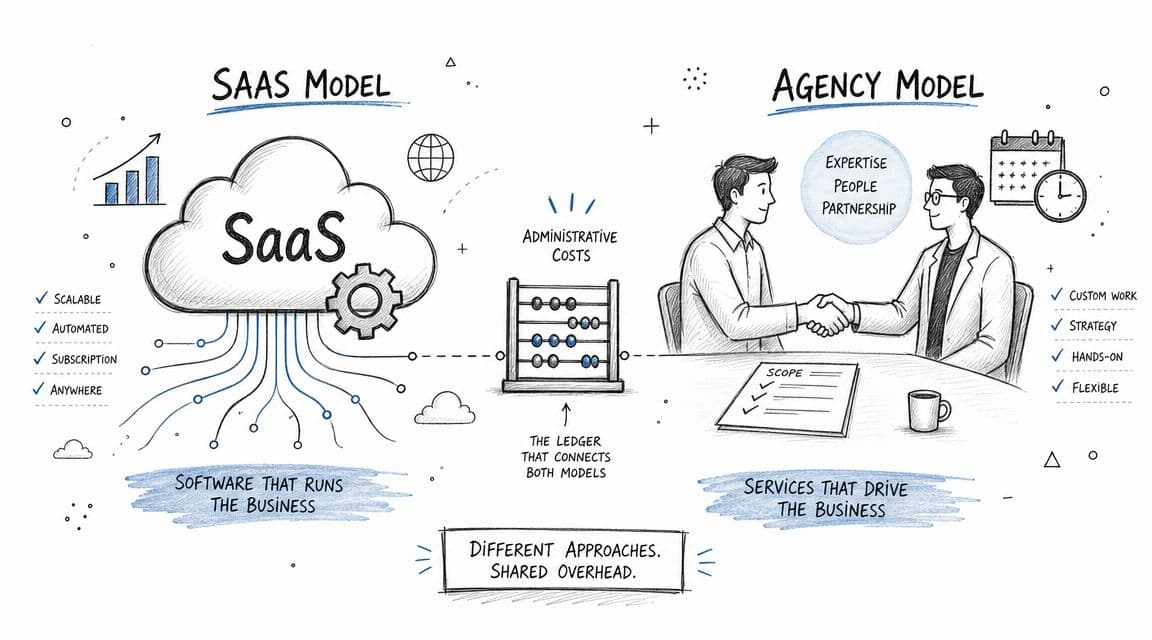
SaaS example with a one-time onboarding admin fee
Assume your SaaS company signs an enterprise customer and charges a $1,500 one-time administration fee. Your team uses that fee to cover security questionnaire coordination, legal paperwork routing, billing profile setup, and dedicated onboarding scheduling.
The invoice can look like this:
- Enterprise platform subscription: billed under your normal subscription terms
- Administration fee: $1,500
- Description: “One-time administrative charge for security review coordination, contract setup, billing configuration, and onboarding support”
This works when the fee reflects support activity around the customer relationship rather than the software subscription itself. It doesn't work if you use the admin label to hide custom implementation work that is really a separate service.
A simple contract clause:
“Client will pay a one-time administration fee of $1,500 for account setup, documentation processing, internal coordination, billing configuration, and onboarding support. This fee is separate from subscription charges.”
That wording is clear because it states purpose, timing, and separation from recurring revenue.
Agency example with a percentage-based admin fee
Now take a digital agency managing $50,000 in monthly ad spend. The agency applies a 15% administration fee to cover campaign reporting infrastructure, billing coordination, vendor payment handling, and account administration.
The calculation is simple:
- Monthly ad spend: $50,000
- Administration fee rate: 15%
- Administration fee: $7,500
Invoice structure:
- Media spend: $50,000
- Administration fee: $7,500
- Description: “Administrative support for payment coordination, reporting operations, account maintenance, and campaign billing management”
This structure can work for agencies because overhead often scales with spend volume. But the fee has to be defensible. If your team is charging for strategic management and optimization, that belongs in a management fee, not in administration.
Why markup logic matters
Professional services already use admin-fee-style pricing in labor-based models. In staffing, administration fees often range from 30% to 75% above worker pay, with a concrete example of $27/hour billed for a worker paid $18/hour, where the $9 difference equals a 50% markup, according to Shiftflow's staffing administration fee explanation.
You shouldn't copy staffing markups blindly into SaaS or agency pricing. You should take the underlying lesson: administrative pricing works when the fee is anchored to a real cost structure and a clear billing model.
Your fee becomes credible when operations, sales, and accounting all describe it the same way.
If you run an agency, your accounting treatment also needs to preserve the distinction between pass-through spend, service revenue, and administrative recovery. To achieve this, a sharper agency chart of accounts is necessary. The agency accounting guide is a practical reference if your current reporting blends all three together.
Proper Accounting Treatment and Journal Entries
Charging the fee correctly is only half the job. Booking it correctly is what keeps your metrics clean.
If you put administration fees into core subscription revenue or standard service revenue without thought, you blur ARR, project margins, and revenue quality. If you dump them into miscellaneous income, you create a second problem. The charge exists, but nobody can tie it back to a policy.
Where to record admin fees
For most SaaS and agency businesses, the cleanest approach is to create a separate revenue account such as Admin Fee Revenue. That keeps the fee visible without inflating the performance metrics that matter most to buyers, lenders, and leadership.
On the expense side, if you pay administration fees to a vendor, landlord, or service provider, book them to a clearly named operating expense account based on purpose. Don't bury them in an ambiguous line if the fee is material enough to review later.
Journal entries for administration fees
| Transaction | Account | Debit | Credit |
|---|---|---|---|
| Invoice client for SaaS admin fee | Accounts Receivable | $1,500 | |
| Invoice client for SaaS admin fee | Admin Fee Revenue | $1,500 | |
| Receive payment from client | Cash | $1,500 | |
| Receive payment from client | Accounts Receivable | $1,500 | |
| Agency invoices monthly admin fee on ad spend | Accounts Receivable | $7,500 | |
| Agency invoices monthly admin fee on ad spend | Admin Fee Revenue | $7,500 | |
| Pay vendor administration fee | Administration Expense | amount paid | |
| Pay vendor administration fee | Cash or Accounts Payable | amount paid |
Those entries are intentionally simple. In practice, timing matters. If you bill before the work tied to the fee is earned, you may need to defer recognition depending on the underlying obligation. That issue is especially important for SaaS companies with setup-related charges, and the deferred revenue guide is worth reviewing before your team finalizes month-end treatment.
What founders should avoid
A few accounting habits create unnecessary risk:
- Blending admin fees into ARR: That makes recurring revenue look stronger than it is.
- Posting to other income by default: If the fee is part of normal operations, “other” often isn't the best home.
- Ignoring consistency: If one customer's fee is revenue and another identical fee is a reduction of expense, your policies aren't stable.
- Skipping documentation: Every fee category should have invoice wording, contract support, and a chart-of-accounts mapping.
Clean books don't just show total revenue. They show what kind of revenue you earned and why.
For audit readiness, that separation matters because it lets you reconcile contract terms to invoices and invoices to ledger activity without subjective cleanup later.
Pricing Strategies and Legal Disclosure Best Practices
The strongest administration fee is the one nobody has to argue about. You get there through pricing logic and blunt disclosure.
If a client sees the fee for the first time on the invoice, you've already lost. If your contract names the fee but doesn't explain what it covers, you've only postponed the dispute. Founders often focus on whether they can charge the fee. The more useful question is whether they can explain it clearly enough that finance, legal, sales, and the client all understand it the same way.
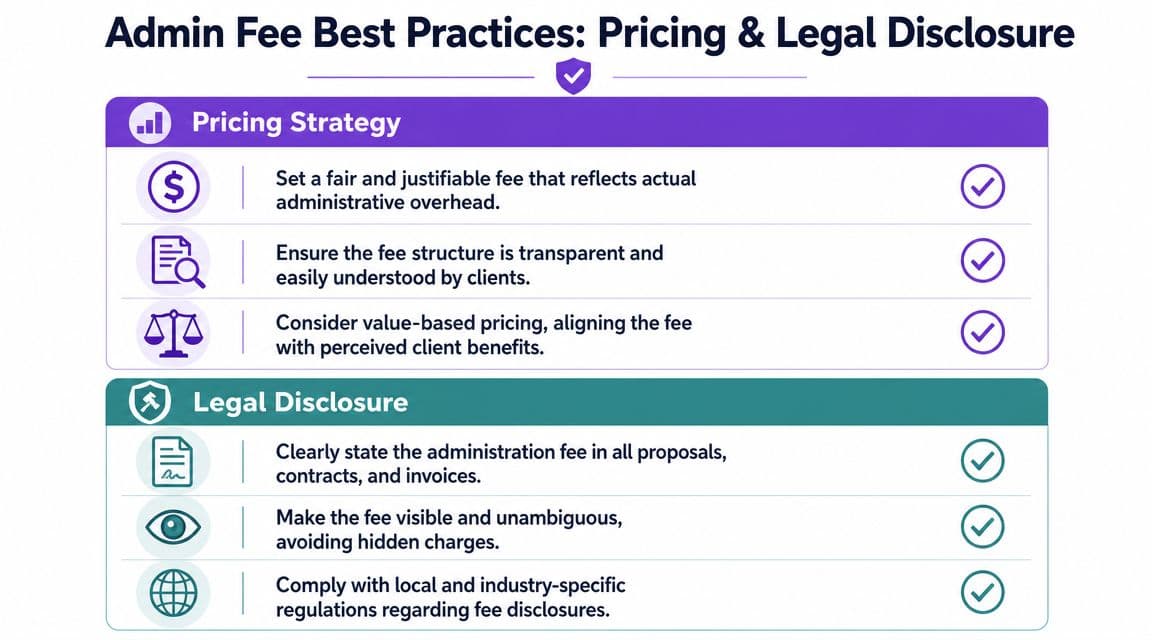
Choose the pricing model that matches the work
There isn't one perfect model. There is a best fit for the cost behavior.
| Pricing approach | Best when | Strength | Weakness |
|---|---|---|---|
| Flat admin fee | Work is predictable across clients | Easy to disclose and budget | Can undercharge complex accounts |
| Percentage-based admin fee | Administrative load scales with transaction size or spend | Aligns with changing volume | Needs stronger justification |
| Built into total price | Simplicity matters more than fee visibility | Clean client experience | Reduces internal visibility unless tracked separately |
For SaaS, a flat one-time fee usually works better when setup and administrative coordination are similar across enterprise customers. For agencies, a percentage model can be reasonable if billing support, reporting operations, and vendor coordination scale with media volume or account complexity.
What your contract and invoice should say
Use plain language. You don't need legal theater.
A clean contract clause:
“Client agrees to pay the administration fee described in the Order Form. The administration fee covers internal account setup, documentation processing, billing configuration, and related administrative support. This fee is separate from service delivery fees and subscription charges.”
A clean invoice description:
- Administration fee
- Description: “Administrative support for account setup, documentation, billing operations, and internal coordination”
If your legal team wants a starting point for drafting standardized fee language, a tool like the Free AI Contract Generator can help produce a first draft that counsel can then tailor to your business model and jurisdiction.
Red flags that trigger disputes and diligence questions
Many businesses often create avoidable friction.
- Hidden fee placement: The fee appears in the invoice but not in the proposal, order form, or MSA.
- No operational support: Your team can't point to actual administrative work behind the charge.
- Inconsistent naming: Setup fee, onboarding fee, admin fee, and platform fee all describe the same thing.
- Punitive pricing: The fee looks like a penalty instead of cost recovery.
- Refund language gaps: The contract doesn't state whether the fee is refundable and under what conditions.
- Weak alignment with pricing strategy: Sales discounts service fees but leaves the admin fee untouched without any policy.
The housing market offers a useful disclosure lesson
Apartment renters often face administration fees that are separate from application fees, security deposits, and rent, and current consumer guidance highlights the need to distinguish fee purpose, timing, and refundability because generic definitions still leave people confused, as discussed in Rent.com's administration fee explainer.
That same principle applies in B2B contracts. Your client needs to know three things immediately:
- What the fee covers
- When you charge it
- Whether it is refundable
If you want stronger pricing discipline overall, the agency pricing strategy guide is a good framework for deciding when to separate fees and when to roll them into a broader service package.
Answering Founder FAQs for Audits and Fundraising
These are the questions that come up when your board asks for cleaner metrics or your auditor starts tracing invoices.
How will investors view administration fees
Investors usually won't object to the existence of an administration fee. They will focus on whether the fee is documented, consistently applied, and separated from the metrics they care about. If your financials clearly distinguish recurring software revenue, project revenue, pass-through amounts, and administrative charges, you look organized.
If the fee inflates ARR or hides margin issues, you create credibility problems. During diligence, be ready to show the contract language, invoice examples, GL mapping, and recognition policy.
The issue isn't whether you charge the fee. The issue is whether your reporting tells the truth about it.
Can you make an administration fee non-refundable
Yes, but only if your contract language and applicable law support that treatment. In housing markets, administration fees are often described as one-time charges for processing paperwork, screening, lease preparation, and move-in coordination, with renter-facing amounts often cited in the $50 to $200 range and usually treated as nonrefundable unless local law or lease terms say otherwise, according to LeaseRunner's explanation of apartment admin fees.
For founders, the lesson is procedural. State refundability explicitly. If the fee is earned when administrative work begins, say that. If part of the fee is refundable before setup starts, define the trigger. Don't leave it implied.
Should admin fees count toward SaaS LTV
Treat one-time administration fees separately from recurring subscription revenue when calculating SaaS operating metrics. You can disclose them, track them, and even analyze payback inclusive of setup economics for internal decision-making. But if you blend one-time fees into recurring value metrics, you make comparability worse.
For fundraising, present both views if useful: core recurring metrics on a clean basis, then a separate note showing one-time fee contribution. If you're preparing your diligence package, use a checklist like this financial due diligence checklist to make sure fee policies, revenue schedules, and contracts align before outside reviewers start asking.
If your admin fees are vague, inconsistently booked, or muddying your SaaS and agency metrics, Jumpstart Partners can help you clean up the policy, chart of accounts, and revenue treatment so your financials hold up in audits, board meetings, and fundraising.