Financial Operations
AR Aging Analysis: How to Read Buckets, DSO and Reserves
Learn how to run an AR aging analysis, read aging buckets and DSO, and estimate bad-debt reserves with worked examples for SaaS and agencies.
ByJumpstart Partners, CPA, QuickBooks ProAdvisor
··17 min readYou're looking at $180,000 in receivables and telling yourself payroll is covered. Then you sort that balance by age and find a large share is already past 60 days. That's not cash on its way. That's cash you have to chase, reserve against, or write off, and your board, lender, or auditor will read it that way before you do.
Table of Contents
- What AR Aging Analysis Shows and Why It Moves Cash
- How to Run an AR Aging Analysis Step by Step
- Reading DSO Against Your Aging Buckets
- Turning Aging Buckets Into a Bad-Debt Reserve
- Warning Signs by Business Model
- What to Automate and What to Keep Manual
- Run Your First AR Aging Review This Month
What AR Aging Analysis Shows and Why It Moves Cash
You see $180,000 owed to you and assume it's coming. Your aging report shows $39,600 of it is more than 60 days past due. Those two facts lead to opposite decisions about hiring, spending, and runway.
AR aging analysis sorts every open invoice by how long it has been outstanding. Read the result as a cash forecast, not a collections to-do list. Current dollars behave differently from dollars sitting at 61 to 90 days, and treating them as equal overstates the cash you can count on.
You're not alone in carrying an old tail. In Dun & Bradstreet's Q1 2025 U.S. Accounts Receivable Industry Report covering 209 industry segments, 17 segments had at least 10% of receivable dollars 91 or more days past due. The same benchmark was 16 segments in Q4 2024, in that same report, so severe delinquency persisted across quarters rather than clearing at year-end.
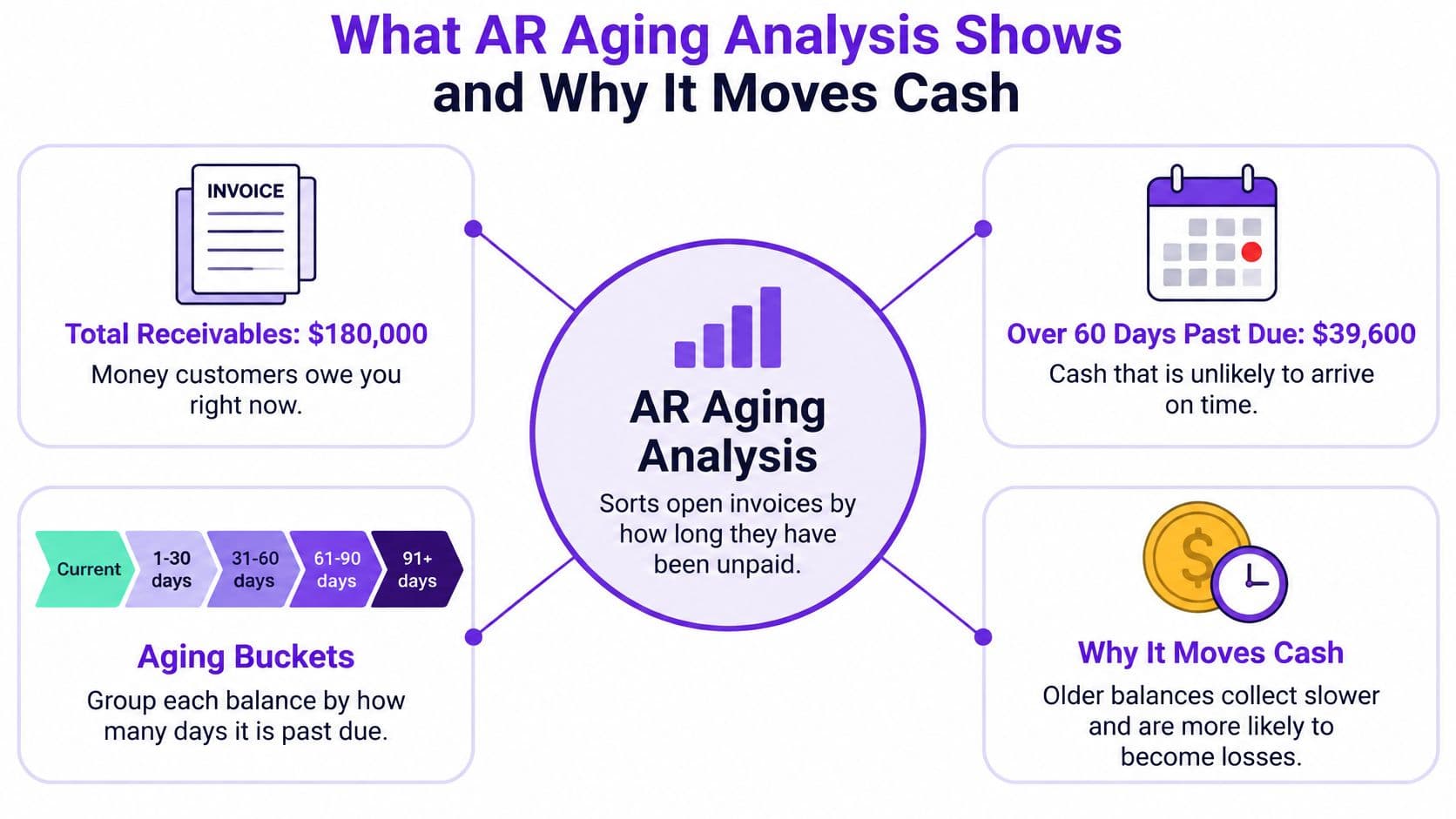
The Five Buckets and Your Default Action
Every open invoice is a short loan you made to a customer. Each day it ages, your odds of full repayment fall and your cost to collect rises.
| Bucket | What it usually signals | Who acts | Default action |
|---|---|---|---|
| Current | Within terms; normal billing timing | Billing or finance ops | Confirm the invoice was sent and delivered |
| 1-30 days past due | A reminder was missed or payment is in process | Account manager | Send automated reminder and check for disputes |
| 31-60 days past due | Stalled approval or payment-run delay | Account manager with finance | Structured call and a confirmed payment date |
| 61-90 days past due | Payment problem, dispute or customer cash strain | Finance and commercial lead | Escalate and pause new work if needed |
| 91+ days past due | High collection risk | Founder or CFO | Payment plan, credit hold and reserve review |
Teams in regulated, payer-heavy settings face the same discipline at larger scale, which is why Clarity on healthcare AR management is useful context for how structured follow-up protects cash. For your business, the principle is simpler. Don't judge receivables by the total.
Pull your report today. Calculate the share of dollars in each bucket, then compare that profile with how your cash conversion cycle turns sales into cash. If the 61-plus share is growing, you don't have a sales problem. You have a cash conversion problem, and it needs an owner this week.
How to Run an AR Aging Analysis Step by Step
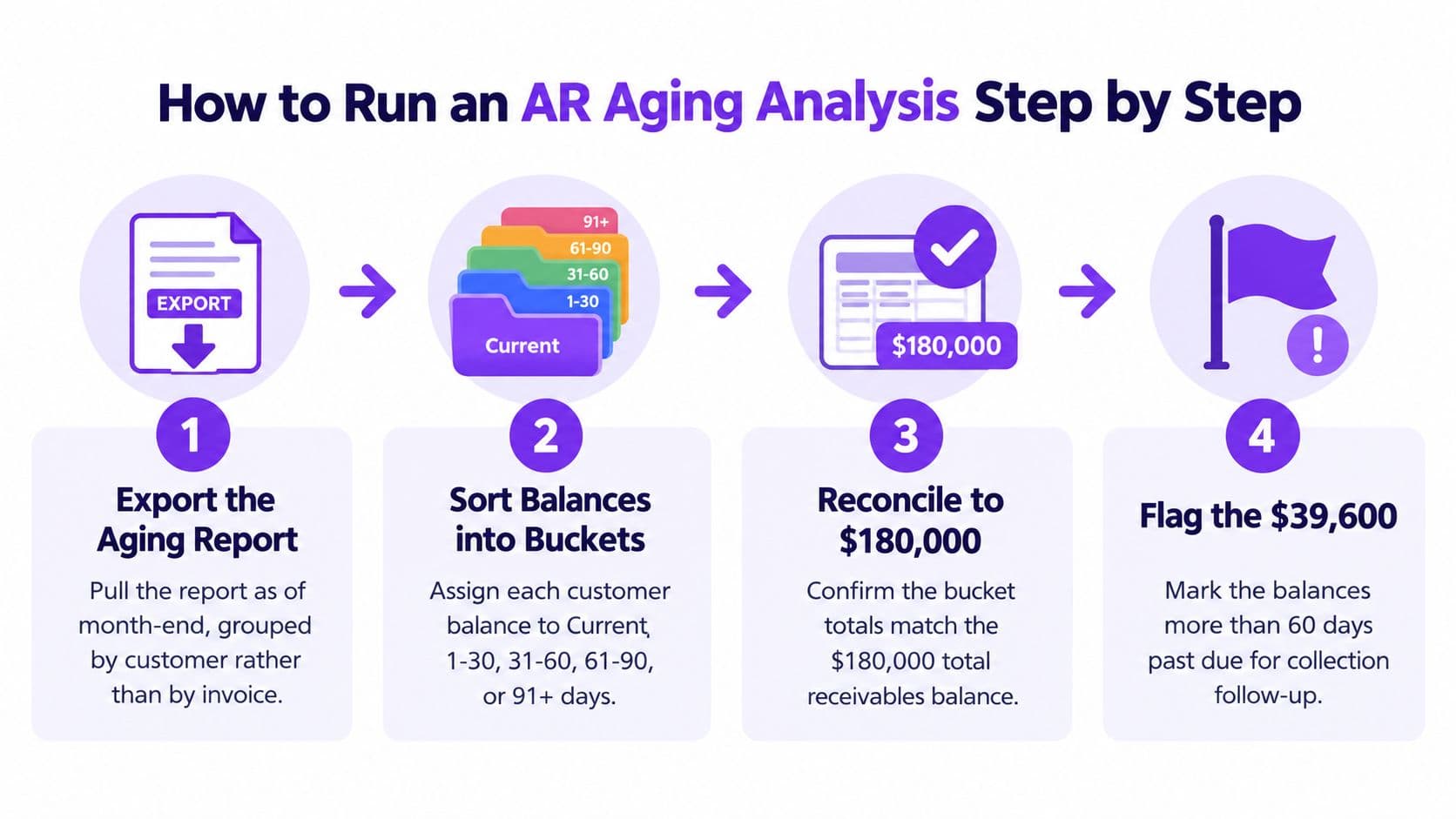
You can complete a clean first review in one afternoon. Use the $180,000 example as your template, work as of month-end, and don't move to collections calls until the numbers reconcile.
Build a Report You Can Trust
-
Export by customer, not by invoice. Pull the aging report as of month-end and put each account's total exposure on one line. Invoice-level lists hide concentration, so you miss that three small invoices from one customer add up to your largest risk.
-
Reconcile to the general ledger. Your bucket totals must match the accounts receivable balance in the ledger exactly. A gap usually means unapplied cash, a missing credit memo, or an invoice posted to the wrong entity, and chasing customers before you fix it destroys credibility.
-
Tag every open invoice by status. Mark each item undisputed, disputed, or awaiting approval. In this example, if $24,000 of the $180,000 is disputed, your collectors should work the remaining $156,000 while operations resolves the disputes separately.
Don't send a dunning email on a disputed invoice. You'll get ignored, and you'll train the customer to ignore your legitimate reminders too.
This sorting step is the core of sound accounts receivable management that separates billing errors from credit risk. A wrong purchase order number needs a corrected invoice. A customer who can't pay needs a credit decision. Mixing them wastes weeks.
Assign Owners and Escalation Triggers
-
Name an owner and next-action date for every balance past 30 days. No owner means no action. The owner records what was promised, when payment is expected, and what happens if that date slips.
-
Escalate at twice the contractual terms. Any account whose days outstanding exceed twice its payment terms moves to finance and commercial review. On net-30 terms, that trigger hits at 60 days, before the balance drifts into the 91-plus bucket.
-
Record the month in a tracker. Log total AR, percentage over 60 days, disputed share, and cash collected after month-end. One month is a snapshot. Three months show whether your process is improving or your customers are deteriorating.
Watch this walkthrough before your first run so your team uses the same definitions for buckets, disputes, and owners.
Standardize the export, the tags, and the tracker now. Once you've done that, you shouldn't need a heroic effort each month. You'll need a routine, a reconciled report, and named owners who close the loop.
Reading DSO Against Your Aging Buckets
Days Sales Outstanding (DSO) tells you how fast cash arrives on average. Aging tells you where the slow money sits. You need both, because an acceptable average can hide a dangerous tail.
Your Worked DSO Calculation
Take $180,000 in receivables and $390,000 in credit sales over the last 90 days. DSO equals $180,000 ÷ $390,000 × 90 = 41.5 days.
That number looks manageable on net-30 terms. It doesn't tell you whether most customers pay at 38 to 45 days or whether a small group sits past 90 days while everyone else pays on time. Two companies can report the same 41.5 days with completely different collection risk.
Practical rule: If DSO stays in range while your 61-plus share rises, trust the buckets. The average is hiding the problem.
Benchmarks for Context
For benchmark context, a 2024 S&P 1500 working-capital benchmark reported by The Hackett Group places median DSO at 46 days and top-quartile performance at 28 days. That same benchmark summary places SaaS DSO roughly between 38 and 52 days depending on customer mix, and construction at approximately 80 to 100 days because of retainage, in that same summary.
| Benchmark | DSO (days) | Source |
|---|---|---|
| Median across industries, S&P 1500 (2024) | 46 | The Hackett Group, 2024 working-capital benchmark |
| Top-quartile performance (2024) | 28 | The Hackett Group, 2024 working-capital benchmark |
| SaaS, depending on customer mix | 38-52 | The Hackett Group, 2024 working-capital benchmark |
| Construction, including retainage | 80-100 | The Hackett Group, 2024 working-capital benchmark |
| Mid-market SaaS on net-30 terms (indicative) | 25-45 | Indicative planning range, no named source |
| Your worked example | 41.5 | $180,000 ÷ $390,000 × 90 days |
Don't chase top-quartile DSO if your customer mix doesn't support it. Do measure yourself against your own terms. A 46-day result on net-30 terms means cash arrives about 16 days late, and on $1,000,000 of annual credit sales that ties up approximately $43,836, calculated as $1,000,000 ÷ 365 × 16, in that same benchmark summary linked above.
That tied-up cash is working capital you can't spend on product, hiring, or ads. Pair DSO with accounts receivable turnover to see how often you convert receivables into cash, then review both against the bucket mix every month.
Track DSO trend, percentage over 60 days, and percentage over 90 days together. If DSO improves because you collected current invoices faster but left old balances untouched, you haven't reduced risk. You've polished the average.
Turning Aging Buckets Into a Bad-Debt Reserve
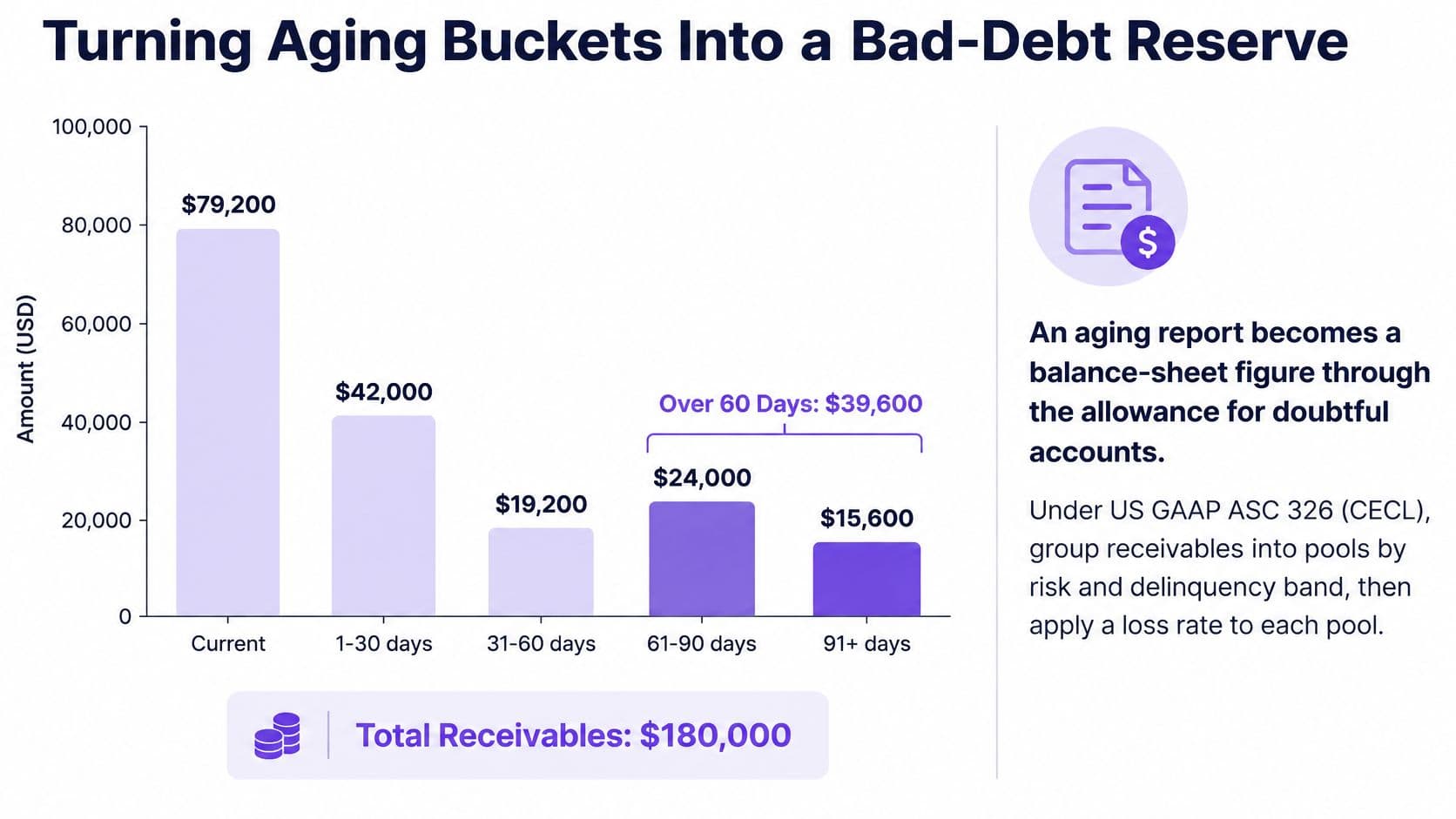
Your aging report becomes a balance-sheet number through the allowance for doubtful accounts. If you don't reserve for old balances, your receivables and your earnings both look better than they are. An auditor will correct that for you, at the worst possible time.
Under U.S. GAAP ASC 326, known as CECL, you group receivables into pools with similar credit-risk characteristics and delinquency bands, apply a loss rate to each pool, then adjust for current conditions and reasonable, supportable forecasts. The logic is direct. As balances migrate into older buckets, your expected loss rate and required reserve rise.
A Worked Reserve Calculation
OpenStax explains that accountants use an aging schedule to estimate bad-debt expense and establish the allowance for doubtful accounts as a contra-asset deducted from gross accounts receivable. Using illustrative rates from that method, the math looks like this.
| Aging bucket | Balance | Loss rate | Reserve |
|---|---|---|---|
| Current | $100,000 | 1% | $1,000 |
| 1-30 days | $40,000 | 5% | $2,000 |
| 31-60 days | $20,000 | 15% | $3,000 |
| 61-90 days | $10,000 | 30% | $3,000 |
| Over 90 days | $6,000 | 50% | $3,000 |
| Total | $176,000 | 6.8% blended | $12,000 |
Check the total yourself. $1,000 + $2,000 + $3,000 + $3,000 + $3,000 = $12,000, and $12,000 ÷ $176,000 = 6.8%. Notice the shape. The oldest two buckets hold only $16,000 of balances but produce $6,000, half of the entire reserve, because older dollars carry far higher loss rates.
These rates are illustrative, not a standard you can copy. Replace them with your own write-off history by bucket over at least twelve months. Separate any customer whose risk differs materially from its pool, including a known dispute, a bankruptcy signal, or a concentration you can't afford to lose.
Why Migration Matters More Than New Sales
Watch what happens when a balance gets older. If $10,000 moves from 31-60 days at 15% to 61-90 days at 30%, its reserve rises from $1,500 to $3,000. Your required allowance grows by $1,500 without one new invoice, one new customer, or one dollar of new revenue.
That's why aging is a valuation tool, not a collections list. Time alone changes what your receivables are worth.
Run this control monthly. Reconcile the aging to the general ledger, keep disputes separate from genuine delinquency, and document every forward-looking adjustment with a reason and a source. Undocumented adjustments won't survive audit review.
Note the coming change too. FASB's ASU 2025-05 provides a practical expedient for estimating losses on current accounts receivable and contract assets arising from ASC 606 transactions, for annual periods beginning after December 15, 2025. That expedient doesn't remove your judgment on aged pools. You still adjust loss rates for customer geography, industry stress, concentration, disputes, and changes in payment terms, and you still document each adjustment.
Decide how you'll treat invoices collected after period-end and apply that policy consistently. Write it down before your close, not after your auditor asks. A defensible reserve protects your credibility in fundraising, lending, and board reporting far more than an optimistic receivables balance does.
Warning Signs by Business Model
Your largest overdue balance is not automatically your largest risk. That assumption sends teams chasing old, familiar slow payers while a current customer slowly stops behaving like a reliable payer.
A customer who paid in 20 days for a year and now promises payment, misses, then pays partially is warning you early. Research on AR prediction notes that static ratio-based models fail to capture changes in payment behavior over time, aging patterns, and transaction-level dependencies. Your buckets describe lateness. Customer-level trends predict collectability.
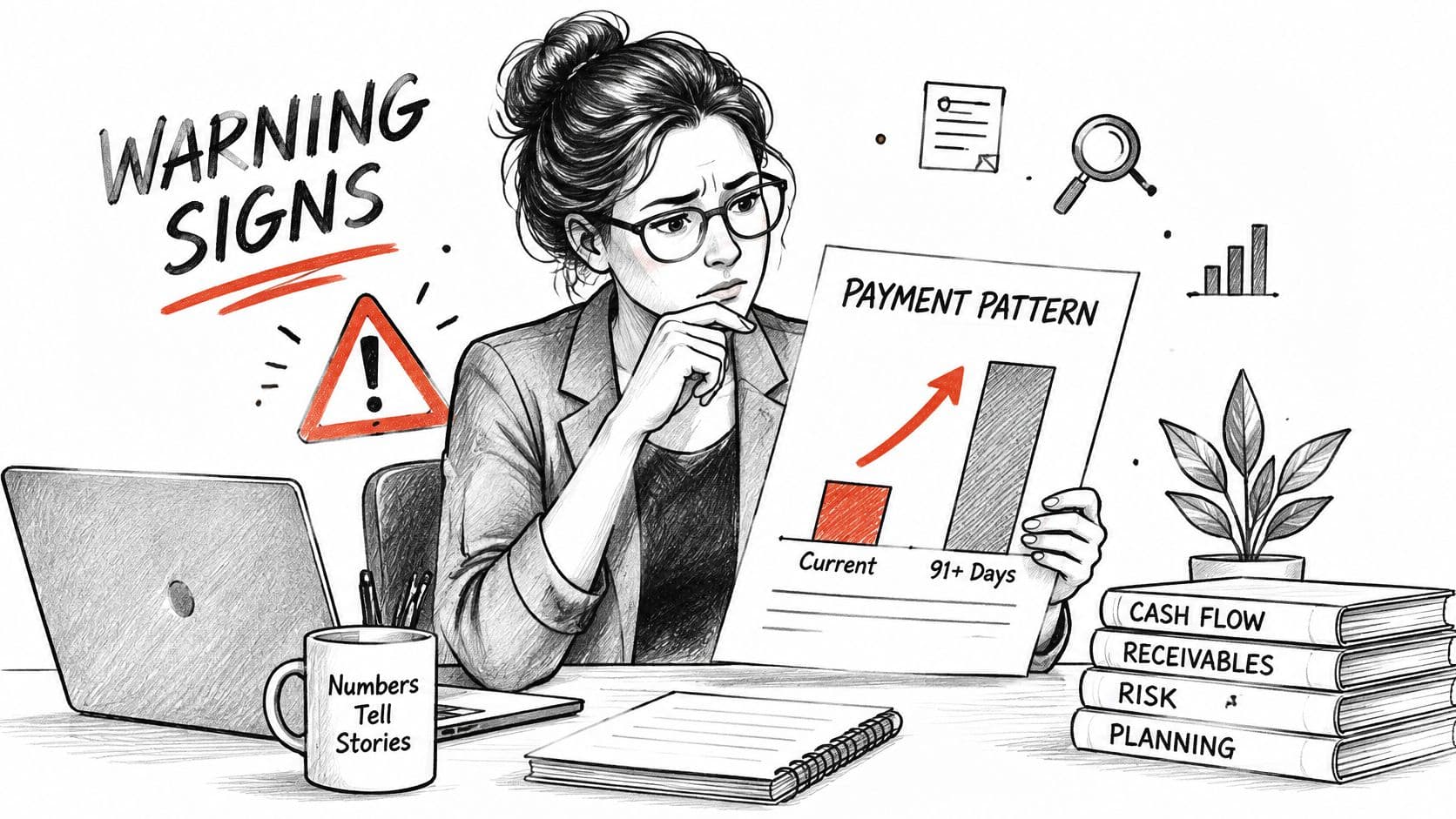
Track Behavior, Not Just Buckets
Add these fields to your review for every material customer.
- Average days to pay: Compare the last three payments with the prior pattern, not with your terms alone.
- Promised versus actual dates: Record every promise and whether the customer kept it.
- Dispute frequency: Repeated small disputes often signal a billing defect or a customer training you to accept delays.
- Partial-payment behavior: Partial payments without a documented plan usually mean cash strain, not an administrative error.
- Concentration and invoice volume: A growing balance from one customer raises exposure even while it's still current.
Patterns by Business Model
| Business model | Warning sign in the report | Likely cause | First fix |
|---|---|---|---|
| SaaS | Card-on-file invoices stuck in 1-30 days | Failed card retries and expired cards | Turn on dunning and card-update emails |
| SaaS | Annual invoices past 60 days | Invoice sent to the wrong AP contact | Confirm billing contact and PO requirements before renewal |
| Agency | Milestone invoice at 31-60 days with no payment date | Client sign-off never recorded | Tie invoice release to documented approval |
| Agency | Retainer balance past 60 days | Scope dispute on part of the invoice | Split the disputed amount and collect the undisputed part |
| E-commerce | Marketplace or wholesale receivables at 31-60 days | Payout schedules or net-60 terms | Map expected payout dates and separate them from defaults |
| E-commerce | One wholesale account growing in 90-plus days | Credit exposure to a single buyer | Set a credit limit and place a hold |
Separate operational delay from credit deterioration before you act. A billing error needs correction and reissue. A deteriorating payer needs tighter terms, a hold, or a higher reserve, and your approach to late payment penalties and enforcement should reflect that difference in writing.
Four Flags That Override the Buckets
Escalate immediately when you see any of these, regardless of bucket.
- One customer above 20% of total receivables: Your cash forecast now depends on one payer's behavior.
- DSO rising two months in a row: Your process or your customer mix is moving against you.
- Disputed share climbing past 10% of open AR: Your billing quality, not your collections effort, is the constraint.
- Same customer missing a promised date twice: Stop accepting new promises without a payment plan or hold.
Balances at 91 or more days past due carry substantially greater collection risk than current or mildly overdue balances, so treat growth in that bucket as a reserve and credit decision, not a reminder problem.
Give each flag a named owner and a deadline. A note in a spreadsheet isn't a control. An owner who reports back on a specific date is.
What to Automate and What to Keep Manual
Automate data movement and reminders. Keep judgment manual. Reversing that order gives you fast, confident, wrong decisions.
Automate the Repetitive Work
Pull invoices and payments from QuickBooks, Xero, NetSuite, Stripe, Shopify, or Square into one aging view so your team isn't reconciling exports by hand. If your billing lives in Stripe and your ledger lives in QuickBooks, that integration is your single source of truth, not someone's spreadsheet tab.
Send scheduled reminders at 1, 31, and 61 days past due, with the invoice attached and a payment link included every time. Customers don't pay faster because your email is firmer. They pay faster when paying takes thirty seconds.
Refresh a dashboard automatically with five numbers.
- Total AR: The full exposure at month-end and today.
- Percentage over 90 days: The share carrying the highest loss risk.
- DSO trend: Direction matters more than one month's result.
- Disputed share: The portion your collectors shouldn't be chasing.
- Cash collected after month-end: Proof that period-end balances converted to cash.
Done well, accounts receivable automation removes manual tracking without removing accountability. Your team spends its time on exceptions, not on building the report.
Keep These Decisions Manual
-
Classify each dispute and split disputed from undisputed amounts. Software can tag a status you choose. It can't decide whether a scope complaint is valid or a stalling tactic.
-
Approve payment plans. A person with commercial authority sets amounts, dates, and consequences for a missed installment.
-
Place and lift credit holds. Holds affect revenue and relationships. Require a named approver and a documented reason both ways.
-
Set loss rates and document forward-looking adjustments. As covered in the reserve section above, you adjust for geography, industry stress, concentration, and term changes, and a person signs off on each call.
Name one person for each manual task, with a due date. Not a team. Not finance in general. One person whose name appears next to the balance in your tracker.
A dashboard changes nothing by itself. Cash moves when a named person owns the next action on every balance past 30 days and the dashboard shows whether that owner acted.
Review the automated feed monthly for stale integrations, duplicate customers, and unapplied cash. Automation amplifies whatever process you feed it. Feed it a reconciled ledger and clear ownership, and it saves you hours. Feed it messy data, and it produces tidy reports you can't trust.
Run Your First AR Aging Review This Month
Run your first review this month. Don't wait for a cleaner ledger, a new hire, or quarter-end. Assign one owner to every balance past 60 days before you do anything else.
Do these four actions in order.
- Build your aging template with customer, invoice, date, amount, status, and owner columns.
- Set up your dashboard with total AR, percentage over 90 days, DSO trend, disputed share, and cash collected after month-end.
- Start a weekly collections call on the 31-plus list only, and end each call with owners and dates.
- Review the reserve at each month-end using your bucket loss rates and documented adjustments.
If your stack and handoffs are tangled, our Finance Ops Diagnostic reviews your current stack and handoffs, maps spreadsheet dependencies, inventories unclear owners and review gaps, and recommends a cleanup path with a monthly routine. The free diagnostic asks three questions to name the likely failure point and explain why, and no email is required for the first result.
Tell us your deadline when you start. The intake asks whether you need help this month, this quarter, or before your next board update, so we sequence the cleanup around the date that matters most to you.
Pick one action today. Run the diagnostic or build the template before your next close, while your current buckets are still collectible.
If your aging report shows a growing 61-plus tail and nobody owns it, we can build the monthly review, reserve, and collections routine with you. Visit Jumpstart Partners to run the free diagnostic, name your likely failure point, and get a cleanup path matched to your deadline.