Financial Operations
Late Payment Penalties: A Founder's Playbook
Master late payment penalties with worked examples, jurisdiction rules, contract wording, and enforcement tactics built for SaaS, agencies, and growing
ByJumpstart Partners, CPA, QuickBooks ProAdvisor
··16 min readA late invoice isn't just a collections problem. It's a financing decision: your business is carrying a customer's unpaid balance while still meeting payroll, paying suppliers, and planning its own cash needs. In the UK, statutory interest on qualifying late commercial payments is generally 8 percentage points above the Bank of England reference rate, but the right penalty policy isn't the highest rate you can put in a contract. It's the one that improves cash collection without needlessly putting a valuable customer relationship at risk. (UK government guidance on late commercial payments)
For founders and finance leaders at SaaS companies, agencies, and professional services firms, that calls for a portfolio approach. Set a clear baseline, then decide how to handle repeat late payers, customers with a genuine dispute, and strategic accounts facing a temporary cash squeeze. A penalty is a control, not a collection strategy on its own.
Table of Contents
- Why Late Payment Hurts Your Business More Than You Think
- What Counts as a Late Payment Penalty
- Statutory vs Contractual Rules by Jurisdiction
- Calculating the Actual Charge Step by Step
- Red Flags That Signal a Customer Will Pay Late
- Policy Templates Tailored to Your Business Model
- Automating Penalties in QuickBooks, Xero, and Stripe
- Warning Signs and Your 30-Day Implementation Plan
Why Late Payment Hurts Your Business More Than You Think
An overdue invoice makes your company finance work it has already delivered. Your team has paid salaries, hosted the customer's software, or completed the agreed project, but the cash is still sitting in the customer's account. That gap can tighten your own cash position, complicate forecasting, and force management to make decisions with less reliable information.
The longer receivables remain outstanding, the harder it becomes to distinguish a temporary processing delay from a customer who is struggling to pay. Aged invoices also deserve careful attention in cash-flow forecasts, deferred-revenue reconciliations, and lender or investor reporting. If you're working through wider cash-flow problems in a small business, start by identifying which overdue balances are affecting near-term decisions, not just by adding up the total.
There's a financing risk behind the delay, too. Research covering SMEs in 11 European countries from 2019 to 2023 found that businesses experiencing frequent or occasional late payments had greater difficulty accessing finance. The documented mechanism was credit rationing: lenders viewed uncertain collections as increased cash-flow risk and responded with smaller loans and higher interest rates. (Firm-level research on late payments and access to finance)
But an automatic fee for every late invoice isn't always the best answer. If a customer has a good payment history and a short-lived cash problem, a rigid penalty may bring in a modest charge while damaging renewal prospects or consuming staff time in a dispute. That doesn't mean you should ignore lateness. It means your policy should distinguish repeat behavior from a one-off problem and apply a consistent response to each.
Practical rule: Treat late payment penalties as one part of order-to-cash control. Pair them with clear terms, prompt invoicing, regular aging reviews, and early escalation.
Your aim is not to maximize penalty revenue. It's to protect working capital, make payment expectations clear, and avoid relying on overdue cash to fund routine operations.
What Counts as a Late Payment Penalty
A late-payment policy can contain several distinct tools. Be precise about which ones your contract permits and what event triggers each.
- Contractual interest is a rate applied to overdue principal over time. It compensates you for the customer holding cash past the agreed due date.
- A fixed late fee is a flat charge per overdue invoice. It doesn't grow with the balance or the number of days outstanding.
- Statutory recovery costs are fixed compensation or reasonable additional recovery costs that a law allows a supplier to claim.
- Acceleration means an agreement makes a larger balance, such as future instalments, due immediately after a specified breach. It's a contract remedy, not another way to calculate interest.
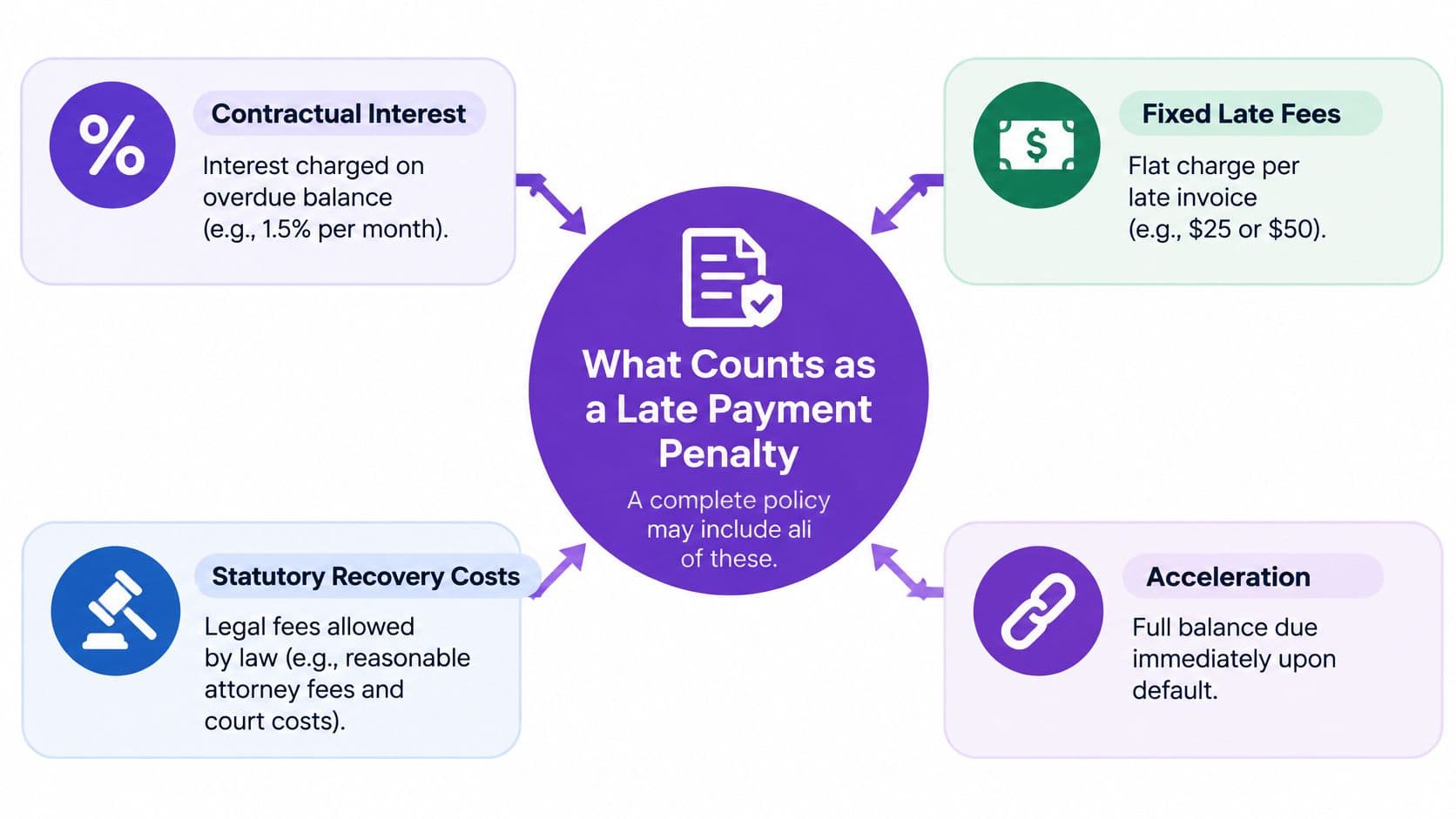
Consider an overdue invoice of £12,000. Interest accrues against that principal as time passes; a fixed recovery charge is a separate amount. Under the UK framework, those can form part of the same claim, but a substantial contractual late-payment remedy generally replaces statutory interest rather than stacking on top of it. (UK late-payment common framework)
A policy only works if you can support it with records. Keep the signed terms, proof that you sent the invoice, delivery or acceptance evidence, and a dated aging schedule. Record whether the customer disputes the invoice in good faith. An overdue, undisputed debt is not the same as an invoice challenged because of a delivery or scope problem.
Don't assume a familiar-looking fee is automatically collectible. Contract wording, applicable law, invoice receipt, and the nature of a dispute all matter. Cross-border contracts need particular care because statutory defaults and enforceability rules can differ by jurisdiction.
Statutory vs Contractual Rules by Jurisdiction
A penalty policy should fit the customer portfolio, not just the invoice. Statutory defaults can protect cash collection where contract terms are silent, while negotiated terms give you more control. Set the structure by customer segment, and check the governing law before applying it.
| Jurisdiction | Default rate | Fixed recovery | Enforceability note |
|---|---|---|---|
| UK | Generally simple interest at 8 percentage points above the applicable Bank of England base rate | Fixed compensation depends on debt size; additional reasonable recovery costs may be claimable | Terms excluding statutory interest are generally void unless they provide a substantial alternative remedy |
| US | Varies by state and contract | No single federal fixed recovery amount; set the fee in the contract and confirm the governing state's rules | Check the governing state's rules and have the contract reviewed before setting a rate |
| EU | Contractual interest may apply; statutory rules can apply when no rate is agreed | €40 per late invoice, plus additional reasonable documented recovery costs where applicable | Rules include statutory defaults, contractual terms, and local limits; check the relevant country |
| Canada | Confirm applicable provincial or federal rules | Recovery costs depend on provincial law; confirm the governing province before invoicing | Confirm the contract's governing law before setting or claiming charges |
For UK business-to-business invoices, statutory interest generally starts the day after the agreed due date. If the contract gives no due date, payment is normally late 30 days after the later of the invoice date or delivery date. Public authorities usually have a 30-day payment limit. Business transactions generally use a 60-day limit unless the parties agree otherwise and the term is not grossly unfair to the supplier. (Small Business Commissioner guidance on calculating interest)
The UK statutory rate is simple interest at 8 percentage points above the applicable Bank of England base rate. The reference rate changes by half-year: the base rate on 31 December applies to interest beginning from 1 January through 30 June, and the rate on 30 June applies from 1 July through 31 December.
For US customers, do not apply one nationwide rate or recovery fee. Rules vary by state and contract, so set terms for the governing jurisdiction and have them reviewed before use. For a portfolio with customers in several states, segment the terms accordingly rather than copying one fee across every account. Apply the same discipline to cross-border sales: confirm the relevant country or province before invoicing, and weigh predictable recovery against the risk that a disputed or unenforceable charge damages the customer relationship.
Calculating the Actual Charge Step by Step
Treat late charges as a portfolio decision. Choose a structure that recovers cash without making good customers less likely to pay or stay. Use one calculation method, then apply it to the customer segments where the terms are clear and enforceable.
For simple interest, use:
Overdue principal × annual interest rate × overdue days ÷ 365
This formula multiplies the balance by a daily rate and the number of overdue days. If your contract sets a monthly rate, follow its wording before converting it to a daily calculation. A 30-day month assumption can produce a charge that differs from the agreed terms.
For example, on a £12,000 overdue agency invoice, 50 days late, at an applicable combined statutory rate of 8.5%:
- Annual interest: £12,000 × 0.085 = £1,020.
- Daily amount: £1,020 ÷ 365 = about £2.79.
- Interest for 50 days: about £2.79 × 50 = approximately £140.
- Add £100 fixed recovery compensation for a debt of £10,000 or more. The total is approximately £240, before qualifying additional recovery costs. See the UK recovery compensation framework.
The fixed recovery amount depends on the debt: £40 below £1,000, £70 from £1,000 to below £10,000, and £100 at £10,000 or more. Check the contract before combining a substantial contractual remedy with statutory interest. The contract may replace statutory interest rather than add to it.
The right structure depends on the segment. For reliable customers, a clear interest charge may protect cash flow without adding friction. For accounts with repeated delays, apply the stated recovery terms consistently and assess whether pursuing additional costs is worthwhile. Explain each item separately, including any administration fee, so the customer can see what each charge covers.
Check the dates before sending the charge: confirm the contractual due date, invoice receipt date if relevant, applicable rate, partial payments, and days overdue. Keep interest and recovery costs on separate lines. A transparent calculation is easier for both the customer and your finance team to verify.
Red Flags That Signal a Customer Will Pay Late
The best time to manage payment risk is before an invoice becomes overdue. Watch how a customer behaves during onboarding, contract negotiation, and the first billing cycle. A request for extended terms isn't proof of poor credit, but a pattern of excuses, invoice disputes, and disappearing communication deserves a specific response.
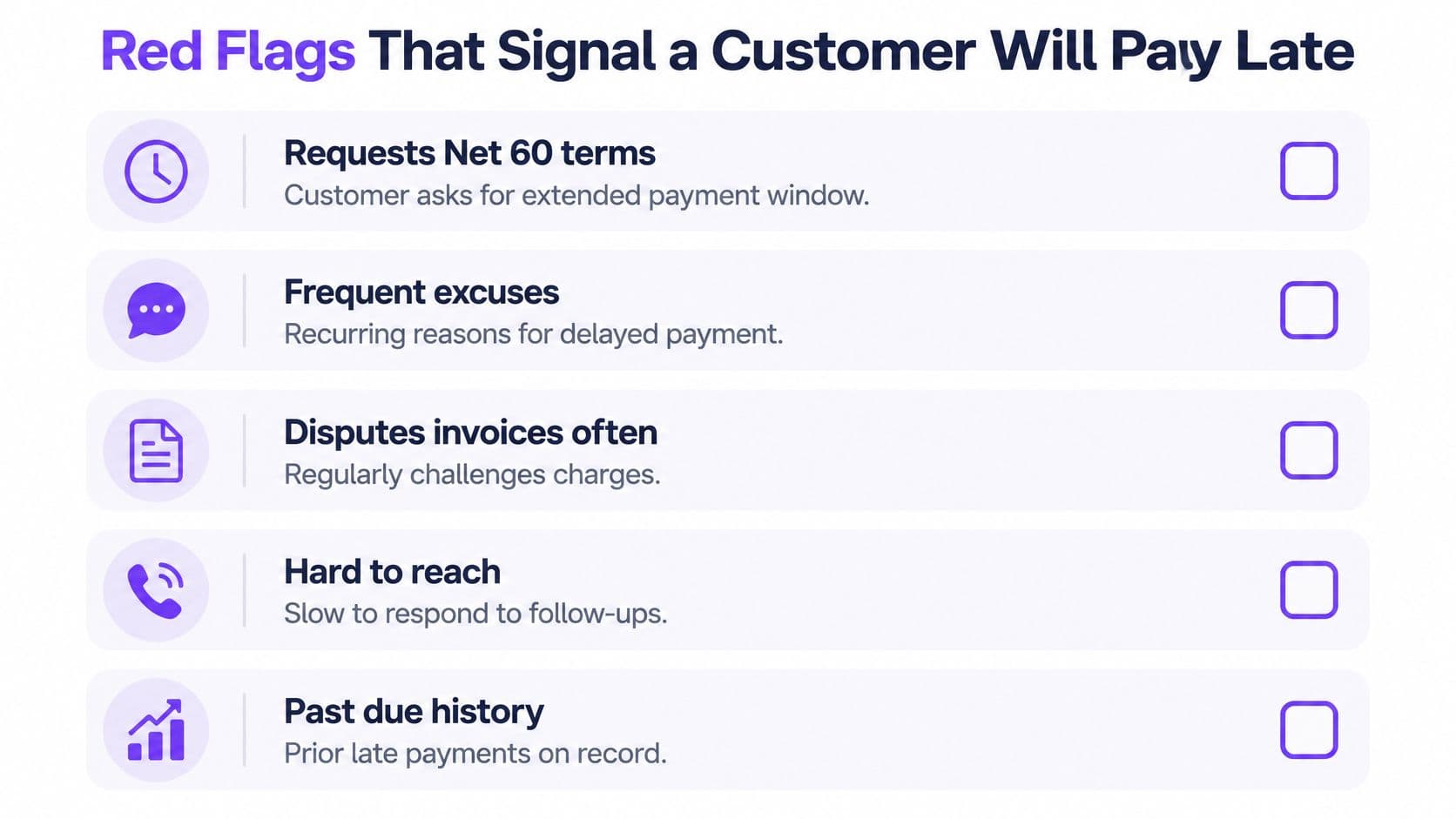
| Warning sign | Likely cause | Recommended action |
|---|---|---|
| Requests extended terms before signing | Cash timing or a procurement process that needs more time | Confirm approval steps, set a clear due date, and price the risk into the terms |
| Pays the first invoice late | Payment setup or a pattern that deserves monitoring | Contact the customer, verify the process, and review the next due date before it passes |
| Asks to split an invoice | Cash pressure or an invoice that needs clarification | Agree any schedule in writing and record each promised payment |
| Stops opening collection emails | The contact may be unavailable, disengaged, or avoiding the balance | Switch channels and ask the account owner to make a direct call |
| Disputes invoices repeatedly | A real delivery concern or chronic avoidance | Separate documented good-faith disputes from repeated objections without supporting detail |
Use the table as an onboarding prompt, not a substitute for judgment. A useful guide to onboarding remote clients can help you capture billing contacts, approval steps, and payment expectations before delivery begins.
A customer who disputes every invoice can be a higher credit risk than one who misses an email, because unresolved disputes make it harder to establish what is owed. But don't use penalties to silence a valid complaint. Log the disputed amount and reason, keep undisputed balances moving through collections, and assign someone to resolve the underlying issue.
Review your accounts receivable aging by customer and trend, not just by total. When a risk signal appears, choose a proportionate response: shorten terms for future work, require a deposit, move to milestone billing, or have the founder speak with the customer before escalating further.
Policy Templates Tailored to Your Business Model
A late-fee policy can damage collection outcomes if it treats every customer the same. A repeat late payer, a customer disputing a deliverable, and a reliable customer with a temporary cash problem don't call for identical responses. Use contract terms to set a baseline, then decide when to enforce, pause, or waive a charge.
The following templates show the structure to adapt, not a blanket recommendation to use a particular rate or trigger. Confirm that your terms comply with the governing law before adopting them.
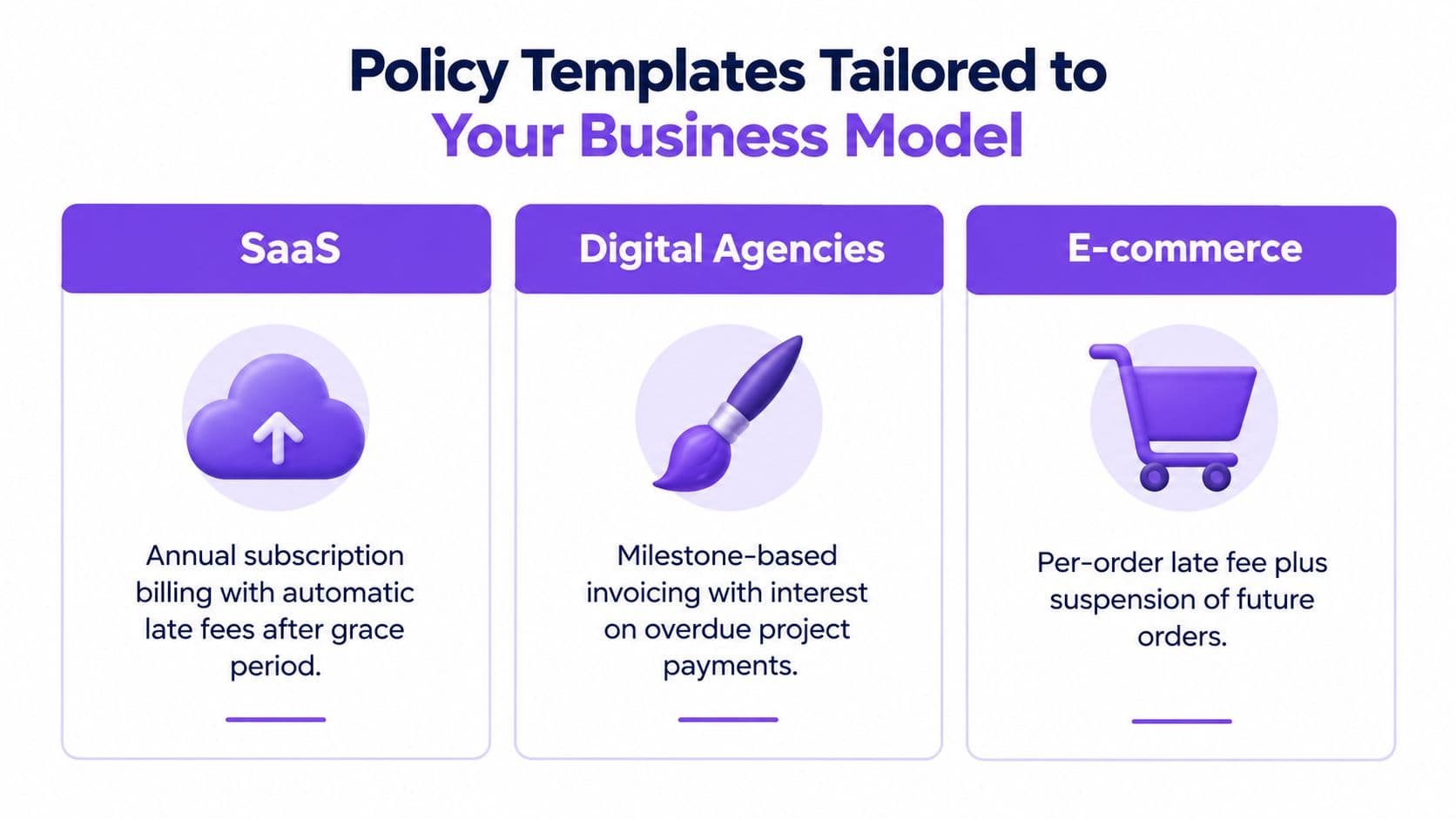
| Business model | Policy outline | Decision to personalize |
|---|---|---|
| SaaS | State the subscription due date, billing method, what happens after a failed payment, and how access or service may be affected | Decide whether to pause service for a disputed charge or only for an undisputed overdue balance |
| Digital agency | Tie invoices to milestones, define acceptance and payment triggers, and state how overdue work or future milestones are handled | Decide what deposit and work-in-progress protections fit your delivery model |
| E-commerce | Explain when payment is due, how saved payment methods are used, and when you'll pause future orders | Decide how to distinguish a processing delay from an unpaid balance before blocking repeat orders |
The customer trade-off is real. A 2025 survey reported that payment-processing delays led 26% of small-business owners to delay paying themselves, 19% to borrow or use a credit card, and 18% to pay another bill late and incur a penalty. That finding illustrates how one delayed B2B payment can push costs through a chain of suppliers. (Small-business late-payment survey)
Your contract should state the payment due date, the delivery or acceptance trigger, the interest rate or statutory basis, any fixed recovery amount, and the dispute-resolution path. Make the invoice process match the contract. A vague acceptance clause or a missing delivery record gives the customer room to challenge when payment became due.
For repeat late payers, use consistent contractual enforcement and review whether future work needs tighter payment controls. For a strategic customer facing a temporary cash shock, consider a documented one-time waiver in exchange for a written payment plan. For chronically late or higher-risk accounts, reset terms for future work rather than relying on penalty income. If your agency bills for work in stages, milestone billing can connect cash collection to completed work and limit how much unpaid work accumulates.
Automating Penalties in QuickBooks, Xero, and Stripe
Automation is useful when it enforces a policy you've already written. It won't fix unclear contract terms, missing invoice records, or disputes that no one owns.
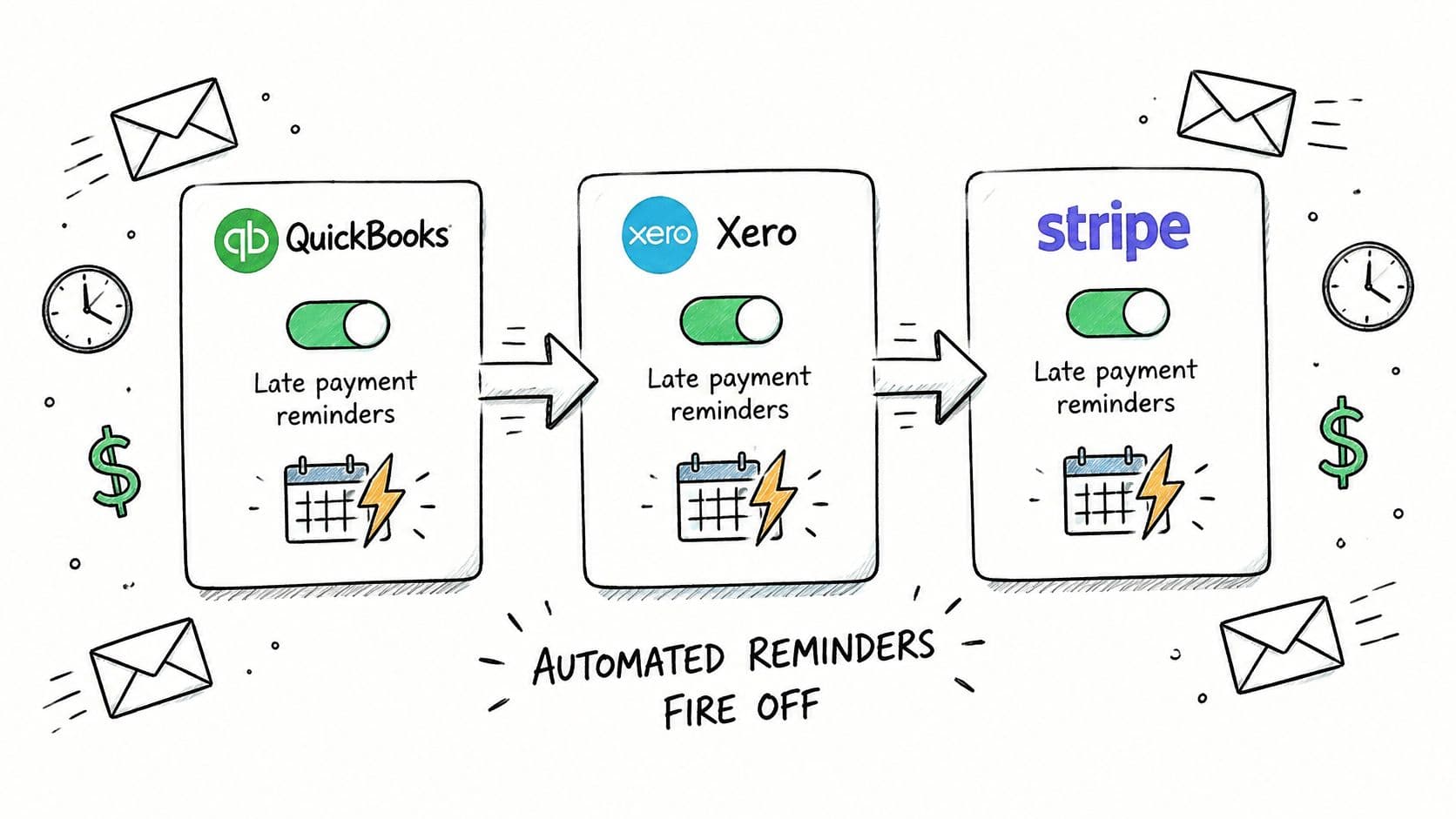
QuickBooks Online: Configure invoice reminders to follow your actual terms. Update the invoice template so it displays the due date and relevant payment wording. Review the accounts receivable aging report regularly and send it to the person responsible for collections, with overdue accounts and next actions clearly identified.
Xero: Set up the available invoice reminder workflow to match your escalation sequence. Use the receivables and analytics views to monitor overdue balances and days-sales-outstanding trends. Have the bookkeeper confirm that the system's reminder dates match the contract's due date.
Stripe: Configure available smart retries and dunning emails for card-on-file invoices. Reconcile payment status to the ledger regularly so a pending or completed payment isn't treated as an unpaid debt because the accounting record hasn't caught up.
For the operational distinction between sending reminders and managing the receivables process, review this guide to accounts receivable automation.
Control check: Put late-payment charges in a separate account from ordinary service revenue. That makes collections reporting easier to interpret and prevents penalty income from obscuring the performance of your core offering.
Aged receivables with collection doubt may also require a credit-loss reserve under your accounting policies. Keep that assessment separate from the question of whether a contractual penalty is claimable: accounting recognition and legal enforceability are different decisions. Ask your accountant to confirm the treatment for your reporting framework and circumstances.
Hand your bookkeeper this checklist: confirm contract terms and invoice dates, activate reminders, assign an owner for aging review, reconcile payment-provider activity to the ledger, and record any interest or recovery claim separately. Test the sequence with a real overdue account before treating the process as fully operational.
Warning Signs and Your 30-Day Implementation Plan
Treat these warning signs as urgent: invoices aging without an owner, repeat late payment from the same customer, disputes that never reach resolution, missing proof of invoice delivery, and a cash forecast that assumes overdue balances will arrive on schedule. Assign each account a next action and a named person responsible for it.
A structured approach to finance leadership can help clarify who owns forecasting, reporting, and collections decisions. This guide to startup financial leadership offers context for setting those responsibilities as your company grows.
Use the next 30 days to put the control in place:
- Week one: Review contract language for the due date, delivery or acceptance trigger, interest, recovery costs, and any acceleration clause. Flag terms that need legal review.
- Week two: Configure your accounting platform's invoice reminders and payment-provider dunning. Confirm that the messages follow your contractual terms.
- Week three: Assign ownership of the aging review. Set escalation actions by customer segment, and document who approves a waiver or payment plan.
- Week four: Test the complete invoice-to-collection workflow with one real overdue invoice. Verify the dates, communications, ledger entries, and dispute handling before relying on automation.
Tomorrow, identify the overdue balances that could affect your cash decisions and assign an owner to each. Then start the contract audit, and make sure your next invoice states when payment is due and how the customer can raise a genuine dispute.
If your business generates $500K–$20M in revenue and you need collections policy connected to your accounting processes, Jumpstart Partners provides outsourced controller and bookkeeping support for SaaS, agencies, and growing businesses. Ask about aligning your invoice terms, receivables workflow, and chart of accounts so your team can manage overdue balances with clearer cash-flow visibility.