Financial Operations
Milestone Billing for Growing Businesses: A Practical Guide
Learn how milestone billing improves cash flow, the ASC 606 rules finance teams must follow, contract language that protects you, and a sample schedule you can
ByJumpstart Partners, CPA, QuickBooks ProAdvisor
··14 min readMilestone billing is a project-based payment structure where invoices become due when the customer accepts predefined deliverables, and it is a payment mechanism, not a revenue-recognition trigger. If your project is moving, payroll is coming up, and your cash is trapped in one big final invoice, this is the structure that fixes the timing problem.
A founder staring at a six-figure receivable that's still unpaid at 90 days already knows the issue. The work is happening, the team is busy, and the bank balance is telling a different story. Milestone billing solves that gap by turning a vague promise of future delivery into a series of hard checkpoints tied to cash collection.
Table of Contents
- The Cash Flow Problem Milestone Billing Solves
- What Milestone Billing Is and How It Differs From Other Models
- ASC 606 and IFRS 15 Rules Every Finance Team Must Follow
- Choosing the Right Milestone Structure for Your Business
- Sample Milestone Schedule and Contract Language You Can Copy
- A Month-End Close Playbook for Milestone Contracts
- Why More Milestones Can Actually Hurt Cash Flow
- Your Milestone Billing Implementation Checklist and Next Steps
The Cash Flow Problem Milestone Billing Solves

A project can look profitable and still starve the bank account. The problem is usually the billing schedule, not the work.
Construction billing works the same way. One industry summary says slow pay is common and expensive, which is why staged billing is a working-capital tool, not an admin preference construction billing milestones and cash flow. If your team is burning payroll, subcontractor, and software costs before cash shows up, you are financing the customer.
A SaaS agency running a $240,000 project feels this fast. If the only invoice goes out at the end, labor and contractor costs pile up for weeks or months with no offsetting cash. If the customer controls acceptance and the contract does not create billable checkpoints, the business becomes the lender.
Practical rule: If you cannot invoice until final handoff, you are carrying the project on your own balance sheet.
Milestone billing fixes that by tying invoices to observable checkpoints, such as architecture approval, design completion, testing, and go-live, so cash moves as work becomes verifiable milestone clause glossary. Finance leaders should pair that schedule with a rolling forecast. A tight cash plan like this 13-week cash flow guide shows whether the next invoice arrives soon enough to cover the next payroll run.
That is why milestone billing matters in project businesses. It reduces the gap between delivery and collection, which is exactly where otherwise healthy firms get squeezed.
If you want a useful adjacent read on how timing changes buyer behavior, fractional hiring cost strategies is a good comparison.
What Milestone Billing Is and How It Differs From Other Models
Milestone billing means you invoice after the customer accepts defined deliverables. The invoice is triggered by progress, not by a calendar date, and it is separate from revenue recognition. Finance teams that blur those lines end up with messy close processes and avoidable cash gaps.
Retainers fit ongoing access, availability, or support. Hourly billing fits work where effort is the product. Fixed-fee billing fits a narrow project that can be billed in one or two tranches. Milestone billing fits projects with real checkpoints, where cash should move as the work becomes verifiable.
A sensible milestone plan usually has a handful of checkpoints, with a final holdback to protect the buyer until acceptance. The holdback is a collection tool, not a discount. In practice, this structure shows up often in technology and services contracts, especially where acceptance can stall the final payment.
| Billing model comparison for project-based businesses | When Cash Arrives | Best For | Main Risk |
|---|---|---|---|
| Retainer | Up front or monthly | Ongoing access and availability | You can end up paid for time, not outcomes |
| Hourly | As time is recorded and invoiced | Unclear scope or evolving work | Revenue is harder to predict |
| Fixed fee | One or two tranches | Narrow, repeatable projects | You finance the work if the fee is back-loaded |
| Milestone billing | When deliverables are accepted | SaaS implementations, agencies, fixed-scope projects | Disputes if acceptance criteria are vague |
A $120,000 agency engagement billed in four $30,000 milestones keeps cash moving as the project advances. Billing the same job in one lump sum at launch changes the risk profile completely. You collect faster, but you also create more pushback if the customer disputes scope, timing, or acceptance.
If you bill across borders or run project work alongside subscriptions, the tax stack matters too. A VAT validation API for Stripe billing keeps tax logic clean when billing data touches multiple systems. For teams that blend recurring revenue with project revenue, usage-based billing is the closest model to compare against milestone billing.
ASC 606 and IFRS 15 Rules Every Finance Team Must Follow
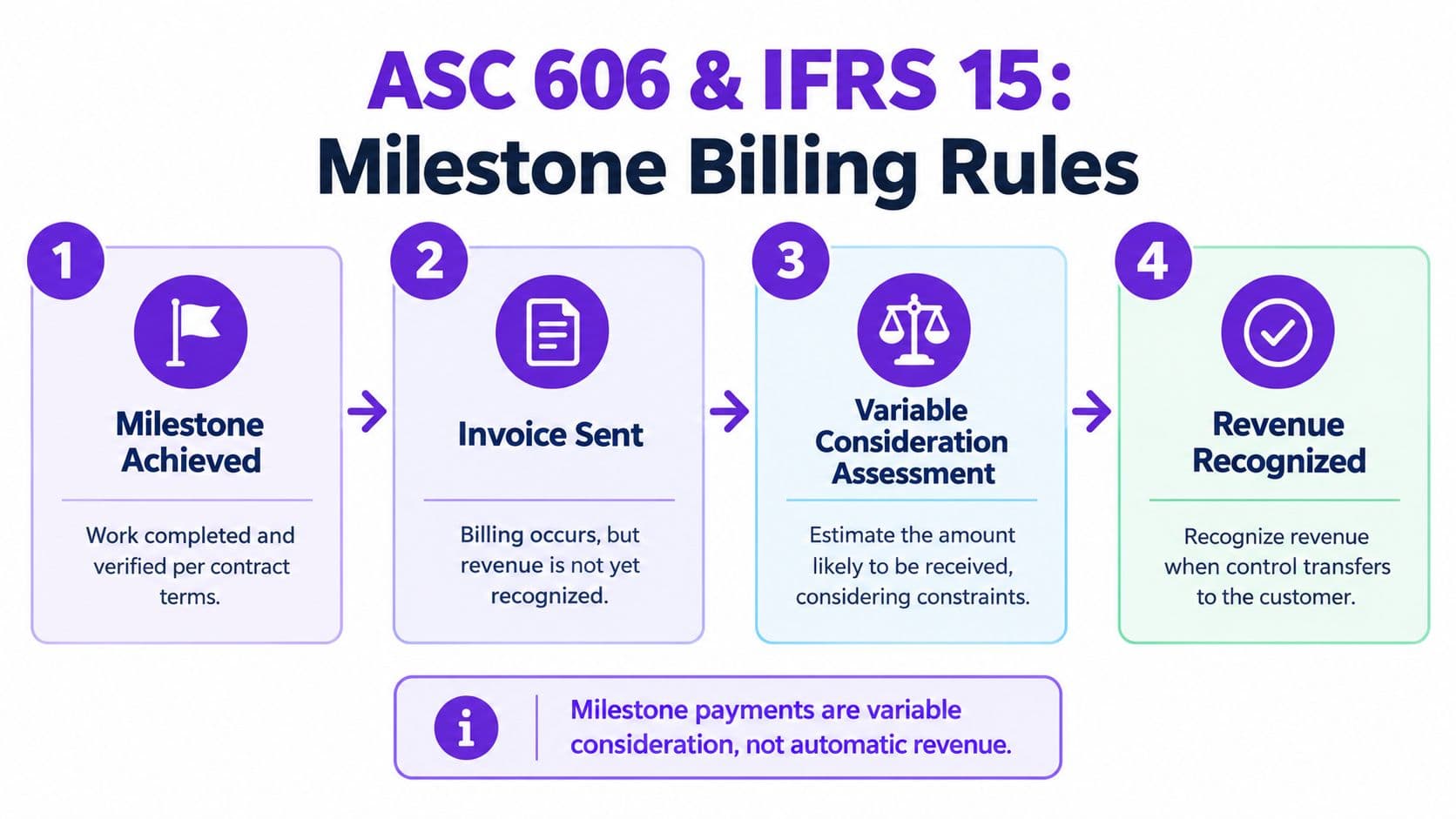
Under ASC 606, milestone billing is a payment mechanism. It is not, by itself, a revenue trigger. The invoice may go out when a customer accepts a deliverable, but revenue only follows when the related performance obligation is satisfied SEC milestone invoicing discussion.
The five-step model you actually need
You first identify the contract and the performance obligations. Then you estimate the transaction price, allocate that consideration, and recognize revenue as each obligation is satisfied. A milestone payment that depends on acceptance is usually variable consideration, so you only include it in the transaction price when it is probable that recognizing it won't create a significant reversal later ASC 606 variable consideration example.
Take a $120,000 implementation contract with a $20,000 acceptance milestone. If acceptance is still uncertain, you don't book the full $20,000 as revenue at signing. You treat the constrained transaction price as $100,000 until the uncertainty clears. Once acceptance happens and the performance obligation is satisfied, the additional $20,000 becomes eligible for recognition.
Finance rule: The invoice schedule and the revenue schedule are separate documents. If your controller treats them as the same thing, your close will be wrong.
IFRS 15 says the same thing in different words
IFRS 15 also tests whether over-time recognition applies based on the right to payment and the pattern of transfer, not the invoice date SEC right-to-payment discussion. That means a company can invoice on a milestone and still recognize revenue over time, or invoice early and carry a contract liability until control transfers.
For a finance team, the operational fix is boring and necessary. Keep a milestone register that ties each billing event to the related performance obligation, acceptance evidence, estimated amount, and reversal risk. If you want a parallel framework for the broader close process, this revenue recognition resource is the right companion reference.
Choosing the Right Milestone Structure for Your Business
A milestone schedule should match where the risk sits. If the customer controls acceptance, push harder on objective deliverables and signed approvals. If your team carries most of the delivery risk, front-load cash with a deposit or early mobilization payment. There is no universal template, only a structure that protects working capital without turning the contract into a fight.
Compare the trade-offs, not the sales pitch
Construction often uses a progress pattern such as 10% at mobilization, 20% after foundation work, 20% at framing, then later payments tied to substantial completion and closeout. SaaS implementation and agency work usually need a cleaner split, such as 30% at kickoff, 40% at configuration complete, 30% at launch, because the customer can see progress in discrete stages milestone billing overview.
| Structure | Working Capital Impact | DSO Impact | Delivery Risk |
|---|---|---|---|
| Deposit plus progress payments | Strong early cash | Lower if deposits are meaningful | Moderate, because early cash reduces financing strain |
| Objective-acceptance milestones | Balanced and defensible | Lower when approvals are fast | Lower if criteria are written clearly |
| Time-based billing | Predictable invoicing cadence | Depends on collection behavior | Higher if progress and billing drift apart |
| Retainage-heavy schedule | Weakest near the end | Highest until release | Lower for the customer, higher for the seller |
Retainage changes the math
On a $500,000 project with 10% retainage, you bill $450,000 in current invoices and hold $50,000 as retainage receivable until final acceptance retainage example. Do not count that withheld amount as cash you can spend.
A good structure is the one where each milestone is objective, approved by the right person, and tied to a real cash event. If the customer cannot sign off on a deliverable, the milestone is too vague. If the payment timing leaves your team financing the project, the schedule is too loose.
For finance leaders comparing project and recurring billing mechanics, usage-based billing starts to look similar in discipline, even though the economics are different.
After that, the decision is simple. Use objective-acceptance milestones when the customer can approve discrete deliverables. If they cannot, do not pretend a milestone exists.
Sample Milestone Schedule and Contract Language You Can Copy
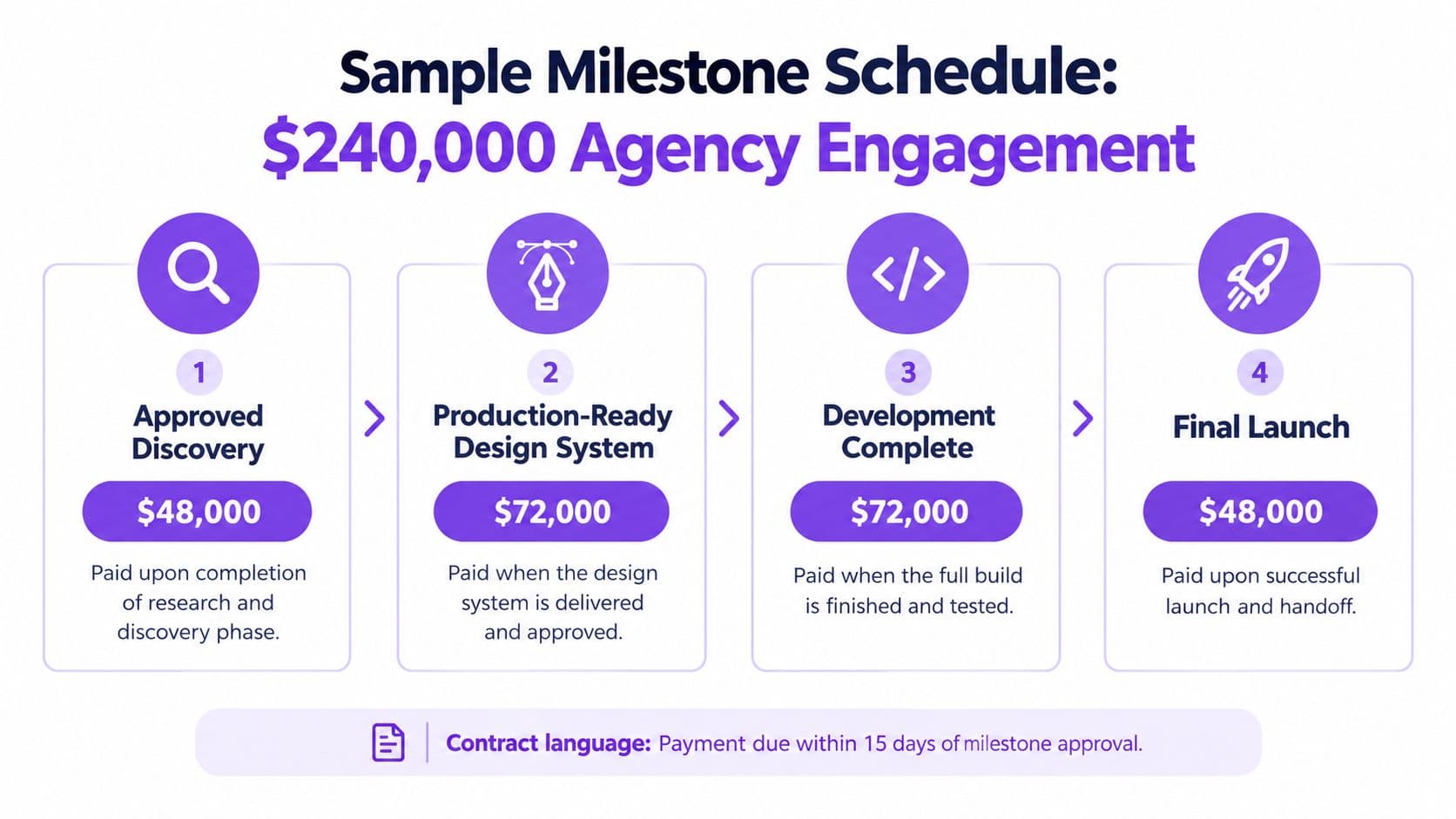
A defensible schedule beats a clever one. For a $240,000 agency engagement, I'd bill $48,000 at approved discovery, $72,000 at delivery of the production-ready design system, $72,000 at launch, and $48,000 after 30 days of accepted stabilization.
Copy-ready schedule logic
Tie discovery to an approved brief, not a vague kickoff call. Tie the design milestone to a delivered system and named approval. Tie launch to successful go-live, and hold back the final payment until the stabilization period ends with no unresolved defects.
Negotiation rule: If the client won't sign off on a milestone, the milestone is not written well enough.
Use contract language that does this:
- Objective acceptance criteria: Define the exact deliverable, test, report, file, or system state that counts as complete.
- Named approver: Identify the person who can approve the milestone.
- Review period: State how many business days the customer has to review.
- Deemed acceptance: Add auto-approval if the customer does not respond within the review period.
- Partial acceptance: Spell out whether the customer can accept part of a milestone and reject part of it.
- Change-order threshold: Require written approval when scope changes affect a milestone amount.
- Dispute payment rule: State whether undisputed amounts remain payable while the parties resolve the issue.
- Retainage release trigger: Define the exact event that releases the final holdback.
For teams that run implementation work with a repair ticket system, every defect, fix, and approval stays visible instead of getting buried in email. That matters when a customer controls acceptance, because the record has to show exactly what was done, what was approved, and what still blocks payment.
For invoicing operations, the practical mechanics line up with how to create invoices in QuickBooks, because a clean schedule only works if finance can issue the invoice on time and for the right amount.
Red flags to reject
- Client satisfaction: Too subjective.
- Substantially complete: Too fuzzy for finance.
- As agreed: Not a term, just a placeholder.
- Approved by client: Which client, and by whom?
- Reasonable acceptance: Reasonable to whom?
A Month-End Close Playbook for Milestone Contracts
Your close process needs three schedules that agree with each other. If they don't, you're going to misstate revenue, overstate receivables, or miss a contract liability.
Build the milestone register first
The register should link each billing event to the performance obligation, the evidence of completion, the estimated amount, and the reversal risk. That's the backbone of the close. Without it, finance is just reconciling invoices and hoping the project team remembered what was delivered.
Then build the three reconciled views:
- Invoice schedule, what you billed and when.
- Revenue schedule, what you earned based on output or input progress.
- Contract asset or liability roll-forward, what has been billed but not yet earned, or earned but not yet billable.
Handle the edge cases explicitly
If a milestone is partially complete at month-end, don't force it into revenue just because the invoice went out. If customer acceptance is delayed, document the delay and assess whether the amount sits in deferred revenue, unbilled revenue, or a reversal-risk bucket. If a change order shifts scope, refresh the contract review before the next close.
If a go-live test fails, the milestone is not complete, even if the team feels close. And if the contract mixes subscription access with implementation services, split the obligations before you book revenue. That's where sloppy billing and sloppy accounting collide.
The close file should answer one question without a follow-up call, what was billed, what was earned, and what still depends on acceptance.
A clean close survives audit because it shows evidence, timing, and judgment in one place. If you need the broader operating rhythm around that close, the process behind close the books is the right operational companion.
Why More Milestones Can Actually Hurt Cash Flow
More invoices do not automatically improve cash flow. They can just create more things to chase.
A recent survey-based report found that only 68.1% of small-business invoices were paid on time in 2025, with average late-payment-related costs of $39,406 per company small-business late payment data. A construction payment report also showed late payments equal to 13% of invoice value at large firms. late-payment construction summary More milestones do not fix buyer behavior.
The trade-off curve is real
Too few milestones push risk to the end. Too many add admin drag, approval friction, and disputes over whether each trigger was met. I'd rather see four clean milestones with hard acceptance rules than nine tiny ones that nobody wants to approve.
If the customer controls acceptance, every extra milestone gives them another chance to delay sign-off. If the provider sets the definition too loosely, every extra milestone creates another argument.
Treat buyer payment behavior as a contract risk. Add deemed acceptance and dispute-payment rules before you add more milestones.
The question is whether each trigger speeds up cash more than it adds overhead. If it does not, cut it.
Your Milestone Billing Implementation Checklist and Next Steps
Audit your contracts for vague acceptance, no deemed-acceptance clause, and subjective sign-off language. Then add five clauses now: objective criteria, named approver, review period, dispute payment rule, and retainage release trigger.
Build the milestone register and set up the three-schedule reconciliation for month-end close. Tie it to the systems you already use, including QuickBooks, NetSuite, Stripe, Xero, and BambooHR, so invoices, approvals, payroll, and revenue timing stop sitting in separate silos. If you need the practical invoicing workflow, start with this QuickBooks invoice setup guide.
In the next 24 hours, flag the bad contracts. In 72 hours, draft the new clauses. Within 30 days, get finance, sales, and legal to sign off on one standardized milestone template.