Financial Operations
Cash Conversion Cycle: Mastering Working Capital
Learn the cash conversion cycle formula, benchmarks by industry, and proven tactics to reduce CCC for SaaS, agencies, and e-commerce businesses.
ByJumpstart Partners, CPA, QuickBooks ProAdvisor
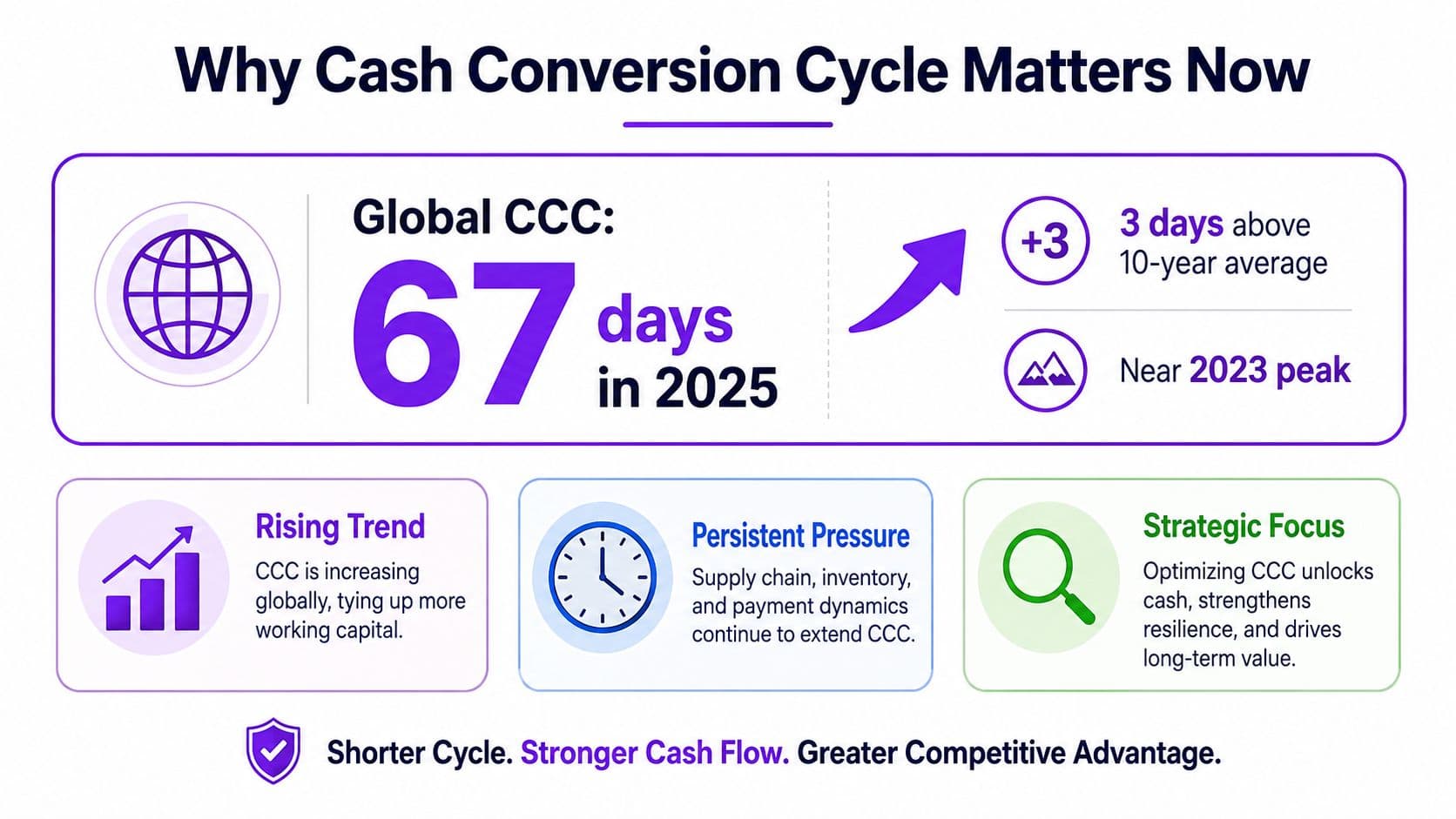
··14 min readGlobal cash conversion cycle performance rose to about 67 days in 2025, roughly 3 days above its 10-year average and near its 2023 peak, according to Allianz Trade's working-capital analysis. That changes the question founders should ask. The issue isn't how to shorten a formula. It's why cash remains unavailable even when revenue is growing.
For a SaaS company, digital agency, or professional services firm, inventory may be minimal or nonexistent. Your cash pressure usually sits elsewhere, in billing cadence, customer payment behavior, contract structure, collections discipline, and the timing of vendor payments. A low or negative cash conversion cycle can still coexist with cash strain when annual contracts, revenue recognition, or customer concentration delay the cash you can use.
This is a controller's view of the metric: cash conversion cycle is a diagnostic, not a universal scorecard. You'll learn how to calculate it, how to interpret it by business model, when a longer cycle represents deliberate growth investment, and which operating changes improve liquidity without damaging customers, suppliers, or service quality.
Table of Contents
- Why Cash Conversion Cycle Matters Now
- Understanding the Cash Conversion Cycle Formula
- Industry Benchmarks and What They Reveal
- When a Longer CCC Signals Strategic Investment
- Prioritized Tactics to Reduce Your CCC
- Implementing Changes Through Controller Services
Why Cash Conversion Cycle Matters Now
U.S. businesses run a CCC of roughly 37 days, while Europe sits at 44.8 days. The gap shows why imported benchmarks can mislead asset-light founders. Allianz Trade's 2025 analysis also places the global cycle at about 67 days in 2025, roughly 3 days above the 10-year average and near the 2023 peak. Regional performance reflects different payment practices, operating models, and working-capital structures, not one universal standard.
For a $500K to $20M business, growth can consume cash before it produces usable liquidity. Hiring may precede demand, delivery may precede full payment, and implementation costs may arrive before collection. Payroll and vendor obligations continue on schedule. Revenue growth can therefore increase funding needs when customer terms lengthen or billing follows delivery.
The metric is often aimed at the wrong problem
Traditional working-capital advice treats inventory as the main constraint. That fits manufacturers and many retailers, but it provides limited guidance for SaaS companies and agencies. A software business may hold little inventory yet face cash pressure because customers pay after delivery, annual contracts create uneven receipts, or a major account delays payment.
The operating dashboard should connect CCC with cash flow visibility. Track invoice dates, contractual terms, actual collection dates, renewals, disputed invoices, vendor due dates, and customer concentration. The formula measures how long cash remains committed. These operating records identify the process causing the delay.
Controller's rule: Set no CCC target until you know which business process is withholding cash.
A practical working-capital improvement framework should start with a 13-week cash forecast and a customer-by-customer receivables view. That structure supports fundraising preparation, hiring decisions, vendor negotiations, and contingency planning more effectively than a standalone ratio. For inventory-heavy businesses, CCC can expose stock and supplier timing. For SaaS and agency models, invoice discipline, contract design, and collection visibility often matter more than the headline formula.
Understanding the Cash Conversion Cycle Formula
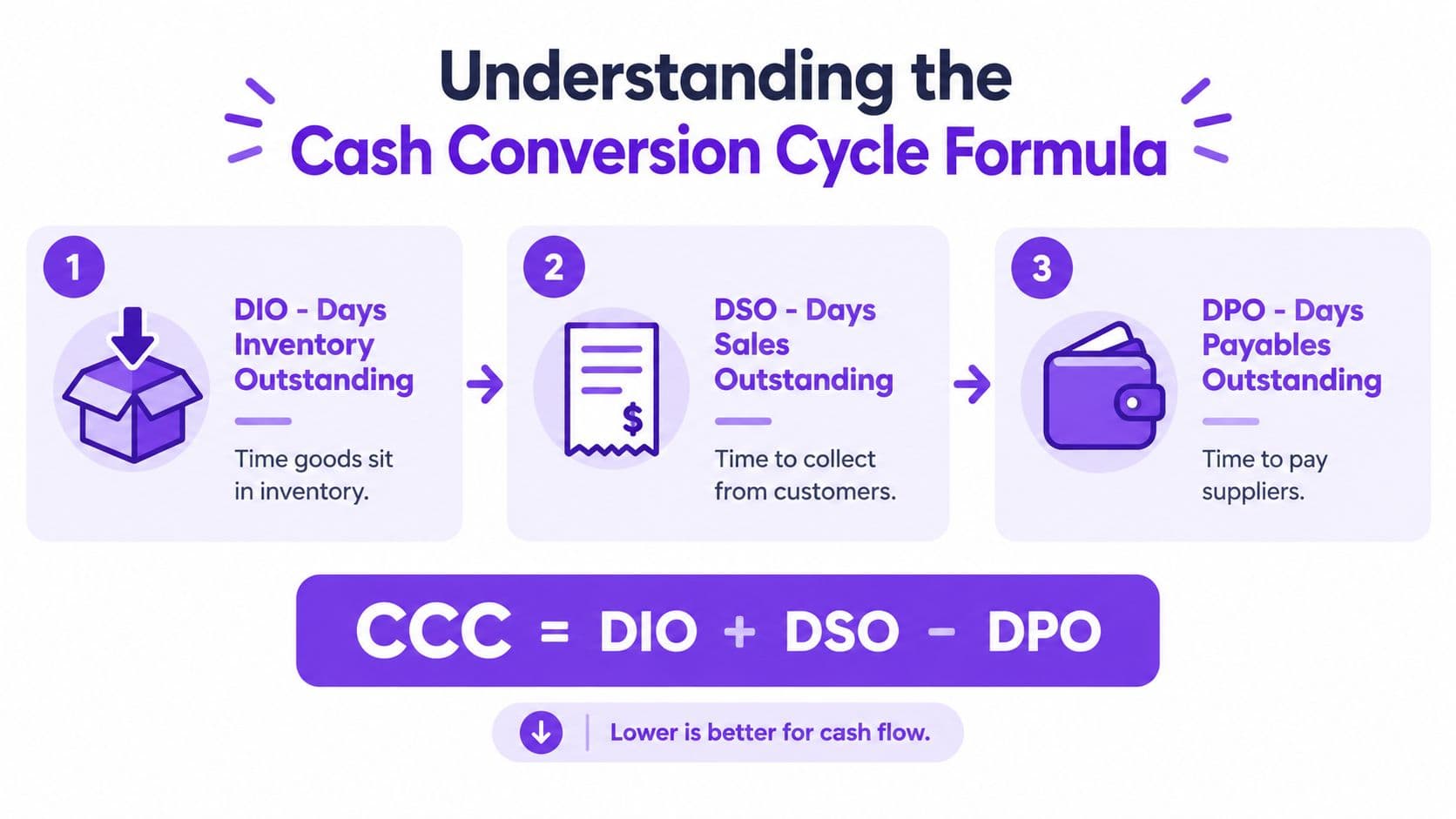
The cash conversion cycle measures the time cash remains committed to operations before it returns as collected cash. J.P. Morgan's explanation of the metric defines the calculation as:
CCC = DIO + DSO − DPO
Each component points to a different operating lever:
- DIO, or Days Inventory Outstanding, measures how long goods remain in inventory before sale.
- DSO, or Days Sales Outstanding, measures how long you wait to collect customer receivables.
- DPO, or Days Payables Outstanding, measures how long you take to pay suppliers.
A worked calculation
Use the example provided by Allianz Trade's cash conversion cycle guide:
| Component | Value |
|---|---|
| DIO | 30 days |
| DSO | 45 days |
| DPO | 20 days |
| CCC | 30 + 45 − 20 = 55 days |
The result is 55 days. In practical terms, the business funds 55 days of operations before it recovers that cash through collections.
The formula also shows where management attention belongs. Reducing DSO by improving invoice accuracy or collecting earlier releases cash. Increasing DPO through negotiated, reliable supplier terms preserves cash, but only when vendors accept the arrangement. Reducing DIO frees capital in inventory-heavy businesses, although cutting stock too aggressively can impair fulfillment.
What the formula doesn't tell you
CCC is a timing measure. It doesn't explain whether a receivable is collectible, whether a customer pays reliably, or whether a vendor relationship can withstand longer terms. It also doesn't show the difference between a predictable cycle and a volatile one.
For an asset-light company, DIO may have little operational meaning. Your most useful analysis may compare contracted billing dates with actual invoice dates, then compare invoice dates with bank receipt dates. Review accounts receivable turnover mechanics alongside aging and cash receipts so you don't confuse accounting revenue with available cash.
Use the embedded explanation as a visual refresher, but build decisions from your own transaction data.
Industry Benchmarks and What They Reveal
There is no universal “good” cash conversion cycle. Umbrex's company-analysis guidance notes that SaaS businesses often carry minimal inventory, so CCC commonly approximates DSO minus DPO. MetricHQ's benchmark discussion provides a broad cash-to-cash reference range of 30 to 45 days, while stressing that the figure must be interpreted within its industry.
A benchmark frames the question. It does not establish whether your liquidity is adequate.
| Business model | Primary CCC driver | What to inspect first |
|---|---|---|
| SaaS | Billing and collection timing | Annual versus monthly billing, renewals, DSO, customer concentration |
| Digital agency | Receivables and delivery timing | Deposits, milestone billing, approval delays, unbilled work |
| Professional services | Contract terms and work completion | Invoice triggers, retainers, time capture, disputed charges |
| E-commerce | Inventory and customer payment timing | Stock levels, fulfillment speed, supplier terms, returns |
| Inventory-heavy business | DIO, DSO, and DPO together | Demand planning, production lead times, collections, supplier reliability |
Why SaaS can look healthy and still feel cash-poor
A near-zero or negative CCC in software does not guarantee comfortable liquidity. Annual subscription collections can arrive before revenue recognition, while revenue can also be recorded before the customer pays. Customer concentration creates another risk. If one major account represents a large share of receivables, average DSO may hide a serious collection dependency.
Agencies have a different cash pattern. They often fund payroll and subcontractor costs before collecting for completed work. Contractual approval requirements can delay invoicing, leaving unbilled work outside the basic CCC calculation while cash continues to leave the business.
For supply-chain operators, KPIs for supply chain from Querio helps place CCC beside operating indicators instead of treating it as a standalone target. Service firms should apply the same discipline by pairing CCC with utilization, backlog, billing completion, and receivables aging.
Pair the benchmark with an accounts payable aging review to test whether your DPO is sustainable. A long payable period may reflect negotiated terms, or it may depend on invoices being paid late.
Benchmark discipline: Compare your current cycle with your trailing twelve months, contract model, and cash forecast before comparing it with another sector.
Inventory-heavy businesses need joint visibility across DIO, DSO, and DPO. Asset-light SaaS and agencies need visibility into billing triggers, approval delays, customer concentration, and actual receipt dates. The formula is shared, but the cash mechanics are structural. Your operating model should determine the target, not an outside average.
When a Longer CCC Signals Strategic Investment
A lower CCC releases cash sooner, but reducing it without context can damage the operating model. Delaying suppliers, cutting inventory buffers, or tightening customer terms may improve the formula while weakening supply continuity, fulfillment quality, or relationships with valuable accounts. The target should be cash efficiency, not the shortest possible cycle.
Pharma shows why the benchmark needs interpretation. Its CCC reached nearly 186 days in 2025, up about 17 days year over year, even as revenue and profitability improved substantially, according to the reported Hackett working-capital findings. The increase does not make a longer cycle automatically healthy. It shows that a deteriorating CCC can reflect deliberate investment rather than simple operating failure.

Separate investment from distress
Start with the operational change and its expected return. A higher cycle may fund faster delivery, preserve availability during volatile demand, or give a strategic customer workable payment terms. Distress looks different: receivables age without a collection plan, inventory accumulates without demand support, or payables stretch because the company cannot fund ordinary obligations.
| A longer CCC can indicate investment when | A longer CCC can indicate distress when |
|---|---|
| Inventory supports a deliberate service-level decision | Inventory grows without a sales rationale |
| Customer terms support profitable strategic accounts | Collections slow across unrelated customers |
| Supplier terms are negotiated and transparent | Vendors escalate overdue balances |
| Management can explain the cash requirement | Forecasts repeatedly miss expected receipts |
The operating model determines the economics. E-commerce may hold inventory buffers to protect fulfillment speed, while excess stock consumes cash and raises markdown risk. A scaling agency may offer flexible customer terms to win work, yet still pay delivery costs before collecting revenue. Asset-light SaaS has little inventory to optimize, so billing readiness, contract timing, and receipt visibility matter more than an industry-wide CCC target.
The decision is simple to state: “What return am I getting for the cash I'm choosing to leave in the operating cycle?” A lender will also assess how receivables and inventory support borrowing capacity. The discussion of cash conversion cycle borrowing base advantage connects operating timing with financing decisions. Better visibility can clarify collateral quality and borrowing needs, but it does not replace collections discipline or a credible forecast.
Decision test: Keep a longer cycle only when you can name the strategic benefit, measure its economics, and fund it without jeopardizing payroll or critical vendors.
Prioritized Tactics to Reduce Your CCC
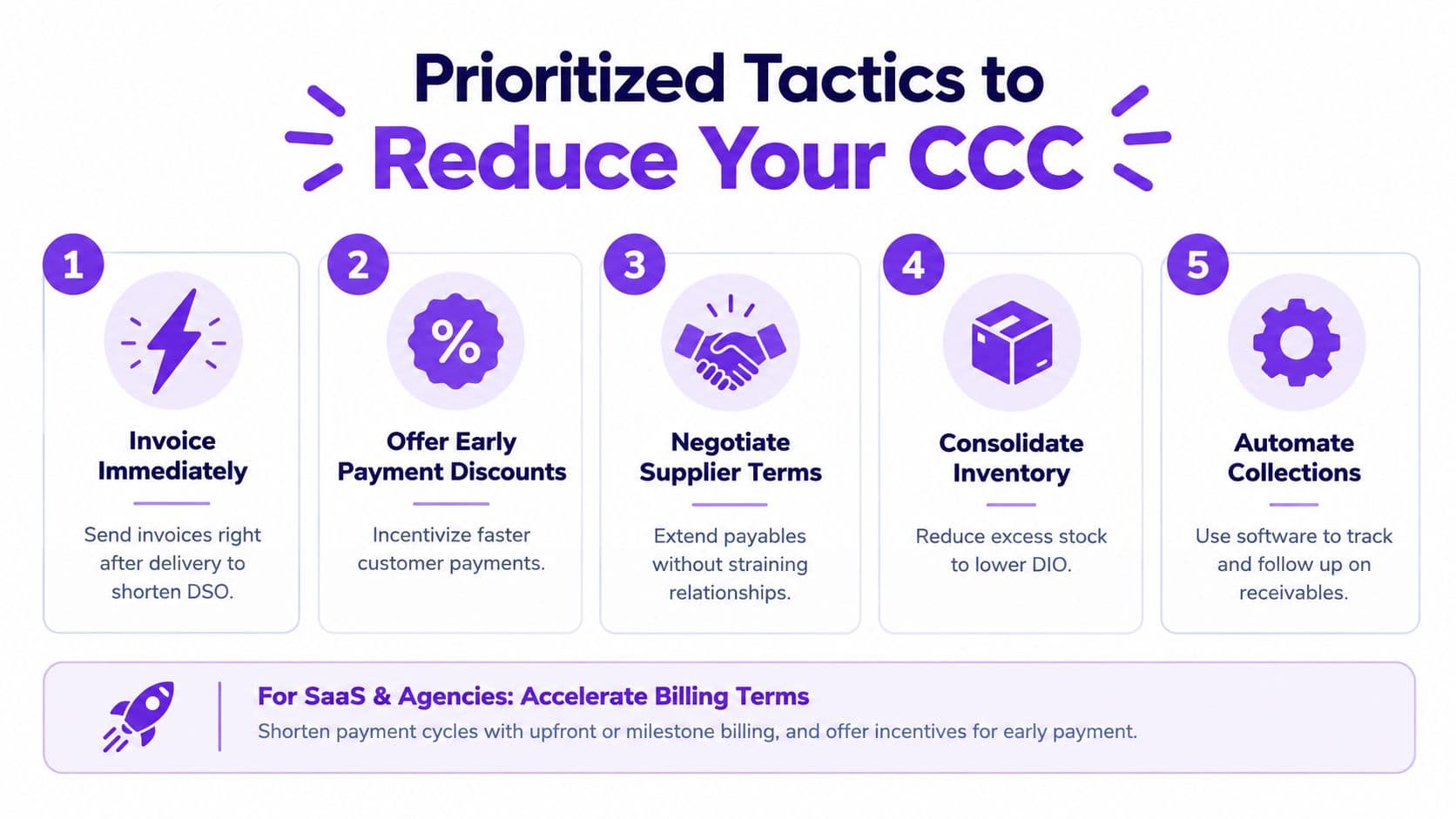
Start with the lever closest to usable cash. For SaaS and agencies, that's usually billing and collections, not inventory. Apply changes in a controlled sequence so you improve liquidity without creating customer disputes or supplier friction.
First, accelerate billing and receivables
-
Invoice at the earliest valid trigger. For an agency, that may mean billing at a milestone rather than waiting until the full project ends. For SaaS, confirm that renewal invoices generate before the service period begins when the contract allows it.
-
Use deposits or upfront billing where the commercial model supports it. This shifts cash timing closer to the point at which you commit delivery resources. It also makes the customer's payment obligation clear before work expands.
-
Make payment easy and follow up consistently. Use accurate purchase-order details, clear remittance instructions, online payment options, and automated reminders. A practical reference on deposit and reminder invoice layout can help standardize invoice presentation and reminder content.
-
Resolve disputes at the source. Tag each overdue receivable by cause, such as missing approval, incorrect invoice data, or service disagreement. Your collections team can then fix the process instead of repeatedly chasing the same symptom.
For a broader operating framework, review accounts receivable management alongside your aging report. The objective is not aggressive collection language. It's predictable conversion from completed work into deposited cash.
Then protect cash through payables
Negotiate terms before invoices become overdue. Align payment dates with your forecast, consolidate vendor commitments where practical, and preserve early-payment discounts only when the economic benefit exceeds the value of retaining cash. Never extend terms. A supplier who loses trust can reduce flexibility precisely when you need it.
Address inventory only where it matters
E-commerce and product businesses should separate excess stock from necessary availability. Review purchasing assumptions, slow-moving items, fulfillment requirements, and supplier lead times. SaaS and agencies shouldn't spend energy optimizing DIO when physical inventory isn't a meaningful cash constraint.
Use a simple priority table for your first operating review:
| Priority | Action | Owner |
|---|---|---|
| Immediate | Review overdue invoices and disputed balances | Controller or AR lead |
| Immediate | Match billing triggers to contract terms | Finance and delivery |
| Next | Map vendor terms against the cash forecast | Finance and operations |
| Contextual | Review excess inventory and service levels | Operations |
| Ongoing | Track actual receipt dates, not only accounting balances | Finance |
Implementing Changes Through Controller Services
CCC improvement fails when the company measures the metric but can't operate the processes behind it. Founders often have accounting software, a payment processor, and a commerce platform, but those systems don't automatically create a reliable view of when cash will arrive. Someone must reconcile transactions, validate invoices, classify disputes, monitor contract terms, and connect operational activity to the forecast.
A practical finance stack can combine QuickBooks, Xero, NetSuite, Stripe, and Shopify with documented workflows. The point isn't to add tools for their own sake. The point is to make billing, collections, reconciliations, revenue recognition, and KPI reporting work from the same source of truth.
Build the operating infrastructure
A controller-led implementation should establish four connected workstreams:
- Data integrity: Reconcile bank, card, payment processor, and accounting records so receivables and payables reflect reality.
- Revenue and billing controls: For SaaS, document ASC 606 workflows and connect contract terms with invoice schedules. For agencies, connect delivery milestones and approvals with billing triggers.
- Cash forecasting: Maintain a rolling 13-week forecast that lists expected receipts by customer and expected payments by vendor. Compare forecasted and actual dates every week.
- Management reporting: Use dashboards for MRR, ARR, CAC, receivables aging, DSO, DPO, and cash runway where those measures fit your model.
A five-day month-end close gives leadership faster access to trustworthy information, but speed only helps when controls remain accurate. Your finance team should define who owns each exception, how disputes escalate, and when management revises the forecast.
Choose the right support model
Outsourced controller services can provide the process ownership that a growing business hasn't yet hired internally. Outsourced controller services from Jumpstart Partners are one option for integrating accounting platforms, building KPI reporting, supporting revenue-recognition workflows, and improving cash-flow visibility. Evaluate any provider against your systems, contract complexity, reporting requirements, and need for investor-ready financials.
Before changing terms or launching a collections campaign, complete this operating sequence:
- Pull current DIO, DSO, and DPO where the metrics apply.
- Segment receivables by customer, contract, age, dispute reason, and expected receipt date.
- Identify the cash constraint that affects your model most.
- Test one billing, collections, payables, or inventory change.
- Track operational impact alongside CCC, including customer response and supplier reliability.
- Update the 13-week forecast with actual payment behavior.
- Set a target based on business model and cash needs, not a generic benchmark.
The central conclusion is simple. The formula measures timing, but the finance operating system creates visibility. When your accounting records, contracts, billing platform, bank activity, and forecast agree, you can decide whether to accelerate collections, preserve supplier relationships, fund deliberate growth, or raise capital from a position of control.
Jumpstart Partners provides outsourced controller and bookkeeping support for SaaS, agencies, e-commerce brands, and professional services businesses managing working-capital pressure. Visit Jumpstart Partners to discuss a 13-week cash-flow forecast, receivables and payables automation, or a controller-led plan for improving your cash conversion cycle.