Financial Operations
Uncover the Best Accounts Payable Automation Software
Discover the best accounts payable automation software for your business. Compare top 10 tools by features, pricing, & integrations for finance leaders.
ByJumpstart Partners, CPA, QuickBooks ProAdvisor
··26 min readManual AP burns cash and management time. Teams that still route invoices through email, spreadsheets, and Slack lose hours every week to coding errors, missed approvals, duplicate payments, and avoidable vendor follow-up.
For a founder, that cost shows up fast. Close takes longer. Cash forecasts get weaker. Vendors chase your team for updates. Finance spends time pushing paper instead of protecting margin.
Here is the simple math.
If one AP hire spends 10 hours a week processing invoices manually, that is 40 hours a month. If automation removes 70% to 80% of that work, you get back 28 to 32 hours monthly. At a fully loaded cost of $35 to $50 per hour for finance support, that is roughly $980 to $1,600 in labor value every month from one seat alone. That excludes the bigger wins: fewer late fees, tighter approval control, cleaner books, and faster month-end close.
This is the primary buying lens. AP automation is an ROI decision before it is a software decision.
The category is mature. You are not betting on an unproven workflow anymore. The central question is simpler: which product fits your accounting system, approval structure, payment volume, and internal capacity to implement it well?
If you process a modest invoice count, have a straightforward approval chain, and your controller can own rollout, software alone is usually enough. If your process is messy, your ERP setup is inconsistent, or no one on the team has time to map workflows, delegation is cheaper than a failed implementation. That is when it makes sense to bring in a firm like Jumpstart Partners to handle tool selection, workflow design, and rollout.
This guide is built for fast decisions. You will get a head-to-head comparison table, a practical implementation checklist, and direct guidance on when to automate internally versus hand the process to an expert.
1. BILL formerly Bill.com
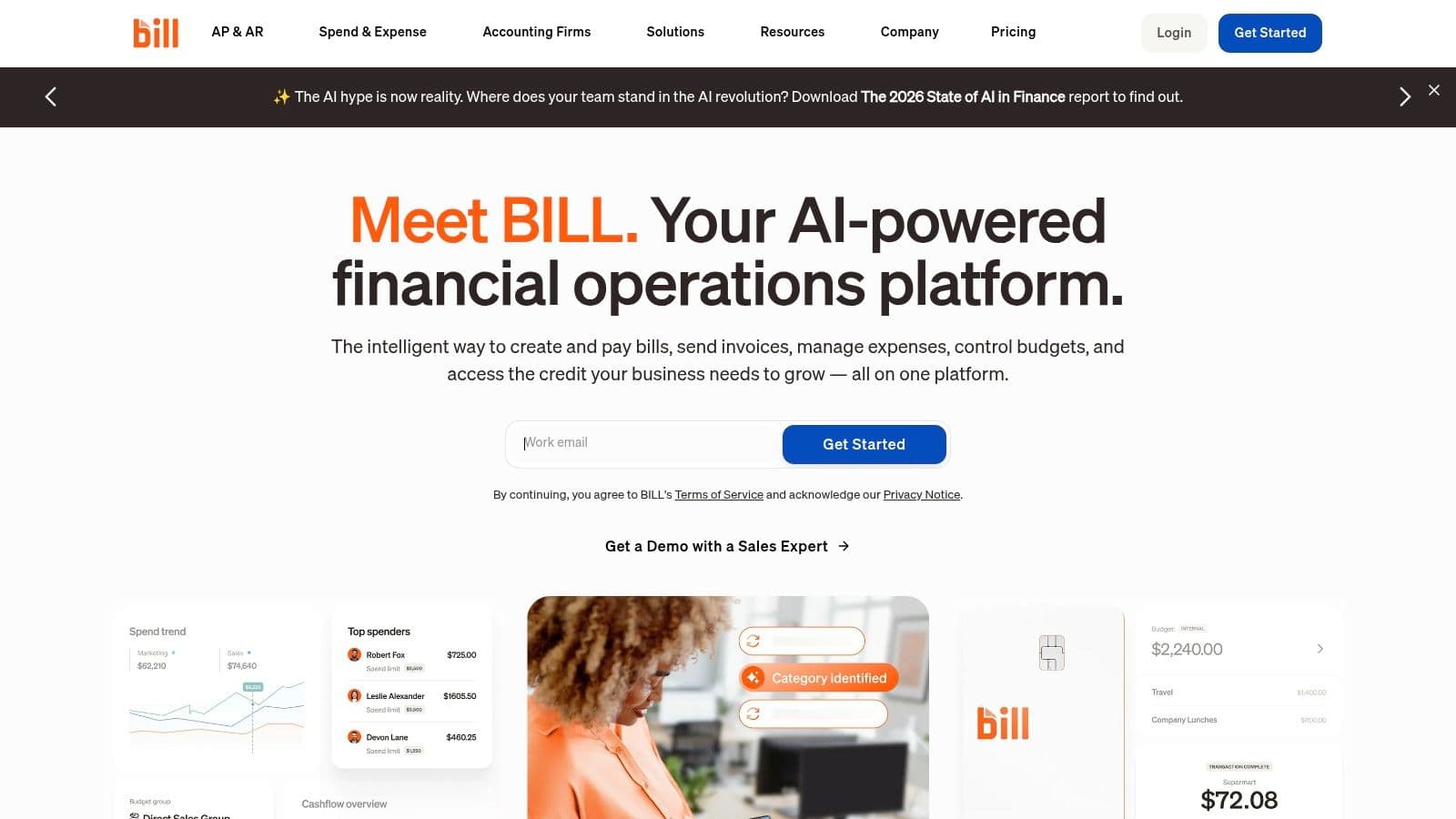
BILL is the safest default choice for small and lower mid-market companies that need AP automation without rebuilding the finance stack.
If you run QuickBooks, Xero, NetSuite, or Sage Intacct, BILL usually gets shortlisted immediately for one reason. It fits how growing companies already work. You get invoice capture, approvals, payment execution, audit trails, and mature accounting syncs in a platform most controllers and outsourced accountants already know.
Why I recommend it
BILL is strongest when your finance process is messy but not unusually complex. You need structure, not a six-month transformation project.
The platform supports:
- Approval discipline with granular approval policies and routing
- Match controls through two-way and three-way PO matching
- Payment flexibility with ACH, checks, virtual cards, domestic wires, international payments, and Pay by Card
- Accounting connectivity through native integrations with QuickBooks, Xero, NetSuite, and Sage Intacct
That combination matters more than flashy AI for many founder-led businesses. If your problem is inconsistent approvals, duplicate work, and poor visibility into what is due, BILL solves the operational core.
Where BILL fits best
Pick BILL if you are in one of these situations:
- You already live in QuickBooks or Xero. BILL is a practical step up from inbox-based AP.
- You want AP and AR in the same ecosystem. That reduces system sprawl.
- You rely on an external bookkeeper or controller. The accountant ecosystem around BILL is broad.
Its main weakness is procurement depth. If you need complex purchasing controls across departments, you may outgrow it and add another tool later.
Founders often overbuy AP software. If your main pain is invoice approvals and payment execution, BILL is enough for many teams.
The pricing for core AP plans is not fully public by dollar amount, so total cost needs review. But as a recommendation, this is simple: if you want proven SMB-to-mid-market AP automation with strong accounting integrations, BILL belongs on your final shortlist.
2. Tipalti
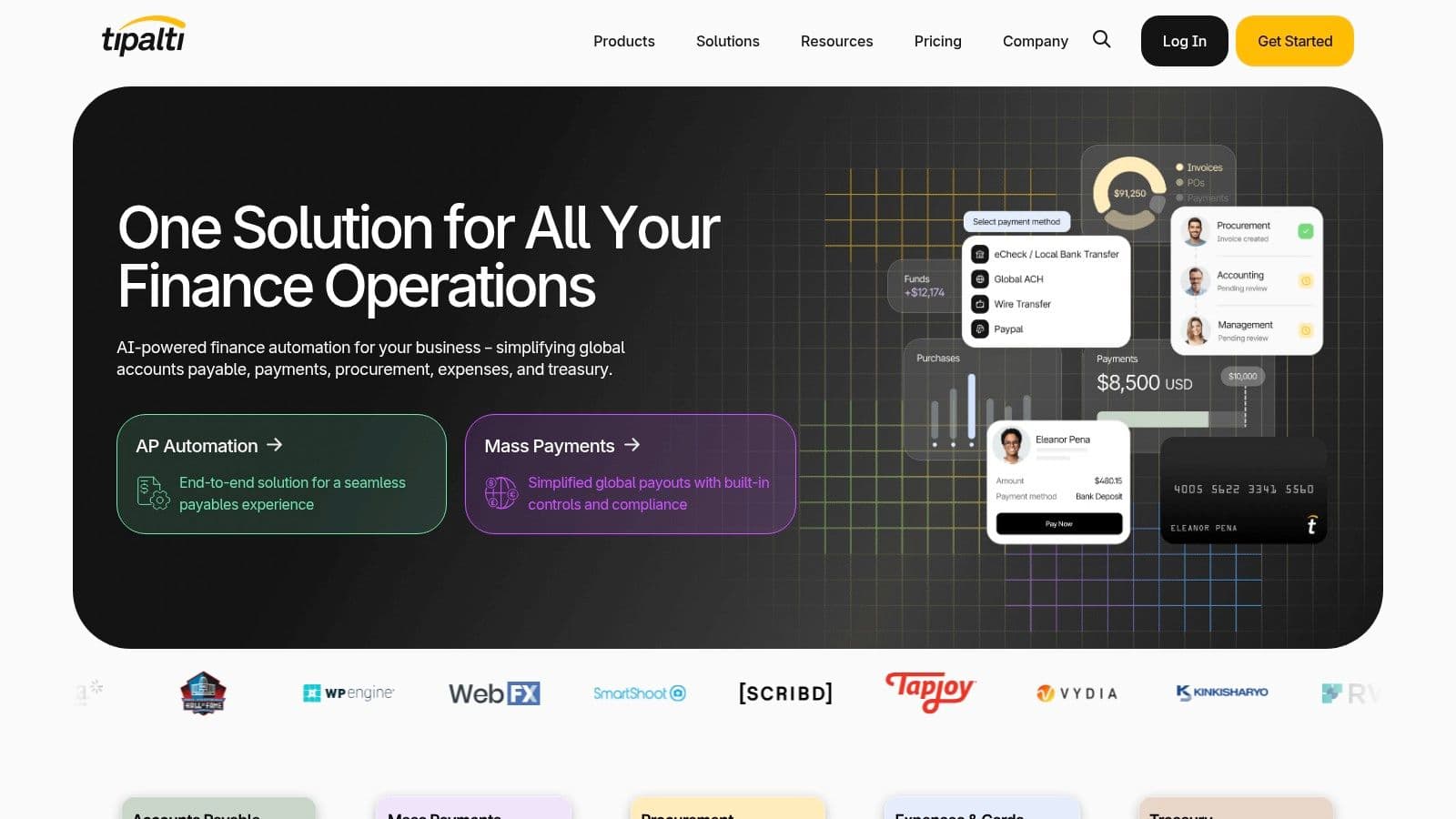
Tipalti earns its keep when one AP hire cannot keep up with vendor onboarding, tax forms, payment exceptions, and cross-border payouts. This is the primary buying trigger. Not invoice count alone.
I recommend Tipalti for finance leaders dealing with operational complexity across countries, entities, and payment methods. If your team pays contractors, affiliate partners, suppliers, and subsidiaries in different jurisdictions, manual AP creates hidden costs fast. Finance wastes time chasing bank details. Tax documentation arrives late. Approvals stall because nobody owns the workflow end to end.
Tipalti fixes that with one system for supplier onboarding, tax data collection, approval routing, payment execution, and reconciliation. The platform is built for global payables. It supports payouts to 200+ countries in 120+ currencies, along with self-service vendor onboarding, W-9 and W-8 workflows, compliance checks, and multi-entity controls.
Where Tipalti delivers ROI
The ROI case is simple. If a controller making $130,000 a year spends even 25 percent of their time handling onboarding issues, tax form follow-up, failed payments, and cross-border payment coordination, you are already burning more than $30,000 a year on manual work before you count error risk or late-close friction.
That is why Tipalti belongs on the shortlist for companies with international payables pressure. Its value shows up in four places:
- Lower labor cost through supplier self-service onboarding and less manual payment handling
- Lower compliance risk with tax form collection and screening built into the process
- Faster close because payment and invoice data land in the right systems with less cleanup
- Better control across entities, approvers, and payment types
This is also where founder discipline matters. AP software works better when spending policy, reimbursement rules, and vendor ownership are already clear. If that foundation is weak, fix it alongside the rollout. A practical starting point is tightening your business expense tracking process so AP, card spend, and reimbursements do not drift into separate systems.
My view on fit
Tipalti is a strong choice for companies in these situations:
- You pay vendors or contractors across multiple countries
- You operate more than one entity
- Your team is manually collecting tax forms and banking details
- You need cleaner controls for audit, compliance, or board reporting
- You expect AP volume and geographic complexity to rise over the next year
The tradeoff is straightforward. Tipalti takes more effort to implement than a lightweight SMB tool. That is the right trade if the alternative is running global payables from email, spreadsheets, and bank portals.
If your business is domestic, simple, and under tight budget pressure, buy a lighter product. If international growth is already creating payment errors, tax headaches, or approval chaos, choose Tipalti early. The cost of waiting usually exceeds the software bill.
3. Ramp Bill Pay
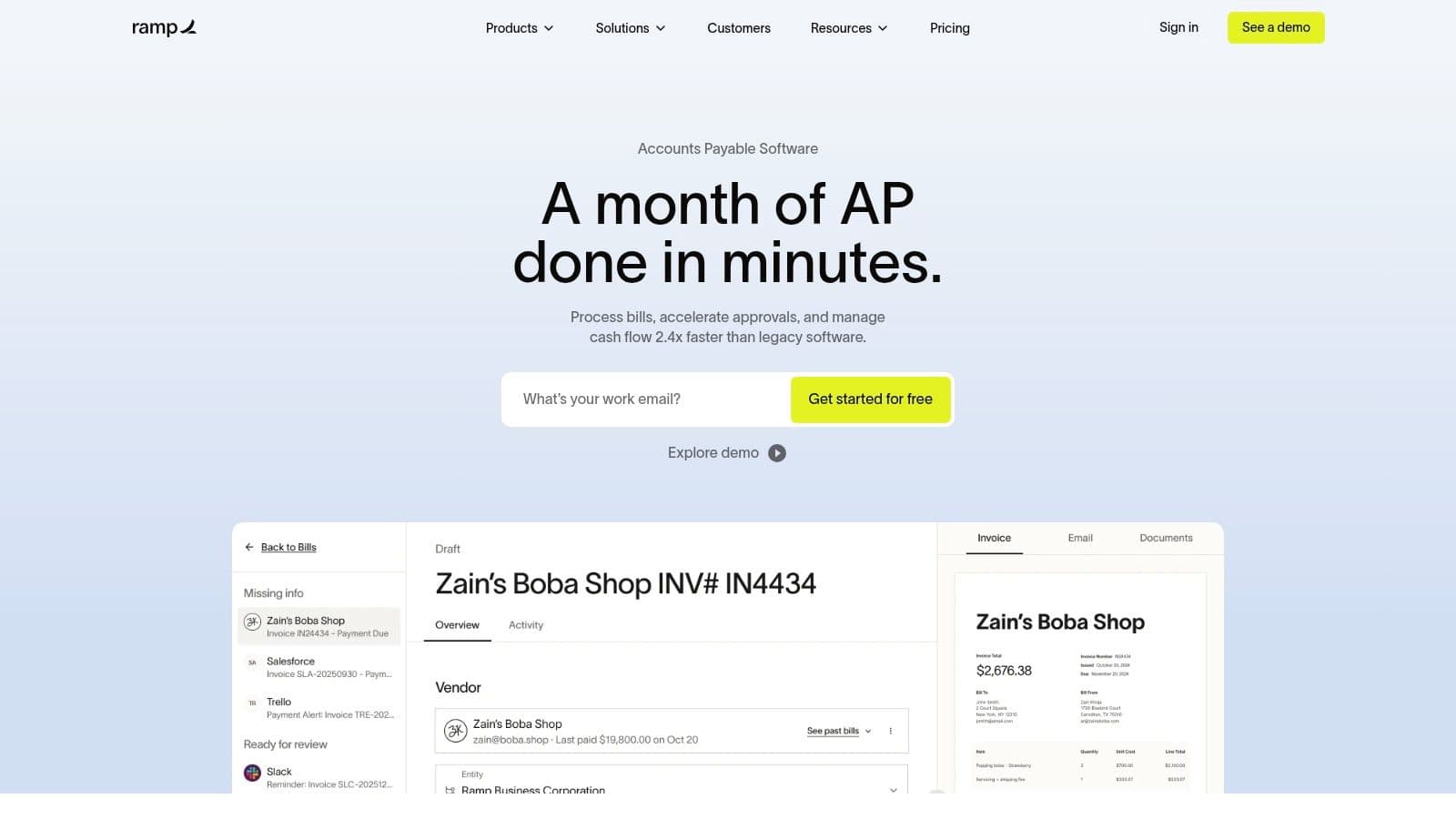
Ramp Bill Pay is the AP platform I’d put in front of a founder who wants results fast. If your team is still routing invoices through inboxes, Slack, and a bank portal, the cost is not abstract. It shows up in late approvals, duplicate effort, and finance staff spending time on clerical work instead of cash control.
Here is the practical ROI case. Assume your company processes 400 invoices a month, and each invoice takes 10 extra manual minutes to code, route, and follow up on. That is roughly 67 hours a month. At a fully loaded finance cost of $45 per hour, you are burning about $3,000 a month on avoidable AP admin before you count late fees, missed discounts, or close delays. Ramp is appealing because it attacks that wasted time without forcing a long, heavy rollout.
Where Ramp wins
Ramp is a strong fit for companies that want AP, cards, expense controls, and payments in one system. That matters if you are trying to reduce tool sprawl and tighten policy enforcement at the same time.
Key strengths include:
- AI-based invoice capture and coding
- Approval workflows with clear reviewer context
- Payment support for ACH, check, card, and wires
- ERP integrations with NetSuite, Intacct, and QuickBooks
- Multi-entity support in a cleaner interface than many legacy AP tools
This is a key consideration, as AP rarely lives alone. It usually sits beside card spend, employee reimbursements, purchasing, and vendor controls. If those processes are still loose, fix them together. A good starting point is tightening your accounts payable process and approval workflow so the software enforces a policy you already believe in.
My view on Ramp
Ramp is best for speed, usability, and consolidation. If you are running separate tools for corporate cards, expense reimbursements, and bill pay, Ramp can simplify the stack and give operators fewer places to make mistakes.
The tradeoff is accounting depth. Companies with complex ERP mappings, unusual entity structures, or messy chart-of-accounts logic should expect some cleanup during implementation. Ramp can handle a lot, but it is still a better fit for a fast-moving operating environment than for for edge-case-heavy accounting teams.
My recommendation is simple. Choose Ramp if you are a founder-led or lean finance team that values fast deployment and unified spend control. Skip it if your primary requirement is highly customized AP controls inside a complicated accounting environment. In that case, buy for complexity, not convenience.
If you can implement software internally and your finance processes are already documented, Ramp is realistic to roll out yourself. If approvals are inconsistent, vendor records are messy, or the ERP setup is already causing reporting issues, bring in a specialist such as Jumpstart Partners to manage the implementation and clean up the process before bad habits get automated.
4. Stampli
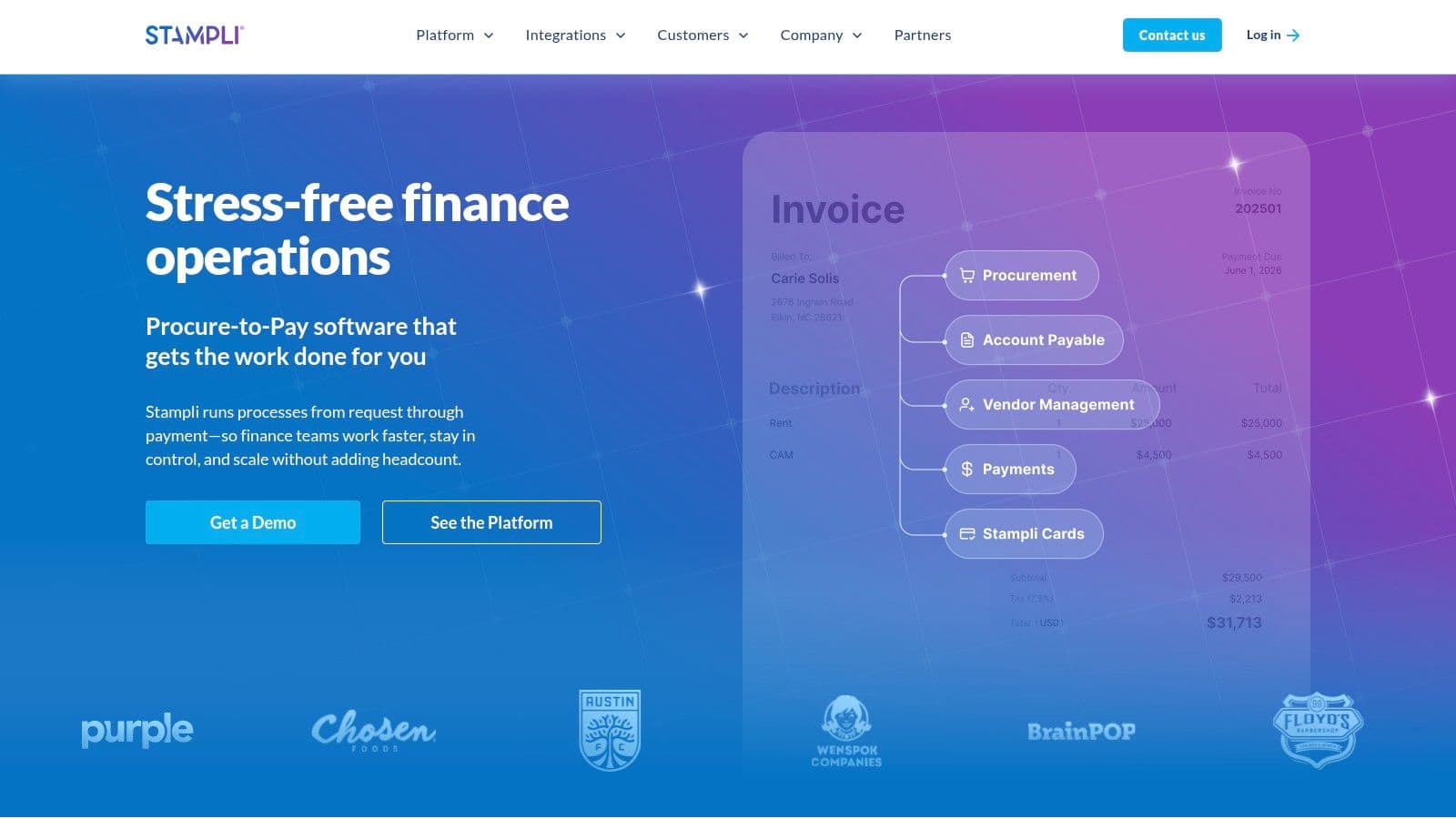
Stampli earns its place on this list for one reason. It removes approval drag.
If your AP team is chasing department heads for coding answers, missing receipts, or signoff on invoices that should have been cleared days ago, that delay has a real cost. A company processing 800 invoices a month can burn dozens of finance hours just on follow-up. Add late fees, missed discounts, and a slower close, and the ROI case gets obvious fast.
Stampli is built around the invoice as the system of record. Comments, questions, approvals, and exception handling stay attached to that invoice instead of getting buried in email threads and Slack messages. That design choice matters more than another generic OCR claim. In AP, context is usually the bottleneck.
Where Stampli performs well
Stampli is a strong fit for finance leaders who already have an ERP and need tighter AP execution, not a full finance stack replacement. It works especially well for teams on NetSuite, Sage Intacct, and QuickBooks that want cleaner routing, faster approvals, and better visibility into why invoices stall.
Its main strengths are:
- AI-based invoice capture and data extraction
- Threaded communication tied to each invoice
- Two-way and three-way matching
- Approval routing and audit trails
- Reporting dashboards
- Optional payments, procurement, and card products
That combination makes Stampli more useful for exception-heavy AP than many lighter tools. If your invoices are simple and your approvers respond quickly, you may not need this much workflow structure. If your monthly close keeps slipping because invoices sit in limbo, you probably do.
You will get more value from Stampli if you fix policy before rollout. Clean approval rules, vendor standards, and escalation paths matter. Start with a tighter accounts payable approval workflow so the software enforces decisions your finance team already supports.
My view on Stampli
I would not choose Stampli because of AI marketing. I would choose it because unresolved exceptions are expensive, and Stampli handles that problem better than tools built primarily for broad spend management.
That makes it a practical choice for companies with real AP volume, cross-functional approvals, and frequent invoice questions. Founders should pay attention here. If one controller or AP manager spends 10 hours a week chasing approvals at a fully loaded cost of $60 to $80 per hour, that is $31,000 to $42,000 a year tied up in administrative follow-up alone. Cut even part of that waste and the software can pay for itself.
My recommendation is clear. Put Stampli near the top of your shortlist if your pain is approval latency, missing context, and invoice back-and-forth across departments. Skip it if your main goal is all-in-one spend management or a simple bill pay tool for a very lean team.
DIY implementation works if your ERP is clean, approval paths are documented, and vendor data is under control. Bring in a specialist such as Jumpstart Partners if the chart of accounts is messy, approvers ignore policy, or AP already breaks during month-end. Software will speed up a disciplined process. It will also expose a broken one.
5. AvidXchange
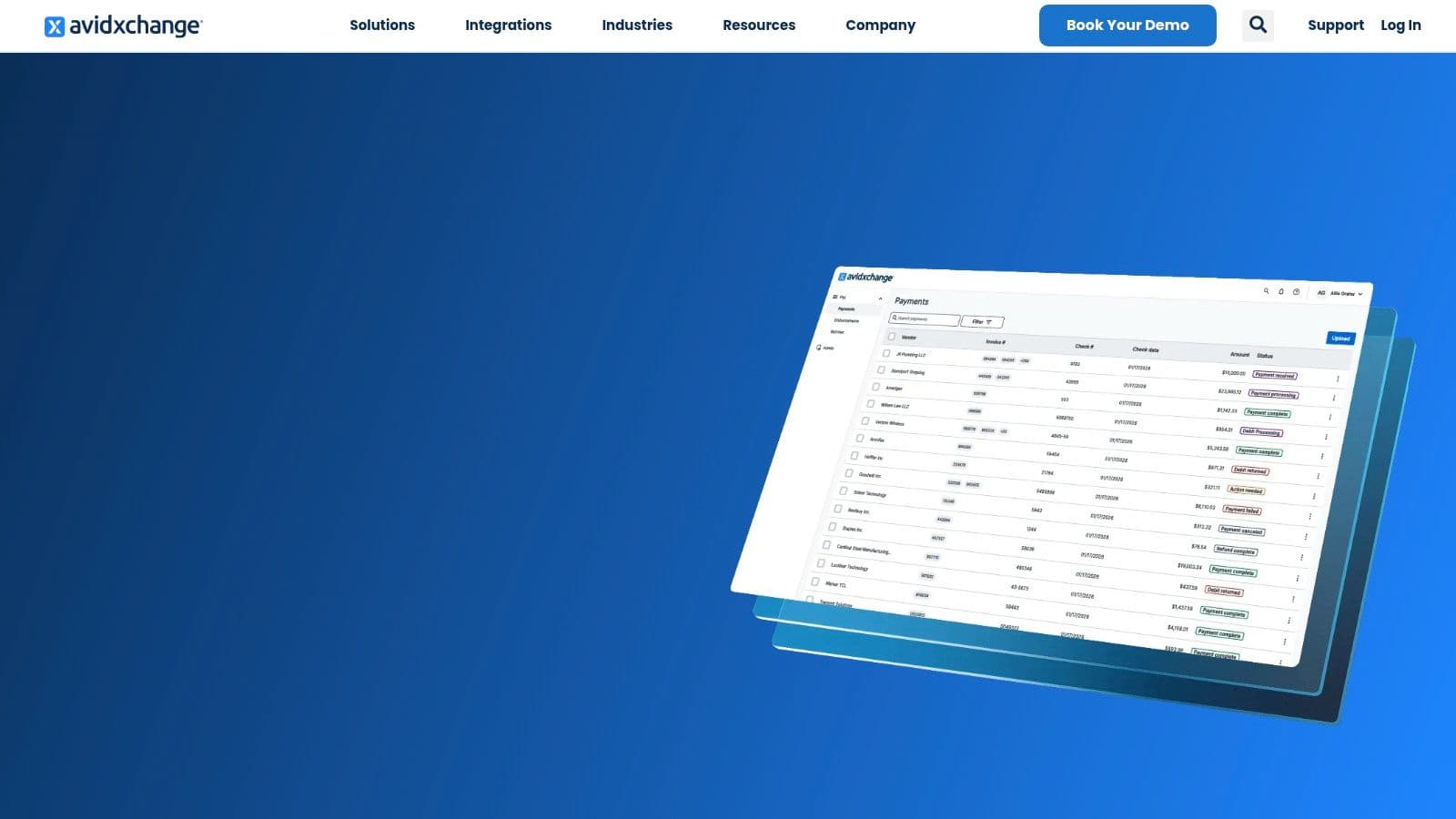
AvidXchange is built for heavier operational environments. If your company processes a high volume of invoices or runs in an industry with repeatable but demanding workflows, this platform deserves serious attention.
I do not usually recommend AvidXchange to an early-stage SaaS company unless volume is already substantial. I do recommend it for middle-market firms that have outgrown lighter AP tools and need stronger workflow structure.
Where it earns its place
AvidXchange offers:
- AI-enhanced invoice processing
- Matching and routing workflows
- Payment automation across ACH, checks, and virtual cards
- Broad ERP integrations
- Industry-focused templates
This is why it shows up often in sectors like construction, real estate, and financial services. Those businesses have approval rules and documentation standards that punish weak AP systems.
There is also a private-equity angle. Rydoo notes AvidXchange’s audit-rich workflows and PO matching support heavy volumes, which is useful for firms chasing tighter closes and board-ready reporting. That is the context where AvidXchange makes sense.
The caveat for founders
AvidXchange can feel enterprise-leaning. Sales cycles are heavier. Configuration can be more involved. If your team is small and your AP pain is basic invoice approval, you can get faster value elsewhere.
Another important nuance comes from the broader category analysis. Some traditional AP tools are strong for high-volume payments but weaker in complex multi-entity SaaS environments that need broader procure-to-pay flexibility. That qualitative gap matters if your business has subsidiaries, software revenue rules, and nonstandard GL mapping.
So my recommendation is narrow and clear. Choose AvidXchange if invoice volume and workflow rigor are your primary problems. Do not choose it just because it is established.
6. MineralTree TotalAP
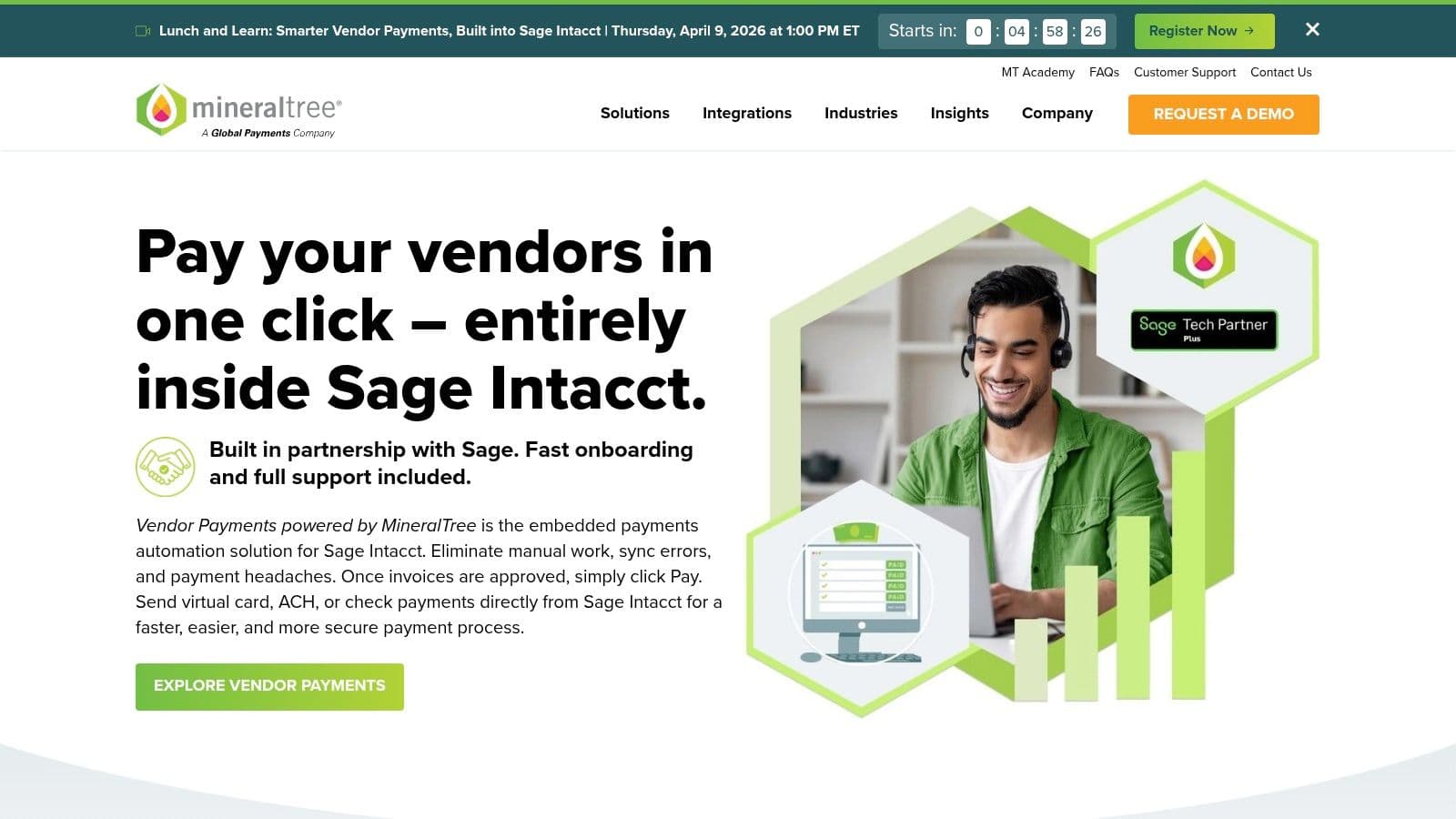
MineralTree TotalAP is a smart pick for finance teams that care about cash control as much as invoice processing. If your controller is already asking which bills to pay now, which to hold, and how to tighten visibility without adding another tool, MineralTree belongs on the shortlist.
The reason is simple. AP is not just an admin workflow. It is a working-capital system. The companies that get real value from AP automation use it to approve faster, schedule payments with more discipline, and see liabilities clearly enough to protect cash.
MineralTree focuses on that operating model with:
- Invoice capture
- Approval workflows
- Payment execution
- ERP connectivity, especially with NetSuite and Sage Intacct
- Reporting tied to payables and cash visibility
That combination matters most in the messy middle stage of growth. You have enough volume that spreadsheets and inbox approvals create risk, but you are not large enough to tolerate a long enterprise software rollout. MineralTree sits in that lane well.
A quick ROI lens makes the case. If a finance team processes 1,000 invoices a month and manual handling costs even a modest amount of staff time per invoice, slow approvals and poorly timed payments can lock up real cash and labor. Founders who want better liquidity should treat AP software selection as part of a broader cash flow improvement strategy, not a back-office tech purchase.
Who should buy it
Choose MineralTree if your AP process is starting to influence cash decisions every week, not just month-end close.
It fits best when you have:
- Growing invoice volume
- A finance stack built around an ERP
- A controller or CFO who wants one system from invoice through payment
- Pressure to improve visibility into outstanding payables
The tradeoff is straightforward. Pricing is quote-based, and implementation will require a real scoping conversation. That is not a problem if your team has enough complexity to justify it. If you only need basic approval routing for a small bill count, you can buy something simpler. If AP timing, controls, and cash visibility are now finance priorities, MineralTree is the better fit.
7. Quadient AP by Beanworks
Quadient AP is the practical choice when many people touch AP approvals and you do not want user-based pricing to punish adoption.
That unlimited-users packaging matters more than it sounds. In many businesses, AP slows down because only a handful of licensed users can interact comfortably with the system. Quadient removes that friction.
The operational case for Quadient
Its strength is straightforward process improvement across invoice capture, coding, approvals, vendor management, and payments.
Quadient’s own analysis, cited in the Fraxion roundup earlier, found manual teams process 5 invoices per hour versus 30 with automation. I bring that up here because Quadient is one of the clearest examples of software designed to raise throughput without forcing the organization into a complex procurement platform.
You get:
- Centralized invoice capture
- Automated coding
- Custom approval workflows
- PO matching
- Vendor management and payments
- Integrations with QuickBooks, Sage Intacct, NetSuite, and Microsoft Dynamics
Best use case
Choose Quadient when your AP workflow touches department heads, project managers, location managers, and finance reviewers across the business.
It is especially useful if:
- You need broad approver participation
- You want predictable user cost
- You are in SMB or mid-market territory
- You need accounting integration more than procurement depth
The limitation is procurement. If you need full source-to-pay controls, you may need a complementary tool later.
Still, for many growing businesses, Quadient hits the sweet spot. It gives you enough automation and control to get invoices moving faster without wrapping AP inside an oversized enterprise suite.
8. Yooz
A founder does not need another AP tool that saves a few clicks. You need one that cuts invoice handling time fast enough to free real finance capacity. Yooz earns its spot because it is built for quick deployment, strong invoice capture, and broad user access without a long systems project.
I recommend Yooz for companies that want proof of ROI before they commit to a heavier rollout. If your team is still keying invoices by hand, chasing approvers in email, and cleaning up coding mistakes at month-end, Yooz can fix those bottlenecks quickly.
Where Yooz fits best
Yooz is strongest in finance teams that need AP automation now, not after a six-month process redesign.
Its core offering includes:
- AI-powered invoice capture
- Approval workflows
- Analytics
- Supplier management
- ERP and accounting integrations
- A 15-day free trial
- Unlimited users on paid tiers
That pricing structure matters. Unlimited users removes one of the usual adoption barriers, which is finance trying to control cost by limiting approvers. In practice, that usually backfires. AP slows down, exceptions pile up, and month-end closes drag.
Yooz also supports broader finance process improvement. Cleaner invoice data and faster approvals make downstream reporting more reliable, which is why AP automation often pairs well with financial reporting automation for faster month-end close.
ROI view
Here is the simple math founders should run.
Assume your team processes 2,000 invoices per month. If automation saves even 5 minutes per invoice across capture, routing, and coding, that is 10,000 minutes back each month, or roughly 167 hours. At a fully loaded finance labor cost of $45 per hour, that is about $7,500 per month in recovered capacity.
That does not include late payment fees, duplicate payment risk, or the cost of pulling a controller into AP cleanup during close.
Yooz is a good option when you want to validate that return with a fast pilot. Its volume-based pricing can work well for lighter AP teams, but high-volume companies should model growth carefully before signing. If invoice counts rise sharply, your software bill will rise with them.
My recommendation
Choose Yooz if you want fast time-to-value, strong document capture, and an easy way to get non-finance approvers into the process.
It is a solid fit if:
- You want to pilot AP automation with low implementation friction
- You process enough invoices to justify automation, but not enough to need a full procurement suite
- You need broad user participation without per-user pricing pressure
- You care more about invoice workflow speed than deep sourcing or procurement controls
The tradeoff is clear. Yooz is better for AP execution than for complex procurement design. If your business depends on highly customized PO workflows or broader source-to-pay controls, you will outgrow it faster than you expect.
9. Medius
Medius is for finance teams that care about exception handling as much as straight-through processing.
A lot of AP software demos look great on perfect invoices. AP departments live in the imperfect cases: wrong amounts, missing POs, duplicate submissions, unusual vendors. Medius earns its place because it is designed to handle those exceptions without collapsing into manual chaos.
Where Medius stands out
Its platform focuses on:
- Multi-way matching
- Exception handling
- AI support through Medius Copilot
- Fraud and risk detection
- Supplier conversations
- Embedded payments
- Unlimited users in packaged offerings
For organizations with layered controls and more complicated approval logic, that matters. It also reduces the need to bolt together too many point solutions.
My recommendation
Pick Medius if your AP process has enough edge cases that a lighter tool would create too many manual workarounds.
I especially like it for businesses that have:
- Multiple entities or departments
- Frequent invoice exceptions
- A stronger control environment
- A need for fraud screening inside AP
The downside is scope. Very small teams may find it broader than they need. Public list pricing is not shown, so budget review requires a sales conversation.
This is not the first tool I would hand to a founder with simple domestic AP. It is one I would hand to a controller who is tired of managing exceptions with spreadsheets, inboxes, and memory.
10. Airbase by Paylocity Paylocity AP Automation
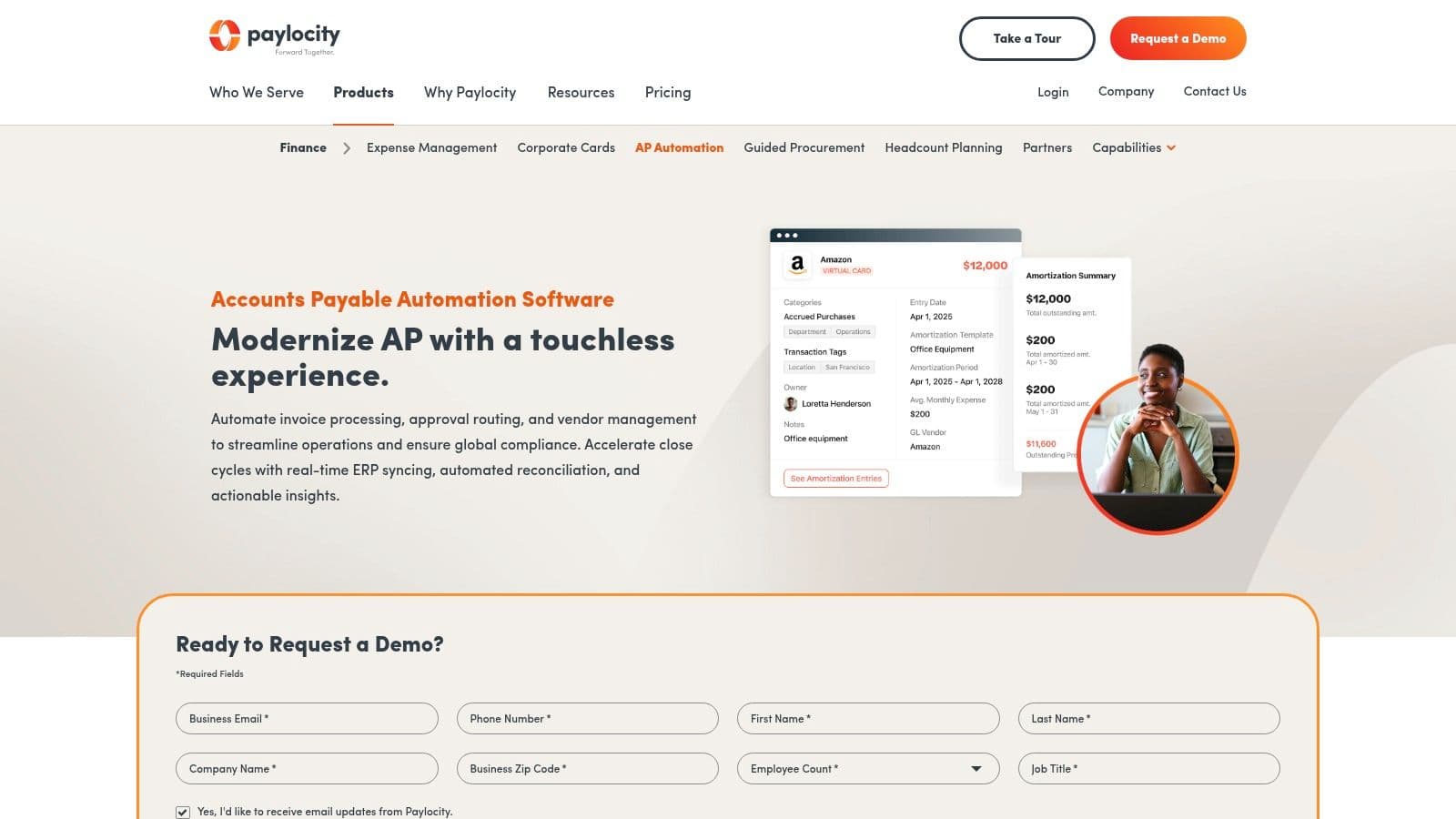
A founder who runs AP in one tool, cards in another, and reimbursements in email usually pays for the same transaction three times. Once in software fees, once in finance labor, and once in policy leakage. Airbase by Paylocity solves that by putting payable workflows, employee spend, and purchasing controls in one system.
Many growing companies don't just have an AP problem. They have a spend-governance problem. Bills get approved without clear budget ownership. Card spend posts before finance sees it. Reimbursements arrive after the month closes. Airbase is built for that mess.
Why Airbase earns a spot on this list
The value is consolidation with control. You get:
- Touchless AP
- Invoice capture and coding
- Three-way matching
- Global payments
- ERP integrations
- Corporate cards
- Expense management
- Procurement controls
That matters for ROI.
If your controller spends 15 hours a week reconciling card transactions, chasing receipt support, and tying employee spend back to vendor bills, that is roughly 780 hours a year. At a fully loaded finance cost of $60 to $80 per hour, you are burning $46,800 to $62,400 annually on administrative cleanup alone. A unified spend platform can cut a meaningful share of that work and tighten policy enforcement at the same time.
Who should choose Airbase
I recommend Airbase for companies that have already outgrown point solutions and now need one policy framework across AP and employee spend.
It is a strong fit if you:
- Want one platform for AP and employee spend
- Need tighter approval controls across departments
- Use NetSuite, Sage Intacct, or QuickBooks
- Are building a finance function that can scale without adding avoidable headcount
The tradeoff is straightforward. If you only need basic invoice capture, approvals, and payments, Airbase can be more platform than you need. If your real issue is fragmented spend control across bills, cards, and reimbursements, it is one of the better choices in this category.
Here is my CFO view. Buy Airbase when consolidation itself is the business case. If your workflows are still undefined, or your team lacks the time to redesign approvals, vendor policies, and ERP mapping, bring in outside help and implement it properly the first time.
Top 10 AP Automation Software Comparison
| Solution | Core features ✨ | UX & Quality ★ | Pricing / Value 💰 | Best for 👥 |
|---|---|---|---|---|
| BILL (formerly Bill.com) | 2/3‑way PO matching; invoice capture; ACH/check/card/wires; native QuickBooks/Xero/NetSuite syncs ✨ | Mature integrations; reliable audit trails ★★★★ | Transparent payment fees; core AP plan pricing opaque 💰 | SMBs on QuickBooks/Xero needing strong AP/AR 👥 |
| Tipalti | Global payouts (200+ countries); supplier onboarding; TIN/OFAC checks; multi‑entity PO matching ✨ | Enterprise‑grade reliability; compliance focus ★★★★ | Subscription + per‑tx fees; no free tier 💰 | Scaling firms with global pay & tax complexity 👥 |
| Ramp Bill Pay | AI agents for invoice processing; 2/3‑way matching; multi‑rail payments; fast setup ✨ | Modern UX; fast time‑to‑value; evolving AI features ★★★★ | Generous free tier; low‑cost Plus; no fees for standard domestic payments 💰 | Startups & tech companies wanting a free, modern AP 👥 |
| Stampli | AI invoice capture; threaded approver/vendor conversations; dashboards; 2/3‑way matching ✨ | Best‑in‑class approver experience & support ★★★★★ | Pricing not public; payments/cards often add‑ons 💰 | Teams prioritizing collaboration & approver UX 👥 |
| AvidXchange | AI invoice processing; payment automation (ACH/check/virtual card); vertical templates ✨ | Scales to very high volumes; industry templates ★★★★ | Enterprise sales/pricing; may be heavy for small teams 💰 | Mid‑market with high invoice volume & industry needs 👥 |
| MineralTree TotalAP | End‑to‑end invoice‑to‑pay; certified NetSuite/Intacct connectors; analytics & pay optimization ✨ | Strong ERP connectors; analytics for cash flow ★★★★ | Volume‑based pricing; sales quote required 💰 | Mid‑market NetSuite/Intacct users focused on pay optimization 👥 |
| Quadient AP (Beanworks) | Centralized capture & coding; customizable approvals; unlimited‑user licensing ✨ | Predictable UX for many approvers; solid integrations ★★★★ | Customized quotes; predictable cost when many users 💰 | Companies with large numbers of approvers 👥 |
| Yooz | AI/OCR capture; touchless processing; approvals & supplier mgmt; 15‑day trial ✨ | Fast pilot & touchless throughput; intuitive ★★★★ | Volume‑based document pricing; free 15‑day trial 💰 | Teams wanting a quick pilot and touchless AP 👥 |
| Medius | AI native (Copilot); multi‑way matching; fraud/risk detection; embedded payments ✨ | High touchless rates; strong exception handling ★★★★ | Module/ entity‑based pricing; quote required 💰 | Mid‑market teams seeking maximum automation 👥 |
| Airbase by Paylocity | Touchless AP + corporate cards + procurement + global payments; ERP syncs ✨ | Unified spend platform; strong reconciliation; Gartner‑recognized ★★★★ | Quote‑based; full suite may be pricier if only AP needed 💰 | Finance teams wanting a single spend + AP platform 👥 |
Your Next Step Automate or Delegate
Companies do not lose money on AP automation because the software fails. They lose money because rollout stalls, ownership gets fuzzy, and the manual process stays in place for another quarter.
Treat this as an ROI decision.
If your team spends 10 hours a week on invoice entry, approvals, payment follow-up, and exception handling, that is about 40 hours a month still tied up in low-value work. If your fully loaded finance cost is $50 to $75 per hour, you are spending roughly $2,000 to $3,000 every month on work that software should reduce. Delay implementation by six months and the cost of inaction alone lands around $12,000 to $18,000, before counting late-payment risk, duplicate payments, or founder time pulled into approvals.
The DIY path
Run implementation internally only if you have one clear owner with enough time to finish it.
That person needs to handle:
- vendor selection
- workflow design
- ERP or accounting integration
- approval policy setup
- vendor onboarding
- user training
- post-launch cleanup
DIY works best in a narrow set of conditions. One entity. Simple approval chains. A clean chart of accounts. Limited PO requirements. Few payment methods. No international complexity.
Bandwidth is the deciding factor.
If your controller is already managing close, reconciliations, reporting, and audit prep, AP automation usually gets pushed into nights, Fridays, and “after we finish month-end.” That is how a 30-day project turns into a 120-day drag on the team.
As noted earlier, AP automation can save meaningful processing time and reduce manual errors. You only get that return when coding rules, approval paths, vendor records, and sync settings are configured correctly. A rushed setup creates a different kind of mess. Invoices route to the wrong people, GL mappings break, and exceptions pile up faster than before.
The delegated path
Delegate the rollout when speed matters, controls matter, or founder attention is already stretched.
Choose outside help if any of these are true:
- Your team is lean. Nobody has 5 to 10 hours a week to own rollout.
- Your books need cleanup. Custom GL logic, class tracking, and historical coding issues will slow the project.
- You need tighter controls now. Fundraising, audits, lender reporting, or board scrutiny make AP discipline urgent.
- You want one implementation. Rebuilding workflows after a bad launch costs more than getting it right the first time.
Many founder-led businesses get stuck at this stage. The software is usually fine. The failure point is implementation discipline.
That is the practical case for using a firm like Jumpstart Partners. The value is not just picking a tool. The value is setting approval logic, cleaning the chart of accounts, connecting QuickBooks, Xero, or NetSuite properly, onboarding vendors, and training the team so invoices move through the system the way your business operates.
If you already work with outsourced accountants, AP automation should fit that operating model. It should improve close speed, reporting quality, and cash visibility, not sit off to the side as one more disconnected app.
Use this checklist before you decide:
- Choose DIY if your AP process is simple, your systems are clean, and one accountable owner has real capacity for the next 30 to 60 days.
- Choose delegated implementation if your team is at capacity, your accounting structure is messy, or you need audit-ready controls fast.
- Pause and clean up first if vendor records, coding rules, and approval policies are inconsistent. Bad inputs will carry into any new platform.
My recommendation is straightforward.
Simple environment, clear owner, available time. Do it yourself.
Messy systems, lean team, urgent reporting needs. Delegate it.
The wrong platform wastes subscription budget. The wrong rollout wastes months.