Financial Operations
Bookkeeping for Marketing Agencies: A Practical Playbook
Master bookkeeping for marketing agencies with project-based accounting, retainer handling, ASC 606 revenue recognition, and KPI dashboards that expose client
ByJumpstart Partners, CPA, QuickBooks ProAdvisor
··18 min readThe most popular advice about bookkeeping for marketing agencies is wrong: “Just categorize every transaction and reconcile the bank.” That produces tax-ready records, but it doesn't tell you whether a retainer is profitable, whether a campaign is consuming unpaid labor, or whether media spend is inflating your revenue.
Agency finance breaks because cash timing, delivery costs, and client economics rarely line up. Marketing firms in the United States numbered 7,761 at the end of 2022, up 17.4% from the prior year, while U.S. digital advertising agency revenue reached $55.7 billion in 2023, more than triple its 2017 level, according to agency bookkeeping benchmark data. Growth adds retainers, milestone work, contractors, production costs, and pass-through media to the same ledger.
You need books that answer a harder question than “Did we make money?” They need to show which client created the margin, which one consumed it, and what operational decision follows.
Table of Contents
- Why Agency Bookkeeping Breaks the Standard P&L
- Building the Chart of Accounts and Project Tags
- Handling Retainers, Milestones, and Pass-Through Costs
- Revenue Recognition Rules for Agency Engagements
- The Five-Day Agency Month-End Close Checklist
- KPI Dashboards That Expose Client Profitability
- Red Flags, Common Pitfalls, and Your Next Steps
Why Agency Bookkeeping Breaks the Standard P&L
A consolidated P&L can report $1.4 million in revenue and a 22% net margin while hiding two clients with radically different economics. One account can run at -8% contribution margin, while another produces 41%. The agency looks healthy in aggregate, yet one client is actively destroying delivery capacity.
That isn't a bookkeeping technicality. It changes your pricing, hiring, scope-control, and retention decisions. A flat chart of accounts combines project labor, contractor fees, production, and media activity into totals that conceal the cost of fulfilling each engagement.
A 12-person creative shop using one service-revenue line may conclude that its model works. If its two worst clients disappear and quarterly net income suddenly falls 38%, the business has learned that its apparent profitability depended on accounts it should have repriced or exited. Those figures are a worked illustration, not an industry benchmark. The point is the reporting failure, not the specific agency profile.
| Metric | Standard P&L View | Client-Level View |
|---|---|---|
| Revenue | Total service revenue | Retainer, project, performance, and pass-through revenue by client |
| Labor | Payroll in one broad expense line | Delivery hours and labor cost assigned to each engagement |
| Contractor spend | Total subcontractor expense | Contractor cost tied to the client and project phase |
| Media spend | Blended expense or inflated revenue | Principal-versus-agent treatment by vendor relationship |
| Profitability | One agency-wide margin | Contribution and delivery margin ranked by client |
| Management action | “Revenue is growing” | Reprice, rescope, staff, collect, or offboard |
The cost of aggregated noise
Many founders trust the P&L because it closes on time. That confidence is misplaced when the books don't connect revenue to the work that generated it. Accounting guidance for marketing agencies treats project accounting, labor tracking, receivables, and client profitability as distinct requirements because a business-level report can't expose delivery economics on its own.
You also need a workflow that keeps each transaction tied to the right client and entity. Teams handling multiple entities, payment accounts, or operating units can review multi-network posting for teams as part of a broader control environment, but software won't rescue an undefined tagging policy.
Controller's rule: If your P&L tells you the agency is profitable but can't tell you which clients are profitable, it isn't a management report yet.
The rest of the system starts with account design and project tags. Until those foundations exist, margin analysis is guesswork dressed up as finance.
Building the Chart of Accounts and Project Tags
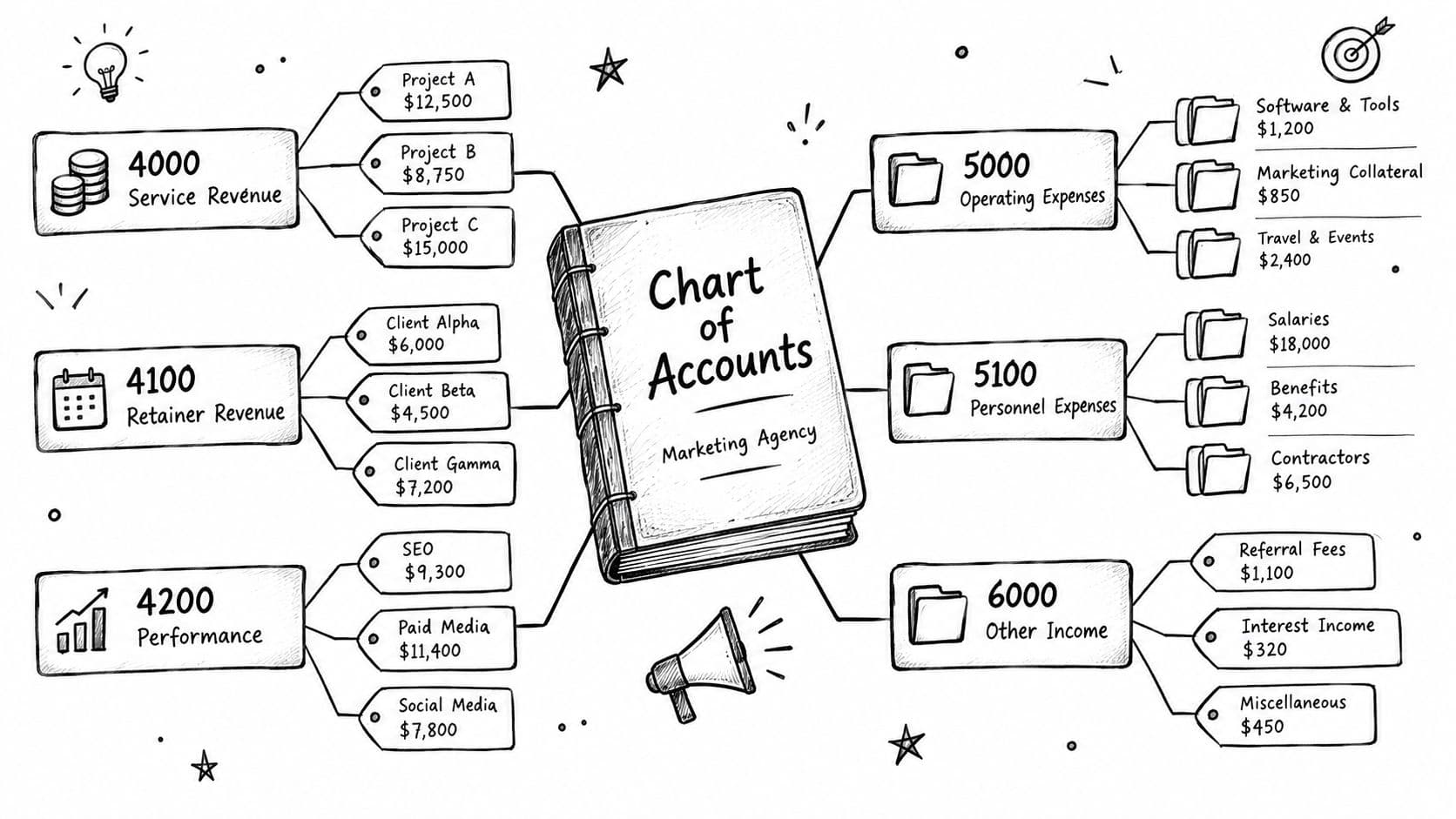
Build the ledger around how your agency earns and delivers work, not around the default account list in QuickBooks Online or Xero. A generic chart of accounts makes tax filing easier to organize, but it forces management to rebuild client economics in spreadsheets.
A practical structure looks like this:
| Account range | Account name | Purpose |
|---|---|---|
| 4000 | Service Revenue | Core service income where a more specific account isn't appropriate |
| 4100 | Retainer Revenue | Recurring service commitments |
| 4200 | Performance Revenue | Contingent or outcome-based fees |
| 4300 | Pass-Through Revenue | Gross presentation only when principal treatment applies |
| 2300 | Pass-Through Liability | Client funds or obligations awaiting settlement |
| 5100 | Direct Labor | Employee delivery labor assigned to client work |
| 5200 | Subcontractor Fees | Freelancers and external delivery partners |
| 5300 | Media Spend | Client media costs requiring explicit classification |
| 5400 | Production Costs | Client-specific production and fulfillment costs |
| 6100 to 6800 | Overhead | Internal payroll, software, rent, insurance, and administration |
| 9100 to 9400 | Owner and Equity | Draws, distributions, contributions, and equity accounts |
Separate revenue accounts matter because ASC 606 reporting depends on what you promised and how you deliver it, not merely on when cash enters the bank. The chart of accounts framework for growing businesses gives you a useful foundation, but agencies need to extend it with client and engagement dimensions.
Make project tagging mandatory
In QuickBooks Online, enable Projects and classes. In Xero, use Tracking Categories. Tag every invoice, vendor bill, expense, and time entry with:
- Client: Acme, Northstar, or another approved client code.
- Engagement phase: Retainer, project, media, production, or internal.
- Service line: Paid media, strategy, design, content, or development.
- Cost type: Employee labor, contractor, software, production, or pass-through.
For a client receiving strategy and paid media, don't tag every transaction only to the client. Use the client code plus the phase, so management can compare strategy margin with media-management margin. Make the client field required wherever the accounting platform allows it, then review untagged entries every week.
Use a short setup session
Reserve 30 minutes to create the accounts, activate Projects or Tracking Categories, define approved tag values, and test one invoice, bill, expense, and time entry. Then run a project profitability report and confirm that revenue and direct costs land together. If the report can't produce a credible client margin, stop and fix the setup before importing more transactions.
Handling Retainers, Milestones, and Pass-Through Costs
Mixed billing models create the most avoidable errors because one engagement can contain fixed fees, contingent consideration, contractor work, and media purchases. Treat each component according to the promised service and the agency's role in delivering it.
Consider four common structures:
| Billing Type | Example Value | Revenue Entry | Recognition Timing | Cash Impact |
|---|---|---|---|---|
| Retainer | $15,000 per month | Debit AR, credit deferred revenue at billing | Recognize as services are delivered | Cash arrives before all work is earned |
| Milestone | $90,000 engagement, split into three $30,000 deliverables | Debit AR, credit deferred revenue or contract revenue | Upon acceptance of each deliverable | Collections follow approval points |
| Performance fee | 12% affiliate-style bonus | Record variable consideration only when supportable | When the contingency is resolved | Cash may lag campaign performance |
| Pass-through with markup | $40,000 media spend billed at $42,000 | Gross revenue and offsetting cost of sales when principal | As the agency satisfies its obligation | Vendor payment can precede client collection |
For a $15,000 monthly retainer, suppose the service is delivered ratably at $5,000 per week. On billing, post debit Accounts Receivable $15,000 and credit Deferred Revenue $15,000. After the first week, post debit Deferred Revenue $5,000 and credit Retainer Revenue $5,000. Mid-month, the deferred revenue liability is $10,000, assuming two of the three weekly recognition increments remain unearned.
Don't let an evergreen auto-renewal clause turn into automatic revenue. Review the current statement of work, service period, cancellation terms, and actual delivery before clearing the liability.
Milestones and variable fees
A $90,000 brand engagement divided into three $30,000 deliverables needs a performance-obligation tracker. Recognize each $30,000 portion when the client accepts the corresponding deliverable, not just when the agency sends the invoice.
A 12% performance fee requires a documented calculation and a conclusion about whether the contingency is resolved. Over-accrual makes current revenue look stronger than supportable. Under-accrual hides earned economics. Refund clauses require a conservative approach to variable consideration and a liability for amounts you may need to return.
Pass-through judgment
If you bill $40,000 in Meta Ads spend back to a client at $42,000, a principal presentation records $42,000 of revenue and $40,000 of cost of sales, leaving the $2,000 markup in margin. If you only arrange the purchase on the client's behalf, the media amount belongs outside agency revenue and the management fee remains the service revenue.
Apply four questions to each vendor relationship:
- Do you control the service before it reaches the client?
- Are you primarily responsible for fulfilling the vendor-related promise?
- Do you carry inventory, payment, or fulfillment risk?
- Do you have discretion to set the vendor price?
Net-30 retainers can create receivables while net-60 media vendor terms delay the related cash payment. That timing mismatch belongs in the AR aging and cash forecast, not just in a revenue report. For a deeper treatment of recurring billing, review agency retainer accounting for recurring revenue.
Revenue Recognition Rules for Agency Engagements
ASC 606 gives you a five-step model, but the operational requirement is simple: recognize revenue as you satisfy the promised service, not when cash arrives or an invoice is issued. Advertising revenue recognition guidance applies that model to agency arrangements involving retainers, media placement, and bundled services.
Use this engagement as the working example: a $15,000 monthly retainer plus $4,000 of media-buy pass-through.
Apply the five steps
- Identify the contract. Confirm the signed agreement, payment terms, cancellation rights, and enforceable obligations.
- Identify performance obligations. Separate strategy hours, ad management, and media buying when they represent distinct promised services.
- Determine the transaction price. Start with the fixed $15,000 and assess whether the $4,000 media amount is agency revenue or a reimbursement.
- Allocate the transaction price. Use standalone selling prices to assign consideration to distinct obligations.
- Recognize revenue as satisfied. Record strategy and management revenue as the agency performs those services. Treat unearned billing as deferred revenue.
If the agency controls the media-related service, is liable for the vendor invoice, and has pricing discretion, gross presentation can produce $19,000 of revenue and $4,000 of cost of goods sold, assuming the $4,000 is the media cost. The entry is debit Accounts Receivable $19,000, credit Service Revenue or Media Revenue $19,000, followed by debit COGS $4,000, credit Accounts Payable $4,000.
If the agency merely arranges a $4,000 pass-through with no markup, record the $15,000 service revenue and keep the media amount out of agency revenue. The exact presentation depends on the principal-versus-agent facts, not on the invoice format.
| Scenario | Revenue Recorded | COGS Recorded | Net Margin Impact |
|---|---|---|---|
| Agency controls media service | $19,000 | $4,000 | $15,000 contribution before overhead |
| Agency acts as agent, no markup | $15,000 service fee | Media amount excluded from agency COGS | Service margin remains visible |
| Retainer billed before delivery | Earned portion only | Related costs as incurred | Deferred balance protects timing |
| Performance fee with unresolved contingency | Supportable amount only | Related delivery costs as incurred | Avoids overstated current margin |
Post deferred and variable amounts correctly
When the retainer is billed in advance, post debit Accounts Receivable and credit Deferred Revenue. As the agency performs, post debit Deferred Revenue and credit Retainer Revenue. For a performance fee with a refund clause, recognize only the amount supportable under the contract and record a refund liability when the agency expects to return consideration.
A principal-versus-agent review belongs in the contract onboarding checklist. The ASC 606 compliance workflow is useful for documenting the conclusion, assigned obligations, and recurring journal entries.
The Five-Day Agency Month-End Close Checklist
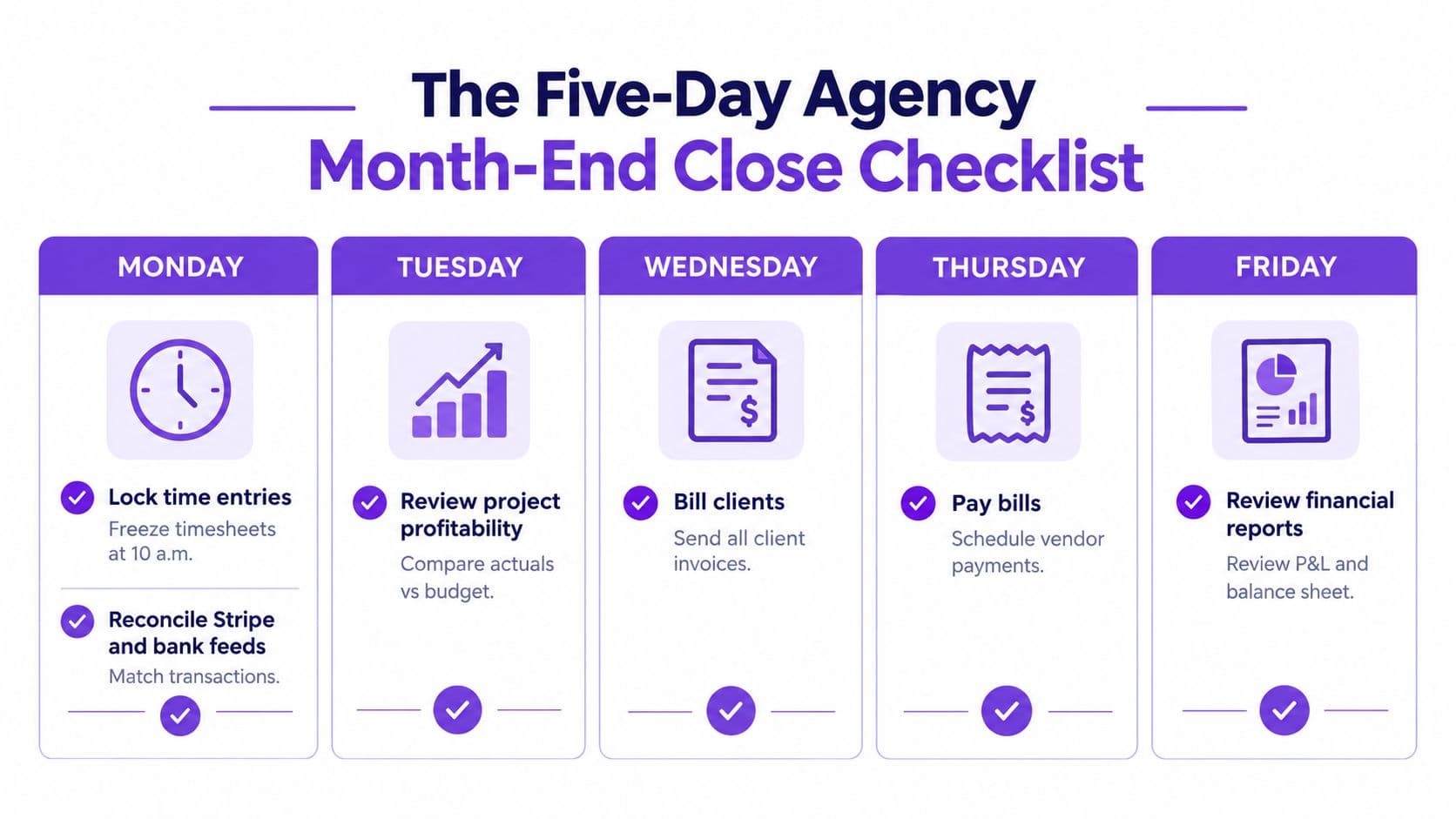
A five-day close works when each day has an owner, a cutoff, and a reconciliation standard. For a 15-to-40-person agency, QuickBooks Online or Xero can support the process if you stop treating the close as a final data dump.
Day 1 and Day 2
Day 1, Monday
- Freeze time entries at 10 a.m.
- Reconcile Stripe payouts and bank feeds to the ledger.
- Post outstanding client invoices and verify billing against active statements of work.
- Investigate every unmatched bank or Stripe item instead of parking it in suspense.
Day 2, Tuesday
- Review vendor bills for client, project, and class coding.
- Accrue subcontractor labor performed but not yet invoiced.
- Confirm credit card transactions carry the correct client and project tags.
- Compare actual direct costs with project budgets and investigate any unexplained variance.
The threshold should be written into your policy. For example, investigate any unexplained difference, missing time entry, or untagged transaction rather than allowing a materiality rule to hide recurring process failures.
Day 3 through Day 5
Day 3, Wednesday
- Reconcile payroll from Gusto or Rippling to the general ledger.
- Post employer tax accruals.
- Compare deferred revenue balances with active SOWs, delivery schedules, and approved milestones.
- Clear stale balances with documented support, not journal-entry guesswork.
Day 4, Thursday
- Run work-in-progress adjustments for delivered work not yet billed.
- Flush intercompany balances and classify owner draws correctly.
- Post depreciation and review unusual overhead movements.
- Reconcile Accounts Payable to the vendor subledger.
Day 5, Friday
- Produce the P&L by class.
- Produce project profitability by client and engagement phase.
- Produce the AR aging report.
- Update the cash forecast and brief leadership on collections, staffing, margin exceptions, and upcoming obligations.
The close should end in decisions. If a client has weak delivery margin, the account lead needs a scope or pricing conversation. If AR is aging, someone owns collection activity. If utilization falls, the staffing plan changes. A controller can use a structured close-the-books process to assign those responsibilities and preserve an audit trail.
KPI Dashboards That Expose Client Profitability
Your Monday dashboard shouldn't be a decorative snapshot. It should connect each metric to a decision. Modern agency accounting tracks client and service-line gross margin, utilization, realization, days sales outstanding, and cash forecast accuracy, as described in agency accounting and operational metrics guidance.
Use QuickBooks Online Advanced, Xero Analytics Plus, or a Google Sheets model fed from your accounting and time-tracking data. Keep the calculation definitions fixed, because changing formulas every month makes trend analysis useless.
| KPI | Formula | Target Range | Decision Triggered |
|---|---|---|---|
| Billable utilization | Billable hours ÷ total available hours | 60% to 75% according to Sage's agency accounting guidance | Rebalance workloads, review hiring, or protect internal capacity |
| Realization rate | Billed value ÷ standard value of recorded billable hours | Set internally by service line | Reprice discounts and investigate write-offs |
| Blended operating margin | Operating profit ÷ adjusted gross income | 20% to 25% in agency accounting benchmarks from Prophet Accounting | Freeze hiring, reduce overhead, or raise prices |
| Client-level gross margin | Client revenue minus direct client costs, divided by client revenue | Rank highest to lowest | Rescope, reprice, or offboard weak accounts |
| AR over 60 days | AR older than 60 days ÷ total AR | Escalate when the share reaches 8%, using the internal policy specified for this dashboard | Assign collections ownership and pause discretionary delivery |
| Cash runway | Available cash ÷ average monthly cash burn | Set from payroll and vendor obligations | Delay hiring or secure funding |
| Revenue concentration | Largest client's recurring revenue ÷ total recurring revenue | Treat 20% as a red-line review point | Diversify pipeline and protect renewal risk |
Utilization needs careful interpretation. The verified benchmark range is 60% to 75%, but pushing every role toward maximum billability can damage quality and retention, while low utilization leaves payroll supporting internal time. Capture time daily, classify it as billable or internal, reconcile it to project budgets weekly, and review delivery margin monthly.
Client margin ranking is the most actionable view. Don't accept an agency-wide average as proof that every account works. A client with strong revenue but heavy contractor or media costs can require a different pricing conversation than a smaller account with clean delivery economics.
Decision rule: Every KPI needs an owner and a response. A dashboard that produces no pricing, staffing, collection, or scope action is only a report.
Red Flags, Common Pitfalls, and Your Next Steps
The most expensive close errors often arrive together. A controller opens the month with media booked gross even though the agency only arranged the purchase. Subcontractor costs sit in COGS, but the payable workflow never identifies the contractors who need reporting. Retainer balances remain deferred after delivery, so earned revenue and recurring performance are understated.
Then the AR aging is ignored past 60 days, draining 8% to 12% of annual revenue in the scenario used for this diagnostic. Time entries lack project tags, utilization reports lie, and leadership approves hiring based on incomplete delivery data. These are illustrative exposures, not universal benchmarks. Diagnose your own ledger before assigning a dollar impact.
| Red Flag | Diagnostic Signal | Typical $ Exposure | One-Line Fix |
|---|---|---|---|
| Media recorded gross when the agency is an agent | Media revenue and COGS rise together without controlled-service evidence | Inflated top line and misleading margin | Complete a principal-versus-agent review for every media line |
| Subcontractor reporting missed | Contractor costs exist in COGS without a linked payable or vendor record | Unrecorded obligations and compliance rework | Require vendor bills and contractor coding before close |
| Retainer deferrals never clear | Deferred revenue grows while delivery is complete | Earned revenue and MRR understated | Reconcile the liability to SOWs and release earned amounts |
| AR aging ignored beyond 60 days | Old invoices remain open without collection ownership | Working capital tied up in overdue balances | Review AR weekly and escalate overdue accounts |
| Time entries lack project tags | Utilization or project reports show unexplained gaps | Understated delivery cost and false margin | Make client and phase fields mandatory |
A two-week correction plan
- Lock the chart of accounts around service revenue, direct delivery cost, pass-through treatment, overhead, and equity.
- Turn on project profitability tracking in QuickBooks Online or tracking categories in Xero.
- Review every media line using the principal-versus-agent test.
- Reconcile AR aging weekly to the general ledger, with an independent reviewer and role-based access controls. AR internal-control guidance specifically addresses subledger-to-GL discrepancies and unauthorized credits.
- Build the five-day close checklist and assign an owner to every reconciliation.
- Wire utilization, realization, client margin, AR, cash, and concentration into a dashboard.
- Schedule a quarterly GAAP review with a controller, especially when contracts bundle retainers, milestones, performance fees, and pass-through costs.
Jumpstart Partners provides outsourced controller and bookkeeping support for growing agencies, including project accounting setup, client profitability reporting, revenue-recognition workflows, reconciliations, and KPI reporting. If your books need to move from tax-prep records to a controlled monthly operating system, visit Jumpstart Partners to discuss the setup and close support your agency needs.