Financial Operations
A Founder's Guide to Startup Bookkeeping: From Mess to Master
Master bookkeeping for startups with our guide. Learn to set up your chart of accounts, recognize revenue, and build investor-ready financials that fuel growth.
ByJumpstart Partners, CPA, QuickBooks ProAdvisor
··24 min readAs a founder, you're obsessed with product, sales, and growth. Your financials? That’s just a compliance headache, right? Wrong. Treating bookkeeping as a low-priority admin task is one of the fastest ways to run your startup into the ground.
This isn't just about taxes or staying out of trouble. It's a strategic weapon. Neglecting your books derails funding, hides your real burn rate, and forces you to make critical decisions based on gut feelings instead of hard data. Accurate bookkeeping is the operational backbone that separates fast-growing companies from cautionary tales.
Why Smart Bookkeeping Is Your Startup’s Secret Weapon

You're scaling fast and chasing ambitious targets. But the biggest threat to your momentum isn't the competition—it's the chaos brewing inside your own financial records. Many founders in the $500K to $20M revenue range fall into this trap.
Messy books create friction at every turn. When investors ask for GAAP-compliant financials during due diligence, a disorganized ledger will stall or kill the deal entirely. You’re left scrambling, trying to piece together 18 months of transactions while your funding window closes. This is an unforced error you cannot afford to make.
The Real Cost of Neglecting Your Books
The consequences of bad bookkeeping are painfully expensive. Startups that DIY their financials for the first 12-24 months often face staggering cleanup bills when a funding round, audit, or tax deadline forces their hand.
These emergency cleanups aren't cheap, often ranging from $10,000 to over $50,000.
Think about it: a founder puts $80,000 in business expenses on a personal credit card and deposits $120,000 in revenue into a personal bank account over a year and a half. Untangling that mess? That's easily a $25,000 bill. We see it all the time.
The cost isn't just financial. It's a massive drain on your time and focus, pulling you away from what you do best: building the company. For a deeper look at foundational practices, check out our guide on bookkeeping basics for small business.
The Cost of DIY Bookkeeping vs. Professional Services
This table breaks down the hidden costs of managing books internally versus the value of outsourcing, helping you see the clear ROI.
| Factor | DIY Bookkeeping (First 12-24 Months) | Outsourced Professional Bookkeeping |
|---|---|---|
| Direct Cost | Appears "free" (just software fees, ~$50/mo) | $500 - $2,500/month depending on complexity |
| Founder Time | 10-20 hours/month spent on low-value tasks | 1-2 hours/month for review and strategy |
| Error Rate | High. Miscategorized expenses, missed revenue, no accruals. | Low. Clean, accurate, GAAP-compliant books. |
| Strategic Value | Zero. Data is a rearview mirror, often inaccurate. | High. Provides forward-looking insights for decision-making. |
| Investor Readiness | Not ready. Requires expensive, time-consuming cleanup. | Audit- and investor-ready financials delivered monthly. |
| Hidden "Cleanup" Cost | $10,000 - $50,000+ bill when funding or audit looms. | $0. It’s done right from the start. |
| Total Cost (18 months) | $20,000+ (Founder Time @$150/hr + Cleanup) | $9,000 - $45,000 (All-inclusive, no surprises) |
The math is simple. The initial "savings" from DIY bookkeeping are an illusion, costing startups far more in the long run through cleanup fees and missed opportunities.
The Strategic Advantage of Clean Books
Viewing bookkeeping as a strategic function flips the script entirely. Instead of a source of stress, your financials become a source of strength. A professional system gives you a powerful set of tools to steer your company.
"Many founders believe that accounting software is a substitute for a bookkeeper. That's like thinking a scalpel makes you a surgeon. The tool is only as good as the expert using it to produce clean, timely, and insightful financial reports." — Jonathan Evans, CPA
Clean, accurate books give you:
- Real-time Cash Visibility: Know exactly how much cash you have and what your true burn rate is. This lets you manage your runway with confidence, not anxiety.
- Accurate KPIs: Track essential metrics like Monthly Recurring Revenue (MRR), Customer Acquisition Cost (CAC), and gross margin without wrestling with manual spreadsheets.
- Investor Confidence: Present polished, audit-ready financials that scream operational maturity. This builds trust with your board and potential VCs long before due diligence begins.
Implementing a robust system doesn't mean drowning in manual work. Modern accounting document automation tools can drastically improve the efficiency and accuracy of your financial records, making it easier to maintain control. This isn't just about avoiding problems; it’s about building the operational backbone that supports sustainable growth.
Laying Your Financial Groundwork The Right Way
Messy books are a startup’s original sin. Getting your bookkeeping right from day one isn't just good practice; it's the difference between building a scalable company and creating a financial time bomb that gets exponentially more expensive to defuse as you grow.
The first dominoes to fall are foundational choices with huge tax and fundraising consequences. If you plan to raise venture capital, a C-Corporation is the non-negotiable standard. VCs are wired to invest in C-Corps because of their straightforward ownership structure and ability to issue preferred stock.
On the other hand, an LLC (Limited Liability Company) gives you pass-through taxation and more flexibility, which is a better fit if you’re bootstrapping or don't see VC funding in your future. While you can convert from an LLC to a C-Corp later, it's a painful and expensive legal process. Get this right from the start.
Your Chart of Accounts: The Blueprint for Your Business
Your Chart of Accounts (COA) is the DNA of your accounting system. It’s the master list of every single account that tracks your money, from revenue streams to software expenses. A generic COA spit out by QuickBooks is useless for a growing SaaS or service business—it tells you nothing. You need a structure that gives you real insight.
The most common rookie mistake is lumping all your income into a single "Sales" account. Instead, break it down to reflect how you actually make money:
- 4010 - SaaS Recurring Revenue: For your core subscription income.
- 4020 - Professional Services Revenue: For one-off implementation, training, or consulting fees.
- 4030 - One-Time Project Revenue: For any distinct, non-recurring project work.
This structure immediately shows you where your revenue is coming from without forcing you to spend hours digging through spreadsheets. Apply the same logic to your expenses. A single "Software" line item is a black hole. Break it down for clarity:
- 6010 - COGS - Hosting (AWS, Azure): Costs directly tied to delivering your product.
- 7010 - G&A - Office Software (Google Workspace, Slack): General software that runs the business.
- 7020 - S&M - CRM Software (Salesforce, HubSpot): Tools specific to your sales and marketing teams.
A detailed COA like this maps directly to your financial statements, giving you—and your investors—a crystal-clear picture of your operational efficiency and unit economics. These accounts are the building blocks of your general ledger, the complete record of all your financial transactions.
Picking and Integrating Your Accounting Software
For most startups in the $500K-$20M revenue range, the debate ends quickly: you’re choosing between QuickBooks Online (QBO) or Xero. They hit the sweet spot of features, scalability, and integrations.
But the software itself is just the beginning. The real magic happens when you connect it to the other platforms where financial data is born. Your goal is ruthless automation.
"A founder's most limited resource is time. Manually entering Stripe payouts or Gusto payroll runs into QuickBooks is a waste of that resource and a recipe for errors. Your goal should be to automate every possible data flow." — Sarah Jennings, Fractional CFO
Here are the non-negotiable integrations you need to set up on day one:
- Payment Processor (e.g., Stripe): Connecting Stripe to your accounting software automates syncing every single transaction, fee, and refund. This is the only way to ensure your revenue recognition is accurate down to the penny.
- Payroll Provider (e.g., Gusto): An integrated payroll system automatically posts journal entries for salaries, taxes, and benefits. This prevents some of the most complex and common bookkeeping mistakes that are a nightmare to unwind.
- Bank Feeds: Connect every business bank and credit card account to automatically pull in all transactions. This single step can cut your monthly reconciliation time from hours to minutes.
By building these automated bridges from the start, you create a system that largely runs itself. You stop wasting cognitive energy on mind-numbing data entry and start using your financials for what they’re for: making smarter decisions. This foundational work is what prevents the panicked, six-figure cleanups that plague so many otherwise successful companies.
Mastering the Month-End Close and Revenue Recognition
Waiting weeks for your financials is a death sentence for a fast-moving startup. You can't make smart decisions about hiring, marketing spend, or your product roadmap if your data is already a month old. A slow, sloppy month-end close means you're flying blind, reacting to the past instead of shaping the future. The goal isn't historical artifacts; it's a disciplined, predictable close that delivers actionable intelligence.
For any serious startup, this means implementing a 5-day month-end close. This isn't a luxury. It's a fundamental requirement for maintaining control and momentum, ensuring you have reliable numbers by the fifth business day of the new month. Every single month.
This kind of speed and accuracy doesn't just happen. It's built on a solid foundation that connects your legal entity, chart of accounts, and software into a seamless system.
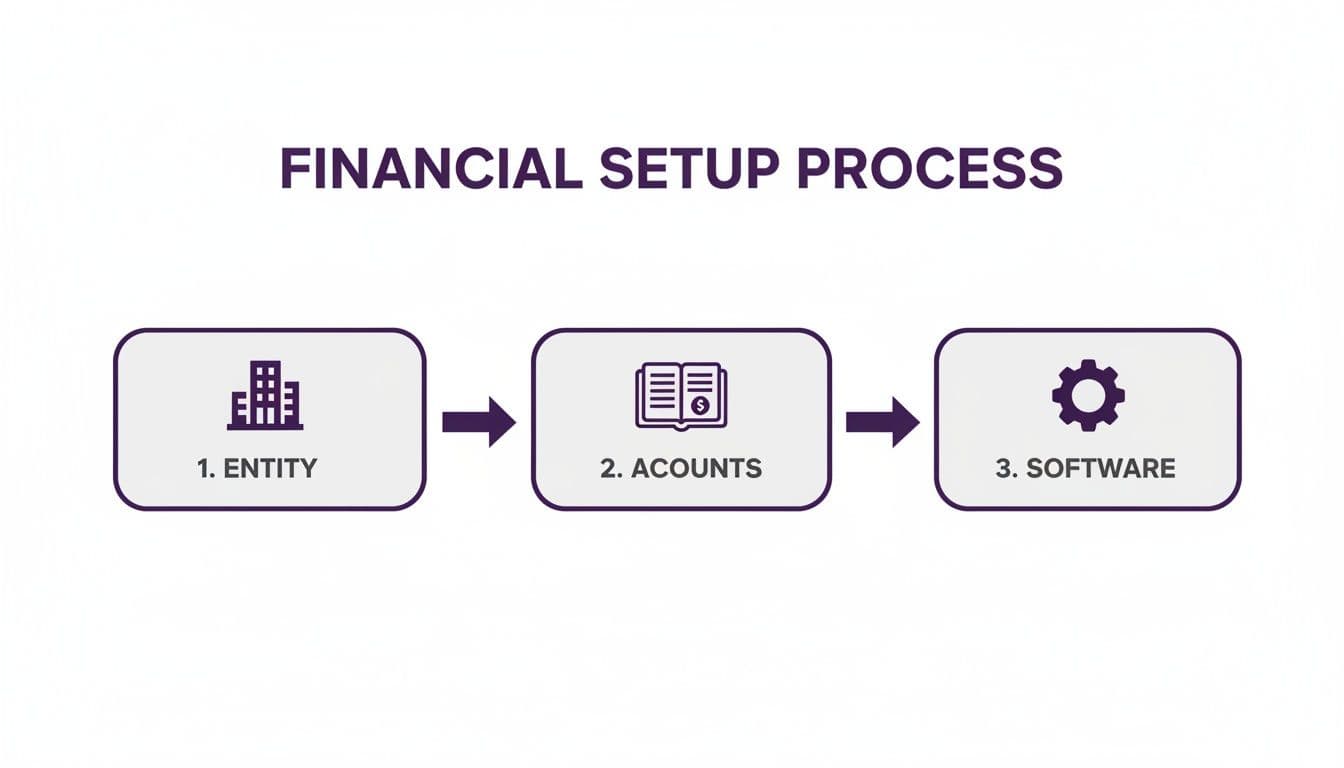
A fast close is simply the end result of getting this initial setup right.
The Five-Day Close: A Practical Checklist
A swift close hinges on a standardized rhythm. It’s about creating a checklist where key tasks get done in a specific order, which minimizes bottlenecks and nasty surprises at the end of the month. For a deeper dive, check out our guide on month-end close best practices.
Here’s what that 5-day cycle actually looks like in practice:
| Day | Key Activities | Why It Matters |
|---|---|---|
| Day 1 | Reconcile Cash & Credit Cards: Match all bank and credit card transactions to your general ledger. | This is the bedrock. Until you confirm your cash positions, nothing else can be trusted. |
| Day 2 | Record Revenue & Accruals: Post revenue based on ASC 606 and record accrued expenses (like unpaid vendor bills or payroll liabilities). | This moves you from cash to accrual accounting, giving you a true picture of performance—not just cash flow. |
| Day 3 | Reconcile Balance Sheet Accounts: Review key accounts like Accounts Receivable, Accounts Payable, and Prepaid Expenses. | This is about integrity. It ensures your balance sheet is solid and catches misclassifications before they compound. |
| Day 4 | Review P&L and Balance Sheet: Analyze financial statements for anomalies and perform variance analysis against your budget. | This is your quality control step. You hunt for trends and ask "why." Is marketing spend way up? Did that big new customer just churn? |
| Day 5 | Close Books & Distribute Reports: Finalize the period, "lock" the books to prevent changes, and send the financial package to stakeholders. | This delivers timely, reliable data to leadership, enabling fast, informed decisions instead of guesswork. |
Demystifying ASC 606 for SaaS Startups
For any SaaS or recurring revenue company, the biggest month-end hurdle—and a huge red flag for investors—is revenue recognition under ASC 606. The core principle is deceptively simple: you must recognize revenue as you earn it, not when the cash hits your bank account.
The most common mistake founders make is booking a full annual contract payment as revenue in the month they receive it. This dramatically inflates your revenue and profit, giving you a dangerously misleading view of your company's health.
Let's walk through a real-world example.
You sign a new customer on a 12-month SaaS contract for $60,000, paid in full on January 15th.
The Wrong Way (Cash Basis): You book $60,000 in revenue in January. Your income statement looks amazing for one month, but the next 11 months show zero revenue from this client. This creates a financial roller coaster that makes it impossible to track your true performance.
The Right Way (ASC 606 - Accrual): You recognize the revenue evenly over the 12-month contract term.
- Total Contract Value: $60,000
- Service Period: 12 months
- Monthly Recognized Revenue: $60,000 / 12 = $5,000 per month
In January, you book only $5,000 in revenue, even though you received $60,000 in cash. The remaining $55,000 sits on your balance sheet as Deferred Revenue—a liability, since you still owe the service—and is drawn down by $5,000 each month.
This method produces a smooth, predictable revenue line that accurately reflects your company's growth trajectory and keeps you GAAP compliant. Mastering this isn't just "good bookkeeping"; it's a non-negotiable part of building trust with investors and making sound business decisions.
Transforming Raw Data Into An Investor-Ready Dashboard
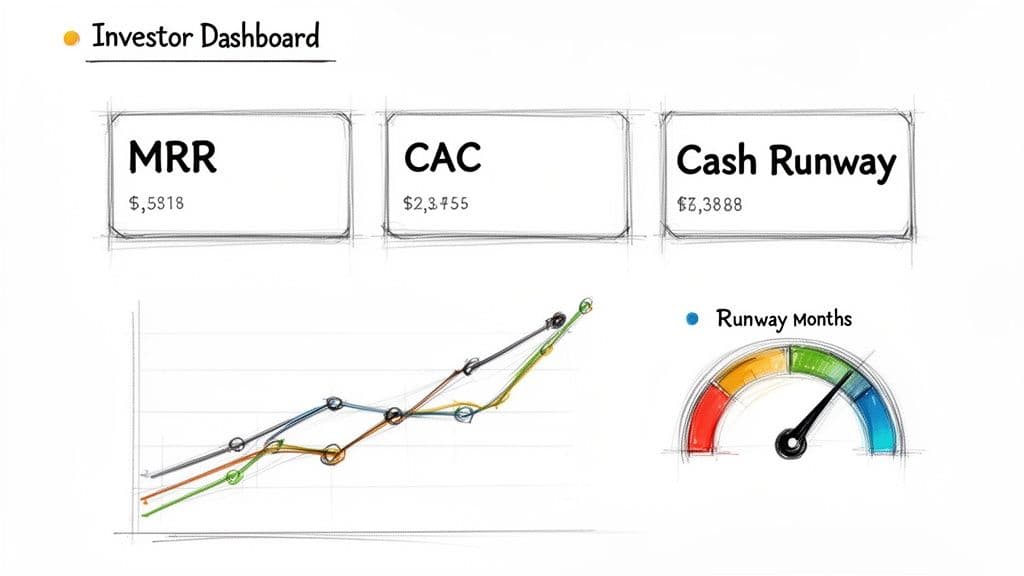
Clean books are the price of entry. But investors don't fund clean books; they fund a clear, compelling story about your business. Raw data from your general ledger is useless if it can't answer their most critical questions in under 30 seconds.
This is where you turn bookkeeping from a compliance chore into your strategic command center. A well-built dashboard is your first line of defense in a board meeting and your most powerful weapon in a fundraising pitch.
It’s no surprise that the U.S. accounting services market for startups is expected to explode from $14.34 billion in 2025 to $39.09 billion by 2033. Founders are realizing they need expert help to translate numbers into a narrative that investors will back. You can dig into the data in this market research report from Grand View Research.
The Core KPIs Every Startup Dashboard Needs
Don't clutter your dashboard with dozens of metrics. Focus on the vital signs of your business—the handful of numbers that tell 90% of the story. For any SaaS or recurring revenue startup, these are the absolute non-negotiables.
- Monthly Recurring Revenue (MRR) / Annual Recurring Revenue (ARR): This is the lifeblood of a subscription business. It’s the predictable revenue you can count on every month.
- Customer Acquisition Cost (CAC): How much do you spend to get one new customer? This measures the efficiency of your entire sales and marketing engine.
- Cash Runway: The most important survival metric, period. It tells you exactly how many months you have until the bank account hits zero.
These numbers aren't just for investors; they're for you. They tell you if your growth is profitable, if the business model works, and when you need to start fundraising or cutting costs. We cover how to get these insights in near real-time in our guide to the automation of financial reporting.
Putting The Metrics To Work: A Practical Example
Formulas are abstract. Let's see how this works for a real B2B SaaS company.
Imagine these are your numbers from last quarter:
- Total Sales & Marketing Spend: $150,000
- New Customers Acquired: 50
- Cash in Bank (start of month): $500,000
- Total Monthly Cash In: $75,000
- Total Monthly Cash Out: $125,000
Here’s how you turn that raw data into dashboard-ready insights.
1. Calculate Your Customer Acquisition Cost (CAC)
Your CAC reveals if your go-to-market strategy is actually making money.
Formula: Total Sales & Marketing Spend / New Customers Acquired
Calculation: $150,000 / 50 = $3,000 CAC
Is a $3,000 CAC good? It depends entirely on your Customer Lifetime Value (LTV). The gold standard rule of thumb is that your LTV needs to be at least 3x your CAC.
2. Calculate Your Net Burn and Cash Runway
Your runway is the countdown clock for your startup. Knowing this number with confidence is the difference between proactive planning and reactive panic.
Formula (Net Burn): Monthly Cash In - Monthly Cash Out
Calculation: $75,000 - $125,000 = -$50,000 Net Monthly Burn
Formula (Runway): Total Cash in Bank / Net Monthly Burn
Calculation: $500,000 / $50,000 = 10 Months of Runway
With 10 months of runway, you have a clear timeline. You know you need to hit key milestones to raise your next round, find ways to cut costs, or push harder on sales to extend that deadline. This single metric drives your most critical decisions.
How Do You Stack Up Against Industry Benchmarks?
Your dashboard becomes infinitely more powerful with context. Comparing your KPIs to industry benchmarks shows investors you understand the game you’re playing and helps you spot where you’re winning or falling behind.
Here’s a look at some key benchmarks to compare against.
Key SaaS And Service Business Benchmarks
Compare your startup's performance against key industry benchmarks to identify strengths and weaknesses.
| Metric | Benchmark for Growth Stage ($1M-$10M ARR) | Source |
|---|---|---|
| ARR Growth Rate | 40% - 100%+ (Top quartile performers exceed 100%) | OpenView 2024 SaaS Benchmarks |
| Gross Margin | 70% - 85%+ (Anything below 70% warrants investigation) | RevOps Co-op / ICONIQ |
| LTV to CAC Ratio | 3x to 5x | Multiple SaaS VC Reports |
| Net Revenue Retention | 100% - 120% (Best-in-class companies are above 120%) | Bessemer Venture Partners |
This is why your bookkeeping matters so much. It must produce data clean enough to feed these KPIs accurately. The dashboard isn't just a pretty chart; it’s the final, most visible output of a well-run financial operation. It’s what separates founders who are in control from those who are just along for the ride.
Red Flags: Warning Signs Your Bookkeeping Is Broken
I’ve seen more than one fast-growing startup run straight into a wall, not because of a bad product, but because of a few fundamental bookkeeping blunders. These aren't just clerical mix-ups; they are strategic errors that hide your true financial health, scare off investors, and create huge, expensive messes down the road.
The first and most damaging mistake is co-mingling personal and business funds. It always starts small. You use your personal AmEx for a SaaS subscription, or maybe deposit a check from a customer into your personal savings. It seems harmless.
It’s not. This single act pierces the corporate veil, which means your personal assets—your house, your car, your savings—are suddenly on the line if the business gets sued. The cleanup is a nightmare that can easily cost tens of thousands of dollars in accounting and legal fees to untangle.
The fix is non-negotiable: Open a dedicated business checking account and get a business credit card from day one. All business income goes in, and all business expenses come out. No exceptions.
Misclassifying Employees And Contractors
Another landmine is misclassifying W-2 employees as 1099 contractors. The temptation is obvious—you avoid payroll taxes and the cost of benefits. But this is a massive red flag for the IRS and the Department of Labor.
The difference comes down to control. If you dictate how, when, and where the work is done, you have an employee, not a contractor. An audit that uncovers misclassification will leave you on the hook for back payroll taxes, steep penalties, and interest.
Understanding the nuances is critical to protect your startup. A key part of this is learning how to prevent payroll fraud and classification errors before they happen.
Key Warning Signs
If any of these sound familiar, your financial foundation is cracked and needs immediate attention:
- You don't reconcile accounts monthly. If your books don't match your bank statements to the penny every single month, your numbers are pure fiction. You can't make real decisions with imaginary data.
- You're still only using cash-basis accounting. It’s simple, but it lies. For a SaaS company, recognizing a $120,000 annual contract as revenue the day the cash hits is self-deception. Accrual accounting is the only way to see your actual performance.
- You think QuickBooks is a magic wand. Believing your accounting software alone is a complete financial solution is a dangerous fantasy. Without an expert setting it up and a human managing it, it’s just a tool that gets very good at magnifying your mistakes.
"The single biggest mistake I see is founders confusing cash in the bank with profitability. They look at a healthy bank balance from a few large pre-payments and think they're crushing it, completely blind to the underlying burn rate and future liabilities. This illusion of success is a silent killer." — Jonathan Evans, CPA
The path forward is clear: you need a disciplined process. Monthly reconciliation isn't a "nice-to-have." For any startup dealing with contracts or subscriptions, moving to accrual accounting isn't a choice; it's a prerequisite for survival and growth.
This isn't just about dodging trouble. It’s about building a company that is fundamentally sound, investable, and built to last. If you see these red flags in your own business, you have to fix them now, before they metastasize.
When To Outsource Your Bookkeeping: A Strategic Decision
DIY bookkeeping has a shelf life. For most founders, that expiration date arrives right around the $500K annual revenue mark. Suddenly, spreadsheets and basic software can't keep up. You're wrestling with deferred revenue, messy payroll, and investors asking for GAAP-compliant reports you can't produce.
The real cost isn't just the frustration; it's the time stolen from growing the business. If you're spending 10+ hours a week on financial admin, you've already crossed the line. That's a quarter of a full-time employee's worth of effort sunk into a non-core function—a massive drag on your focus and momentum.
This isn't a new problem. It’s why the market for expert bookkeeping services is exploding, as detailed in this bookkeeping services market report. With 90% of startup failures linked back to some form of financial mismanagement, founders are realizing that professional oversight isn't a luxury; it's a survival tool.
Trigger Points That Signal It's Time To Outsource
The decision to outsource isn't just about a revenue number. It’s about recognizing specific inflection points where the risk and hidden costs of DIY bookkeeping become greater than the perceived savings. You know it's time when you hit one or more of these triggers:
- You're Actively Fundraising: VCs and angel investors demand pristine, audit-ready financials. Showing up with messy, non-GAAP books is one of the fastest ways to kill a deal in due diligence. Outsourcing ensures your numbers are defensible from day one.
- Transaction Volume Becomes Overwhelming: As your customer base grows, so does the sheer volume of invoices, payments, and expenses. Once you cross 50-75 transactions per month, manual reconciliation becomes a breeding ground for errors and delays.
- Your Business Model Adds Complexity: Are you expanding internationally? Managing physical inventory? Trying to figure out ASC 606 for your SaaS revenue? These scenarios introduce specialized accounting rules that require an expert to navigate correctly.
"Outsourcing your bookkeeping isn't an expense; it’s an investment in operational excellence. You're not just buying back your time. You're buying accuracy, scalability, and the strategic financial intelligence needed to guide your company." — David F. Allen, Founder & Managing Partner
The ROI of Professional Bookkeeping
When you partner with a specialized firm, you're not just offloading tasks. You're upgrading your back office from a liability into a strategic asset. You gain access to a team of experts who can deliver a guaranteed 5-day month-end close, giving you timely, accurate data to make decisions that matter.
This level of professional oversight moves you beyond just recording transactions and into higher-level financial strategy. For many founders, this is the first step toward building a more robust finance function, often leading them to explore outsourced controller services to guide their growth. For a predictable monthly fee, you get investor-ready financials, a clear view of your cash flow, and the peace of mind that comes from knowing your books are managed with expert precision.
Frequently Asked Questions About Startup Bookkeeping
Even with the best playbook, a few tough questions always pop up on the bookkeeping journey. Here’s how we answer the ones we hear most often from founders.
What Should I Look For In An Outsourced Bookkeeping Provider?
Don't just hire someone to do data entry. For a startup in the $500K-$20M range, you need a strategic partner, not just a number cruncher.
Here's your checklist:
- Industry Expertise: Do they live and breathe SaaS metrics like MRR and churn? Can they handle agency-style revenue recognition? A generic bookkeeper who also does the local pizza shop won't get the nuances of your business.
- A Guaranteed Close Timeline: Ask if they guarantee a 5-day month-end close. This isn't just a nice-to-have; it's proof they have their act together with a repeatable, efficient process. No excuses.
- Tech Stack Fluency: They must be experts in your core systems—QuickBooks, Xero, Stripe, Gusto. This is critical for maximizing automation and ensuring your data flows seamlessly.
- Serious Security & Compliance: Look for SOC 2 compliance. It’s the gold standard, proving they handle your incredibly sensitive financial data with bank-level security.
How Do I Fix My Messy Books Before Fundraising?
This scenario is incredibly common: you have 18 months of tangled transactions and a big VC meeting next month. Your first instinct might be to DIY the cleanup over a weekend. Don't. You will only make it worse.
The only real solution is a professional cleanup project. This isn't just "tidying up"—it’s a forensic process where a dedicated team systematically untangles co-mingled personal and business funds, reconstructs missing data, and correctly restates your financials from cash to accrual basis.
For instance, a proper cleanup might involve re-categorizing $150,000 in vague "software" expenses into their correct COGS and OpEx accounts. Why does that matter? Because it's the only way to calculate an accurate gross margin—a metric every investor will scrutinize. It’s an investment that can literally save a funding round.
What’s The Real Cost of Bad Bookkeeping?
The initial pain might be a $10,000-$50,000 cleanup fee, but that’s just the entry ticket. The real price is paid in lost opportunities and catastrophic decisions made on bad data.
"The biggest cost of messy books is the 'ignorance tax.' You're flying blind, making critical decisions on hiring, marketing spend, and product investment based on a faulty cash balance in your bank app. One bad call driven by inaccurate financials can cost you more than five years of professional bookkeeping fees." — David F. Allen, Founder & Managing Partner
Imagine your books make you think you have 12 months of cash runway, so you go ahead and hire three expensive engineers. In reality, your books failed to account for a $75,000 deferred revenue liability for an annual contract you just signed. Your actual runway was only 8 months.
That’s the strategic cost of bad bookkeeping. It’s not about accounting errors; it’s about creating operational and existential risk for your entire company.
Your Next Step: Gain Control of Your Financials
Ready to turn your bookkeeping from a liability into a strategic asset? It's time to get a clear, accurate picture of your business. The first step is to implement the foundational practices in this guide:
- Separate all business and personal finances immediately.
- Build a detailed Chart of Accounts that reflects your business model.
- Automate your core financial stack (Accounting, Payroll, Payments).
- Commit to a monthly close process and start tracking your core KPIs.
If you're managing more than 50 transactions a month or preparing to fundraise, you've outgrown the DIY stage. Jumpstart Partners provides SOC 2 compliant, expert bookkeeping and controller services with a guaranteed 5-day close. We deliver the investor-ready financials you need to grow with confidence.
Schedule a free consultation to see how we deliver financials you can actually trust. Learn more at https://jumpstartpartners.finance.