Financial Operations
Bookkeeping Services Pricing: What You Should Pay in 2026
Bookkeeping services pricing explained: monthly ranges, pricing models, cost drivers and red flags, with worked examples for SaaS and agencies.
ByJumpstart Partners, CPA, QuickBooks ProAdvisor
··17 min readThe cheapest bookkeeping quote often costs you the most. Not because bookkeepers are dishonest, but because a low monthly price usually buys transaction coding without a real close, without accruals, and without anyone accountable when your CPA finds the gaps at year end. Judge bookkeeping services pricing by two numbers instead: your total annual cost as a share of revenue, and the list of work the monthly fee excludes. Get those two right and the sticker price stops misleading you.
Table of Contents
- Typical Bookkeeping Prices by Service Level
- Four Pricing Models and How Each One Bills
- What Actually Drives Your Monthly Quote
- Bookkeeping, Controller and Add-On Packages Compared
- Worked Annual Costs From $500K to $20M in Revenue
- Red Flags in Bookkeeping Quotes and How to Respond
- Confirm the Scope and ROI Before You Sign
Typical Bookkeeping Prices by Service Level
The monthly sticker price is the least useful number in a bookkeeping quote. Price tracks the depth of work, not the label on the package. A provider coding transactions and reconciling one bank account sells a different product from a provider who owns your close, reviews revenue, and produces a board package, even if both call it bookkeeping.
That spread shows up in market data. According to the 2025 Ignition benchmark reported by CPA Practice Advisor, monthly bookkeeping and accounting most commonly fell into the $250 to $499 range, reported by 29% of 219 U.S. accounting firms, followed by $500 to $749, reported by 27.1%. Together those bands covered 56.1% of firms, and 10% or fewer billed hourly for most surveyed service categories. Use those bands as a directional benchmark, not a universal price. The respondents used one billing platform, so they don't represent every firm in the country.
Typical prices by service level
| Service level | Typical price | What it usually covers |
|---|---|---|
| Monthly bookkeeping, most common band | $250 to $499 per month | Reconciliations and monthly reporting for 29% of surveyed firms |
| Monthly bookkeeping, second band | $500 to $749 per month | Higher-volume or multi-account scope for 27.1% of firms |
| Controller-led retainer | From $2,500 per month | Monthly close ownership, management reporting, board package support |
| Fixed-fee diagnostic | $3,500 one-time | Stack and handoff review, dependency map, cleanup path in five business days |
| Fixed-fee project, such as AP setup or books cleanup | Quoted per defined scope | One deliverable with a set end date |
| Hourly out-of-scope work | Set in the contract | Change orders and one-time remediation |
Read the table by outcome first. If you only need current books, the first two rows fit. If you need close ownership, you're in retainer territory. Our Controller-led Finance Ops core retainer costs $2,500 per month, and our Finance Ops Diagnostic is a $3,500 fixed fee delivered in 5 business days and ends with a written workflow map before you sign any retainer. That gap isn't markup. It's accountability for accruals, revenue recognition, and reporting your board can use.
If you're behind, price the backlog separately from the recurring work. Our guide to catch-up bookkeeping services shows how to scope that remediation. If steady overflow support fits better than a full package, you can also hire a remote bookkeeper through Virtustant to cover routine capacity while you keep review in house. Either way, demand a written definition of entities, accounts, close deadline, reporting package, and cleanup exclusions before you compare numbers.
Find the row that matches the outcome you need, check what's included, and only then compare prices across rows.
Four Pricing Models and How Each One Bills
The billing model decides who carries the risk when your volume grows. Under hourly billing, you carry it. Under a fixed fee, the provider prices an agreed scope and you get predictability, provided the limits are written down.
The chart below compares the four models you'll see in proposals.
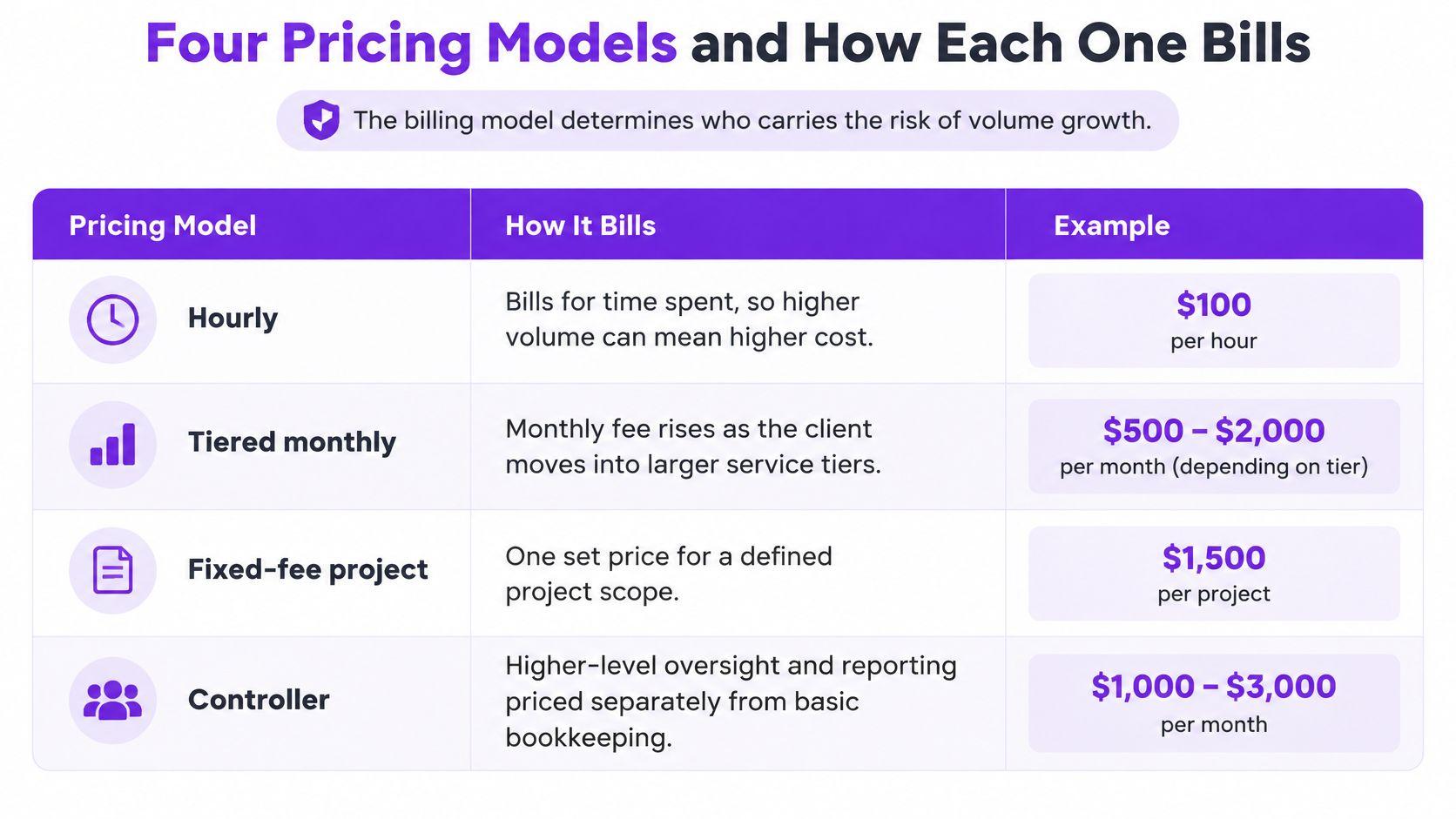
| Model | How it bills | Predictability | Best fit |
|---|---|---|---|
| Hourly | Time logged at a set rate | Low, cost rises with volume | Irregular advisory or one-time cleanup |
| Tiered monthly | Fixed fee per tier of volume and scope | High | Recurring books with steady transaction volume |
| Fixed-fee project | One price for a defined scope | High for that scope | AP setup, cash flow sprint, books cleanup |
| Controller retainer | Fee tied to close ownership and reporting | High, scope agreed upfront | Growing SaaS and agencies needing close and investor reporting |
Fixed pricing is now the norm. According to the 2024 Ignition benchmark summarized by LedgerHQ, 79% of 345 U.S. accounting firms used fixed-fee or value-based pricing for bookkeeping and accounting, 61% charged $250 to $749 per month, and only 8% still charged hourly for that work.
Run the break-even math
A $749 monthly fee gives you a known annual cost of $8,988. Hourly billing at $100 per hour reaches the same amount after 89.88 hours. Past that point, the fixed fee wins, and you still don't know your hourly total until the invoice arrives. That's the difference. One model lets you budget. The other makes you guess.
A fixed fee doesn't mean unlimited work. It means the provider converted a defined scope into a recurring price with stated limits. Require the proposal to name included transaction volume, account count, close timeline, reporting package, payroll scope, and the out-of-scope hourly rate. Require a written change-order policy too, with triggers such as acquisitions, inventory, new entities, or transaction jumps priced before work begins.
Use fixed-fee projects when the deliverable has an end date. We offer fixed-fee projects for AP setup, cash flow optimization, and books cleanup, because each one finishes and shouldn't inflate your recurring fee forever.
Selection rule: Pick hourly only for irregular advisory, a tiered monthly plan for steady volume, a project for a defined deliverable, and a controller retainer when you need close ownership and investor-ready reporting.
What Actually Drives Your Monthly Quote
Revenue alone doesn't set your price. The work does. Two companies at the same revenue pay very different fees when one runs 100 clean transactions through one account and the other pushes usage billing, payroll, and three payment platforms through five accounts.
The diagram below maps the drivers that move your quote.
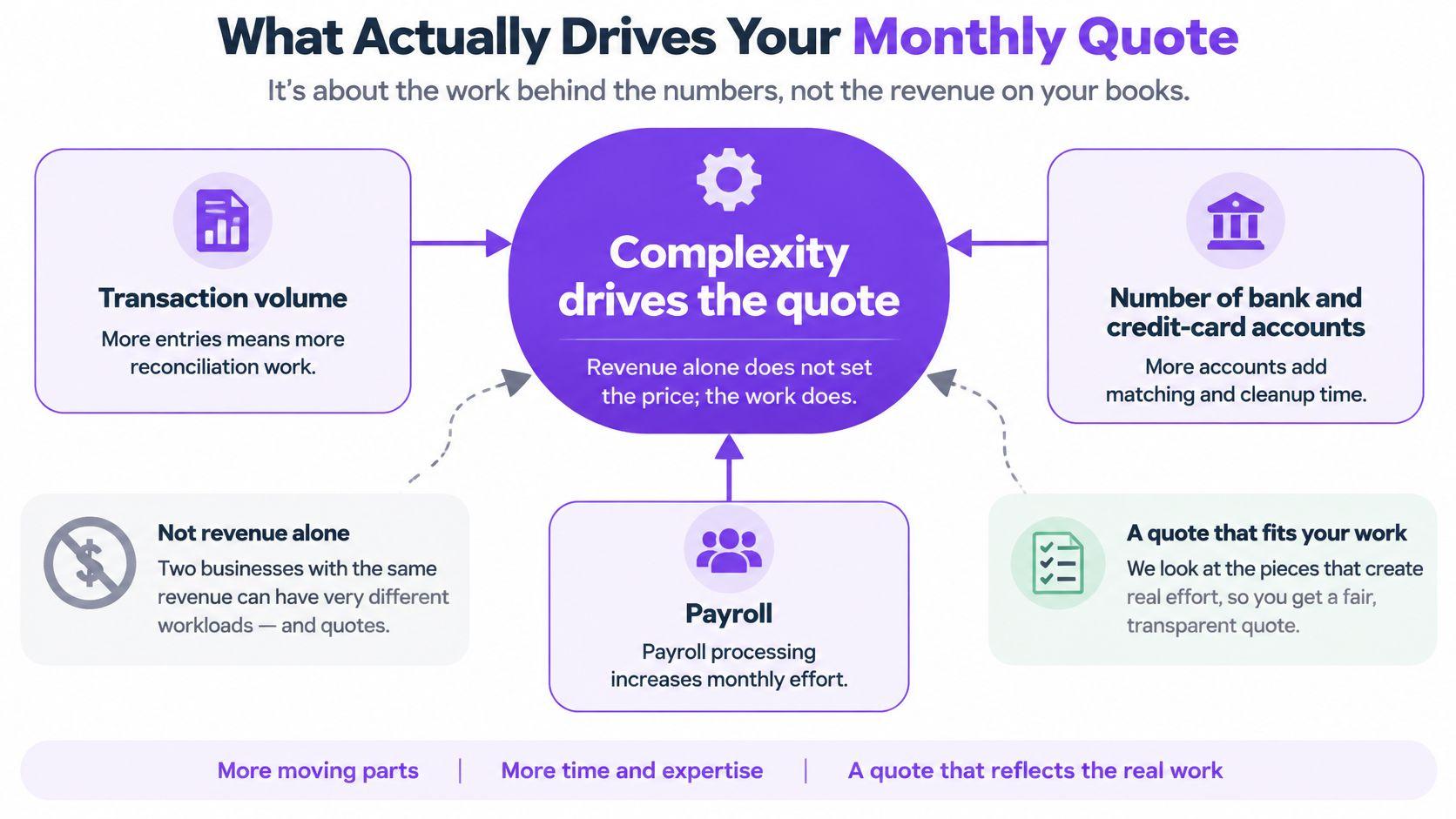
According to NerdWallet's bookkeeping pricing guide, monthly bookkeeping for a U.S. small business commonly costs about $300 or more, with reported package ranges of roughly $200 to $700-plus depending on complexity, and transaction volume, number of bank and credit-card accounts, payroll, inventory, and job costing all increase the required work. The same guide reports a 2024 median bookkeeper wage of $23.66 per hour and an average Upwork bookkeeping rate of $43 per hour.
| Cost driver | Low-cost case | High-cost case |
|---|---|---|
| Transaction volume | Under 100 per month | 500 or more per month, the example used here |
| Bank and credit-card accounts | One or two | Three or more, each needing monthly reconciliation |
| Payroll | None or a single simple run | Monthly payroll with multiple pay groups |
| Inventory and job costing | None | Tracked per product or per client project |
| Integrations | One bank feed | Several platforms such as Stripe, Shopify, NetSuite, payroll sync |
| Cleanup backlog | None, books current | Months of unreconciled activity before the first close |
Say you're a $1 million agency with 500 monthly transactions, three bank accounts, and monthly payroll. At $700 per month, you pay $8,400 a year, or 0.84% of revenue. A $300 package totals $3,600, or 0.36%. That difference isn't waste. It reflects whether reconciliations, close, reporting, payroll support, and cleanup are included.
Integrations deserve their own line. Our billing bridge handoff from Ops to the controller ties invoices, usage, credits, and cash into one reviewed file, and every connected platform adds reconciliation work. If your books are behind, a structured bookkeeping clean up belongs in a separate project scope, not buried in month one of a recurring fee.
The walkthrough below shows how those drivers turn into hours in practice.
Don't fall for the low hourly rate. 20 hours at $43 equals $860, which costs more than a $700 fixed package delivering the same defined work. Before you request any quote, answer four questions: how many transactions, how many accounts, which integrations, and how far behind are the books?
Bookkeeping, Controller and Add-On Packages Compared
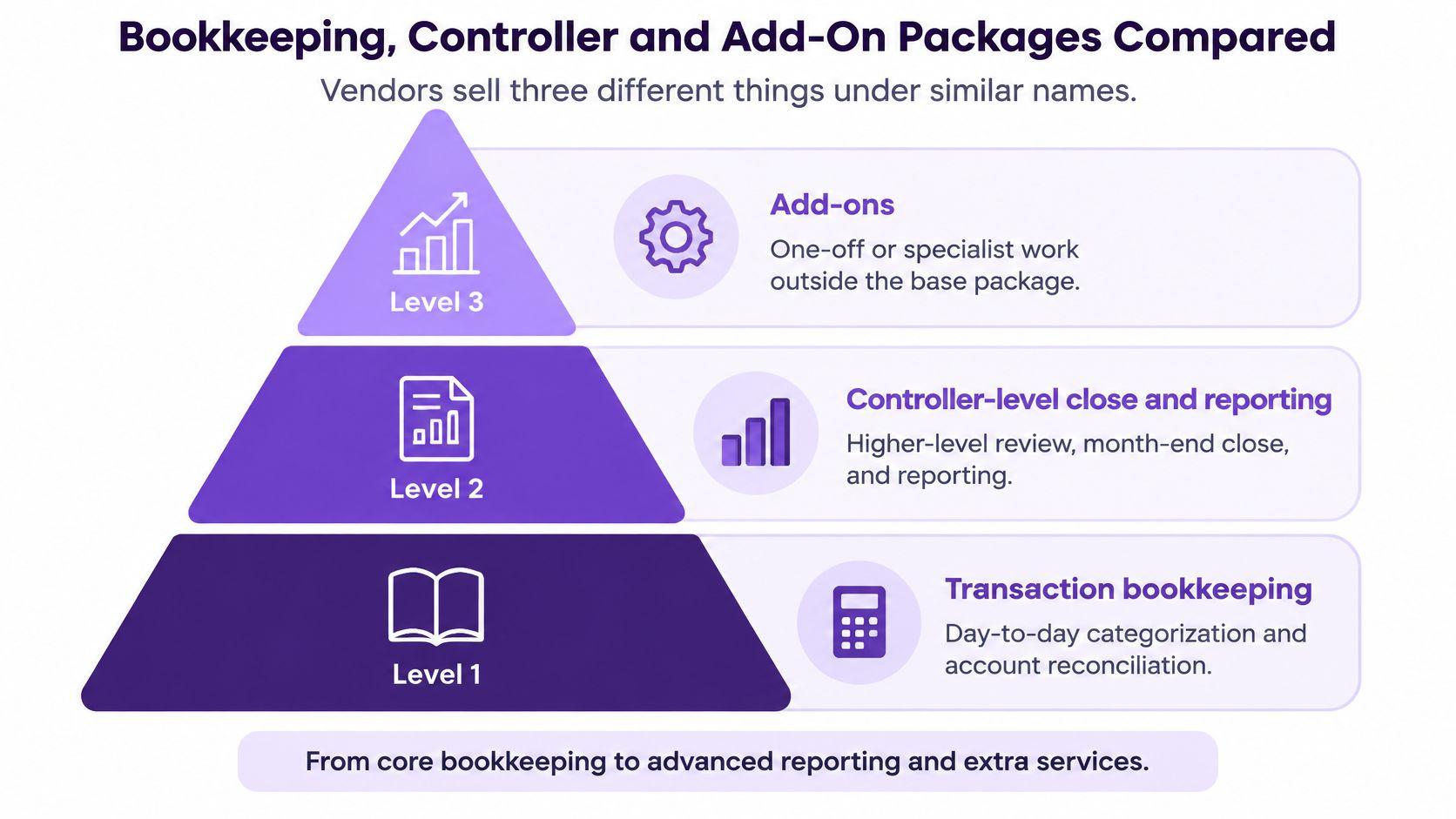
Vendors sell three different things under similar names. Transaction bookkeeping keeps records current. Controller work owns the close and the reporting. Add-ons handle specialist or one-off jobs. Confusing the three is how you end up paying controller prices for data entry, or bookkeeping prices and expecting investor-ready financials.
The pyramid below shows how those layers stack.
| Component | Bookkeeping package | Controller package | Add-on |
|---|---|---|---|
| Transaction coding and bank reconciliations | Included | Included | Not usually sold separately |
| Monthly close ownership | Not included | Included | Close design set up as a project |
| Management reporting package | Basic P&L | Full package with commentary | Custom dashboards, such as MRR and CAC |
| Accruals and revenue recognition | Not included | Included | Set up as a project |
| Historical cleanup | Excluded | Excluded | Fixed-fee project |
| Payroll and accounts payable | Add-on | Included in defined scope | Fixed-fee project, such as AP automation |
The logic is straightforward. Coding and reconciliations form the core. Monthly close ownership, accruals, and revenue-recognition workflows define the controller tier. Cleanup, payroll setup, and AP automation sit outside both because they spike once and then settle. If you're weighing the roles themselves, our comparison of bookkeeper vs controller responsibilities lays out where one job ends and the other starts.
What a controller retainer actually includes
Our Controller-led Finance Ops retainer includes monthly close ownership, a management reporting package, billing, revenue and cash review, AI cost and margin review, process cleanup and automation, clear owners and review points, a monthly finance operating meeting, and board package support. That's an operating routine, not a pile of coded transactions.
Our Finance Ops Plus tier is custom-priced for heavier usage billing, multi-system reporting, and board or investor packages. It does not include fundraising strategy, tax filing, or an audit opinion. Read exclusions with the same care as inclusions. Exclusions tell you which invoices arrive later and which specialists you still need to hire.
If a quote names a price but not the close, the revenue review, and the reporting package, you're buying data entry, not finance operations.
Worked Annual Costs From $500K to $20M in Revenue
Annual cost as a share of revenue tells you whether a package is affordable. Monthly cost doesn't. A $700 fee feels identical to every founder until you divide it by revenue and see whether finance support consumes a rounding error or a real slice of gross profit.
| Revenue and business | Scope | Monthly cost | Annual cost | Share of revenue |
|---|---|---|---|---|
| $500K SaaS | Close and reconciliations for one entity | $300 | $3,600 | 0.72% |
| $1M agency | 500 transactions, three bank accounts, payroll | $700 | $8,400 | 0.84% |
| $1M agency, lower volume | 150 transactions, same accounts | $300 | $3,600 | 0.36% |
| $5M professional services firm | Close-ready package | $1,200 | $14,400 | 0.29% |
| $20M SaaS | Controller retainer | $2,500 | $30,000 | 0.15% |
Work through two rows in full. The $1 million agency pays $700 times 12, which equals $8,400. Divide $8,400 by $1,000,000 and you get 0.0084, or 0.84% of revenue. The $5 million professional services firm pays $1,200 times 12, which equals $14,400. Divide $14,400 by $5,000,000 and you get 0.00288, or about 0.29%. The larger firm spends more dollars and less of each revenue dollar, because close and reporting work doesn't scale linearly with sales.
At the top end, our monthly finance help starts from $2,500 per month after scope is confirmed, which is why the $20M row uses that figure. $2,500 times 12 equals $30,000, and $30,000 divided by $20,000,000 equals 0.15%. At that share, the question isn't affordability. It's whether the reporting quality supports pricing, hiring, and board decisions.
Hiring in house versus outsourcing
Founders often compare an outsourced fee with a clerk's wage and conclude outsourcing is expensive. That comparison is wrong because a wage isn't a loaded cost.
According to the U.S. Bureau of Labor Statistics occupational outlook for bookkeeping, accounting, and auditing clerks, median pay was $50,670 per year, or $24.36 per hour, in May 2025, the lowest 10% earned less than $36,000 annually, and the highest 10% earned more than $74,550. At that median, 20 hours equals approximately $487 in direct wages and 40 hours equals approximately $974, before any employment overhead.
Now load that wage properly. Add payroll taxes, benefits, recruiting, training, software, management oversight, paid leave, equipment, and turnover risk. Add your own review time, because a clerk computing, classifying, and recording transactions still needs someone to own accruals, month-end adjustments, and management reporting. That loaded figure is your true in-house comparison, and it's materially higher than $487.
- Outsource when you need fewer hours than a full-time hire provides but still need review and close discipline.
- Hire when transaction volume fills a full workload and you can supervise, train, and cover absences.
- Combine both when an internal bookkeeper handles daily coding and an external controller owns the close.
Run every quote through the same division. Monthly fee times 12, divided by annual revenue. If that share looks high, cut scope deliberately instead of buying a vague package that excludes the close.
Red Flags in Bookkeeping Quotes and How to Respond
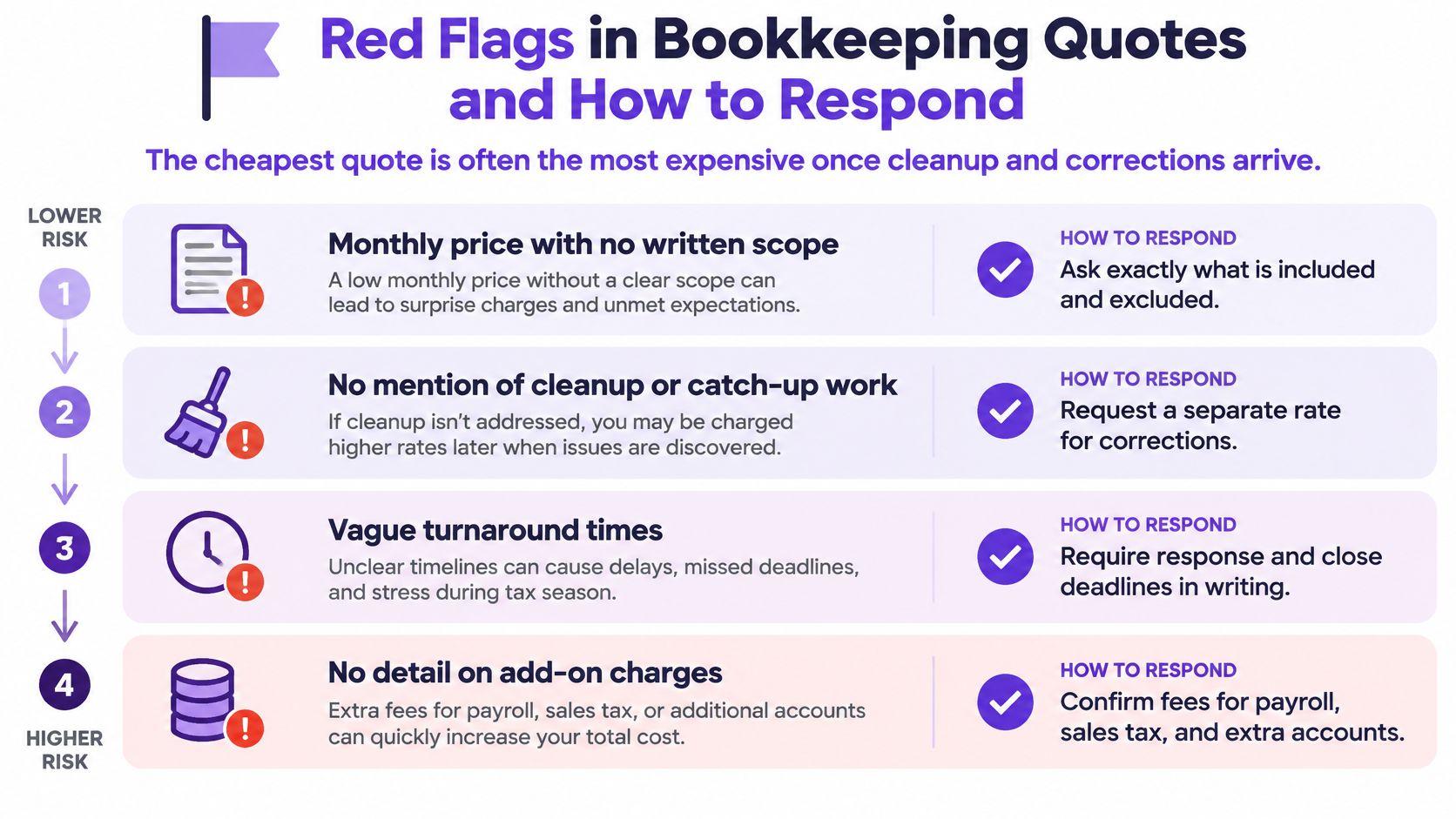
The cheapest quote is often the most expensive once cleanup and corrections arrive. You don't save money when low-scope books force your tax professional to rebuild twelve months of records under deadline pressure. You defer the cost and pay a premium for urgency.
Use the checklist below to test any proposal before you sign.
Warning signs in order of severity
- Price with no written scope: The quote lists a monthly fee but does not specify supported entities, bank and credit-card accounts, close deadline, or reporting package. Respond by requesting a complete service-level definition in writing. No definition, no signature.
- Core work sold as add-ons: Controller review, historical corrections, and integrations appear as extras even though your business cannot close without them. Ask the provider to reprice including those items in the recurring scope so you see the monthly total.
- No change-order policy: Incremental work is priced after the fact. Ask for named triggers, such as acquisitions, new entities, inventory, or volume jumps, with the incremental price stated before work begins.
- Forced full reset on day one: The provider insists on replacing your entire setup immediately. We collaborate with your existing founder, ops, CPA, or bookkeeper setup rather than requiring a full reset, because removing effective routines causes errors you then pay to fix.
- No workflow map before a retainer: You're asked to commit before anyone documents handoffs and owners. Our diagnostic runs for five business days and ends with a written workflow map delivered before either side commits to a retainer. Demand the same discipline from any provider.
- One-sided service terms: Check termination, service-change, and working-paper ownership clauses closely. We reserve the right to modify or discontinue our services at any time, and you should know exactly what that means for notice, handoff, and your records before you rely on any provider, including us.
Compare providers on effective cost per deliverable, such as cost per monthly close or per reconciled account, instead of cost per hour. A faster, reviewed close creates more value than cheap data entry you must check yourself. If you're evaluating remote providers specifically, our review of online bookkeeping services criteria covers security, handoff terms, and month-to-month flexibility.
A quote that won't state what's excluded is telling you the exclusions are where the margin lives.
Confirm the Scope and ROI Before You Sign
Buy a bookkeeping package only when the loss it prevents exceeds its annual cost. That's the test. Not whether the monthly fee sounds reasonable on a sales call.
According to Taxstra's guide to small business accountant costs, basic bookkeeping alone is commonly reported at approximately $300 to $800 per month, while broader monthly accounting that includes a real close, financial statements, and tax coordination is reported at roughly $500 to $3,000 or more. Those ranges describe different products, so compare within the tier that matches your required outcome.
Worked ROI example
Say you pay $1,200 per month for a close-ready package. That's $14,400 per year. If that package prevents $47,000 of billing, payroll, or classification errors, your avoided-loss value after fees is $47,000 minus $14,400, which equals $32,600. Your benefit-to-cost ratio is $47,000 divided by $14,400, or approximately 3.26 to 1. At that ratio, cutting the package to save $400 a month destroys value.
Map each proposal to one required outcome before you negotiate price: reconciled books, accrual accounting, revenue recognition, cash-flow reporting, KPI dashboards, or investor-ready financials. Then delete anything that doesn't serve that outcome. You'll stop paying for dashboards nobody opens and start funding the close discipline your board needs.
Check vendor fit with the same rigor:
- Integration coverage: QuickBooks, Xero, NetSuite, Stripe, and your payroll platform must connect without manual re-entry.
- Revenue model experience: SaaS deferred revenue and agency project billing break generic workflows. Ask for your model by name.
- Security and access: Confirm certifications, user permissions, and who owns the working papers if you leave.
- Contract flexibility: Month-to-month terms protect you while scope is still settling.
We offer complimentary ROI assessments to help you determine whether controller services make financial sense for your specific situation, and our structured controller services ROI analysis walks through the inputs. Start smaller if you prefer. Our free diagnostic asks three questions to name the likely failure point and explain why, and no email is required for the first result.
Do these four things this week:
- List every bank account, entity, and integration you run today.
- Request a written scope with change-order triggers from each finalist.
- Calculate annual cost as a share of revenue for every quote.
- Book the ROI assessment before you sign anything.
Stop comparing monthly stickers and start pricing the close you need. Jumpstart Partners gives SaaS and agency founders controller-led bookkeeping with a defined scope, a documented workflow map before any retainer, and reporting your board can act on. Book your complimentary ROI assessment this week and find out, in dollars, whether better books pay for themselves in your business.