Financial Operations
Bookkeeping Clean Up: A Guide for Growing Businesses
Bookkeeping clean up helps growing businesses fix errors, organize records, and stay compliant. Follow our practical steps to get your books in order.
ByJumpstart Partners, CPA, QuickBooks ProAdvisor
··16 min readIf your finance team spends 10 or more hours collectively closing the books at month-end, you're dealing with an operational problem, not an administrative nuisance. A Brex survey found that 59% of finance teams reported this time burden, while an APQC-based benchmark cited in the same source found a median close of 6.0 calendar days across 10,198 organizations. When your books contain unreconciled accounts, duplicate payments, missing entries, and unreliable revenue schedules, every management report becomes slower and less trustworthy.
For a $1M to $5M ARR business, bookkeeping clean up should restore the control layer behind your financial reporting. That means repairing bank feeds, payment processors, accounts receivable, accounts payable, payroll, revenue schedules, approval workflows, and account mapping. It does not mean randomly editing QuickBooks until the profit and loss statement looks reasonable.
Table of Contents
- Why Bookkeeping Clean Up Is a Business Risk, Not a Chore
- The Real Cost of Messy Books You Cannot See
- Diagnose Before You Touch a Single Entry
- Cleaning Up QuickBooks and Xero Without Making It Worse
- In-House Cleanup vs Outsourcing the Fix
- Rebuilding SaaS Revenue Recognition During a Clean Up
- Your Cleanup Timeline, Checklist, and Handoff Decision
Why Bookkeeping Clean Up Is a Business Risk, Not a Chore
Messy books create a chain of failures across systems. Stripe records a gross customer payment, the processor deducts fees, the bank receives a net payout, and your accounting platform imports another transaction through a bank feed. If those events aren't mapped and matched correctly, your general ledger can show duplicated revenue, missing fees, unexplained deposits, or an inflated accounts receivable balance.
Payment reconciliation has become a serious operating issue for multi-system businesses. Recent reporting found that 74% of Hong Kong SMEs struggle with payment reconciliation, with notable pressure in financial services, retail, hospitality, and wellness businesses (Hong Kong Business). The lesson applies well beyond Hong Kong. Your books are only as reliable as the transaction chain connecting your customer, processor, bank, subledger, and general ledger.
The founder mistake that makes cleanup worse
Founders often start by posting journal entries. They see an incorrect expense balance, create a reclassification, and move on. That approach treats the visible symptom while leaving the source problem intact. If an incorrect bank rule continues to categorize transactions, the ledger will become unreliable again as soon as new activity arrives.
Start with the data integrity problem instead:
- Feed rules: Pause incorrect QuickBooks Online auto-categorization rules and Xero bank rules before editing historical transactions.
- Account mapping: Separate gross payment volume, processor fees, refunds, chargebacks, transfers, and deposits.
- Approval workflows: Identify who can create vendors, approve bills, issue refunds, and edit closed periods.
- Audit trail: Preserve reports, supporting documents, and a change log for every material adjustment.
Reconciliation is the control that exposes errors before financial statements are published. A historical Dimensional Research survey reported that only 1 in 4 finance professionals were “very confident” their last close was error free, and 3 out of 4 said they had reopened their books after close to correct errors (FloQast). That evidence supports a direct conclusion: cleanup is foundational financial control work.
Controller's rule: Never improve a report before you know whether the underlying transaction population is complete, unique, correctly dated, and reconciled.
If you're preparing for financing, an audit, or a sale, accurate historical reporting matters just as much as current cash. A practical resource on preparing financial statements for a profitable exit can help you connect cleanup work to the wider transaction-readiness process. If you're staring at 6 to 18 months of incomplete or unreliable activity, treat the project as triage and control remediation, not cosmetic bookkeeping.
The Real Cost of Messy Books You Cannot See
Unreliable books rarely announce their full cost in one obvious line. The damage appears through delayed decisions, repeated reconciliations, weak lender reporting, and financial statements that need explanation before anyone can use them.
Consider a business that takes 12 days to close a month. If a controller spends 60 or more hours on overtime resolving old transactions, that time displaces forecasting, cash management, pricing analysis, and operational review. The accounting cost is visible. The opportunity cost is larger because the business waits longer for information it needs to act.
A second example shows why categorization matters. Suppose $40,000 of operating costs are posted to cost of goods sold instead of the correct expense category. Gross margin falls by that amount, operating expenses appear understated, and management may raise prices or cut staff based on distorted information. If a lender's covenant calculation uses the affected margin or earnings measure, the classification error can trigger an avoidable breach.
The third example is a payment-control failure. If a $120,000 accounts receivable write-off traces back to an unreconciled Stripe payout, the issue isn't that one invoice was mishandled. The business failed to connect customer invoices, processor activity, fees, refunds, payouts, and bank deposits.
Hidden costs of unreliable books
| Failure Mode | Worked Example | Annualized Impact |
|---|---|---|
| Delayed close | A 12-day close requires 60 or more controller overtime hours | Repeated overtime and delayed management reporting |
| Misclassified costs | $40,000 of COGS is posted to the wrong account | Distorted margin, pricing, hiring, and covenant analysis |
| Payment reconciliation failure | A $120,000 AR write-off traces to an unreconciled Stripe payout | Inflated receivables, impaired cash visibility, and difficult collections |
These examples also affect external relationships. Investors reviewing inconsistent monthly reports may ask for additional schedules and explanations. Lenders may delay updates when balances don't tie to bank statements or subledgers. Tax professionals may need to reconstruct the same activity before filing.
A clean ledger gives you a defensible answer to basic operating questions. Which services are profitable? Can you hire? Is runway improving? Are customer collections slowing? Are payment fees eroding margin? Without reconciled financials, you're answering from bank balances and memory.
The business impact compounds when you make decisions from bad information. A founder may hire too early because receivables appear collectible, delay hiring because payroll liabilities look inflated, or pursue fundraising with a margin story that doesn't survive diligence. Bookkeeping clean up protects decision quality by restoring the connection between transactions and management reports.
Diagnose Before You Touch a Single Entry
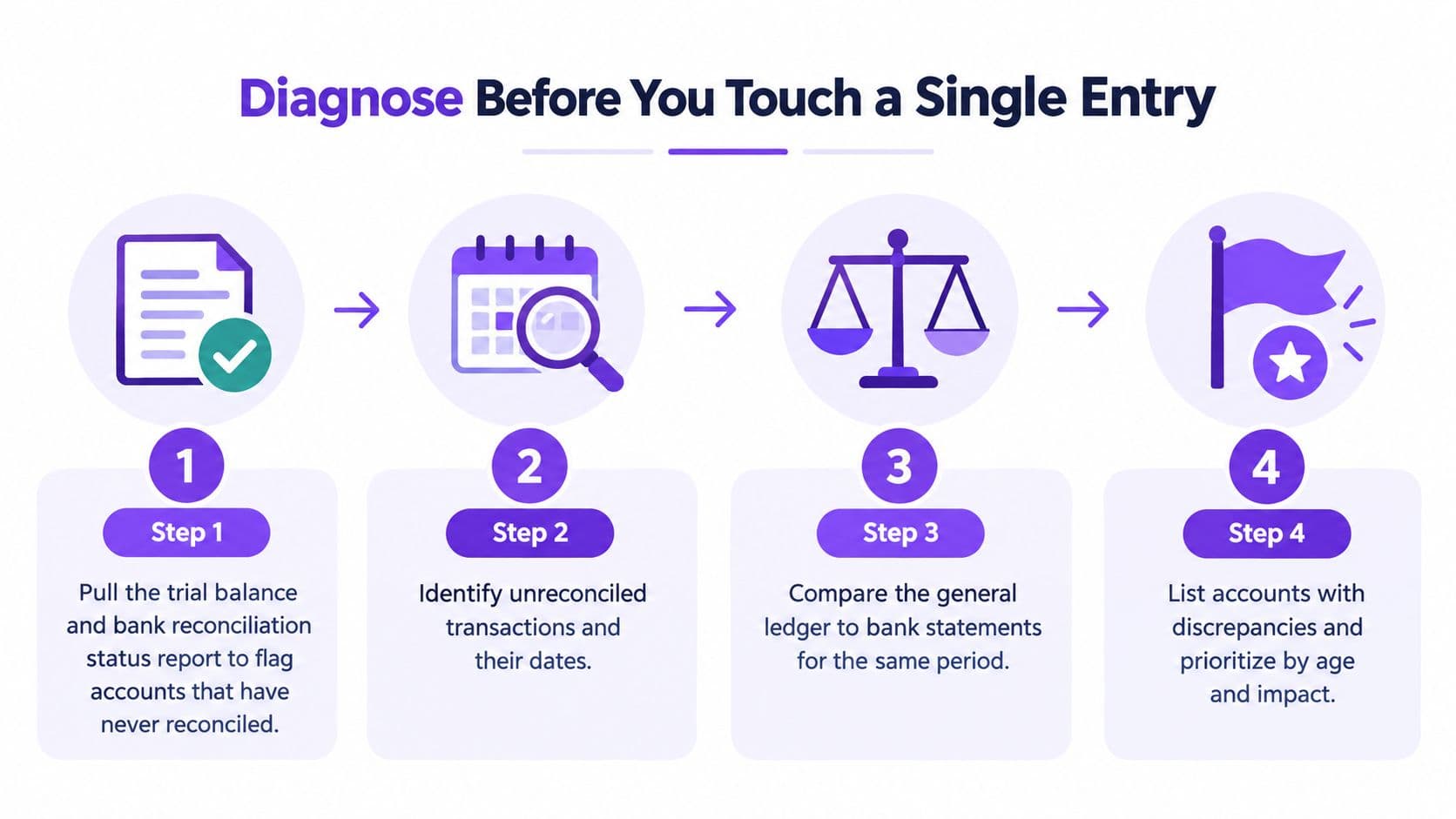
Don't edit the ledger until you know what's wrong. A discrepancy-first workflow prevents you from burying evidence under premature journal entries. Independent reconciliation guidance identifies duplicate transactions, timing differences, and manual entry as frequent sources of mismatch (Scry AI).
Start with a written diagnostic
Pull the trial balance, balance sheet, profit and loss statement, bank reconciliation status, accounts receivable aging, accounts payable aging, payroll reports, loan statements, and payment processor reports. Save these as baseline files before making changes.
Then work through the following sequence:
- Isolate the difference. Identify the exact out-of-balance amount, affected account, date range, and last month that reconciled correctly.
- Run duplicate checks. Search bank feeds, expense entries, invoice numbers, and processor payouts for repeated amounts, dates, vendors, and transaction identifiers.
- Review cutoff. Examine transactions posted around the beginning and end of the cleanup period. Look for expenses, invoices, payouts, payroll, refunds, and transfers recorded in the wrong month.
- Test subledger drift. Compare AR and AP subledgers to the general ledger. Tie payroll liabilities to provider reports and test processor payouts against bank deposits.
- Log findings first. Record the issue, proposed correction, source document, period affected, preparer, reviewer, and status in a working memo.
Reconcile in the right order
Reconcile bank and credit card accounts first. These accounts provide third-party evidence and establish the cash position. Next, repair AR and AP, because both subledgers affect revenue, expenses, working capital, and the balance sheet. Then address payroll, loans, fixed assets, equity, deferred revenue, and other schedules.
Don't plug a difference into an “adjustment” account just to make the reconciliation screen clear. A plug removes the visible symptom without explaining the transaction. If the issue involves revenue data or inconsistent source records, the broader discipline of fixing data quality for revenue is relevant because processor and subledger errors often begin before data reaches the general ledger.
Use an internal controls assessment to document who owns each control and how reviewers verify it. The cleanup should end with an auditable memo, not a file that only one person understands.
Cleaning Up QuickBooks and Xero Without Making It Worse
Accounting software won't correct a broken process by itself. Before you clean QuickBooks Online or Xero, stop the rules and feeds that created the problem.
In QuickBooks Online, pause auto-categorization rules and review recurring transactions. In Xero, disable or revise bank rules that match transactions to the wrong accounts. Export the trial balance, balance sheet, profit and loss statement, reconciliation reports, and general ledger before making edits. You need a baseline so you can explain what changed.
Rebuild from a known opening balance
Use the most recent reconciled bank statement as your anchor, then work backward through the open period. Reconcile chronologically, oldest month to newest month. Don't clear the unreconciled queue by choosing the largest dollar items first. The oldest unresolved transaction often affects the opening balance for every later month.
Once a month is correct, lock it or close it so later edits don't change prior reporting. QuickBooks users should review the closing date and permissions. Xero users should lock prior months, run the Bank Reconciliation Summary report, and correct coding only after the reconciliation balance agrees.

Repair processor mappings
Reconnect Stripe, PayPal, and Square feeds with date-specific coverage. Map the transaction chain separately:
- Gross customer payments: Record the full customer charge.
- Processor fees: Post fees to a dedicated expense account.
- Refunds and chargebacks: Track them distinctly from ordinary expenses.
- Payouts: Match net deposits to processor activity, not directly to income.
- Transfers: Record movement between your own accounts as transfers, not revenue or expense.
In QuickBooks, clear the unreconciled transaction queue from oldest to newest. In Xero, use the Bank Reconciliation Summary to identify the exact month and account where the balance diverges. Use journal entries for period corrections when the accounting treatment requires one, and avoid editing posted transactions without documenting the reason.
The QuickBooks cleanup process should include bank and credit card reconciliation, account recategorization, chart of accounts review, AR and AP cleanup, and a final balance sheet tie-out. Those are control steps, not software shortcuts.
In-House Cleanup vs Outsourcing the Fix
The right choice depends on scope, complexity, and whether your internal team can protect dedicated time. Founders routinely underestimate cleanup because they price the visible accounting work and ignore the cost of interrupting AP, AR, payroll, and customer operations.
Published cleanup ranges vary widely. One independent guide cites projects from roughly $1,500 to $40,000 or more, depending on backlog severity (Aibarra CPA). That spread reinforces the need for a diagnostic before anyone promises a fixed fee.
| Factor | In-House Cleanup | Outsourced Cleanup |
|---|---|---|
| Cost basis | Internal labor, often priced at $75 to $150 per hour | Project fee based on accounts, periods, volume, and risk |
| Typical scope | Works best when the file has limited errors and one entity | Better for mixed cleanup, catch-up, subledger repair, or multi-system work |
| Timeline | Daily AP, AR, and payroll compete with cleanup | Dedicated team can focus on the defined project |
| Review quality | May lack independent review | Usually includes preparer and reviewer separation |
| Risk tradeoff | Internal context is strong, capacity is limited | Technical depth is stronger, but access and documentation must be managed |
Use a simple decision rule
Outsource when more than two of these conditions apply:
- Prior periods need restatement.
- You have multiple entities or intercompany activity.
- Inventory or COGS needs rebuilding.
- Tax filings are pending.
- Revenue recognition is incomplete.
- The founder is also the bookkeeper.
- Payment processors don't tie to bank deposits.
- Payroll liabilities or AR and AP subledgers don't reconcile.
The founder-bookkeeper combination is the clearest warning. You're asking one person to process transactions, investigate their own errors, operate the business, and meet reporting deadlines. That structure delays cleanup and weakens review.
If you need a provider, compare capabilities through outsourced accounting services. Ask whether the engagement includes a diagnostic, reconciliation support, adjustment documentation, balance sheet tie-out, and a handoff process.
Rebuilding SaaS Revenue Recognition During a Clean Up
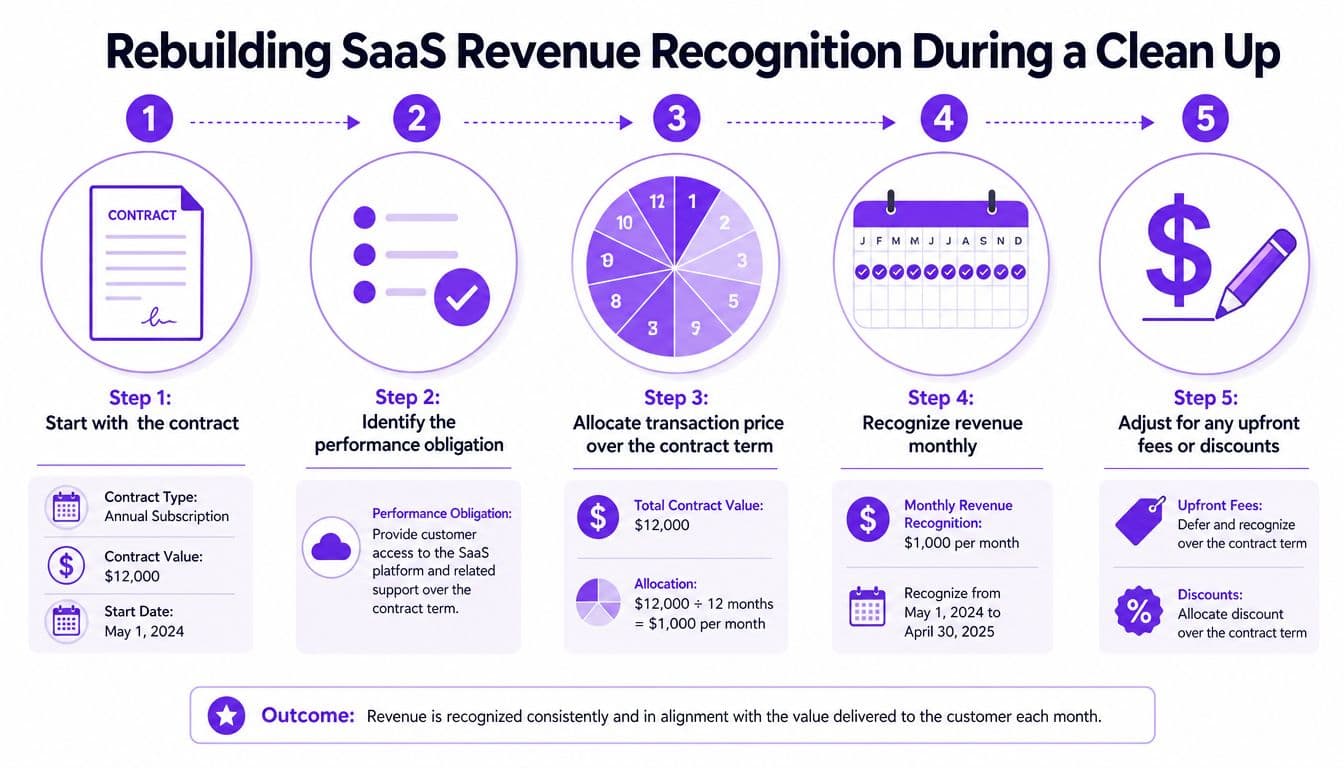
SaaS cleanup often fails because teams treat cash collection as revenue. ASC 606 requires revenue recognition when or as the entity satisfies a performance obligation, and KPMG's revenue recognition handbook explains the five-step model that governs the analysis.
Start with a contract inventory. For each customer, record the start date, term, billing frequency, contracted MRR or ARR, upgrades, downgrades, refunds, discounts, and termination terms. Then compare the schedule to Stripe or another payment processor, separating billed amounts from cash collected.
A worked annual subscription example
A customer prepays $12,000 for a 12-month subscription. Assume the SaaS access is one performance obligation delivered evenly throughout the contract term.
The calculation is:
- Contract value: $12,000
- Contract term: 12 months
- Monthly revenue: $12,000 ÷ 12 = $1,000
- Revenue after month one: $1,000
- Deferred revenue after month one: $12,000 minus $1,000 = $11,000
The remaining $11,000 is not missing revenue. It represents the company's obligation to provide future service. If the books recorded the full prepayment as revenue on day one, cleanup must reduce recognized revenue, establish deferred revenue, and correct prior periods where necessary.
Build the schedule and tie it out
Pull the deferred revenue schedule forward month by month. Adjust for contract modifications, upgrades, downgrades, refunds, upfront fees, and discounts. For each affected period, book a documented catch-up entry that updates revenue and deferred revenue, then evaluate the retained earnings impact with your CPA.
Your final control is the tie-out:
Recognized revenue + ending deferred revenue = cumulative billings minus refunds.
If your growth model depends on MRR, ARR, churn, or customer acquisition economics, the revenue schedule must feed those metrics consistently. Operational teams seeking specialized support can also review a best AI SEO agency for SaaS when growth reporting and financial reporting need to align, but don't use marketing metrics to compensate for weak accounting data.
For a deeper accounting treatment, use this guide to ASC 606 revenue recognition and have your CPA review material historical adjustments.
Your Cleanup Timeline, Checklist, and Handoff Decision
A cleanup succeeds when each phase has an owner, a deliverable, and an exit criterion. Don't declare victory because the bank feed is current. The books are ready when the balance sheet ties to support, subledgers agree with the general ledger, and you can close one month end-to-end within 5 business days. Industry guidance identifies a healthy close for many organizations as 3 to 6 business days, with complexity affecting the required time (Rand Group).
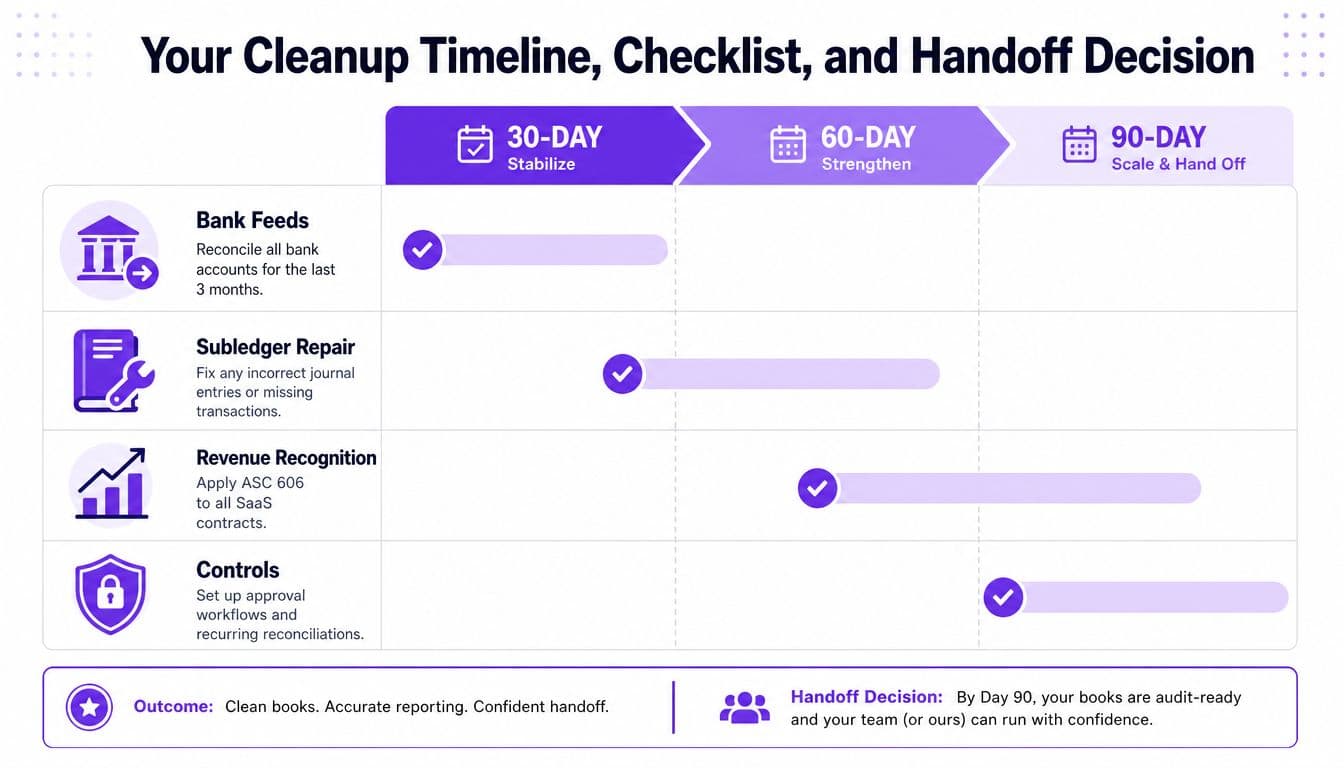
The 30, 60, and 90-day plan
| Phase | Primary Owner | Work | Exit Criteria |
|---|---|---|---|
| First 30 days | Controller or cleanup lead | Freeze rules, collect source documents, reconcile bank and credit card accounts, log discrepancies | Opening balances are supported and priority cash accounts reconcile |
| Days 31 to 60 | Accounting lead with reviewer | Repair AR, AP, payroll, processors, loans, and revenue schedules | Subledgers and supporting schedules tie to the general ledger |
| Days 61 to 90 | Finance leader | Complete reporting review, document controls, lock periods, and run a full close | One month closes within 5 business days with a signed review packet |
Use this checklist during the project:
- Bank feeds: Confirm every account has complete statement coverage, duplicate imports are removed, and transfers are coded correctly.
- Categorization: Review account mapping, processor fees, refunds, chargebacks, payroll, owner activity, and COGS.
- Reconciliations: Tie bank, credit card, AR, AP, payroll, loan, deferred revenue, and clearing accounts to independent support.
- Reporting: Save the final trial balance, balance sheet, profit and loss statement, reconciliation reports, adjustment log, and unresolved-items list.
Decide when to hand off
Engage a QuickBooks ProAdvisor or Xero-certified bookkeeper when open transactions exceed 500, unreconciled balances span 3 or more months, or revenue recognition or COGS has never been addressed. A scoped 40-to-80-hour engagement costing $2,500 to $7,500 gives the provider enough room to diagnose, repair, review, and document the work (Jumpstart Partners catch-up bookkeeping services).
Measure reconciliation performance after the project. The reconciliation error rate is calculated as erroneous reconciliations divided by total reconciliations, multiplied by 100 (Hyperbots). If 30 of 1,000 reconciliations are wrong, the error rate is 3%, meaning roughly one in every 33 reconciliations needs correction. Also watch the operating deadline. If bank reconciliations remain open after 5 business days, or the error rate exceeds 1% to 2%, your reporting process isn't stable enough for lender, investor, or month-end use (XE).
Turn the final cleanup packet into a permanent monthly close checklist. Assign preparers and reviewers, lock completed periods, investigate exceptions, and preserve support while the transaction context is still fresh.
Jumpstart Partners provides outsourced controller and bookkeeping support for SaaS companies, digital agencies, professional services firms, and other growing businesses in the $1M to $5M ARR revenue range. Visit Jumpstart Partners to discuss a scoped QuickBooks or Xero cleanup, subledger and payment reconciliation, revenue recognition repair, and a controlled month-end close process.