Financial Operations
Catch Up Bookkeeping Services: A Practical Playbook
Catch up bookkeeping services explained for growing businesses. Learn costs, timelines, vet questions, and a step-by-step cleanup plan from assessment to close.
ByJumpstart Partners, CPA, QuickBooks ProAdvisor
··15 min readYou're staring at a bookkeeping backlog that didn't happen overnight. It showed up after growth outpaced process, after receipts piled up, after Stripe, Shopify, payroll, and the bank stopped agreeing with each other, and now you're making decisions with incomplete numbers. That's not a bookkeeping nuisance, it's a business risk, and the fix is to treat it like triage, not data entry.
If you're leading a SaaS company, agency, or e-commerce brand in the $500K to $20M revenue range, you already know the pattern. Cash feels tight, receivables are stale, the monthly close keeps slipping, and every investor, lender, or buyer question lands with the same problem, your books aren't current enough to trust. Catch-up bookkeeping services exist to rebuild that record, close the gap, and hand you back a clean set of books you can use.
Table of Contents
- What Catch Up Bookkeeping Actually Means for a Growing Business
- Why Businesses Fall Behind and What the Backlog Is Really Telling You
- The Catch Up Playbook From Assessment to Clean Close
- What Catch Up Bookkeeping Should Cost and What Drives the Number
- How to Pick the Right Provider and Vetted Questions to Ask
- Common Pitfalls and How to Avoid Them
- What to Do in the 30 60 and 90 Days After the Books Are Clean
What Catch Up Bookkeeping Actually Means for a Growing Business
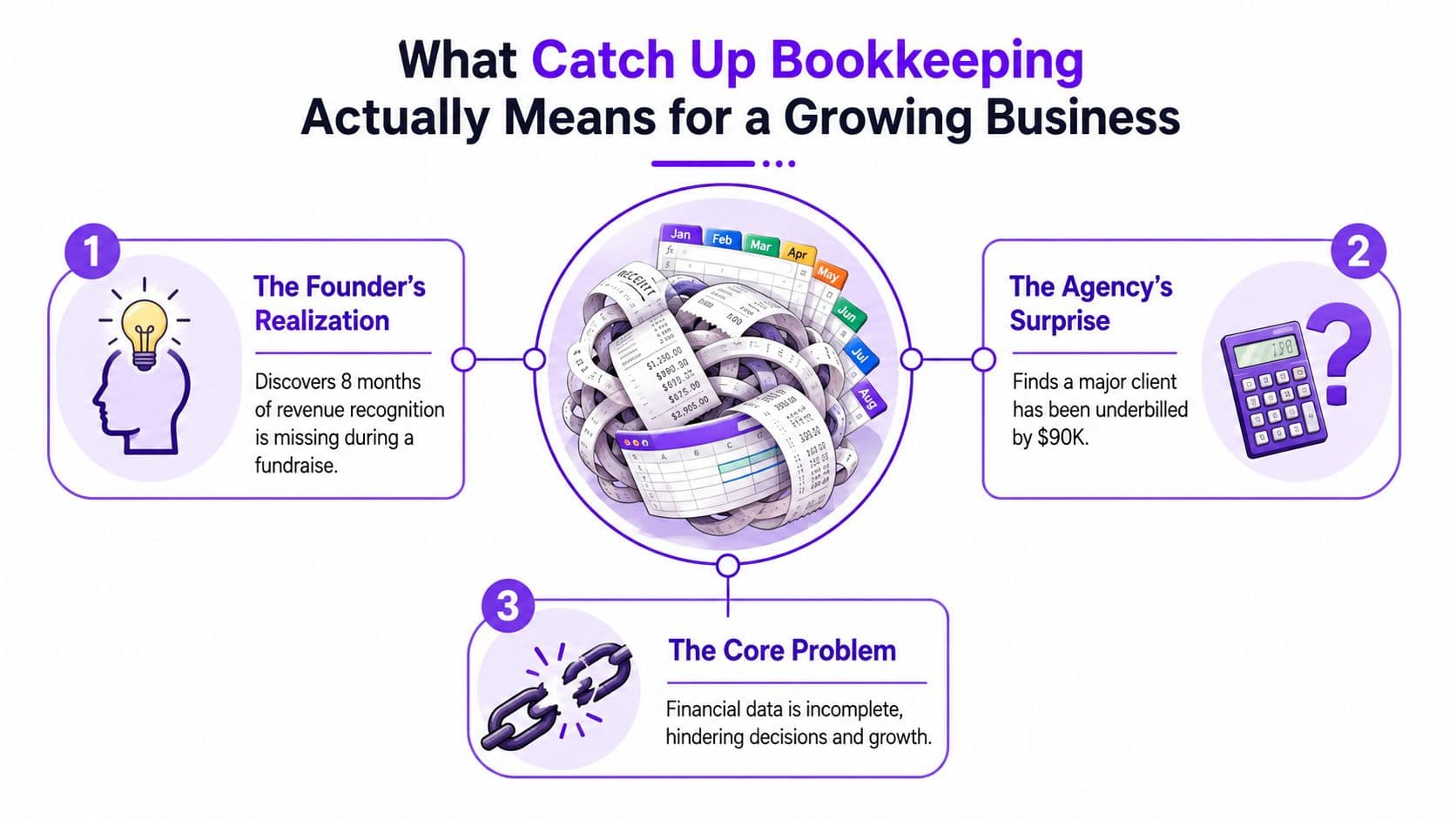
A SaaS founder closes a fundraise deck, then realizes eight months of revenue recognition never got recorded. An agency owner checks a key client file and discovers the account has been underbilled for two quarters. That's the kind of mess that turns bookkeeping into a boardroom problem fast.
Catch-up bookkeeping is the finite project of reconstructing overdue books, reconciling them to source records, and bringing the company to a current, defensible state. It is not ongoing monthly bookkeeping, which is maintenance after the books are already clean.
The output should be concrete. You want reconciled bank, card, loan, payroll, and merchant accounts, a rebuilt chart of accounts if the old one is useless, and corrected P&L, Balance Sheet, and cash flow statements. If the provider can't hand you those, you didn't buy catch-up bookkeeping, you bought a partial cleanup.
Practical rule: if the books are not reconciled to primary statements, they are not clean.
A lot of founders think this is just about getting transactions coded. It isn't. The value is that catch-up work turns a foggy ledger into a working asset, and independent 2026 industry guidance puts the usual completion window at about 2 to 8 weeks depending on access and volume (catch-up bookkeeping guide). That time frame matters because you're not looking for a forever project, you're looking for a reset.
If you need the simplest conceptual anchor, start with the general ledger. A clean explanation of that base layer is in what a general ledger is, and everything else in catch-up work flows from there.
Why Businesses Fall Behind and What the Backlog Is Really Telling You
The backlog usually tells you more about operations than it does about discipline. In SaaS, the common failure is growth outrunning the accounting stack, especially when annual contracts, deferred revenue, and subscription billing start moving faster than the close process. In agencies, the pain shows up when the owner's inbox becomes the system of record and billing gets delayed until someone has time to chase timesheets.
SaaS and agency backlogs are usually process failures, not accounting failures
A SaaS company that turns on annual prepayments without a revenue schedule creates accounting work the team has to unwind later. An agency that bills after delivery, not at milestones, often lets receivables age while the books sit untouched. The backlog is a symptom, not the disease.
E-commerce looks different, but the cause is just as familiar. Stripe, Shopify, PayPal, and multiple bank feeds all need to tie together, and if nobody reconciles those feeds monthly, you end up with mismatched deposits, stale balances, and expenses sitting in the wrong place. That's why a backlog in e-commerce often starts as a reconciliation problem and ends as a reporting problem.
The other factor is cash pressure. In the 2025 Intuit QuickBooks Late Payments Report, 56% of U.S. small businesses said they were owed unpaid invoices, averaging $17.5K each, and 47% said some invoices were more than 30 days overdue (late payments report). When receivables are stuck, bookkeeping gets deprioritized because the founder is trying to make payroll, collect cash, and keep the lights on.
Match the backlog to the operational problem
If you can identify the pattern, you can scope the fix correctly.
| Business pattern | What usually broke | What the cleanup has to include |
|---|---|---|
| SaaS with annual contracts | Revenue recognition and deferred revenue tracking | Historical schedules, balance sheet corrections, monthly revenue allocation |
| Agency with messy collections | Delayed invoicing and old receivables | Open invoice review, unapplied cash cleanup, billing support data |
| E-commerce with platform sprawl | Processor, inventory, and bank mismatches | Feed reconciliation, payout matching, account mapping, inventory review |
That last point is where a lot of owners get stuck. They think they need “better bookkeeping,” but what they need is a triage plan that separates collections, cash visibility, and historical cleanup. If you want a practical reconciliation lens, the reconciliation services discussion is worth keeping handy because that's the control point that keeps the cleanup from turning into guesswork.
The Catch Up Playbook From Assessment to Clean Close
A competent catch-up engagement starts by sizing the mess, not by typing transactions into software. The first pass should identify how far behind the business is, how many accounts need attention, what software is in use, and whether payroll, loans, and merchant processors create extra complexity. If the provider skips that conversation, they're not scoping, they're guessing.
The work moves in sequence, and reconciliation is the gate
The team should collect bank, credit card, payroll, loan, and merchant statements for every month in scope, then import and categorize transactions against source documents. After that, each account gets reconciled month by month so the ending balance in one period becomes the opening balance in the next. That's the control point, not data entry.
A good provider also flags unclear items instead of forcing an answer. That prevents a dirty shortcut from turning into a tax problem or a management reporting problem later. The final stage is reporting, with updated P&L, Balance Sheet, cash flow, and any revenue schedules or KPI reports the business needs.
For a plain-English refresher on the accounting foundation behind that workflow, small business accounting basics is a solid reference to hand to a founder or ops lead who hasn't lived in the ledger before.
The practical timeline usually follows backlog depth more than calendar time. A published process example puts reconstruction and reconciliation at roughly 4 to 12 weeks, plus 1 to 2 weeks for review and QA (catch-up bookkeeping guide). That's the right way to think about it, because a six-month backlog with 20 accounts is not the same as a six-month backlog with three accounts.
| Cleanup timeline by backlog size | Transaction volume | Typical duration | Key milestones |
|---|---|---|---|
| 1 to 3 months behind | Lower volume | Short project window | Access, import, reconcile, review |
| 4 to 6 months behind | Moderate volume | Mid-length project window | Rebuild chart of accounts, statement collection, monthly tie-outs |
| 7 to 12 months behind | Higher volume | Longer project window | Prior-period corrections, QA, final reporting |
| More than 12 months behind | Heavy complexity | Extended project window | Multiple reconciliations, special ledger review, handoff plan |
If you want to see how a workflow is typically framed in software terms, QuickBooks cleanup services is a useful adjacent read, because many catch-up projects start there even when the issue is broader than QuickBooks itself.
What Catch Up Bookkeeping Should Cost and What Drives the Number
Budgeting for catch-up work is easier when you stop thinking in hourly fragments. Published 2026 market guides put typical pricing at about $300 to $500 for 1 to 3 months behind, $500 to $1,500 for 4 to 6 months, $1,500 to $3,500 for 7 to 12 months, and $3,500 to $8,000+ for more than a year of backlog (catch-up bookkeeping cost guide). That's the shape of the market, and it scales with time elapsed, transaction volume, payroll complexity, and record quality.
What pushes a project up the range
Firms often charge $75 to $150 per hour for staff-led cleanup, while CPA-led work rises to $150 to $300 per hour (catch-up bookkeeping cost guide). That premium is justified when the work touches deferred revenue, multiple entities, inventory, sales tax, or messy payroll. Those issues demand judgment, not just classification.
A simple way to pressure test a quote is to map the backlog to the scope. A $1M SaaS company six months behind should not get a vague retainer and a shrug, it should get a fixed scope tied to revenue schedules, bank feeds, and account reconciliations. A $5M agency twelve months behind needs billing and receivables cleanup in the same scope. A $15M e-commerce brand eighteen months behind needs processor, inventory, and tax-sensitive work priced as a real project, not a casual monthly bookkeeping fee.
Use the market range as a budgeting frame
| Backlog depth | Typical market price | What you should expect |
|---|---|---|
| 1 to 3 months behind | $300 to $500 | Small cleanup, limited accounts |
| 4 to 6 months behind | $500 to $1,500 | Moderate backlog, more reconciliation |
| 7 to 12 months behind | $1,500 to $3,500 | Broader reconstruction, more review |
| More than 12 months behind | $3,500 to $8,000+ | Heavy cleanup, special ledgers, more QA |
I'm blunt on this point, fixed-fee project pricing beats hourly billing for catch-up work. Hourly bills reward ambiguity, and ambiguity is exactly what you're trying to eliminate. If you want a deeper benchmark on accounting service pricing more broadly, what accountants charge small businesses helps frame the market without confusing ongoing bookkeeping with project cleanup.
For founders comparing outsourced options, cost of accounting is the cleaner lens to use when you want to compare cleanup against ongoing monthly support and controller-level oversight. One option in that category is Jumpstart Partners, which offers fixed-fee cleanup alongside outsourced controller and bookkeeping support for growing companies.
How to Pick the Right Provider and Vetted Questions to Ask
Before a provider gives you a quote, they should know what software you use, how many accounts exist, whether statements are available, who runs payroll, what merchant processors are in play, who owns the historical books, and whether the work is being driven by a loan, audit, fundraising event, or sale. If they skip that intake, they don't understand the project yet.
Ask these questions in a 30-minute sales call
Capability
- How do you handle revenue recognition for annual contracts and deferred revenue?
- Which platforms do you reconcile natively, especially QuickBooks, Xero, NetSuite, Stripe, and Shopify?
- What do you do when the chart of accounts is too messy to support reporting?
- How do you handle payroll, loans, and merchant processor balances?
Process
- Can you show me a sample cleanup plan and deliverables list?
- What does your QA process look like before handoff?
- Do you reconcile to primary statements month by month, or do you batch work?
- What reports do I get at the end, and who signs off on them?
Security
- Are you SOC 2 Type II certified?
- How do you handle bank credential access and document storage?
- Who can see historical documents and financial files?
- What happens if we need to revoke access quickly?
If the provider can't answer those without hand-waving, stop the conversation. The same goes for pricing conversations. A useful pricing reference for small business accounting is what accountants charge small businesses, but don't let a low headline number distract you from scope, QA, and security.
Red flags: vague scope, no fixed fee, slow response during sales, refusal to explain the reconciliation method, and no client references.
For the $500K to $20M revenue segment, US-based CPA-certified teams with native support for core accounting and billing platforms are the right fit most of the time. If you want a broader service comparison, best outsourced accounting services is the type of resource to compare against when you're deciding whether you need cleanup only or cleanup plus ongoing controller support.

Common Pitfalls and How to Avoid Them
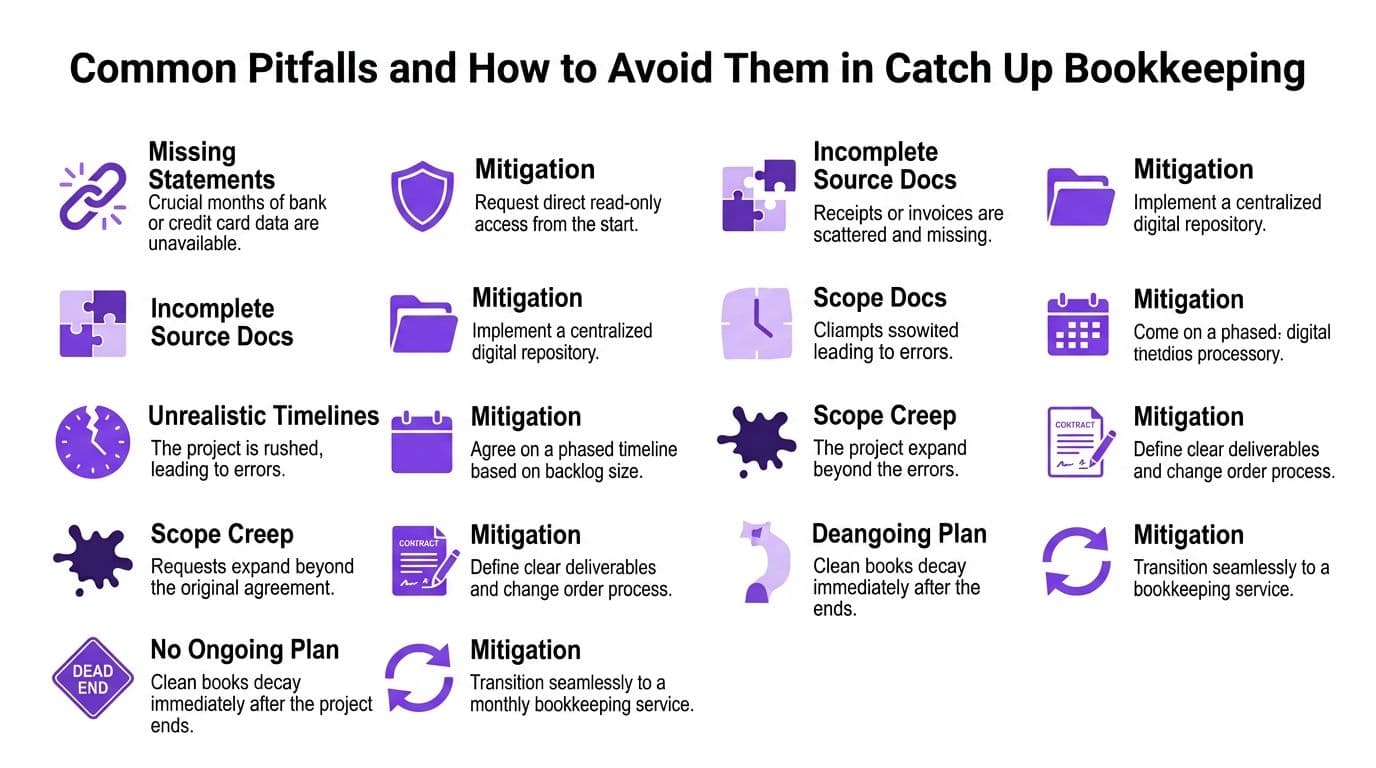
Most bad catch-up projects fail for the same five reasons. Missing statements stop the work cold because reconciliation has nothing to tie to. Duplicate entries and uncategorized expenses distort the reports even when the numbers look “done.”
Protect the engagement before it starts
The other mistake is confusing cleanup with tax prep. Tax filing is not the same thing as reconstructing prior periods, correcting balance-sheet accounts, and documenting where the books were wrong. If the provider treats catch-up as a filing exercise, the cleanup will be shallow.
Hourly billing is another trap. It invites scope creep, and scope creep turns a finite project into an open-ended cost center. You want a fixed-fee agreement with a defined period, defined deliverables, and a change-order process if new months or entities get added.
The biggest blind spot is collections. Backlog is often a symptom of operational stress, not just poor recordkeeping, so the cleanup has to run in parallel with a receivables triage plan. If cash is still leaking and invoices are still aging, the books will slide again.
Do
- Require statement delivery before work starts.
- Lock the project to a fixed fee and defined months.
- Require prior-period adjustment review before final sign-off.
- Run collections cleanup at the same time as bookkeeping.
Don't
- Let anyone guess missing balances.
- Approve open-ended hourly cleanup.
- Treat tax prep as a substitute for reconciliation.
- Assume clean books will stay clean without a monthly process.
The best defense is simple. Put the scope in writing, require primary source documents, and make sure the provider shows you exactly how reconciliation, review, and handoff will work. The cleaner the rules up front, the fewer unpleasant surprises at the end.
What to Do in the 30 60 and 90 Days After the Books Are Clean
Once the backlog is gone, act like a controller, not a relieved founder. The first 30 days are about locking the close calendar, setting recurring reconciliation for every bank, card, and merchant feed, and documenting the chart of accounts and accounting policies so the next person can follow them. If you skip that, the cleanup decays fast.
Build reporting that matches how you run the company
Days 31 to 60 should produce the monthly reporting package. At minimum, that means P&L, Balance Sheet, cash flow, and a KPI dashboard built around the business model, whether that means MRR, ARR, CAC, and gross margin for SaaS, or the equivalent operating metrics for agencies and e-commerce. That reporting package is what turns clean books into management decisions.
By days 61 to 90, package the books for the event that triggered the cleanup in the first place. If you're fundraising, that means a data room with reconciled statements and a revenue policy. If you're preparing for audit, it means support files and a clean trail. If you're handing off to a fractional CFO, it means enough documentation that they don't spend the first month untangling the past.
Aim for a 5-day close cycle, a clear revenue recognition policy, and a 13-week cash flow forecast. Those three items give you the operating discipline most growing businesses never build on their own.
If you want the work handled instead of managed internally, Jumpstart Partners offers outsourced controller and bookkeeping support, including fixed-fee cleanup projects, a 5-day month-end close, and a 30-day money-back guarantee. The right next step is a discovery call, not a sales pitch, because the only thing that matters now is getting your books current and keeping them that way.
If your books are behind, stop treating that as a side task and fix the operating problem behind it. Jumpstart Partners handles catch-up bookkeeping services for SaaS, agencies, and e-commerce businesses that need clean reconciliations, current reporting, and a handoff into steady monthly close. Visit Jumpstart Partners to book a discovery call and get the cleanup scoped correctly.