Financial Operations
Online Bookkeeping Services: How to Choose the Right One
Compare online bookkeeping services on pricing, security, close speed and integrations. Learn what SaaS and agency founders should verify before signing.
ByJumpstart Partners, CPA, QuickBooks ProAdvisor
··16 min readIn 2024, 94% of 707 U.S. accounting professionals surveyed said technology would help save time on bookkeeping and financial reporting over the following 12 months, according to the Intuit QuickBooks accountant technology survey. Technology alone doesn't close your books. You still need a named owner, reconciled source systems, and a reviewer who signs the monthly package before you use it for pricing, hiring, or fundraising decisions.
Table of Contents
- Why Founder-Run Books Stop Working as You Scale
- What Online Bookkeeping Services Actually Cover
- How SaaS and Agency Books Differ From Standard Bookkeeping
- How the Monthly Close Works, Step by Step
- Prove the Books Match Every Source System
- Pricing Models and What Each One Costs
- How to Vet a Provider and When to Walk Away
- Book Your Finance Diagnostic Before You Commit
Why Founder-Run Books Stop Working as You Scale
You're not saving money by running the books yourself. In 2024, businesses surveyed reported spending an average of 25 hours per week on manual data entry or reconciling data across applications, according to Intuit QuickBooks research. That's 25 x 52 = 1,300 hours a year. At an illustrative $100 per hour for founder time, you're spending $130,000 of capacity on entries instead of pricing, hiring, and sales.
That burden hits even smaller firms. In a Q4 2023 survey of 750 U.S. small-business owners and executives at companies generating $50,000 to $1 million in 2022, owners spent approximately 20 hours per week on accounting activities on average, and about half outsourced some work yet still spent roughly the same total time, according to the Tight embedded accounting report. Outsourcing fails when you still review every line.
Three Breaking Points
- Close slips past two weeks: You can't price or hire from stale cash and margin data.
- Investor asks for a tie-out: Your board wants billings, cash, and recognized revenue reconciled, and your spreadsheet can't prove it.
- Second billing system appears: Stripe plus a CRM invoice tool creates duplicates with no owner for matching them.
Good online bookkeeping services replace that handoff with a remote team in shared cloud books. They reconcile bank, card, billing, and payroll feeds and deliver a reviewed package. If you don't know whether you need recording help or close ownership, read this bookkeeper versus controller comparison before you hire.
Self-test: Total last month's hours spent categorizing, reconciling, and chasing receipts. If you exceeded five hours a week, you have a case for outsourcing.
What Online Bookkeeping Services Actually Cover
An online bookkeeping service is outsourced, remote bookkeeping and accounting in cloud software that ends in a reviewed output. It's not data entry with a dashboard. In 2024, 64% of small businesses with fewer than 500 employees used cloud-based accounting software as their primary bookkeeping tool, according to Clutch, as reported by Fortune. Cloud access is the default, so judge providers on ownership and review, not connectivity.
Components of an Online Bookkeeping Service
| Component | What it covers | What you receive | Typical cadence |
|---|---|---|---|
| Transaction categorization | Coding bank, card and payment activity to the chart of accounts | Clean general ledger | Daily or weekly |
| Bank and card reconciliation | Matching statements to ledger balances | Reconciled accounts with explained differences | Monthly, with weekly checks for high volume |
| Accounts payable and receivable | Bill entry, approvals and invoice follow-up | AP and AR aging reports | Weekly |
| Revenue schedules | Deferred revenue and ratable recognition for subscriptions | Revenue waterfall tied to billing | Monthly |
| Month-end close | Accruals, cut-off and variance review | Locked period and close checklist | Monthly, target 5 business days |
| Management reporting | P&L, cash, runway and ARR movement | Monthly package with commentary | Monthly |
| Integration upkeep | Connectors across accounting, billing, payroll and payments | Reconciled data flows | Ongoing |
Read the table by output, not activity. Categorization means nothing if accounts don't reconcile to statements. AP and AR mean nothing without aging reports you can act on weekly. Integration upkeep across QuickBooks, Xero, NetSuite, Stripe, Shopify, Square, Gusto, and BambooHR means nothing unless imported totals tie to source systems.
Bookkeeping records transactions. Controller work owns the close, reviews variances, and signs off. Buy recording only if someone inside your company already performs that review. For a one-time fix, use a fixed-fee project instead of a retainer. We offer fixed-fee projects for AP setup, cash flow optimization, and books cleanup, which fit a defined cleanup or a 13-week cash flow sprint.
Start with categorization, reconciliation, close, and reporting. Add AP and AR when late bills or collections consume founder time. Add revenue schedules immediately if customers prepay.
How SaaS and Agency Books Differ From Standard Bookkeeping
An invoice is not revenue. That distinction separates SaaS bookkeeping from standard transaction posting, and it's where cheap providers expose you during diligence.
The visual below contrasts subscription revenue with project revenue before we work the numbers.
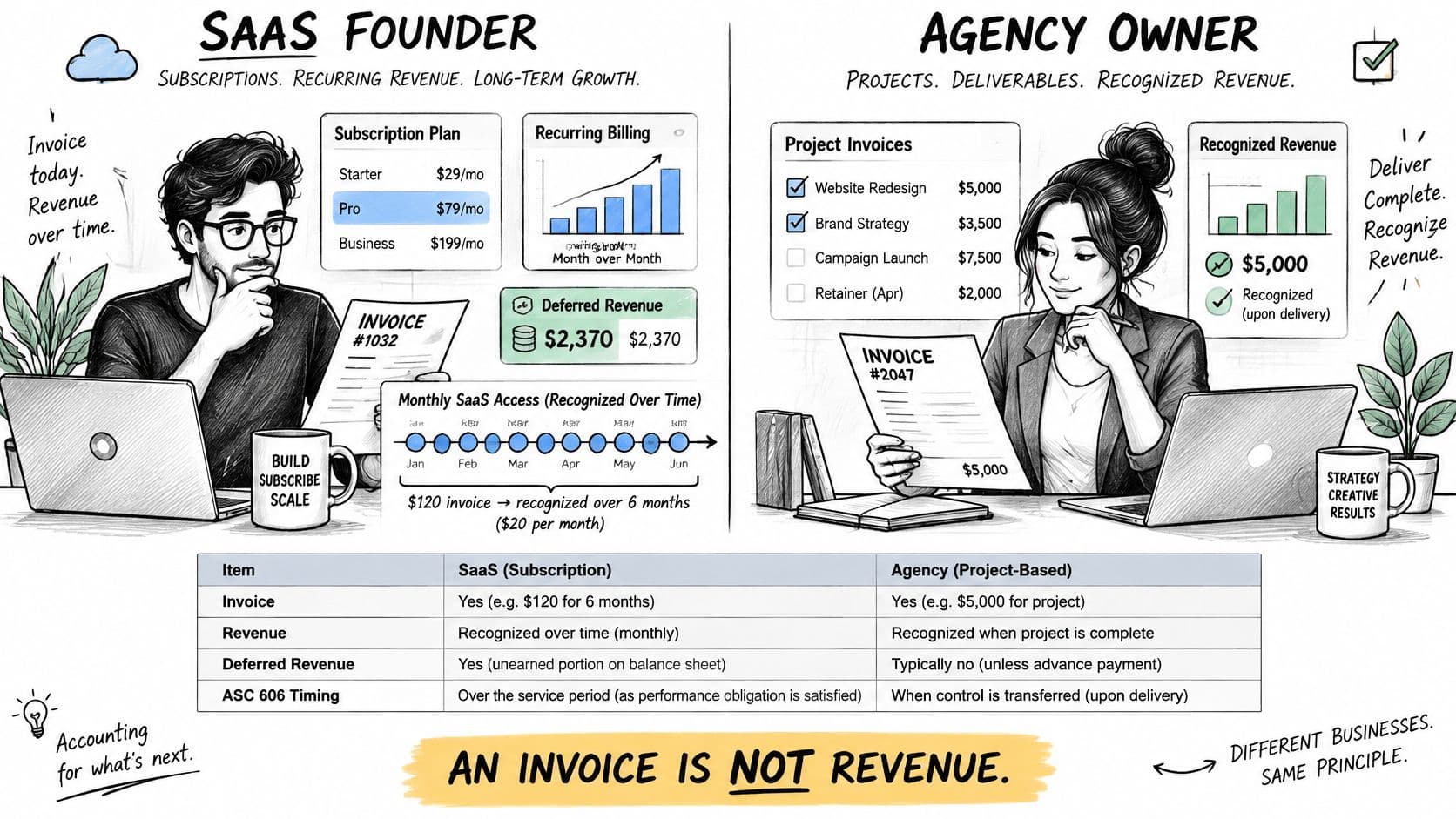
Say a customer prepays $24,000 on January 5 for a 12-month plan. Cash rises $24,000, but you recognize only $2,000 in January. You carry $22,000 in deferred revenue at January 31. Under the ASC 606 five-step process described in this SEC filing excerpt, you identify the contract and performance obligations, determine and allocate the transaction price, then recognize revenue as each obligation is satisfied. Annual subscriptions therefore create deferred revenue, and recurring access is commonly recognized ratably over the service period.
Your provider must maintain contract dates, amendments, refunds, credits, upgrades, and cancellations. Each close, they reconcile billed receivables, cash, deferred revenue, and recognized revenue. Use our ASC 606 revenue recognition guide to test whether your current process does that.
Agencies Need Client Margins
Say Client A produces $60,000 revenue and $33,000 labor, leaving $27,000 profit at a 45% margin. Client B produces $75,000 revenue and $61,500 labor, leaving $13,500 profit at an 18% margin. A combined P&L hides the problem. Client A subsidizes Client B, and you'd renew the wrong account.
This walkthrough shows how contract schedules support cleaner reporting.
MRR and ARR are operational metrics, not GAAP revenue. Reconcile them every month. We provide controller-led finance help for B2B AI SaaS companies, and our reporting release packages P&L, cash, runway, ARR movement, and commentary into one approved operating view. Ask every provider for a revenue waterfall and client-level margin view. If they only post invoices, walk away.
How the Monthly Close Works, Step by Step
Demand a five business day close with named owners. A close without dates is a hope, not a process.
This sequence shows the target flow from feed sync to locked books.
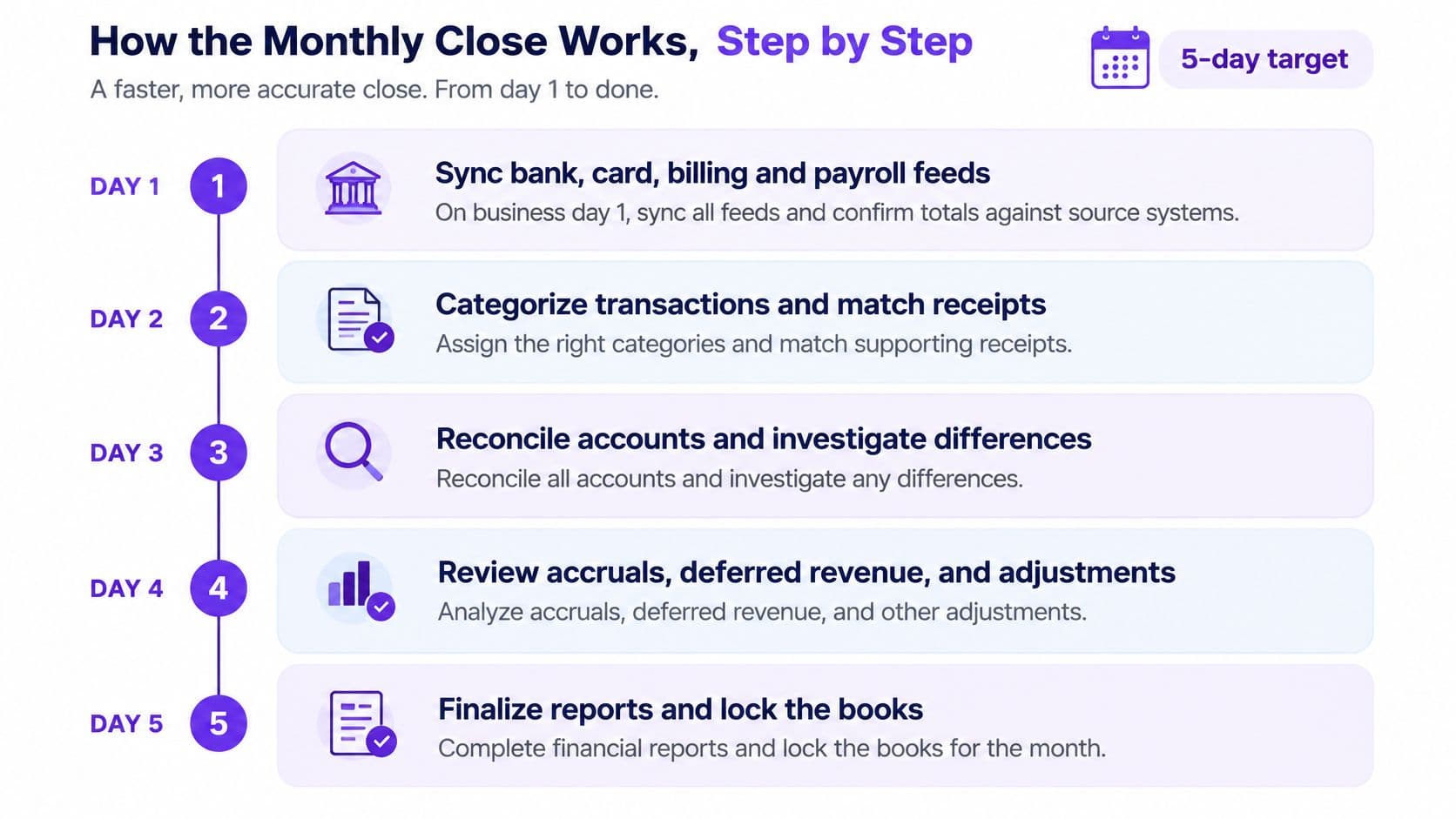
- Sync feeds on day 1: Pull bank, card, billing, and payroll data and confirm totals against source systems. Silent feed failures create missing transactions, so the bookkeeper checks connection status first.
- Categorize and reconcile: Code transactions to the chart of accounts and reconcile every bank and card account to its statement. Unexplained differences stay open, with an owner and due date.
- Build the billing bridge: Match invoices, credits, and refunds to cash. Our billing bridge ties invoices, usage, credits, and cash into one reviewed file, which catches duplicate Stripe payouts before they inflate revenue.
- Post schedules and accruals: Update deferred revenue, prepaid expenses, payroll accruals, and vendor accruals. Check annual contracts individually because one wrong end date distorts every remaining month.
- Review variances: Compare results with the prior month and budget. The controller clears exceptions with owners and documents unusual movements instead of forcing balances.
- Lock and release: Lock the period and issue P&L, cash, runway, ARR movement, and commentary with controller approval. Nobody edits a locked month without a documented adjustment.
Our controller-led retainer includes monthly close ownership, a management reporting package, billing, revenue and cash review, AI cost and margin review, process cleanup and automation, clear owners and review points, a monthly finance operating meeting, and board package support. Compare that scope with our financial close process breakdown when you interview providers.
Can you produce the package by business day 5 without the founder touching the books? If not, you don't have a close process yet.
Unmatched refunds make cash look short. Duplicate payouts overstate revenue. Your checklist must name who catches each one.
Prove the Books Match Every Source System
Fragmented tools create financial risk, not just inconvenience. In a 2026 survey of accounting professionals, 48% viewed their setup as functional but fragmented, while professionals lost about five hours per week moving, re-entering, or reconciling information across tools, according to the Financial Cents 2026 bookkeeping firm tech stack report. More integrations won't fix that. Controlled tie-outs will.
Build the System of Record Map
Name one source of truth per stream. Use Stripe or your billing app for invoices, the processor and bank for payouts, Gusto or BambooHR for payroll, the CRM for pipeline, and QuickBooks, Xero, or NetSuite for the general ledger. If two systems claim the same number, decide which one wins before month-end.
Assign one owner per tie-out, not a shared inbox. Set the cut-off clearly: feeds sync on day 1, exceptions clear by day 3, and the period locks on day 5. Track exception rate as unmatched lines divided by total lines, with a target under 2% before lock.
For transaction-heavy reporting, Chartsy's breakdown of ecommerce revenue metrics is useful context for separating storefront activity from ledger revenue. Your bookkeeping still needs its own tie-out, regardless of the analytics dashboard you prefer.
Reconciliation Ownership Matrix
| Stream | System of record | Tie-out | Owner | Due |
|---|---|---|---|---|
| Billing invoices | Stripe or billing app | Invoices to receivables | Bookkeeper | Business day 1 |
| Payouts and cash | Processor and bank | Payouts to deposits | Bookkeeper | Business day 2 |
| Payroll | Gusto or BambooHR | Register to wages and liabilities | Provider reviewer | Business day 3 |
| Deferred revenue | Contract schedule | Waterfall to trial balance | Controller | Business day 4 |
| General ledger | QuickBooks, Xero, or NetSuite | Subledgers to trial balance | Controller | Business day 5 |
Each month, reconcile billed receivables, cash collected, deferred revenue, and recognized revenue to the trial balance. Reconcile payroll register totals to wages and liabilities too. Our bank reconciliation services guide shows the evidence standard to expect.
Take this matrix to every provider call. If they can't name the owner, source report, and due day, you're buying a connector, not control.
Pricing Models and What Each One Costs
Don't compare monthly fees until you know the billing model. The cheapest quote often excludes the review work you need.
Pricing Models Compared
| Pricing model | How you are billed | Best fit | Watch-out |
|---|---|---|---|
| Per-transaction | Per entry or bank line | Low, predictable volume | Cost climbs as transactions grow |
| Monthly tiered retainer | Flat monthly fee for a defined scope | Steady growth with regular close and reporting | Confirm which tasks sit inside the tier |
| Fixed-fee project | One price per defined deliverable | Books cleanup, AP setup, or 13-week cash sprint | Scope creep if deliverables are vague |
| Hourly | Billed per hour worked | Occasional questions | Hard to forecast the monthly total |
| Custom managed service | Priced to usage and reporting load | Heavy billing, multi-system reporting, board packages | Needs a scoping call before any number is set |
Per-transaction pricing punishes growth because Stripe payouts, refunds, and card activity multiply before revenue does. Hourly billing makes budgeting impossible and rewards slow work. A tiered retainer works when the provider lists close tasks, reports, meetings, and revision limits inside the tier.
Our Controller-led Finance Ops core retainer costs $2,500 per month, or $30,000 per year. Our Finance Ops Diagnostic is a $3,500 fixed fee, delivered in 5 business days, equal to 1.4 months of that retainer. Finance Ops Plus is custom-priced for heavier usage billing, reporting, or board-package needs, so it requires scoping before anyone quotes responsibly.
Run the capacity test. At 25 hours per week, you spend about 108 hours per month. At an illustrative $100 per hour, that's $10,800 per month against a $2,500 retainer. The retainer wins if it removes those hours and prevents revenue or cash errors. It loses if you still chase receipts and review every categorization.
Ask what triggers extra charges before you sign. Price catch-up months, another entity, a second billing system, payroll changes, and board reporting separately. Get the first-year total, not just the monthly headline, and reject any quote that won't define included tasks in writing.
How to Vet a Provider and When to Walk Away
A provider's sales pitch is easy to deliver. Ask for evidence that shows who reviews the work, how transactions tie to source systems, and who is accountable for the close.
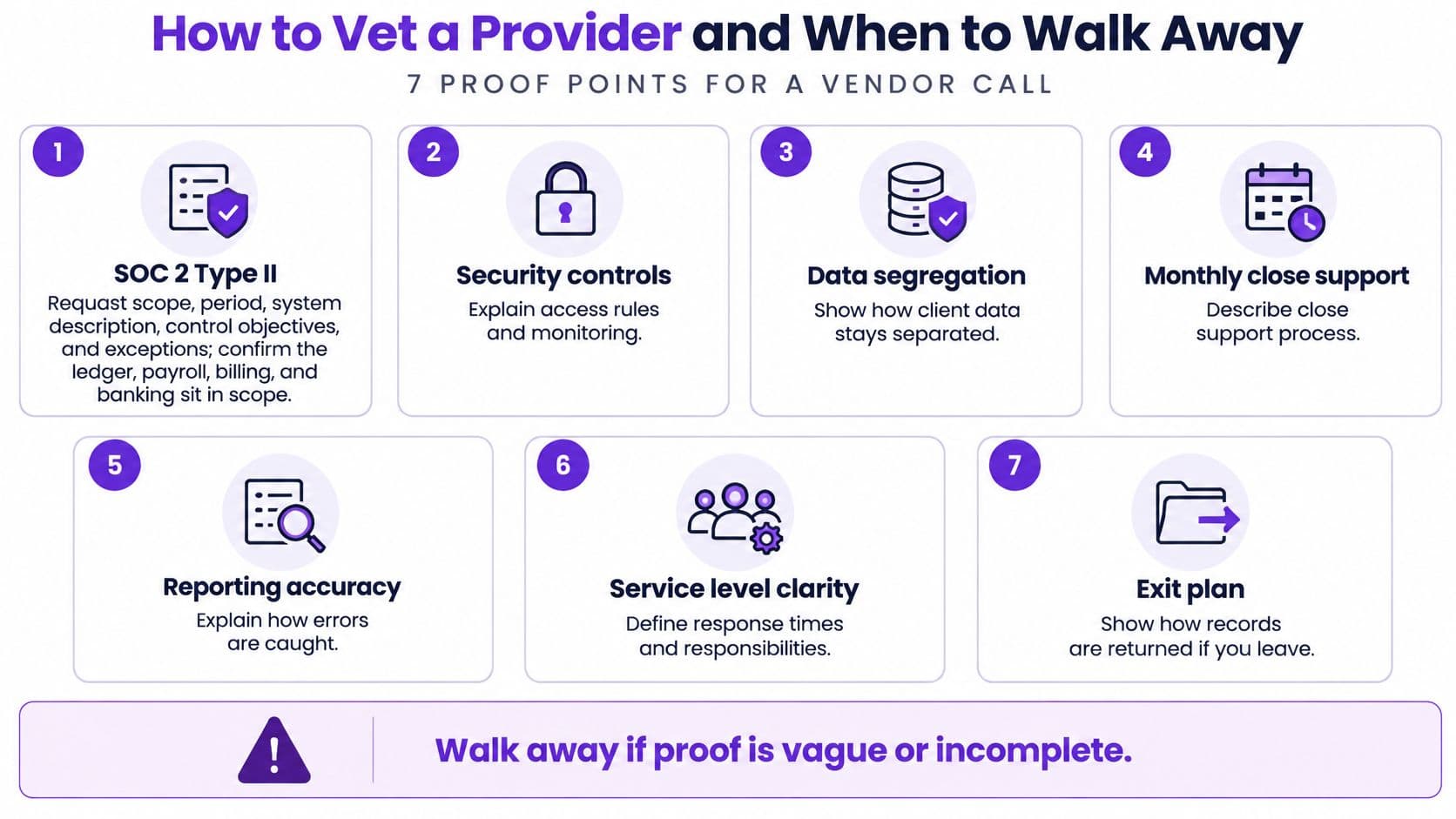
Use this checklist in vendor interviews:
- Security evidence: Ask for the SOC 2 Type II report, including its scope, examination period, system description, control objectives, and exceptions. The AICPA and CIMA's explanation of SOC 2 describes the criteria, including security, availability, processing integrity, confidentiality, and privacy. Check whether the systems handling your billing and payroll fall within the report's scope.
- Access controls: Require least-privilege permissions, multifactor authentication, and logs of administrator and data-change activity across accounting, payroll, banking, and payment systems.
- Segregation of duties: Keep preparation, approval, and payment with different people. If one person controls all three, ask how the provider prevents and detects payment errors.
- Accuracy claims: Ask what the provider counts as an error, how it measures accuracy, what period the claim covers, and what remedy applies when work falls short. A percentage without those details is marketing, not a usable service standard.
- Integration proof: A connector only moves data. Require a close process that ties imported totals back to the source systems, including invoices, usage, credits, and cash for SaaS and agency revenue.
- Named accountability: Before you pay, get the name of the person who will review and sign the close. Verify credentials directly. Jumpstart Partners' engagements are CPA-led, the firm holds the QuickBooks ProAdvisor credential, and it works with a client's existing founder, ops, CPA, or bookkeeper setup rather than forcing a full reset on day one. For a comparison of provider roles, see this guide to accountants for startups.
- AI governance: Require a named human reviewer, approval thresholds, an audit trail, model-error testing, data-retention rules, and a clear owner for correcting incorrectly coded transactions.
Provider Green Lights and Red Flags
| Signal | Walk away if | Accept only if |
|---|---|---|
| Automation | No named human reviewer | Reviewer, approval threshold, and audit trail are defined |
| SOC 2 | No report, or billing and payroll fall outside its scope | Type II report identifies scope, period, and exceptions |
| Accuracy | A guarantee has no error definition or remedy | Measurement basis, period, and remedy are stated |
| Close | No calendar, owner, or sign-off | Calendar and named controller sign-off are defined |
| Integrations | Connectors move data without a source-system tie-out | Imported totals are reconciled to source systems |
| Scope | The monthly fee blurs bookkeeping with audit, tax, or fundraising work | Included work and exclusions are stated in writing |
Walk away if the provider cannot name the close reviewer, show how imported balances are reconciled, or explain who approves payments. A bookkeeping engagement does not provide an audit opinion, tax filing, or fundraising strategy. Ask for the security report before proceeding, and confirm that its scope covers the systems the provider will access.
Book Your Finance Diagnostic Before You Commit
Leave with a decision, not another vendor tab. Score last month on three facts: hours spent categorizing, reconciling, and chasing receipts; whether the close passed five business days; and whether billings, cash, and recognized revenue tie. Our Finance Ops Scorecard asks three quick questions to identify your first likely finance break, and no email is required to use it.
Then book the Finance Ops Diagnostic, a $3,500 fixed fee delivered in 5 business days after a 30-minute kickoff you schedule. Read the output before buying any retainer. It includes a current stack and handoff review, a spreadsheet dependency map, an unclear owner and review gap inventory, a recommended cleanup path, and a monthly routine recommendation.
Buy ongoing support only if that path names a controller-led close owner and the monthly fee stays below the capacity you priced up front. The diagnostic excludes fundraising strategy, tax preparation, and transaction-only cleanup. Bring your last two monthly closes plus your billing and payroll setup, and walk out with the written path before you sign.
Book a Finance Ops Diagnostic with Jumpstart Partners to get a controller-led review of your stack, handoffs, owners, and cleanup path in 5 business days. You'll know whether you need cleanup, a $2,500 monthly close retainer, or custom Finance Ops Plus support before you commit. Bring your last two closes and leave with a monthly routine you can run.