Financial Operations
Budget V Forecast
Budget v forecast. Budget vs forecast explained for founders. Learn when each drives decisions, how to build and reconcile them, and avoid common cash planning
ByJumpstart Partners, CPA, QuickBooks ProAdvisor
··16 min readA budget that looks precise can still be the reason you run out of cash. Across 54 medium-term UK forecasts issued between 1990 and 2019, actual managed expenditure exceeded the original forecast every time. Excluding the exceptional COVID-19 period, final-year spending averaged 3.5% of GDP above the initial forecast, equivalent to approximately £100 billion in today's economy. The lesson for a growing company is simple: a budget sets the commitment, but a forecast tells you what the commitment is becoming. UK fiscal analysis
If you let the annual budget control every decision after the facts change, you aren't managing performance. You're defending an old assumption. This budget v forecast guide shows how to separate authorization from prediction, assign decision rights, set trigger rules, and use variance reporting to protect hiring capacity, fundraising plans, and cash.
Table of Contents
- Why the Budget vs Forecast Question Costs Real Money
- What a Budget Actually Is and What a Forecast Actually Is
- Side by Side Comparison Across the Criteria That Matter
- How to Build Each Document With Real Numbers
- Reading Variance Reports Without Fooling Yourself
- How the Framework Plays Out in SaaS, Agencies, and E-Commerce
- Four Misconceptions That Quietly Destroy Forecasts
- Your 30-60-90 Day Rollout and When to Get Help
Why the Budget vs Forecast Question Costs Real Money
A SaaS company reaches October having achieved 80% of its annual revenue plan. Leadership keeps hiring against the original budget because the headcount plan was approved, even though sales timing has slipped and collections are weaker than expected. The company runs out of runway 60 days before its raise closes.
That scenario is representative of a governance failure, not an arithmetic failure. The budget was treated as the live operating plan, no rolling forecast was maintained, and nobody had agreed in advance which conditions would force a reset. The cost isn't the difference between two spreadsheet tabs. It's payroll, delayed delivery, rushed fundraising, and negotiating strength lost when cash becomes urgent.
A budget and a forecast have different jobs:
- The budget authorizes resources. It defines the approved spending envelope, hiring assumptions, targets, and accountability baseline.
- The forecast updates expectations. It incorporates actual revenue, pipeline movement, churn, payroll commitments, collections, and financing costs.
- Variance reporting explains the gap. It separates poor execution from changed assumptions and intentional strategic choices.
Practical rule: Never ask whether the budget or forecast is “right.” Ask which document controls this decision, and whether its assumptions still describe the business.
Founders often begin with a cash question, then discover the operating model is the problem. A disciplined cash flow forecasting process connects revenue timing, payment behavior, payroll, hiring, and funding needs instead of treating cash as the final line in an annual plan.
The operating answer is direct. Keep the approved budget as the authorization baseline. Maintain a rolling forecast as the current expectation. Give one person ownership of each, and define the triggers that override stale assumptions before the bank account forces the issue.
What a Budget Actually Is and What a Forecast Actually Is
A budget is a fixed, usually 12-month plan that allocates resources and establishes performance targets. Your board or leadership team approves it, managers use it to plan spending and hiring, and the finance team measures actual results against it.
A forecast is an updated estimate of what is likely to happen. It should include revenue, costs, cash flow, and headcount over a forward-looking horizon, commonly maintained as a rolling view of the next 12 to 18 months. The forecast changes when actual results, pipeline, churn, pricing, hiring dates, or collections change.
Consider a fictional SaaS company with $4.2M ARR:
| Metric | Approved budget | Current forecast |
|---|---|---|
| ARR outcome | $5.0M target | $4.5M expected |
| Headcount | 28 FTE plan | 31 FTE already hired |
| Cash burn | $1.4M planned | $1.1M expected |
The budget answers, “What did we authorize and promise to manage toward?” The forecast answers, “Given what we know now, where are we heading?” Neither document replaces the other. The budget is useful because it remains stable. The forecast is useful because it changes.
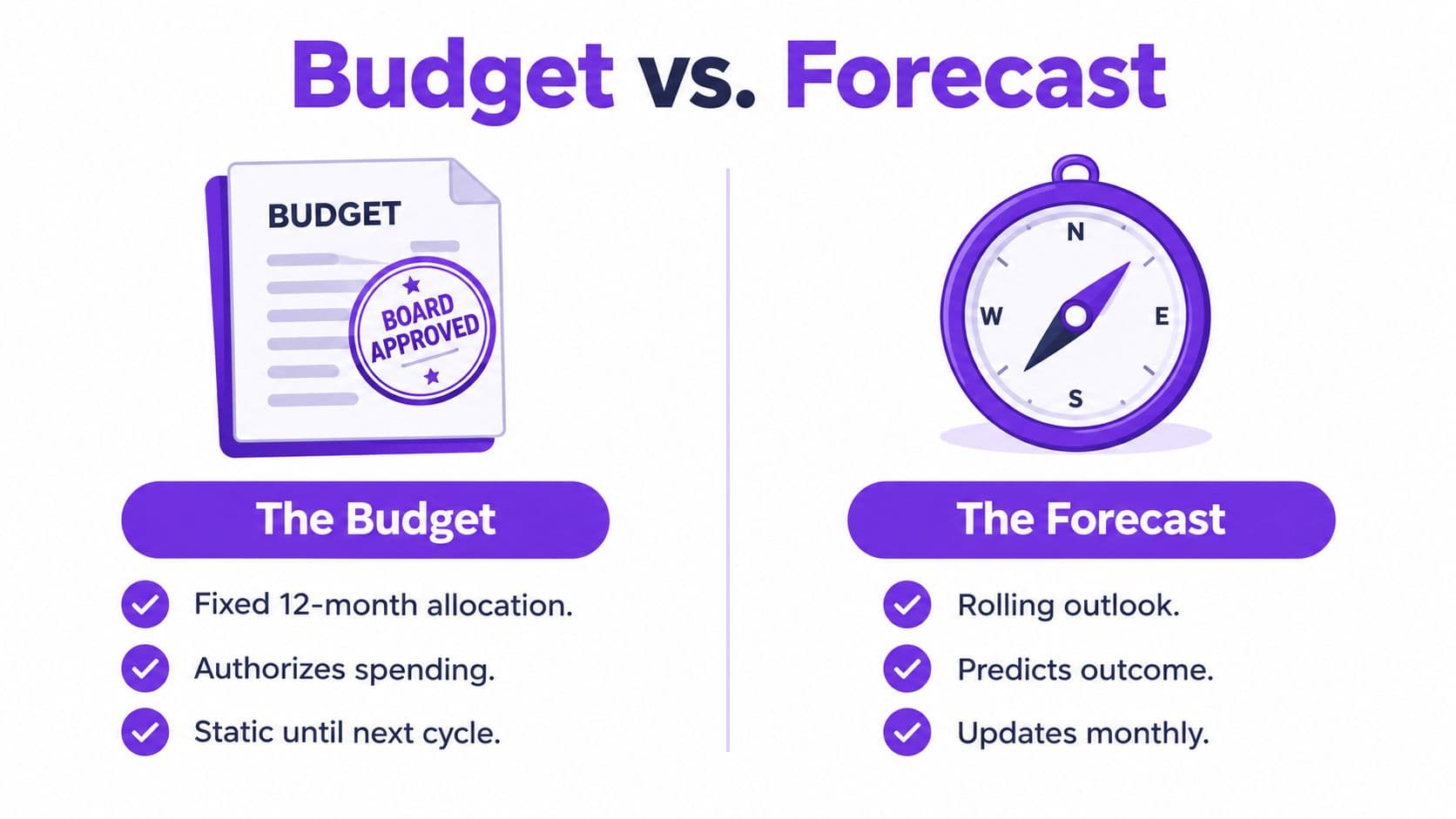
Use the budget to approve a new role, set a department's spending limit, or establish the board's operating commitments. Use the forecast to decide whether that role still fits the company's cash position, demand outlook, and delivery capacity. A rolling forecast keeps that second decision current.
Watch the distinction between plan and prediction. A budget can be well constructed and still become obsolete. A forecast can be wrong and still be the more useful document because it exposes the latest risk early. Within your first 30 days, decide which document authorizes the next dollar of spend. My recommendation is the budget sets the ceiling, while the forecast determines whether you release the dollar now.
Side by Side Comparison Across the Criteria That Matter
Definitions don't settle operating disputes. Your COO wants to hire, your head of sales wants more acquisition spend, and your board wants a credible outlook. The team needs to know which document governs each decision.
Budget vs Forecast Decision Matrix
| Criterion | Budget | Forecast |
|---|---|---|
| Purpose | Authorizes resources and sets targets | Estimates likely future results |
| Time horizon | Fixed annual period, usually 12 months | Rolling forward view, commonly 12 to 18 months |
| Owner | Finance leads, leadership and board approve | Finance owns the model, operators provide drivers |
| Approval cycle | Approved during annual planning or a formal reset | Updated monthly, with governance for material changes |
| Update cadence | Static until formally amended | Revised as actuals and assumptions change |
| What it controls | Hiring caps, spending limits, capital allocation | Cash preservation, hiring timing, fundraising expectations |
| Variance interpretation | Accountability against the original commitment | Prediction quality against the latest expectation |
| What kills usefulness | Quietly changing the baseline | Updating without reliable operational inputs |
A budget is not more accurate than a forecast. It is more fixed. A forecast isn't more conservative than a budget. It is more current. Treating those qualities as interchangeable creates bad decisions.
The owner distinction matters. Finance should maintain model integrity, but sales must own pipeline and renewal inputs, operations must own capacity assumptions, and department leaders must own controllable spend. Finance shouldn't invent the drivers it later audits.
Forecast reliability also declines as the horizon expands. The US Congressional Budget Office found that average absolute error was 1.1% of GDP for the first fiscal year and approximately 3.5% of GDP for the 11th year in projections covering 1985 through 2022. CBO projection analysis That supports scenario-based long-range planning, not false precision.
A 2026 AFP benchmarking survey found that 52% of finance leaders had revenue forecasts differing from actual results by more than 6%. AFP integrated planning survey That doesn't prove forecasting is pointless. It proves one document cannot simultaneously remain a fixed accountability baseline and reflect changing reality.
How to Build Each Document With Real Numbers
Start the budget from operational drivers, not last year's general ledger with arbitrary growth added. For a SaaS company doing $3.6M ARR, build revenue by customer cohort, new bookings, expansion, contraction, and churn. Then map hosting and support into COGS, assign headcount by function and start date, and load operating expenses such as sales tools, insurance, professional fees, travel, and office costs.
A practical build sequence looks like this:
- Revenue: Model existing recurring revenue, new contracts, expansion, downgrades, churn, and implementation or project revenue separately.
- COGS: Tie hosting to usage, support to service volume and staffing, and payment processing to collections.
- Headcount: List every role, team, salary, benefits assumption, start month, and hiring dependency.
- Operating expense: Build department-level costs from contracts, activity, and approved initiatives rather than broad percentage increases.
- Cash impact: Convert accrual revenue and expenses into collections, payment dates, payroll runs, taxes, and one-time payments.
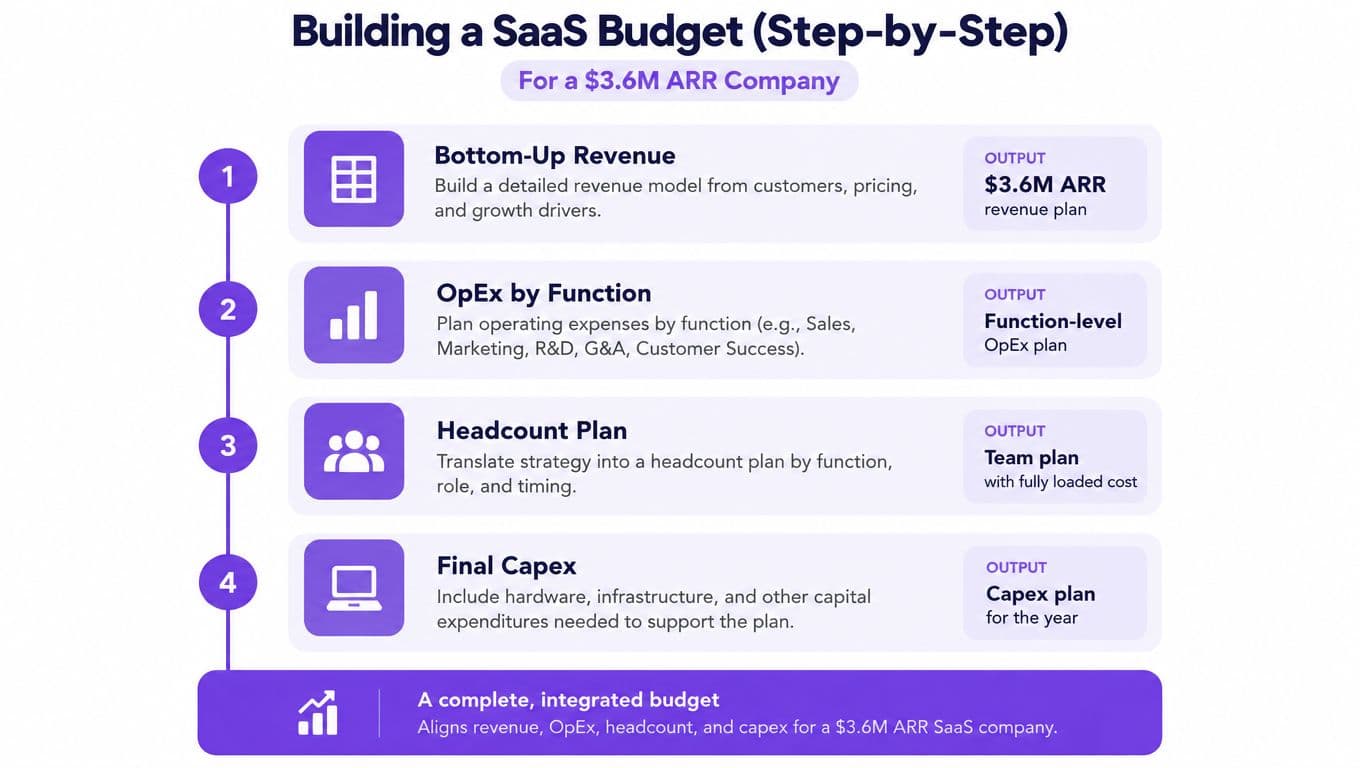
The startup financial model template can help structure the first pass, but the quality comes from your drivers and ownership. A clean template with unsupported assumptions is still a weak budget.
The forecast uses the same operating model, then refreshes it monthly. Layer a 13-week cash forecast over the model using opening cash, collection timing, deferred revenue roll-off, payroll dates, tax payments, vendor terms, and financing activity.
Here is a simple cash schedule using the required operating inputs:
| Week | Opening cash | Collections | Payroll | Ending cash |
|---|---|---|---|---|
| 1 | $620K | $145K | $58K | $707K |
| 2 | $707K | $145K | $58K | $794K |
| 3 | $794K | $145K | $58K | $881K |
| 4 | $881K | $145K | $58K | $968K |
| 5 | $968K | $145K | $58K | $1,055K |
| 6 | $1,055K | $145K | $58K | $1,142K |
| 7 | $1,142K | $145K | $58K | $1,229K |
| 8 | $1,229K | $145K | $58K | $1,316K |
| 9 | $1,316K | $145K | $58K plus other cash outflows | Below the $400K operating floor |
| 10 to 13 | Reforecast required | Reforecast required | Reforecast required | Decision-dependent |
The first eight rows illustrate the formula, opening cash plus collections minus cash payments equals ending cash. Week 9 cannot be treated as a normal continuation because other cash outflows push the balance below the $400K operating floor. That is a trigger to investigate collections, defer nonessential spending, or change hiring and financing timing.
Tooling should match complexity. 90% of finance teams still use Excel for at least part of financial modeling and reporting, according to Vena's FP&A trends research. Excel is workable for a disciplined company in the $1M to $5M range. Above $10M, driver-based planning software usually becomes necessary because version control and data plumbing consume too much finance capacity.
Reading Variance Reports Without Fooling Yourself
Variance analysis is where your approved plan, current expectation, and actual results meet. Many teams look at one comparison and label the result favorable or unfavorable. That approach hides timing, mix, data, and strategic decisions.
Your monthly close package should show three views:
| View | Management question |
|---|---|
| Actual vs budget | Did the team execute against the approved commitment? |
| Actual vs latest forecast | Did the prediction reflect current operating reality? |
| Budget vs latest forecast | How large and directional is the plan reset? |
Use thresholds to decide which exceptions deserve investigation. PwC reports that 55% of surveyed organizations experienced actual performance differing from forecasts by more than 5% over the prior three years, and 17% reported deviations exceeding 10%. PwC budgeting and forecasting evidence The same source reports that 53% attributed variances to uncertainty in the business environment.
Set metric-specific rules:
- Revenue and gross margin: Investigate deviations above 5%.
- Cash: Investigate deviations above 5% of the 13-week forecast.
- Headcount and operating expense: Investigate deviations above 3%, unless pre-approved.
- Root cause: Split every material variance into volume, price or rate, mix, timing, foreign exchange, and one-time items.
A favorable variance can damage the business. A six-week hiring freeze may save $180K, but if it costs $420K in delivery capacity, finance must report the capacity loss rather than celebrate lower payroll. An unfavorable variance can be correct. An additional $60K of customer acquisition spend may be a deliberate investment when it produces a 2.4x LTV-to-CAC improvement.
Those examples require operational reconciliation. Test revenue against bookings, churn, usage, pricing, and recognized revenue. Test payroll against headcount, start dates, compensation, and contractors. Test cash against collections timing, payment terms, and one-time payments.
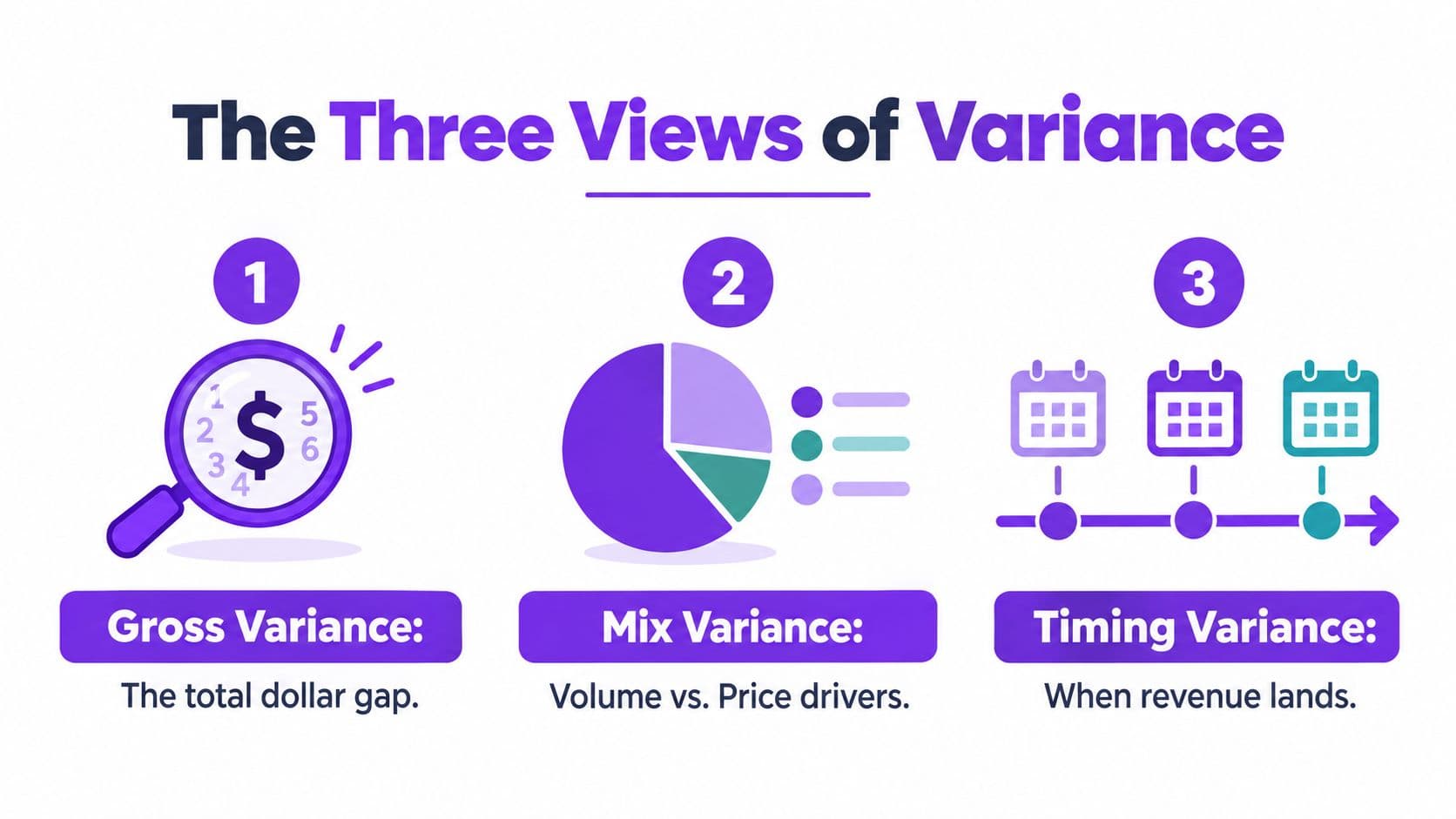
A useful budget variance analysis framework starts with the accounting gap, then asks whether the model, the data, the execution, or the decision caused it. Don't let a clean favorable number conceal delayed hiring, missed delivery, or underinvestment in growth.
How the Framework Plays Out in SaaS, Agencies, and E-Commerce
The framework stays consistent, but the drivers change sharply by business model. A SaaS company worries about retention and revenue recognition. An agency worries about utilization and bench cost. An e-commerce brand worries about inventory cash and contribution margin.
SaaS
Take a SaaS company with $6M ARR, 6% monthly churn, and annual contracts. The budget holds the board-approved hiring cap and planned sales investment. The forecast updates net retention, expansion pipeline, renewal timing, and deferred revenue release as customer behavior changes.
The most important variance isn't just annual recurring revenue versus plan. It is the relationship between retention, expansion, bookings, collections, and delivery capacity. Set the primary trigger around churn or net retention deterioration, then require finance and sales to explain whether the movement reflects customer health, contract timing, pricing, or model timing.
Digital agencies
A $9M revenue agency with 14 active retainers and project work needs a different forecast. Update utilization by team, project backlog, contractor commitments, billing milestones, and bench cost. Keep the owner compensation pool and approved operating structure in the budget, but use the forecast to decide whether to hire, subcontract, or delay nonessential work.
The key threshold is utilization. A revenue shortfall may be manageable when capacity is flexible, while a small utilization decline can create a large margin problem when salaries remain fixed. Break the variance into sold hours, delivered hours, realization rate, and collection timing.
E-commerce
A $4M DTC brand on Shopify with 28% gross margin and 60-day inventory needs a cash-sensitive forecast. Update sell-through, returns, ad efficiency, purchase orders, landed cost, and channel mix. Keep the budget's channel-mix assumption as the approved plan, but don't keep buying inventory just because the annual model expected demand.
The critical threshold is gross margin after marketing and fulfillment, not revenue alone. A promotion can lift sales while weakening cash generation. Founders who need to interpret retailer disclosures and public-company operating language can also use plain-English signals from filings to sharpen their understanding of revenue timing, margins, and working-capital drivers.
Four Misconceptions That Quietly Destroy Forecasts
A more accurate budget is the goal
Accuracy matters, but decision usefulness matters more. A stale budget with carefully modeled assumptions can be less valuable than a less accurate forecast updated with this month's pipeline, churn, payroll, and collections.
Replacement rule: Preserve the original budget for accountability. Judge the forecast by whether it gives decision-makers a current view soon enough to act.
The budget is always the performance target
For a stable business, the budget can serve as a practical operating target. For a volatile SaaS, agency, or e-commerce company, it should function primarily as an authorization ceiling. If conditions change materially, forcing teams to hit obsolete targets encourages bad hiring, bad spending, or sandbagging.
Replacement rule: Use the latest forecast to manage the business, and use the budget to explain the original commitment.
One annual planning cycle is enough
A 2026 benchmarking survey of 332 finance professionals across 54 countries found that the average budgeting cycle still takes nearly nine weeks and hasn't shortened over three years. AFP benchmarking data Annual planning still has value, but it cannot be your only response mechanism.
Replacement rule: Run annual planning for authorization and strategy, then update the forecast monthly and reforecast when agreed triggers fire.
Excel is fine for everything
Excel remains useful, especially when the model has clear ownership, controlled inputs, and a disciplined close process. It becomes a liability when multiple teams maintain disconnected versions, operational drivers sit outside finance, and leadership waits for manual consolidation.
Replacement rule: Upgrade to driver-based tooling when complexity, not fashion, makes spreadsheet control unreliable. Integrate revenue, headcount, billing, payroll, and cash inputs before buying more dashboard layers.

Your 30-60-90 Day Rollout and When to Get Help
A budget v forecast process fails when nobody owns the decision rights. A 2018 peer-reviewed study in the Journal of Business Economics found that rolling forecasts can support proactive adaptation or retrospective variance diagnosis depending on governance. The peer-reviewed rolling forecast study The model isn't the governance. Your rules are.
Days 1 to 30
Lock the current-year budget as the authorization baseline. Build the first 13-week cash forecast, reconcile it to actual bank balances and payroll dates, and assign one owner for the budget and one owner for the forecast. Document who can approve spending, who can pause hiring, and who must be notified when cash crosses the operating floor.
Days 31 to 60
Set thresholds for revenue, gross margin, cash, headcount, and operating expense. Build the three-view monthly close package, then run your first actual-versus-latest-forecast reconciliation without rewriting history. Keep a short variance log that records the driver, owner, action, and expected resolution date.
Days 61 to 90
Move the forecast to a monthly rolling cadence. Write trigger rules that force a reforecast when cash runway falls below six months, bookings fall below 85% of plan for two months, or gross margin compresses by more than 300 basis points. Brief the board on the difference between the fixed budget, the current forecast, and the decisions each document controls.
A finance peer group can help you pressure-test these rules against similar businesses. Resources for peer groups for CFOs are useful when you need operating perspective without turning every decision into a board debate.
If you're below $20M in revenue and don't have a controller, an outsourced controller service is the fastest practical route to a five-day close, investor-ready financials, and the discipline this framework requires. Review CFO services for startups when you need someone to own reconciliations, variance reporting, cash visibility, and the handoff between accounting and operating decisions.
Jumpstart Partners provides outsourced controller and bookkeeping support for SaaS, agencies, professional services, and other businesses generating $500K to $20M in revenue, including 13-week cash-flow forecasting and budget-versus-actual reporting. Visit Jumpstart Partners to discuss your current budget, forecast, and the trigger rules your team needs before the next cash decision.