Financial Operations
CFO Services for Startups: A Complete 2026 Guide
Unlock growth with CFO services for startups. This guide covers forecasting, fundraising, KPIs, and pricing to help you choose the right finance partner.
ByJumpstart Partners, CPA, QuickBooks ProAdvisor
··23 min readCash failure ends more startups than product failure. Founders rarely lose because they cannot describe the vision. They lose because they run out of room to make the next decision.
If you check the bank balance every few days and call that financial management, you are flying with the rearview mirror. Payroll clears. A customer pays late. Annual software contracts renew in the same month. Growth eats cash before collections catch up. The business looks busy and still gets squeezed.
Strategic CFO services for startups create value by turning messy numbers into clear operating calls. Slow hiring until gross margin improves. Raise capital before the runway gets tight. Change pricing before growth adds unprofitable revenue. Tighten collections before receivables become a financing problem. Fix reporting before investors or lenders find the weak spots.
For startups between $500K and $20M in ARR or annual revenue, this is the stretch where finance stops being back-office admin and becomes an operating system. SaaS founders need visibility into burn, retention, and payback. Service firms need control over utilization, project margin, and cash conversion. Both need the same thing: timely forecasts, decision-grade reporting, and a finance partner who can tell them what to do next.
Start with a 13-week cash flow forecast for growing companies. It is the fastest way to see whether your growth plan is fundable, your hiring plan is safe, and your current cash discipline is strong enough to support the next 12 months.
Your Startup's Biggest Blind Spot
A startup rarely fails because the founder cannot sell. It fails because cash runs out before management sees the problem in time.
Revenue, profit, and cash move on different clocks. SaaS firms feel it when annual contracts are signed but collections slip, implementation costs hit early, or churn weakens next quarter’s inflows. Service firms feel it when revenue looks strong, but payroll, subcontractors, and delayed client payments drain the account faster than invoices convert to cash.

Bank balance is not a finance system
Your bank account shows the ending result of past decisions. It does not show the next payroll strain, the renewal cluster hitting in 18 days, the customer who will pay 21 days late, or the hiring plan that cuts runway below your comfort zone.
That is why serious operators build a 13-week cash flow forecast early. If you want a practical template and walkthrough, use this guide to a 13-week cash flow forecast for growing companies.
For companies in the $500K to $20M range, that forecast should answer a few direct questions:
- What cash do we expect each week, not just this month?
- Which receipts are committed, likely, or at risk?
- What spending is fixed, and what can management delay?
- How much room do we have before we need to cut, collect faster, or raise?
That is the blind spot. Founders track activity. They do not track timing.
Growth exposes weak finance fast
Growth makes the problem worse because complexity shows up before finance discipline does. More customers mean more invoice timing issues, more exceptions, and more pressure on collections. More headcount raises fixed costs quickly. More software, contractors, commissions, and implementation work make gross margin harder to read.
This isn't about clean books. It's about survival.
A SaaS founder should know payback period, renewal cash timing, and the cash impact of hiring ahead of revenue. A service firm founder should know utilization, project margin by client, days sales outstanding, and how much delivery slippage the business can absorb before cash tightens. If those numbers are unclear, growth is not under control. It only looks busy.
If cash surprises you, the decision window already closed.
Defining CFO Services Beyond the Buzzword
Founders throw around “CFO” when they often mean three different jobs.
A bookkeeper records what happened. A controller makes sure the numbers are accurate and closed properly. A CFO helps you decide what to do next.
Scorekeeper, operator, coach
Use this simple lens.
| Role | What they do | What they do not do |
|---|---|---|
| Bookkeeper | Categorizes transactions, reconciles accounts, keeps records current | Drive pricing, fundraising strategy, or capital allocation |
| Controller | Owns close process, financial reporting, controls, policy enforcement | Lead strategic planning at the executive level |
| CFO | Translates numbers into decisions on hiring, pricing, runway, growth, and risk | Replace day-to-day accounting execution |
A lot of startups stall because they hire for yesterday’s problem. They think they need “finance help,” so they add bookkeeping. Books get cleaner, but decisions do not improve. Then fundraising starts, margins slip, or cash gets tight, and they realize historical reporting is not enough.
What real CFO services include
Good cfo services for startups are forward-looking. The job is not to email a P&L and call it done.
A CFO partner should help you:
- Decide where capital goes so growth spend matches your constraints
- Model scenarios before you hire, cut, raise, or launch
- Translate metrics into action instead of dumping dashboards in Slack
- Prepare for investor scrutiny with reporting that holds up in diligence
- Spot operational risk early when collections, margins, or costs start drifting
That is why founders who say, “Our accountant already handles finance,” usually have a gap they cannot see yet.
The standard that matters
You do not need a CFO because finance is complex. You need one because business decisions get expensive when they are made with stale numbers.
The CFO’s job is not to admire the rearview mirror. It is to tell you what the next turn costs.
That is the practical definition. A CFO helps you allocate scarce capital with discipline. For a startup, that is one of the few advantages that compounds.
Core Deliverables Your Startup Will Use
A startup does not need more finance commentary. It needs a short list of operating tools the CEO, head of sales, and delivery lead will open every month and use to make decisions.
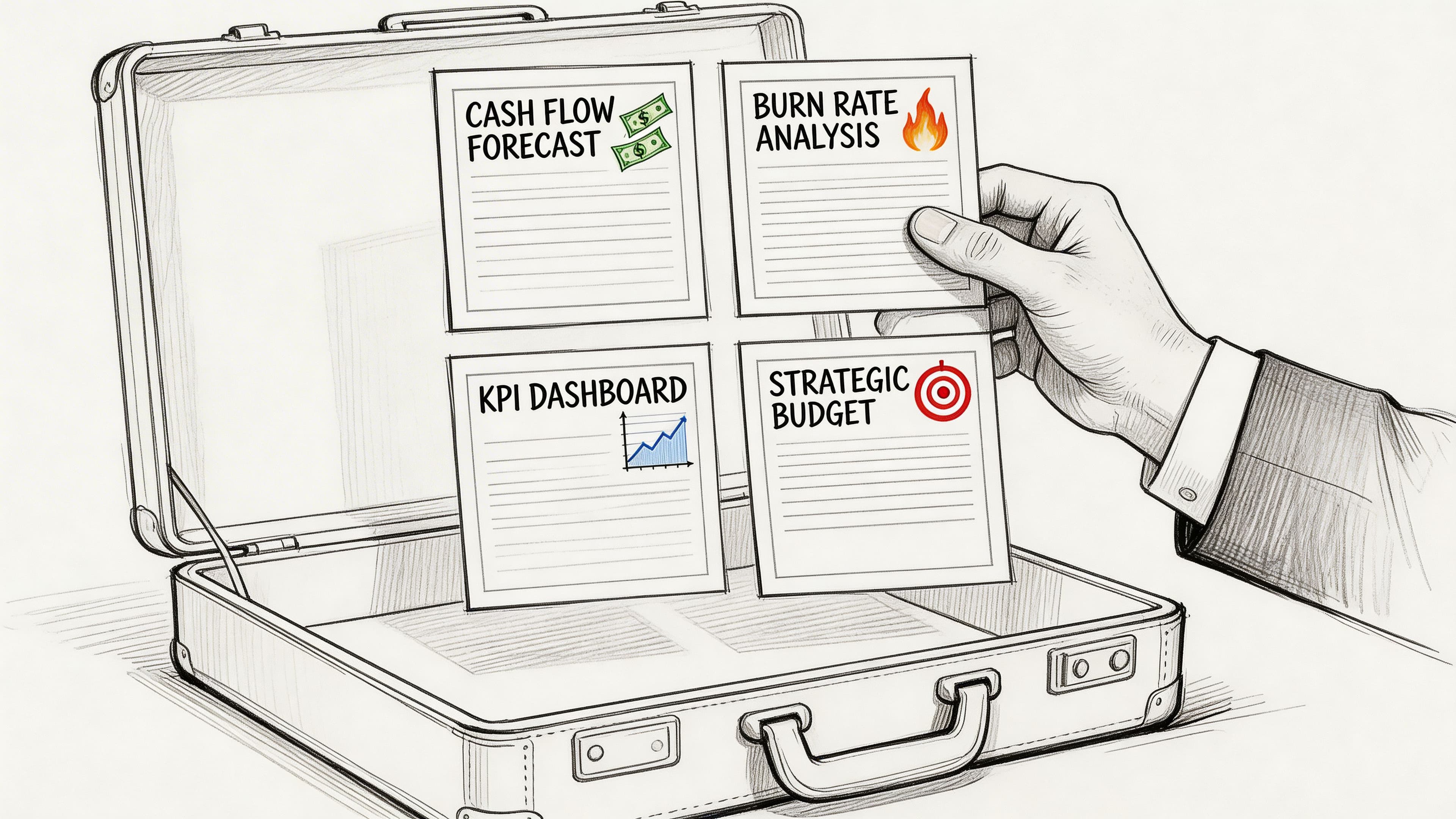
For SaaS and service firms in the $500K to $20M ARR range, the right deliverables are predictable. You need a fast close, a 13-week cash forecast, a KPI pack tied to action, revenue recognition that holds up under scrutiny, and board reporting that explains what changed and what management will do next. Founders comparing fractional CFO support for startups should ask to see examples of each before signing anything.
A fast close that gives you decision speed
If finance closes the books after the month is already half over, every decision trails reality.
Wiss notes that technology startups can reach a 5-day month-end close with the right systems, reconciliations, and revenue workflows in place, according to Wiss on CFO services for technology startups. That standard is worth chasing because late reporting hides problems that get expensive fast.
A useful close package is not just an income statement. It should include:
- Revenue by product line or service line
- Gross margin by offering
- Payroll versus plan
- Cash movement versus forecast
- Deferred revenue and accounts receivable aging
- A short variance memo that explains what changed and what action follows
For SaaS, that close should surface churn, expansion, collections, and hosting or support costs. For agencies and service firms, it should show utilization, write-downs, project overruns, and client concentration.
A 13-week cash flow forecast
This is the first deliverable I would ask for in nearly every founder-led company.
A 13-week cash forecast forces weekly discipline. You stop talking in broad annual targets and start dealing with the timing of payroll, customer collections, software renewals, debt payments, contractor invoices, and tax obligations.
Here is a simple worked example.
| Week | Starting cash | Cash in | Cash out | Ending cash |
|---|---|---|---|---|
| 1 | $300,000 | $40,000 | $55,000 | $285,000 |
| 2 | $285,000 | $35,000 | $60,000 | $260,000 |
| 3 | $260,000 | $90,000 | $58,000 | $292,000 |
| 4 | $292,000 | $30,000 | $82,000 | $240,000 |
This is what a founder should pull from a table like that:
- Week 4 is the pressure point
- Collections need attention in weeks 1 and 2
- Hiring should wait until receipts improve
- Vendor terms may need to be renegotiated now, not after cash dips
For deeper scenario planning, founders usually also need a proper financial model built for startups, not just a cash sheet.
KPI dashboards that tie activity to outcomes
A dashboard earns its keep only if it changes behavior.
For SaaS, the monthly KPI pack should track MRR or ARR movement, net revenue retention, gross margin, burn, sales efficiency, collections, and deferred revenue accuracy. For service firms, it should track utilization, billable headcount, backlog, average project margin, write-offs, and revenue per delivery employee.
The format matters as much as the metrics. A good dashboard includes:
- A clear definition for each metric
- Actual versus plan and versus prior period
- A named owner
- A decision note
That last item is where weak finance teams fail. If utilization drops from 74% to 66%, the dashboard should not stop at the number. It should say whether you need to cut bench, raise prices, slow hiring, or push sales toward higher-margin work.
The same discipline shows up in other specialized operators. Teams buying fractional consulting services usually expect clear deliverables, defined owners, and measurable outcomes. CFO services should be held to the same standard.
Error detection that protects cash
Bad classifications and timing errors do not stay inside accounting. They spread into hiring, pricing, and fundraising decisions.
A common example in SaaS is deferred revenue recorded incorrectly, contract labor buried in the wrong cost bucket, or software costs capitalized when they should hit the P&L. In a services firm, the usual misses are project labor allocation, incomplete accruals, and margin reporting that ignores write-downs. Each one creates a false sense of performance.
That false view leads to expensive calls:
- hiring ahead of cash capacity
- approving customer acquisition spend that payback cannot support
- taking owner distributions too early
- quoting work below true delivery cost
Here is a useful walkthrough on what good finance infrastructure should support.
Revenue recognition and board-ready reporting
If you sell annual contracts, prepaids, retainers, milestone projects, implementation fees, or mixed service and software bundles, revenue recognition needs to be clean from the start.
This is not only a compliance task. It changes how management reads growth. If revenue is timed incorrectly, trend lines become noisy, margin analysis gets distorted, and forecast accuracy falls apart. Then investor updates turn into explanation sessions instead of decision sessions.
The monthly board pack should be simple and sharp. For companies in this range, I recommend five parts:
- Executive summary with three wins, three risks, and the decisions needed
- P&L, balance sheet, and cash flow with concise variance commentary
- KPI scorecard by business model, SaaS or services
- Updated forecast with base, upside, and downside cases
- Cash runway view with hiring and spend triggers
That is what founders should pay for. Not meetings. Not abstract strategy talk. Deliverables that let the company choose faster, spend smarter, and avoid preventable mistakes.
Choosing Your Model Outsourced vs Fractional vs Full-Time
Companies do not fail because they picked the wrong title. They fail because the finance workload outgrew the support model and nobody corrected it in time.
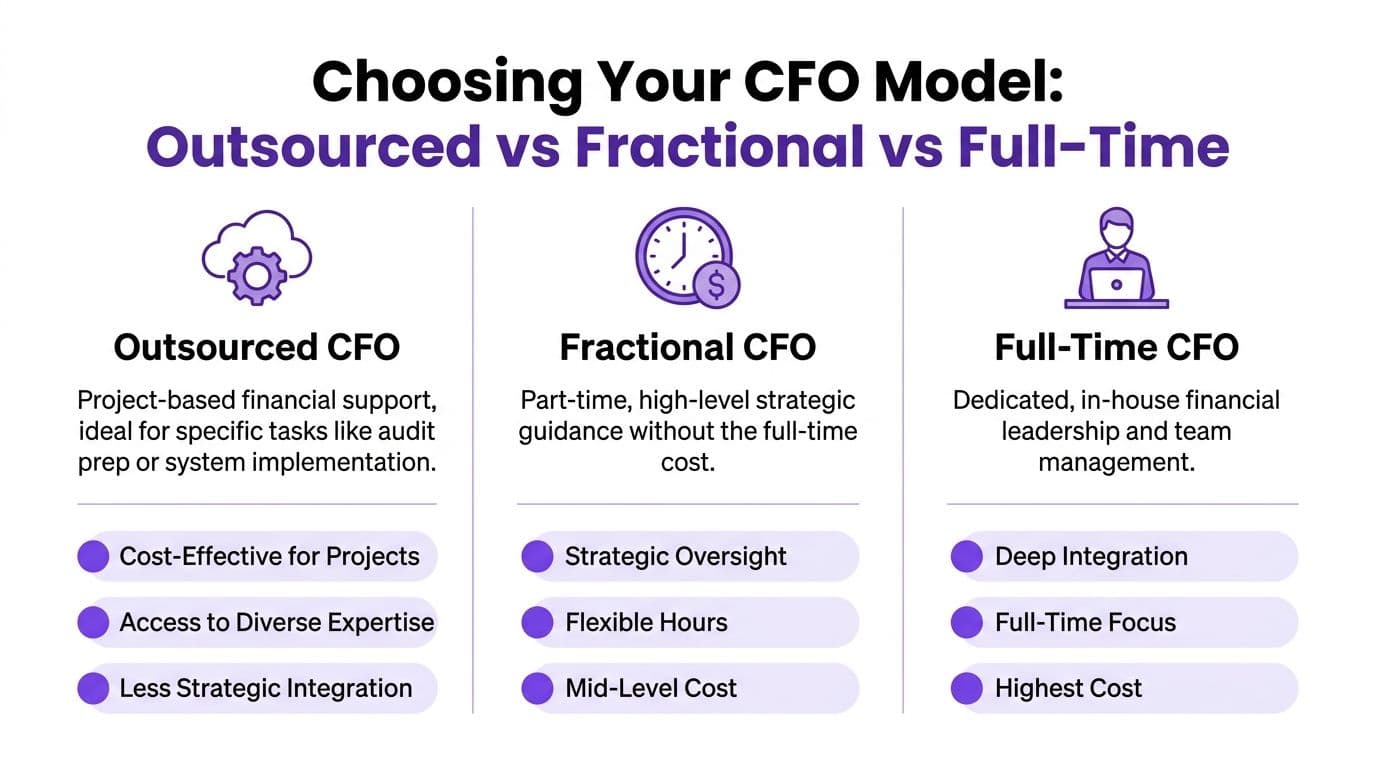
A founder running a SaaS business at $2M ARR with one pricing model, clean billing, and a small team does not need the same finance setup as a services firm at $8M with utilization targets, project margin issues, and uneven cash collections. Start there. Match the model to the load.
CFO model comparison for startups
| Criteria | Outsourced CFO support | Fractional CFO | Full-Time CFO |
|---|---|---|---|
| Primary role | Project or process execution | Part-time finance leadership | Dedicated executive finance leadership |
| Cost structure | Usually scoped by project or monthly retainer | Monthly engagement, often below the cost of a full executive seat. GetExact’s startup CFO cost breakdown places many fractional engagements in the $4,000 to $10,000 monthly range, while full-time CFO compensation often lands far higher once salary, benefits, and equity are included | Annual salary, benefits, bonus, and usually equity |
| Best fit | Cleanup, audit prep, systems work, reporting buildout | Startups that need decision support, forecasting, board prep, and operating discipline without a full-time hire | Companies with constant complexity, active fundraising, team leadership needs, and daily executive finance demands |
| Flexibility | High | High | Low |
| Team leadership | Limited | Moderate | High |
| Speed to start | Fast | Fast | Slow |
| Depth of involvement | Narrower scope | Strategic and recurring | Deep and continuous |
My recommendation by stage
Under about $10M ARR, fractional is usually the right answer. The reason is simple. Most companies in that range need senior judgment every month, not another full-time executive salary.
For SaaS, choose fractional when key tasks involve pricing changes, cash runway planning, board reporting, hiring models, and revenue forecast accuracy. Choose full-time when you have enough moving parts to justify daily executive finance leadership, such as multiple product lines, international entities, debt covenants, or a large internal finance team.
For service firms, the trigger comes earlier if delivery complexity is high. If gross margin moves week to week based on staffing, utilization, and scope control, you need stronger finance oversight sooner. Even then, many firms in the $500K to $20M range still get better value from a fractional leader paired with a solid controller than from one expensive full-time CFO hire.
Use this decision filter
Pick outsourced support if you need someone to build or fix something:
- clean up the chart of accounts
- implement revenue recognition rules
- prepare for diligence or audit
- rebuild reporting packs
- repair forecasting models
Pick fractional support if you need someone to own recurring decisions:
- set the monthly finance cadence
- pressure-test hiring plans
- review CAC payback, gross margin, and runway
- lead board and lender prep
- translate financial results into operating actions
Pick full-time support if the business now needs daily executive finance leadership:
- finance is managing managers
- fundraising or M&A is active and sustained
- banking, legal, tax, and board work are constant
- the CEO needs a finance partner in the room most days, not a few times a month
Sample deliverables by model
Founders should judge the model by outputs.
Outsourced support deliverables
- 13-week cash flow rebuild
- deferred revenue cleanup
- KPI dashboard setup
- pricing model refresh
- backlog and project margin analysis for service firms
Fractional CFO deliverables
- monthly board pack with commentary
- SaaS forecast by ARR, churn, expansion, and cash runway
- services forecast by bookings, utilization, gross margin, and collections
- hiring plan model with trigger points
- decision memo for pricing, compensation, or capital needs
Full-time CFO deliverables
- finance team leadership and hiring
- bank, investor, and board ownership
- annual planning across departments
- capital strategy
- internal controls and company-wide financial accountability
If you want a more detailed stage-by-stage breakdown, this guide to a fractional CFO for startups covers where the model fits best.
Outsourced and fractional are not the same
Founders blur these terms and then buy the wrong service.
Outsourced work is usually bounded. A project, a system, a reporting fix, a cleanup sprint. Fractional work carries executive ownership. That person should challenge assumptions, improve planning quality, and help the leadership team make better calls with the numbers in front of them.
The same buying logic shows up in other specialist models, including fractional consulting services. You bring in senior judgment when the business needs expertise and decision support, but the workload does not justify a full-time executive seat.
A simple rule works well here. If you need better reports, outsourced may be enough. If you need better decisions, hire fractional. If the company needs a finance executive embedded in the business every day, hire full-time.
Pricing Packages and What You Should Expect to Pay in 2026
Pricing for CFO services is often misunderstood.
Founders in the $500K to $20M ARR range often compare monthly retainers and miss the bigger cost driver. Scope. A low fee is a bad deal if it buys late reporting, a weak cash forecast, and no decision support for hiring, pricing, or fundraising.
The right question is simple. What financial decisions will this engagement help you make each month, and what output will your team receive to support those decisions?
The pricing baseline
The pricing split comes from involvement level, business complexity, and whether you need decision support or just finance production.
For a SaaS company, price should move with revenue model complexity, board expectations, and capital plans. If you have annual contracts, deferred revenue, sales commissions, and investor reporting, expect to pay more than a simple monthly retainer business.
For a service firm, price should move with margin volatility, utilization tracking, client concentration, and multi-entity or multi-state complexity. An agency with sloppy project economics can lose more from weak finance than it saves on a cheap engagement.
Use proposals to test value, not just cost. If one firm is priced lower, ask which deliverables are excluded. If one is priced higher, ask what decisions get faster, what reporting gets cleaner, and how quickly the finance lead will be in the room when a hard call has to be made.
What a good package should include
A serious CFO package needs defined outputs. Titles do not matter. Deliverables do.
At a minimum, your proposal should name:
- a monthly reporting package with delivery dates
- a 13-week cash forecast with update cadence and owner
- a forecast or model that supports hiring, pricing, and capital decisions
- leadership meeting access, including budget reviews and urgent issue handling
- cleanup or systems work, if revenue recognition, close process, or dashboards need repair
- clear limits on ad hoc work, with approval rules for anything outside scope
For SaaS, ask for sample deliverables before you sign. You should be able to review a board-ready KPI pack, a bookings to cash waterfall, and a scenario model that shows the impact of churn, pricing changes, and sales efficiency.
For service firms, ask for different samples. You want an account margin view, utilization and capacity tracking, a rolling cash plan, and a forecast that separates revenue growth from gross margin improvement. If the provider cannot show those examples, they are selling a general finance service, not startup CFO leadership.
If you need a broader benchmark for how finance spend stacks up below the CFO layer, review this breakdown of the cost of accounting for growing businesses.
Red flags in CFO proposals
Bad proposals are easy to spot once you know what to check.
Slow down if you see:
- vague language such as "strategic support" with no recurring deliverable list
- no cash forecast in the core monthly scope
- no commitment on close timing or reporting delivery
- hourly overages that start too early and rise without written approval
- a senior seller in the pitch, but junior execution after kickoff
- no sample dashboard, no sample model, and no sample board package
My recommendation is blunt. Ask every provider for one sample monthly package and one sample decision model, with confidential details removed. For SaaS, that model should show MRR movement, cash runway, and hiring impact. For service firms, it should show revenue by team or client, gross margin, and cash collection risk.
If they cannot show the work, do not buy the promise.
Real-World Examples and Timelines
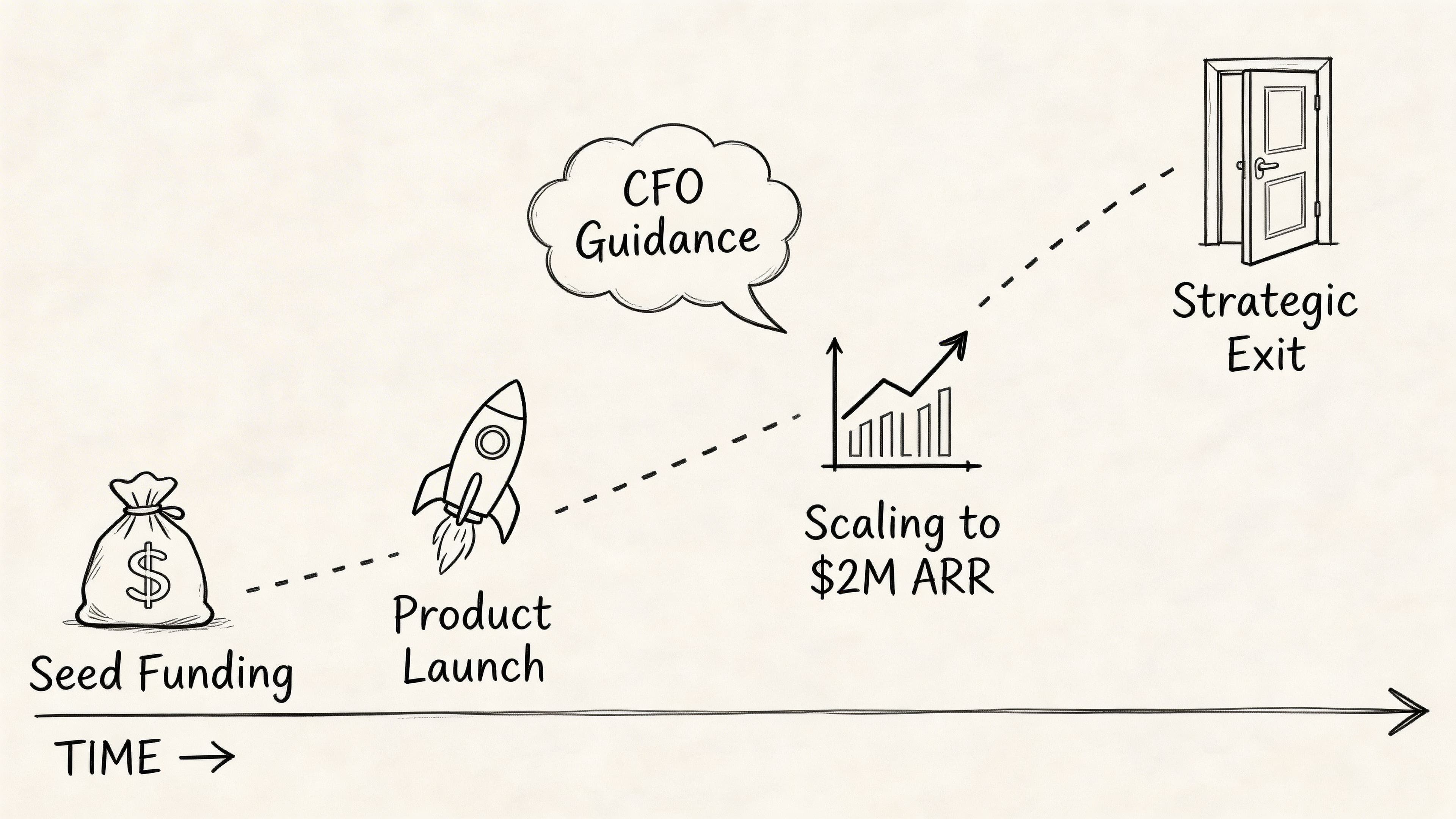
The value of cfo services for startups shows up when finance changes an operating decision. Not when it produces a prettier report.
SaaS company raising with weak reporting
A SaaS founder at roughly the middle of this market often hits the same wall. Revenue is growing, the product is sticky enough, and investors are interested, but the financial package is weak.
The common pattern looks like this:
- month-end reporting arrives too late,
- deferred revenue is messy,
- the model breaks when assumptions change,
- and board materials are assembled manually.
The right CFO intervention is not “help with fundraising.” It is a tight sequence. Clean revenue recognition. A dependable close process. A rolling forecast. A metrics package that matches how the business sells and collects.
Once that exists, fundraising conversations become cleaner because the company can answer basic questions without scrambling. The timeline shortens because diligence friction drops. Founders stop spending nights rebuilding numbers they should have trusted already.
Agency with strong revenue and weak margin control
A digital agency can grow for years while hiding margin problems inside account-level complexity.
The usual symptoms are obvious once someone looks:
- large clients that appear healthy but drain management time,
- project teams that over-service without re-scoping,
- retainers priced on old assumptions,
- and no clean view of contribution by client, service line, or delivery team.
A CFO does not solve this by sending a generic P&L. The work is operational. Rebuild job-level profitability. Compare planned versus use of labor. Separate high-revenue accounts from high-margin accounts. Tighten invoicing and collection discipline.
The result is usually not dramatic in one giant move. It comes from a series of hard calls. Reprice certain work. End unprofitable engagements. Adjust staffing mix. Change payment terms. Founders often discover they do not have a revenue problem. They have a margin discipline problem.
AI SaaS with GPU burn pressure
For AI SaaS startups, GPU burn can represent 30% to 50% of operating expense, according to CFO Advisors on AI SaaS CFO support. In that environment, spreadsheet-level finance is too slow. Here, specialized finance matters.
A CFO with the right skill set focuses on:
| Pressure point | CFO action |
|---|---|
| Compute cost volatility | Build models that tie usage, pricing, and margin together |
| R&D-heavy spend | Identify qualified expenses and tax credit opportunities |
| Inference-heavy pricing | Test pricing models against cost-to-serve |
| Runway risk | Reforecast quickly as infrastructure spend shifts |
The same source notes that this approach can extend runway by 6 to 12 months. That is not a bookkeeping benefit. That is strategic survival.
Non-tech firms need this just as much
Some of the most under-served companies in this revenue band are not SaaS at all. Agencies, healthcare groups, e-commerce brands, construction firms, and nonprofits often outgrow DIY finance. Then compliance, reporting quality, and cash planning all break at once.
The founders I see make the same mistake. They assume outsourced CFO support is “for venture-backed tech companies.” It is not. It is for any business where financial complexity has started to outrun internal capacity.
The right finance partner does not just tell you what happened. They force clarity on what to fix next and how fast to do it.
Your Decision Checklist and Next Steps
You do not need more theory. You need a clear trigger list.
If several of these are true, you need CFO-level support now:
- Your close is slow or inconsistent and leadership waits too long for clean monthly numbers.
- You manage cash by gut feel instead of using a forward-looking forecast.
- You are hiring ahead of visibility and cannot clearly show the cash impact.
- Your pricing is stale and nobody owns margin analysis.
- You plan to raise capital, take on debt, or face diligence and your reporting package is not ready.
- Your team argues about the numbers because definitions and ownership are unclear.
- You run a non-tech company with sector-specific compliance needs. A Bench.co survey summarized by ECA Labs found that 68% of non-tech startups in the $500K to $5M range struggle with industry-specific compliance, while only 12% access customized outsourced CFO services.
The practical next step
Use this short internal test.
| Question | If yes |
|---|---|
| Are your books technically closed but not decision-useful? | Upgrade from basic accounting support |
| Are you making hiring or spend decisions without scenario modeling? | Add CFO-level forecasting |
| Are you unsure whether you need a bookkeeper, controller, or CFO? | Review this breakdown on when to hire a bookkeeper, controller, or CFO |
If you are between $500K and $20M in revenue, the goal is not to build a bloated finance department. The goal is to get the minimum senior finance capacity required to protect cash, improve reporting, and make sharper decisions.
Frequently Asked Questions About Startup CFO Services
What is the difference between a controller and a CFO
A controller owns accuracy, close process, controls, and reporting discipline. A CFO owns decisions. That includes forecasting, pricing, cash strategy, fundraising readiness, and capital allocation.
You usually need both functions eventually. Many growing businesses start by accessing them through one outsourced or fractional setup rather than hiring both in-house.
When should a startup hire CFO support
When the business becomes hard to steer by instinct.
That usually happens when cash timing gets tight, revenue recognition gets more complex, margins become harder to read, or leadership is preparing for fundraising, debt, expansion, or an ownership transition.
What are the warning signs that a bookkeeper is no longer enough
The numbers arrive, but they do not answer management questions.
You also know you have outgrown basic bookkeeping when nobody owns forecast updates, cash planning, board reporting, pricing analysis, or financial decision support.
Is fractional CFO support only for SaaS companies
No. SaaS gets the most attention, but agencies, professional services firms, e-commerce brands, healthcare companies, nonprofits, and construction businesses all hit the same finance maturity wall. The reporting needs differ. The need for leadership does not.
What should I ask before hiring a provider
Ask for the monthly deliverables, close timeline, cash forecasting process, systems they work in, and how they support leadership decisions between scheduled meetings. If the answer stays vague, keep looking.
If you want a finance partner that helps you close faster, improve cash visibility, and build investor-ready reporting without the cost of a full-time CFO, talk to Jumpstart Partners. Their team works with SaaS, agencies, and other growing businesses in the $500K to $20M range, with outsourced controller, bookkeeping, and CFO-level support built for companies that need decisions, not just reports.