Financial Operations
What Is A Rolling Forecast: Adaptive Planning for 2026 Success
What is a rolling forecast - Struggling with static budgets? Discover what is a rolling forecast and how this dynamic financial planning tool helps you adapt, g
ByJumpstart Partners, CPA, QuickBooks ProAdvisor
··14 min readThat annual budget you spent weeks finalizing last quarter? It’s already obsolete. In today’s market, relying on a static, year-old plan is like navigating with a paper map on the freeway—you’re blind to the traffic jams, detours, and opportunities right in front of you. This forces you into a reactive cycle, constantly explaining why you missed outdated targets instead of proactively steering the business toward its goals.
The result is founder anxiety. You're left making critical decisions on hiring, marketing spend, and R&D based on stale assumptions, leading to sudden cash crunches and missed growth targets. There is a better way. A rolling forecast is your business's live financial GPS, constantly recalculating the path forward for the next 12 to 18 months. It keeps your financial outlook current and, more importantly, actionable.
Why Your Static Budget Is Holding You Back
The problem with a static budget isn’t just that it gets old; its strategic value actively shrinks every single month, leaving you with an ever-diminishing view of the future.
- In January: You have a full 12-month view. You feel in control.
- By June: Your visibility is cut in half. You can only see six months ahead.
- By October: You're down to a two-month horizon, making critical Q4 and next-year planning decisions in the dark.
This "shrinking horizon" forces your leadership team into a defensive, backward-looking posture. Instead of planning for future growth, you spend your time justifying variances against a plan that lost relevance months ago. For a SaaS, agency, or services firm between $500K and $20M in revenue, that’s a massive handicap.
"For decades, annual operating planning (AOP) has anchored business performance management... But in today’s volatile environment, its shortcomings are clear: static annual planning is time-consuming, resource-intensive, and quickly outdated." - Anaplan
A rolling forecast solves this by acting as your company's live navigation system. By continuously pulling in actual performance data and updating future projections, it gives you the agility to see market shifts coming and adapt in real time. It transforms finance from a historical chore into a forward-looking strategic weapon.
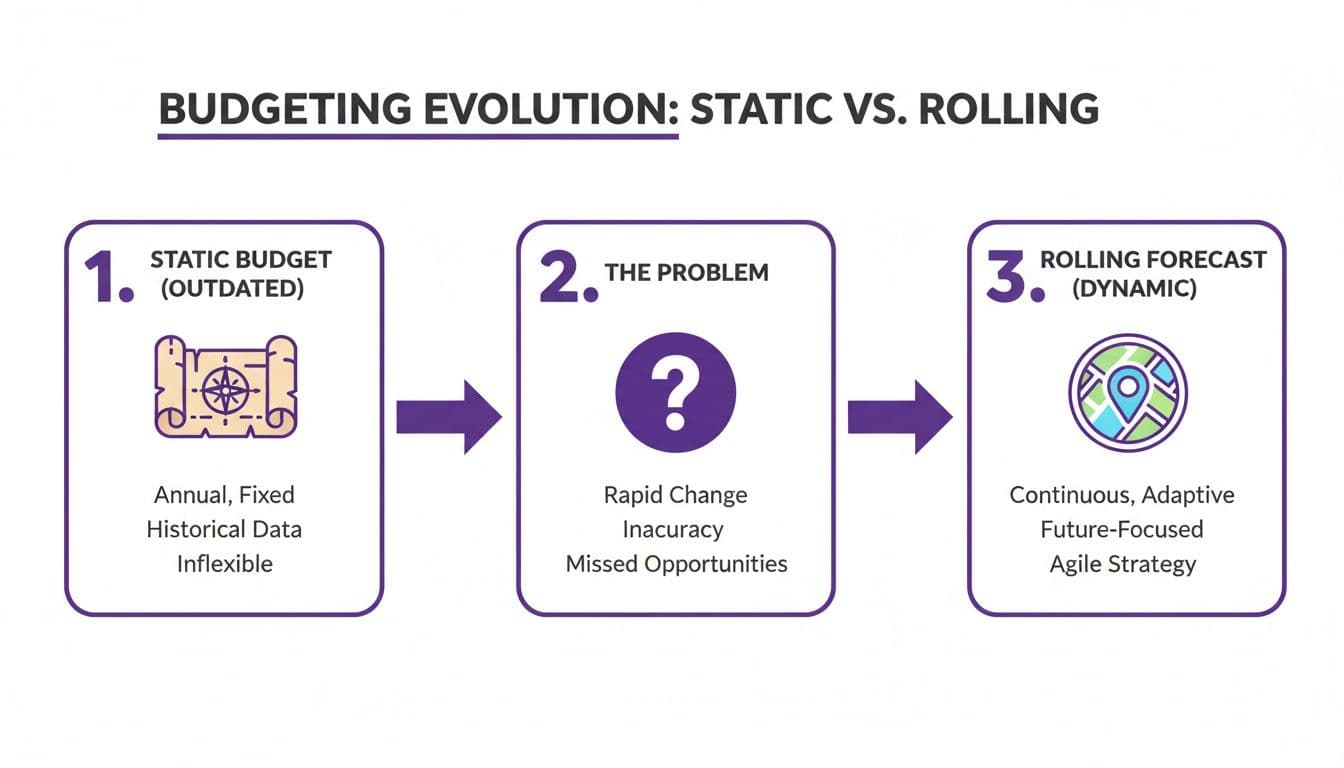
What Is a Rolling Forecast and How Does It Actually Work?
A rolling forecast is a dynamic financial model that constantly projects your financials 12 to 18 months into the future. As each month or quarter of actual results is recorded, you drop that historical period from the forecast and add a new period to the end.
This simple shift transforms finance from a rearview mirror into a forward-looking navigation system. The result is a perpetual, consistent view of your financial runway, ensuring you're never making decisions on stale data.
The Continuous Loop of a Rolling Forecast: A Worked Example
The power of a rolling forecast is its simple, repeatable rhythm: forecast, measure, refine, and extend. Let's walk through a real-world example for a SaaS company in early 2026.
| Period | Action | Calculation & Outcome |
|---|---|---|
| Early Feb 2026 | Lock in January actuals. You discover new MRR was $25,000, beating the $20,000 forecast due to a successful new marketing campaign. | You have fresh, real-world data. Your new MRR assumption was too conservative. |
| Mid-Feb 2026 | Update future assumptions. You now believe the marketing campaign will continue to drive higher lead volume. | You revise your new MRR forecast for February and March up to $26,000/month. (Old Forecast: $20,000 x 1.3 = New Forecast: $26,000) |
| Late Feb 2026 | "Roll" the forecast forward. You drop January 2026 from the view and add February 2027 to the end of your model. | Your forecast horizon stays locked at a consistent 12 months (now running from February 2026 to February 2027), giving you a constant runway for strategic moves. |
This monthly cadence ensures your financial plan is always current. This ongoing cycle helps you improve forecast accuracy, making your data far more reliable for critical decisions around hiring, spending, and growth. If you’re still building your foundational financial plan, you can learn more about defining operating budgets in our detailed guide.
Rolling Forecast vs. Static Budget: A Head-to-Head Comparison
Sticking to a static budget is like using a printed road map. The route was planned based on old information, and it can't account for a sudden detour, a new highway, or a massive traffic jam ahead. You’re locked into a plan that's already obsolete.
A rolling forecast is your live GPS. It constantly updates your route based on real-time conditions, ensuring you always know the best way forward. One method anchors you to the past; the other gives you the agility to win the future.
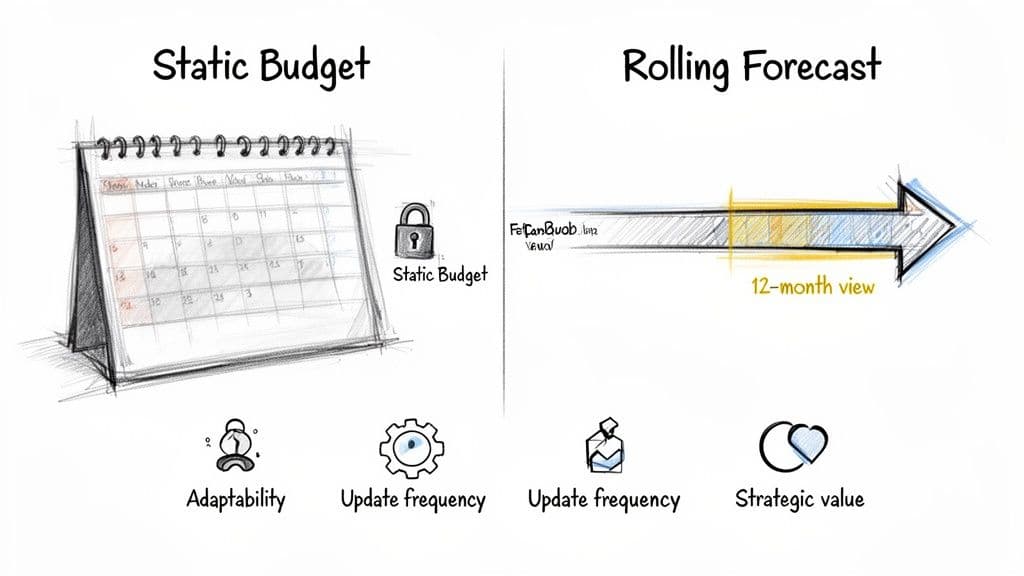
Key Differences at a Glance
| Attribute | Static Budget (The Road Map) | Rolling Forecast (The Live GPS) |
|---|---|---|
| Planning Horizon | Shrinking View: Starts at 12 months, ends at zero by year-end. | Constant View: Maintains a consistent 12-18 month forward look. |
| Update Frequency | Annual: Created once a year in a time-consuming, high-stakes process. | Continuous: Updated monthly or quarterly with new actuals and assumptions. |
| Adaptability | Rigid: Cannot adapt to market shifts, new competitors, or internal changes. | Dynamic: Built to incorporate new data and adjust assumptions on the fly. |
| Strategic Value | Historical Benchmark: Used for variance analysis against an old plan. | Forward-Looking Guide: Informs strategic decisions on hiring, spend, and growth. |
| Business Impact | Encourages "use it or lose it" spending and explaining past variances. | Drives proactive resource allocation and focuses teams on future outcomes. |
The biggest flaw of a static budget is its shrinking horizon. This traps you in a reactive cycle of explaining why your actuals vs. budget have diverged. A rolling forecast maintains its value all year long. It doesn't necessarily replace the annual plan; it makes it smarter.
"Instead of treating your AOP [Annual Operating Plan] as obsolete, think of it as a necessary anchor... rolling forecasts come in — not as a replacement, but as a complement that keeps your AOP fresh and decision-ready throughout the year." - Anaplan
This hybrid approach gives you the best of both worlds: a fixed annual target for accountability and a dynamic forecast for agile decision-making.
The Bottom-Line Impact of Using a Rolling Forecast
Moving to a rolling forecast isn't just a process change—it has a real, tangible impact on your cash, profitability, and strategic confidence. It’s the difference between reacting to last quarter's bad news and proactively shaping next quarter's success.
This iterative process delivers three core financial benefits:
- Smarter Resource Allocation: You can pivot quickly. If a marketing channel's CAC suddenly doubles, you can reallocate that spend to a better-performing channel next month, not next year.
- Improved Cash Management: By accurately projecting cash inflows and outflows 12 months out, you can anticipate crunches, make smarter hiring decisions, and avoid running out of runway. For more strategies, check out our guide on how to improve cash flow.
- Higher Forecast Accuracy: With each monthly update, your projections become more reliable. According to the 2024 SaaS Benchmarks report from OpenView, top-quartile companies achieve forecast accuracy within a +/- 5% variance. A rolling forecast is a key tool to reach that level of precision, giving you, your board, and your investors much greater confidence in your guidance.
Impress Investors and Secure Your Next Round
For founders, a rolling forecast is a critical tool for building credibility with investors. When you can walk into a board meeting and show that you not only understand your numbers but can also accurately predict them, it signals a high level of operational maturity.
Presenting a clear, data-backed 12-month outlook proves you have a firm grip on the drivers of your business. This level of financial command is exactly what venture capitalists look for. It shows you’re not just managing a company—you’re strategically steering it toward predictable, scalable growth. If you're just starting to build out your first models, our guide on financial forecasting for startups is a great place to begin.
How to Implement Your First Rolling Forecast in 4 Steps
The biggest pushback I hear from founders is, "This sounds like way too much work." The reality is you're trading a stressful, 40-hour annual budgeting fire drill for a predictable, 3-hour monthly process that delivers infinitely more strategic value. Here’s how you get it done.
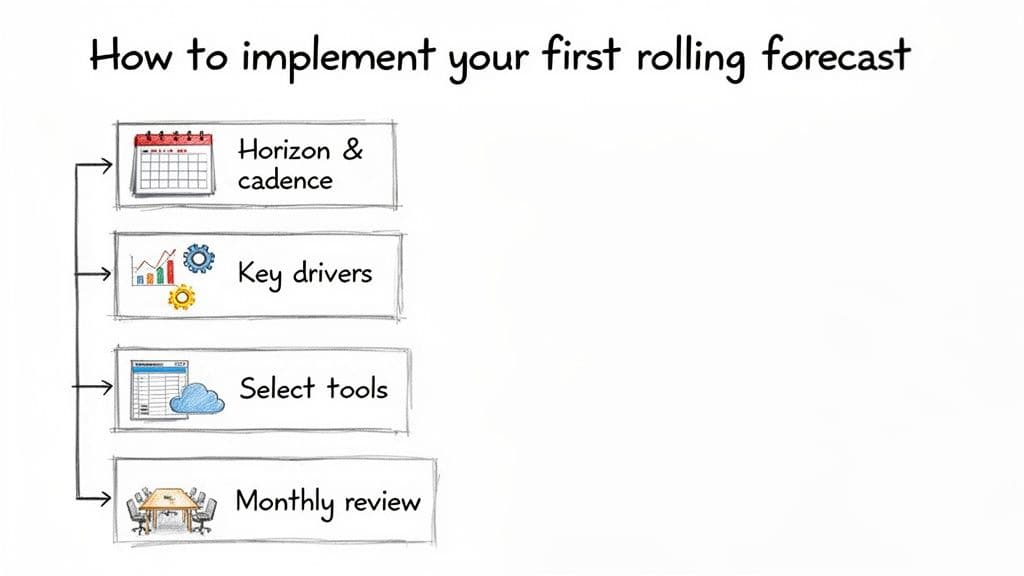
Step 1: Define Your Horizon and Cadence
First, decide how far out you need to see and how often you'll update the view. Don't over-engineer this. The industry standard works for a reason.
- Horizon: A 12-month rolling horizon is the sweet spot for most growing businesses. It provides a full year of visibility for managing cash and making hiring decisions.
- Cadence: Update it monthly. As soon as one month's books are closed, you plug in those actuals, refine your assumptions, and add a new forecast month to the end.
This 12-month-view-updated-monthly structure ensures your financial plan is never more than 30 days out of date.
Step 2: Identify Your Key Business Drivers
A rolling forecast is not about re-forecasting every single line item. That’s a recipe for burnout. Focus on the handful of operational metrics that actually drive financial performance.
- For a SaaS Company: Hinge your model on New MRR, Expansion MRR, Churn Rate, and Customer Acquisition Cost (CAC).
- For a Digital Agency: Your world revolves around Project Pipeline Value, Win Rate, Billable Utilization Rate, and Average Project Revenue.
- For a Professional Services Firm: Zero in on Active Client Count, Average Revenue per Client, and Team Billable Hours. You can read more about tracking your sales performance using a sales growth rate formula.
Step 3: Select Your Tools
You do not need a six-figure enterprise software suite. The goal is to pick a tool that efficiently connects your actuals to your forecast with minimal manual data entry.
- Advanced Spreadsheets (Google Sheets/Excel): This is where most companies start. It’s manual and prone to errors, but it's a viable first step.
- FP&A Software: Purpose-built tools like Datarails, Cube, or Jirav are the logical next step. They plug directly into your accounting system (QuickBooks, Xero, NetSuite) and pull in actuals automatically, eliminating hours of manual work. Our guide to financial reporting automation digs deeper into these platforms.
- Outsourced Expertise: Working with a firm like Jumpstart Partners gives you the best of both worlds. We build and run the forecast for you using dedicated software and deliver the strategic analysis that helps you make better decisions.
Step 4: Establish a Monthly Review Process
A forecast is useless unless you use it to make decisions. The final step is to bake it into your monthly leadership rhythm. This isn't a meeting for just staring at numbers. It’s for asking, "So what?" and "Now what?"
"A rolling forecast forces a discipline of regular reviews of performance and expectations, and it makes the management team more agile in responding to change. It becomes the basis of a 'learning organization' and continuous improvement." - Steve Player, Founder of The Player Group
This disciplined monthly cadence is what turns a rolling forecast from a document into a core strategic tool for running your business.
Warning Signs Your Static Budget Is Failing You
Does your month-end close feel like a surprise party you didn't want? Do your team leads spend more time explaining why they missed targets set six months ago than planning for what’s ahead? These aren't just minor headaches. They’re red flags that your static annual budget is actively holding your business back.
1. Significant and Frequent Budget Variances
The most obvious sign is a massive, consistent gap between your plan and reality. A 5% variance is business as usual. But when your actual revenue is 25% below budget for the second quarter in a row, your plan isn't a reliable guide—it’s fiction.
For a digital agency:
- The Plan: Budgeted $400,000 in new project revenue for Q2.
- The Reality: A key client delayed a project and the sales cycle stretched. Actual revenue comes in at $280,000.
That $120,000 miss triggers a fire drill, all because your budget was built on outdated assumptions from half a year ago.
2. Inability to React to Market Changes
A static budget locks you into a year-long plan. When a competitor launches a game-changing feature or a new marketing channel starts delivering incredible results, your budget has no mechanism to pivot. You’re stuck watching from the sidelines. If your answer to a major market shift is, "We'll have to wait for next year's budget cycle," you’re handing an advantage to your more nimble competitors.
3. Decisions Based on Gut-Feel Instead of Data
You're debating whether to hire two new engineers. The annual budget says you can’t afford them until Q4, but your gut tells you the product roadmap is falling behind. You're forced into a high-stakes decision based on instinct because your budget is too rigid to model the impact.
This is a critical failure. A static budget can’t answer strategic “what-if” questions, forcing you to guess instead of calculate. This is precisely the kind of problem a what is a rolling forecast model is designed to solve by enabling dynamic scenario planning. If the annual plan is collecting dust by the end of Q1, it has failed. It provides no real-world strategic value for most of the year.
Common Objections to Rolling Forecasts
Even with the upside clear, you probably have some practical questions. Let's tackle the common hesitations with direct, no-nonsense answers.
"This sounds like too much work. How much time does it really take?"
This is the most common objection, and it comes from the memory of the annual budgeting nightmare. You are not recreating the budget from scratch every 30 days.
Once the model is built, the monthly update is surprisingly fast. For most businesses, it's a focused 3-to-5-hour process. You're just updating key business drivers—like new sales bookings or hiring start dates—based on the latest actual data. Compare that to the 40+ hour fire drill of the traditional annual budget. You make a small monthly investment for far more value.
"Do we still need an annual budget?"
Yes, but its job changes. Think of your annual budget as the "stake in the ground." It’s the fixed target you set for the year, the number you communicate to your board, and the baseline for calculating bonuses. It provides high-level accountability.
Your rolling forecast is the "GPS" you use to navigate toward that target month by month. It's the agile management tool that helps you make the course corrections needed to actually hit the annual goal. The two work together: one sets the destination, the other guides the journey.
"How is this different from just re-forecasting?"
"Re-forecasting" is the chaotic fire drill you run when your static annual budget is hopelessly broken by Q2. It’s a reactive admission that your plan failed.
A rolling forecast is the opposite. It's a proactive, disciplined monthly rhythm. It’s a continuous feedback loop, not a one-off panic attack. This systematic approach turns forecasting from a reactive chore into a forward-looking strategic habit.
"What tools do we need to get started?"
You don't need a massive, complex enterprise system. For most businesses under $20M in revenue, the progression is straightforward:
- Good: A well-structured spreadsheet in Google Sheets or Excel. It’s manual but gets the job done when you're starting out.
- Better: Dedicated FP&A software like Datarails or Cube. These tools plug directly into your accounting system (QuickBooks, Xero, NetSuite), pulling in your actuals automatically.
- Best: An outsourced partner who brings the software and the expertise. This is the fastest path to value, combining automated data integration with strategic analysis from a seasoned financial pro.
Ready to replace guesswork with a clear, 12-month view of your business? The team at Jumpstart Partners builds and manages rolling forecasts for founders just like you, delivering the financial clarity you need to scale with confidence.