Financial Operations
Financial Statement Presentation: The SaaS Founder's Guide
Master financial statement presentation for your SaaS or growth company. Learn GAAP and IFRS rules, SaaS-specific considerations, and get a month-end checklist.
ByJumpstart Partners, CPA, QuickBooks ProAdvisor
··15 min readA proper financial statement presentation starts with at least four core statements and supporting notes, and both IFRS and U.S. GAAP require current-period figures alongside comparative prior-period amounts in the full package. If your statements don't do that, investors and lenders spend their time decoding your business instead of backing it.
For founders, CEOs, and finance leaders in the $500K to $20M revenue range, that difference gets expensive fast. A clean presentation makes a SaaS company look controlled, financeable, and ready for diligence. A messy one makes a growing business look fragile, even when the underlying performance is solid.
Table of Contents
- Why Financial Statement Presentation Decides Your Next Chapter
- What Financial Statement Presentation Actually Means
- The Four Required Statements and What Each One Tells You
- GAAP and IFRS Rules That Shape Your Presentation
- SaaS Revenue Recognition and Growth Metrics in Your Statements
- Investor Readiness and Common Presentation Errors
- Your Month-End Close and Presentation Checklist
Why Financial Statement Presentation Decides Your Next Chapter
A deal rarely dies because the numbers are bad on paper. More often, it dies because the numbers are presented badly, so nobody trusts the story behind them. That's why financial statement presentation is a funding issue, not just an accounting issue.
Why clarity changes the conversation
When a lender or investor opens your package, they are asking a simple question, can I trace performance, position, and cash without guessing? If your P&L sits alone, or your margins jump around without explanation, the answer becomes no. A clear presentation gives them a path through the business, while a sloppy one forces them to work backwards from confusion.
For a SaaS company, digital agency, or professional services firm, that matters because the business is already complex. Deferred revenue, backlog, retainers, capitalized costs, and owner distributions all affect how your results should read. If those items are buried or grouped too aggressively, your reports stop behaving like decision tools.
Practical rule: if a board member can't tell what changed in the business in under a minute, your presentation isn't ready for capital conversations.
Why founders get this wrong
Most founders think presentation means making reports look cleaner. It doesn't. It means arranging the right statements, classifications, and notes so the financials remain defensible under audit while still being understandable to non-accounting stakeholders.
That tension is real, and it's why many founders get stuck between two bad options. Over-simplify the package, and you lose the reconciliation trail. Overbuild it with raw detail, and nobody outside finance can use it. The right presentation is disciplined, not decorative.
The history of formal statement presentation shows why this discipline exists. IAS 1 was first issued in 1997 and later adopted by the IASB in April 2001, consolidating earlier standards into one framework for presentation consistency IFRS IAS 1 history. That consolidation wasn't about making reports prettier. It was about making them comparable and usable.
What Financial Statement Presentation Actually Means
Financial statement presentation is the structure of the story, not the bookkeeping itself. Preparation records the transactions. Presentation decides how those transactions appear, how they're grouped, and how a reader moves from one number to the next without losing the audit trail.
Readability and auditability have to coexist
That's the part most guides gloss over. A founder wants a clean package that a board can scan quickly. An auditor wants every line item tied back to source records, with no gaps in the reconciliation trail. Both needs are valid, and strong presentation satisfies both at once.
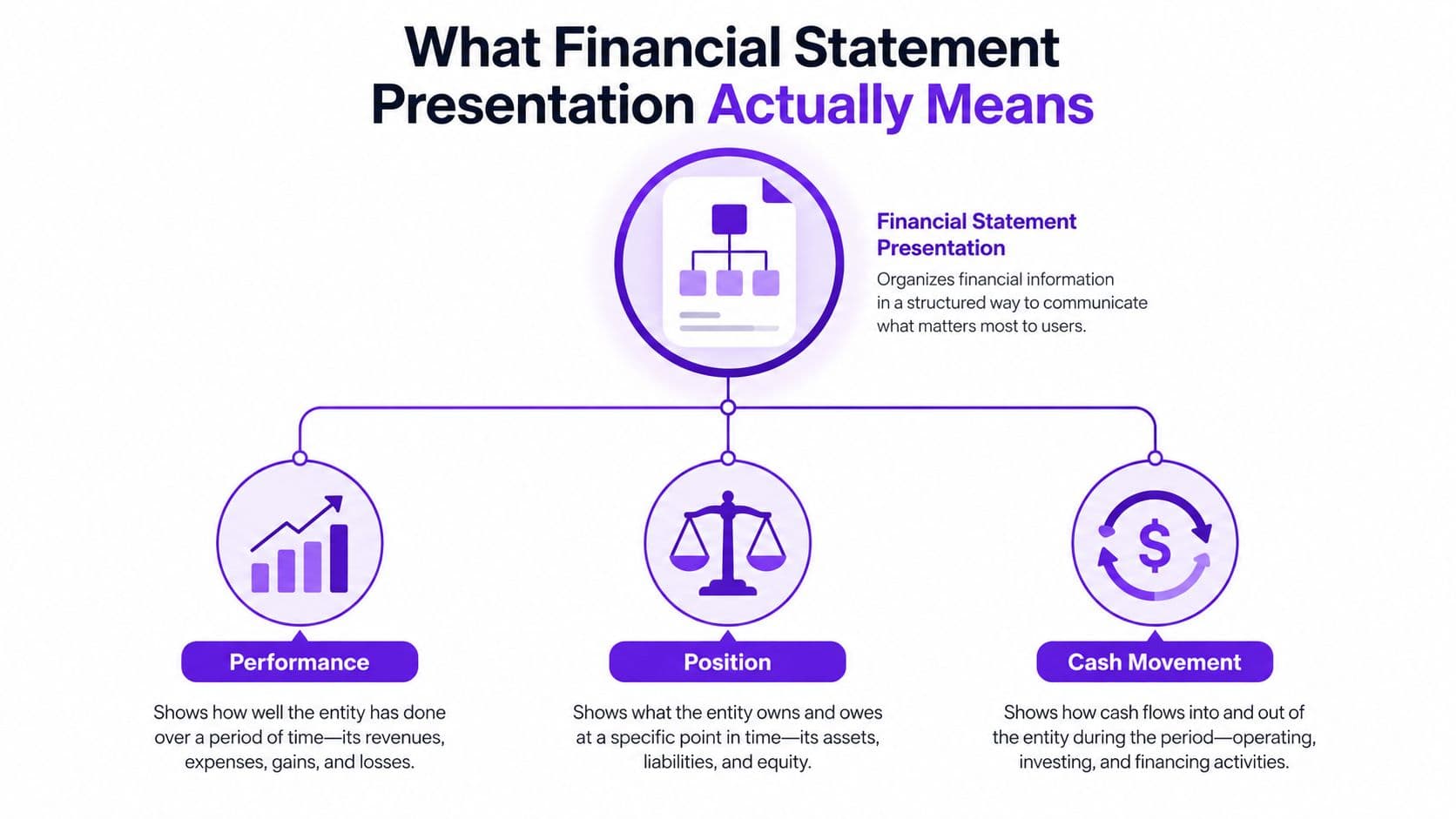
The best packages use hierarchy. The face of the statements gives the broad view, then the notes explain the mechanics underneath. That structure keeps a founder from drowning in detail while still letting an auditor or lender trace the logic.
If you need a practical companion while tightening your close, the guide to statement preparation for practices is a useful reference point for how presentation and preparation fit together in a real workflow.
What good presentation does and does not do
Good presentation translates accounting into business language without breaking accounting logic. It shows why deferred revenue is a liability, why operating cash can diverge from profit, and why equity movements matter even when the P&L looks stable. It doesn't hide complexity, it organizes it.
A report that feels “simpler” but can't be reconciled is not clearer. It's just harder to defend.
That's why the question isn't whether your statements are neat. The question is whether a reader can move from performance to position to cash movement and arrive at the same conclusion you did. If they can't, the presentation failed.
The Four Required Statements and What Each One Tells You
A complete financial package answers four different questions. Together, the statements show what you own, what you earned, what cash moved, and how equity changed. The notes then make those numbers auditable.
The core reports in plain English
| Statement | Key Line Items | Primary Question Answered |
|---|---|---|
| Statement of financial position | Cash, receivables, deferred revenue, debt, equity | What do you own and owe right now? |
| Profit or loss statement | Revenue, cost of revenue, operating expenses, net income | Did you make money during the period? |
| Cash flow statement | Operating cash, investing cash, financing cash | Where did the cash come from and where did it go? |
| Statement of changes in equity | Capital contributions, distributions, retained earnings | How did ownership value change? |
A clean reader should be able to connect those four reports. For example, if you bill a customer $12,000 for a yearly SaaS contract, the statement of financial position carries the unearned amount as deferred revenue, the profit or loss statement recognizes revenue over time, and the cash flow statement shows the cash when collected. The statements should not contradict each other. They should explain each other.
What each statement is really doing
The statement of financial position answers the balance question. It tells a lender whether your working capital is tight, whether liabilities are growing, and whether assets are being built or consumed.
The profit or loss statement answers the performance question. It shows whether the business is scaling profitably or buying growth with margin pressure.
The cash flow statement is the reality check. A company can show profit and still run short on cash if collections lag or deferred items are handled poorly.
The statement of changes in equity is the one founders ignore too often. It matters because it captures capital contributions, distributions, and retained earnings movement. Under U.S. GAAP, a complete set of statements includes investments by and distributions to owners during the period as one of the required items PwC presentation guide.
For a practical reading guide, this financial statements overview for operators can help non-accountants connect the pieces without getting lost in terminology.
GAAP and IFRS Rules That Shape Your Presentation
The framework you report under changes the package structure, the disclosures that sit behind the numbers, and how much judgment you can use in the narrative. That is not a footnote issue. It affects whether a founder, lender, or investor can read the story without losing the audit trail.
Where U.S. GAAP sets the floor
Under U.S. GAAP, ASC Topics 205–280 define the baseline presentation and disclosure framework, and ASC 205-10 requires a full set of statements covering financial position, earnings, income, cash flows, and owner-related changes in equity KPMG on financial statement presentation. For SEC filers, that baseline is layered with SEC rules and more granular disclosure requirements.
ASU 2024-03 adds more tabular footnote disclosure around expense categories without changing the face of the income statement. The practical result is simple, the statement may still look clean while the footnotes carry more of the analytical load. Founders who want cleaner dashboards have to remember that auditability lives in those notes, not just in the headline numbers.
Where IFRS is stricter on comparison
IFRS is more explicit about comparatives. IAS 1 requires a complete set of financial statements at least annually, plus comparative information for the preceding period, with at minimum two statements of financial position, two statements of profit or loss and other income, two statements of cash flows, two statements of changes in equity, and related notes IAS 1 current requirements. The standard was updated in December 2014 through the Disclosure Initiative to improve judgment in presentation and disclosure.
That framework pushes management to explain the business, not just list accounts. It also creates tighter expectations around consistency from one period to the next, which matters when a SaaS company is trying to show trend lines to investors and lenders without obscuring the accounting basis.
Deloitte's comparison notes that IFRS requires one year of comparative financial information, while U.S. GAAP has no general comparative requirement. For SEC public registrants, two years of comparative information is usually required for the income statement, equity, and cash flows Deloitte IFRS vs U.S. GAAP comparison. That difference changes how you prepare the package if you are heading toward fundraising or an IPO path.
| Topic | U.S. GAAP | IFRS |
|---|---|---|
| Core baseline | ASC 205–280 | IAS 1 |
| Comparative information | No general requirement, SEC rules add more for public filers | One prior period required |
| Statement package | Full set including equity movements | Full set including equity movements |
| Presentation emphasis | Authoritative baseline plus SEC layering | Comparative presentation and judgment in disclosure |
For a practical bridge between revenue timing and statement presentation, the revenue recognition resource for founders is useful before you lock the package. If you want a current operating view of recurring revenue in SaaS, the 2026 recurring revenue guide is a useful companion when you are tying metrics back to the statements.
SaaS Revenue Recognition and Growth Metrics in Your Statements
SaaS financials break badly when founders treat cash and revenue as the same thing. They're not the same, and presentation has to make that difference obvious without turning the package into an accounting lecture.
Deferred revenue is the first test
A $12,000 annual SaaS contract billed upfront creates $12,000 of deferred revenue on day one, then revenue is recognized over the service period at $1,000 per month. That means the income statement shows monthly revenue, the balance sheet shows the liability shrinking, and the cash flow statement shows the full billing amount when cash arrives.
That timing split is where non-accounting stakeholders get lost. They see cash come in and expect revenue to follow immediately. They see profit and assume cash should match. Clean presentation removes that confusion by showing the accounting logic in the notes and the management commentary.
ARR and MRR belong next to the statements, not inside them
ARR and MRR are not GAAP or IFRS line items, so they belong in supplemental schedules or management commentary with clear reconciliation to the nearest accounting measure. If you present them without that bridge, investors start questioning the numbers instead of using them.
A good package separates statutory reporting from operating metrics. That way, the audited statements stay defensible while the management layer still tells the growth story. For recurring-revenue operators, that distinction is especially important when customers pay in advance, churn changes the shape of cash, or service delivery stretches across reporting periods.
If you need a broader operating context, the 2026 recurring revenue guide is useful background for framing subscription metrics in board materials.
Capitalized costs change the margin story
Capitalized implementation or setup costs under ASC 340-40 change how your margins read over time. They affect the balance sheet first, then amortization flows through the income statement later. If you fail to present those costs clearly, your gross margin and operating margin commentary will look inconsistent even when the accounting is correct.
Practical rule: never let ARR, MRR, or capitalized costs sit in a deck without a reconciliation path back to the statutory statements.
For founders and finance leads building a reporting package around operating metrics, this SaaS financial metrics guide is a useful companion to the formal statements.
Investor Readiness and Common Presentation Errors
Investor-ready financial statements do three things well, they are clear, consistent, and complete. Miss any one of those, and diligence gets slower, questions get sharper, and confidence drops.
The mistakes that trigger pushback
The first error is sending management reports instead of financial statements. A P&L by itself is not a complete presentation. You need the balance sheet, cash flow statement, equity movement, and notes for the package to hold up in diligence.
The second error is mixing operating and non-operating items so aggressively that core performance becomes unreadable. That's common when founders want the EBITDA story to look better than the underlying business supports. The problem is that investors know how to spot the gap.
The third error is skipping comparatives or changing presentation methods without explaining the shift. Under IFRS, comparative information is required, and SEC filers under U.S. GAAP usually need two years for key statements Deloitte IFRS vs U.S. GAAP comparison. If the layout changes between periods, the story gets harder to trust.
If your board package and statutory financials don't reconcile cleanly, investors assume the harder problem is still hidden.
Red flags investors notice fast
- Revenue timing errors: revenue appears before performance obligations are satisfied.
- Weak notes: a material balance shows up on the face of the statements with almost no support.
- Missing reconciliation: adjusted metrics appear without a bridge back to net income.
- Inconsistent classifications: the same item shows up differently from one period to the next.
- Unexplained report gaps: management reports and statutory financials tell different stories.
The practical test is simple. An outside auditor should be able to trace the numbers back to source transactions quickly. If that trace takes a hunt through spreadsheets, email threads, and stale workpapers, the package is not ready.
For a tighter operating rhythm, this financial reporting best practices guide is worth reviewing before your next board or lender package.
Your Month-End Close and Presentation Checklist
A clean presentation starts before the statements are drafted. If the close is messy, the package will be messy. No amount of formatting fixes that.
What to verify before you release the package
- Record revenue in the right period. Confirm performance obligations are satisfied before revenue hits the books.
- Reconcile balance sheet accounts. Focus on deferred revenue, accounts receivable, and accrued expenses first.
- Check intercompany activity. Eliminate or disclose it properly, or the package loses credibility fast.
- Compare management reports to statutory financials. Document the reason for every material difference.
- Update the notes. Every material balance needs support, not just a label.
- Write the commentary. Explain the drivers of the period without slipping non-GAAP metrics into the narrative without reconciliation.
- Run a completeness check. Confirm the required statements and disclosures are all present.
- Get a second review. A second set of eyes catches presentation errors the preparer stops seeing.
For SaaS companies, add one more step, reconcile ARR and MRR to the general ledger and confirm the deferred revenue rollforward matches the liability account. That check keeps your operating story aligned with your audited story.
If your team doesn't have the bandwidth to do this cleanly every month, outsourced controller support is a practical fix. A firm like Jumpstart Partners handles investor-ready financials, cash flow visibility, and month-end close work for growing businesses, which is exactly the level of support that keeps presentation defensible as the company scales.
Use this month-end close checklist template to tighten the process before your next board meeting or diligence request.
If you want your financial statements to tell a clear, defensible story, talk to Jumpstart Partners about outsourced controller and bookkeeping support built for growing SaaS, agency, and professional services businesses. They prepare investor-ready financials, tighten month-end close, and help you present numbers that lenders and boards can use. Visit Jumpstart Partners to see how their team can support your next close and make your reporting package diligence-ready.