Financial Operations
How Does ASC 606 Change Revenue Recognition for SaaS
How Does ASC 606 Change Revenue Recognition. Learn how ASC 606 changes revenue recognition for SaaS and agencies. Master the five-step model, variable
ByJumpstart Partners, CPA, QuickBooks ProAdvisor
··17 min readASC 606 replaced industry-specific revenue rules with a single five-step, contract-centered model. A $120,000 annual SaaS contract now recognizes roughly $10,000 per month over 12 months instead of recording the full invoice at signing.
That change answers the question, how does ASC 606 change revenue recognition, but it understates the operational impact. ASC 606 moves your finance team away from billing dates and shipment events and toward the transfer of control, contract terms, delivery evidence, estimates, and contract changes. Your cash can arrive today while your revenue belongs to future periods.
For a SaaS company, digital agency, or professional-services firm between $500K and $20M in revenue, that distinction affects MRR reporting, investor materials, tax planning, audit support, commissions, and the month-end close. The accounting standard is principles-based, but your process can't be informal.
Table of Contents
- Why ASC 606 Hits Founders Where It Hurts
- The Five-Step Model Explained with Real Numbers
- ASC 606 Compared to the Old Rules
- Where ASC 606 Breaks SaaS and Agency Workflows
- Systems and Reporting That Make ASC 606 Work
- Your 30-60-90 Day ASC 606 Implementation Plan
- When to Outsource and What to Do Next
Why ASC 606 Hits Founders Where It Hurts
The most expensive revenue mistake founders make is treating an invoice as earned revenue. Under ASC 606, a company can bill $120,000 upfront for a 12-month service arrangement, record $120,000 as cash and deferred revenue, and recognize approximately $10,000 per month when the service is delivered evenly as one stand-ready obligation. The SEC-filed description of ASC 606 explains that revenue follows the transfer of control and satisfaction of performance obligations, not just billing or collection dates (SEC filing on ASC 606 revenue recognition).
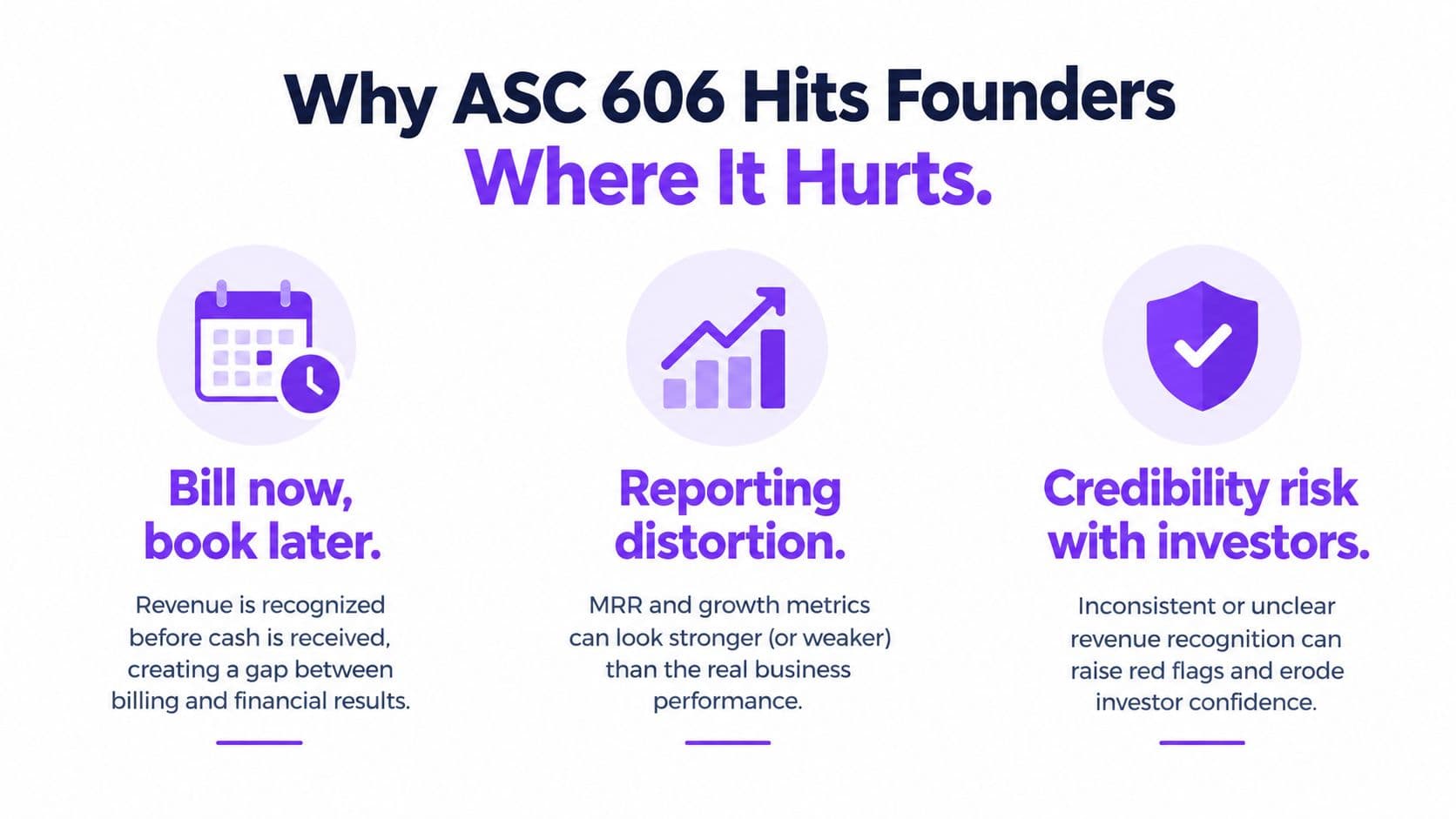
If your bookkeeper credits revenue when the invoice posts, your first month shows revenue that belongs to the full service period. The later months then look artificially weak because the work continues but the revenue has already been recorded. That distorts MRR, revenue forecasts, cohort analysis, and management decisions even when cash collections look healthy.
The problem becomes more serious when your contract includes implementation, setup, usage fees, credits, or separate support. A $120,000 subscription may not be one accounting unit. A strategy engagement may include a distinct plan, implementation work, media buying, and ongoing support, each requiring separate analysis.
The credibility cost
Investors and lenders don't need your revenue schedule to match your bank balance. They need your reported revenue to match the work you've promised and delivered. A deferred revenue balance that doesn't reconcile to contracts creates questions about the reliability of your financial statements and operating metrics.
ASC 606 became a common implementation milestone for U.S. businesses. Public business entities generally applied it for annual reporting periods beginning after December 15, 2017, effectively the 2018 calendar year, while many private companies received a one-year deferral (ASC 606 implementation overview for U.S. companies). Companies commonly selected either full retrospective adoption or modified retrospective adoption, but neither method removed the need to reassess contracts, obligations, estimates, allocations, and delivery timing.
Controller's rule: If your MRR report starts with invoices instead of earned revenue, it's a sales report, not an accounting report.
Three warning signs
- Revenue equals billing: Your monthly revenue rises sharply when annual invoices are issued, then drops despite continuous service delivery.
- Deferred revenue is a plug: Nobody can trace the balance to contract terms, remaining service periods, and recognized revenue.
- The close depends on sales explanations: Finance learns about upgrades, concessions, scope changes, and renewals through informal messages instead of an approved contract-change process.
A practical starting point is to compare your current process with this ASC 606 revenue recognition guide, then test one contract from invoice through the general ledger.
The Five-Step Model Explained with Real Numbers
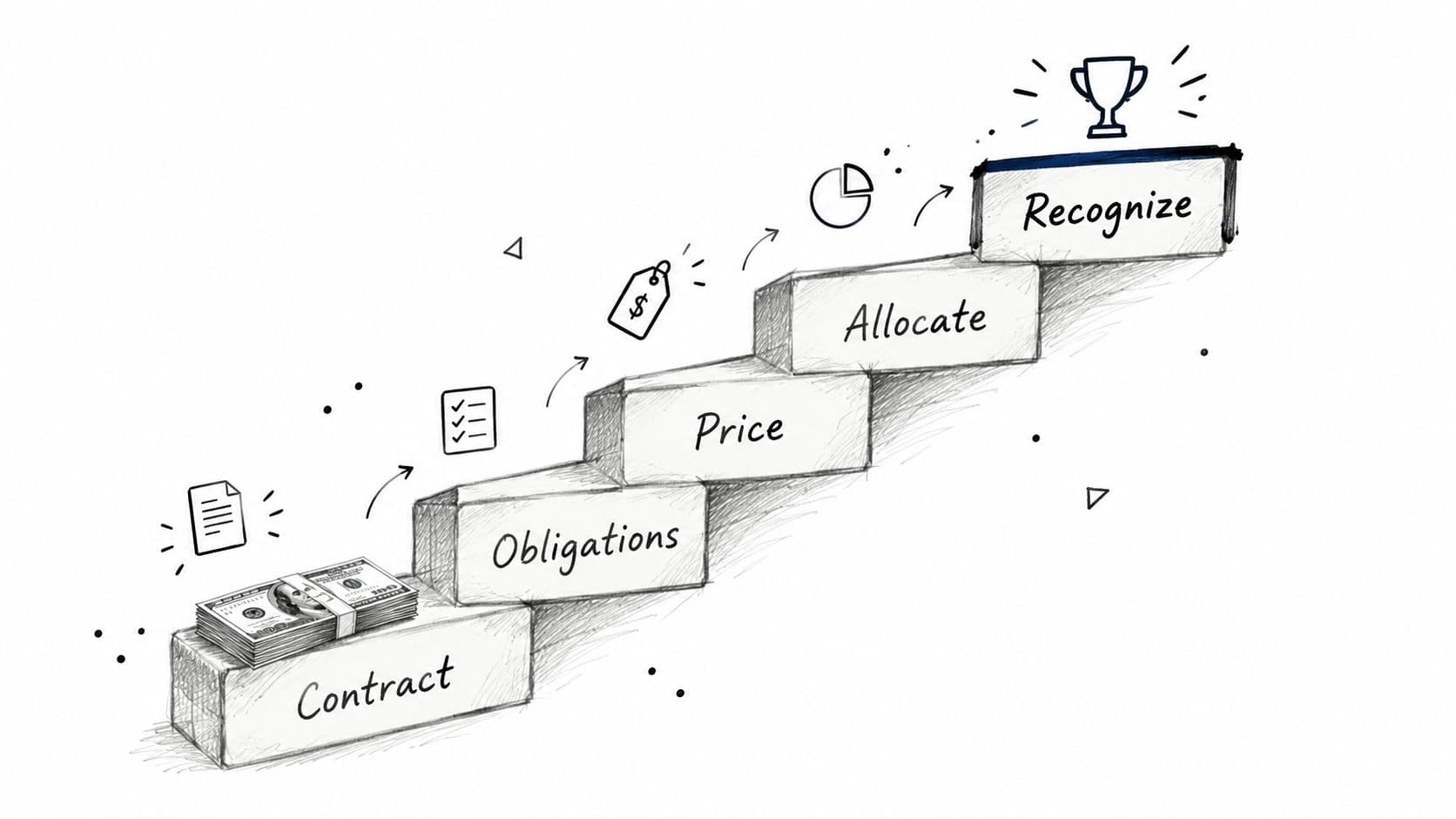
ASC 606 requires a five-step process: identify the contract, identify distinct performance obligations, determine the transaction price, allocate that price, and recognize revenue as each obligation is satisfied. The framework sounds straightforward until one contract contains subscription access, setup, usage, rebates, and amendments.
Use this contract as a working example:
| Contract component | Amount | Initial accounting conclusion |
|---|---|---|
| 12-month SaaS access | $120,000 | Recognize over the access period |
| Setup service | $9,000 | Analyze separately if distinct |
| Estimated usage overage | $6,000 | Include only to the extent the constraint permits |
| Total stated and estimated consideration | $135,000 | Allocate across obligations |
Step one, identify the contract
Confirm approved terms, commercial substance, payment rights, and collectability. The invoice alone isn't enough. Your evidence should include the executed order form, pricing, service period, renewal language, usage terms, and any approved changes.
Step two, identify performance obligations
The SaaS access is often a stand-ready obligation because the customer receives continuous access throughout the term. The $9,000 setup service is separate only if the customer can benefit from it independently and it's distinct from the ongoing SaaS promise. If setup only activates or customizes the hosted service and doesn't provide a separate benefit, it may be combined with the subscription.
This is why a "one performance obligation" conclusion needs documentation. Don't accept a default template without testing what the customer receives.
Step three, determine the transaction price
The starting consideration is $120,000 plus $9,000 plus the estimated $6,000 usage component, or $135,000, before applying the variable-consideration constraint. If the usage estimate creates a probable significant revenue reversal, exclude the constrained amount until the uncertainty resolves.
That distinction is separate from staged payments and revenue timing. Payment timing describes when cash is due. ASC 606 describes when the company earns consideration.
Step four, allocate the price
Allocate the transaction price based on relative stand-alone selling prices. If the SaaS service, setup service, and usage rights are distinct, maintain an approved stand-alone selling price schedule. Don't allocate based on whichever line item appears first on the invoice.
Step five, recognize revenue
Assume the $6,000 usage estimate is constrained and excluded initially, and assume the $9,000 setup service is distinct and delivered at contract inception. The initial schedule would show:
- Setup revenue: $9,000 when the setup obligation is satisfied.
- SaaS revenue: $120,000 divided across 12 months, or approximately $10,000 per month.
- Usage revenue: $0 initially if the constraint prevents recognition, followed by recognition when the uncertainty no longer creates a probable significant reversal.
A simplified entry when the customer pays upfront is:
| Account | Debit | Credit |
|---|---|---|
| Cash | $120,000 | |
| Deferred revenue | $120,000 |
When one month of SaaS service is delivered:
| Account | Debit | Credit |
|---|---|---|
| Deferred revenue | $10,000 | |
| SaaS revenue | $10,000 |
When the distinct setup service is delivered:
| Account | Debit | Credit |
|---|---|---|
| Deferred revenue | $9,000 | |
| Setup revenue | $9,000 |
Your schedule should show the obligation, allocated consideration, satisfaction pattern, recognized amount, and remaining deferred balance. A worked example should also be documented in your accounting policy, not kept only in a spreadsheet. For another practical treatment of contract scenarios, review these ASC 606 examples.
ASC 606 Compared to the Old Rules
ASC 606 didn't just rename the old revenue process. It replaced industry-specific rules with a common, principles-based model centered on contracts and control. Legacy ASC 605 often encouraged teams to focus on delivery, persuasive evidence, fixed or determinable fees, and collectability. ASC 606 asks a broader question: what did you promise, what consideration belongs to those promises, and when did you satisfy them?
ASC 606 vs ASC 605 at a Glance
| Criterion | ASC 606 | Legacy ASC 605 |
|---|---|---|
| Revenue trigger | Transfer of control as performance obligations are satisfied | Industry-specific recognition criteria and delivery evidence |
| Performance obligations | Identify distinct promised goods or services | Often analyzed through industry-specific guidance |
| Variable consideration | Estimate rebates, refunds, credits, bonuses, usage fees, and penalties, subject to a constraint | More limited and less uniform treatment |
| Contract modifications | Assess whether the change is a separate contract, termination and replacement, or continuation of the existing contract | Treatment depended more heavily on the applicable industry guidance |
| Principal versus agent | Principal reports gross consideration, agent reports the retained fee or commission | Presentation was addressed through more fragmented guidance |
| Contract costs | Capitalize eligible incremental costs of obtaining a contract and amortize them over the benefit period, with a practical expedient for periods of one year or less | Less consistent treatment across arrangements |
For a SaaS company, the first row changes the monthly close. A $120,000 annual subscription isn't automatically $120,000 of current-period revenue because the customer receives access over time.
The performance-obligation row changes how agencies write and review statements of work. Strategy, implementation, media buying, and support may not share one recognition pattern. You need to assess whether each promise is distinct and whether the customer receives the benefit separately.
Variable consideration creates a recurring estimate. Usage overages, service-level penalties, refunds, and credits belong in the transaction-price analysis, but you can't recognize an amount that creates a probable significant reversal. The schedule must be refreshed as facts change.
The presentation and commission effects
Principal-versus-agent analysis affects reported revenue without necessarily changing cash economics. A marketplace that controls a service before transfer may report gross consideration. An agent arranging another party's service reports only the fee or commission retained.
Contract costs create another difference. Eligible sales commissions are generally recorded as contract-cost assets when the company expects to recover them, then amortized over the period benefited by the customer relationship. A practical expedient allows expensing when the amortization period would be one year or less, as described in public-company guidance (ASC 606 principal-agent and contract-cost guidance).
The operating conclusion is direct: ASC 606 demands more contract data, more judgment, and better documentation than ASC 605. Your old invoice-driven habit can't survive the new model. For a plain-language explanation of the broader accounting principle, use this resource on the revenue recognition principle.
Where ASC 606 Breaks SaaS and Agency Workflows
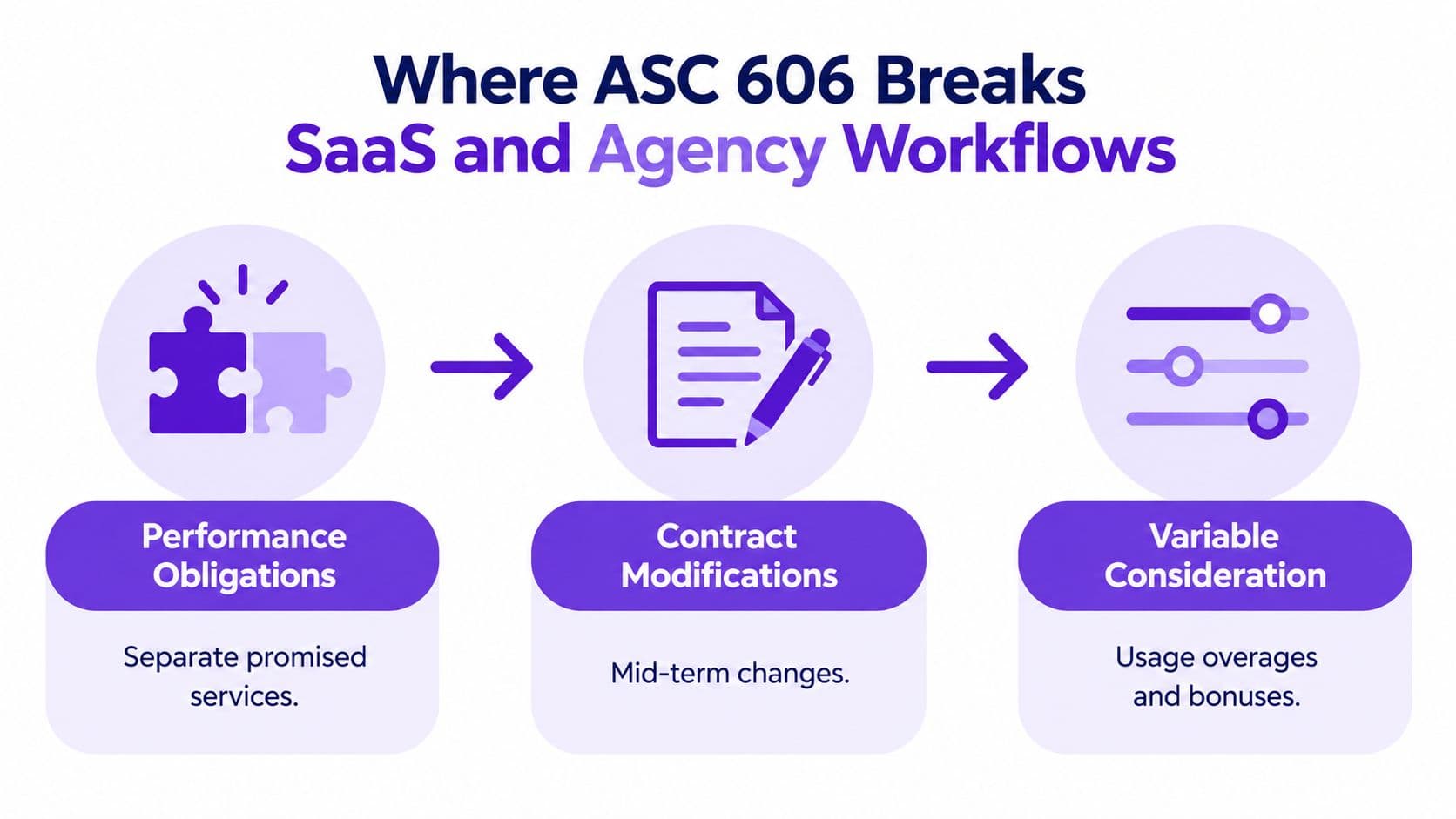
ASC 606 breaks workflows in three places: teams bundle promises that should be separated, they treat contract changes as administrative updates, and they recognize variable amounts before the evidence supports them.
Performance obligations in agency work
Consider a digital agency engagement with a strategy deliverable, implementation work, media buying, and an ongoing support retainer. Don't force the entire statement of work into one straight-line schedule.
Strategy may be satisfied when the client receives and accepts the completed plan. Implementation may follow milestones or a measure of progress. Media buying requires analysis of whether the agency acts as principal or agent, particularly when a third party delivers the advertising service. Support may represent a stand-ready obligation over the retainer period.
Your contract review should answer four questions:
- Benefit: Can the client benefit from the promised service on its own or with available resources?
- Distinctness: Is the promise separately identifiable from the other promises in the arrangement?
- Evidence: What proves satisfaction, acceptance, progress, or ongoing availability?
- Allocation: What stand-alone selling price supports the amount assigned to each obligation?
Contract modifications are accounting events
A renewal, upgrade, downgrade, concession, seat change, module addition, or usage-right revision can change the revenue schedule. A modification may qualify as a separate contract only when it adds distinct goods or services and the price reflects stand-alone selling prices. Otherwise, you may need termination-and-replacement treatment, a cumulative catch-up, or another approach based on the facts.
A blend-and-extend renewal deserves special attention. Suppose a customer renews early, adds a module, and changes the remaining term and price. The new order form doesn't decide the accounting by itself. You need to assess whether the added service is distinct and whether the revised price reflects its stand-alone selling price.
Create a modification trigger log connected to your CRM and billing systems. Record the approval date, effective date, changed promises, revised consideration, variable terms, and accounting conclusion. Oral approvals, customary business practices, and approved scope changes with unresolved pricing can also create enforceable changes that finance needs to evaluate.
Variable consideration needs evidence
Assume a SaaS contract includes a $50,000 variable component from usage overages, volume rebates, and service-level credits. You can't recognize the entire amount just because the customer has a usage provision.
Start with the estimate supported by current usage and contract terms. Then subtract or constrain amounts exposed to probable significant reversal. For example, if your evidence supports $30,000 of usage consideration but unresolved credits and rebates make $20,000 uncertain, recognize only the amount that passes the constraint test. Update the estimate at every reporting date and track the reason for each change.
The specific number in that example is an illustration of the constraint calculation, not a benchmark. Your evidence should include usage exports, approved credit calculations, rebate terms, service-level records, customer disputes, and management approval.
Operational rule: Every contract change needs an owner, an effective date, an evidence source, and an accounting conclusion. If any one is missing, the schedule isn't finished.
Systems and Reporting That Make ASC 606 Work
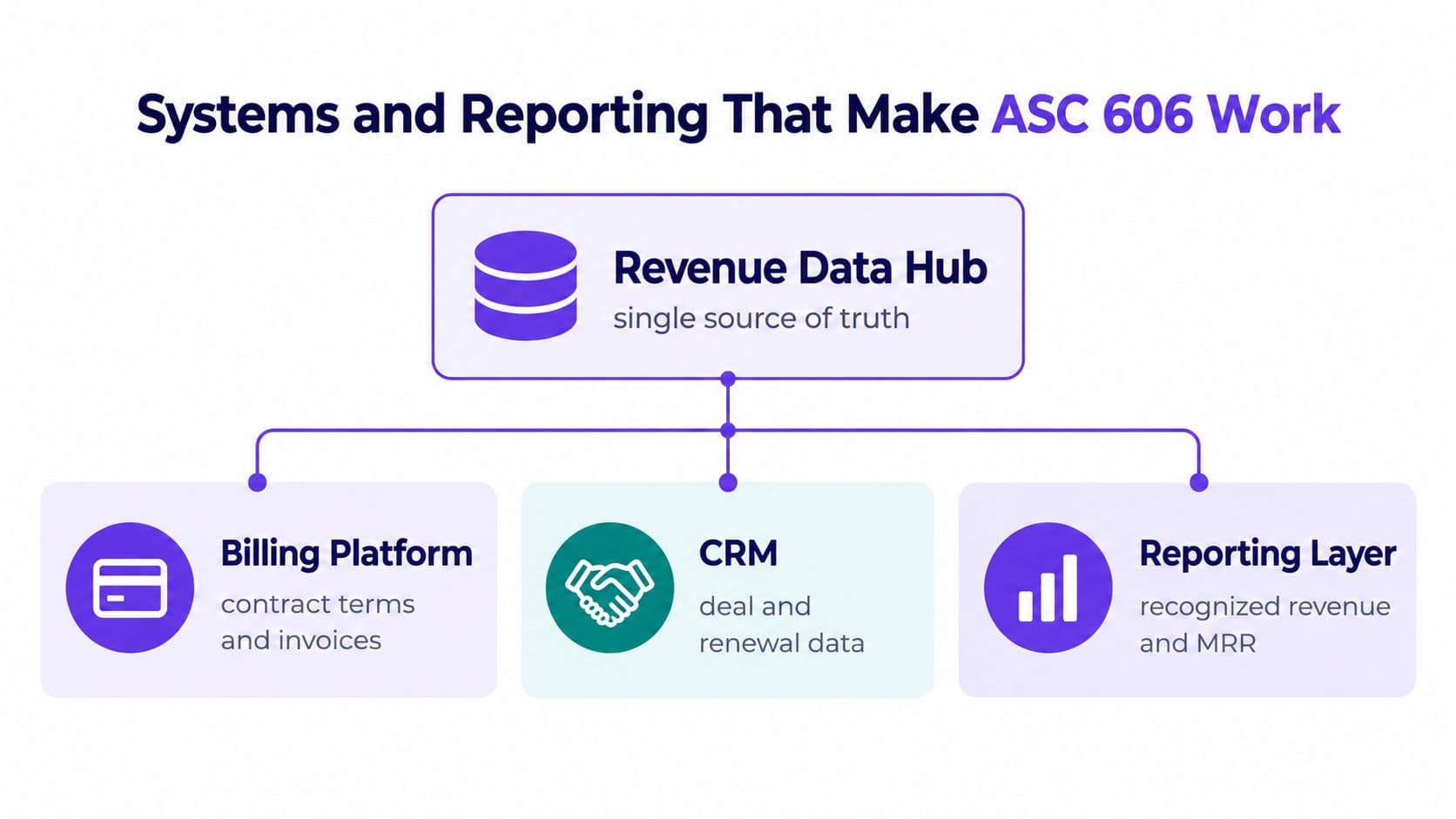
ASC 606 is a data problem disguised as an accounting policy. Your billing platform knows invoices and payment terms. Your CRM knows opportunities, renewals, concessions, and amendments. Your general ledger records entries. Your contract repository preserves the terms and approvals. None of those systems can independently explain earned revenue.
Assign ownership by data type
| System | Owns | Finance control |
|---|---|---|
| Stripe, Chargebee, or Maxio | Contract billing terms, invoices, collections, and usage feeds | Reconcile billed amounts and amendments |
| HubSpot or Salesforce | Deal approvals, renewals, concessions, and sales metadata | Lock approval status and change history |
| QuickBooks, Xero, or NetSuite | Journal entries, account balances, and financial reporting | Reconcile subledger output to the GL |
| Contract repository | Executed agreements, order forms, SOWs, and approvals | Preserve the version used for the accounting conclusion |
| Revenue data hub or recognition layer | Obligations, allocations, schedules, and exceptions | Maintain the audit trail and exception queue |
Don't let the CRM remain a sales-only system. A renewal that changes seats or modules must reach the revenue schedule. Don't let Stripe remain an invoice-only source. Usage data and credits can affect the transaction price.
Four reports belong in every close
- Deferred revenue rollforward: Beginning balance, billings, recognized revenue, modifications, credits, and ending balance.
- Contract asset and liability reconciliation: Tie each contract balance to the general ledger and supporting schedule.
- Recognized versus billed revenue: Explain timing differences instead of treating them as errors.
- ARR by performance obligation: Separate recurring access from implementation, services, usage, and other non-recurring promises.
If your stack can't produce these reports, correct journal entries alone won't protect you. Teams assessing process improvements can also review how sellers automate financial reporting, particularly where CRM, billing, and finance data need a controlled handoff.
A recognition engine can calculate schedules, but your team still needs reconciliation, exception review, and evidence retention. For a practical framework on connecting those controls, see revenue recognition automation.
Your 30-60-90 Day ASC 606 Implementation Plan
A growing company doesn't need a theoretical policy manual. It needs a controlled project with deliverables, owners, and escalation points.
Days 1 through 30, diagnose
Build the contract inventory first. Include subscriptions, implementation packages, agency SOWs, renewals, discounts, usage arrangements, refunds, credits, and sales commissions.
Then map each contract type to performance obligations and recognition patterns. Select a representative contract sample and perform a deferred revenue walk from invoice to schedule to general ledger.
Deliverable: A contract matrix showing obligation, allocation method, satisfaction pattern, variable terms, modification triggers, and source system.
Red flag: If sales, customer success, and finance can't agree on the active contract population, stop the build phase and resolve the data ownership problem.
Days 31 through 60, build
Create schedule templates for standard SaaS, setup, implementation, retainer, milestone, usage, and commission arrangements. Define the stand-alone selling price methodology and document the approval process for estimates.
Connect billing, CRM, contract storage, recognition tooling, and the GL. Revise the close calendar so contract changes have a cutoff, owners review exceptions, and reconciliations happen before final reporting. A focused financial close automation process can help assign those controls and deadlines.
Deliverable: A tested schedule that produces journal entries, deferred balances, exception reports, and supporting evidence.
Red flag: If the schedule depends on manual rekeying from email or spreadsheets, it isn't ready for production.
Days 61 through 90, harden
Run the first month-end close under the new policy. Compare recognized revenue, billed revenue, deferred revenue, contract assets, and contract costs to the prior process. Investigate every difference instead of posting a catch-up entry without documentation.
Train sales operations, customer success, billing, bookkeeping, and finance on modification triggers. Prepare an auditor-ready package containing the policy, contract matrix, sample calculations, approvals, reconciliations, and exception log.
Deliverable: A signed monthly close package with clear review evidence.
Red flag: If you can't explain a variable consideration estimate to an auditor using source data, assign an owner and rebuild the estimate before issuing financials.
When to Outsource and What to Do Next
Keep ASC 606 in-house when your team closes in five days with an auditor-ready deferred revenue schedule and can defend variable consideration estimates without reconstructing the evidence. If either capability is missing, an outsourced controller is usually the faster route than hiring a full-time accounting leader before your process is stable.
The decision isn't about whether your bookkeeper can post a journal entry. It's about whether someone owns contract changes, allocation judgments, reconciliations, reporting, and audit support every month.
Take these three actions this week:
- Pull a contract sample: Select one annual SaaS agreement, one amendment, and one agency SOW.
- Test one estimate: Recalculate a usage overage, rebate, refund, or service-level credit and document the constraint conclusion.
- Book a working session: Bring the contract, billing export, CRM record, deferred revenue schedule, and general-ledger balance so the team can identify the break in the workflow.
Jumpstart Partners provides outsourced controller and bookkeeping support for SaaS, agency, and professional-services businesses, including ASC 606 cleanup, revenue schedules, reconciliations, and investor-ready reporting. Visit Jumpstart Partners to schedule a working session focused on your contracts, systems, and next month-end close.