Financial Operations
Outsourced Accounting Benefits That Pay for Themselves
Outsourced accounting benefits for SaaS and agencies: real cost math, faster closes, and when DIY books stop working.
ByJumpstart Partners, CPA, QuickBooks ProAdvisor
··17 min readHanding your books to an outside team doesn't automatically improve your business. A peer-reviewed study of small and medium-sized enterprises found that outsourcing accounting activities alone didn't produce a statistically significant performance effect. You're buying better financial operations, not just fewer tasks on your calendar.
For founders running SaaS companies, digital agencies, and professional services firms, the outsourced accounting benefits worth paying for are specific: a dependable close, revenue you can defend, and a clear view of cash commitments. External capacity should improve those outputs while you keep approval rights, KPI definitions, and cash decisions.
Table of Contents
- Why Founder-Led Books Break Past $500K
- What Outsourced Accounting Actually Changes
- Six Benefits You Can Measure Each Month
- Worked ROI for an Agency and a SaaS Company
- Red Flags That Outsourcing Will Waste Money
- When to Leave DIY Books
- How to Move Off DIY Books Without Losing Control
- Start With a Finance Ops Diagnostic
Why Founder-Led Books Break Past $500K
Your bank balance tells you what's available today. It doesn't tell you whether you earned the customer prepayment, whether an agency project made money, or how much cash approved vendor bills will consume.
At $500K–$20M in revenue, you're often managing a business that needs specialized accounting work without enough workload to justify an entire internal department. The founder or bookkeeper becomes the default owner of everything, including work they don't have time to review properly.
A 2025 Financial Executives International survey of more than 200 executives found that 52% used outsourcing for accounting, finance, or related functions, including 48% at smaller firms. Resource shortages were cited by 78%, cost reduction by 53%, and focus on core business activities by 45%.
DIY books versus a controller-led outsourced model
| Outcome | DIY founder books | Outsourced model | Benchmark |
|---|---|---|---|
| Staffing | Founder or one bookkeeper covers AP, payroll, reconciliations, and reporting | Specialist capacity without hiring a full finance department | FEI's resource-shortage finding |
| Cost | Salary, benefits, recruiting, and management overhead | Scoped capacity rather than an entire permanent team | Compare fully loaded costs, not salary alone |
| Leadership time | Founder stuck in reconciliations | Time available for product, sales, delivery, or fundraising | FEI's focus-on-core-work finding |
| Close quality | Bank balance stands in for the statements | Separate preparer and reviewer, checklist, retained evidence | Reviewed statements with explained exceptions |
| Cash visibility | AP aging and committed spend unknown | Reconciled payables and an approval workflow | Processing cost and receipt-to-posting time |
Your problem isn't necessarily the bookkeeper
A bookkeeper can categorize transactions correctly and still leave you without decision-ready financials. Someone must review accruals, challenge unusual balances, check revenue timing, and explain why margin changed.
If nobody owns that review, you become the reviewer by default. You investigate transactions between sales calls, approve bills without a complete commitments report, and answer investor questions from spreadsheets you haven't reconciled.
That's a management-design problem, not a software problem. Switching from QuickBooks to another ledger won't assign ownership or establish review rights.
Use these signs you've outgrown your bookkeeper to distinguish missing processing capacity from missing financial oversight. Don't replace a capable bookkeeper when the actual gap is controller-level judgment.
Practical rule: Don't evaluate outsourcing by how many tasks leave your desk. Evaluate whether you can make a hiring, pricing, or cash decision without rebuilding the numbers yourself.
Keep the scorecard compact: close days, fully loaded finance cost versus a US hire, invoice-processing cost, and whether recognized revenue reconciles to billing and cash. Those measures expose whether the arrangement improves operations or merely moves work elsewhere.
What Outsourced Accounting Actually Changes
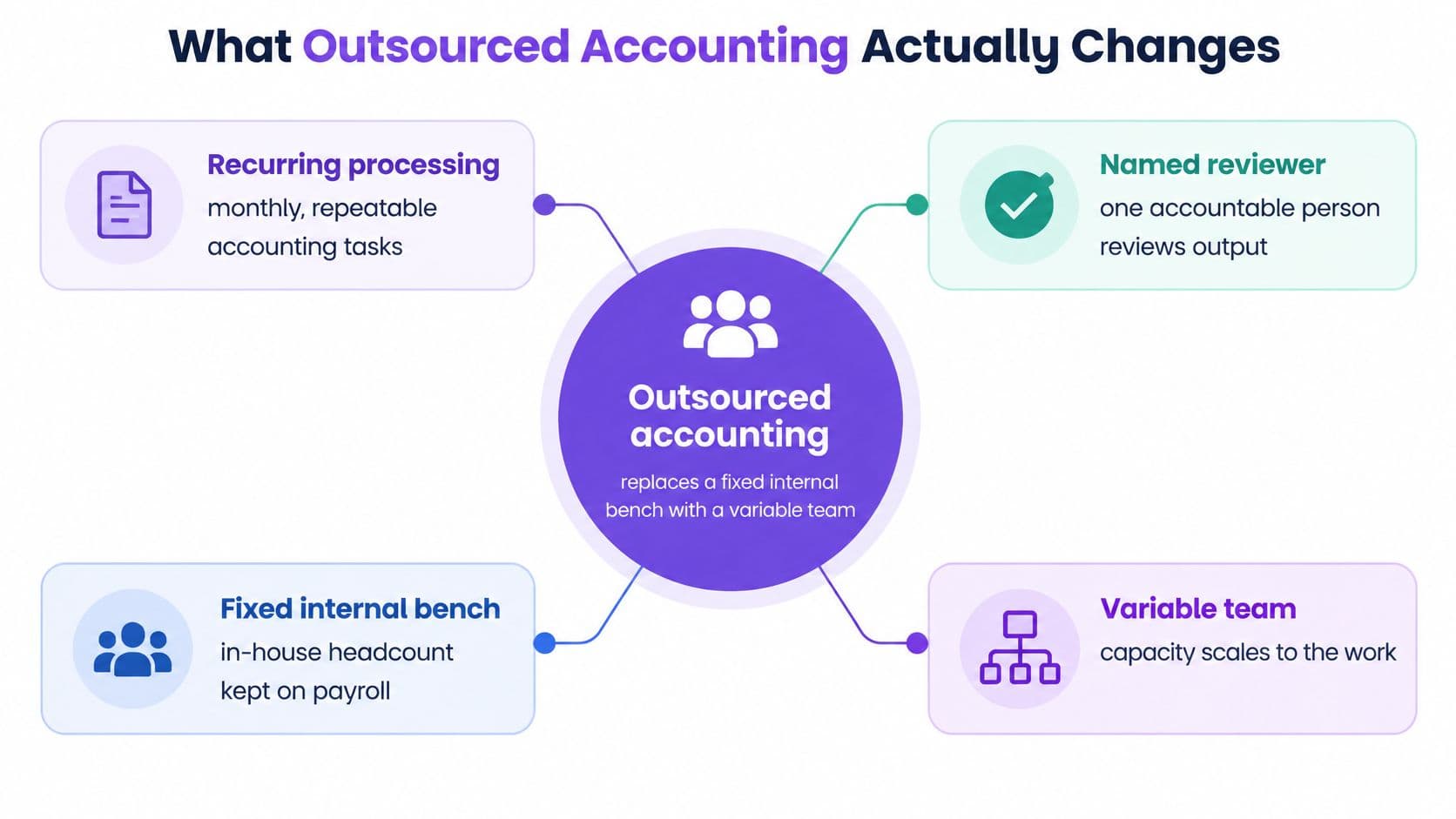
Outsourced accounting replaces a fixed internal bench with a variable team responsible for recurring processing and a named reviewer. Bookkeeping alone isn't the complete service. You need someone accountable for the financial package before management uses it.
An empirical study published in Problems and Perspectives in Management found that routine and advisory outsourced accounting improved compliance and management benefits, which supported operational performance. Non-routine services improved management benefits but didn't significantly improve compliance benefits.
The operating model matters more than the outsourcing label.
Build a monthly operating routine
Your preparer records transactions, reconciles accounts, and assembles supporting schedules. A controller reviews unusual entries, unresolved balances, revenue treatment, and the completeness of expenses.
Evidence stays attached to journal entries and reconciliations. The management meeting then converts the completed package into decisions: whether to hire, change pricing, collect overdue invoices, or delay discretionary spending.
Think of the bookkeeper as the pit crew and the controller as the race engineer. Completing the work gets the car back on track; reviewing performance tells you what to change. The distinction between a bookkeeper and a controller should appear in the responsibility map, not just the engagement title.
For broader context on separating external execution from internal accountability, ELECTE's business-process outsourcing guide, guida al BPO aziendale, is a useful companion.
Keep decision rights inside your business
| Workstream | External team owns | You retain |
|---|---|---|
| Payables | Capture, coding, matching, approval routing | Vendor authorization and payment approval |
| Payroll coordination | Input checks and ledger reconciliation | Compensation decisions and payroll authorization |
| Reporting | Preparation, review, and commentary | KPI definitions and operating priorities |
| Cash planning | Forecast maintenance and variance explanations | Transfers, financing, and spending decisions |
For SaaS, the scope must explicitly name contract data, deferred revenue, and ASC 606 schedules. For agencies and professional services, it must name project margin, utilization, and work in progress. A generic monthly-reporting promise doesn't establish responsibility for either model.
At Jumpstart Partners, we work with your existing founder, operations lead, CPA, and bookkeeper rather than forcing a full reset. We make close ownership, reporting responsibilities, and review points explicit before the recurring cadence starts.
Measure the resulting process through close days, open reconciliation items, audit adjustments, forecast variance, and the share of management decisions supported by current financials.
Six Benefits You Can Measure Each Month
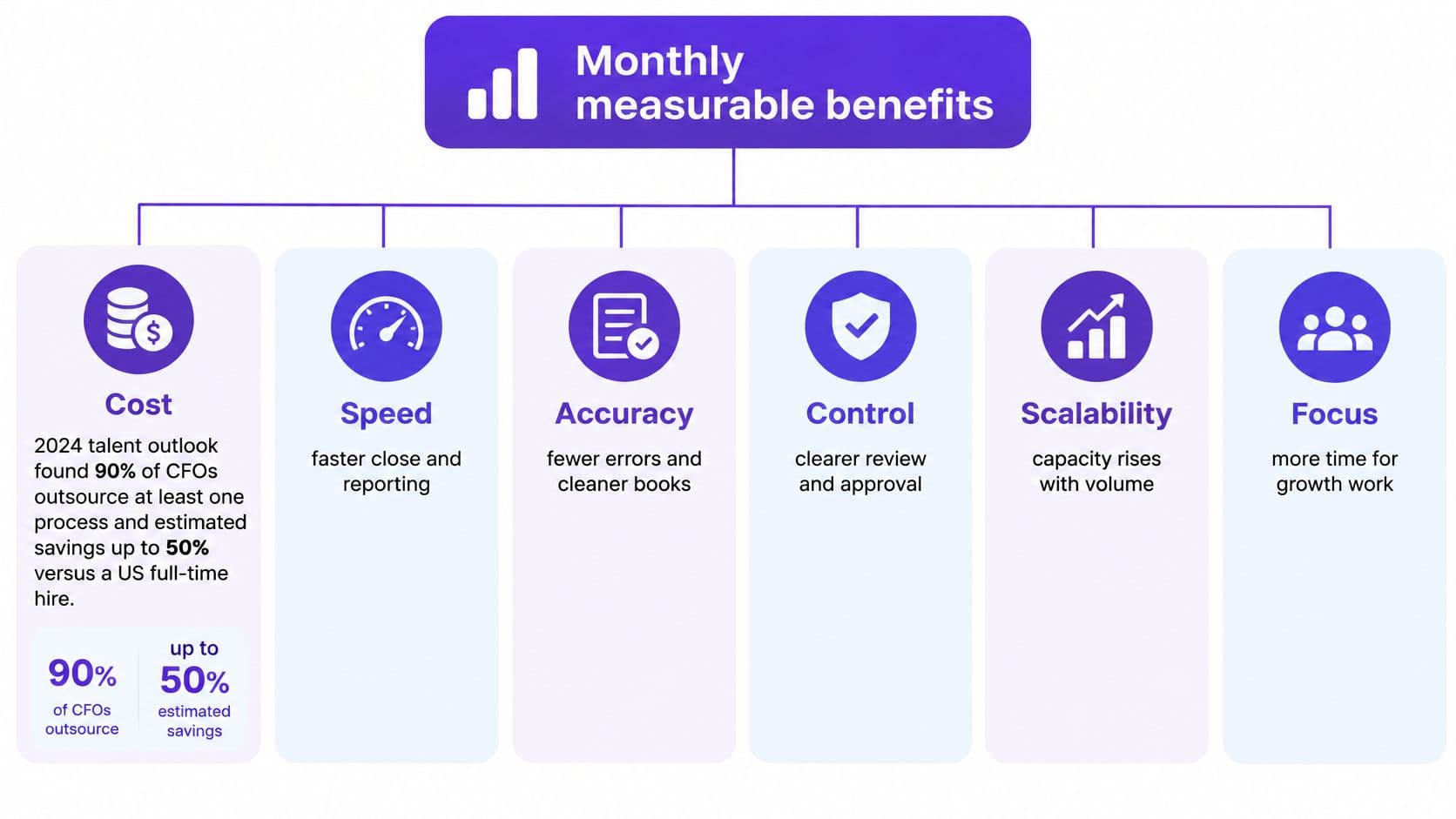
An outsourced accounting fee earns its place when it shortens the close, clarifies revenue, or improves cash decisions. Set a service level for each benefit before you sign. A low fee that leaves you closing from the bank balance is still expensive.
Put the promise into the agreement
Six benefits and the proof for each
| Benefit | Metric to track | Evidence or operating test | Service level to demand |
|---|---|---|---|
| Cost | Fully loaded monthly finance spend | Compare the fee with your current costs and remaining oversight time | Fixed fee with inclusions and exclusions |
| Close speed | Close days per month | Documented checklist and separate reviewer | Delivery date committed in writing |
| Investor-ready financials | Revenue, MRR, ARR, and gross-margin reconciliation | Contract-level revenue support | Revenue schedule per contract |
| Cash | Receivable days and AP aging | Cash application, AR, and AP records | Weekly aging report with owners |
| Scale | Capacity added during growth | Defined workload and scope | Written scope-change procedure |
| Audit readiness | Unresolved balances and audit adjustments | Retrievable reconciliations and journal evidence | Support retained for every close |
Cost: Compare the retainer with the work you need. Include your oversight time, software, transition work, and out-of-scope charges. A lower fee only saves money if the close and review still get done.
Close speed: Set a delivery date early enough to guide the next operating decision. Require an exception log that names missing information, its owner, and the date it must be resolved.
Investor-ready financials: Document your ARR and MRR definitions, then reconcile those metrics to recognized revenue. Subscription measures and accounting revenue answer different questions. Use revenue reporting best practices for 2026 as a reference for documenting the reporting workflow.
Measure cash outcomes, not report production
For cash, assign collection owners and identify approved bills awaiting payment. Build a rolling cash-flow forecast that includes those expected receipts and commitments, rather than treating the bank feed as a forecast.
Scalability means adding a defined workload, such as receivables follow-up or close support, without immediately creating a permanent position. Audit readiness means another accountant can trace a reported balance to its evidence without asking you to reconstruct the month.
A delivered report isn't the finish line. A reconciled report with an accountable reviewer and a decision attached is.
Worked ROI for an Agency and a SaaS Company
Separate cash savings from accounting corrections. An agency's payables redesign can reduce processing expense; correcting SaaS revenue timing improves the reliability of decisions but doesn't create additional customer cash.
The comparison below separates those outcomes.
Agency payables with visible arithmetic
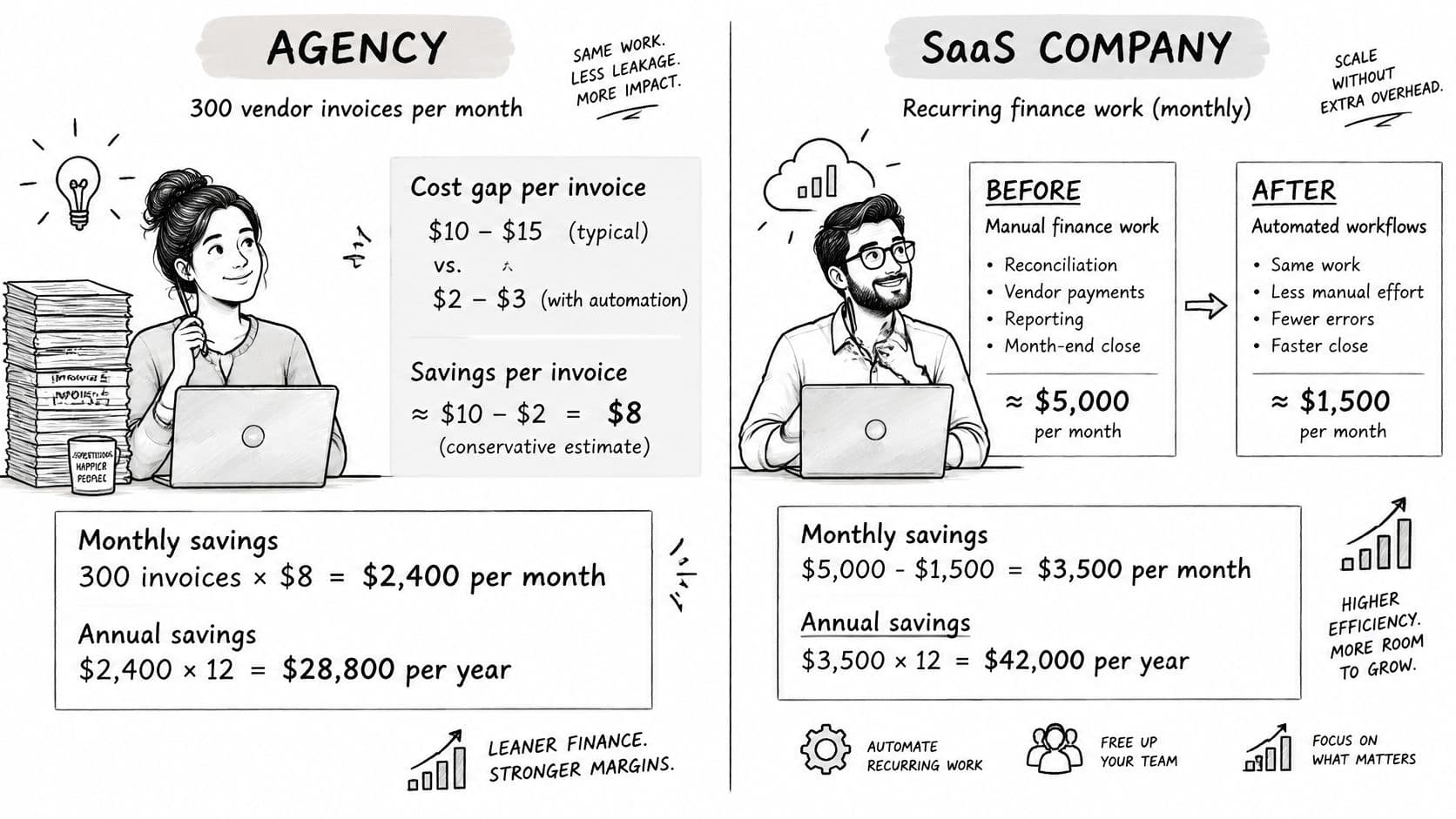
Deloitte's invoice-processing benchmark puts best-in-class processing at roughly €2–€3 per invoice and about three days, compared with €10–€15 and more than two weeks for other organizations. Using that benchmark in a hypothetical agency processing 300 invoices monthly, the calculation is:
- Current processing: €12 × 300 = €3,600 per month.
- Improved processing: €2.50 × 300 = €750 per month.
- Monthly difference: €3,600 − €750 = €2,850.
- Annual difference: €2,850 × 12 = €34,200.
That's a gross process-cost opportunity, not guaranteed net savings. Deduct implementation costs, technology charges, and any provider fees not included in the processing estimate. Don't double-count staff costs that remain after the handoff.
A provider who only rekeys bills hasn't earned that gap. The redesigned workflow must improve capture, matching, approvals, posting, and reconciliation.
SaaS revenue timing without invented returns
The five-step revenue model described in this SEC-filed revenue-recognition disclosure recognizes revenue as performance obligations are satisfied. For the hypothetical $120,000 annual subscription, assuming the subscription is the sole obligation and service transfers evenly, $120,000 ÷ 12 = $10,000 monthly, so recognizing everything immediately overstates the first month by $120,000 − $10,000 = $110,000.
If a separate $12,000 implementation service is distinct and completed immediately, recognize its allocated amount at completion while spreading the subscription allocation over its service period. Document the allocation rather than assuming invoice labels determine the accounting.
Two ROI calculations you can rerun
| Case | Baseline | Corrected | Annual effect |
|---|---|---|---|
| Agency AP, 300 monthly invoices | €12 × 300 = €3,600 monthly | €2.50 × 300 = €750 monthly | €2,850 × 12 = €34,200 gross opportunity |
| AP cycle time | More than two weeks | About three days | Earlier committed-cash visibility |
| SaaS annual prepay of $120,000 | Entire amount recognized immediately | $10,000 monthly | Same subscription revenue over the full service year; corrected timing |
| Hiring an accountant | Recruiting delays leave work uncovered | External capacity fills defined responsibilities | Capacity without building a full department |
The revenue correction doesn't change runway mechanically: cash arrived when the customer paid. It prevents you from using an inflated profit figure to justify spending.
For additional context on finance automation, this video provides a separate viewing resource.
Before comparing outsourced bookkeeping costs with a hire, enter your own invoice count, current processing effort, and prepaid-contract balance. Don't label better revenue presentation as cost savings.
Red Flags That Outsourcing Will Waste Money
Outsourcing isn't automatically the better operating model. CFO.com's coverage of the 2025 Personiv outlook reported that 65% of surveyed CFOs outsourced some finance work, down 25% year over year.
The same coverage identified concerns about quality and accuracy at 59%, loss of control at 56%, communication at 32%, and systems and process integration at 25%. Meanwhile, 87% of decision-makers reported a finance and accounting talent shortage, up from 83% in 2024.
A staffing shortage explains why you seek help. It doesn't excuse weak controls.
Objections and the control you keep
| Objection | Share citing it | Keep in-house | Walk away if |
|---|---|---|---|
| Quality and accuracy | 59% | Review rights and an error threshold | No reviewer separate from the preparer |
| Loss of control | 56% | Payment approval, KPI definitions, cash decisions | Provider can independently move cash or redefine MRR |
| Communication | 32% | Named owners and a monthly finance meeting | No operating cadence on the calendar |
| Systems and process fit | 25% | Your ledger, billing, and payroll stack | Work is rekeyed outside the live system |
Control test: Your reviewer should challenge the numbers. Your external team should never quietly inherit authority to approve its own work or release your cash.
Look for evidence during onboarding
Quality failures appear when nobody can explain how an error gets identified, corrected, and escalated. Require a review trail and an unresolved-items list, not an accuracy promise without a definition.
Communication failures appear when your questions bounce between an account manager and an unnamed processing team. A named owner needs authority to resolve missing inputs and explain the close.
Integration failures appear when the team maintains a shadow spreadsheet that doesn't reconcile to QuickBooks, Xero, Stripe, or your billing system. Exporting information for analysis is sensible; maintaining an uncontrolled second ledger isn't.
The peer-reviewed SME finding is the caution: transferring accounting tasks alone doesn't establish a performance return. Tie the engagement to close duration, aged receivables, forecast variance, and the schedules your business model requires.
Walk away if the proposal can't identify owners, review points, and measurable outputs. A low fee doesn't compensate for financial information you still have to rebuild.
When to Leave DIY Books
Name the trigger before choosing the provider. Use this editorial working rule: start the transition when two or more of the following apply. These are management thresholds, not survey findings.
- Reporting pressure: Revenue has passed $500K, and a board, lender, or buyer expects monthly MRR or project-margin reporting.
- Late close: Closing takes more than 10 business days, or you still perform bank reconciliations yourself.
- Uncontrolled payables: Vendor bills move through email and spreadsheets without documented approvals.
- Unsupported prepayments: Customer retainers or subscription prepayments sit in cash without a revenue schedule.
- Missed compliance: You missed a payroll or sales-tax deadline during the last 12 months.
Choose the missing capability
Pull last month's close date, invoice count, and unexplained bank items. Separate unfinished transaction work from questions that require judgment.
If the problem is transaction volume with stable requirements, bookkeeping and close support fit. If you need someone to challenge revenue treatment, explain margin movements, or release management reports, add controller review.
A permanent finance leader makes sense when you've established a durable leadership workload. Don't hire a senior title to solve an undefined collection of overdue tasks.
Decision rule: Choose the least complicated model that gives you reliable numbers and accountable review. Expand it when the work proves the need.
Keep your CPA involved in tax responsibilities and filing ownership. Outsourcing the monthly close doesn't automatically transfer every compliance obligation.
How to Move Off DIY Books Without Losing Control
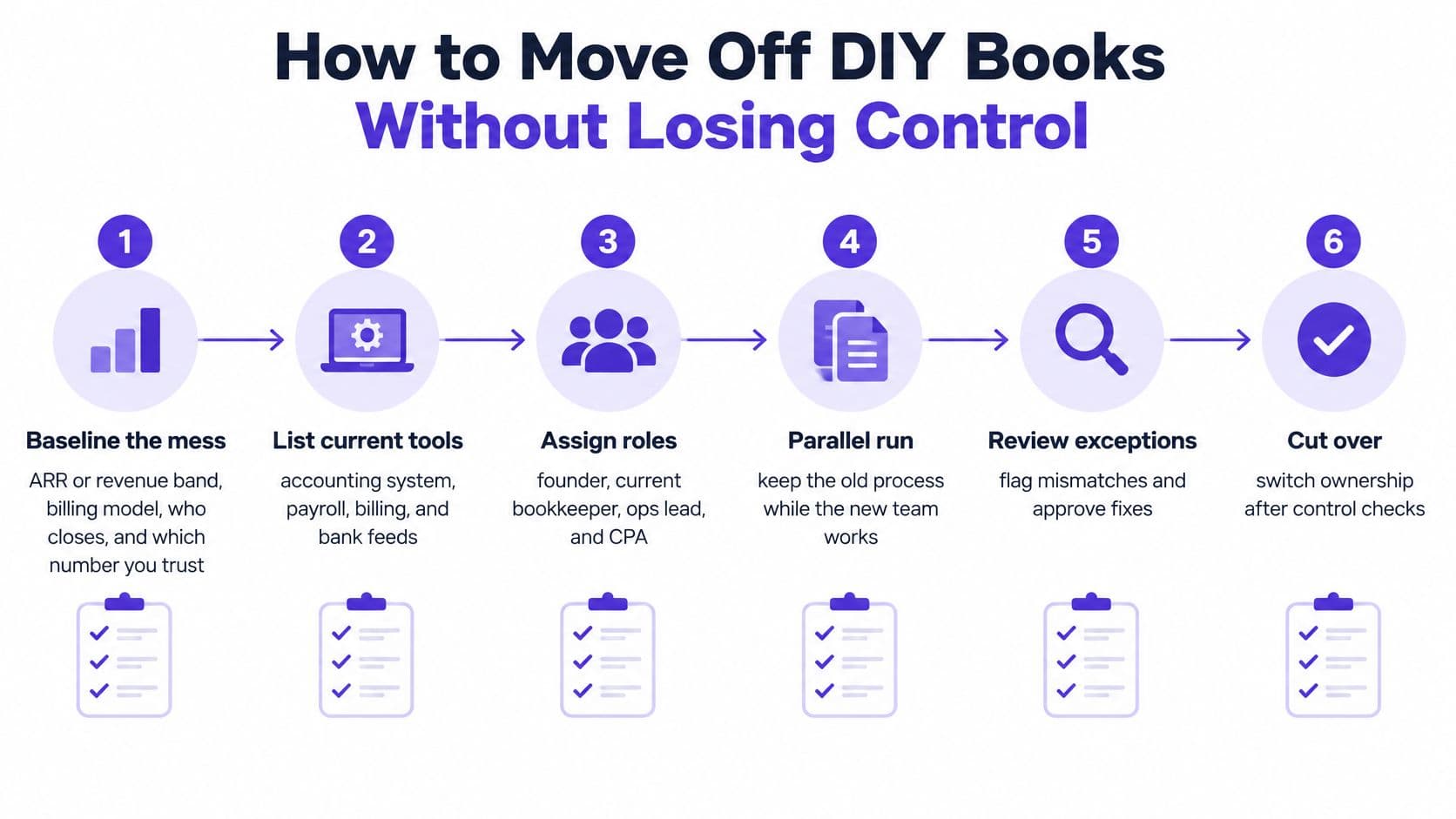
Treat the first live close as a test, not a reorganization. Keep your current bookkeeper, operations lead, and CPA involved while the new team proves it can produce a controlled result.
The handoff should make responsibilities visible before anyone changes historical transactions.
Establish the baseline and boundaries
-
Baseline the mess. Record your revenue or ARR band, billing model, current close owner, and the number you don't trust. Save the existing reports so you can compare outputs without relying on memory.
-
Map dependencies before recoding. Identify spreadsheets feeding revenue, payroll, project costs, and management reporting. List missing source documents and unclear owners. Separate historical accounting cleanup from recurring work so old errors don't obscure the new process.
-
Freeze decision rights in writing. Assign bill approval, KPI definitions, journal review, and cash-release authority. Use individual system accounts and permissions that match those responsibilities. Don't share the founder's banking credentials as an onboarding shortcut.
At Jumpstart Partners, we review the close, reporting, billing, cost, and handoff issues that make finance difficult to explain. The purpose is to establish who prepares, who reviews, and who authorizes changes before recurring work begins.
Prove the process before expanding it
-
Set the first close checklist. Include bank and card reconciliations, deferred revenue or work in progress, payables aging, accruals, and a delivery date. Identify what blocks release and what can remain on a documented exception list.
-
Run a monthly cycle inside the existing stack. Keep QuickBooks, Xero, NetSuite, Stripe, and your payroll tool in place unless a specific defect requires change. Preserve the prior reporting method as a comparison, but avoid duplicate posting. Compare close days, unresolved balances, and forecast variance with the baseline.
-
Add scope only after acceptance. Introduce AP automation, more detailed billing controls, or cash forecasting after the core close works. Review mismatches and approve corrections before switching ownership completely.
Task transfer without outcome measures doesn't establish that the arrangement improves performance. Your acceptance test must evaluate the financial outputs and the control environment together.
Continue when close days fall, unexplained items shrink, and you still approve cash. If the new team delivers faster by skipping reconciliations or bypassing approvals, reject the shortcut and fix the process before expanding the engagement.
Start With a Finance Ops Diagnostic
If your invoice volume, prepaid contracts, or reporting demands expose a control gap, start with a scoped diagnostic rather than an undefined hiring search. You need to understand the work before deciding who should own it permanently.
Jumpstart Partners is a CPA-led firm serving SaaS companies, agencies, and other growing businesses remotely. Our Finance Ops Diagnostic costs a $3,500 fixed fee and is delivered in 5 business days. Steven, our Director of Finance, runs it himself, end to end.
Get a defined cleanup and operating path
The diagnostic includes:
- Stack and handoff review: How information moves between billing, accounting, payroll, and management.
- Spreadsheet dependency map: Which files support reporting and where manual intervention remains.
- Ownership and review inventory: Unclear responsibilities and missing checks.
- Recommended cleanup path: What to fix before establishing the recurring routine.
- Monthly operating recommendation: How to keep close, reporting, and decisions connected.
It doesn't include fundraising strategy, tax preparation, or transaction-only cleanup. That boundary matters: the output is a clear operating recommendation, not a promise to solve every finance issue inside a short engagement.
Bring last month's close date, invoice volume, and any prepaid or retainer balance. Include a financial report you don't trust and the spreadsheet you use to compensate for it. Those materials make the conversation about your actual workload rather than an abstract list of outsourced accounting benefits.
Jumpstart Partners offers the Finance Ops Diagnostic and a complimentary ROI assessment when you need to determine whether controller services make financial sense. Visit Jumpstart Partners to book the appropriate conversation, and bring your close date, invoice count, and prepaid balances so we can start with your numbers.