Financial Operations
Accounting Clean Up: A Roadmap to Audit-Ready Books
Tidy ledgers, fix errors and reconcile accounts with a practical accounting clean up process that gets your books audit-ready and decision-ready.
ByJumpstart Partners, CPA, QuickBooks ProAdvisor
··16 min readFinancial-statement restatements have never been just a bookkeeping nuisance. A U.S. Government Accountability Office review identified 845 publicly traded companies that restated their financial statements between January 1997 and June 2002, and revenue-recognition issues represented almost 38% of 919 restatements examined. The GAO review shows why accounting clean up deserves executive attention: timing errors, unsupported estimates, stale reconciliations, and misclassified costs can become reporting, tax, fundraising, and investor-confidence problems.
For a SaaS company, digital agency, or professional services firm generating $500K to $20M in revenue, the risk usually starts small. A Stripe payout lands without a matching ledger entry. An annual subscription gets booked as current-month revenue. A retainer sits in income instead of a liability. Then growth adds more payment platforms, contracts, payroll records, spreadsheets, and pressure to close quickly. A proper clean up reconstructs the revenue model, proves the balance sheet, and leaves controls that stop the same errors from returning.
Table of Contents
- Why Messy Books Become Expensive Problems
- Triage and Prioritization for Your Cleanup
- The Controlled Cleanup Workflow Step by Step
- Fixing Revenue Recognition Under ASC 606
- Testing, Flux Analysis, and Locking the Period
- Keeping the Books Clean After the Cleanup
- Timelines, Costs, and When to Hire Outside Help
Why Messy Books Become Expensive Problems
The most damaging cleanup failures aren't dramatic fraud schemes. They're ordinary processes nobody owns: revenue recorded when cash arrives, expenses posted in the wrong period, accounts receivable that doesn't tie to customer records, deferred revenue without a contract schedule, and bank reconciliations carrying unexplained items month after month.
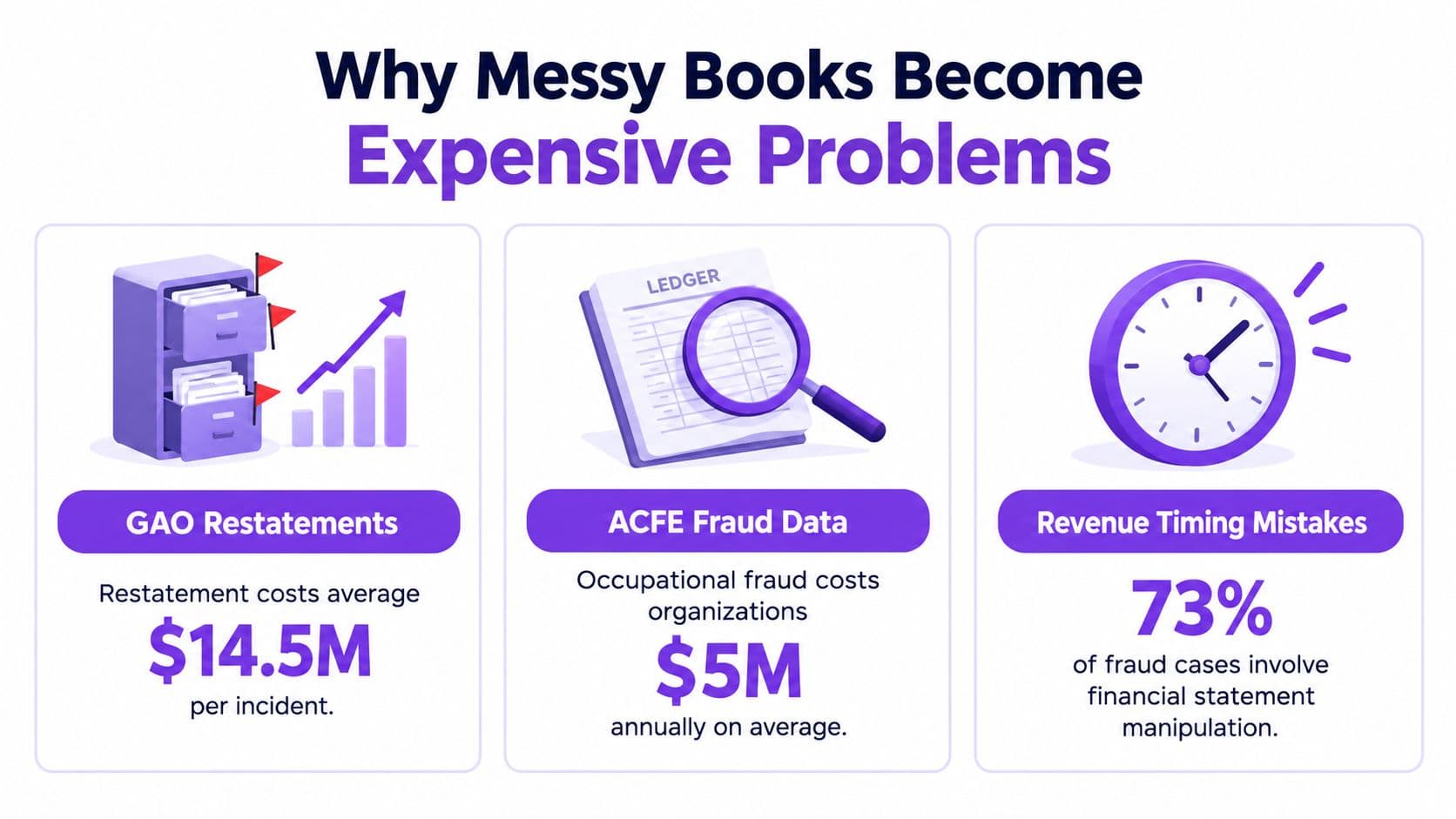
The historical pattern is clear. The GAO found that the number of companies restating because of accounting irregularities increased by 145% during the period it reviewed, and 689 publicly traded companies announcing restatements between January 1997 and March 2002 lost billions of dollars in market capitalization around announcement dates. The same review reported that approximately 20% of Securities and Exchange Commission enforcement cases since the late 1990s involved violations arising from financial-reporting or accounting practices. These figures come from the GAO's financial restatement review.
The exposure isn't limited to public companies
Private businesses face the same underlying failure modes, even if the consequence appears first as a failed lender review, a delayed audit, an incorrect tax filing, or a founder making hiring decisions from unreliable margins. Revenue timing, expense cutoff, customer balances, payroll, and cash reconciliation all become harder when transaction volume grows faster than finance controls.
The Association of Certified Fraud Examiners' 2024 report analyzed 1,921 real fraud cases investigated between January 2022 and September 2023. It distinguishes financial-statement fraud from ordinary error, but the practical lesson applies to both: manipulating or misstating revenue, expenses, assets, liabilities, or earnings can create disproportionately large losses. The ACFE 2024 Report to the Nations also reinforces why journal-entry review, segregation of duties, and reconciliations belong in cleanup work.
Practical rule: If you can't explain a balance-sheet account from an independent schedule, the account isn't clean, even if the trial balance balances.
Start with the areas most likely to distort decisions:
- Revenue recognition: Confirm that subscriptions, retainers, implementation work, usage fees, and renewals are recognized as obligations are satisfied.
- Cutoff: Test invoices, cash receipts, vendor bills, payroll, and accruals around period-end.
- Accounts receivable: Tie customer balances to invoices, credits, collections, and subsequent cash receipts.
- Deferred revenue: Reconstruct contract-level schedules rather than forcing a liability to match a percentage of billings.
- Expense classification: Separate operating expenses, prepaid costs, fixed assets, contractor costs, and owner activity.
- Intercompany and payment platforms: Match transfers and processor settlements to the general ledger.
Before a lender, auditor, or investor asks for support, use this audit preparation checklist to identify missing schedules and ownership gaps. Accounting clean up is remediation, not cosmetic recoding.
Triage and Prioritization for Your Cleanup
Don't start by editing transactions. Start by determining where an error would change management's decisions, tax reporting, covenant calculations, or reported growth.
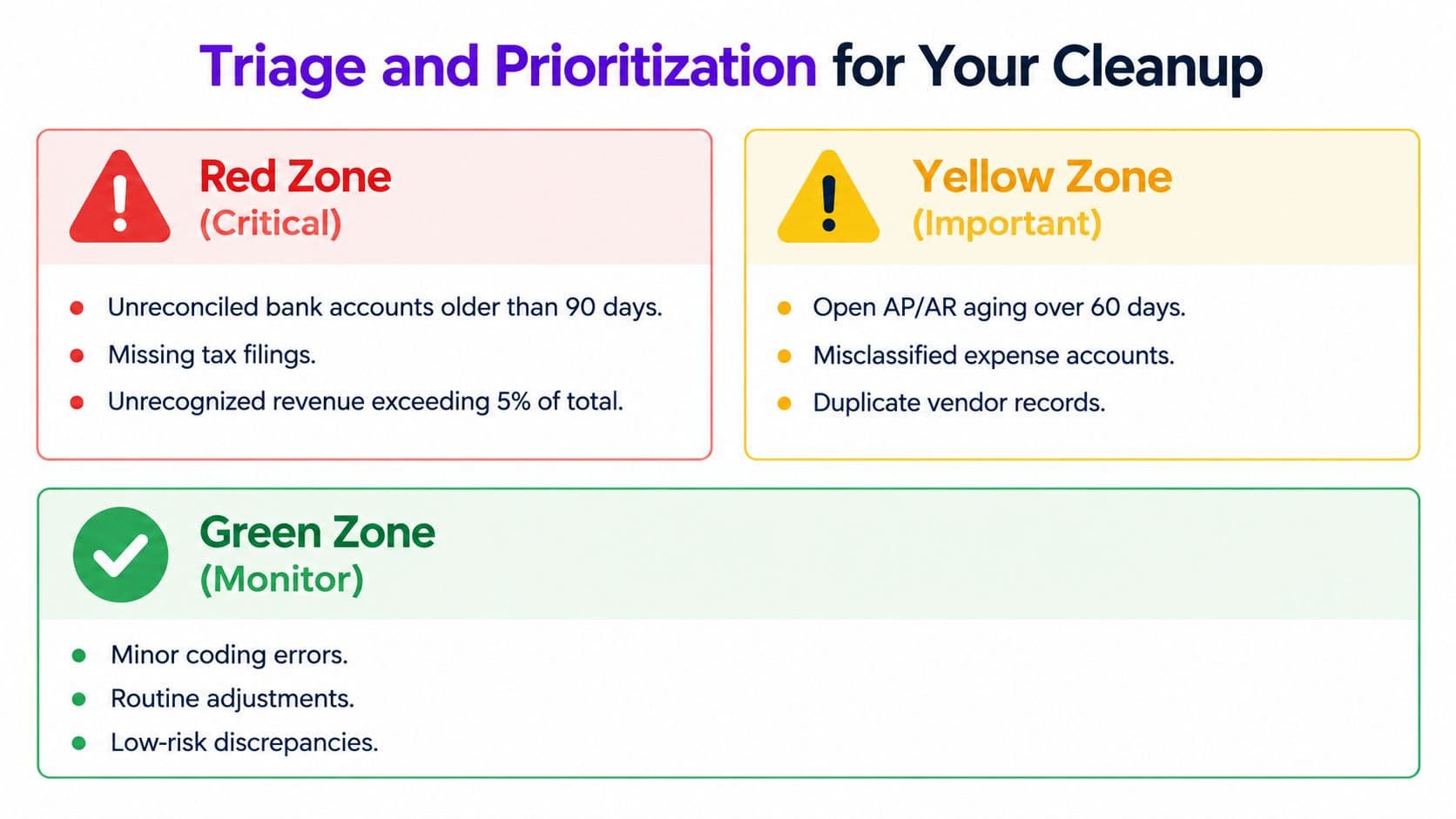
Pull the latest trial balance, general ledger, bank reconciliations, AR and AP aging, deferred-revenue schedule, payroll reports, sales-tax filings, and system exports. Then age every open reconciling item. A $300 timing difference with clear support belongs in a different queue from an unexplained six-month cash variance or a deferred-revenue balance that has no contract detail.
Score each balance-sheet account against five factors:
- Materiality: Would an error change a management, lender, tax, or investor conclusion?
- Transaction volume: Does the account receive frequent activity from multiple systems?
- Judgment: Does the balance depend on estimates, allocations, or revenue timing?
- Fraud exposure: Can one person initiate, approve, and conceal activity?
- Prior variance: Has the account repeatedly required corrections?
Build the work queue before posting entries
High-risk accounts deserve transaction-level or sample-based testing. Lower-risk accounts can often use roll-forward procedures, provided the opening balance is supported and current activity is limited.
| Risk Factor | Weight | What to Look For | Testing Approach |
|---|---|---|---|
| Materiality | High | Balance affects reported profit, cash, debt, or tax | Reconcile to external support and review all material adjustments |
| Transaction volume | High | Many entries from Stripe, Shopify, payroll, or expense tools | Tie source-system totals to the GL and test exceptions |
| Judgment | High | Revenue allocation, accruals, useful lives, or contract modifications | Document policy, assumptions, calculations, and review |
| Fraud exposure | High | One person controls setup, posting, and approval | Separate duties and inspect unusual entries |
| Prior variance | Medium | Repeated unreconciled items or late corrections | Trace root cause and test the recurring control |
| Low activity | Low | Stable account with independent support | Roll forward and investigate only exceptions |
Red flags deserve immediate escalation: stale reconciliations, unsupported journal entries, unexplained intercompany mismatches, chart-of-accounts sprawl, negative customer balances without credits, and an “uncategorized” account that keeps growing.
For a backlog that combines missing months with incorrect existing records, define the scope before anyone begins. A structured catch-up bookkeeping service can help separate reconstruction from correction, but the owner still needs to approve material accounting judgments.
The Controlled Cleanup Workflow Step by Step
A defensible project follows a controlled sequence. Each step should produce evidence another person can inspect without relying on the preparer's memory.
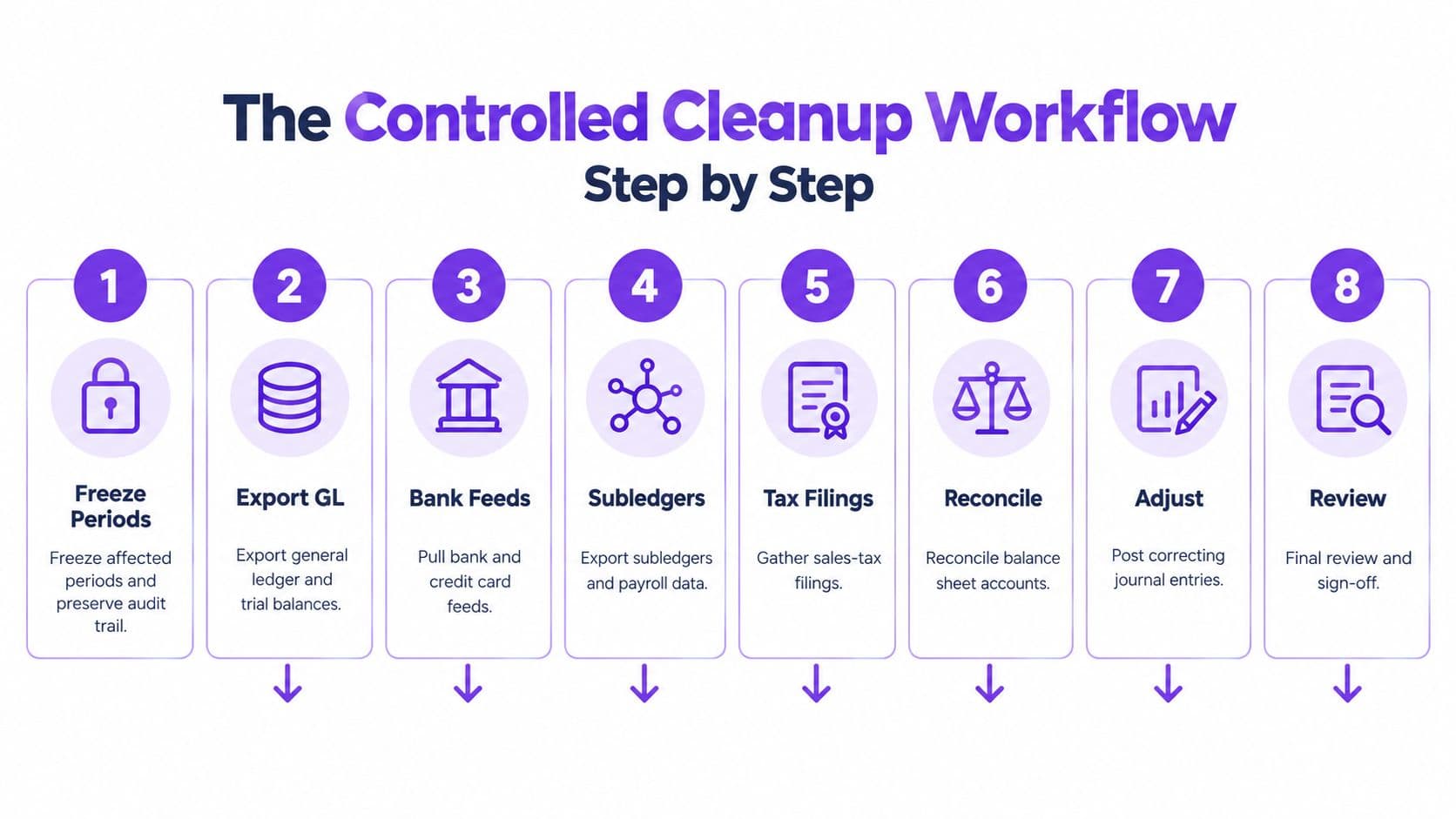
- Freeze affected periods. Stop casual edits and preserve the audit trail. Record the last reconciled date, system permissions, and known open issues.
- Export the source records. Save the general ledger, trial balances, bank and credit-card feeds, subledgers, payroll records, sales-tax filings, and reports from Stripe, Shopify, billing, expense, and project systems.
- Map balance-sheet accounts. Give every cash, receivable, payable, payroll, tax, fixed-asset, inventory, deferred-revenue, accrual, debt, and intercompany balance an independent support schedule.
- Reconcile material accounts. Match the books to bank statements, processor settlements, customer ledgers, vendor statements, payroll reports, tax filings, and contract schedules.
- Age every reconciling item. Assign an owner, date, root cause, expected resolution, and whether the item represents timing or error.
- Post documented corrections. Each entry needs the affected accounts, period, amount, rationale, source evidence, preparer, and reviewer.
- Perform flux analysis. Compare gross margin, operating expenses, cash, AR aging, deferred revenue, and unusual movements against prior periods and operating records.
- Lock the period. Publish a reopen policy. Require documented approval for any later adjustment and retain the original entry, replacement entry, and explanation.
A reconciliation must explain the difference
Assume the bank reconciliation shows a $5,400 difference. The investigation identifies a $3,200 Stripe payout recorded by the processor but missing from the ledger, a $1,500 customer refund in transit, and a $700 bank error.
The support schedule should show the arithmetic:
$3,200 + $1,500 + $700 = $5,400
The entries and treatment differ. The missing Stripe payout requires recording the settlement and clearing the processor balance. The refund requires recording the customer credit or cash movement in the appropriate period. The bank error isn't a company entry until the bank corrects it, so it remains an identified reconciling item with correspondence attached. Don't plug the difference to miscellaneous income or expense.
The Journal of Accountancy guidance on streamlining the month-end close emphasizes standardized procedures and checklists, and recommends beginning recurring entries and some accrual or impairment calculations before period-end. That approach reduces the temptation to force every judgment into the final close days.
For a practical reference on presenting financial statements before a transaction or diligence process, see the Bizbe guide to sale-ready books. Once the evidence is assembled, use a controlled QuickBooks cleanup process rather than making disconnected edits across months.
Fixing Revenue Recognition Under ASC 606
A bank reconciliation can be perfect while revenue is wrong. For subscription businesses and agencies, the cleanup must connect signed contracts, billing records, delivery evidence, and the general ledger.
ASC 606 uses five steps:
- Identify the customer contract.
- Identify the performance obligations.
- Determine the transaction price.
- Allocate consideration to the obligations.
- Recognize revenue as each obligation is satisfied.

A customer who prepays $12,000 for a 12-month subscription hasn't created $12,000 of current-month revenue. Assuming service began at the start of the period, you initially record the payment as a contract liability, commonly called deferred revenue. After three months, the correct result is $3,000 of revenue, calculated as $1,000 per month × 3 months, and $9,000 of deferred revenue.
| Scenario | Cash Timing | Correct Revenue Timing | Common Error |
|---|---|---|---|
| $12,000 annual subscription | Customer prepays the annual amount | $1,000 per month as service is delivered | Booking the full invoice as current revenue |
| $48,000 opening deferred revenue, $24,000 invoiced, $10,000 recognized, $2,000 refunded | Cash, invoices, service, and refund occur in different periods | Ending deferred revenue equals $60,000 | Plugging the liability to an arbitrary billing percentage |
| $30,000 agency package | Customer pays for implementation and campaign services | $6,000 implementation in month one plus $4,000 campaign revenue in month one | Recording the full $30,000 invoice immediately |
The deferred-revenue rollforward is:
$48,000 + $24,000 - $10,000 - $2,000 = $60,000
If the ledger shows $72,000, the $12,000 gap signals a missing recognition entry, refund, cancellation, or opening-balance error. Preserve customer, contract start date, billing amount, service period, recognition amount, cancellations, credits, and ending balance for each material contract.
Bundled services require contract judgment
An agency package containing $24,000 of campaign services and $6,000 of implementation has more than one promise if the implementation is distinct. If implementation is delivered in the first month and campaign services are delivered evenly over six months, month-one revenue is $10,000, made up of $6,000 for implementation and $4,000 of campaign services. The remaining campaign revenue is approximately $4,000 per month over the remaining service period.
ASC 606 also considers implied promises and customary business practices when identifying performance obligations. Review statements of work, renewal terms, onboarding commitments, support, training, customization, service levels, customary concessions, and sales descriptions. A policy that says “we've always booked these packages upfront” doesn't override the accounting model.
ASC 606 guidance requires entities to present or disclose opening and closing balances for receivables, contract assets, and contract liabilities, including revenue recognized during the period that was included in the opening contract-liability balance. This ASC 606 disclosure roadmap provides useful context for the schedules your cleanup should retain.
Use this ASC 606 accounting resource when translating the standard into contract schedules, KPI reporting, and monthly close procedures.
The core misconception is simple: an invoice or bank deposit is not automatically revenue. Your schedule must show when the business earned the amount, not merely when the customer paid.
Testing, Flux Analysis, and Locking the Period
Correcting entries don't prove the books are right. Testing does.
Start with cutoff. Trace cash receipts and disbursements around period-end, match vendor statements to accounts payable, inspect subsequent collections for AR existence, compare accrued expenses with post-close invoices, and reconcile payroll registers to the general ledger and tax filings.
Expense recognition deserves focused attention. A historical CPA Journal analysis of 1,195 public-company restatements correcting GAAP errors in 2005 identified 1,796 separately categorized errors, with expense-recognition errors representing approximately 25% of those errors. The CPA Journal analysis supports a practical priority: test whether expenses belong in the period recorded, not just whether the bank account cleared.
Use flux analysis to investigate, not decorate reports
Suppose software expense rises by $14,000 from one period to the next. Don't accept the variance because the total expense appears plausible. Trace the vendor detail and find that an annual renewal was coded as a monthly subscription. The correction may involve reclassification and prepaid expense treatment, depending on the service period and policy.
Review these movements:
- Gross margin and direct delivery costs
- Operating expenses by account and vendor
- Cash compared with the bank reconciliation
- AR aging and subsequent collections
- Deferred revenue additions and recognition
- Unusual period-over-period journal entries
A cleanup is ready to exit only when the evidence meets defined criteria:
- Material balance-sheet accounts: 100% reconciled to independent support.
- Reconciling items: Assigned, aged, resolved, or formally documented.
- Subledgers: Tied to the general ledger.
- Journal entries: No unsupported material entries remain.
- Close process: A repeatable checklist names deadlines, preparers, reviewers, and owners.
- Management review: Significant judgments and unresolved risks have written approval.
Exit criterion: A clean trial balance is an output. A signed support schedule, reviewed entry log, and documented exception list are evidence.
Lock periods after management signs off. Publish who can reopen a period, what qualifies as a reopening event, which approval is required, and how replacement entries will be tracked. For teams building a durable record of changes, guidance on how to log and retain audit trails helps turn system history into usable evidence.
Keeping the Books Clean After the Cleanup
A one-time correction doesn't fix the process that created the correction. If Stripe mappings, payroll imports, expense approvals, and spreadsheet uploads remain unmanaged, the balance sheet will drift again.
One accounting-services survey reports that approximately 65% of small-business respondents view manual bookkeeping as a major problem, while about 40% report financial errors associated with manual processes. The survey source points to a real operating issue: automation reduces typing, but it doesn't eliminate bad mappings, duplicate synchronization, incomplete connector feeds, or incorrect assumptions.
Build controls around ownership
Your post-cleanup checklist should include:
- Reconciliation sign-offs: The preparer completes the reconciliation, and a separate reviewer approves it.
- Locked periods: Closed periods remain closed unless a named approver documents the reason for reopening.
- Approval thresholds: Material journals, refunds, credits, write-offs, and manual revenue entries require review.
- Audit trails: Retain source reports, calculations, contracts, journal support, and approval evidence.
- Exception reports: Review uncategorized transactions, failed imports, duplicate vendors, unmatched payments, and unusual journal entries.
- Connector monitoring: Check QuickBooks, Stripe, payroll, expense platforms, and spreadsheets for missing or duplicated data.
- Named ownership: Assign revenue, payroll, expenses, intercompany, tax, and balance-sheet schedules to specific people.
Before an audit or fundraise, run four checks. Tie every open annual invoice to a contract schedule. Reconcile deferred revenue monthly. Document judgmental items such as implementation, usage-based fees, refunds, and modifications. Review standard contracts for implied promises that create obligations even when the language isn't explicit.
For broader readiness work, audit preparation resources for CIOs can supplement the finance team's control documentation. The important test isn't whether the books were fixed once. It's whether another reviewer can prove they stayed fixed.
Timelines, Costs, and When to Hire Outside Help
A focused QuickBooks cleanup covering 6 to 18 months of books for a $1M to $5M business typically takes 2 to 4 weeks of dedicated work. A multi-year, multi-entity project that includes revenue-recognition corrections can run 6 to 10 weeks. Those are planning ranges, not promises, because transaction volume, missing records, contract complexity, and reviewer availability determine the actual scope.
Use this decision rule:
| Situation | Practical choice | Expected outcome |
|---|---|---|
| One platform, limited backlog, clear support, controller-level expertise available | Handle it in-house | Controlled correction with internal ownership |
| Cleanup overlaps with fundraising, lender reporting, or audit preparation | Use a fractional controller | Review, judgment support, and investor-ready schedules |
| Multi-year backlog, multiple entities, ASC 606 work, or an overwhelmed team | Use an outsourced firm | Dedicated project ownership and repeatable close controls |
Don't choose a provider based only on transaction entry. Define the deliverables first: balance-sheet tie-out, reconciliations, revenue schedules, documented journal entries, a five-day close target, investor-ready financials, MRR and ARR reporting, and audit-ready support.
The ACFE 2024 report analyzed 1,921 real fraud cases investigated between January 2022 and September 2023 and found that financial-statement fraud was less frequent than other fraud types but produced disproportionately large losses because it can affect revenue, expenses, assets, liabilities, or earnings. The report is a useful reminder that outside help should strengthen review and segregation of duties, not just accelerate posting.
Review outsourced accounting services pricing by scope and deliverables, then request a fixed project plan. Jumpstart Partners offers outsourced controller and bookkeeping services for growing SaaS, agency, and professional services businesses, including QuickBooks cleanup, reconciliations, revenue-recognition workflows, and close support.
If your books have stale reconciliations, unexplained deferred revenue, or a backlog before fundraising or an audit, Jumpstart Partners can assess the records, define the cleanup scope, and build the controls needed for a reliable close. Visit the team to discuss a fixed-fee cleanup or ongoing controller support tied to investor-ready financials and documented monthly ownership.