Financial Operations
How Much Does It Cost to Outsource Bookkeeping
Learn how much does it cost to outsource bookkeeping for SaaS, agencies, and growing businesses, with real benchmarks and pricing tiers that match your stage.
ByJumpstart Partners, CPA, QuickBooks ProAdvisor
··15 min readOutsourced bookkeeping typically costs $500 to $2,500 per month for a small business, while hiring an in-house bookkeeper starts near $4,200 per month in direct wages. The question isn't which sticker price looks lower, but which scope gives you reliable books, a faster close, and the financial control your company needs.
For founders and finance leaders at $500K to $20M revenue businesses, bookkeeping is no longer just transaction entry. A SaaS company needs dependable revenue workflows and subscription reporting. An agency needs project profitability and receivables visibility. A professional services firm needs clean accruals, payroll coordination, and financial statements management can trust.
A cheap package can leave you with delayed reconciliations, unclear ownership, and a year-end cleanup bill. A more expensive package can be reasonable if it includes controller review, integrations, reporting, and accountability. To understand the economics of expense categorization and approval workflows, use this practical business expense tracking playbook 2026 from Coto & Waddington, Attorneys at Law. You can also compare broader accounting cost structures in this accounting cost guide.
Table of Contents
- Why the Sticker Price Is the Wrong Question
- What Outsource Bookkeeping Actually Costs in 2026
- The Four Levers That Move Your Monthly Number
- Matching Your Business to the Right Pricing Tier
- Outsourcing Versus Hiring In-House
- Red Flags and Warning Signs in Cheap Quotes
- How to Compare Vendor Quotes Line by Line
- Your Next Steps Toward the Right Outsourced Setup
Why the Sticker Price Is the Wrong Question
The wrong question is, “How much does bookkeeping cost?” The better question is, “What operational outcome am I buying?”
If your provider only categorizes transactions and reconciles bank accounts, you're buying data maintenance. If the provider closes the books on a defined schedule, reviews balance-sheet accounts, coordinates payroll, supports revenue recognition, and delivers management reporting, you're buying financial control. Those services shouldn't sit in the same pricing bucket.
A founder-led business can tolerate a basic monthly package while its books are simple. A growing SaaS company preparing for fundraising can't rely on a spreadsheet and an unreconciled Stripe balance. An agency that can't see receivables and project margins is making hiring and cash decisions with incomplete information.
Price follows operational complexity
Transaction volume matters, but it isn't the whole quote. Providers price around the number of accounts, integrations, entities, payroll requirements, reporting deadlines, cleanup needs, and review level. A business with fewer transactions can still require more work if it has complex revenue arrangements, multiple entities, or investor reporting obligations.
The monthly fee also replaces costs you may overlook in an internal hire, including supervision, software, quality control, payroll taxes, benefits, recruiting, management time, and continuity coverage. Comparing a vendor's fee with an employee's wage alone produces a bad decision.
Practical rule: If a quote doesn't define the close timetable, reviewer, reconciliations, reporting package, and out-of-scope rates, you don't have a price. You have an opening bid.
For the companies I work with, the meaningful payoff is usually faster decisions and less executive time trapped in the books. Reliable monthly financials support investor questions, audit preparation, cash planning, and hiring decisions. That value deserves a scope-based comparison, not a race to the lowest retainer.
What Outsource Bookkeeping Actually Costs in 2026
The defensible 2026 range is broad because outsourced bookkeeping isn't a standardized product. Available pricing benchmarks place many engagements between $250 and $2,500 per month, and industry surveys consistently show the lower half of that band as the most common fee level for basic work. For a fuller breakdown of how providers tier their fees, see the outsourced accounting services pricing guide, which places typical small-business expectations around $500 to $2,500 per month depending on service level.
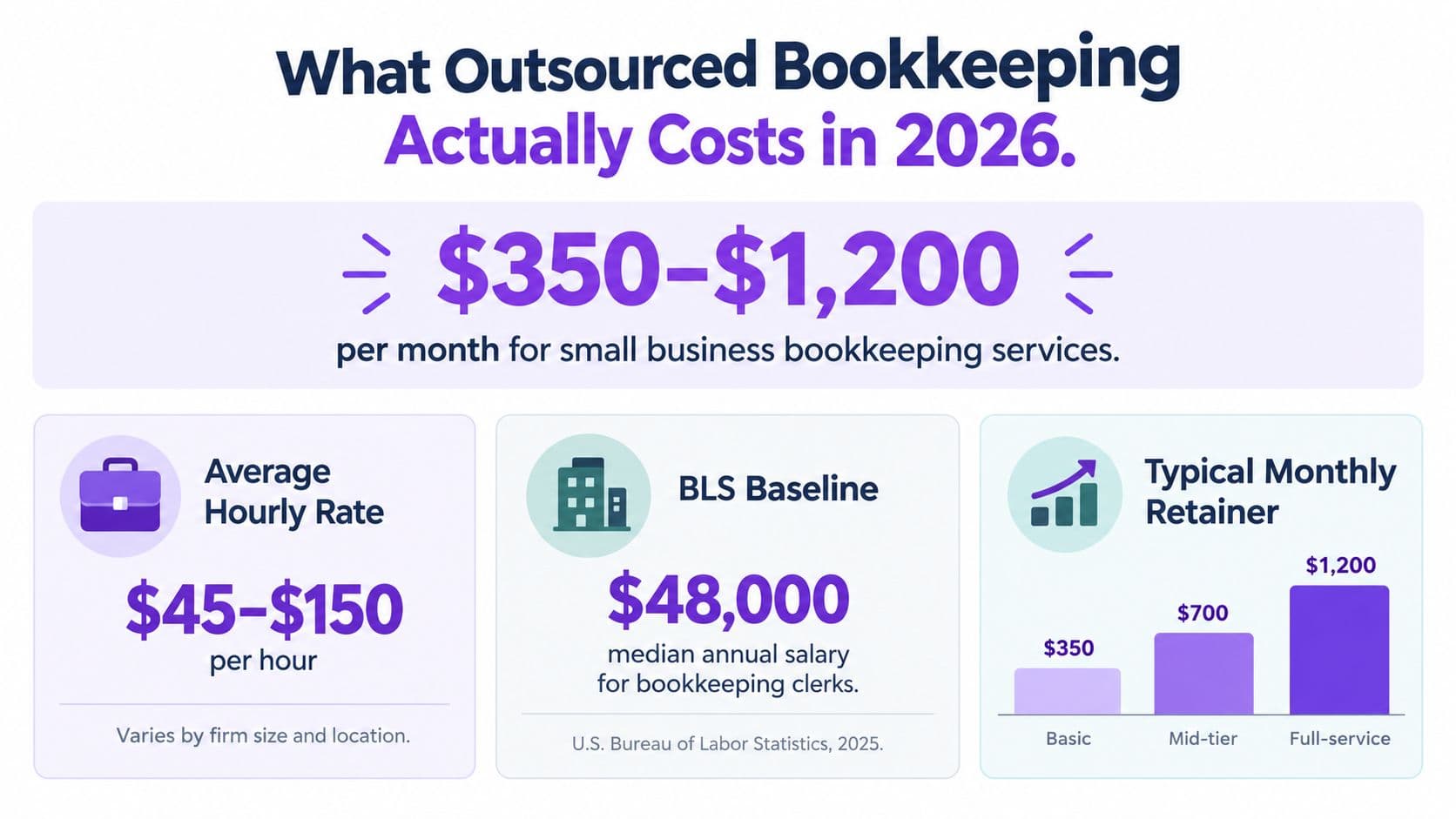
The range isn't a contradiction. $250 per month equals $3,000 per year, while $2,500 per month equals $30,000 per year, a tenfold difference. The lower end generally reflects limited categorization and reconciliations. The upper end reflects frequent closes, complex revenue recognition, multiple entities, reporting, cleanup, and controller-level review. Most pricing guides blur that distinction. This one doesn't, because the distinction is exactly what determines whether your quote is fair.
The in-house benchmark
The U.S. Bureau of Labor Statistics reported median annual pay of $50,670, or $24.36 per hour, for bookkeeping, accounting, and auditing clerks in May 2025, according to BLS occupational data for bookkeeping, accounting, and auditing clerks. The equivalent wage-only monthly amount is approximately $4,223.
That figure represents employee wages, not the fully loaded cost of employing someone. An internal hire also requires benefits, payroll taxes, recruiting, onboarding, management, software, quality review, and coverage during absences. An outsourced quote can therefore exceed the employee's hourly wage while still replacing a wider set of costs.
| Service level | Illustrative monthly position | Typical scope |
|---|---|---|
| Entry bookkeeping | Around the lower market bands | Categorization, basic reconciliations, standard reports |
| Recurring growth support | Mid-range pricing | Reconciliations, payroll coordination, monthly statements, AP or AR support |
| Controller-grade output | Upper market bands | Faster close, review, revenue workflows, multi-entity reporting, investor or audit preparation |
A SaaS business with straightforward books may sit near the lower or middle range. An e-commerce company with payment processors, inventory, sales-tax obligations, and returns needs more operational coverage. A growing agency may pay for project reporting and receivables oversight rather than transaction volume alone.
Don't use the BLS wage as a vendor price target. Use it as a neutral baseline for the build-versus-buy discussion, then compare each proposal against the actual work delivered.
The Four Levers That Move Your Monthly Number
A vendor quote moves when the work changes. Four levers explain most of the difference between a basic engagement and a controller-grade arrangement: volume, systems, scope, and accounting complexity.
Volume and systems
Start with transactions, but don't stop there. A company processing 400 monthly transactions through one bank account is operationally different from one processing 4,000 transactions across Stripe, Shopify, multiple cards, and payroll accounts. Each additional feed requires mapping, exception handling, reconciliation, and review.
Now add integrations. Stripe can require payout and fee reconciliation. Shopify can create settlement, refund, and sales-tax questions. Payroll adds another control point. These aren't merely extra lines in a feed. They create workflows that someone must own.
Scope and revenue logic
Basic service may stop at categorization, reconciliations, and financial statements. The invoice rises when you add AP, AR, payroll coordination, management reporting, cleanup, cash-flow analysis, or a defined close deadline.
Revenue complexity creates another jump. SaaS companies may need contract and deferred-revenue workflows. Agencies may need project or client profitability. Multi-entity businesses need intercompany processes and consolidation. Those requirements justify a higher tier because the provider is performing accounting judgment and review, not just entering data.
| Business profile | Typical revenue | Monthly range | What it includes |
|---|---|---|---|
| Simple founder-led business | Under $1M | $500 to $700 | Core reconciliations and standard financial statements |
| Growing SaaS or agency | $1M to $5M | $700 to $1,500 | Monthly close, payroll coordination, AP or AR, management reporting |
| Complex growth company | $5M to $20M | $1,500 to $2,500 or more | Multi-entity work, revenue workflows, controller review, investor or audit support |
These are planning bands, not universal quotes. A business can sit outside them when its systems or accounting requirements are unusual. If your company operates across jurisdictions or has an international founder structure, resources such as EU Inc. founder advantages may also inform the legal and operating context around your finance setup.
When the books are already behind, separate recurring service from one-time remediation. A catch-up bookkeeping service should have its own scope, deliverables, and completion criteria rather than inflating your monthly retainer.
Matching Your Business to the Right Pricing Tier
Your revenue gives you a starting point, not a final answer. Match the tier to how often you need reliable information, who reviews the work, and how much accounting judgment your business requires.
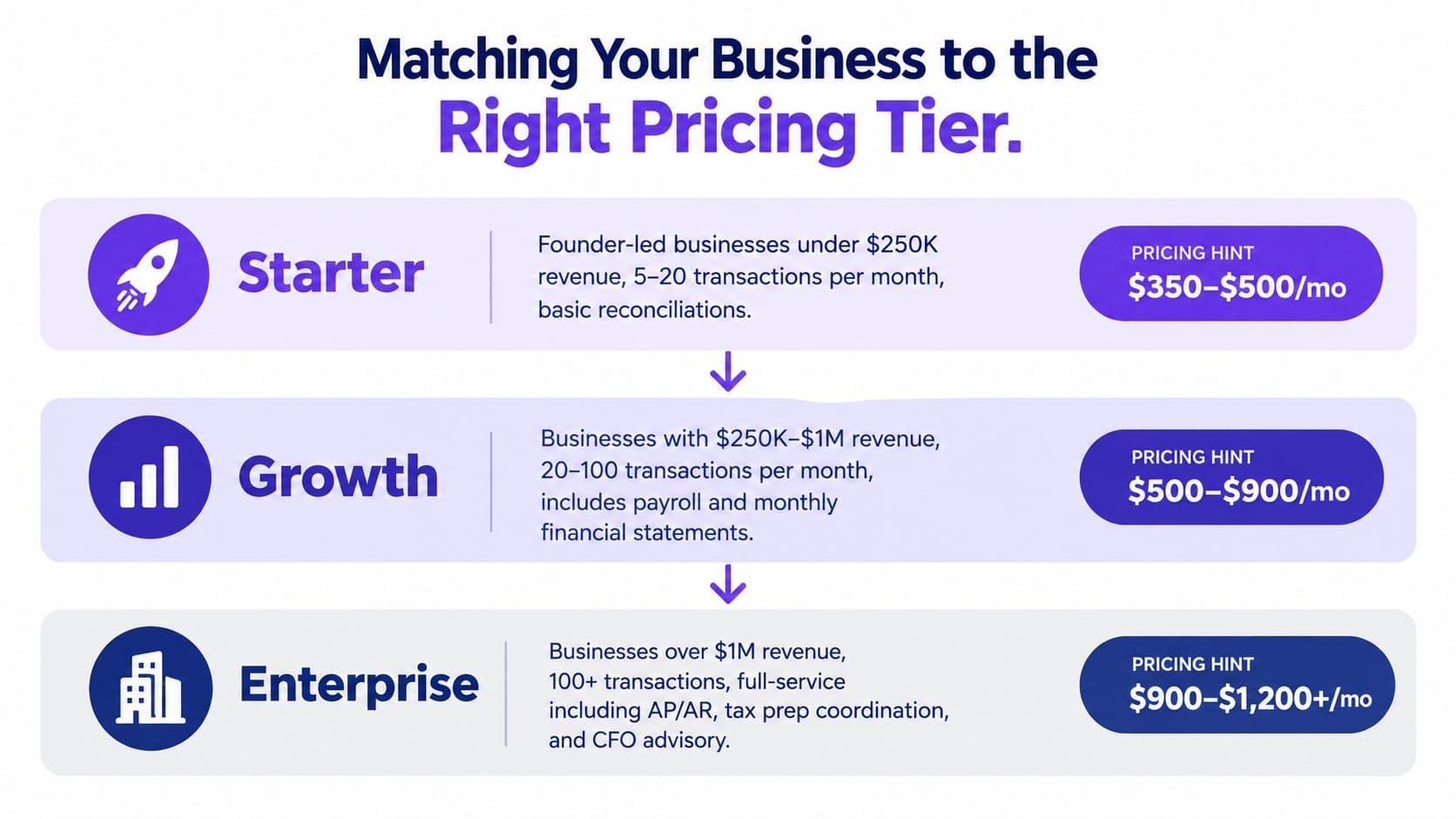
Starter
The Starter tier suits a founder-led company with simple books, limited accounts, and modest reporting requirements. You need recurring categorization, bank and card reconciliations, and clean standard statements. You don't need a full finance department yet.
Ask for a named contact, monthly reconciliation coverage, a delivery date, and clear cleanup pricing. If your provider can't explain who reviews the reconciliations, the package is too thin regardless of its price.
Growth
The Growth tier fits a SaaS company, agency, or professional services firm that has outgrown founder-led bookkeeping. You need a repeatable close, payroll coordination, AP or AR visibility, and management reports that support decisions.
Monthly timing becomes important. A late P&L can be technically accurate and still be useless for hiring, cash planning, or pipeline decisions. Your proposal should specify the close timetable and identify the person responsible for review.
Scale
The Scale tier fits businesses approaching fundraising, audits, multi-entity operations, or more demanding investor reporting. You need controller oversight, accounting policies, revenue workflows, consolidation, and support for external accountants or auditors.
Don't buy this tier because it sounds advanced. Buy it when the consequences of weak controls exceed the incremental fee. A company preparing for institutional scrutiny needs evidence that balances reconcile, adjustments are reviewed, and reporting follows a repeatable process.
For a small business still deciding whether a basic package is enough, compare the scope in this guide to bookkeeping services for small businesses. The right tier is the one that closes the gap between your current books and the decisions your leadership team must make.
Outsourcing Versus Hiring In-House
The build-versus-buy decision should use total cost of ownership, not salary alone. The BLS median wage provides a useful baseline, but an internal employee also creates costs for recruiting, onboarding, software, supervision, benefits, payroll taxes, controls, and continuity.
An internal bookkeeper hired at the BLS median wage would receive approximately $50,670 in direct annual wages, or about $4,223 per month in wage-only cost. That number doesn't include the rest of the employment package. An outsourced provider's retainer bundles some of those costs and gives you access to fractional capacity rather than a full-time role.
Finance leaders continue to use outsourcing as part of the operating model. A 2025 finance-leader survey reported that 65% of surveyed CFOs outsourced at least one finance function, while accounts receivable and accounts payable were outsourced by 37% and 35%, respectively. The data supports outsourcing as a common choice, not as proof that it always wins economically. The source is CFO's coverage of the 2025 finance and accounting talent market outlook.
Use a defensible comparison
Build a simple side-by-side model before approving a proposal.
| Cost or outcome | Internal hire | Outsourced team |
|---|---|---|
| Direct labor or monthly fee | Wage baseline | Defined recurring retainer |
| Benefits and payroll taxes | Added employment cost | Usually embedded in provider pricing |
| Software and systems | Purchased and managed internally | Included or listed separately |
| Supervision and review | Requires internal management | Provider assigns review responsibility |
| Coverage risk | Depends on one employee or small team | Depends on provider continuity model |
| Close quality | Must be designed internally | Should be contractual and measurable |
Hiring in-house makes sense when you need a dedicated daily operator, have stable work that fills the role, and can provide management, review, and backup coverage. Outsourcing dominates when you need fractional capacity, specialized accounting judgment, system integrations, or a faster path to a controlled close.
Don't confuse bookkeeping with controller work. Use this bookkeeper versus controller comparison to define whether your gap is data processing or financial oversight.
Red Flags and Warning Signs in Cheap Quotes
A low quote isn't a bargain if it leaves you responsible for the work you assumed you were buying. Published estimates span roughly $250 to $2,500 per month, with mid-range services often cited at $500 to $700 and premium packages at $1,000 to $2,500. Those figures aren't standardized by transactions, entities, sales-tax jurisdictions, payroll, inventory, revenue recognition, or reporting deadlines, as this bookkeeping pricing reference makes clear.

The proposal problems I reject
- Transaction-only pricing: A quote based only on feed volume ignores account complexity, review, close timing, and accounting judgment.
- No named reviewer: If nobody owns quality control, errors will return to you or your tax preparer.
- No close deadline: A provider that won't commit to when reports arrive hasn't shown you a dependable operating process.
- No correction policy: The engagement should explain how the provider fixes errors and who pays for rework caused by its process.
- Unclear security controls: Ask for documented access permissions, breach procedures, data retention, and independent controls assurance such as SOC 2 or an equivalent framework.
- Unpriced cleanup: Historical catch-up work should be scoped separately. Otherwise, the recurring retainer becomes a vehicle for indefinite remediation.
The downstream cost isn't limited to accounting. Misclassified revenue can distort operating decisions. Late financials can delay investor responses. An audit adjustment can pull leadership back into the books at the exact moment the company needs to focus on growth.
A cheap quote is acceptable only when the scope is genuinely small, the books are clean, and the provider can prove how it protects quality.
How to Compare Vendor Quotes Line by Line
Send every provider the same scope matrix. Ask them to mark each deliverable as included, extra cost, or not offered. You can't compare proposals that describe different work with the same label.
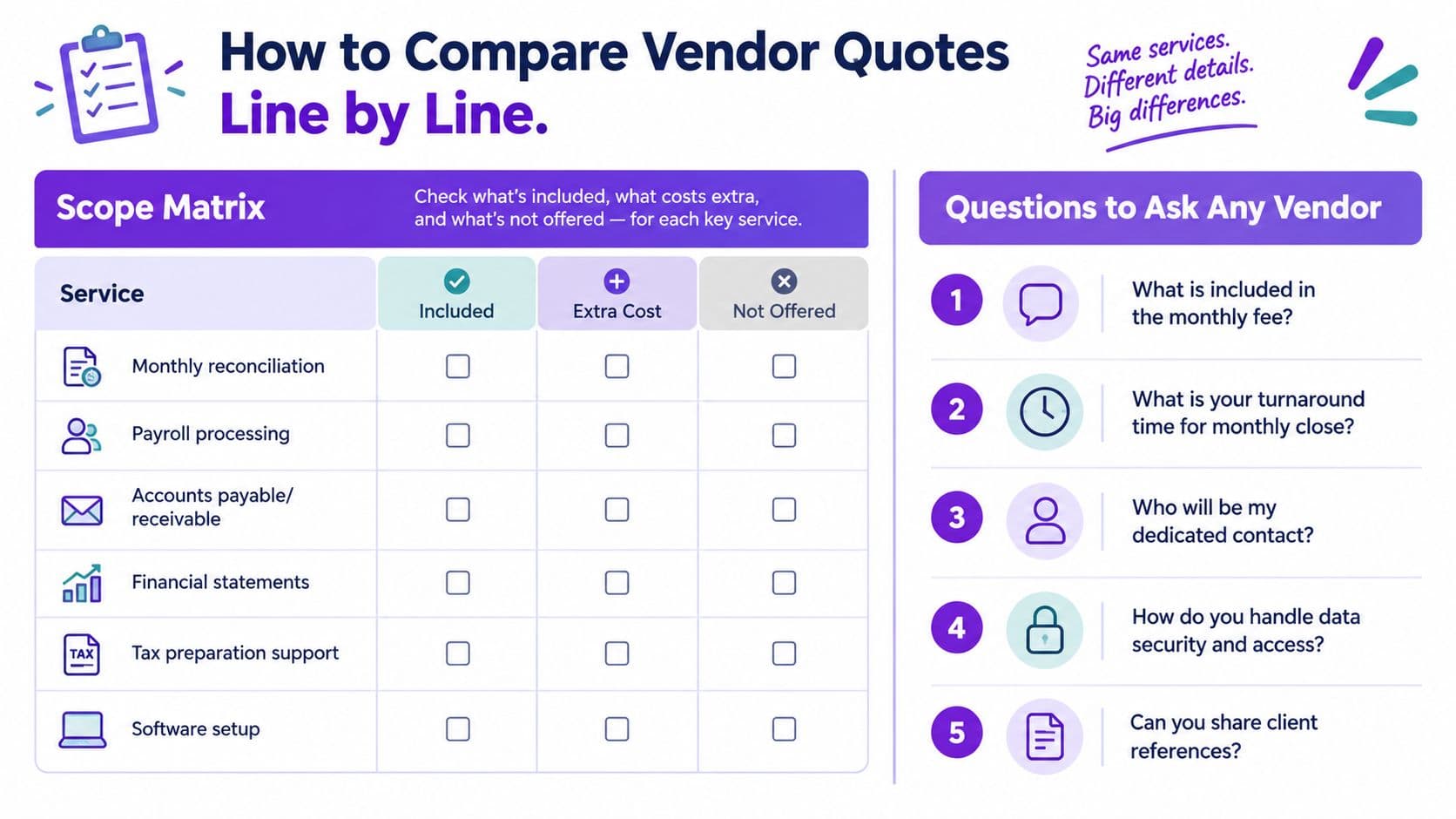
| Deliverable | Included | Extra cost | Not offered |
|---|---|---|---|
| Monthly bank and card reconciliation | |||
| Payroll processing or coordination | |||
| Accounts payable and receivable | |||
| Monthly financial statements | |||
| Tax preparation support | |||
| Software setup and integrations |
Ask these questions in writing:
- Who reviews my work before the books are closed?
- What does the monthly fee include, and what triggers an additional charge?
- What is the expected close turnaround?
- Which software subscriptions and integrations are included?
- How are errors corrected, and how quickly?
- What happens if the assigned bookkeeper leaves or is unavailable?
- What security, access, retention, and continuity controls do you maintain?
Three providers can each quote $1,200 per month, or $14,400 per year, and still deliver very different outcomes. Provider A may offer categorization and reconciliations only. Provider B may add payroll and statements. Provider C may include a reviewed close, integrations, cleanup boundaries, and reporting. The annual fee is identical. The operating value isn't.
Your Next Steps Toward the Right Outsourced Setup
Start with your books, not a vendor directory. Pull the latest reconciliations, financial statements, account list, payroll workflow, payment processor reports, and any unresolved CPA questions. Mark every missing, late, or manually maintained process.
Then define your complexity in plain terms:
- Systems: List QuickBooks or Xero, Stripe, Shopify, payroll, expense management, and other connected platforms.
- Volume: Record your recurring transaction activity and the number of bank, card, and payment accounts.
- Reporting: Specify whether you need basic statements, cash visibility, KPI reporting, investor packages, or audit support.
- Timing: Set the date by which leadership needs dependable monthly financials.
- Ownership: Decide whether you need bookkeeping execution, controller review, or both.
Request proposals from two or three providers using the same scope matrix. Require each quote to separate onboarding, cleanup, recurring bookkeeping, integrations, payroll, tax coordination, and advisory work. If you also need flexible operational support outside accounting, you can evaluate resources such as hire Latin American virtual assistants separately, but don't use general administrative capacity as a substitute for accounting ownership.
Choose a scoped consultation, not a generic demo. Your decision should connect the monthly fee to faster close reporting, investor-ready financials, cleaner audit support, and better cash-flow visibility. That is how you answer “how much does it cost to outsource bookkeeping” with a number you can defend.
Jumpstart Partners provides outsourced bookkeeping and controller services for SaaS, agencies, professional services firms, e-commerce companies, and other businesses with $500K to $20M in revenue. Visit Jumpstart Partners to request a scoped consultation that maps your systems, close requirements, reporting needs, and pricing tier before you commit.