Financial Operations
Find Outsourced Accounting Services Near Me: Expert Guide
Looking for outsourced accounting services near me? Our comparison guide helps you vet vendors, compare pricing, and hire with confidence in 2026.
ByJumpstart Partners, CPA, QuickBooks ProAdvisor
··16 min readA local accounting firm isn't automatically the safest choice. For a growing SaaS, agency, or e-commerce business, close speed and US compliance knowledge usually matter more than the provider's office address. Top-performing finance teams close their books in 4.8 days, while median performers take 6.9 days, according to close-process research on accrual automation. If your “nearby” bookkeeper still delivers reports weeks late, proximity hasn't solved the problem.
You're searching for outsourced accounting services near me because you want dependable numbers, faster decisions, and less founder involvement in transaction cleanup. The right partner should produce a controlled month-end close, understand your revenue model, protect sensitive data, and give you reporting you can use in a board meeting, fundraising process, or audit.
For businesses generating $500K to $20M, the question isn't whether outsourcing is fashionable. It's whether the provider can connect bookkeeping, controller oversight, compliance, and cash visibility without forcing you to build a full finance department first.
Table of Contents
- Why Near-Me Matters Less Than You Think
- Building a Realistic Shortlist of Outsourced Accounting Services Near Me
- Local, Regional, and Nearshore Providers Compared
- Pricing Benchmarks With Worked Monthly Calculations
- The 10-Question Vetting Checklist for Every Provider
- Onboarding Timeline and What a Clean Setup Looks Like
- When the Right Partner Pays for Itself
Why Near-Me Matters Less Than You Think
Same-time-zone access, US compliance knowledge, and close speed matter more than a local office address. A nearby provider may understand your market, yet still miss US GAAP, ASC 606 revenue recognition, SaaS metrics, agency utilization, or e-commerce COGS. Location can simplify meetings. It cannot produce accurate reconciliations or an investor-ready close.
Some firms sell a local relationship while assigning routine work to junior staff you never meet. You can pay local rates and receive generic bookkeeping that ignores your billing model, payment processors, deferred revenue, or reporting needs. Ask for evidence that the assigned team can close your books in 5 to 7 business days, maintain compliance-ready records, and explain the results clearly.
The three outcomes that matter
Evaluate every provider against three operating results:
- Close speed: Reconciled financials should arrive within the same reporting cycle, while the information still supports decisions.
- Compliance accuracy: The team should understand US reporting requirements and document judgment areas such as revenue recognition, leases, multi-entity accounting, and cutoffs.
- Operating relevance: A SaaS provider should report MRR, ARR, CAC, deferred revenue, and gross margin. An agency provider should understand utilization, project profitability, and contractor costs. An e-commerce provider should reconcile Shopify or other sales channels, payment processors, inventory, refunds, and COGS.
Same-time-zone coverage remains useful for a board call, audit request, or urgent cash question. Require more than fast replies. The provider must have the systems and technical judgment to answer correctly.
Practical rule: Reframe “near me” as close to my numbers. Ask how the provider handles your systems, reporting calendar, compliance requirements, and escalation process before asking where the team sits.
A virtual firm can be the stronger choice when it offers clear ownership, secure access, documented workflows, and reliable communication. This guide to virtual accounting firms helps compare remote delivery with a traditional local engagement.
The finance and accounting outsourcing market is now a mainstream operating model. One market report estimates USD 70.19 billion in 2025, projecting USD 142.66 billion by 2033 and a 9.3% CAGR from 2026 to 2033. The report connects that growth with demand for reliable services, accounting technology, and BPO infrastructure in emerging economies. Grand View Research provides market context. Your decision should remain operational: choose the team that produces accurate financials on schedule.
Building a Realistic Shortlist of Outsourced Accounting Services Near Me
Don't let Google Ads determine your finance partner. Build a shortlist from several channels, because each one reveals a different type of evidence.
Start with capability-based searches
Use queries that identify expertise rather than geography:
- “Outsourced accounting SaaS startup” surfaces providers familiar with recurring revenue and deferred revenue.
- “Fractional CFO bookkeeper e-commerce” points toward firms that combine transaction processing with higher-level oversight.
- “Controller services digital agency” helps identify teams that understand project profitability, utilization, and contractor spend.
- Add your software, such as QuickBooks, NetSuite, Stripe, Shopify, or HubSpot, to expose integration experience.
A location term can remain in the search, but it shouldn't lead the query. You want to see how firms describe their work, not how effectively they buy local search traffic.
Use directories as a filter, not a final recommendation
Review the AICPA Marketplace, Clutch top-rated firms, and Bookkeeper Launch directories. Filter by industry, company size, and service type where available. Directory placement isn't proof of quality, so use it to identify candidates and then verify their work through references, sample deliverables, and technical questions.
If your business depends heavily on Shopify acquisition and conversion economics, a practical companion resource on finding a PPC agency for Shopify can help you evaluate adjacent growth partners without confusing marketing performance with accounting quality.
Ask founders for evidence, not names
A useful referral question is specific: Which firm handled your last clean audit, software migration, or ASC 606 transition? Ask what the provider owned, how the handoffs worked, and whether the reporting improved after onboarding. A founder who only says “they're nice” hasn't given you enough signal.
Send a one-page RFQ
Request the same information from every candidate:
| RFQ item | What to request |
|---|---|
| Business profile | Revenue band, industry, entity count, and reporting needs |
| Transaction volume | Monthly transactions, invoices, bills, payroll complexity, and sales channels |
| Technology | Current ledger, CRM, payment processors, payroll system, and commerce platform |
| Close requirement | Current close time and target close time |
| Team structure | Named roles, seniority, location, backup coverage, and escalation owner |
| Deliverables | Monthly financial statements, KPI package, cash reporting, and forecast support |
| Transition work | Cleanup scope, opening balances, and historical-period reconstruction |
Cap the shortlist at five vendors. More options create demo fatigue and encourage you to choose based on presentation quality instead of operational fit. Before pricing conversations, read this comparison of outsourced accounting services and use its criteria to score each finalist consistently.
Local, Regional, and Nearshore Providers Compared
There isn't one winning provider archetype. A local firm can be valuable when you need in-person audit preparation or state tax familiarity. A nearshore team can provide same-time-zone coverage without the full cost of a local practice. A regional boutique may offer the strongest combination of specialization and senior access.
The trade-off becomes clearer when you compare the models directly.
Provider archetypes compared
| Provider Type | Pricing Model | Typical Close Speed | Integrations Supported | Best-Fit Company Size |
|---|---|---|---|---|
| Local US firm | Premium monthly retainer, often with separate project fees | Depends on staffing and process maturity. Confirm the target in writing | Commonly QuickBooks and payroll platforms, with depth varying by firm | Businesses needing local meetings, state tax fluency, or in-person audit preparation |
| Regional US firm or boutique fractional practice | Monthly retainer or scoped package, usually tiered by complexity | Often designed around a defined close calendar. Ask for the provider's measured average | QuickBooks, NetSuite, Stripe, Shopify, HubSpot, and other integrations when the firm specializes in your industry | Growing companies that need US-based delivery and controller-level support |
| Nearshore provider in Latin America or Canada | Retainer, dedicated-team pricing, or transaction-based fees | Same-time-zone coverage can support responsive handoffs. Actual speed depends on controls | Cloud accounting, billing, payroll, commerce, and CRM integrations vary by provider | Businesses prioritizing time-zone alignment and cost control while accepting more diligence on staffing |
Local US firms commonly quote $3,000 to $8,000 per month for full-service accounting at $1M to $5M in revenue, according to the assigned market comparison in this guide. That range is a benchmark for the specified service scope, not a universal quote. Ask the firm to separate bookkeeping, close management, controller review, tax coordination, and advisory work.
Nearshore delivery is forecast to grow faster than offshore delivery, reflecting buyer interest in time-zone alignment, responsiveness, and oversight, according to Market.us research on finance and accounting outsourcing. The lower price only helps if the senior reviewer is involved. Ask whether any work is subcontracted, where the people handling your ledger are located, and who reviews their entries.
Regional US practices often fit $500K to $20M operators best when the business needs more than data entry but isn't ready for a large national firm. For SaaS, agencies, and e-commerce brands, industry specialization should outweigh the appeal of a nearby office.
Pricing Benchmarks With Worked Monthly Calculations
Treat every quote as a scope equation. A vendor that gives you one monthly number without transaction assumptions, integrations, close requirements, and review responsibilities hasn't given you a usable proposal.
The brief scenarios below use illustrative pricing assumptions for comparison, not verified market averages. Use the math to test a vendor's quote, then ask the provider to replace the assumptions with your actual volume.
Monthly outsourced accounting fees by revenue tier and pricing model
| Revenue Tier | Avg Monthly Transactions | Per-Transaction Model | Monthly Retainer Model | Percentage-of-Revenue Model |
|---|---|---|---|---|
| $1M SaaS | 500 | 500 × $6 = $3,000 | $4,000 | 0.5% × $1,000,000 ÷ 12 = $416.67 |
| $5M agency | 2,000 | 2,000 × $4 = $8,000 | $7,000 | 0.5% × $5,000,000 ÷ 12 = $2,083.33 |
| $15M e-commerce | 15,000 orders | 15,000 × $2 = $30,000 | $12,000 | 0.5% × $15,000,000 ÷ 12 = $6,250 |
These calculations show why pricing models need scrutiny. A per-transaction model looks simple at lower volume, but 15,000 monthly orders at $2 each becomes $30,000 before you add inventory accounting, returns, multi-channel reconciliation, or controller review. Percentage-of-revenue pricing punishes high-margin businesses because the fee rises with sales even when accounting workload stays stable.
What to demand in the quote
Request a line-item proposal covering:
- Transaction volume included in the base fee
- Additional transaction charges
- Number of entities and bank accounts
- Payroll and sales-tax coordination
- Historical cleanup
- Revenue recognition schedules
- Inventory and COGS reconciliation
- Monthly reporting and controller review
- Forecasting and cash reporting
- Out-of-scope hourly or project fees
Flat-fee retainers often need repricing above $10M in revenue because reporting complexity, entity structure, controls, and management demands change. Per-transaction fees can become uneconomical past 10,000 transactions. A percentage model can look attractive for a low-volume, lower-revenue business and become punitive as revenue scales.
Use your own transaction count and required deliverables. If a proposal lands 30% or more above or below your internally calculated range, don't accept the variance without a detailed explanation. The issue may be a broader scope, weak assumptions, or an incomplete proposal. Review outsourced accounting pricing models before signing anything.
The 10-Question Vetting Checklist for Every Provider
Run the same interview with every finalist. Sales calls reward polished answers, so ask for examples, owners, timing, and deliverables. If the representative can't answer directly, request a follow-up with the person who would manage your account.
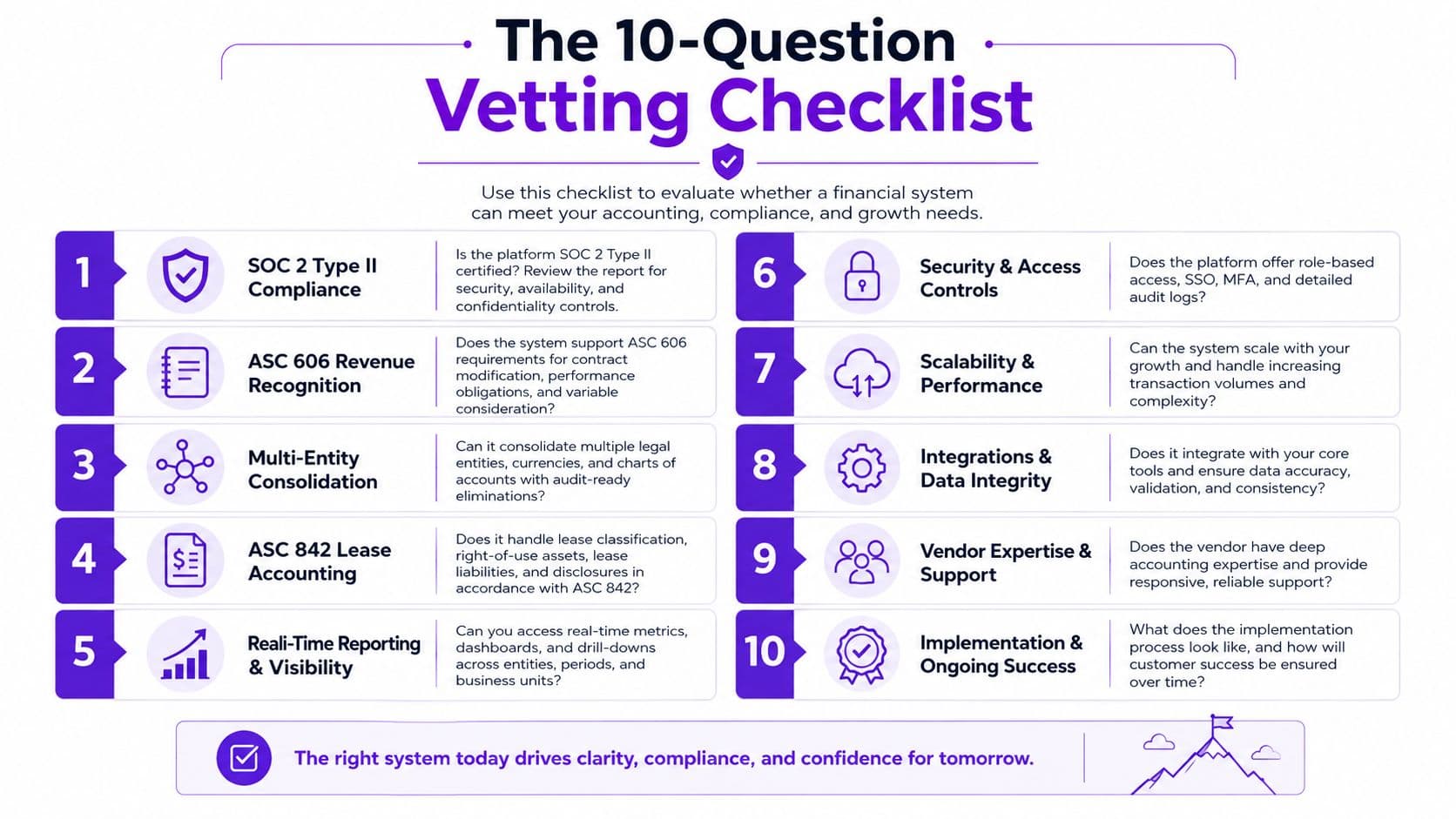
Ask these questions in order
- How do you address SOC 2 Type II requirements? Ask what controls, access reviews, security procedures, and evidence you maintain. Don't settle for “we take security seriously.”
- How do you handle ASC 606 revenue recognition? For SaaS, ask how the team maps contracts, billing schedules, performance obligations, deferred revenue, and modifications.
- Can you manage multi-entity consolidation? Confirm how intercompany transactions, eliminations, currencies, and consolidated reporting are handled.
- How do you apply ASC 842 lease accounting? Ask whether lease schedules, classifications, amortization, and disclosures fall within the engagement.
- What is the assigned accountant-to-client ratio? You need the actual staffing model, not a generic promise of “a dedicated team.”
- What is your average month-end close time? Ask how the provider measures close completion and what remains open when reports go out.
- What does your dual-ledger reconciliation process look like? Require a clear explanation of source-system-to-ledger checks, exception handling, and reviewer sign-off.
- Which integrations do you actively support? Name QuickBooks, NetSuite, Stripe, Shopify, and HubSpot and ask for a recent example involving your stack.
- Who owns the chart of accounts? Your provider should define the structure with you, document mapping, and prevent uncontrolled account creation.
- What happens in month one if our prior books are a mess? Get the cleanup scope, opening-balance process, timeline, price, and responsible senior reviewer in writing.
Deal test: If a provider can't show how it validates journal entries, period cutoffs, duplicate postings, and reconciliations, don't let a low fee decide the engagement.
A structured handoff also matters for accounts payable. Review accounts payable outsourcing considerations before you delegate bill approval, payment scheduling, or vendor communication.
Onboarding Timeline and What a Clean Setup Looks Like
A clean onboarding takes 8 to 12 weeks, not a week-one miracle. The provider needs time to understand your systems, repair the ledger, document policies, test integrations, and establish a close rhythm.
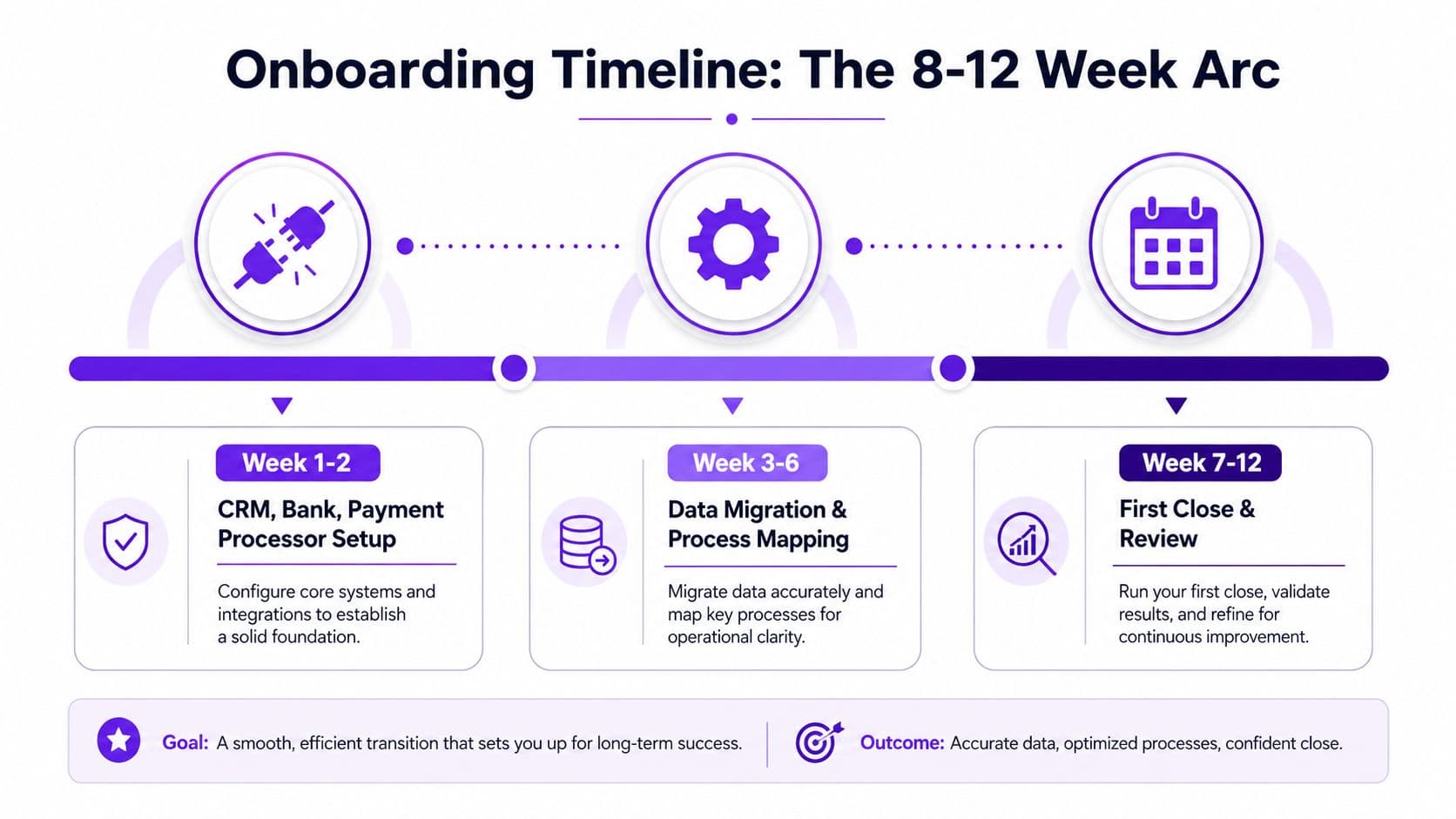
The first 30 days
During Week 1 to Week 2, the team should connect your CRM, bank feeds, payment processors, payroll platform, and accounting ledger. It should also inspect the chart of accounts and propose a rebuild where the current structure makes reporting unreliable.
By Week 3 to Week 4, you should see the first reconciled bank feed, a clean AP and AR aging report, and a documented plan to rebuild any prior period that was materially wrong. The provider should identify unresolved transactions rather than burying them in suspense accounts.
Days 60 and 90
By Day 60, expect a variable compensation accrual, deferred revenue schedule, and draft management reporting pack. You should know which assumptions remain open and who must approve them.
By Day 90, the provider should close the first complete month-end and deliver a CFO-ready P&L, balance sheet, cash flow statement, and 13-week cash forecast. The report pack should connect to your operating metrics, not just reproduce a general ledger export.
A vendor who promises to close your books in week two is usually skipping the diagnostic work. A vendor that still hasn't produced a cash report by day 60 is moving too slowly or hasn't defined the deliverable.
Use this video as a practical discussion aid before your kickoff call:
Your onboarding plan should name the client-side owner, provider-side owner, data dependencies, review meetings, and acceptance criteria. Without those details, delays become everyone's problem and no one's responsibility.
When the Right Partner Pays for Itself
Outsourced accounting pays for itself when it improves decisions, not when it merely lowers a payroll line. A founder who spends six hours each week chasing receipts, checking bank activity, and rebuilding reports is paying for finance work twice. A partner that delivers a Monday morning cash report and a five-day close gives the leadership team time to decide whether to hire, slow spending, or change a sales target.
Judge the relationship by measurable operating outcomes. The provider should standardize accrual intake, automate reconciliations, and enforce a short review window. Spreadsheet-driven accrual tracking carries a 5.2% error rate, compared with 2.1% for structured ERP templates without AI and 0.4% for AI-assisted workflows with human review, according to the accrual automation benchmark. Keep a human review step. Automation does not remove cutoff, duplicate-posting, or judgment risk.
Measure value through finance outcomes
Track the partner against five outcomes:
- Close completion: When do reconciled financials arrive, and what remains open?
- Reporting quality: Can you trust the P&L, balance sheet, cash flow, and KPI pack?
- Cash visibility: Do you have a current cash position and a usable 13-week forecast?
- Decision support: Can the team explain variance, burn, collections, and margin movement?
- Audit posture: Can someone produce schedules, support, and documented judgments without a last-minute scramble?
Measure the cost of the service against the time it returns to the founder, the accuracy it adds, and the decisions it supports. Use this controller services ROI analysis to structure that review around finance outcomes rather than a simple monthly-fee comparison.
Financial reporting quality matters beyond speed. An academic study of small Finnish LLCs found outsourced firms scored higher on reporting-quality metrics, with outsourced firms at M = 4.12, SD = 0.197, compared with non-outsourced firms at M = 3.41, SD = 0.202. The findings apply to that study population, so treat them as context rather than a forecast for your company. The operational takeaway is practical: define review points and measure cost per transaction, average processing time, and error rate. The study on externally procured accounting services and reporting quality supports treating quality as an operating outcome, not just a staffing decision.
For SaaS leaders, accounting must connect to growth economics. ARR equals 12 times MRR, and CAC equals total sales and marketing expense divided by new customers acquired, as defined in the SaaS metric cheat sheet. If MRR is $100,000, ARR calculates to 12 × $100,000 = $1,200,000. If sales and marketing expense is $180,000 and you acquired 100 customers, CAC calculates to $180,000 ÷ 100 = $1,800. These examples apply the formulas and do not describe your company's performance.
The right partner does not need to be in your city. It needs accurate numbers, clear ownership, fast close execution, and reporting that changes what you do next. Choose three vendors from your shortlist, run the ten questions with each, and request a scoped proposal within 14 days.
Jumpstart Partners provides outsourced bookkeeping and controller support for SaaS, agencies, e-commerce, and other growing businesses in the $500K to $20M revenue range. Its integrations include QuickBooks, NetSuite, Stripe, Shopify, Square, Gusto, and BambooHR. Use the firm to discuss your close process, cleanup needs, and cash-reporting requirements.