Financial Operations
Outsourced Bookkeeping for Nonprofits: A Practical Guide
Outsourced bookkeeping for nonprofits explained. Learn fund accounting, compliance, donor reporting, cost models, and how to choose the right provider
ByJumpstart Partners, CPA, QuickBooks ProAdvisor
··15 min readOutsourced bookkeeping for nonprofits is a fund-accounting function, not a transaction-entry service. The practical test is whether your books clearly separate net assets with donor restrictions from net assets without donor restrictions, not whether your bank balance matches the ledger.
That distinction matters because the U.S. nonprofit universe is enormous. IRS-linked reporting cited by WhippleWood on outsourced bookkeeping for nonprofits estimates about 1.54 million 501(c)(3) charitable organizations in 2024, within nearly 1.9 million organizations exempt under Section 501(c), while the IRS processed 136,323 exempt-status applications that year. Outsourcing has become a practical operating model because boards need reliable compliance, grant reporting, and restriction tracking without building a full finance department.
The counterintuitive point is simple: a low-cost bookkeeper who records every transaction can still leave you with unreliable financial statements. If the provider doesn't understand donor intent, grant conditions, functional expenses, and release rules, clean-looking books can conceal money you can't legally or contractually spend.
Table of Contents
- Why Standard Bookkeeping Fails Nonprofits
- What Outsourced Bookkeeping for Nonprofits Includes
- Fund Accounting and Donor Restriction Reporting
- Cost Models, Pricing Ranges, and the In-House Cost Math
- How to Evaluate Outsourced Bookkeeping Providers
- Red Flags That Signal the Wrong Provider
- Choosing the Right Outsourcing Model for Your Nonprofit
Why Standard Bookkeeping Fails Nonprofits
Most nonprofit financial failures begin with bookkeeping designed for a profit-and-loss statement rather than mission accountability. A standard small-business workflow asks whether revenue exceeded expenses. Your board, donors, and grantors need a different answer: which resources are available, which are restricted, and whether each program used money for its approved purpose.
For-profit bookkeeping often treats the organization as one operating pool. That model breaks down when you receive a grant for a defined program, a time-limited gift, or an endowment contribution. Recording the cash correctly isn't enough. You must preserve the restriction through the general ledger, expense coding, reconciliations, and financial reports.
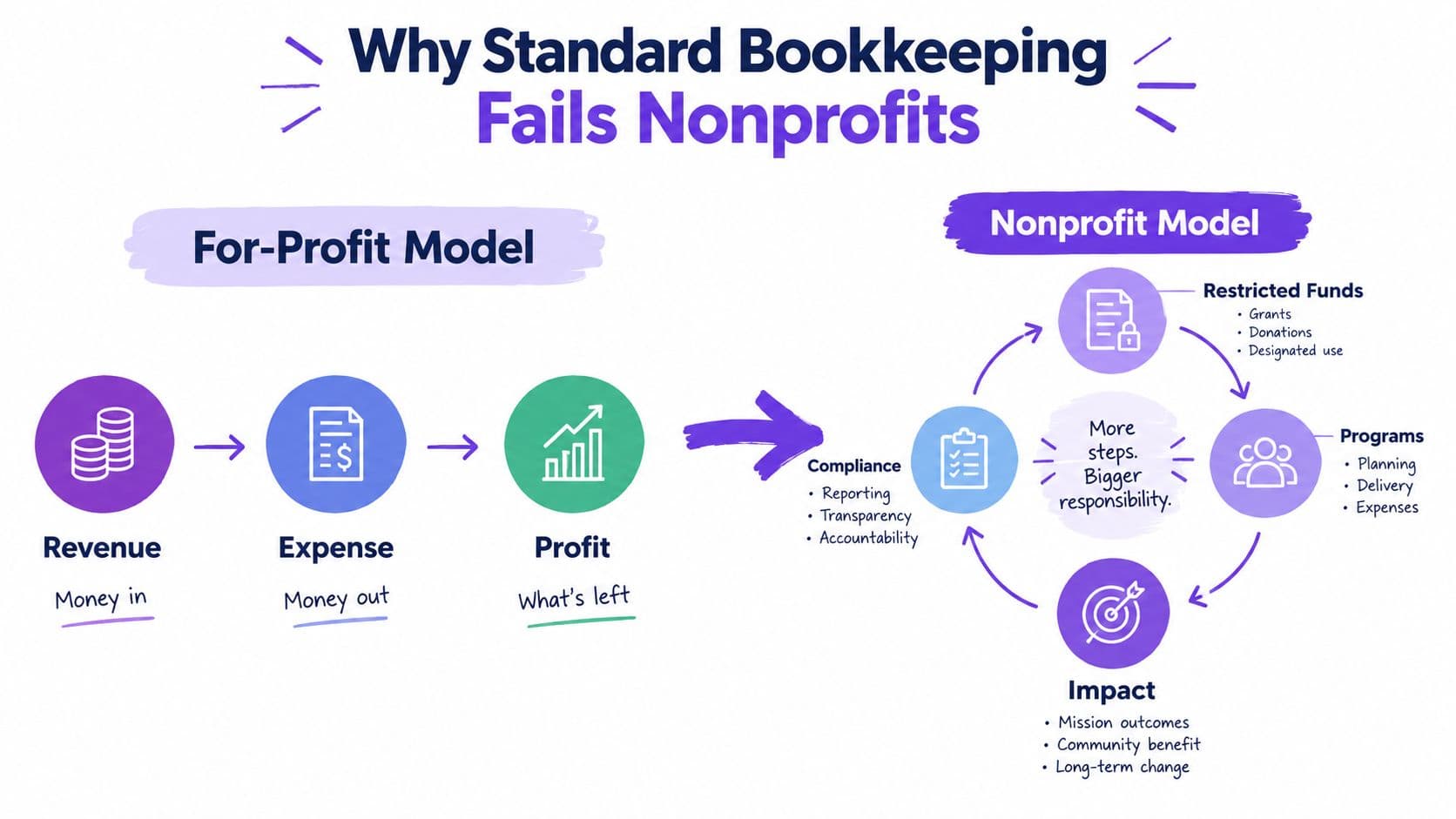
The two classes your board must see
Under FASB ASC 958 nonprofit bookkeeping guidance, current GAAP uses two net asset classes:
- Without donor restrictions: Resources available for general operating or other permitted organizational purposes.
- With donor restrictions: Resources limited by donor purpose, time, or perpetual-use requirements.
A balance sheet that reports only total net assets can make an organization look financially stronger than it is. Cash may be sitting in the bank, but a substantial portion may be unavailable for payroll, rent, or unrestricted program costs. That isn't a liquidity detail. It determines whether your organization can sustain operations.
Board rule: Never approve a spending plan from total cash alone. Require unrestricted cash, restricted balances, upcoming releases, and grant obligations in the same reporting package.
Why fund accounting carries the load
Fund accounting separates transactions by funds, grants, programs, locations, and cost categories. Every journal entry needs enough dimensional detail to answer who provided the money, what restrictions apply, where the expense belongs, and whether the balance reconciles to the general ledger.
That structure also supports the financial statements your stakeholders rely on. The Statement of Financial Position shows assets, liabilities, and net assets by restriction class. The Statement of Activities shows changes in those classes. Functional expense reporting distinguishes program services from management and general activity and fundraising, giving the board a clearer view of how resources support the mission.
Your outsourced provider should therefore begin with your chart of accounts and coding architecture, not with a promise to process transactions quickly. If the system can't preserve donor intent at the journal-entry level, it isn't nonprofit bookkeeping.
What Outsourced Bookkeeping for Nonprofits Includes
A serious engagement covers more than bank reconciliations. Outsourced accounting services for nonprofits commonly include bookkeeping, grant accounting, restricted-fund tracking, monthly close, financial statements, audit preparation, payroll administration, donor-system reconciliation, and Form 990 support.
You should separate the work into recurring deliverables, review responsibilities, and services that require a CPA, tax professional, or auditor.
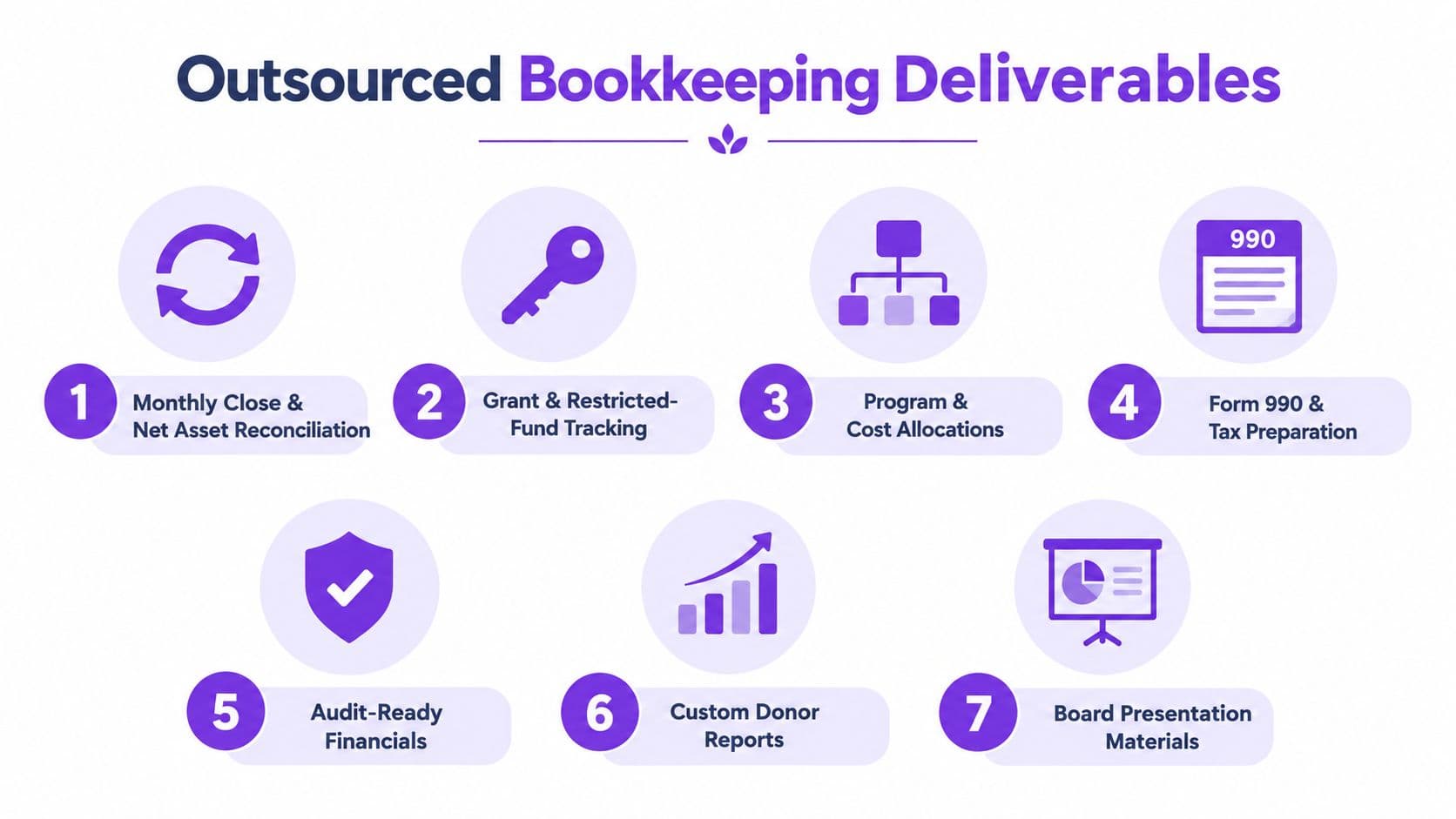
The seven deliverables to put in your scope
| Deliverable | What you should receive | Primary responsibility |
|---|---|---|
| Monthly close and net asset reconciliation | Reconciled accounts, adjusting entries, fund balances, and a close checklist | Bookkeeper with reviewer oversight |
| Grant and restricted-fund tracking | Award-level activity, restrictions, budgets, expenditures, and remaining balances | Nonprofit accounting specialist |
| Program and cost allocations | Documented allocation rules for payroll, occupancy, technology, and shared costs | Controller or CPA oversight |
| Form 990 and tax preparation support | Trial balance, schedules, reconciliations, and responses for the tax preparer | Bookkeeper supplies data, CPA prepares or reviews |
| Audit-ready financials | Workpapers, supporting schedules, reconciliations, and a prepared-items list | Controller or CPA-led team |
| Custom donor reports | Statements and reports that reconcile gifts to donor designations | Bookkeeper, development team validates donor data |
| Board presentation materials | Plain-English financial package with variances, liquidity, restrictions, and risks | Controller or fractional CFO |
The transaction layer includes recording receipts, payments, payroll entries, accounts payable, and reconciliations. The interpretation layer includes budgeting, forecasting, reserve analysis, and board advice. Don't allow a provider to blur those scopes. A bookkeeper can prepare the evidence for Form 990, but preparation and filing may belong to your CPA or tax specialist.
You also need a clear handoff with development. The donor CRM, payment processor, and general ledger must agree, but donor acknowledgment language and relationship ownership should remain with your fundraising team. For broader operational support, you can also review free nonprofit tools that help staff organize volunteer and program workflows without asking the accounting system to do jobs it wasn't designed to handle.
Fund Accounting and Donor Restriction Reporting
Fund accounting works best as a multidimensional coding system. A single transaction should identify the fund, grant, program, cost category, and net asset class where relevant. Those dimensions let you trace a restricted contribution from receipt through spending and eventual release.
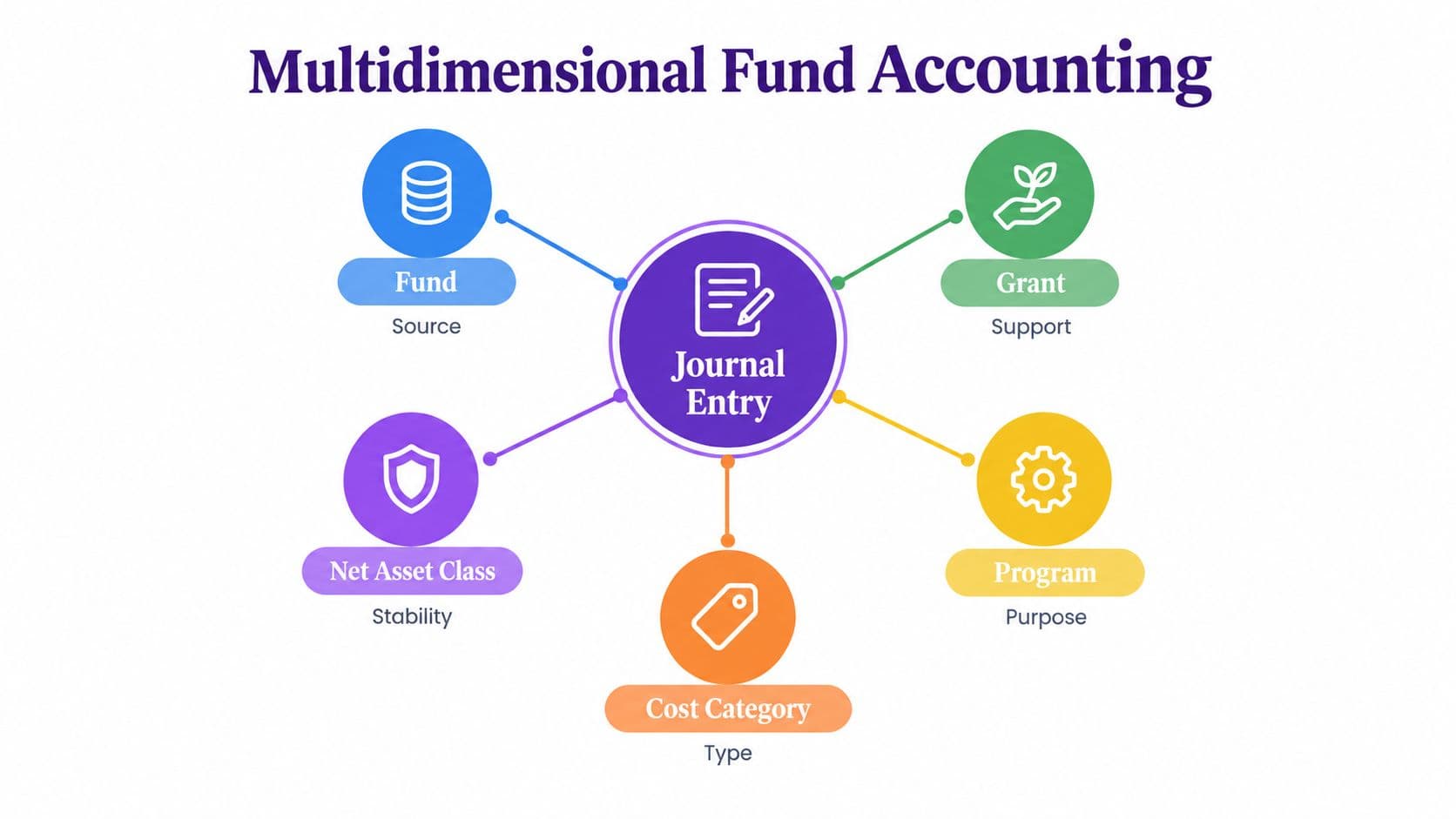
Suppose a grant supports a particular program. The cash receipt belongs to the appropriate restricted fund and grant record. Payroll, supplies, and vendor costs must then be coded to that program and grant only when they meet the award terms. Shared costs need a documented allocation method, not a convenient guess at month-end.
Restriction tracking is a lifecycle
Your provider should track the restriction when the gift or grant enters the books, monitor qualifying activity, and record a release when the time or purpose condition is satisfied. A time restriction remains tied to the applicable period. A purpose restriction remains tied to the approved activity. A perpetual restriction generally applies to the principal of an endowment or similar arrangement.
You don't need separate bank accounts for restricted and unrestricted money. Fund accounting guidance from Foundant explains that the accounting records must separate the balances and show releases when conditions are met. Bank structure cannot replace ledger discipline.
The monthly close should reconcile fund balances back to the general ledger and produce reports that a donor, grantor, auditor, or board member can follow. That includes restricted and unrestricted activity, remaining grant budgets, functional expenses, and unexplained variances.
A restricted-fund report that doesn't reconcile to the general ledger is a narrative, not control evidence.
Your provider also needs grant-compliance knowledge. Nonprofit fund accounting and grant reporting guidance emphasizes dimension-level coding and monthly reconciliation to preserve donor restrictions and support board- and audit-ready reporting. For federal awards, ask specifically about Uniform Guidance procedures, award-level documentation, allowable costs, and the information your auditor will request.
For a deeper technical reference, review this guide to fund accounting for nonprofits. Then use the embedded walkthrough below as a training resource for your finance committee.
Cost Models, Pricing Ranges, and the In-House Cost Math
Price outsourced bookkeeping by complexity, not by bank-transaction volume. A nonprofit with modest activity but several restricted grants may require more accounting expertise than an organization with higher volume and uncomplicated unrestricted operations. Fund structure, donor restrictions, grant reporting, and Uniform Guidance requirements should shape the scope and fee.
Use planning ranges to test a proposal, not to approve one. Common monthly ranges are $150 to $700 for smaller organizations and $2,000 to $3,500 for typical mid-sized nonprofits. Fractional CFO support can add $3,000 to $12,000 per month when you need strategic finance leadership. Ask the provider what each fee includes, especially reconciliations, restricted-fund reporting, grant schedules, and review.
| Organization Size | Annual Revenue | Monthly Outsourced Range | Fully Loaded In-House Cost |
|---|---|---|---|
| Smaller organization | Under $500K | $150 to $700 | Wage plus benefits, software, supervision, and review |
| Mid-sized organization | $500K to $2M | $2,000 to $3,500 | Wage plus benefits, software, supervision, and review |
| Larger organization | Above $2M | Scope-driven | Multiple finance roles or layered outsourced support |
Compare the four pricing structures
Monthly flat fee supports predictable budgeting when deliverables, close deadlines, grant volume, and reporting cadence are defined in writing. Reject vague packages that promise “monthly bookkeeping” without naming the reconciliations and reports included.
Hourly billing suits cleanup work and unusual technical assignments. It becomes costly when recurring tasks remain manual or the provider has no reason to standardize them.
Transaction pricing overlooks nonprofit accounting complexity. A restricted-grant reconciliation requires different judgment and documentation from an unrestricted bank entry, even when both count as transactions.
Hybrid pricing usually fits a growing organization. Combine a fixed monthly close with separately scoped grant work, Form 990 support, cleanup, or fractional controller services. Put approval limits and out-of-scope rates in the contract.
The U.S. median annual wage for bookkeeping and accounting clerks was $49,210 in May 2024, according to the BLS Occupational Employment and Wage Statistics page for bookkeeping and accounting clerks. Your comparison must add payroll taxes, benefits, software, management time, leave coverage, and independent review. If you still spend monthly hours correcting reconciliations, the in-house cost exceeds the salary.
Use the accounting cost comparison from Jumpstart Partners to build that comparison. You can also see HR Management 365 finance when coordinating accounting with broader operations and staffing responsibilities.
How to Evaluate Outsourced Bookkeeping Providers
Your provider interview should test technical competence, not personality. Require written answers, sample reports, and a clear responsibility matrix before you sign.
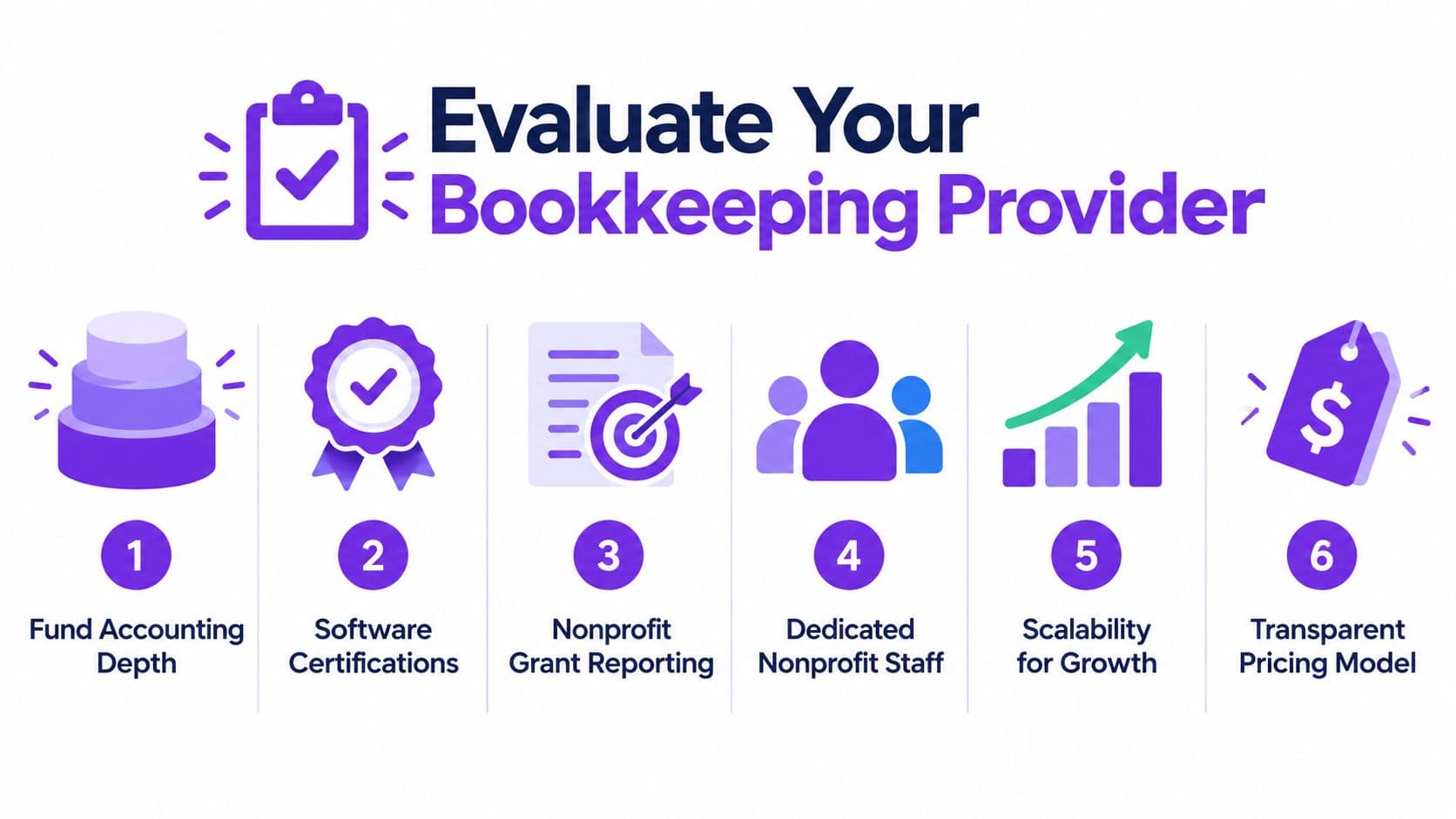
Score six capabilities
| Criterion | What strong evidence looks like |
|---|---|
| Fund accounting depth | They explain restrictions, releases, funds, programs, and allocations without reverting to generic business language |
| Software fit | They have relevant experience with QuickBooks Online, Sage Intacct, Aplos, MIP Fund Accounting, or Blackbaud Financial Edge |
| Grant compliance | They can discuss award-level tracking and Uniform Guidance requirements |
| Audit-ready close | They provide reconciliations, workpapers, review notes, and a repeatable close checklist |
| Segregation of duties | They separate authorization, custody, recording, and reconciliation |
| Reporting cadence | They define when management and board reports arrive and who explains variances |
Ask these questions on the discovery call:
- How do you distinguish net assets with donor restrictions from net assets without donor restrictions?
- How do you record a release from restriction?
- Can your general ledger report by grant, fund, program, and location?
- How do you reconcile each grant award to approved budgets and expenses?
- What is your documented month-end close checklist?
- Who reviews bank, payroll, credit-card, and donor-system reconciliations?
- How do you allocate shared payroll and overhead costs?
- What information do you provide to the Form 990 preparer?
- What federal award and Uniform Guidance experience does the assigned team have?
- Can you show a redacted month-end close package and board report?
A generic bookkeeper will answer with software features. A nonprofit specialist will explain the control and reporting outcome. Use a simple scoring rubric: assign each criterion a score from one to five, require evidence for every score above the midpoint, and reject any provider that refuses to show sample deliverables.
For additional context on the broader model, review finance and accounts outsourcing. Keep ownership of payment approvals and board oversight inside the nonprofit, even when the accounting team is external.
Red Flags That Signal the Wrong Provider
The wrong provider usually reveals the problem before the first month closes. They talk about transaction volume, bank feeds, and low monthly fees, but avoid questions about donor restrictions and grant compliance.
Watch for these warning signs:
- No net asset classes: The chart of accounts contains income and expense accounts but no reliable structure for resources with and without donor restrictions. Your Statement of Activities then requires manual reconstruction.
- No grant dimensions: The provider tracks all grants in one revenue account. You can't demonstrate which costs belong to which award without rebuilding the ledger.
- No release process: The team records restricted revenue once and never explains how purpose or time restrictions are released. Reports overstate restricted balances.
- No Uniform Guidance experience: The provider says federal grants are “just another project.” That answer signals a serious compliance gap when award requirements demand more detailed support.
- One-person cash control: One staff member enters bills, approves payments, records transactions, and performs reconciliations. Internal control guidance from Sage identifies segregation of duties, approval thresholds, independent reconciliations, role-based access, and audit trails as core protections.
- Vague deliverables: “Monthly bookkeeping” tells you nothing about close timing, reports, review, or audit support.
- No sample close package: A provider that won't show a redacted reconciliation package or board report gives you no way to test its quality before engagement.
- Year-end handoff only: If the firm returns a trial balance at year-end with no supporting schedules, your auditor will spend time recreating the control trail.
Don't confuse a SOC report with nonprofit expertise. Security controls matter, but they don't prove that a provider understands restricted gifts or grant accounting. You can use SOC 2 Type II compliance guidance as part of your vendor-risk review, then separately test fund-accounting competence.
Choosing the Right Outsourcing Model for Your Nonprofit
Choose your model by revenue, grant complexity, and audit posture, not headcount alone. Fund accounting, donor-restriction integrity, and Uniform Guidance requirements should determine the division of work.
| Operating situation | Recommended model | Keep in-house |
|---|---|---|
| Under $1M with restricted funds | Full-cycle outsourced bookkeeping | Approvals, donor relationships, board oversight |
| Between $1M and $3M | Outsourced close, grant reconciliation, and Form 990 support | Budget ownership and program accountability |
| Between $3M and $10M | Outsourced accounting with fractional controller support | Executive decisions and finance committee governance |
| Above $10M | Fractional CFO, controller oversight, and audit-ready close | Strategic finance, risk decisions, and board reporting |
These thresholds are planning guidelines, not fixed rules. A smaller nonprofit with complex federal awards may need stronger review and documentation than a larger organization funded mainly by unrestricted contributions.
Use a hybrid model deliberately
Keep payment authorization, spending decisions, donor stewardship, and budget ownership inside the organization. Your development team should control donor-CRM relationships, while finance manages the general ledger, reconciliations, fund reports, and grant schedules. Outsource technical accounting that benefits from experienced review, but retain approval authority and accountability with your staff and board.
The outsourced nonprofit accounting market has become an established professional-services category. One market report values it at US$29.919 billion in 2024 and projects US$55.359 billion by 2031, a 9.2% compound annual growth rate, according to Valuates market data. The practical conclusion is clear: outsourcing can support planned growth, not only emergency bookkeeping cleanup.
If fundraising or program expansion requires campaign infrastructure, use resources such as this Kickstarter campaign for nonprofits to plan operational responsibilities. Require your finance provider to map every new funding stream to donor restrictions, grant reporting duties, and approval controls.
At $2M in federal expenditures, require demonstrated Uniform Guidance capability before expanding the engagement. Use this in-house versus outsourced controller decision guide to document the choice, then have the board approve the responsibility split in writing.
Jumpstart Partners provides outsourced bookkeeping and controller support for nonprofits, including fund-accounting workflows, reporting redesign, cleanup, and audit-ready financial operations. Visit Jumpstart Partners to discuss your books, restricted-fund structure, and required level of monthly finance support.