Financial Operations
Outsourced Finance Services Guide
Discover how outsourced finance services accelerate growth for SaaS and agencies. Compare costs, service tiers, and ROI to build a scalable finance team.
ByJumpstart Partners, CPA, QuickBooks ProAdvisor
··16 min readThe most popular advice about outsourced finance services is wrong: outsource bookkeeping to save money, then keep strategic finance inside the company. That approach treats finance as data entry when your lenders, investors, tax authorities, and operating team need something far more valuable, reliable information delivered quickly enough to guide decisions.
For a SaaS or agency business between $1M-$5M ARR, finance infrastructure affects cash flow, valuation, fundraising readiness, and management focus. A clean ledger isn't the finish line. You need a dependable close, defensible revenue treatment, usable forecasts, and controls that survive diligence. The global finance and accounting outsourcing market was valued at about $59.05 billion in 2026 and is projected to reach $85.92 billion by 2031, a rise of nearly 45% over five years, according to accounting outsourcing market data.
That scale reflects a change in buyer expectations. Outsourcing now includes controller oversight, compliance workflows, cash forecasting, KPI reporting, and finance systems design. You aren't buying cheap labor. You're choosing the operating model that determines whether your financial information becomes a strategic asset or a recurring source of risk.
Table of Contents
- The Strategic Shift in Finance Outsourcing
- Matching Service Tiers to Your Revenue Stage
- Calculating the True Cost and ROI
- Security and Compliance Requirements
- Red Flags in Your Current Finance Setup
- Selecting the Right Outsourced Partner
- Executing the Transition and Next Steps
The Strategic Shift in Finance Outsourcing
Outsourcing isn't automatically strategic. A low-cost provider that posts transactions without understanding your revenue model can create a faster version of the wrong process. The strategic decision is to assign the right finance work to the right level of expertise, while keeping ownership of approvals, policies, and business judgment inside your company.
The category has matured well beyond basic offshore bookkeeping. Finance and accounting business process outsourcing was estimated at $70.19 billion in 2025 and $76.45 billion in 2026, with a projection of $142.66 billion by 2033 and a 9.3% CAGR from 2026 to 2033, according to Grand View Research's finance and accounting BPO analysis. Different reports define the market differently, but both point to the same conclusion: recurring accounting, reporting, and compliance work has become a globally scaled operating model.
Speed changes the quality of decisions
A month-end close that arrives late turns historical data into stale data. Founders then make hiring, pricing, spending, and fundraising decisions using estimates or instinct. SaaS companies face additional complexity from subscription revenue, deferred revenue, and ASC 606 treatment. Agencies need project-level profitability, utilization visibility, and disciplined accounts receivable follow-up.
A benchmark for SaaS and technology teams reports that 18% close in one to three business days, 32% in four to five days, 23% in six to seven days, and 27% take more than seven business days, meaning 50% still require six or more business days. The benchmark appears in month-end close data for 2025. A separate SaaS close benchmark identifies five to eight business days as a practical range and names ASC 606 revenue recognition and deferred revenue as key complexity drivers.
Practical rule: If your finance team can produce accurate information only after the decision has already been made, you don't have management reporting. You have historical administration.
Control stays with you
Outsourcing doesn't mean surrendering control. It means separating preparation from approval and introducing repeatable checkpoints. Your partner can reconcile bank accounts, maintain schedules, prepare journal entries, and assemble reporting packages. You should retain approval rights over payments, access permissions, accounting policies, and material adjustments.
Independent finance-control guidance says that if a provider doesn't supply a SOC report, the user organization should test its own controls over outsourced activities or test the provider's controls directly. It also identifies reconciliations, validations, and oversight of provider output as common compensating controls, as described in this finance control guidance.
Use that principle when reviewing any outsourced finance and accounting model. Demand documented review checkpoints, data-validity testing, access controls, and a clear contract defining who prepares, reviews, and approves each workflow. The objective isn't to remove your responsibility. It's to make responsibility visible, testable, and manageable.
Matching Service Tiers to Your Revenue Stage
Revenue alone doesn't determine the right finance tier. Operational complexity does. A services firm with modest revenue but dozens of active projects may need stronger controller support than a simpler company with higher sales. The decision should reflect transaction volume, revenue recognition, reporting expectations, cash pressure, and the next business event you need to survive.
Finance Service Tiers by Revenue Stage
| Service Tier | Ideal Revenue Range | Core Focus | Key Deliverables |
|---|---|---|---|
| Basic bookkeeping | $1M ARR to $1.5M | Accurate transaction processing | Bank reconciliations, chart-of-accounts maintenance, monthly financial statements, basic AP and AR support |
| Outsourced controller | $1.5M to $10M | Close management and accounting judgment | Close calendar, reconciliations, accruals, revenue schedules, management reporting, control documentation |
| Controller-led finance ops | $5M to $20M | Planning, capital strategy, and business performance | Cash forecasting, scenario models, board reporting, fundraising support, KPI architecture, strategic decision support |
The ranges overlap because business complexity matters more than an arbitrary revenue cutoff. A founder should upgrade when the current tier stops answering the questions the company needs answered.
Match the role to the operating trigger
Basic bookkeeping fits when the primary problem is incomplete records and inconsistent reconciliations. It doesn't solve a broken close process, unreliable deferred revenue schedule, or missing forecast.
Outsourced controller support becomes necessary when you need someone to own the close, establish accounting policies, review reconciliations, and explain why results changed. A $3M SaaS company, for example, needs disciplined handling of ASC 606 revenue recognition and deferred revenue, not just accurate bank feeds.
Controller-led finance ops support is the right move when leadership needs forward-looking decisions. A $10M agency may need project-level profitability analysis, capacity planning, cash flow forecasting, and a pricing model that connects scope changes to margin. A bookkeeper can report what happened. A CFO helps decide what to do next.
Before selecting a provider, verify that its technology recommendations support your workflows. A practical overview of startup finance software features can help you assess requirements for reporting, integrations, automation, and financial controls.
The wrong tier creates a predictable failure: you pay for transaction processing while still doing the controller or CFO's work yourself.
Use a bookkeeper versus controller comparison to identify the point where review, policy, and management accountability have outgrown basic bookkeeping. Then define the next operational trigger, such as an audit, fundraising process, new billing model, or persistent cash uncertainty.
Calculating the True Cost and ROI
The monthly invoice is only one line in the finance-function budget. An internal hire carries salary, benefits, payroll taxes, recruiting, software, equipment, management time, and the cost of waiting for that person to become effective. Outsourcing carries a service fee, but it can also provide access to bookkeeping, controller review, reporting, and CFO-level analysis without building every capability internally.
Start with loaded cost
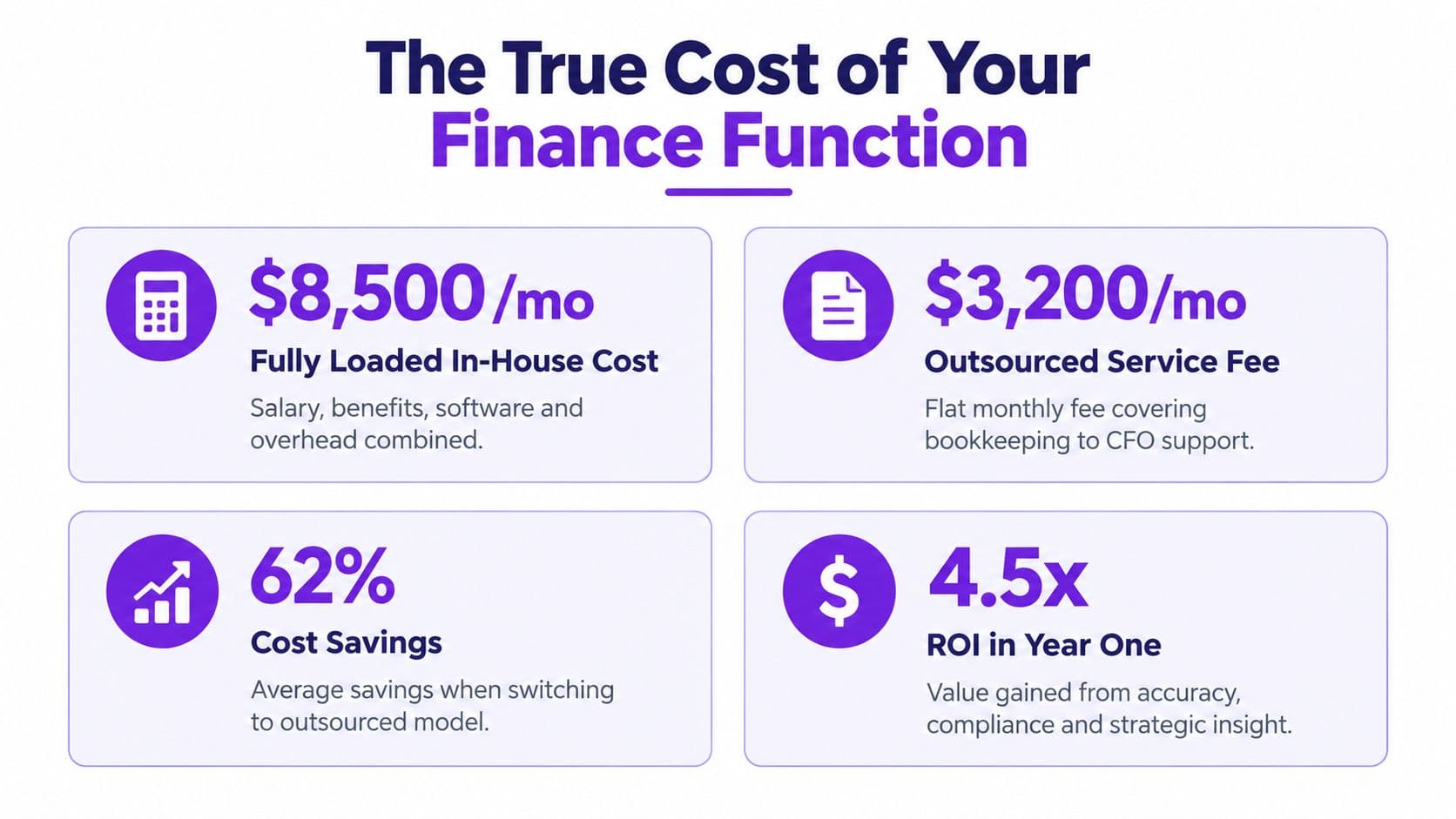
One cost benchmark estimates that a bookkeeper earns $49K to $65K in salary, plus $15K to $22K in benefits and overhead, producing a loaded annual cost of $64K to $87K. The same benchmark places outsourced bookkeeping at $1,500 to $4,000 per month, or $18K to $48K annually, as shown in this SMB finance-function cost comparison.
For controller work, the benchmark estimates $90K to $150K in salary, plus $27K to $50K in benefits and overhead. That produces a loaded annual range of $117K to $200K, while fractional outsourced controller support runs $2,000 to $6,000 per month, or $24K to $72K per year.
Work the calculation, don't repeat the sales pitch
Suppose you hire a controller at a $120,000 salary. Using the benchmark's controller ranges, a reasonable benefits and overhead load falls between $27,000 and $50,000, creating a total employment cost between $147,000 and $170,000 before recruiting, software, equipment, and management time. The midpoint calculation is simple: $120,000 plus $38,500 in midpoint benefits and overhead equals $158,500 annually, or approximately $13,208 per month.
Now compare a $4,000 monthly outsourced controller engagement. Annual service cost equals $4,000 multiplied by 12, or $48,000. The direct annual difference against the midpoint internal cost is $110,500, before considering recruiting and tooling. That isn't automatically ROI. It becomes ROI only if the outsourced team delivers accurate close management, better cash visibility, fewer corrections, and decision support that changes outcomes.
A separate pricing guide places basic bookkeeping at $500 to $1,500 per month, full outsourced accounting with AP, AR, and payroll coordination at $1,500 to $3,500, and controller-level support with CFO oversight at $3,500 to $7,500. It also frames outsourced accounting spend at roughly 1% to 3% of revenue, with lighter bookkeeping near 1% and controller-level scope approaching 3%, according to this outsourced accounting cost guide.
Use the controller services ROI analysis to structure the board conversation around scope, avoided cost, reporting quality, and cash impact, rather than invoice size alone.
Security and Compliance Requirements
Financial outsourcing fails when leaders evaluate technical skill but ignore control architecture. Your provider will handle sensitive banking information, payroll data, customer billing records, and investor-facing reports. The contract must define how that access is granted, reviewed, logged, and removed.
Require evidence, not assurances
Ask for a current SOC report and understand exactly which systems and services it covers. SOC documentation isn't a substitute for your own controls, but it gives you a basis for evaluating the provider's control environment. You should also require bank-level encryption, multi-factor authentication, role-based access, secure credential handling, and a documented offboarding process.
Don't give every team member unrestricted access. Separate transaction preparation from payment approval. Review user permissions regularly. Require the provider to document material changes to accounting policies, mappings, and integrations. Your finance leader should know who can alter a revenue schedule or release a payment, and you should be able to prove it.
The documented financial controls overview offers useful context for evaluating how a provider documents controls and operating effectiveness.
Build compliance into the close
For SaaS, ASC 606 isn't a year-end exercise. Your billing platform, contract terms, performance obligations, deferred revenue schedule, and general ledger must connect throughout the month. Your outsourced team should document the policy, identify exceptions, reconcile subledgers to the ledger, and preserve an audit trail for judgments.
For agencies and professional services firms, the equivalent risk often appears in project accounting, work-in-progress balances, retainers, reimbursable expenses, and revenue cutoffs. Ask how the provider handles those workflows before signing. A generic month-end checklist won't protect a business with specialized revenue mechanics.
Set formal checkpoints:
- Reconciliation review: Confirm bank, credit card, payroll, AR, AP, and revenue-related balances reconcile to supporting records.
- Exception review: Require an explanation for unusual transactions, aging changes, margin movement, and material journal entries.
- Management approval: Keep final approval for payments, policies, forecasts, and significant adjustments with designated internal leaders.
- Audit package retention: Store reconciliations, schedules, reports, approvals, and supporting documentation in an organized repository.
Red Flags in Your Current Finance Setup
A finance setup becomes a liability before the numbers visibly break. The symptoms usually appear as slow reporting, recurring corrections, unexplained cash pressure, and founder dependence. If you recognize several of these signs, hiring another junior bookkeeper won't fix the operating model. You need ownership of the close and a stronger review layer.
Warning signs that demand action
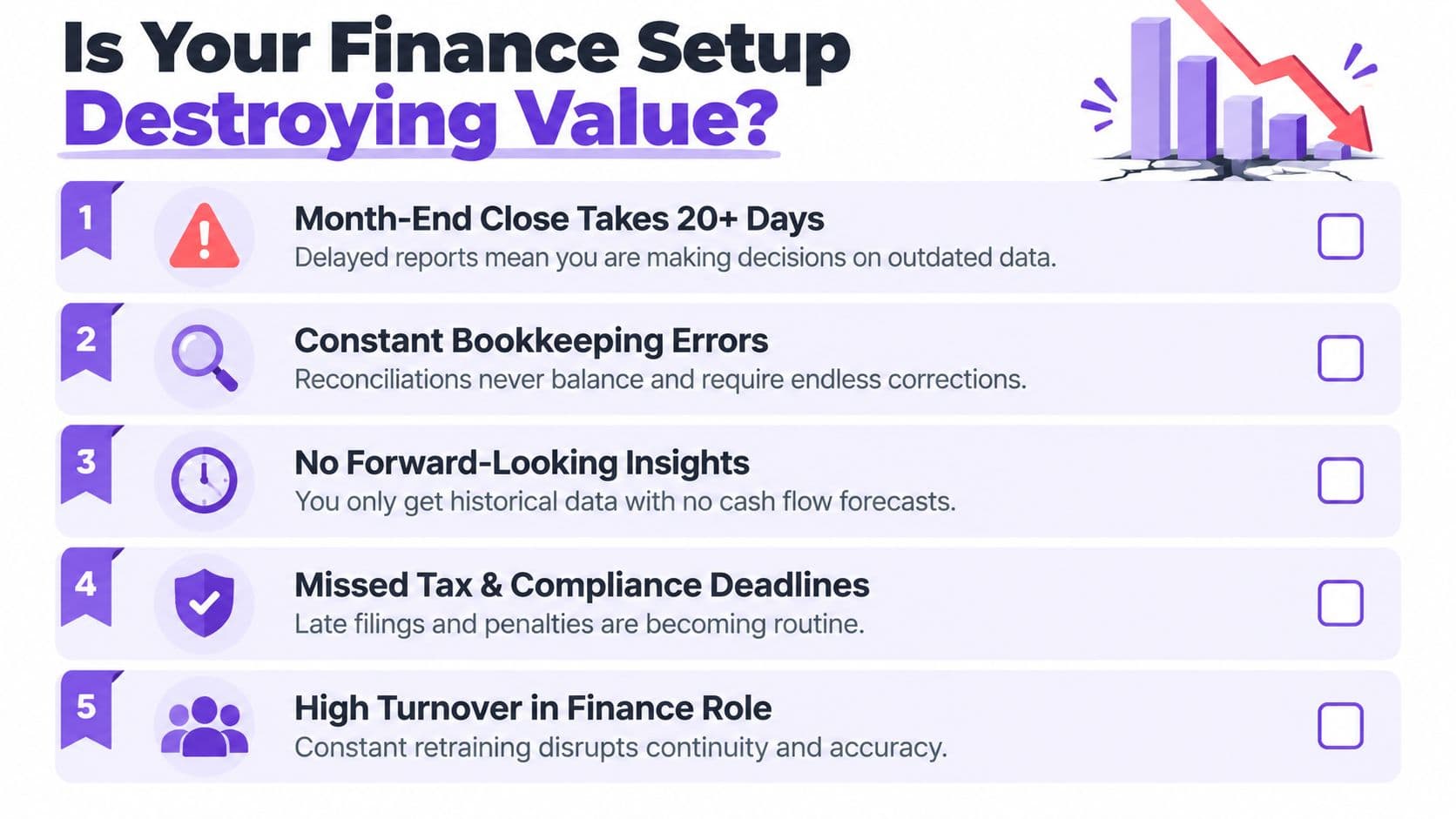
The close takes longer than 10 days. Leadership is making decisions from old information, and the delay often signals unresolved reconciliations, missing accruals, weak cutoff procedures, or unclear ownership.
Cash surprises you despite strong revenue. Revenue doesn't pay suppliers. If collections, payment timing, payroll, taxes, and vendor commitments aren't visible in a forward-looking model, your income statement can look healthy while your bank balance deteriorates.
Deferred revenue schedules require constant repairs. For SaaS companies, recurring changes to deferred revenue or revenue recognition schedules create diligence risk. They also make reported growth and gross margin harder to trust.
Past financial statements keep changing. Corrections are part of accounting, but constant revisions indicate that reconciliations, review procedures, or source-system integrations aren't working.
You lack a KPI dashboard. A SaaS founder should be able to connect bookings, MRR, ARR, churn, CAC, collections, and cash. An agency leader needs project margin, utilization, backlog, receivables, and capacity visibility. Historical financial statements alone don't answer those questions.
Why low cost becomes expensive
A low-cost team can appear efficient while forcing the founder to review every report, answer recurring questions, and discover errors late. That management time is an economic cost, even when it doesn't appear in the accounting system.
The 2025 CFO Pulse Survey reported that 65% of CFOs outsourced finance functions, but that represented a 25% decline from the prior year. Respondents still outsourced AR at 37%, AP at 35%, and cash application at 29%, according to the financial services outsourcing survey coverage. The lesson isn't that outsourcing always rises. Buyers are becoming more selective about which workflows belong outside the company.
Keep strategic approvals and sensitive judgment client-side. Outsource repeatable work where a specialist can create dependable throughput, control, and visibility.
Selecting the Right Outsourced Partner
Don't choose a finance provider by hourly rate. Choose based on whether the team can understand your business model, operate inside your technology stack, and produce information your leadership team will use.
Use a structured evaluation
| Evaluation Area | Questions to Ask | Evidence to Request |
|---|---|---|
| Business-model expertise | Have you handled SaaS revenue, agency projects, retainers, or usage billing? | Sample close checklist and revenue-policy discussion |
| Technology integration | How do you work with QuickBooks, NetSuite, Stripe, Shopify, Gusto, or other core systems? | Integration map and implementation plan |
| Reporting depth | Which KPIs will you report, and who owns the definitions? | Sample dashboard with MRR, ARR, CAC, margin, or cash metrics |
| Control environment | How are access, approvals, reconciliations, and exceptions managed? | SOC documentation, control matrix, and escalation policy |
| Service continuity | Who performs the work, reviews it, and covers absences? | Team structure, communication cadence, and backup plan |
| Transition quality | What happens during cleanup, migration, and the first close? | Detailed onboarding timeline and client responsibilities |
Ask the provider to walk through one real transaction from source system to management report. For SaaS, trace a subscription invoice through Stripe, revenue recognition, deferred revenue, reconciliation, and reporting. For an agency, trace a project from signed scope through time tracking, billing, collections, and project margin. This exposes shallow expertise quickly.
Test the operating relationship
Agree on response times, meeting cadence, escalation rules, deliverables, and correction procedures before work begins. You need a named owner for the close, not a generic support inbox. You also need a documented process for correcting errors without erasing the audit trail.
A broader guide to DFW managed service providers provides a useful framework for evaluating managed-service relationships, including fit, support expectations, and provider accountability.
Don't accept a dashboard full of undefined metrics. Your team should agree on what counts as MRR, ARR, gross margin, CAC, project margin, and collected revenue. If definitions change from month to month, visual polish won't create management value.
Review outsourced accounting services near you as one part of your search, but don't limit the process to geographic proximity. A remote team with the right systems, controls, and communication rhythm can be more effective than a nearby provider that lacks industry expertise.
Executing the Transition and Next Steps
The transition should produce a clean baseline before the new team owns the recurring close. Rushing the handoff transfers old errors into a new workflow and makes it difficult to tell whether the provider is improving performance.
Run the transition in sequence
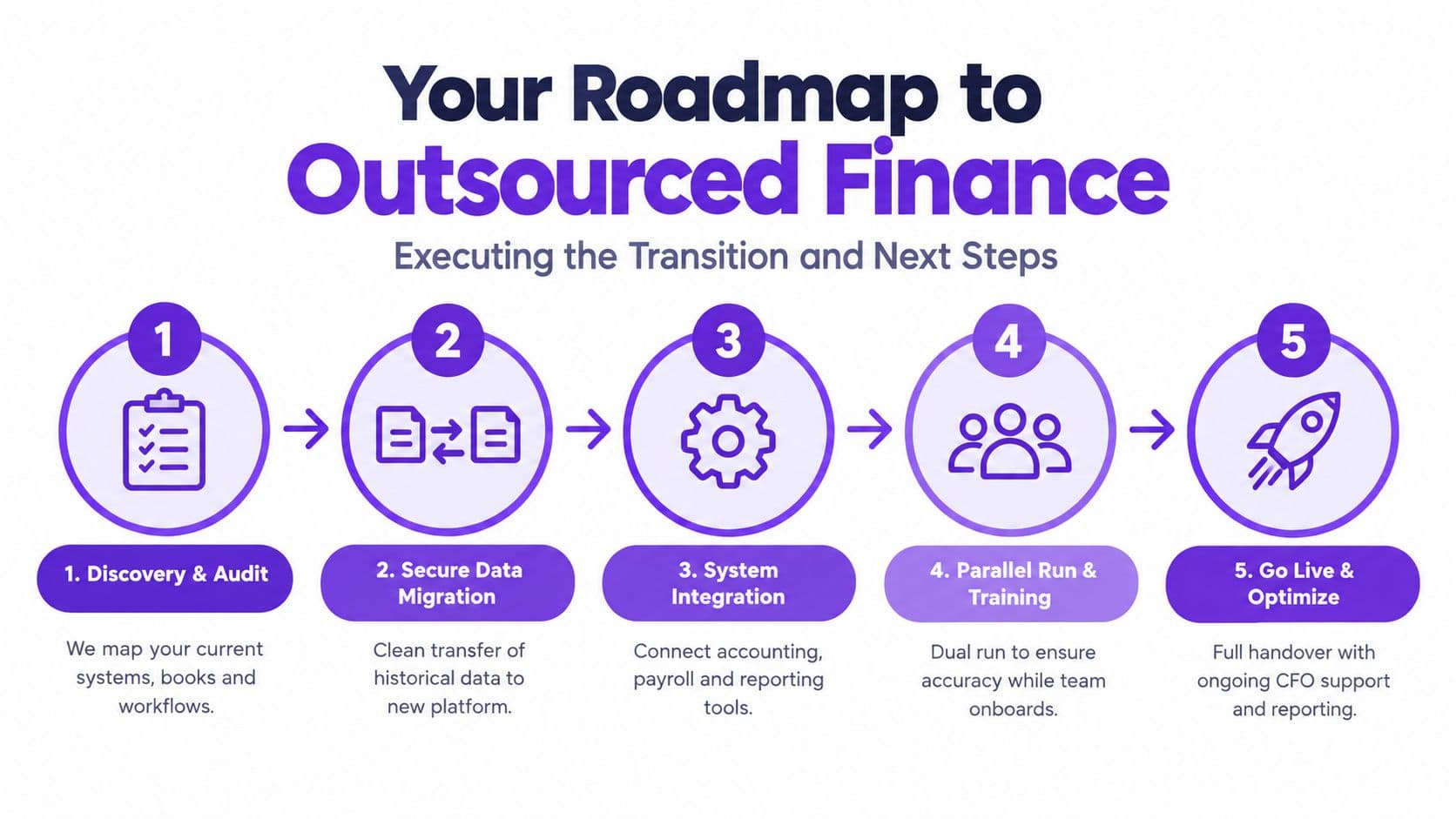
- Audit the current state. Document your chart of accounts, bank and credit-card reconciliations, open AR and AP, payroll process, revenue schedules, close calendar, reporting package, and system permissions.
- Define the target state. Decide which work stays internal, which work moves outside, who approves payments, which KPIs leadership needs, and what the close calendar must deliver.
- Clean historical records. Use a QuickBooks cleanup project or a focused 13-week cash flow sprint to establish reliable opening balances and immediate liquidity visibility.
- Migrate securely. Transfer historical data, contracts, supporting schedules, vendor records, customer data, and access credentials through approved systems. Don't send sensitive financial files through unmanaged personal channels.
- Run in parallel. Have the incoming team prepare the close while your current process remains available for comparison. Resolve differences before making the new workflow authoritative.
- Go live with measurement. Track close completion, unreconciled items, reporting delivery, forecast variance, open corrections, and management response time.
Your immediate finance audit
Start this week by recording the date your last five month-end closes finished, listing every post-close adjustment, and identifying which reports leadership receives before making major decisions. Then map your systems, assign an owner to every reconciliation, and separate preparation permissions from approval permissions.
If the review shows late closes, unreliable schedules, cash surprises, or constant founder intervention, don't wait for fundraising or an audit to expose the problem. Build the finance function before the next inflection point requires it.
Jumpstart Partners provides outsourced bookkeeping and controller support for SaaS, agencies, and growing businesses, including monthly close management, cash flow work, reconciliations, revenue recognition, and KPI reporting. Visit Jumpstart Partners to discuss a finance infrastructure plan built around your current systems, upcoming audit or fundraising needs, and the level of oversight your business requires.