Financial Operations
Outsourced Xero Bookkeeping: Accuracy & Faster Close
Outsourced Xero bookkeeping improves accuracy, speeds month-end close, integrates with Stripe/Shopify/Gusto, and ensures SOC 2 security. Learn more.
ByJumpstart Partners, CPA, QuickBooks ProAdvisor
··15 min readYour books are technically in Xero, but month-end still feels like a fire drill. Bank feeds are unreconciled, Stripe deposits don't match the ledger, invoices sit overdue, and the management report arrives after the decision it was supposed to support. By the time you answer investor questions, you're defending numbers you haven't had time to validate.
For founders, CEOs, and finance leaders at $500K to $20M revenue businesses, this isn't an administrative nuisance. It affects hiring, runway, fundraising, tax compliance, and your confidence in every operating decision. Outsourced Xero bookkeeping works when you treat it as a controlled finance operation, not as a low-cost transaction-entry service.
This guide explains how the model works, where automation needs human review, how to evaluate security and service levels, how to compare pricing, and how to transition without losing control. If your close is unreliable today, start with this practical overview of finance and accounts outsourcing.
Table of Contents
- Why Outsource Xero Bookkeeping Now
- Understanding Outsourced Xero Bookkeeping
- Benefits for Growing Businesses
- Key Buyer Considerations
- Comparing Pricing Models and ROI
- How to Choose and Transition Providers
- Next Steps and Call to Action
Why Outsource Xero Bookkeeping Now
A delayed close creates more than frustration. It leaves you managing cash from an old balance, reviewing performance with incomplete data, and postponing decisions because nobody trusts the numbers. A SaaS company preparing for funding can lose momentum when its revenue, deferred revenue, or cash position requires last-minute reconstruction. The issue isn't that the team lacks effort. The issue is that ownership, review gates, and close procedures aren't clear enough.
Xero makes an external model practical because it stores the ledger, bank feeds, documents, permissions, and reports in a shared cloud environment. Your internal leaders can retain visibility while a remote finance team handles recurring work, investigates exceptions, and prepares the close.
The right approach has three parts:
- Stabilize the ledger. Reconcile every bank, card, payroll, and payment-platform account, then document unresolved differences.
- Design the workflow. Separate low-risk automated matches from transactions requiring judgment, approval, or supporting documents.
- Measure the outcome. Track close completion, unreconciled items, forecast variance, overdue invoices, and exception-resolution time.
Outsourcing won't fix weak finance policies by itself. It gives you the operating discipline and specialist capacity to enforce them consistently.
Understanding Outsourced Xero Bookkeeping
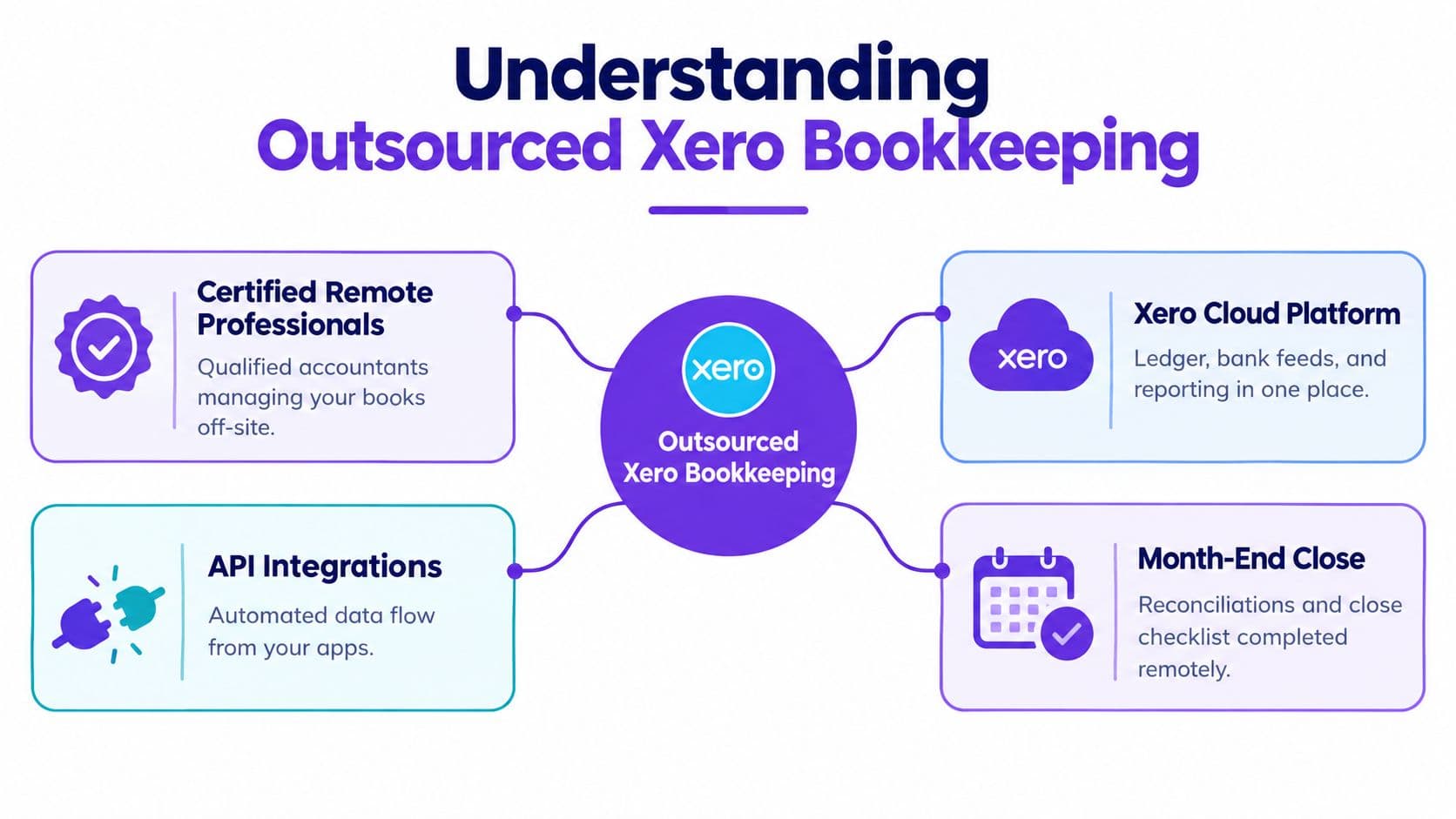
Outsourced Xero bookkeeping is a remote finance operation in which accounting professionals manage defined parts of your Xero ledger, reconciliations, reporting, and month-end close under documented controls. The provider doesn't just log in and categorize transactions. A properly designed service assigns responsibilities, sets approval thresholds, maintains evidence, and escalates anything that falls outside the expected pattern.
Xero's history explains why this model works. The company launched in New Zealand on July 6, 2006, under the original name Accounting 2.0, founded by Rod Drury and Hamish Edwards. Its cloud-based architecture replaced desktop accounting software with browser access to a shared financial dataset. Xero grew to more than 1 million global subscribers by 2017, then surpassed 2 million in 2019 and exceeded 3 million in September 2021, according to the company's historical overview. That development removed the old dependence on exchanging files with a local bookkeeper.
What the provider actually manages
A service scope commonly includes:
- Transaction processing: Coding bank-feed activity, bills, expenses, receipts, and payment-platform movements.
- Bank reconciliation: Matching statement lines to invoices, bills, expenses, transfers, and clearing accounts.
- Accounts receivable: Maintaining invoice status, aging, payment follow-up, and dispute visibility.
- Accounts payable: Processing bills, preparing payment batches, and routing approvals.
- Payroll coordination: Reconciling payroll journals and cash withdrawals with payroll systems.
- Month-end close: Posting approved accruals, reviewing balance-sheet accounts, and issuing management reports.
Xero's Accounting API supports the creation and extraction of invoices, credit notes, transactions, and accounting reports. That allows an external team to connect billing, payments, and operational systems to Xero, while preserving review gates for refunds, credit notes, deferred revenue, and period-end adjustments. A successful API request can still produce inaccurate accounting data if warnings aren't logged and investigated, so the provider needs an exception queue with an owner, deadline, and resolution record.
For a growing business, the useful question isn't whether the provider can access Xero. It's whether the provider can operate your ledger as a repeatable, visible, and auditable process. Use this guide to choosing accounting software for a growing business to assess whether your current platform and workflow can support the next stage.
Benefits for Growing Businesses
You see the problem in the cash account first. The sales report looks strong, but the bank balance is tighter than expected, one processor payout is off, two customer payments are still open, and nobody can tell you by Friday whether the gap is timing, fees, refunds, or a posting error. That is where outsourced Xero bookkeeping earns its keep. The value is not speed on its own. The value is a controlled workflow that gives leadership reliable numbers soon enough to act on them.
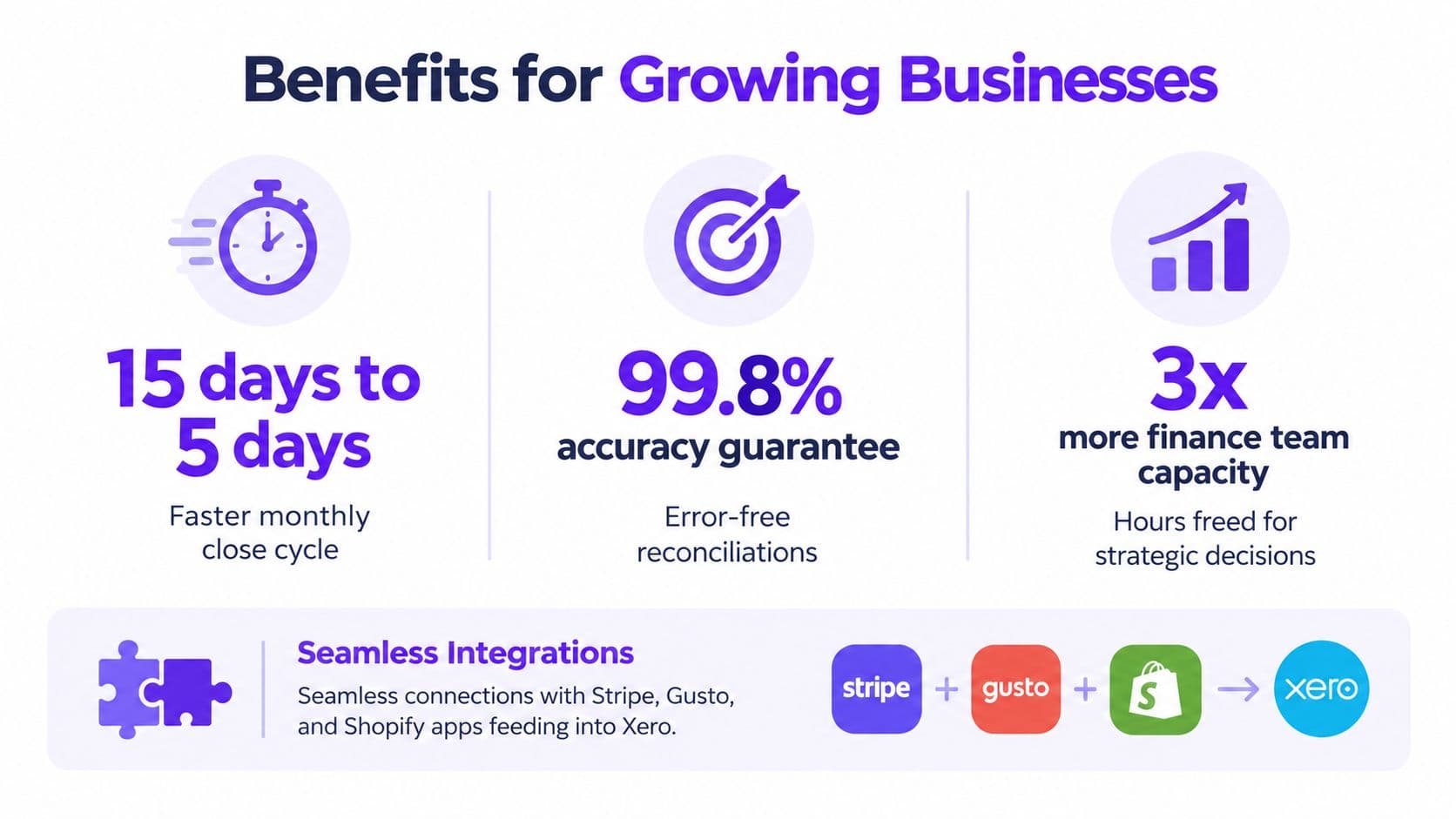
Xero's reconciliation workflow uses Rule, Match, Memory, and Prediction methods to automate high-confidence matches while keeping exceptions in front of a reviewer, as explained in Xero's reconciliation guidance. That human check is the point. Good providers do not automate away judgment. They use automation for recurring patterns, then require review of unusual amounts, unfamiliar payees, duplicates, refunds, intercompany activity, and revenue items that can distort cash-flow decisions.
Take a SaaS business that receives a $12,000 Stripe payout with a matching receivable already recorded. Xero should match the deposit instead of creating new income. If the bank receives $1,800 for a recurring software charge and an established rule sends it to software expense, the reviewer can approve it quickly. If the expected payout is $12,000 and the deposit is short by $300, nobody should wave it through. A capable bookkeeper investigates fees, refunds, chargebacks, or timing before that difference feeds the P&L or forecast.
Where the business value appears
A strong provider improves four areas that matter to a growing company:
- Close discipline: Each account, journal, report, and review step has a defined owner.
- Data integrity: Exceptions are investigated before imported data turns into misstated reporting.
- Integration coverage: Stripe, Shopify, Square, Gusto, BambooHR, and similar systems feed the accounting process without repeated spreadsheet exports.
- Management capacity: Your finance lead spends more time on margin, runway, hiring capacity, and customer economics, and less time chasing source documents.
That only matters if the process improves cash. Your team should maintain invoice aging, identify disputes, reconcile processor settlements, monitor refunds and reserves, and produce a rolling 13-week cash forecast. Clean books without better collection timing, payment timing, and visibility into settlement delays are incomplete.
The commercial case is clear. 41% of surveyed SMEs experienced cash-flow difficulties and 46% struggled with late payments, according to recent SME cash-flow reporting. Bookkeeping starts producing ROI when overdue invoices, payout timing, and approval delays are tied directly to weekly cash decisions.
A simple reconciliation check shows how this works. If the bank statement shows $85,000, deposits in transit total $7,500, and outstanding checks total $4,000, the adjusted bank balance is $88,500. If the ledger reports $91,200, the unexplained gap is $2,700. That difference needs an owner and an explanation before management relies on the income statement or forecast. Common causes include duplicate Stripe imports, a missing payroll withdrawal, an incorrectly dated check, or a transaction posted to the wrong entity.
A short video can help your team visualize the operational workflow before you redesign it:
Use a structured close process to turn these controls into a recurring operating rhythm. That is how growing companies get reliable reporting and better cash control at the same time.
Key Buyer Considerations
Outsourcing doesn't weaken control when the provider gives you better control evidence than your current process. It weakens control when you hand over access without defining who can post, approve, review, change, or remove information.
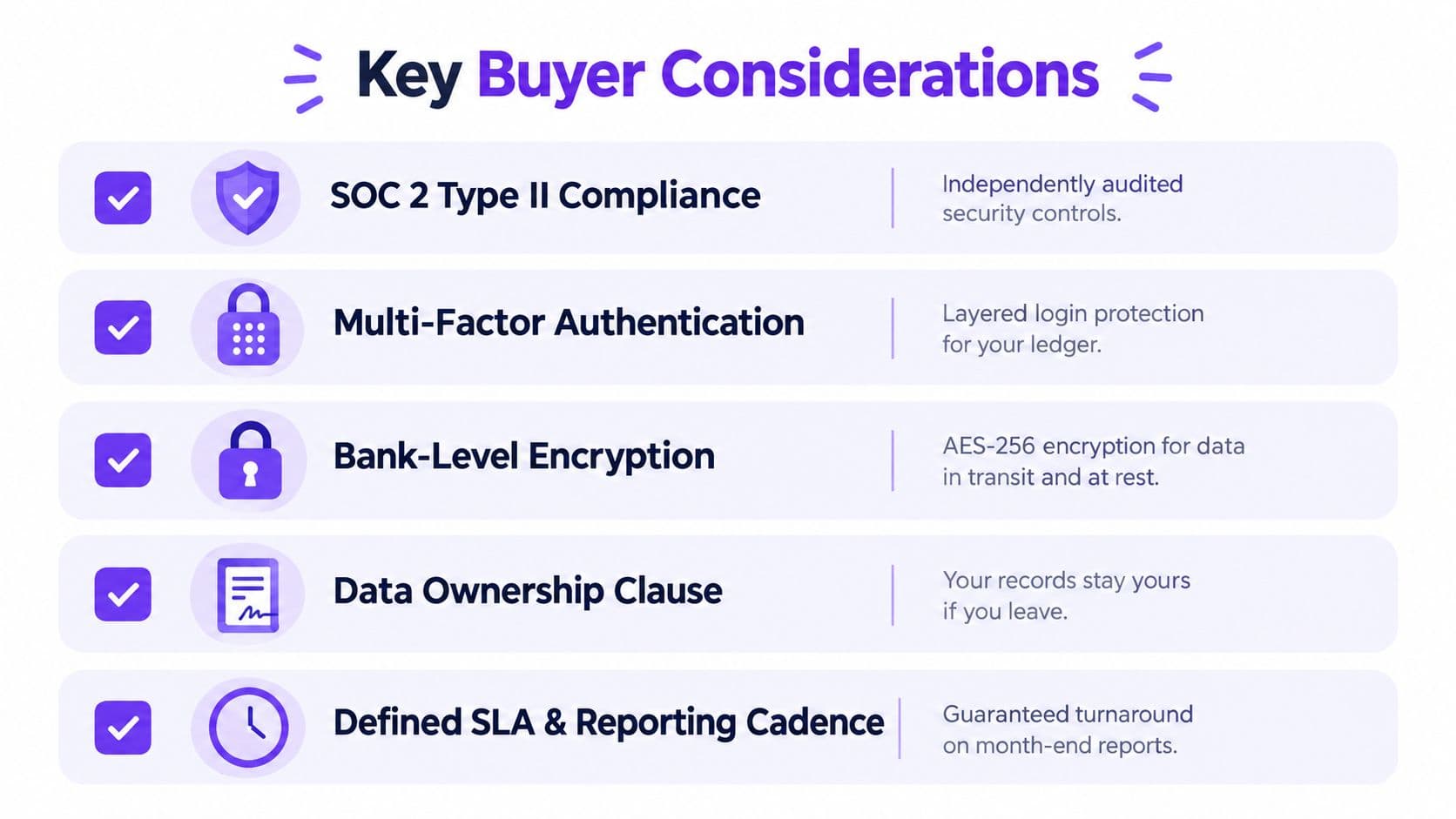
Start with the provider's security evidence. A SOC 2 report evaluates controls relevant to security, availability, processing integrity, confidentiality, and privacy. Processing integrity means that system processing is complete, valid, accurate, timely, and authorized, according to the U.S. Department of Labor's SOC reporting summary.
Demand evidence, not assurances
Ask for specific answers to these questions:
- Who has access? Require role-based permissions, multi-factor authentication, and joiner, mover, and leaver reviews.
- Who approves payments and journals? Set thresholds for revenue adjustments, refunds, owner distributions, payroll, and related-party transactions.
- What happens after a warning? The provider should log the exception, assign an owner, set a deadline, and preserve the resolution.
- What does the close file contain? Each material journal and reconciliation should link to source support, preparer and reviewer identities, approval timing, and post-close change history.
- How often are permissions reviewed? Require periodic access recertification and documented removal of unnecessary users.
A buyer often asks for a “5-day close guarantee” or an accuracy threshold. Treat those as contract terms, not slogans. Define when the close clock starts, what information you must provide, which accounts are included, how late source data affects the deadline, and what remedy applies when an exception remains unresolved.
Practical rule: A green reconciliation status isn't proof that the books are correct. Require agreement between the adjusted bank balance and the adjusted book balance, with every unexplained difference documented.
Security controls should also cover encrypted document exchange, audit trails, granular permissions, and data ownership. Your provider should be able to return your records in a usable format if you leave, and your agreement should state who owns source documents, reports, workpapers, and accounting data.
A human-in-the-loop model is essential after automation. The provider can approve standard recurring expenses, investigate amount or payee changes, and manually review uncategorized or unmatched transactions. Judgment remains necessary for revenue recognition, accruals, multi-entity consolidations, unusual payments, SaaS metrics, and period-end adjustments.
The provider should make your governance stronger by separating preparation from approval. You retain decision rights over cash, related parties, tax-sensitive items, and material reporting changes. The outsourced team supplies the operating capacity and evidence.
Comparing Pricing Models and ROI
A cheap bookkeeping quote usually costs more than it looks. If the provider leaves out cleanup work, receivables follow-up, payment-platform reconciliation, or review of unusual entries, your team still carries the risk and the extra labour.
Price the service against complexity, control requirements, and the cash decisions it supports.
The common pricing structures are straightforward:
| Model | Best fit | What you receive | Main risk |
|---|---|---|---|
| Tiered monthly plan | Recurring bookkeeping and close | Defined accounts, reconciliations, reporting, and support | Scope may exclude complex integrations |
| Fixed-fee cleanup | Historical errors or catch-up work | A defined correction project and handover file | It doesn't replace ongoing ownership |
| Cash-flow sprint | Immediate liquidity pressure | Forecast model, collections review, and cash controls | The result depends on current source data |
| AP automation project | High bill volume or approval friction | Workflow design, integrations, and approval routing | Automation without human review can accelerate errors |
| Controller support | Growing businesses needing oversight | Close governance, policies, reporting, and decision support | Requires clear executive access and accountability |
Use the next comparison as a decision tool, not a market benchmark. The fees and limits are examples for testing whether a Jumpstart Partners proposal matches the scope, review model, and business risk you need covered.
Example: Comparing Jumpstart Partners Tiered Plans Against Scope
| Plan | Monthly Fee | Transaction Limit | Close Guarantee | Key Features |
|---|---|---|---|---|
| Starter | Quote based on scope | Defined during onboarding | Agreed close date | Core reconciliations, monthly statements, close checklist |
| Growth | $2,500 example plan | Defined during onboarding | Agreed close date | Full close, AP and AR workflows, integrations, management reporting |
| Scale | Quote based on scope | Defined during onboarding | Agreed close date | Controller oversight, multi-entity support, cash forecasting, KPI reporting |
ROI needs a hard calculation. Suppose the Growth plan costs $2,500 per month. Annual cost is $2,500 × 12 = $30,000.
Now test the benefit side with numbers you can defend. If the workflow prevents $15,000 of errors annually and saves 60 hours of manual work valued at $75 per hour, the labour saving is 60 × $75 = $4,500. Total quantified benefit is $15,000 + $4,500 = $19,500.
That result is clear. On those assumptions, the quantified benefit of $19,500 stays below the annual plan cost of $30,000, so the net return is negative. This is why finance leaders should reject vague ROI claims. Define the gain in cash collected, corrections avoided, reporting speed, and management time returned to revenue or financing work, then calculate the answer.
For cash-focused work, speed alone is the wrong target. Faster close matters, but cash-flow ROI matters more. If outsourced Xero bookkeeping gives you cleaner reconciliations without clear ownership of collections visibility, forecast variance, and exception review, you are paying for tidier records rather than better financial control.
That is also where human review changes the economics. Automated Xero workflows can process recurring items, sync apps, and route approvals quickly, but a person still needs to review mismatches, investigate changes in payment patterns, and catch exceptions before they distort cash reporting. Human-in-the-loop controls stop automation from pushing bad data through faster. They also give CEOs and CFOs a clearer view of what affects liquidity.
Before you compare proposals, review these outsourced bookkeeping rates and pricing structures. Then ask each provider to itemise included accounts, transaction assumptions, integrations, close deliverables, reviewer responsibilities, onboarding fees, and project charges. If a proposal cannot show who reviews exceptions and who owns cash-impacting follow-up, the price is incomplete.
How to Choose and Transition Providers
Select the provider as if you're hiring a finance operator, because that's what you're doing. A polished sales process means little if the team can't explain how it handles a duplicate import, a missing payroll withdrawal, a late invoice, or an unusual customer refund.
Vet the operating model
Request these items before signing:
- A security report or control summary. Confirm access management, MFA, encryption, audit trails, and access recertification.
- A sample close file. Look for reconciliations, supporting documents, reviewer identity, unresolved-item tracking, and journal approvals.
- A written scope. Specify accounts, integrations, reporting, payroll coordination, AP, AR, and tax support boundaries.
- Reference conversations. Ask how the provider handled errors, missed information, changing transaction patterns, and executive reporting.
- An exception policy. Every unresolved item needs an owner, materiality threshold, escalation route, and target resolution date.
Use a controlled 30-day transition
Days 1 through 5, setup and access. Grant the minimum necessary Xero permissions, connect bank and payment feeds, inventory the chart of accounts, document entities, and list every connected application.
Days 6 through 12, reconciliation remediation. Reconcile opening balances, bank accounts, credit cards, payroll, Stripe or other processors, and clearing accounts. Don't allow the provider to start a new close on top of unexplained historical differences.
Days 13 through 18, policy design. Agree on revenue treatment, expense coding, capitalization, accruals, refunds, intercompany entries, approval thresholds, and evidence requirements. SaaS businesses should define how billing data, deferred revenue, credits, and refunds reach the ledger.
Days 19 through 25, parallel close. Have the new team prepare the close while your existing process remains available for comparison. Compare balances, outstanding items, journals, and management reports. Resolve differences before the new process becomes the only process.
Days 26 through 30, first live close and retrospective. Issue the first report package, record close duration and exceptions, then hold a review with named owners. Update the checklist immediately, while the problems are still visible.
A provider should never say “the system imported it” as an explanation. The accounting team owns the review of what entered Xero and whether it belongs there.
Founders moving from DIY bookkeeping often need a broader operating model than transaction coding. Review startup bookkeeping services if your business also needs reporting, cash planning, or controller support.
Outsourcing finance follows the same evaluation logic as assessing the costs of outsourced lead generation. Compare the full scope, ownership, handoffs, reporting cadence, and expected business outcome, not just the headline monthly fee.
Next Steps and Call to Action
Outsourced Xero bookkeeping earns its place when it produces faster closes, dependable reconciliations, integrated workflows, visible cash movements, and defensible audit evidence. It isn't a cost center when it helps you collect cash sooner, identify errors before reporting, and give investors reliable financial information.
Start by listing every account and integration, measuring your current unreconciled balance, documenting the close date, and identifying who owns collections and exceptions. Then request a sample close file, security evidence, and a written transition plan. A focused consultation will show whether you need recurring bookkeeping, a cleanup project, cash-flow support, or controller oversight.
Jumpstart Partners provides outsourced Xero bookkeeping and controller support for SaaS, agencies, professional services, e-commerce, and other growing businesses. Visit Jumpstart Partners to discuss your close process, cash controls, integrations, and a practical transition plan.