Financial Operations
Startup Bookkeeping Services: Your Guide to a 5-Day Close
Get investor-ready financials with expert startup bookkeeping services. Our guide covers pricing, SOC 2 security, ASC 606, and finding a CPA-led team.
ByJumpstart Partners, CPA, QuickBooks ProAdvisor
··20 min readYou’re probably closer to a finance failure than you think.
A founder gets an investor email asking for current financials, deferred revenue detail, and a clean cash view by end of day. Then the scramble starts. Stripe exports. Gusto reports. credit card statements. A QuickBooks file nobody fully trusts. A spreadsheet that “mostly ties out.” That’s not a bookkeeping problem. That’s an operating risk.
At $500K to $20M in revenue, bookkeeping stops being back-office admin. It becomes the system that determines whether you can raise, hire, forecast, pass diligence, and make decisions without guessing. If your books are late, unclear, or wrong, your growth slows down even when sales are strong.
When Messy Books Kill a Startup's Momentum
A founder gets a diligence request on Tuesday morning. The lead investor wants current financials, deferred revenue support, cash by entity, and a clean monthly close package by Thursday. Your controller is still chasing Stripe data, payroll entries are unreconciled, and the revenue schedule does not match the general ledger. The round does not fall apart because demand is weak. It stalls because finance cannot produce numbers anyone trusts.
That is how messy books kill momentum.
For a startup between $500K and $20M, bookkeeping is the control layer for fundraising, hiring, and planning. If the books are wrong, every decision built on them is wrong too. Burn looks lower than it is. Gross margin looks healthier than it is. Runway gets overstated. Then the correction comes late, usually when your options are worse and more expensive.
Sloppy books create investor risk fast
Investors do not care that QuickBooks is "mostly up to date." They care whether revenue is recognized correctly, liabilities are complete, and reporting can survive diligence. If you have subscription contracts, usage-based billing, annual prepaids, or multi-entity operations, basic categorization is not enough. You need a service that can handle ASC 606, maintain support for deferred revenue, and close fast enough that the board is reviewing current numbers, not stale guesses.
Security matters too. A bookkeeping firm will touch payroll data, banking access, customer billing information, and often cap table-adjacent reporting. If they cannot explain their controls clearly, ask whether they have SOC 2, define user permissions, and document who can access what. If the answer is vague, move on.
Practical rule: If your CPA has to rebuild the file before taxes, an audit, or diligence, your bookkeeping function is failing in real time.
Software does not fix a bad finance process
QuickBooks, Xero, and NetSuite can all support a solid close. They can also hide a mess for months. Founders get in trouble when they confuse a bookkeeping platform with a bookkeeping system. The system is the chart of accounts, reconciliations, month-end checklist, revenue treatment, review cadence, and document trail behind every material balance.
If your file is already unreliable, clean it up before you add volume. A focused QuickBooks cleanup process for messy startup books stops old errors from bleeding into forecasts, tax work, lender reporting, and diligence requests. The same discipline applies when finance data starts pulling from product, billing, and engineering systems. Teams doing finops and devops data analysis still need accounting records that tie back to the source systems cleanly.
The standard is higher than "books are done"
Ambitious founders should expect four outcomes from bookkeeping:
- A close you can rely on quickly, with a defined timeline and no recurring excuses
- Revenue recorded correctly, especially if your model includes contracts, prepayments, or deferred revenue
- Security controls that match the sensitivity of the data, including clear access management and documented processes
- Audit and fundraising readiness, with support behind the numbers instead of last-minute spreadsheet archaeology
Anything less creates drag at the exact moment the company needs speed. Messy books do not stay in the finance folder. They show up as delayed raises, weak board reporting, missed hiring plans, and bad decisions made with false confidence.
Core Deliverables of a Modern Bookkeeping Service
Startup bookkeeping services should produce usable financial control. If all you’re getting is categorized transactions and a delayed profit and loss statement, you’re paying for recordkeeping, not finance operations.
Fast close changes how you run the company
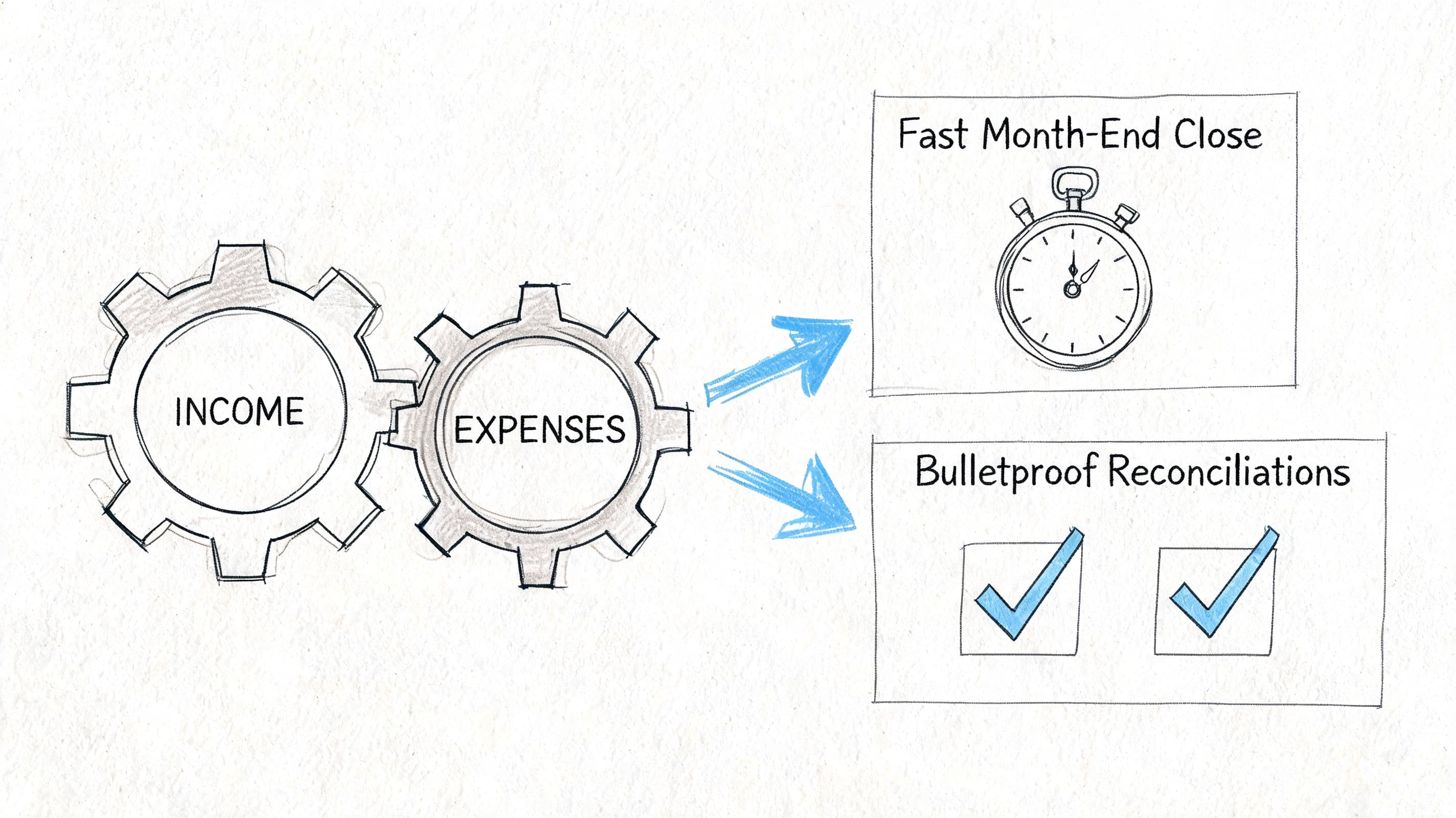
The first deliverable is a fast month-end close. That means your financial statements are finalized quickly enough to guide decisions while the information still matters.
If your books close in 5 days, you spend the rest of the month acting on current data. If they close in 20 days, you’re managing the business based on history that’s already stale. For a founder hiring aggressively or adjusting pricing, that delay is expensive.
A proper close includes:
- Bank and credit card reconciliations completed, not postponed
- Payroll and benefits posting matched to the general ledger
- Accruals and prepaids recorded correctly
- Revenue and deferred revenue updated based on actual performance
- Financial review before reports go out
If you want the close to stay fast as volume grows, build repeatable workflows early. That’s why many teams invest in financial reporting automation for recurring close tasks instead of relying on one person’s memory and a month-end checklist buried in Slack.
Bulletproof reconciliations are non-negotiable
Reconciliation sounds boring until you realize nearly every ugly finance surprise starts there.
Unreconciled accounts hide duplicate expenses, missing deposits, payroll misposts, stale liabilities, and revenue timing errors. The founder usually discovers the problem at the worst possible time. During diligence, board prep, a tax filing, or a loan review.
Here’s what “bulletproof” looks like:
| Account area | What good looks like | What bad looks like |
|---|---|---|
| Bank accounts | Every statement tied out monthly | Old uncleared items piling up |
| Credit cards | Charges coded and matched to receipts or purpose | Miscategorized spend and owner guesswork |
| Payroll | Gross wages, taxes, and benefits posted correctly | One payroll journal entry dumped to payroll expense |
| Stripe or payment processors | Payouts matched to fees, refunds, and reserves | Deposits booked as revenue without detail |
| Loans and liabilities | Principal and interest split correctly | Debt payments coded entirely as expense |
Clean reconciliations don’t make your business look better. They make your real business visible.
ASC 606 isn’t optional if you sell subscriptions
For SaaS, revenue recognition is where weak bookkeeping gets exposed fast.
According to technical accounting analysis from UseHaven on neglected bookkeeping and startup fundraising, companies with clean, audit-ready financials that correctly account for deferred revenue close funding rounds 30% to 60% faster than peers who need restatements during due diligence.
That’s a direct business consequence, not an accounting detail.
Worked example for deferred revenue
Assume your SaaS company signs a customer to a $12,000 annual contract on November 1 and gets paid upfront.
If you record the full $12,000 as November revenue, your books are wrong.
Under ASC 606, if the service is delivered evenly over the contract term, you recognize revenue ratably:
| Month | Cash received | Revenue recognized | Deferred revenue remaining |
|---|---|---|---|
| November | $12,000 | $1,000 | $11,000 |
| December | $0 | $1,000 | $10,000 |
| January | $0 | $1,000 | $9,000 |
The correct November journal result is:
- Cash increases by $12,000
- Revenue increases by $1,000
- Deferred revenue liability increases by $11,000
That distinction matters because investors and auditors want to know what you’ve earned, not just what you collected.
Real-time cash visibility beats end-of-month panic
Founders don’t go out of business because they lacked a profit and loss statement. They go out of business because they ran short on cash and saw it too late.
Your bookkeeping service should give you current visibility into:
- Collections timing
- Upcoming payroll
- Vendor obligations
- Subscription renewals and cancellations
- Large annual software payments
- Deferred revenue that doesn’t equal spendable cash
For technical teams that need cleaner exports from infrastructure tools before finance can analyze cloud spend and usage trends, resources on finops and devops data analysis can help bridge raw operational data into something your finance stack can use.
The point is simple. Modern startup bookkeeping services should turn disconnected systems into a reliable operating view. Not just archive transactions after the fact.
Common Pitfalls That Signal Your Bookkeeping Is Broken
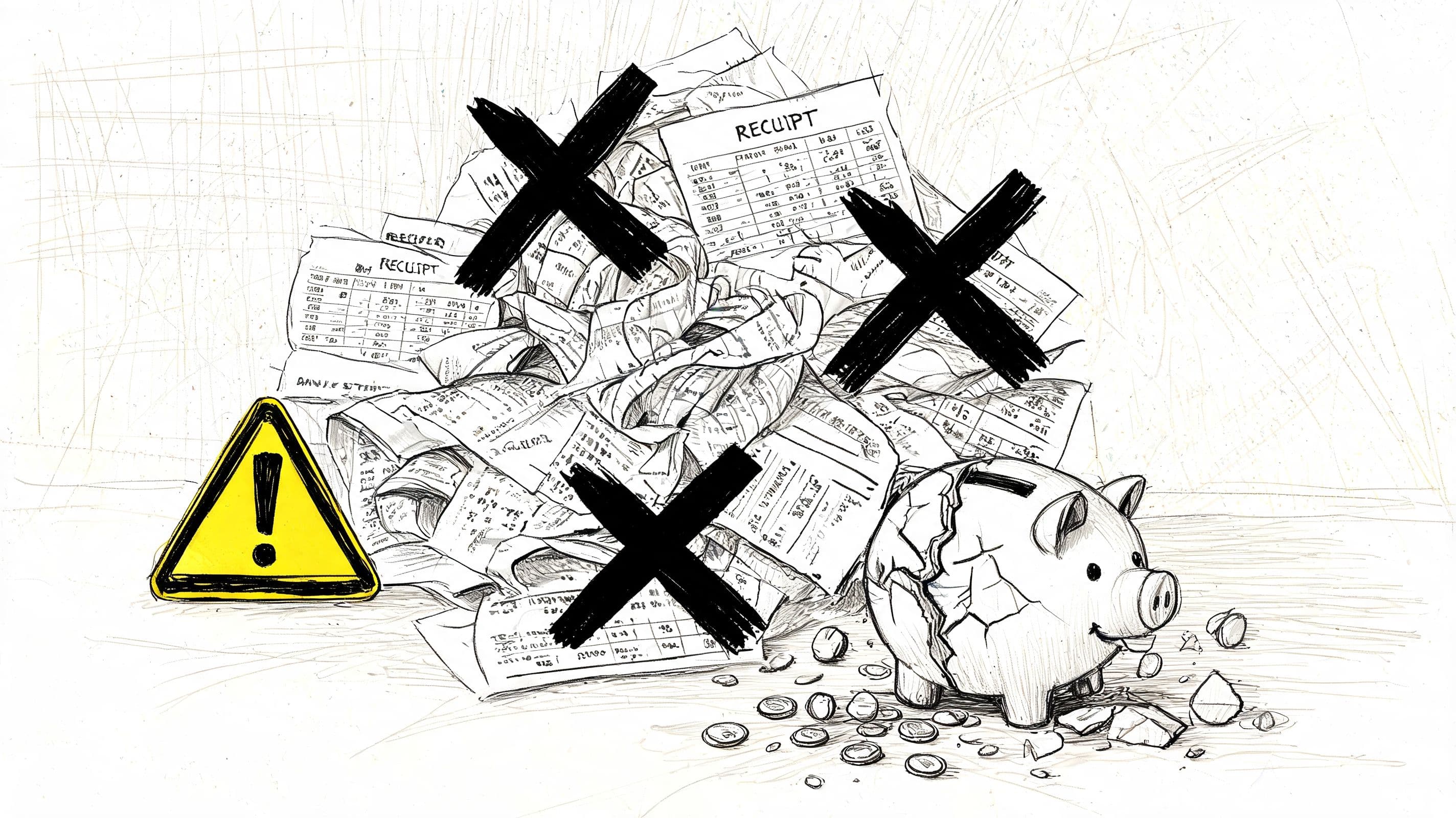
Most broken bookkeeping systems don’t fail loudly. They fail by slowing decisions, hiding errors, and making everyone less confident in the numbers.
The DIY stage ends earlier than founders admit
Founders love to save money by doing their own books. That instinct makes sense at the beginning. It becomes destructive when complexity arrives before discipline does.
A 2025 analysis found that 40% of early-stage founders using DIY tools mishandle revenue recognition, leading to over $10,000 in undetected errors per quarter, according to CFO Hub’s analysis of accounting and bookkeeping services for startups. That’s the cost of “we’ll clean it up later.”
If you’re still relying on founder-managed spreadsheets, generic software rules, or a low-cost bookkeeper who doesn’t understand your business model, you need to read the warning signs and act. This guide on signs you've outgrown your bookkeeper and what to do next is a useful gut check.
Red flags founders should take seriously
Here are the warning signs I see most often:
-
Your close drags on for weeks
If the books are still moving long after month-end, your reports aren’t reliable enough to run the company. -
You can’t explain deferred revenue or accruals
If nobody on the team can explain why revenue landed in a given month, your financials won’t survive scrutiny. -
Cash flow forecasting is guesswork
Looking at the bank balance isn’t forecasting. It’s reacting. -
Your chart of accounts is messy
If software subscriptions, contractor costs, owner reimbursements, and customer refunds are all mixed together, your margin analysis is fiction. -
Board reporting takes manual cleanup every month
You shouldn’t need a last-minute spreadsheet rescue to produce investor-ready numbers.
A short walkthrough can help you spot these issues in practice:
The cheap bookkeeper usually becomes the expensive mistake
A generalist bookkeeper can be fine for a simple local business. That person is often the wrong fit for SaaS, agencies, and professional services firms with accruals, recurring billing, prepaid contracts, payroll allocations, and investor reporting.
Founder test: Ask your current provider how they handle deferred revenue, prepaid expenses, payroll allocations, and processor reconciliations. If the answers are vague, you already have your answer.
You don’t need more effort. You need a system built for the company you are now.
How to Evaluate and Choose the Right Service
Most founders shop for bookkeeping the wrong way. They compare monthly price, software familiarity, and whether the provider “seems responsive.” That’s too shallow for a growing company.
You should evaluate startup bookkeeping services the same way you’d evaluate a critical infrastructure vendor. Because that’s what they are.
Start with the non-negotiables
According to Kruze Consulting’s discussion of startup bookkeeping requirements, human-led services still outperform pure AI by 40% in complex error detection, and 25% of Series A firms cite data security as a fundraising blocker. That means two things.
First, automation matters, but human review still catches the errors that hurt you. Second, if a provider can’t speak clearly about SOC 2 compliance, access controls, and how they protect financial data, they’re not ready for investor-grade work.
Here’s the comparison that matters.
| Attribute | Standard Bookkeeper | Specialized Startup Service |
|---|---|---|
| Team structure | Single operator or small admin team | Bookkeeping plus controller-level review |
| Revenue recognition knowledge | Basic cash tracking | ASC 606 understanding for recurring revenue |
| Security posture | General file sharing and passwords | SOC 2-oriented controls and disciplined access |
| Month-end close | Flexible timeline | Defined close process with deadlines |
| Tech stack depth | QuickBooks entry only | Integrations across QuickBooks, Xero, NetSuite, Stripe, Gusto, Shopify, BambooHR |
| Reporting | Basic P&L and balance sheet | Investor-ready reporting and KPI support |
| Error review | Reactive | Structured review and exception handling |
| Industry fit | Broad small business | SaaS, agencies, e-commerce, services with model-specific workflows |
Questions that separate serious providers from clerks
Ask these directly:
-
Who reviews the books before statements go out?
If there’s no controller or CPA oversight, you’re buying data entry. -
How do you handle deferred revenue, prepaid expenses, and accruals?
You want a clear operational answer, not a vague promise. -
What does your month-end close checklist include?
Good firms have a repeatable process. Weak firms improvise. -
How do you secure bank, payroll, and accounting access?
You’re handing over your financial core. Treat that accordingly. -
What industries do you support well? “We work with everyone” usually means “we’re not excellent at yours.”
For Canadian operators or cross-border founders comparing systems for local compliance, a practical overview of CRA compliant accounting software is worth reviewing before you lock in your stack.
Don’t outsource judgment
Software can automate categorization. AI can flag anomalies. Neither replaces accounting judgment.
“Human oversight matters most where the business is unusual, fast-moving, or under diligence.”
That’s the expert view I give every founder because it’s the reality. Complex revenue, financing events, refunds, payroll changes, and multi-system reconciliations are exactly where generic automation breaks.
If you’re comparing providers, a shortlist of outsourced accounting services for growing companies can help frame what a specialist model looks like. One option in this category is Jumpstart Partners, which provides outsourced controller and bookkeeping support for companies in the $500K to $20M range with integrations across tools like QuickBooks, Xero, NetSuite, Stripe, Gusto, and Shopify.
Pick the team that can defend the numbers, not just enter them.
Understanding Pricing and Packages
A founder picks the cheapest bookkeeping package, closes the month six weeks late, and walks into an investor meeting with numbers nobody trusts. That is how a small monthly savings turns into a financing problem.
Pricing only matters if the service delivers control. For a startup in the $500K to $20M range, the primary question is whether the package gives you accurate accruals, clean revenue treatment, a fast close, and books that can survive diligence. If it does not, the price is a distraction.
What actually drives the monthly fee
Monthly cost rises with accounting complexity, review depth, and risk. Headcount and revenue matter less than founders assume.
The biggest cost drivers are:
- Transaction volume across banks, cards, payables, receivables, and reimbursements
- Number of entities, accounts, and legal structures
- Revenue complexity, especially subscriptions, deferred revenue, usage billing, and contract changes
- System count and integration quality, including QuickBooks, Xero, NetSuite, Stripe, Shopify, and Gusto
- Close expectations, such as whether you need books closed in 10 business days or 30
- Oversight level, from basic data entry to controller review, board reporting, and cash forecasting
- Compliance requirements, including sales tax, audit prep, and ASC 606 support
That last point separates real startup accounting from generic bookkeeping. Venture-backed companies do not need a vendor that only reconciles bank accounts. They need a team that can handle contract-driven revenue, produce board-ready reporting, and keep the close moving on schedule.
What package tiers should include
Most firms sell some version of three packages. The names vary. The economics do not.
| Package type | Best fit | Typical scope |
|---|---|---|
| Starter | Early company with low volume and simple cash accounting | Monthly reconciliations, basic financial statements, expense categorization |
| Growth | Scaling startup with accrual accounting and investor reporting needs | Monthly close, accruals, prepaid and deferred revenue schedules, management reporting |
| Scale | High-growth or diligence-facing company with multi-system complexity | Controller review, revenue recognition support, KPI reporting, audit prep, close calendar ownership |
Here is my recommendation. If you are preparing for a fundraise, lender review, or audit, skip the bare-bones package. Pay for the level that gives you monthly accrual accounting, documented reconciliations, and a defined close timeline. Those are the outputs investors and auditors care about.
Ask one more question before you sign: what is excluded? Cleanup work, historical catch-up, sales tax filings, 1099s, audit support, and revenue memo preparation often sit outside the base fee. Founders get burned when the proposal looks cheap and the actual bill starts after onboarding.
Cheap bookkeeping gets expensive fast
A low monthly invoice can hide expensive failure. Missed accruals distort burn. Bad deferred revenue treatment inflates performance. A slow close leaves you managing cash off stale information. Under diligence, those problems become rework, delays, and credibility loss.
That is why package evaluation should be tied to outcomes:
- How fast will the books close each month?
- Who reviews the work before reports go out?
- Can the team handle ASC 606 if your contracts require it?
- Will they support audit requests without rebuilding schedules from scratch?
- Do they protect financial data with real security controls such as SOC 2 aligned processes?
If the answer to those questions is weak, the package is underbuilt for a growth-stage startup.
If you need a pricing benchmark, this breakdown of the cost of accounting services for growing businesses is a useful way to compare fee levels against complexity and reporting needs.
Buy the package that gives you clean books, a fast close, and numbers you can defend in front of investors. That is the package that protects momentum.
Your Onboarding Checklist for a Seamless Transition
Switching providers feels painful when your current books are disorganized. A good transition is still manageable if you prepare the right materials and set expectations early.
Before kickoff
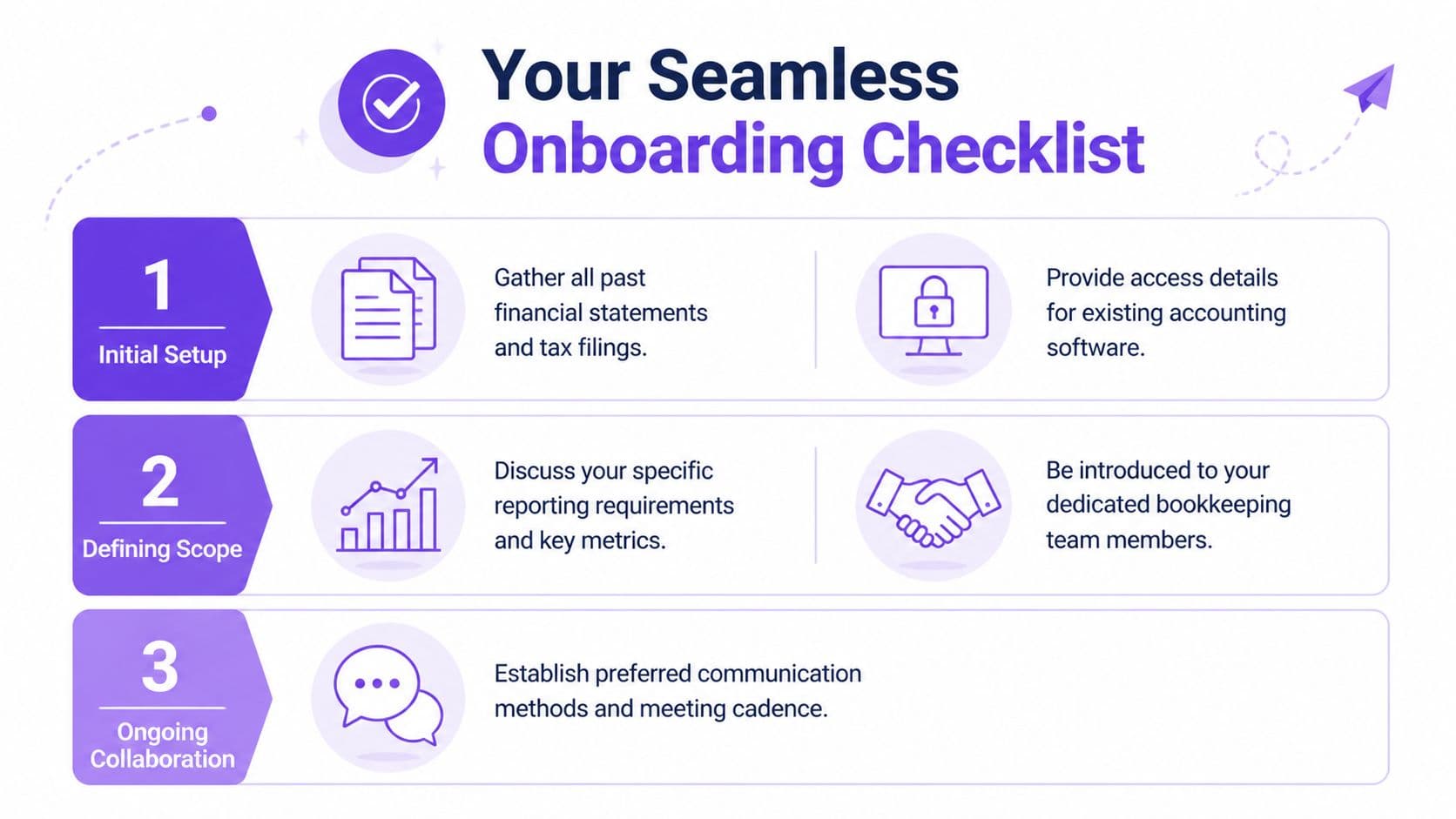
Gather the records your new team will need to assess what’s clean, what’s incomplete, and what needs repair.
- Prior financial statements for recent periods
- Bank and credit card statements
- Access to accounting software
- Payroll reports
- Major customer contracts
- Loan documents
- Sales tax and prior tax filing information
- Current chart of accounts
If anything is missing, say so up front. Hidden gaps are what derail onboarding.
At the kickoff meeting
The first meeting should settle ownership, systems, and reporting expectations.
Use this checklist:
| Topic | What to confirm |
|---|---|
| Scope | What the provider owns, and what your team still handles |
| Systems | Access to QuickBooks, Xero, NetSuite, Stripe, Gusto, Shopify, banks, and cards |
| Reporting needs | Monthly statements, board reporting, cash view, department or client-level reporting |
| Revenue treatment | How contracts, deposits, prepayments, and subscription billing should be handled |
| Communication | Main contacts, meeting cadence, issue escalation path |
Operational advice: Put one person on your side in charge of approvals, document requests, and open questions. Shared ownership slows everything down.
During the first close
Expect the first month to focus on cleanup, baseline reconciliations, and chart-of-accounts adjustments. That’s normal.
What matters is whether the provider can produce a stable close process from there. By the end of the first cycle, you should know:
- what reports you’ll receive
- when they’ll arrive
- what inputs your team must provide
- where unresolved historical issues still exist
A smooth onboarding doesn’t mean zero questions. It means the questions are structured, prioritized, and resolved without chaos.
Industry-Specific Needs Your Bookkeeper Must Understand
Generic bookkeeping is weak bookkeeping once your business model gets even slightly specialized.
A 2025 Xero report found that 70% of high-growth accounting practices now offer specialized advisory services, and 56% directly attribute profit growth to service diversification, according to Xero’s U.S. State of the Industry report. That tracks with what founders need. Not just reconciled books, but reporting that reflects how their business earns money.
SaaS needs revenue discipline and KPI logic
SaaS companies need a provider who understands recurring revenue mechanics.
That means your bookkeeper should know how to support:
- deferred revenue treatment
- MRR and ARR reporting logic
- churn and contraction tracking
- billing platform reconciliation
- contract changes, credits, and renewals
If they treat Stripe or your billing platform as just another bank feed, they don’t understand your business.
Agencies need client and project profitability
Digital agencies and professional services firms need more than an expense ledger. They need visibility into whether the work is profitable.
A useful setup tracks revenue and cost by:
- client
- service line
- team or department
- project or retainer type
That gives you pricing clarity. Without it, you can grow top-line revenue while bleeding margin.
E-commerce needs operational reconciliation
E-commerce finance is one of the fastest places for bookkeeping to go sideways. Payment processors, refunds, reserves, inventory movements, platform fees, shipping costs, and sales tax create constant reconciliation risk.
If you run Shopify, Amazon, or multiple channels, your provider should understand payout timing, holds, and reserve behavior. This guide on managing Shopify fund holds is a useful example of the operational issues that can distort cash expectations if your finance team only looks at gross sales.
A provider who doesn’t understand your operating model will still produce reports. They just won’t produce reports you can trust.
Industry fit isn’t a bonus feature. It’s what turns bookkeeping into useful management information.
Founder FAQs on Startup Bookkeeping
When should I stop doing the books myself
Stop when bookkeeping starts affecting reporting quality, cash visibility, or your time. If you’re second-guessing revenue treatment, delaying the close, or fixing errors retroactively, you’re already late.
Do I need bookkeeping or controller support
If you only need transaction recording and basic monthly statements, bookkeeping may be enough for now. If you need accruals, revenue recognition, close management, cash forecasting, board reporting, or diligence readiness, you need controller involvement too.
Can I keep QuickBooks
Usually yes. Most growing companies don’t need new software first. They need a cleaner chart of accounts, better workflows, and tighter review. Software migration only makes sense when complexity outgrows the current system.
How long does it take to switch providers
It depends on how clean your current books are and how quickly your team can provide access, statements, and historical records. A good provider will sequence the work so cleanup and forward-looking operations don’t collapse into one messy project.
Is outsourced bookkeeping less secure than hiring in-house
Not automatically. Security depends on controls, access discipline, and the provider’s operating standards. You should ask exactly how financial data is stored, shared, reviewed, and protected.
What should I ask on the first sales call
Ask who reviews the books, how they handle accruals and deferred revenue, what the close timeline looks like, what systems they support, and how they secure data access. If the answers are fuzzy, move on.
What’s the biggest mistake founders make here
They wait until a fundraise, audit, tax deadline, or cash problem exposes the weakness. Then they need cleanup under pressure. That’s the most expensive way to solve a finance problem.
If your books are late, unclear, or failing basic diligence standards, fix it before the next investor request, audit, or cash surprise forces the issue. Jumpstart Partners works with growing companies that need cleaner closes, stronger controls, and investor-ready financials without building a full in-house finance team.