Financial Operations
Outsourced Bookkeeping Rates: A 2026 Pricing Guide
Compare outsourced bookkeeping rates for 2026. See what growth companies actually pay and find a plan that fits your budget.
ByJumpstart Partners, CPA, QuickBooks ProAdvisor
··16 min readUS-based outsourced bookkeeping for growing companies typically costs $500 to $2,500 per month, depending on transaction volume and service tier. Controller-supported close work reaches $3,500 to $7,500 per month because it adds accruals, review layers, and investor-ready reporting.
That range is wide enough to expose the problem with asking for an “average” bookkeeping rate. A lean agency that needs categorized transactions and a monthly profit and loss statement isn't buying the same service as a SaaS company that needs revenue recognition, multi-entity reconciliations, and a controlled month-end close.
The right question isn't just, "What does a bookkeeper charge?" Ask instead: What financial work does your business require, how much activity does the team process, and how much decision support must the provider deliver? The answer determines whether a low monthly fee is efficient or dangerously incomplete.
Table of Contents
- How Much Outsourced Bookkeeping Actually Costs Right Now
- The Three Pricing Models Behind Bookkeeper Rates
- What Moves the Needle on Your Monthly Bookkeeping Cost
- Real Outsourced Bookkeeping Rate Scenarios for Different Businesses
- Red Flags That Your Bookkeeping Quote Is Misleading
- How to Evaluate Bookkeeping Value Beyond the Monthly Rate
How Much Outsourced Bookkeeping Actually Costs Right Now
The current market spans roughly $200 to $2,500+ per month for standard outsourced bookkeeping, while controller-supported close work reaches $3,500 to $7,500 per month, according to current outsourced bookkeeping cost benchmarks. Those figures aren't contradictory. They represent different workloads and different levels of financial responsibility.
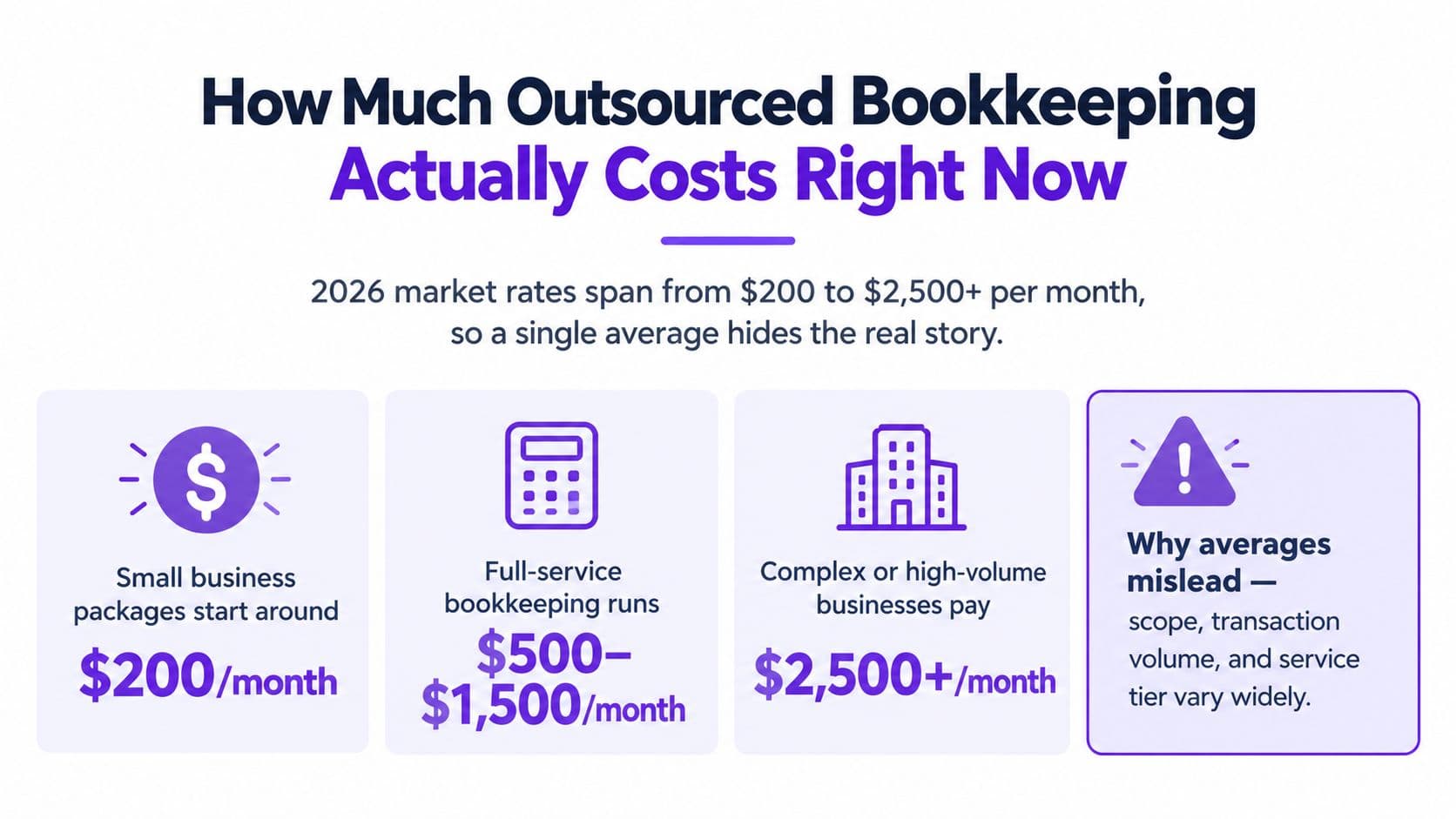
A provider handling straightforward bank reconciliations and monthly statements can operate at the lower end. A provider managing accounts payable, accounts receivable, payroll coordination, accruals, review procedures, and management reporting belongs in a higher tier. The work changes, so the price changes.
Start with activity thresholds
Transaction volume is the first pricing filter. A published 2026 guide places monthly fees around $250 to $400 for 0 to 50 transactions, $400 to $800 for 51 to 200, $800 to $1,500 for 201 to 500, and $1,500 to $3,000+ for more than 500 transactions. See the transaction-based accounting service pricing guide for the underlying tiers.
| Transaction volume | Rate band | Typical scope |
|---|---|---|
| 0 to 50 monthly transactions | $250 to $400 | Categorization, bank reconciliation, basic statements |
| 51 to 200 | $400 to $800 | Reconciliations across several accounts, monthly reporting |
| 201 to 500 | $800 to $1,500 | Broader close work, payroll coordination, more review |
| More than 500 | $1,500 to $3,000+ | High-volume processing, multi-account or multi-entity support |
These thresholds are more useful than revenue alone. A SaaS company with modest revenue but a large number of card charges, bank events, payroll entries, and billing-platform transactions can require more bookkeeping labor than a larger professional services firm with fewer monthly entries.
For a broader comparison before you request proposals, review this outsourced accounting services pricing overview. Use it to frame the conversation, then insist that every quote identify transaction limits, account limits, close responsibilities, and excluded work.
Complexity determines the upper tier
Basic categorization isn't financial oversight. Accrual entries, revenue recognition, inventory, multi-entity consolidation, review workflows, and investor reporting all add work that a low-cost package usually doesn't include. Controller-supported close pricing reaches $3,500 to $7,500 per month, while standard and full-service packages often fall below that level, according to outsourced bookkeeping scope benchmarks.
A realistic quote should therefore begin with your activity profile, not a vague retainer. Give the provider your transaction count, account list, payroll setup, reporting requirements, and desired close timetable. You'll get a more defensible rate and fewer unpleasant change orders.
The Three Pricing Models Behind Bookkeeper Rates
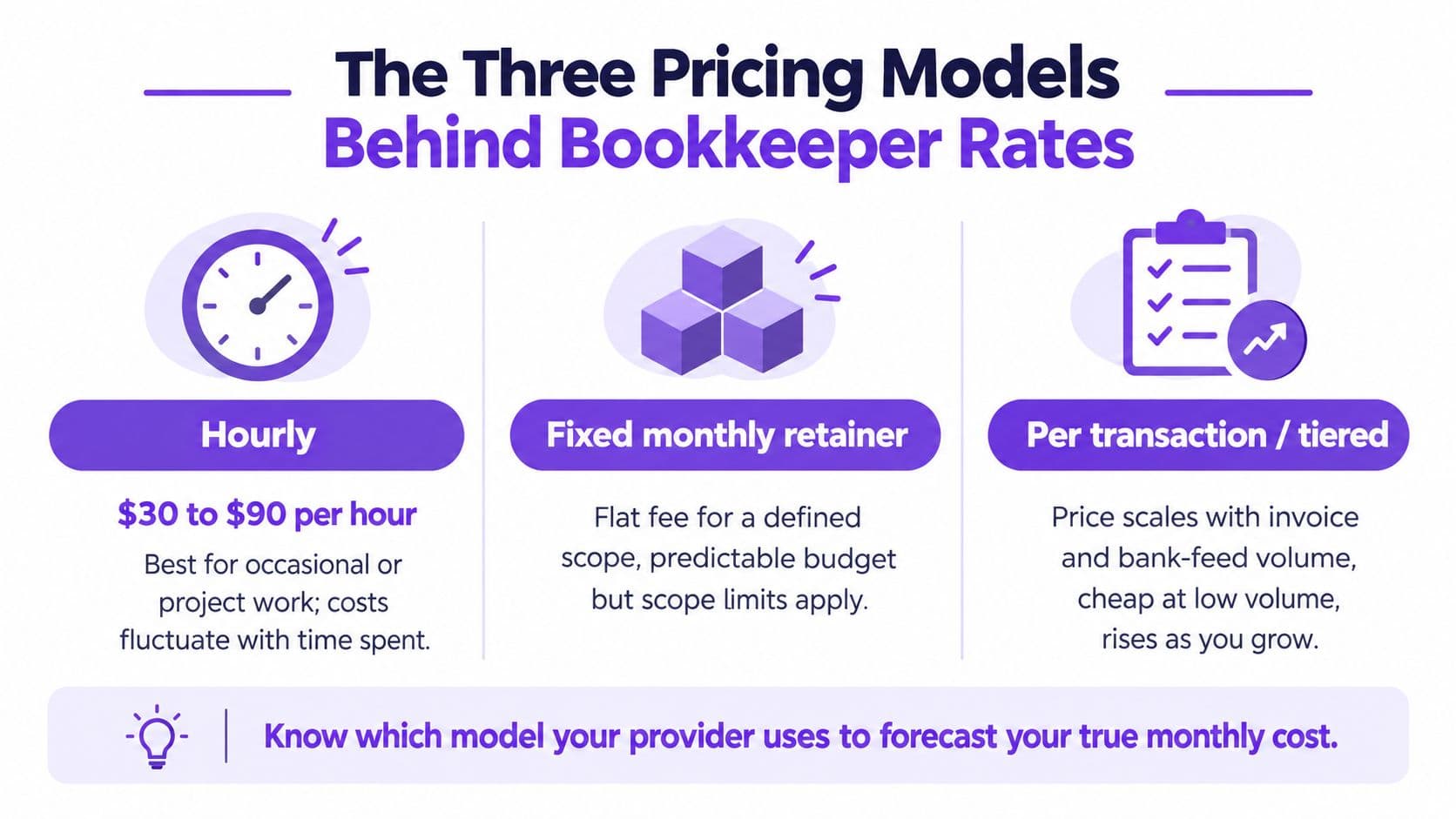
Providers generally use hourly billing, fixed monthly retainers, or transaction-based tiers. Each model can work. The mistake is comparing a low hourly headline against a fixed monthly quote without calculating the work each price buys.
Hourly pricing
A 2026 pricing summary places freelance and outsourced bookkeeping commonly at $30 to $90 per hour, with specialized and controller-level work priced above that range. The bookkeeper pricing benchmark also notes a $55 hourly benchmark for one fractional bookkeeping offering.
Take a business that needs 12 hours of ordinary bookkeeping in a month. At $55 per hour, the calculation is:
12 hours × $55 = $660 per month
That sounds reasonable until month-end cleanup adds 8 hours:
20 hours × $55 = $1,100 per month
Hourly pricing works for cleanup projects, unusual accounting questions, or fluctuating workloads. For recurring bookkeeping, require a monthly cap and written approval before the provider exceeds it. Otherwise, you carry the provider's efficiency risk.
Fixed monthly retainers
A fixed fee buys a defined scope. You pay the same amount each month, but the contract usually sets limits around transactions, accounts, payroll, reporting, or response obligations. A useful explanation of what flat rate pricing means can help you distinguish predictable billing from an artificially narrow package.
Suppose a provider quotes $800 per month for up to 200 transactions, monthly reconciliations, and a standard income statement. Your effective cost at 160 transactions is:
$800 ÷ 160 = $5 per transaction
At 200 transactions, it falls to:
$800 ÷ 200 = $4 per transaction
The rate becomes attractive as volume approaches the package ceiling, provided the scope remains adequate.
Transaction-based tiers
Transaction pricing ties cost directly to activity. If your monthly volume falls into the 201 to 500 band at $800 to $1,500, a business processing 300 transactions at a $1,000 monthly fee pays:
$1,000 ÷ 300 = $3.33 per transaction
That calculation isn't a complete value judgment. Ten complex reconciliations can require more judgment than hundreds of clean bank-feed entries. Treat transaction pricing as a forecasting tool, not proof that the provider understands your accounting.
| Model | Rate range | Best for | Risk profile |
|---|---|---|---|
| Hourly | $30 to $90 per hour | Cleanup, projects, occasional support | Scope creep and unpredictable totals |
| Fixed monthly | Defined monthly fee | Stable recurring work | Paying for unused capacity or exceeding scope |
| Transaction-based | Tiered by activity | Variable or high-volume processing | Fees rise as transaction volume rises |
For recurring finance operations, I favor a fixed monthly fee with explicit activity thresholds and an hourly or project rate for exceptions. That structure gives you budget control without pretending that every month requires identical effort. Broader service requirements belong in a separately defined outsourced finance services scope, not hidden inside a basic bookkeeping label.
What Moves the Needle on Your Monthly Bookkeeping Cost
Revenue is a poor shortcut for estimating bookkeeping effort. Volume and operational complexity drive the workload. A SaaS company can have modest revenue and still generate a dense stream of card charges, payroll records, subscription events, and platform settlements. A professional services firm with higher revenue can need less monthly processing if it has fewer accounts and simpler billing.
Six levers usually determine where your quote lands.
| Cost driver | Low impact | High impact |
|---|---|---|
| Transaction count | Few bank and card entries | Dense feeds, payment platforms, and frequent adjustments |
| Accounts to reconcile | One operating account and one card | Multiple banks, cards, merchant accounts, and entities |
| Payroll coordination | One straightforward payroll run | Multiple states, providers, benefits, or departments |
| AP and AR management | Client-managed bills and collections | Provider handles approvals, invoices, aging, and follow-up |
| Month-end close cadence | Statements delivered after basic reconciliation | Controlled close with accruals, review, and deadlines |
| Reporting depth | Standard P&L and balance sheet | Departmental reporting, KPIs, cash flow, and investor packages |
Score the work before you request a quote
Use a simple qualitative score. Put yourself in the lower band when activity is light, accounts are few, payroll is simple, and the provider only prepares standard statements. You belong in the middle band when several payment systems, payroll coordination, AP or AR, and recurring close tasks are involved.
The upper band applies when you need multi-entity work, accrual accounting, revenue recognition, inventory, review layers, or reporting for lenders, investors, or a board. Don't ask a basic bookkeeper to deliver controller accountability at a basic bookkeeper price.
Practical rule: Every added account, platform, approval workflow, and reporting deadline creates work. Put each one in the scope before you compare rates.
Fixed-fee surprises usually appear at the boundary between “included bookkeeping” and “financial operations.” A quote can include reconciliation while excluding the journal entries needed to make the financial statements accurate. It can include monthly reports while excluding the close review that makes those reports reliable.
For a smaller business, compare providers using this bookkeeping services guide for small businesses, then adjust the scope for your actual systems. QuickBooks, Xero, Stripe, Shopify, Gusto, and NetSuite workflows don't carry the same reconciliation burden. Ask the provider to show how each system enters the monthly close rather than accepting “integration support” as a deliverable.
Real Outsourced Bookkeeping Rate Scenarios for Different Businesses
The cleanest way to understand outsourced bookkeeping rates is to map them to operating profiles. The following examples use published market bands, not invented client results. Your quote should move within or above these ranges when the underlying workload changes.
A lean digital agency
An agency with fewer than 100 monthly transactions and uncomplicated client billing fits the lower fixed-monthly tier. The market guide for monthly close work places businesses with fewer than 100 monthly transactions around $300 to $600 per month. The relevant monthly close pricing benchmark identifies transaction volume, account count, and scope as the main pricing mechanics.
At this level, the expected package should include transaction categorization, bank and card reconciliation, basic account review, and a monthly P&L and balance sheet. A monthly fee of $500, for example, represents:
$500 ÷ 80 transactions = $6.25 per transaction
That price is sensible only if the agency supplies clean records and handles bill payment, collections, payroll administration, and unusual adjustments internally. Cleanup work, project-level profitability, or additional reporting should trigger a separately priced add-on.
A scaling SaaS company
A SaaS company with subscription revenue, several payment platforms, payroll, and a growing account structure belongs in standard to full-service pricing. The bookkeeping team isn't merely coding bank activity. It must reconcile billing and cash, handle timing differences, coordinate payroll entries, and support revenue recognition under ASC 606 where applicable.
Published market ranges place standard bookkeeping around $1,500 to $3,000 per month when scope expands to AP or AR management, payroll coordination, monthly statements, review, and adjusting entries, as outlined in this outsourced bookkeeping cost guide. A $2,000 monthly fee for 400 transactions produces:
$2,000 ÷ 400 transactions = $5 per transaction
That calculation understates the value of the engagement if the provider also supports the close and produces decision-ready reporting. It overstates value if “full service” means only more transaction coding.
A multi-entity or PE-backed business
A multi-entity or private-equity-backed company needs a different operating model. Accruals, intercompany balances, consolidation, review procedures, investor reporting, and a controlled close create several layers of work. Controller-supported close services sit around $3,500 to $7,500 per month, according to the cited market roundup.
The right question here isn't whether the company can find a cheaper bookkeeper. It's whether the provider can maintain consistent accounting policies, document review, explain variances, and prepare financials that withstand investor scrutiny. A low rate that excludes those controls transfers the cost to management, the CPA, or the next diligence process.
| Company profile | Monthly rate | Key scope drivers |
|---|---|---|
| Lean digital agency | $300 to $600 | Fewer than 100 transactions, simple reconciliations, monthly P&L |
| Scaling SaaS company | $1,500 to $3,000 | Subscription revenue, platform reconciliations, payroll, close support |
| Multi-entity or PE-backed business | $3,500 to $7,500 | Accruals, consolidation, review layers, investor reporting |
Founders moving from DIY accounting can use this startup bookkeeping services resource to define the transition scope. Don't confuse startup branding with startup-level complexity. Once the company has multiple revenue streams, entities, or reporting obligations, the engagement needs to mature with it.
Red Flags That Your Bookkeeping Quote Is Misleading
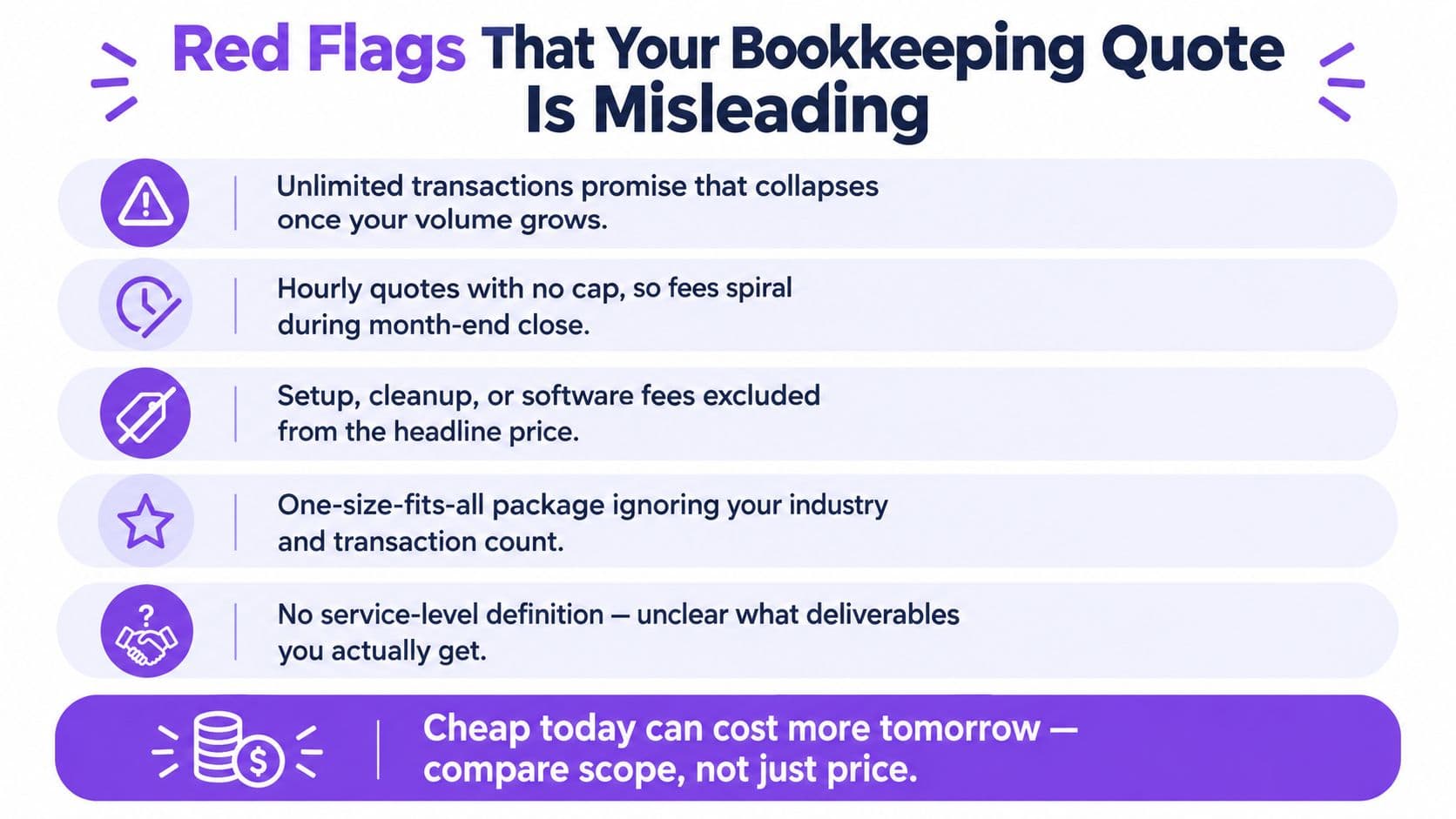
The cheapest quote often wins because buyers compare the headline fee before comparing the work. That approach fails when the provider leaves out close procedures, caps activity unexpectedly, or charges extra for the adjustments required to make the books usable.
Unlimited transactions that aren't unlimited
An “unlimited” plan deserves scrutiny. Ask whether the promise covers bank and card entries only, or whether it also covers invoices, bills, payroll entries, merchant settlements, journal entries, and cleanup. If the provider adds a surcharge once your activity grows, the headline rate isn't your real rate.
Hourly billing without a ceiling
Hourly work has a legitimate place, but recurring bookkeeping without a cap exposes you to scope creep. Month-end close takes longer when records arrive late, integrations fail, or the provider discovers unreconciled balances. Require a monthly estimate, a spending ceiling, and written approval for overages.
Premium pricing without month-end close
A package can advertise monthly financial statements while excluding accruals, depreciation, deferred revenue, or review. You then receive reports that look complete but don't reflect the accounting decisions your company needs. Ask for the exact close checklist and the date by which reports are delivered.
Offshore pricing with no review layer
Offshore delivery can reduce labor cost. One market comparison says offshore or outsourced models may cost roughly 50% less than onshore staffing in some cases, while the same coverage describes growing expectations for digital workflows and AI-enabled delivery. Read the ACCA coverage of outsourcing trends for that market context.
The issue isn't geography by itself. The issue is whether communication, quality review, data security, and escalation ownership are clearly defined. A lower rate doesn't compensate for delayed answers during close or repeated remediation by your internal team.
Vague deliverables
“Full-service bookkeeping” means little without a workplan. Your proposal should specify accounts reconciled, reports delivered, journal entries included, close date, payroll responsibilities, AP and AR responsibilities, software fees, cleanup treatment, and change-order triggers.
Use this validation checklist before signing:
- Scope: Are transaction and account limits explicit?
- Close: Is there a defined close calendar and review owner?
- Exceptions: What creates an add-on charge?
- Ownership: Who answers technical accounting questions?
- Controls: Who reviews reconciliations and journal entries?
- Continuity: What happens when the assigned bookkeeper is unavailable?
Use catch-up bookkeeping services when prior periods need remediation, but keep cleanup separate from the recurring monthly scope. Mixing historical repair with ongoing work makes both the price and the delivery timeline harder to control.
How to Evaluate Bookkeeping Value Beyond the Monthly Rate
A useful provider comparison has five dimensions: close reliability, error detection, technology integration, reporting quality, and continuity. Price remains important, but it should be the final filter after you confirm that the provider can produce the financial information your business actually uses.
Close reliability
Ask when the prior month closes, who reviews the reconciliations, and what happens when an account doesn't tie. A fast close without review is careless. A careful close with no reliable deadline is operationally weak. You need both control and predictability.
Error detection and remediation
Request examples of how the team identifies duplicate transactions, unreconciled balances, incorrect classifications, and revenue timing issues. Don't accept a generic accuracy promise. Ask how errors are logged, corrected, and prevented from recurring.
Technology and reporting
List your systems before the sales call. A provider supporting QuickBooks or Xero must understand how Stripe, Shopify, Square, Gusto, BambooHR, or NetSuite activity reaches the general ledger. Ask whether integrations are automated, reviewed, and documented.
Your reports should support decisions, not merely satisfy a filing requirement. Test whether the provider can explain gross margin movement, cash runway, deferred revenue, client profitability, or department performance in plain English. For teams building a stronger reporting process, this practical guide for 2026 offers useful context on turning financial data into analysis.
The questions that expose weak proposals
Ask each candidate:
- What exactly is included in the monthly fee?
- Which transaction, account, entity, and payroll thresholds change the price?
- What work is excluded from month-end close?
- Who reviews the preparer's work?
- What is the escalation path for technical accounting questions?
- Which software costs are included?
- How do you handle cleanup, late records, and system changes?
- Can the same team support the next stage of growth?
Jumpstart Partners is one option for companies that need outsourced bookkeeping, monthly close management, reconciliations, and basic AP or AR support. Its stated service model also covers CPA-certified delivery, investor-ready financials, and integrations across common accounting, payroll, billing, and commerce platforms.
The right outsourced bookkeeping rates reflect the total financial operation, not just transaction coding. Compare the fee against close discipline, reporting usefulness, review quality, security, and the cost of replacing the provider when your company outgrows the package.
If your business is generating $500K to $20M in revenue, Jumpstart Partners can help define the bookkeeping, close, reconciliation, and controller support your operating profile requires. Visit the site to request a scope-based consultation and compare a clear monthly plan with the financial oversight your next growth phase demands.