Financial Operations
Revenue Recognition GAAP for SaaS Founders
Master revenue recognition GAAP and ASC 606 for SaaS and agencies. Learn the 5-step model, journal entries, and audit prep to protect your valuation.
ByJumpstart Partners, CPA, QuickBooks ProAdvisor
··16 min readThe fastest way to create a fundraising problem is to report revenue when cash arrives. Under revenue recognition GAAP, an annual SaaS prepayment usually starts as a contract liability, not earned revenue. That distinction affects your income statement, deferred revenue, MRR, ARR, investor reporting, and the credibility of every forecast you hand to a buyer or auditor.
ASC 606 replaced a fragmented U.S. GAAP environment of more than 100 pronouncements, including industry-specific rules such as SFAS No. 48 and SOP 97-2, with a single five-step model. FASB and IASB issued the converged standards in May 2014. The guidance became effective for public companies with calendar-year ends on January 1, 2018, while nonpublic entities received an additional year, as summarized in this overview of revenue recognition and matching.
For a company generating $500K to $20M in revenue, this isn't academic accounting. A premature revenue entry can inflate growth metrics, create a deferred revenue hole, force a restatement during diligence, and delay a financing close. You need a contract-level process that your bookkeeper, controller, auditor, and investors can all follow.
Table of Contents
- Why Cash in the Bank Is Not Recognized Revenue
- The ASC 606 Five-Step Model Explained for Founders
- Timing and Allocation in SaaS and Agency Models
- Recording the Journal Entries for Deferred Revenue
- Red Flags and Common Revenue Recognition Mistakes
- Preparing Your Disclosures for Audits and Fundraising
- Securing Your Financial Foundation with Expert Support
Why Cash in the Bank Is Not Recognized Revenue
An annual customer prepayment improves liquidity immediately, but it doesn't automatically increase recognized revenue. If a customer pays $120,000 for a year of access, you generally recognize that subscription as you deliver the service, not when Stripe, ACH, or a bank transfer puts the cash on your balance sheet.
That rule follows ASC 606's central principle. Revenue is recognized when control of a promised good or service transfers to the customer. The invoice date and cash date provide evidence about billing and collection. They don't determine when you satisfied the performance obligation.
The business consequences of getting timing wrong
Suppose you invoice an annual subscription in January and record the entire amount as January revenue. Your January P&L looks stronger, but the following months understate operating performance. Your reported MRR becomes unstable, your ARR analysis loses meaning, and your forecast no longer reflects the service your customers are receiving.
That creates problems beyond bookkeeping:
- Fundraising diligence: Investors reconcile bookings, billings, cash collections, recognized revenue, deferred revenue, and customer cohorts. An unexplained mismatch raises questions about the reliability of your operating metrics.
- M&A diligence: Buyers can require purchase-price adjustments or post-close claims when reported revenue doesn't survive a contract review.
- Audit procedures: Revenue receives concentrated scrutiny because management has incentives to report growth early. Unsupported spreadsheets and undocumented judgments make routine testing painful.
- Management decisions: Hiring, pricing, and cash planning based on invoice totals can cause you to mistake a timing effect for genuine growth.
Your accounting team should maintain a written revenue policy before contract volume becomes difficult to review. A practical subscription revenue recognition reference can help your team explain the distinction between billing, cash collection, deferred revenue, and earned revenue. You can also use this deferred revenue guide as a plain-English reference for the balance-sheet mechanics.
Practical rule: Treat every new pricing model, onboarding package, usage fee, and customer concession as a revenue-policy question before it becomes a journal entry.
ASC 606 and IFRS 15 use the same five-step model, which created a common contract-based framework across major markets. IFRS 15 was issued in May 2014 and became effective for annual periods beginning on or after January 1, 2018. U.S. public companies adopted ASC 606 for fiscal years beginning after December 15, 2017, with private companies and nonprofits following a year later, according to this ASC 606 versus IFRS 15 comparison.
The ASC 606 Five-Step Model Explained for Founders
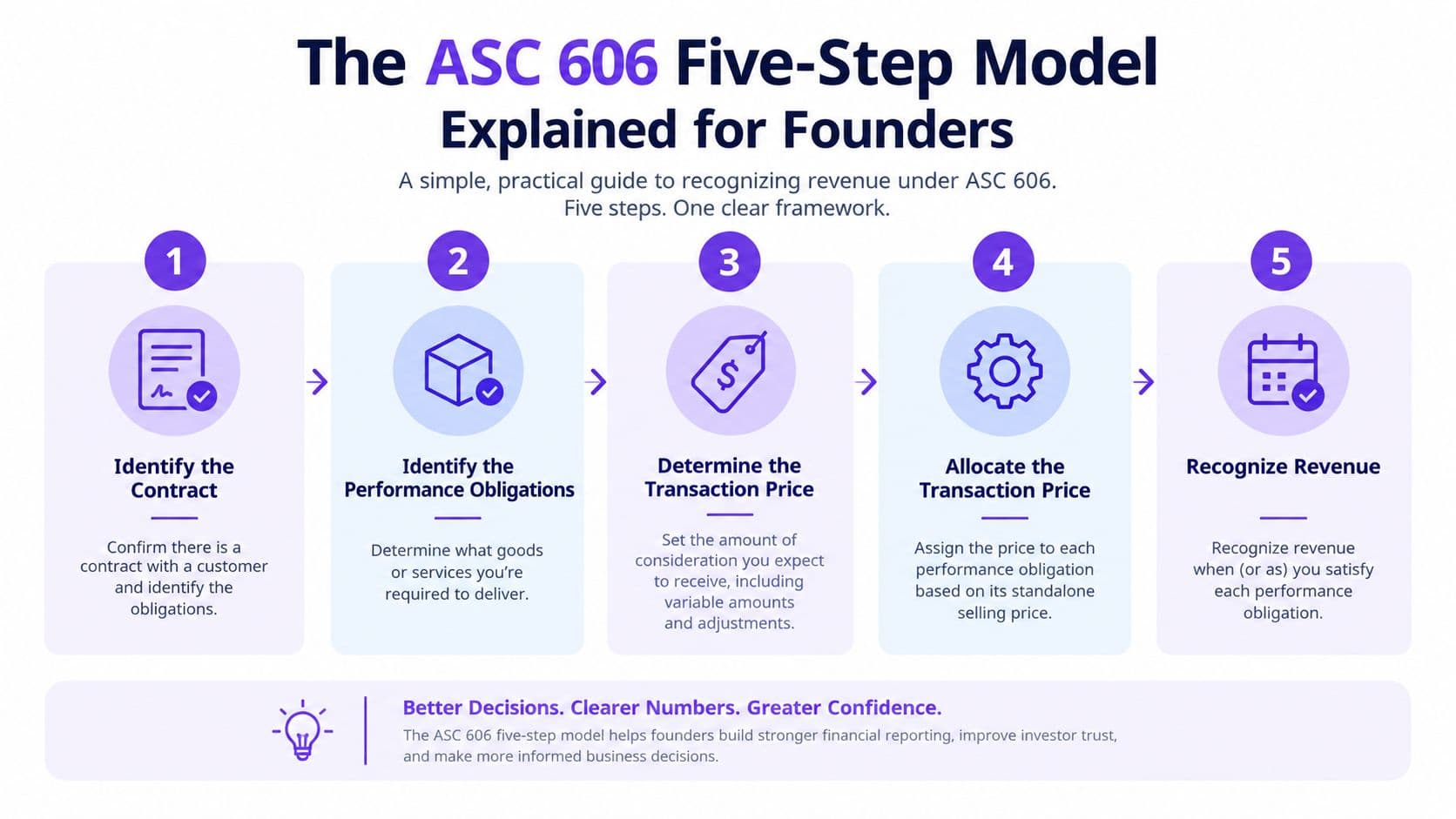
ASC 606 becomes manageable when you apply it to the actual contract instead of memorizing accounting terminology. The model asks five questions in sequence, but the answers connect. Your performance-obligation decision determines allocation, and allocation determines the timing and amount of revenue.
Start with the contract
Step one, identify the contract with the customer. Confirm that the parties approved the arrangement, each party's rights are identifiable, payment terms are clear, the arrangement has commercial substance, and collection is probable. Your process should include written agreements, order forms, statements of work, and approved amendments.
A signed document isn't enough if the commercial terms remain unresolved. Review side letters, cancellation rights, credits, implementation commitments, and promises made by sales.
Separate what you promised
Step two, identify the performance obligations. A promise is a separate performance obligation when the customer can benefit from it on its own or with readily available resources, and when it's separately identifiable from other promises in the contract.
A SaaS contract could include platform access, implementation, data migration, training, support, and professional services. Don't bundle those items just because the customer sees one invoice. Use the performance obligations guide to pressure-test whether each promised service is distinct.
Measure the consideration
Step three, determine the transaction price. Start with fixed consideration, then evaluate usage fees, rebates, refunds, credits, bonuses, penalties, and other variable amounts. ASC 606 permits variable consideration only to the extent that it's probable a significant revenue reversal won't occur.
You must document whether the expected-value method or most-likely-amount method better predicts the consideration. The choice should follow the contract's economics, not the result management wants for the month.
Allocate using standalone selling prices
Step four, allocate the transaction price. Assign the contract price to each performance obligation based on relative standalone selling prices. If you sell implementation and subscriptions separately, those transactions provide useful evidence. If no observable price exists, document a defensible estimate based on market evidence, expected cost plus margin, or another appropriate method.
Recognize as the customer receives value
Step five, recognize revenue when each obligation is satisfied. A SaaS service delivered evenly over a subscription period generally follows an over-time pattern. A distinct deliverable, such as a completed one-time implementation, may be recognized at a point in time when control transfers.
The correct question isn't, “Did we invoice?” Ask, “What did we transfer, and when did the customer obtain control or receive the service?”
Timing and Allocation in SaaS and Agency Models
The difficult judgment isn't the five-step list. It's deciding how your real contract behaves. SaaS companies often deliver stand-ready access over time, while agencies may deliver campaigns, creative assets, or milestones with different transfer patterns. A single customer agreement can contain both.
ASC 606 recognizes revenue over time when the customer simultaneously receives and consumes benefits, when the customer controls an asset as it's created, or when the work has no alternative use and you have an enforceable right to payment for performance completed to date. If none of those conditions applies, recognize revenue at a point in time when control transfers.
A worked allocation example
Assume a customer signs a $120,000 contract containing:
- A $20,000 setup and implementation service
- A $100,000 annual SaaS subscription
Assume the standalone selling price of setup is $30,000 and the standalone selling price of the annual subscription is $120,000. The combined standalone value is $150,000, so the contract discount is allocated proportionally.
| Performance Obligation | Standalone Price | Allocation % | Allocated Revenue |
|---|---|---|---|
| Setup and implementation | $30,000 | 20% | $24,000 |
| Annual SaaS subscription | $120,000 | 80% | $96,000 |
| Total | $150,000 | 100% | $120,000 |
If setup is satisfied at completion, you recognize $24,000 when that obligation is complete, assuming the facts support point-in-time recognition. You recognize the remaining $96,000 over the annual subscription period. Dividing $96,000 by the contract's twelve monthly service periods produces $8,000 per month for the subscription component.
The invoice still totals $120,000. The accounting follows the allocated obligations, not the invoice layout. Calling the entire amount “subscription revenue” would overstate the subscription's allocated revenue and hide the setup obligation.
Variable consideration requires restraint
Usage-based pricing creates a separate control problem. A 2025 SaaS survey reported that 85% of respondents had adopted usage-based pricing and nearly 50% had done so within the prior two years, according to revenue recognition statistics for usage-based pricing. Those models force you to address estimates, true-ups, credits, and revenue disaggregation.
For a usage fee, estimate consideration using the expected-value or most-likely-amount method, then apply the constraint. Historical usage helps, but it doesn't eliminate the need to consider current conditions and reasonable forecasts. Document why the estimate won't create a significant reversal, and define when you will remeasure it.
Agencies face the same issue with milestone bonuses, client acceptance clauses, refunds, and performance incentives. Don't recognize a bonus because the sales team expects to earn it. Recognize it only when the reversal analysis supports inclusion.
For founders evaluating recurring revenue quality, a useful companion resource is The Owner's Shortlist on valuation. Keep its commercial valuation perspective separate from your accounting conclusion. Recurring revenue can support a strong business model, but it doesn't override ASC 606 timing.
Recording the Journal Entries for Deferred Revenue
Your policy has to reach the general ledger. Consider an annual SaaS subscription where the customer pays $120,000 upfront and the service is delivered evenly across the annual term.
At collection, the customer has paid before you transfer the related service. ASC 606 presents that amount as a contract liability. The initial entry is:
| Account | Debit | Credit |
|---|---|---|
| Cash | $120,000 | |
| Contract liability, deferred revenue | $120,000 |
This entry increases cash and records the obligation to provide future service. It does not create revenue.
Release revenue as service is delivered
Assuming the subscription is satisfied evenly over the annual service period, the monthly revenue release is:
$120,000 ÷ 12 monthly service periods = $10,000 per month
The recurring monthly entry is:
| Account | Debit | Credit |
|---|---|---|
| Contract liability, deferred revenue | $10,000 | |
| Subscription revenue | $10,000 |
After the first monthly release, the contract liability falls to $110,000. After subsequent monthly releases, the balance continues declining as the company provides access. The journal entry should tie to a contract schedule, not to a manual plug that makes the P&L hit a target.
Distinguish liabilities from assets
A contract liability exists when the customer pays, or payment becomes due, before you transfer the promised good or service. A contract asset goes in the opposite direction. You recognize a contract asset when you have transferred goods or services before obtaining an unconditional right to payment, such as unbilled services.
That distinction matters for agencies that perform work before billing and SaaS companies with earned usage charges that haven't yet become billable. Don't label every timing difference deferred revenue.
Classified balance sheets may also require current and noncurrent presentation based on when the related right or obligation will settle. Annual SaaS prepayments can make cash look healthy while earned revenue remains lower, and unbilled services can make reported revenue lag behind work already performed. Your balance-sheet schedule should show both the classification and the expected release pattern.
For a broader look at how prepayment structures affect customer financing and revenue timing, review this discussion of customer financing prepayment models. Then make sure your controller documents the actual contract terms rather than applying a generic schedule.
The mechanics are summarized well in this revenue recognition journal entries guide. Your close checklist should reconcile beginning contract liabilities, additions from new billings, revenue recognized, credits, modifications, and ending balances.
Red Flags and Common Revenue Recognition Mistakes
Most ASC 606 failures don't begin with an exotic accounting issue. They begin with a shortcut that looks harmless during a busy close. Auditors and investors then find that the shortcut has been applied inconsistently across contracts.
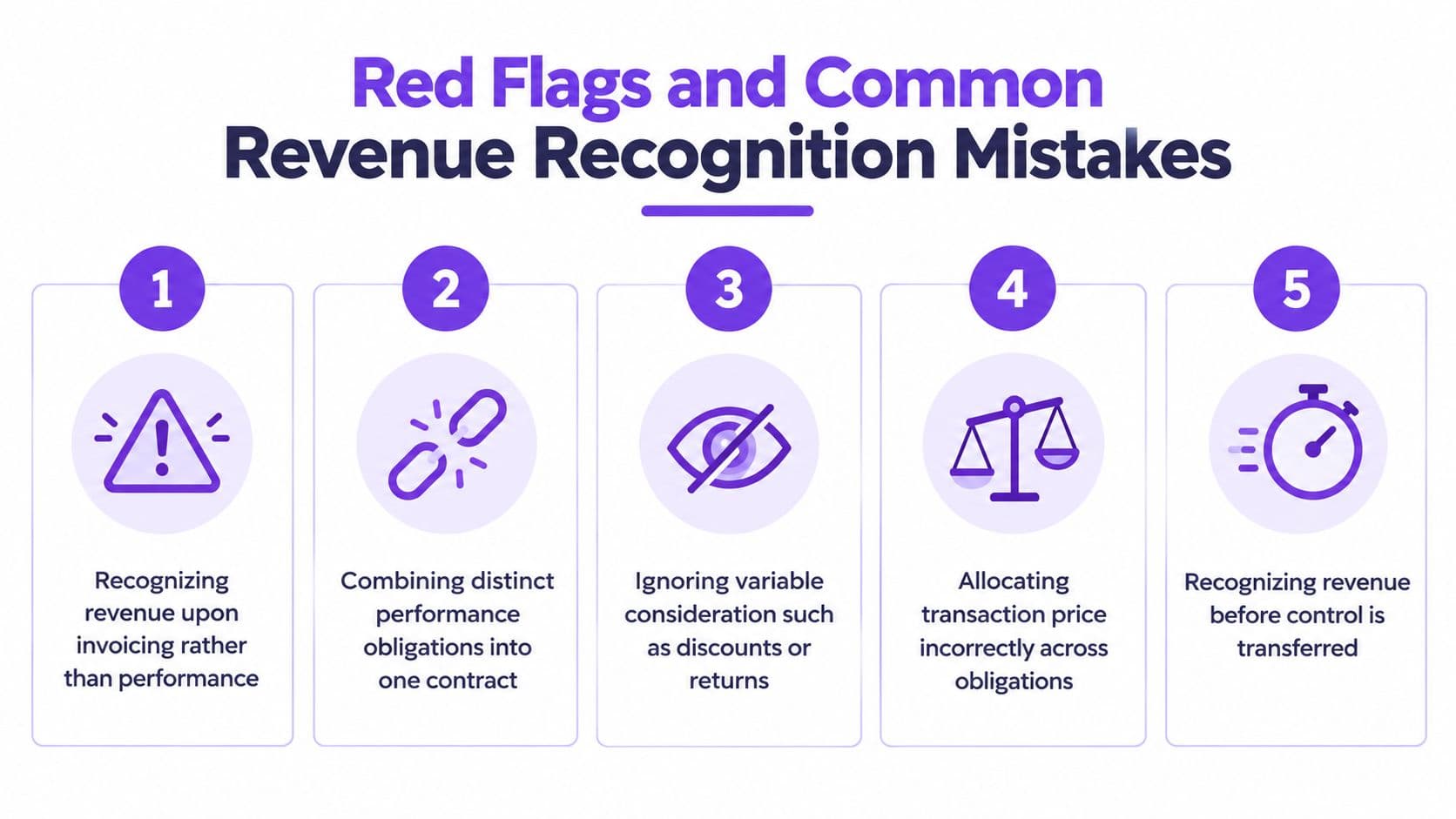
Compare the shortcut with the control
| Shortcut | Why it fails | Better control |
|---|---|---|
| Recognize revenue when invoiced | Billing doesn't prove transfer of control | Tie recognition to each performance obligation |
| Treat a bundle as one service | Setup, implementation, and access may be distinct | Maintain a contract-obligation matrix |
| Include every expected bonus or usage amount | Variable consideration can reverse | Apply and document the constraint |
| Leave modifications in Excel | Scope and price changes can alter allocation | Version amendments and regenerate schedules |
| Use an unsupported SSP | Allocation lacks objective support | Refresh SSP analysis and approve assumptions |
Warning signs inside your close
Invoice-based recognition is the clearest warning sign. If your monthly revenue entry comes directly from the billing report with no service-period or obligation analysis, your process is probably measuring invoices rather than performance.
Unlogged contract modifications create another exposure. A customer may add seats, reduce scope, extend a term, change pricing, or receive a concession. Recent guidance emphasizes a documented audit trail for determining whether the modification is a combined contract, a separate contract, or a change to the existing arrangement. You also need to show when a new standalone selling price triggers reallocation and how the deferred revenue rollforward was regenerated from source data, as discussed in this recent analysis of contract modifications and SSP reallocations.
Excel-only true-ups deserve immediate attention. A spreadsheet can support a small, stable population of contracts, but disconnected files create version-control problems when sales, billing, CRM, and accounting data disagree. The risk grows when one person changes an assumption without preserving the previous calculation or approval.
A clean bank reconciliation doesn't prove clean revenue recognition. It proves only that cash activity was reconciled.
Other red flags include unsupported usage estimates, missing credit and refund reserves, setup fees recognized immediately without a distinct-service analysis, and MRR dashboards that pull from invoices instead of the revenue schedule. During fundraising, a restatement or unexplained adjustment can consume management time and undermine confidence precisely when investors are testing your reporting discipline.
Preparing Your Disclosures for Audits and Fundraising
Investors don't need a theoretical memo. They need a repeatable explanation of how your contracts become reported revenue. Your audit package should let a reviewer trace an agreement from source document to performance obligations, transaction price, allocation, recognition schedule, journal entry, and disclosure.
ASC 606 disclosures generally address four areas:
- Disaggregated revenue: Break revenue into categories that show how economic factors affect its nature, amount, timing, and uncertainty.
- Contract balances: Reconcile opening and closing contract assets and contract liabilities, including the activity that explains changes.
- Performance obligations: Describe the promised goods and services, when you satisfy them, and the important payment terms.
- Significant judgments: Explain decisions about obligation identification, variable consideration, allocation, and timing.
Build an investor-ready evidence file
Your revenue policy should include examples from your own contracts. Attach a contract matrix showing product, customer type, pricing model, identified obligations, standalone selling prices, recognition pattern, and treatment of modifications.
For variable consideration, retain the estimation method, supporting historical data, current-condition analysis, reversal assessment, and remeasurement triggers. If you use an expected-value method for one class of contracts and a most-likely-amount method for another, explain why each method best predicts consideration.
Your rollforward should reconcile:
- Beginning contract liability and contract asset balances.
- New billings and payments.
- Revenue recognized during the period.
- Credits, refunds, cancellations, and modifications.
- Ending balances by current and noncurrent classification.
Fundraising teams should also reconcile recognized revenue to bookings, billings, cash collections, ARR, and MRR. These metrics serve different purposes. Don't force them to match. Explain the timing differences and show that the differences arise from contract terms rather than accounting errors.
A clean due diligence report framework can help organize the evidence investors request. The standard of quality is simple: another qualified reviewer should be able to reproduce your conclusion without relying on the founder's memory or an undocumented spreadsheet.
Securing Your Financial Foundation with Expert Support
You don't fix revenue recognition by adding one more spreadsheet tab. You fix it by connecting contracts, CRM data, billing, deferred revenue schedules, journal entries, and management reporting under one approved policy.
Start with this checklist:
- Review your largest contracts and every nonstandard pricing term.
- Map each product and service to performance obligations.
- Document standalone selling prices and approval ownership.
- Separate fixed and variable consideration.
- Test over-time versus point-in-time conclusions.
- Reconcile deferred revenue and contract assets monthly.
- Preserve every contract modification and true-up.
- Reconcile MRR and ARR dashboards to recognized revenue without treating them as identical metrics.
For a company between $500K and $20M in revenue, an outsourced controller can provide the accounting structure that a bookkeeper alone usually can't. Jumpstart Partners is one option that provides outsourced controller and bookkeeping support, including ASC 606 workflows, deferred revenue journal entries, GAAP reporting, and investor-ready financial packages. Review outsourced controller services when your internal team needs controller-level ownership without building that function entirely in-house.
Don't wait for an audit request or term sheet to expose the gaps. Fix the policy, schedules, evidence, and reporting workflow while your contract population is still manageable.
Jumpstart Partners helps SaaS, agency, and professional services businesses implement ASC 606 workflows, reconcile deferred revenue, and produce financial reporting that stands up to fundraising and audit scrutiny. Visit Jumpstart Partners to discuss your revenue recognition process and determine the right controller support for your business.