Financial Operations
Self Employed Tax Calculator: Estimate Your 2026 Liability
Accurately estimate your 2026 tax liability with our self employed tax calculator. Discover formulas, deductions & strategies for SaaS/agency founders.
ByJumpstart Partners, CPA, QuickBooks ProAdvisor
··17 min readMost founders overestimate self-employment tax because they start with the wrong number. The tax isn't applied to the full profit figure you see on your P&L. It's applied after a required adjustment, and that single detail changes how much cash you should reserve for taxes, payroll, and growth.
That matters more than most operators realize. If you run a SaaS company, digital agency, or professional services firm, a bad tax estimate doesn't just create filing pain. It distorts hiring plans, owner distributions, and quarterly cash decisions. A generic self employed tax calculator can give you a rough answer. It usually won't tell you whether your current entity structure is inefficient, whether your quarterly payment pattern fits volatile revenue, or whether owner draws are setting you up for a tax surprise.
Table of Contents
- Why Your Self Employed Tax Calculation Is a Growth Lever
- Deconstructing Your Self Employment Tax Bill
- A Four-Step Calculation for Accurate Tax Estimates
- Strategic Deductions for SaaS and Agency Founders
- Mastering Estimated Quarterly Tax Payments
- When an S-Corp Election Beats a Sole Proprietorship
Why Your Self Employed Tax Calculation Is a Growth Lever
Founders often treat tax estimating like a year-end cleanup task. That's backwards. Your tax estimate is a live operating input, just like pipeline coverage, gross margin, or burn.
If you under-reserve, you starve the business later. If you over-reserve, you leave money idle that could have funded paid acquisition, a key engineering hire, or overdue systems work. The point of a self employed tax calculator isn't just compliance. It's capital allocation.
The cash flow mistake that shows up in growth plans
In founder-led businesses, personal tax liability often comes out of the same economic engine that funds expansion. You may keep the liability outside the company books, but the cash still has to come from somewhere. That's why tax forecasting belongs inside the same process as cash flow forecasting best practices.
A weak estimate usually creates one of three problems:
- You distribute too much too early: The business looks flush after a strong month, so you take draws that should've stayed reserved for taxes.
- You hire off gross profit instead of true after-tax cash: Revenue feels strong, but owner tax drag hasn't been modeled.
- You use a generic calculator as if it were a planning model: It gives you a number, but not a decision framework.
Practical rule: If your business has variable monthly profit, your tax reserve should move with actual results, not sit on a flat annual assumption.
Why founders get this wrong
The biggest conceptual error is simple. Founders assume the tax starts with gross profit in the plain-English sense. It doesn't. Tax calculations depend on net self-employment earnings and then move through separate layers of self-employment tax and income tax.
That distinction matters most once the business starts scaling. At a small size, rough estimates are survivable. At a larger size, the same sloppiness affects quarterly cash, owner pay design, and whether an S-Corp election has become overdue.
A self employed tax calculator is useful when it helps you answer a business question: how much cash is available after tax? If it can't answer that, it's not a strategic tool. It's just a form with a number at the end.
Deconstructing Your Self Employment Tax Bill
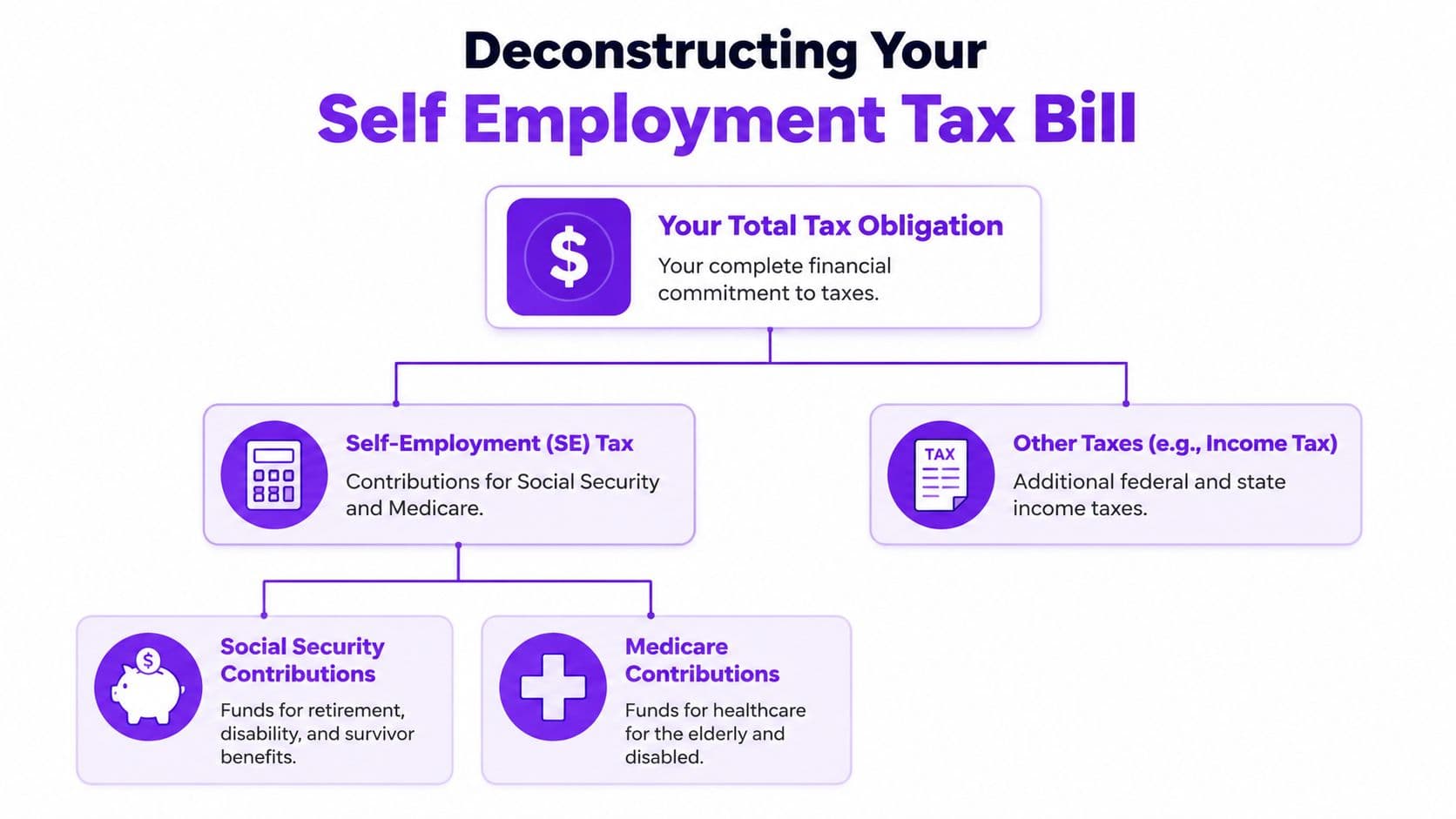
Your total tax bill is not one tax. It's two separate obligations that founders often blur together.
First, there's self-employment tax, which includes the Social Security and Medicare side of what a W-2 employee would normally share with an employer. Second, there's federal income tax, which applies separately. If you combine them too early, you lose visibility into what's driving the liability.
What the self-employment tax actually includes
In the United States, the self-employment tax rate is 15.3%, combining a 12.4% Social Security tax and a 2.9% Medicare tax. For 2026, the Social Security portion applies only to the first $184,500 of adjusted earnings. The IRS requires you to file and pay this tax if your net earnings from self-employment are $400 or more, according to this 2026 self-employment tax overview.
That gives you the baseline mechanics, but not the whole planning picture. For founders, a key issue is that this tax sits on top of income tax. The two interact, but they are not the same thing.
Think about it like payroll and profit tax
A clean mental model helps.
| Tax component | What it covers | Why founders mix it up |
|---|---|---|
| Self-employment tax | Social Security and Medicare obligation on self-employment earnings | It feels like “business tax,” so owners assume it replaces income tax |
| Federal income tax | Tax on taxable income after applicable deductions | Owners see one combined cash outflow and stop separating the drivers |
If you've ever asked why a calculator result felt too high or too low, it's usually because one of these was handled incorrectly.
Where generic calculators fall short
Many tools are fine for a first-pass estimate. They break down when your situation includes:
- W-2 wages plus business profit: The Social Security cap interaction matters.
- An S-Corp decision in play: A sole proprietor estimate doesn't answer whether the structure still fits.
- Large owner draws: Draw timing isn't the same as tax timing.
- Other tax layers: A broader tax plan can interact with other considerations, and that's where more technical planning starts to matter, especially if you're also reviewing topics like how alternative minimum tax is calculated.
The right calculation separates the taxes first. Only then should you ask how to reduce or manage them.
That discipline prevents a common founder mistake. They see one big tax number, assume the entire problem is “income tax,” and miss the structural decisions that affect the self-employment portion.
A Four-Step Calculation for Accurate Tax Estimates
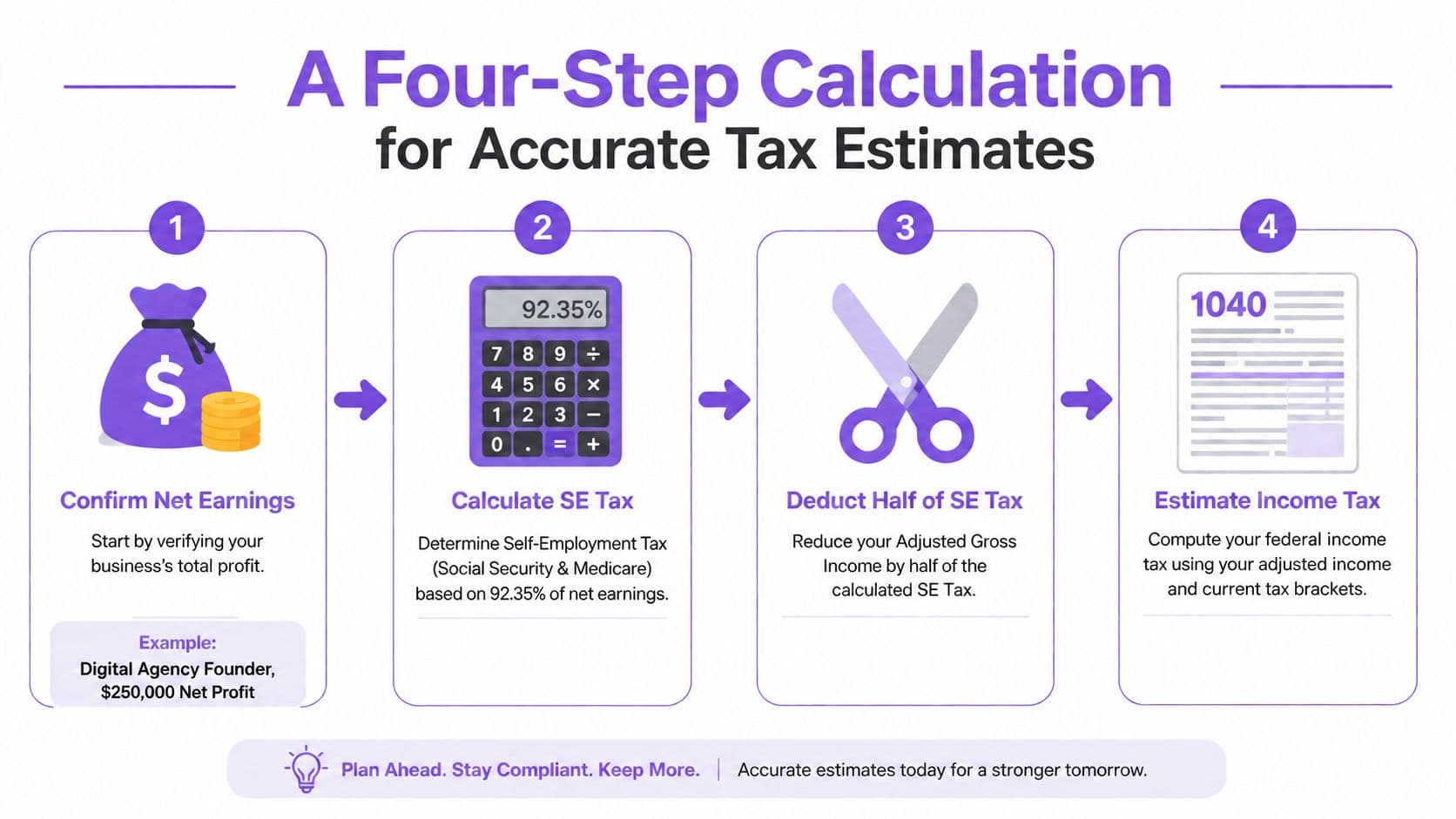
A reliable self employed tax calculator should mirror the actual logic of the tax, not just multiply profit by a flat rate. For founders, that matters because rough math becomes expensive once profits grow and distributions start moving ahead of tax planning.
Use this sequence when you want a planning-grade estimate.
Step 1 Confirm net earnings
Start with net profit from the business, not top-line revenue and not owner draws. If you run a digital agency and the business shows $250,000 in net profit for the year, that's your starting point for this example.
This sounds obvious, but founders regularly muddy the number by mixing in personal expenses, distributions, or unpaid owner labor assumptions. Before you run any tax estimate, reconcile expenses and make sure your bookkeeping reflects the actual operating result. Tight expense hygiene matters here, especially if you're still improving your system for tracking business expenses correctly.
Step 2 Apply the required adjustment
This is the step generic DIY math often misses.
The core methodology requires a 92.35% adjustment factor applied to net earnings before the self-employment tax is calculated, as explained in this self-employment tax methodology breakdown. Skipping that multiplier leads founders to over-calculate by applying the full rate to the wrong base.
For $250,000 of net profit, the adjusted self-employment earnings base is:
| Item | Calculation | Result |
|---|---|---|
| Net profit | Starting amount | $250,000 |
| Adjusted earnings base | $250,000 × 0.9235 | $230,875 |
This is the number you use for self-employment tax logic, not the raw profit figure.
Founders who apply 15.3% directly to net profit usually reserve too much cash for this line item and then make poor decisions with the remainder.
Step 3 Calculate self-employment tax
Now apply the self-employment tax structure to the adjusted base.
For 2026, the Social Security wage base limit is $184,500, and calculators need to cap the 12.4% Social Security portion there while continuing the 2.9% Medicare portion above that level, according to this 2026 self-employment tax guide.
For the $230,875 adjusted base:
- Social Security portion: only the first $184,500 is subject to 12.4%
- Medicare portion: the full $230,875 is subject to 2.9%
That means your self-employment tax estimate should reflect the cap, not a flat percentage on the full amount.
Here's a worked breakdown:
| Component | Base used | Rate |
|---|---|---|
| Social Security | First $184,500 of adjusted earnings | 12.4% |
| Medicare | Full $230,875 adjusted earnings | 2.9% |
I'm keeping the result at the component level because the critical takeaway is structural: once you move above the Social Security cap, the self-employment tax doesn't rise in a straight line the way many founders assume.
For a simpler worked example, a founder with $150,000 net profit would calculate $150,000 × 0.9235 = $138,525 taxable base, then $138,525 × 0.153 = $21,194 in self-employment tax, according to this founder tax calculator example.
Step 4 Estimate federal income tax after deductions
Self-employment tax is only one layer. You still need to estimate federal income tax, and founders often miss planning opportunities during this process.
The Qualified Business Income deduction under Section 199A allows self-employed founders earning under $197,300 single or $394,600 married filing jointly in 2026 to deduct up to 20% of net business income from taxable income, according to this QBI deduction explanation for self-employed founders.
That means a profitable service business can lower taxable income materially even though the self-employment tax calculation follows its own rules.
What works and what doesn't
What works
- Use net profit from clean books: Bad books create bad tax estimates.
- Apply the 92.35% adjustment before self-employment tax: This is required.
- Separate self-employment tax from federal income tax: Different rules, different planning levers.
- Check whether QBI applies: Don't leave that deduction out of your estimate.
What doesn't
- Multiplying profit by 15.3% and calling it done
- Using owner draws as the tax base
- Assuming one calculator output equals a tax strategy
- Ignoring the Social Security cap once profits rise
A self employed tax calculator is helpful when it follows these steps. If it skips any of them, treat the output as rough, not decision-ready.
Strategic Deductions for SaaS and Agency Founders
Tax savings start with expense discipline, not last-minute creativity. In SaaS, agencies, and professional services, the strongest deductions usually come from ordinary operating spend that founders already have. The problem is poor classification, weak documentation, or forgetting categories that feel too routine to matter.

The deductions that usually move the needle
For a SaaS company or digital agency, these categories deserve close attention:
- Software and cloud tools: Your stack often includes billing systems, analytics tools, project management software, CRM seats, design platforms, and collaboration apps. These costs can accumulate, especially when teams buy tools on separate cards.
- Contractor and freelancer spend: Agencies and product teams often rely on designers, developers, media buyers, writers, or implementation partners. If this spend is core to delivery, it belongs in a clean and well-supported expense workflow.
- Marketing and customer acquisition costs: Ad spend, creative production, sponsorships, and agency support are usually substantial for growth-stage businesses. If those costs are mixed across accounts, your tax estimate will be off because your profit number is off.
- Insurance and professional fees: Business insurance, legal support, tax preparation, and outside finance help are easy to overlook because they don't sit inside direct fulfillment.
- Home office and remote-work costs: Founders running remote-first businesses often miss legitimate business-use expenses because they assume the deduction is too small or too risky to track properly.
The overlooked deduction founders miss
Retirement planning is one of the few tax levers that also strengthens the owner's long-term balance sheet.
"The most overlooked deduction I see with founders is their SEP IRA contribution. Not only does it build your retirement savings, but a contribution of up to 25% of your net adjusted self-employment earnings is fully deductible, which can create a five-figure tax savings annually." CPA at Jumpstart Partners
That's not a fringe tactic. It's a standard planning tool that too many founders ignore because they treat taxes and wealth-building as separate conversations.
A better deduction checklist for service businesses
| Expense area | Why it matters operationally | What founders miss |
|---|---|---|
| Tech stack | Runs delivery, reporting, support, and billing | Decentralized subscriptions and duplicate tools |
| Contractor costs | Expands capacity without full-time headcount | Poor categorization and incomplete records |
| Marketing spend | Drives pipeline and retention | Mixed personal and business card usage |
| Professional support | Protects compliance and financial accuracy | Assuming small recurring fees aren't material |
| Retirement contributions | Reduces taxable income while building personal assets | Waiting until year-end to evaluate options |
If your business claims or pursues innovation-related work, it's also worth reviewing adjacent planning areas like R&D tax credits for growing companies. That's separate from a self employed tax calculator, but it affects the broader tax picture.
Mastering Estimated Quarterly Tax Payments
The standard advice to divide your annual estimate by four is wrong for a lot of founders. It's simple. It's easy. It's also a bad fit for businesses with uneven revenue, launch-driven sales, retainers plus project spikes, or founder distributions that don't track cleanly with quarterly profit.
A practical walkthrough can help if you want a visual overview:
The payment calendar you actually need to manage
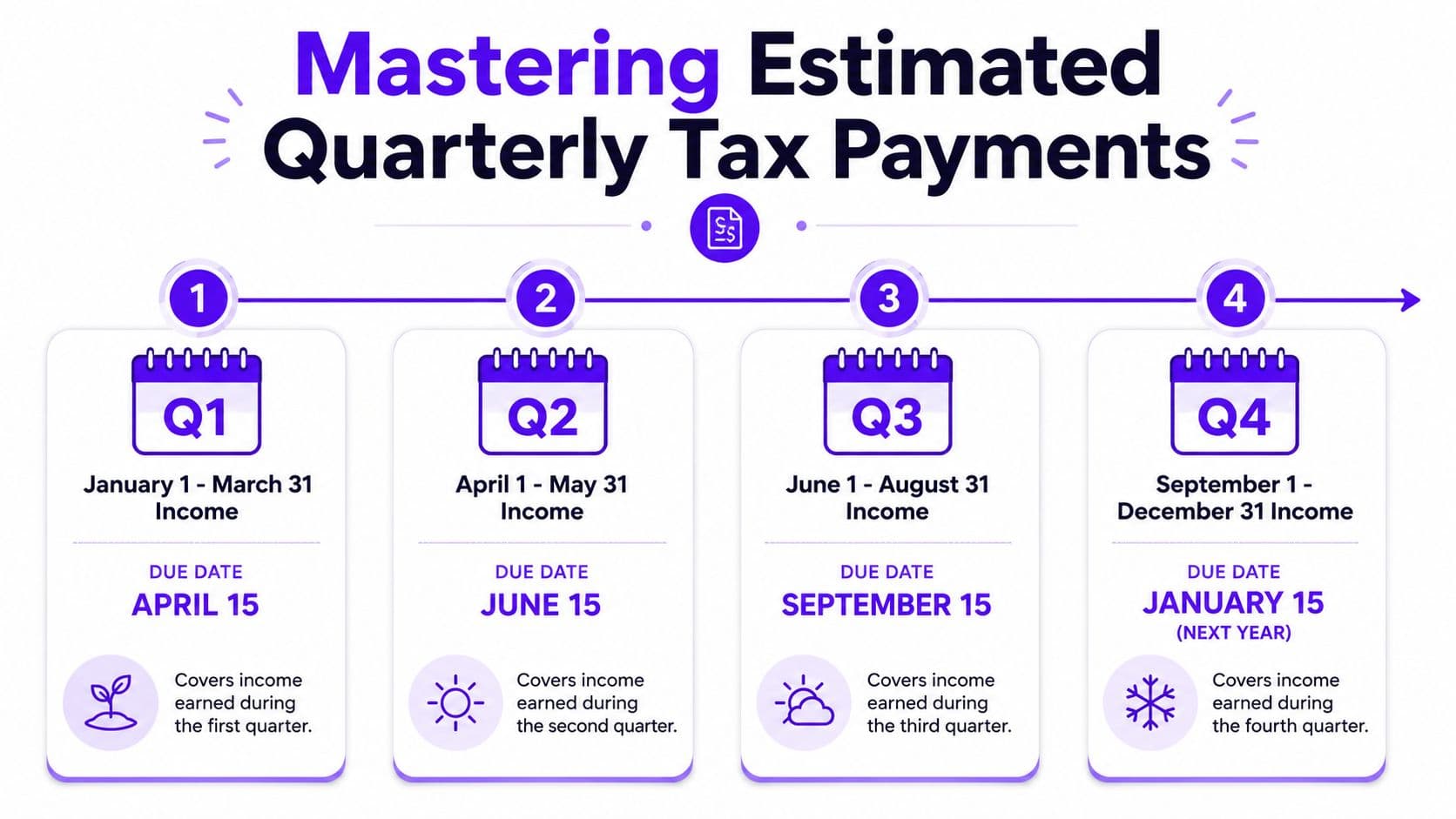
Quarterly estimated payments follow this timeline:
| Payment period | Due date |
|---|---|
| January 1 to March 31 income | April 15 |
| April 1 to May 31 income | June 15 |
| June 1 to August 31 income | September 15 |
| September 1 to December 31 income | January 15 of the following year |
The trap is obvious. Those periods aren't evenly spaced in the way many founders mentally model them, and your revenue pattern probably isn't even either.
Why equal quarterly payments fail scaling businesses
Most self-employed tax calculators ignore irregular income. The IRS explicitly allows the annualized income installment method (Form 2210) so founders with volatile cash flow can adjust payments by quarter and avoid underpayment penalties, as noted in this guide to self-employment calculators and Form 2210.
That's the better approach when your business looks like any of these:
- A SaaS company with heavy annual prepay seasonality
- An agency with large campaign launches in one or two quarters
- A consulting firm with delayed collections and uneven partner distributions
- A founder who shifts from reinvesting to taking larger draws mid-year
If your income arrives unevenly, your estimated tax process should reflect uneven income. Flat quarterly math ignores how the business actually performs.
Red flags that trigger trouble
Watch for these warning signs:
- You're still using last year's payment pattern: Growth changes the tax picture fast.
- You take distributions after strong months without updating the reserve: That's one of the most common founder errors.
- Your calculator assumes a smooth year: Many do.
- You have multiple income types: W-2 pay, self-employment income, and owner distributions complicate payment planning.
What to do instead
Use a rolling estimate and update it with actual year-to-date results. Don't rely on a static January forecast through the entire year.
A simple operating rhythm works well:
- Close the books each month.
- Update year-to-date profit and owner compensation.
- Recalculate your annual tax estimate.
- Decide whether the next payment should follow the standard method or annualized income treatment.
If quarterly tax payments have become a recurring source of surprises, review a more detailed quarterly estimated taxes guide for small business owners. The core point is straightforward. Estimated taxes should follow profit timing, not calendar convenience.
When an S-Corp Election Beats a Sole Proprietorship
At a certain point, the default sole proprietor or single-member LLC setup stops being tax-efficient. That doesn't mean every founder should rush into an S-Corp election. It means you should know when the structure is no longer serving the economics of the business.
The strategic difference is simple. In a sole proprietorship, business profit generally flows through in a way that keeps self-employment tax front and center. In an S-Corporation, you pay yourself a reasonable salary through payroll, and additional profit may be distributed in a form that isn't subject to self-employment tax in the same way. That's why scaling founders revisit this election as profits rise.
The decision isn't only about tax savings
An S-Corp can reduce self-employment tax exposure, but it also adds process:
- You need payroll discipline: Salary has to run through payroll, not through casual owner draws.
- You need cleaner books: Sloppy accounting creates compliance risk fast.
- You need a compensation rationale: “Reasonable salary” isn't a guess.
- You need separation between wages and distributions: That's where many founder-run businesses fail.
This is why a self employed tax calculator, by itself, isn't enough once your company matures. It can estimate liability under the current structure. It usually won't tell you whether the structure itself is the problem.
Sole Proprietorship vs. S-Corp Tax on $200,000 Profit
| Metric | Sole Proprietorship / LLC | S-Corporation |
|---|---|---|
| Profit base used for owner tax planning | Entire business profit drives the self-employment tax analysis | Salary and distributions must be separated |
| Self-employment tax exposure | Broadly higher because profit remains the central driver | Often lower when part of earnings is paid as distributions rather than salary |
| Payroll requirement | None for owner compensation | Required for owner salary |
| Administrative complexity | Lower | Higher |
| Best fit | Early-stage owner-operated businesses | Scaling businesses with stable profit and better finance discipline |
A common misconception is that an S-Corp is a universal tax hack. It isn't. If your profits are inconsistent, your bookkeeping is weak, or you aren't ready to run compliant payroll, the added complexity can create more problems than savings.
Decision test: If you're consistently profitable, taking substantial owner distributions, and still taxed like a sole proprietor, it's time to model the S-Corp option seriously.
The founders who benefit most are usually the ones who've outgrown DIY finance. They've got recurring revenue, more predictable margins, and enough operating maturity to handle payroll, tax deposits, and cleaner reporting without constant fire drills.
If you're running a growing SaaS company, agency, or professional services firm and your tax planning still depends on rough calculator outputs, it's time for a tighter model. Jumpstart Partners helps founders build clean books, accurate cash flow forecasts, and decision-ready financial reporting so owner tax liability, payroll, and quarterly planning stop disrupting growth.