Financial Operations
What Is a Financial Audit: A Founder's Guide to Preparation
Learn what is a financial audit, how it works, and why founders preparing for fundraising must get audit-ready in 2026.
ByJumpstart Partners, CPA, QuickBooks ProAdvisor
··18 min readA financial audit provides reasonable, not absolute, assurance that your financial statements are free from material misstatement under GAAP or IFRS. It doesn't certify every transaction, guarantee perfect books, or prove that your business has no financial risk.
That distinction matters when you're running a SaaS company, digital agency, or professional services firm with $500K to $20M in revenue. An audit can support a financing, fundraising process, acquisition, or larger customer contract. It can also expose weak revenue schedules, unreconciled accounts, unsupported journal entries, and control gaps at the worst possible time.
The buyer-side question is more useful than the textbook definition: What does the audit prove, what does it miss, and how do you prepare without letting the process derail your operating plan? The answer starts with understanding the opinion you're buying, the evidence auditors need, and the work your finance team must complete before fieldwork begins.
Table of Contents
- What Founders Get Wrong About Financial Audits
- The Statutory Origins and Modern Standards That Govern Audits
- The Four Audit Types and Which One Your Investors Actually Want
- How the Audit Process Unfolds From Planning to Opinion
- What an Audit Really Costs and Why the Fee Is Only Part of the Bill
- The Pre-Audit Checklist That Separates Clean Audits From Painful Ones
- Four Audit Myths That Quietly Damage Growth-Stage Companies
- Engineering Audit Readiness With the Right Finance Partner
What Founders Get Wrong About Financial Audits
The most damaging founder misconception is treating an audit as a forensic endorsement of the business. An independent CPA applies Generally Accepted Auditing Standards, or GAAS, to obtain reasonable assurance that your financial statements are fairly presented in all material respects under the applicable reporting framework. GAAS establishes the minimum standards auditors follow when examining financial statements under GAAP, as explained by Georgetown Law's overview of auditing standards.
That's very different from testing every transaction and certifying that your books are clean. Auditors use evidence, risk assessment, materiality, analytical procedures, and sampling to form an opinion. They're evaluating whether an error or omission could affect a reasonable user's decision, not promising that no small error exists anywhere in the ledger.
Practical rule: Treat an audit opinion as an evidence-based conclusion about financial statements, not as a warranty on your accounting system.
The expectation gap creates real commercial damage. If you assume the auditor will discover and explain every problem, you'll delay reconciliations, under-document accounting judgments, and send incomplete support. The auditor then spends more time asking follow-up questions, your finance team loses time answering avoidable requests, and investors encounter unresolved issues during diligence.
That's especially dangerous when a lender or investor asks for audited financials alongside a data room. A financial audit and a due diligence report answer different questions. The audit addresses whether the statements are fairly presented under the relevant framework. Diligence digs into earnings quality, customer concentration, revenue durability, working capital, cash needs, and deal-specific risks.
What the opinion actually tells a stakeholder
A clean opinion tells the reader that the auditor obtained sufficient appropriate evidence and concluded that the financial statements are fairly presented in all material respects. It doesn't say your growth forecast is credible, your pricing is defensible, your customers will renew, or your internal reporting is fast enough for the next financing round.
It also doesn't eliminate uncertainty from estimates, management judgment, fraud risk, or incomplete evidence. The audit provides confidence within a defined scope. Your job is to make that scope understandable, supportable, and aligned with the story you're presenting to capital providers.
The Statutory Origins and Modern Standards That Govern Audits
Modern auditing exists because capital markets needed independent oversight. A major milestone arrived in 1844, when mandatory financial auditing provisions first appeared in the United Kingdom. The Companies Act 1862 then made appointing auditors compulsory, marking the shift from informal account checking to legally required external oversight, according to the UK government history of statutory financial audit.
The United States built on that foundation through the Securities Act of 1933 and the Securities Exchange Act of 1934, which required firms to be audited and helped establish audited financial statements as a core feature of public-capital markets. The modern framework is layered, and founders should know what each layer does.
The standards stack in plain English
| Layer | What it governs | Why you care |
|---|---|---|
| GAAP | How financial statements are prepared and presented | It determines how you recognize revenue, capitalize costs, classify items, and disclose information |
| GAAS | How a CPA performs a private-company audit | It governs evidence, risk assessment, testing, documentation, and the audit opinion |
| ISA | International Standards on Auditing | They guide audit engagements where an international framework or jurisdiction requires them |
| PCAOB | Oversight and standards for US public-company auditors | It becomes central when a company enters the public-company reporting environment |
| AICPA | Professional guidance relevant to private-company CPA engagements | It shapes the standards your private-company audit firm follows |
For a US-based SaaS company, GAAP answers what the numbers should mean. GAAS answers how the auditor tests whether your reporting is fairly presented. The Public Company Accounting Oversight Board, or PCAOB, governs the public-company audit environment. A private growth-stage company generally isn't subject to a full public-company controls audit because it has venture backing.
Why sampling and materiality change the work
Auditors don't examine 100% of transactions. They select items from a population, design procedures around assessed risk and materiality, and use the results to support a conclusion about the broader population. The ISA 530 sampling standard requires sampling units to have a chance of selection and makes clear that sampling supports evidence evaluation, not proof that every item is correct.
That's why a clean opinion is bounded rather than absolute. Higher assessed risk requires more persuasive procedures. A weak close, inconsistent revenue policy, or unexplained balance-sheet movement can expand the work even when the final financial statements appear reasonable.
The Four Audit Types and Which One Your Investors Actually Want
Founders often hear “audit” used as shorthand for several different engagements. That creates confusion when a lender wants audited financial statements, a buyer requests quality of earnings analysis, or an operations leader asks for a controls review.
| Audit Type | Who Requests It | What It Tests | Typical Deliverable |
|---|---|---|---|
| External financial audit | Banks, lenders, investors, boards, and transaction stakeholders | Whether financial statements are fairly presented under GAAP or IFRS | Independent auditor's opinion accompanying the financial statements |
| Internal audit | Management, the board, or an audit committee | Financial reporting controls, compliance, and risk-management processes | Internal findings, control observations, and remediation recommendations |
| Operational audit | Management or operations leadership | Efficiency, process performance, resource use, and operating controls | Operational assessment and improvement plan |
| Financial due diligence | Strategic acquirers, private equity firms, and transaction teams | Earnings quality, recurring revenue, working capital, customer trends, and deal risks | Diligence report or quality of earnings analysis |
Match the engagement to the stakeholder
For Series B and later companies preparing to raise capital, an external financial audit is usually the default deliverable when investors or lenders require independent financial statements. It gives the stakeholder an opinion from an independent CPA firm, not just management-prepared reporting.
A VC may also request quality of earnings work, especially when the financing involves complex revenue streams, aggressive growth, unusual adjustments, or a possible acquisition path. That work is complementary, not interchangeable. A quality of earnings analysis may adjust EBITDA, assess recurring revenue, normalize owner expenses, and examine customer concentration. An audit won't answer all of those questions.
Large strategic buyers and private equity acquirers often commission financial diligence themselves. Don't assume your audited statements eliminate that review. Buyers want transaction-specific analysis, and they'll examine areas an audit isn't designed to validate, including forecast quality and sustainable earnings.
The recommendation
Ask the requesting party to name the exact deliverable. “Financials” can mean monthly management accounts, reviewed statements, audited statements, a quality of earnings report, or a full diligence package. Get the requirement in writing before you select the firm or build the data room.
How the Audit Process Unfolds From Planning to Opinion
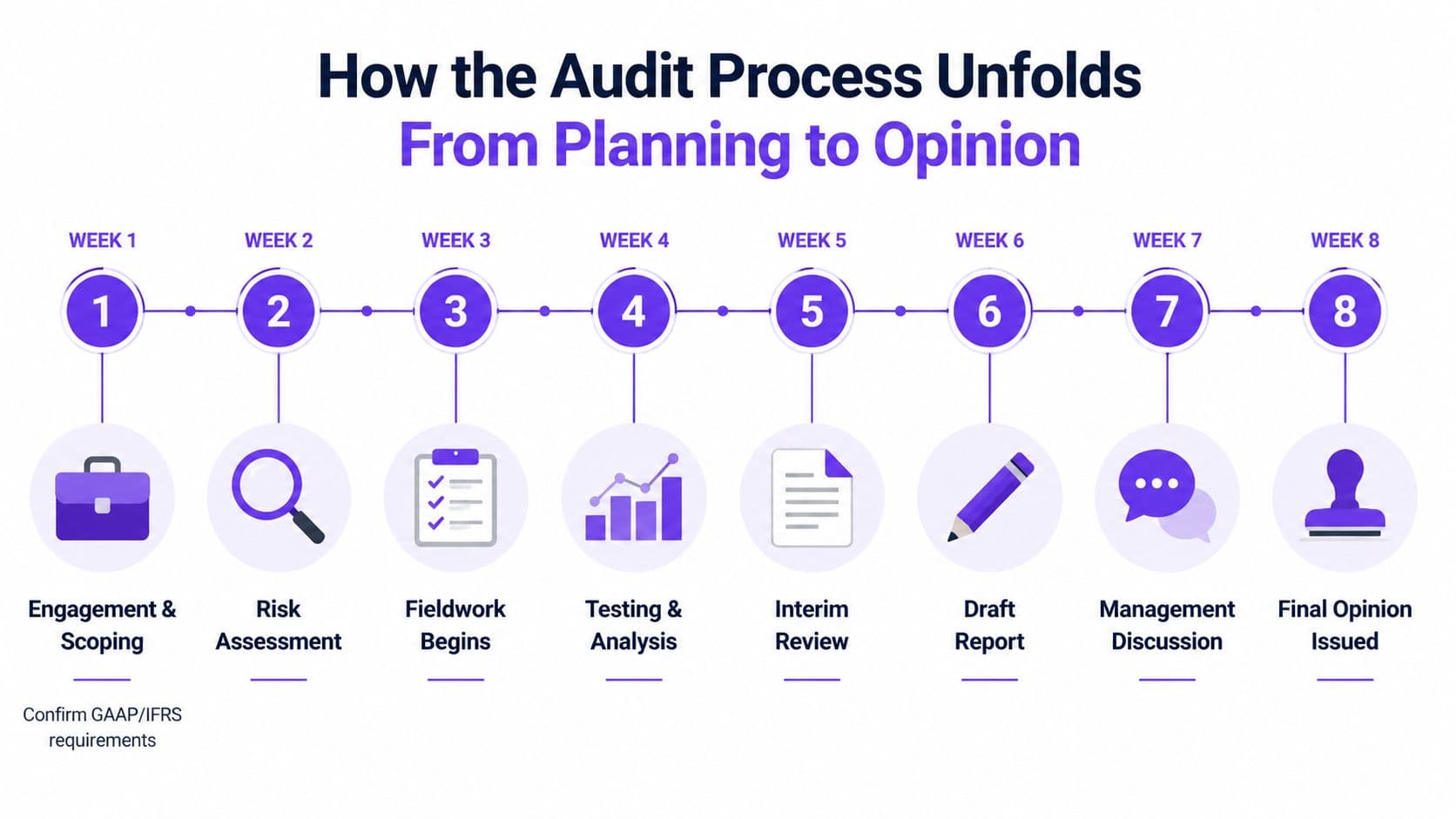
Treat a first-time audit as a 6 to 8 week project, not a year-end event. Consider a SaaS company with $5 million in revenue. The finance team should work backward from the expected opinion date, assign owners to every request, and stop making nonessential accounting changes once substantive testing begins.
Weeks one through three
Week one is planning and scoping. The auditor confirms whether GAAP or IFRS applies, reviews the year-end close, discusses materiality and significant accounting policies, and identifies areas with higher risk. Expect questions about revenue recognition, deferred contract costs, payroll, debt, cash, equity, related parties, and the systems that process transactions.
The auditor then assesses controls, fraud risk, and key systems. That doesn't mean the auditor accepts your process because you use QuickBooks, Xero, NetSuite, Stripe, Gusto, or another established platform. The team needs to understand who initiates, records, reviews, and approves transactions.
Weeks two and three begin fieldwork. The auditor requests population-based schedules and supporting evidence, then tests selected items. Meetings may involve the CFO, controller, sales operations, HR, legal, and the people responsible for billing and payroll.
The bottlenecks are predictable:
- Contract evidence: Signed customer agreements don't match invoices or revenue schedules.
- Deferred revenue: The rollforward doesn't reconcile from opening balance through additions, releases, and closing balance.
- Intercompany balances: Related-entity transactions were recorded but never reconciled.
- Close support: Journal entries lack explanations, approvals, or source documentation.
You can avoid most of these problems by completing a structured audit of your financial records before the external auditor starts substantive testing.
Weeks four through eight
During the middle of the engagement, auditors test revenue, payroll, debt, cash, fixed assets, expenses, and selected disclosures. They investigate exceptions, compare management responses to source evidence, and expand procedures when risk or missing documentation requires it.
The final phase involves resolving proposed adjustments, reviewing disclosures, drafting the financial statements, and documenting management's representations. The auditor won't issue the opinion until unresolved material issues are addressed and the company formally represents that it has provided complete information.
The video below provides a visual explanation of the audit process and the evidence trail auditors follow.
Your operating rule should be simple: close first, document second, test third. If the ledger keeps changing while the auditor is testing it, you'll create avoidable version conflicts and repeat work.
What an Audit Really Costs and Why the Fee Is Only Part of the Bill
The external auditor's invoice is only one part of the economic cost. The full burden includes finance-team hours, delayed reporting, executive involvement, remediation work, and the opportunity cost of pulling people away from fundraising, sales support, and operating decisions.
External audit fees for a growth-stage company commonly range from $20,000 to $150,000 or more, depending on complexity and the required opinion, as described in the financial audit cost overview. A first audit for a company in the $2 million to $10 million revenue range often lands near the middle of that span, while multiple entities, international activity, complex contracts, or inventory can push the fee higher.
| Cost Component | Typical Range | What Drives It |
|---|---|---|
| External audit fee | $20,000 to $150,000 or more | Revenue complexity, entity count, systems, controls, transaction volume, and reporting framework |
| Review or compilation | $10,000 to $50,000 | Limited assurance, simpler scope, and lower evidence requirements |
| Internal finance effort | 300 to 800 hours | Reconciliations, schedules, PBC responses, meeting time, and issue remediation |
| Internal labor cost | $75 to $150 per hour | Blended cost of controller, CFO, accounting, and operational staff |
The internal burden can rival or exceed the auditor's invoice. At 300 hours and $75 per hour, the calculation is 300 × $75 = $22,500. At 800 hours and $150 per hour, it becomes 800 × $150 = $120,000. Those are direct labor calculations, before considering the cost of delayed decisions or a missed financing timeline.
A review or compilation may look attractive because it costs less, but it doesn't provide the same assurance as an audit. If your lender, investor, or buyer requires an audit opinion, choosing a cheaper engagement won't satisfy the requirement.
Budgeting position: Approve the audit as a financing and operating infrastructure project, not as a compliance invoice.
Strong reconciliations, documented policies, and complete support can reduce follow-up and prevent fieldwork delays. Investors also read preparation quality as evidence of whether management can operate at institutional scale, which helps defend the credibility of your fundraising narrative.
The Pre-Audit Checklist That Separates Clean Audits From Painful Ones
Start 60 to 90 days before fieldwork. Waiting for the auditor's first request list guarantees a reactive process, especially if your controller is also responsible for the monthly close.
Begin with the balance sheet. Reconcile every account to an external statement, subledger, contract schedule, or other appropriate support. Investigate old reconciling items, clear unsupported journal entries, remove suspense balances, and document unusual movements before the auditor asks about them.
| Financial Area | Required Evidence | Red Flags |
|---|---|---|
| Cash and restricted cash | Bank statements, reconciliations, confirmations, and restrictions | Unexplained differences or recurring negative balances |
| Revenue and receivables | Contracts, invoices, deposits, billing reports, and revenue policy | Inconsistent contract terms or missing customer support |
| Deferred revenue and contract assets | Transaction-level rollforwards from opening to closing balances | Year-end totals that don't tie to underlying contracts |
| Payroll and benefits | Payroll registers, tax filings, benefit schedules, and accrual calculations | Manual adjustments without approval |
| Debt and leases | Agreements, amortization schedules, lender statements, and covenant terms | Missing amendments or incorrect current-versus-long-term classification |
| Equity and compensation | Cap table, issuance documents, option records, warrants, and valuation support | Changes that don't reconcile to legal records |
| Fixed assets and prepaid expenses | Additions, disposals, useful lives, amortization, and cutoff support | Capitalized items with no policy basis |
| Related parties and taxes | Agreements, balances, tax filings, and management disclosures | Transactions without clear terms or documentation |
Revenue deserves special attention in a SaaS business. Tie recurring subscriptions, implementation fees, and usage-based charges to contracts, invoices, bank deposits, the billing system, and the general ledger. Make sure the policy is applied consistently, and preserve the reasoning behind significant judgments.
Controls auditors will ask you to demonstrate
Document who prepares, reviews, and approves cash disbursements, revenue adjustments, payroll changes, and journal entries. A policy that exists only in the CFO's memory isn't a control auditors can evaluate efficiently.
Run a controller-led dry run using the same evidence an auditor will request. For organizations with specialized fund accounting needs, a resource such as Grain's guide to fund reconciliation for churches offers useful context on organizing reconciliation evidence and supporting records.
Common warning signs include:
- Late closes: Month-end reporting depends on manual catch-up work.
- Unsupported overrides: Management changes revenue, expenses, or accruals without written rationale.
- Unreconciled subledgers: Accounts receivable, deferred revenue, payroll, or intercompany balances don't tie to the general ledger.
- Missing confirmations: The team can't identify the right customer, bank, lender, or vendor support.
- Inconsistent contracts: Similar arrangements receive different accounting treatment.
Use this audit preparation checklist to turn the dry run into an owner-assigned work plan rather than an informal review.
Four Audit Myths That Quietly Damage Growth-Stage Companies
Bad audit assumptions create worse preparation decisions. The four below show up repeatedly in growth-stage finance teams.
| Myth | Reality | Corrected Mindset |
|---|---|---|
| An audit guarantees clean books | It provides reasonable assurance about material misstatement, not proof that every transaction is error-free | Build disciplined monthly close and reconciliation processes before the audit |
| Auditors detect all fraud | Sampling, management override, collusion, and incomplete evidence limit what an audit can uncover | Design controls to prevent and detect fraud, then document how they operate |
| QuickBooks or Xero is audit-ready automatically | Software records transactions, but it doesn't create accruals, approvals, reconciliations, or accounting judgments for you | Treat the accounting platform as a ledger, not a finance function |
| Auditors fix the problems they find | Auditors identify issues, request support, propose adjustments, and communicate findings. Management owns remediation | Assign internal owners and resolve weaknesses before fieldwork |
Myth one is the most expensive
A clean opinion isn't a clean bill of health. It doesn't validate your forecast, sales pipeline, customer retention, pricing strategy, or operating efficiency. It also doesn't certify that every control works perfectly every time.
The correct mindset is to use the audit to verify a reporting system you already manage. If you need help finding operational weaknesses before the audit, commission an internal controls assessment rather than expecting the external auditor to redesign your finance function.
Software doesn't replace judgment
QuickBooks and Xero can store detailed transactions, but they won't decide whether an implementation fee should be recognized immediately, whether a software cost qualifies for capitalization, or whether an intercompany balance is supported. They also won't explain why a reconciliation remains open.
The finance team must own the close calendar, accounting policies, evidence package, and remediation plan. An auditor's independence depends on management making those decisions, not outsourcing the responsibility to the audit firm.
Engineering Audit Readiness With the Right Finance Partner
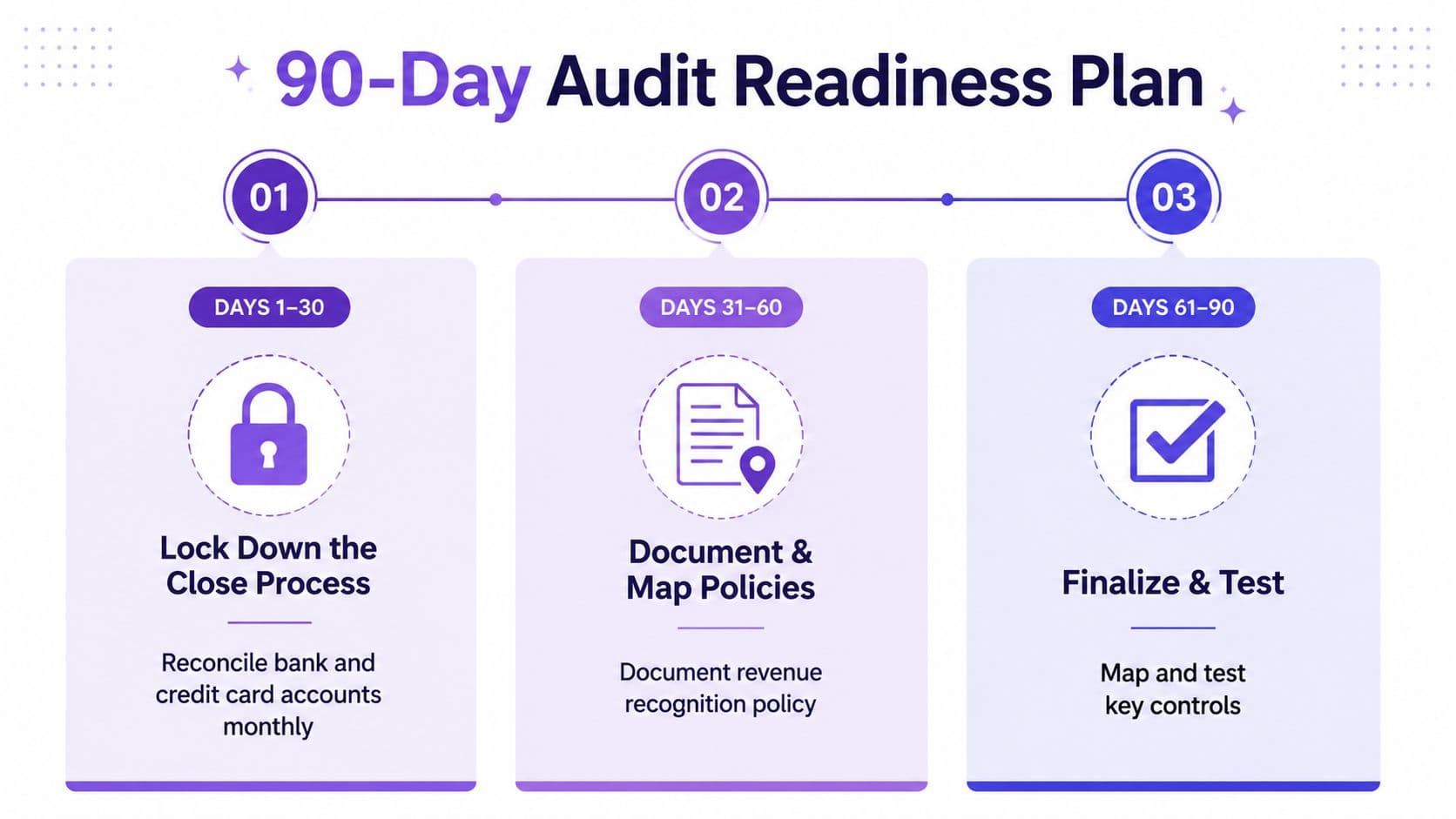
A practical readiness program fits into a 90-day sequence. The order matters because you can't produce reliable schedules until the close is stable, and you can't run a useful mock audit until the schedules tie to the ledger.
Days one through thirty
Lock down the close process. Reconcile bank and credit card accounts monthly, assign preparer and reviewer responsibilities, document revenue recognition policy, and map the chart of accounts to GAAP. Eliminate suspense accounts and create a central evidence folder with clear naming conventions and version control.
Days thirty-one through sixty
Prepare the schedules auditors will request:
- Deferred revenue waterfall: Opening balance, new billings, recognized revenue, credits, and closing balance.
- Fixed asset rollforward: Beginning balance, additions, disposals, depreciation, and ending balance.
- Debt schedule: Principal, interest, maturities, amendments, and covenant information.
- Equity support: Cap table changes, issuances, options, warrants, and compensation records.
- Revenue bridge: Billing data, contract terms, recognized revenue, receivables, and cash collections.
Days sixty-one through ninety
Run a mock audit. Select representative transactions, trace revenue from contract to ledger, test journal entry approvals, confirm account reconciliations, and document every exception. Remediate findings before you choose the external firm, then select an auditor with experience in your revenue model, entity structure, and reporting framework.
An outsourced controller can act as the force multiplier here. The right partner owns the close calendar, maintains reconciliations, prepares the PBC package, coordinates auditor responses, and keeps you focused on investor conversations instead of chasing support schedules. For companies that need that operating model, fractional controller services can provide structured ownership without requiring a full internal controller hire.
Your final selection criteria should be operational, not cosmetic. Ask prospective firms how they handle SaaS revenue, deferred costs, equity, multi-entity consolidations, audit requests, and unresolved findings. Require a clear timeline, named responsibilities, and a process for escalating missing evidence before it becomes a report-date problem.
Jumpstart Partners provides outsourced controller and bookkeeping support for growing SaaS, agency, and professional services companies, including audit-support work, PBC package assembly, and QuickBooks cleanup. Visit Jumpstart Partners to discuss your audit-readiness timeline and build the reconciliations, schedules, and controls your next investor or lender review will require.