Financial Operations
What Is ACV in SaaS? Formulas, Examples, and Uses
Learn what is ACV in SaaS, how to calculate it, compare it with ARR, MRR, and TCV, and use it for forecasting, pricing, and reporting.
ByJumpstart Partners, CPA, QuickBooks ProAdvisor
··16 min readAnnual contract value (ACV) in SaaS is the recurring contract value divided by the contract term in years, so a two-year contract with $200,000 in recurring fees has $100,000 of ACV. You likely already use that number in a board pack, a quota sheet, and a forecast. If sales, finance, and your CRM each built it differently, you don't have one metric. You have three arguments waiting for diligence.
That's the lesson behind what is ACV in SaaS. The formula takes ten seconds. Governing what enters the numerator, how you treat services and usage, and which population you're averaging determines whether ACV helps you allocate reps, set prices, and hire implementers, or misleads you. Treat ACV as a policy, not a spreadsheet convenience.
Table of Contents
- Why ACV Decisions Need One Definition
- Defining ACV and Its Accounting Boundary
- Calculating ACV with Worked Examples
- Comparing ACV, ARR, MRR, and TCV
- Handling Contract Variations and Renewal Edge Cases
- Using ACV Benchmarks Without Chasing Vanity
- Reporting ACV Under ASC 606
- Implementing ACV Tracking in Your Financial Stack
Why ACV Decisions Need One Definition
Your sales leader closes a three-year agreement and reports a large win. Finance reports a smaller recurring number because it stripped out implementation. A board member divides the full contract by three and asks why neither figure matches. Nobody made an arithmetic error. Each person answered a different question.
That disconnect is predictable because ACV isn't recognized revenue or cash collected. It's a commercial normalization that puts contracts of different lengths on a one-year basis. The IVP SaaS fundraising playbook on annualized contract measurement frames the core calculation as recurring contract value divided by contract length in years, which makes a six-month and a multi-year deal comparable without pretending they bill or recognize the same way.
Where Inconsistent ACV Hurts You
- Board reporting: You overstate recurring capacity when one-time services sit inside ACV, and growth looks stronger than the subscription base supporting it.
- Compensation: Reps earn commission on a definition finance doesn't use for forecasting, so you pay for value that won't recur.
- Pipeline reviews: A services-heavy enterprise deal outranks a clean subscription deal even though it consumes more delivery capacity and renews at less.
- Fundraising: An investor rebuilds your cohort, finds mixed fee types, and discounts every other metric you presented.
Decide your ACV policy before you need it for a board meeting. Retrofitting definitions after quotas and dashboards are live creates restated trends and internal distrust.
Write the definition down, version it, and apply it to bookings, cohorts, compensation, and forecasts. If you change it, restate history or clearly bridge the change. Don't let each team keep a private version that flatters its own function.
Defining ACV and Its Accounting Boundary
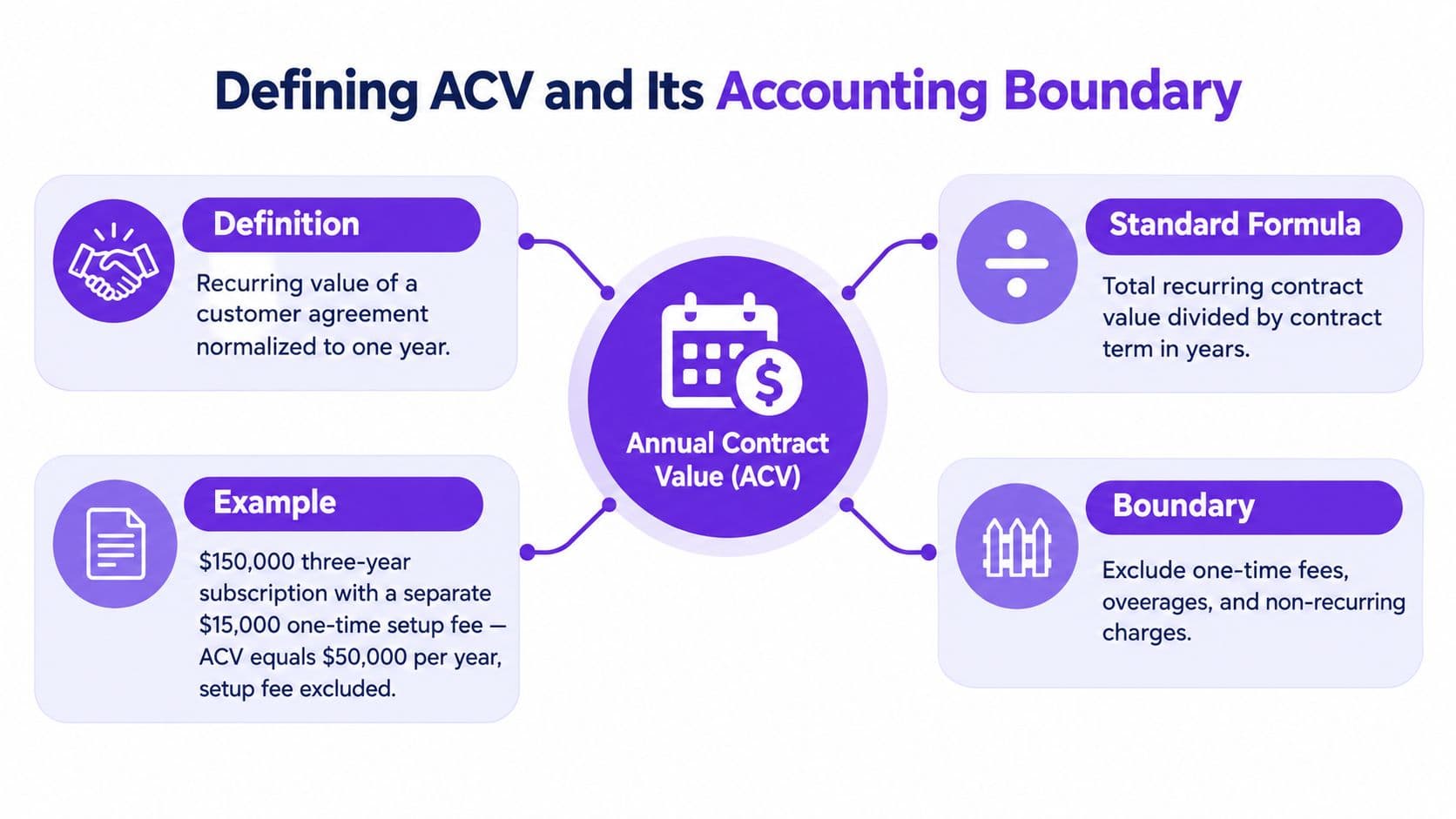
ACV is the recurring value of one customer agreement normalized to one year. Think of contracts as loaves of different lengths. ACV cuts each loaf into a standard one-year slice so you can compare slice size, not loaf size. The slice doesn't promise that billing, cash, or revenue recognition will arrive evenly.
The Standard Formula
ACV equals recurring contract value divided by contract term in years. Stripe's ACV in SaaS explanation of recurring contract normalization uses that structure and warns that the result isn't identical to recognized revenue or cash collected. That's the right caution. You're standardizing deal economics, not performing accounting recognition.
Take a three-year subscription with $150,000 of recurring fees plus a separate $15,000 implementation fee. Recurring-only ACV is $150,000 divided by 3, which equals $50,000. If you annualize everything, you get $165,000 divided by 3, which equals $55,000. That second figure isn't cleaner. It spreads a one-time charge across future years where it will not recur.
What Belongs Inside the Boundary
- Include: committed subscription fees, contractual minimums, and recurring support that's part of the ongoing agreement.
- Exclude from core ACV: implementation, onboarding, training, setup, and other one-time professional services.
- Treat by written rule: committed usage, discounts, credits, and renewal pricing. State whether discounted value or list value drives the field, and never switch without explanation.
Label an inclusive first-year number as first-year contract value or first-year billings, not ACV. When you review how ACV relates to signed deal totals, use a clear definition of bookings for your contract records so bookings, ACV, and billings don't collapse into one ambiguous field.
Core rule: Recurring committed subscription economics form reported ACV. Nonrecurring services and uncertain usage stay visible in separate fields.
Calculating ACV with Worked Examples
Run every calculation the same way. Identify recurring value first, confirm term in years second, divide third. Don't start from total invoice value and hope the result means something.
Four Contracts From Short to Multi-Year
Example 1, six-month pilot. A customer signs a six-month subscription worth $30,000 in recurring fees. Term in years is 0.5. ACV is $30,000 divided by 0.5, which equals $60,000. The annualized figure exceeds cash under the current term because you're expressing the run rate, not guaranteeing renewal.
Example 2, one-year subscription. A one-year subscription is $72,000. ACV is $72,000 divided by 1, which equals $72,000. Annual deals hide policy problems because the division doesn't change the number.
Example 3, clean multi-year deal. A three-year agreement contains $300,000 of recurring subscription fees and no services. ACV is $300,000 divided by 3, which equals $100,000. Use this figure for segment and rep comparisons. Reserve the full $300,000 for total contract discussions.
Example 4, services-heavy agreement. A three-year contract includes $75,000 of recurring subscription fees and $15,000 of one-time implementation. According to the ChartExpo ACV versus ARR calculation breakdown, recurring-only ACV is $75,000 divided by 3, which equals $25,000, while an all-in approach gives $90,000 divided by 3, which equals $30,000. Report $25,000 as ACV and track the implementation separately.
A Worksheet You Can Reuse
| Field | What to Enter |
|---|---|
| Recurring contract value | Committed subscription and recurring support only |
| Total contract value | Recurring value plus one-time fees across the full term |
| Term in years | Contract months divided by 12 |
| Reported ACV | Recurring contract value divided by term in years |
| One-time fees | Implementation, onboarding, setup, training |
| Policy note | Usage, discount, credit, and ramp treatment |
Reject the largest defensible answer as a selection method. Your goal is comparability across reps, segments, and quarters. A slightly lower ACV that every team calculates identically beats an impressive number nobody can reproduce from the signed contract.
Comparing ACV, ARR, MRR, and TCV
These four metrics answer different questions, and mixing them creates false confidence. ACV asks how large one contract or cohort is per year. ARR asks how much recurring subscription value your active customer base represents annually. MRR gives you the monthly version of that base. TCV asks what the whole signed agreement is worth over its full term.
SaaS Revenue Metric Comparison
| Metric | Measurement Unit | What It Captures | Primary Management Use |
|---|---|---|---|
| ACV | One contract or defined cohort | Recurring value normalized to one year | Deal size, segmentation, quotas |
| ARR | Entire active customer base | Aggregate recurring subscription value annualized | Scale, growth, retention roll-forwards |
| MRR | Entire active customer base | Recurring revenue in one month | Short-term movement and monthly forecasting |
| TCV | One contract | All contracted value over the full term | Multi-year commitment and services planning |
Stripe's comparison of ACV and ARR as deal-level versus company-level measures makes the population distinction explicit. ACV usually describes a single agreement. ARR aggregates recurring value across customers. If you add ACVs carelessly, label whether you're describing new bookings, active contracts, or a forecast cohort.
Multiplying one deal's monthly recurring amount by 12 can approximate that deal's annualized recurring value. It doesn't create company-wide ARR, because ARR requires the full active population. For a practical primer on that population logic, see this recurring revenue explained for indie hackers resource from Fundl, and align terminology with your own guide to what is monthly recurring revenue in a SaaS finance stack.
Ask one question before using any figure. Are we measuring a deal, a signed cohort, or the whole active base? Most metric arguments disappear once the population is named.
In board reporting, never show average ACV beside ARR without defining the cohort and period. A rising average on new deals can coexist with a shrinking base if churn removes large customers faster than sales replaces them.
Handling Contract Variations and Renewal Edge Cases
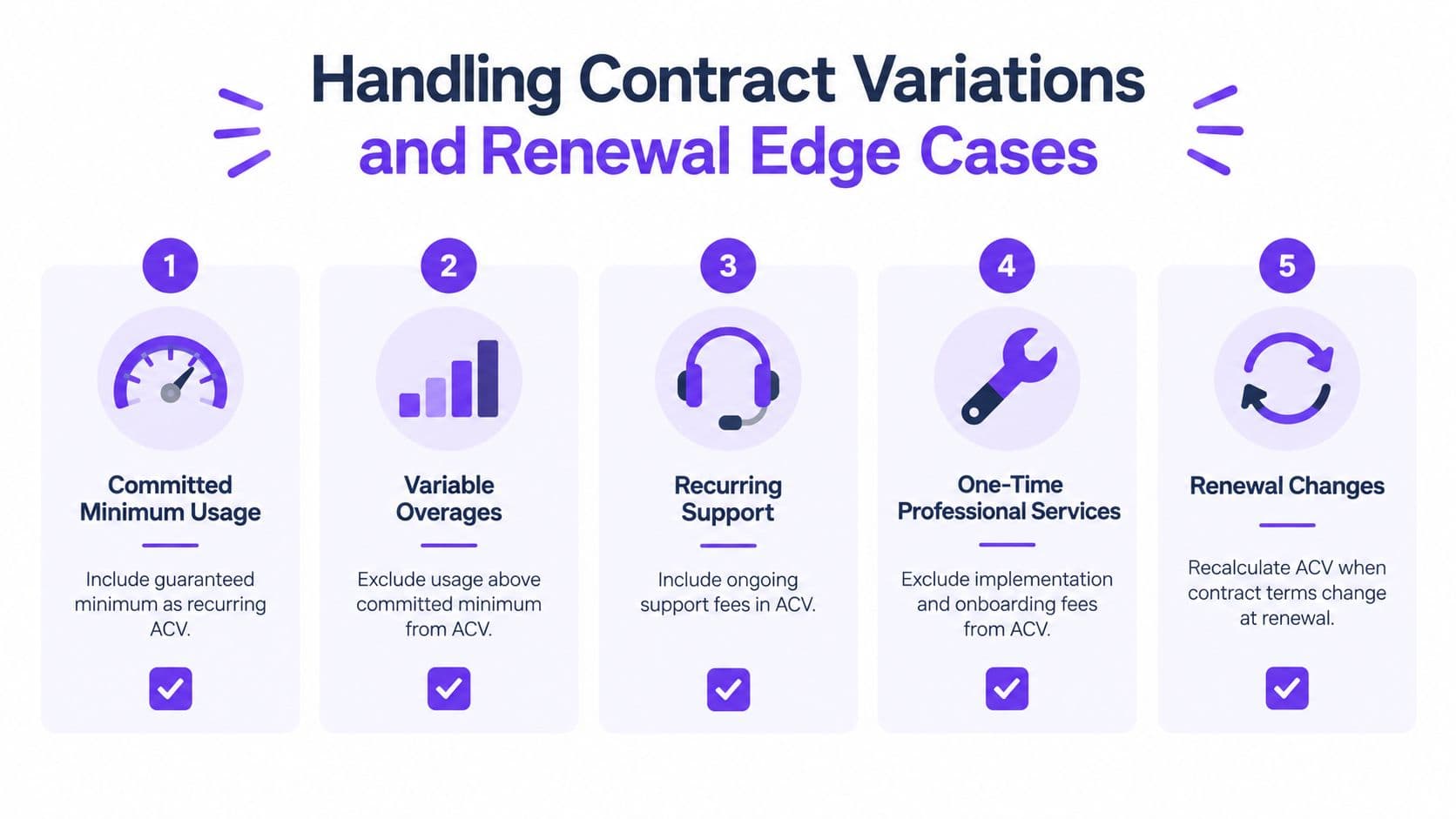
Basic annual subscriptions are easy. Your policy earns its keep when contracts include usage, ramps, services, discounts, and mid-term changes. Decide each case once, document it, and force the CRM to follow it.
Edge-Case Policy Matrix
| Contract Feature | Reported ACV Treatment | Separate Field |
|---|---|---|
| Committed usage minimum | Include the contractual minimum | Expected usage above minimum |
| Variable overages | Exclude until your policy's forecast rule is met | Actual overage billings |
| Recurring support | Include when charged for ongoing service | Support tier and renewal date |
| One-time services | Exclude | Services TCV and delivery cost |
| Discounts and credits | Use net committed recurring value consistently | List value and discount reason |
| Mid-term expansion | Record as a contract event with its own date | Expansion ACV and co-term end date |
| Downgrade or contraction | Reduce ACV from the effective date | Contraction reason |
| Renewal | Recalculate under the new term | Prior ACV for retention analysis |
Usage needs special discipline. A contractual minimum is committed recurring economics. Hopeful consumption isn't. Connect your policy to your usage-based billing controls and metering records so finance can reconcile committed minimums, actual usage, and invoices without reconstructing deals from emails.
Ramps and co-terms require effective dates, not manual averages buried in notes. If a customer starts smaller and steps up later, store each recurring schedule line with its start and end date. Your reported ACV should reflect the contract structure your policy defines, while first-year billings and ARR contribution show timing differences openly.
Treat a renewal as a new contract event. Do not blend the old price, new price, and expansion into one revised historical ACV. Preserve the original booking, record the renewal value, and let retention reporting compare the two. That audit trail matters when a customer renews for less, expands mid-term, or receives a credit that changes net committed value.
Using ACV Benchmarks Without Chasing Vanity
A higher ACV isn't automatically a better business. It's a different operating model with different costs, risks, and capacity demands. Benchmarks help you identify which model you're running. They don't tell you which model you should want.
The Startups.com ACV lexicon summary of 2025 segment ranges places typical ACV at approximately $500 to $10,000 for SMB self-serve, $10,000 to $30,000 for sales-assisted SMB, $30,000 to $100,000 for mid-market, $100,000 to $500,000 for enterprise, and $500,000 to $2 million or more for strategic enterprise accounts. Read those bands as segmentation guides, not grades.
The Trade-Off Behind Each Band
Lower-ACV models depend on product-led acquisition, automated onboarding, self-service support, and volume. Higher-ACV models usually require account executives, sales engineering, security reviews, procurement work, implementation labor, and executive relationship management. If those costs rise faster than contract value, you've raised ACV and weakened contribution margin.
The Prowi ACV glossary benchmark summary by customer segment similarly places many SMB-focused products below approximately $5,000, mid-market products around $10,000 to $25,000 or higher, and enterprise products around $50,000 to $100,000 or more. Different summaries draw boundaries differently, which proves the point. Don't reorganize your company around an external band.
Ask instead what ACV your operating model can profitably support. Analyze each segment with the broader set of SaaS financial metrics used for operating decisions, including:
- CAC and payback: Does the segment recover acquisition cost fast enough?
- Gross margin: Do implementation and support consume the apparent deal premium?
- Retention and expansion: Does the customer stay and grow after the expensive first sale?
- Concentration: Would losing a few large logos damage the whole forecast?
- Capacity: Can delivery and security teams absorb more deals of this size?
A lower-ACV product with efficient acquisition, strong margin, and durable retention can be healthier than a larger-contract business that buys growth with implementation labor.
Segment ACV by customer size, product, channel, geography, and contract term before changing prices or quotas. A blended average hides the segment that carries, or drains, the business.
Reporting ACV Under ASC 606
ACV and ASC 606 answer different questions, and your board package should never blur them. ACV normalizes contracted recurring value for management decisions. ASC 606 governs how you recognize revenue as performance obligations are satisfied. Annualizing a contract doesn't make the result recognized revenue.
Keep Commercial and Accounting Views Separate
A subscription and implementation service in the same agreement need separate assessment. The subscription normally represents ongoing access over time. Implementation may have a different delivery pattern and economics. Your commercial policy can exclude the service from ACV while your accounting workflow still evaluates the full arrangement, allocates consideration, and recognizes each component appropriately.
Use your documented ASC 606 revenue recognition workflow for subscription contracts for modifications, discounts, credits, and renewals. At management level, the discipline is simple. Preserve the signed terms, identify what changed and when, and don't rewrite accounting history to make a sales dashboard trend look smooth.
Red Flags in Board Packages
- Contract value labeled as revenue: ACV, billings, cash, and recognized revenue appear interchangeably.
- Unknown usage netted into totals: Expected overages offset discounts or credits without a contractual basis.
- Unexplained policy changes: Average ACV jumps because services entered the numerator, not because deal quality improved.
- Two compensation truths: Sales commissions use one ACV definition while finance forecasts with another.
- Renewals blended into originals: Prior-period ACV changes without an event record or bridge.
Reconcile ACV to signed contracts and billing schedules, then reconcile recognized revenue through your accounting process. Those are separate reconciliations with separate purposes. Forcing them to match usually means one of them is wrong.
When auditors or investors ask for ACV, provide the policy, population, period, and treatment of services and usage with the number. A transparent definition builds confidence. A heroic number with no boundary invites a rebuild you won't control.
Implementing ACV Tracking in Your Financial Stack
Build ACV tracking at the contract-line level, not as a free-text opportunity field. If a rep can type any number into the CRM, you'll spend every close arguing about whose version is real.
Implementation Sequence
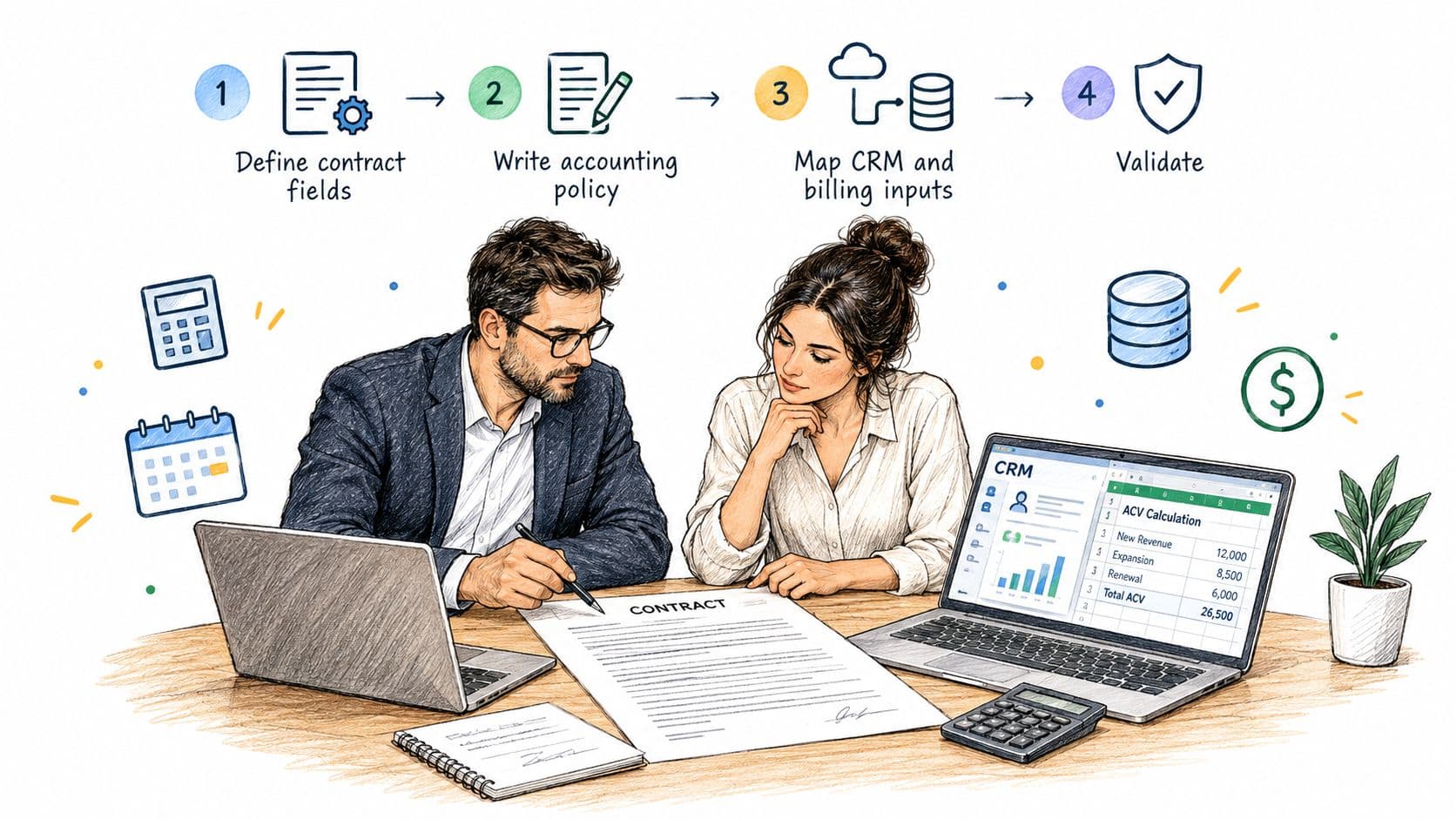
- Write the policy. Define recurring value, committed usage, variable usage, services, discounts, credits, expansions, downgrades, ramps, and renewals. Assign an owner in finance and a policy version number.
- Create structured fields. Capture customer, contract start and end dates, term in years, recurring subscription value, committed minimum, expected variable usage, one-time services, discount, renewal date, reported ACV, first-year billings, and ARR contribution.
- Map source systems. Pull signed values from the contract record, opportunity data from the CRM, and schedules from billing. Don't let three systems originate the same field.
- Automate the calculation. Calculate ACV from recurring value and term. Lock the formula and require an exception reason for manual overrides.
- Reconcile monthly. Tie new ACV to signed contracts, compare first-year billings with invoice schedules, and bridge ARR contribution to the active subscription base.
- Review exceptions. Investigate missing terms, mixed fee types, unusual mid-term changes, negative values, and contracts whose billing population doesn't match the CRM population.
Field Template for Finance and RevOps
| Field Group | Required Fields |
|---|---|
| Contract identity | Customer, contract ID, start date, end date, term in years, renewal date |
| Recurring economics | Subscription value, recurring support, committed usage minimum, discount, reported ACV |
| Variable and services | Expected usage, actual overages, implementation, onboarding, professional services |
| Reporting outputs | TCV, first-year billings, ARR contribution, segment, channel, policy version |
| Change history | Expansion, contraction, credit, renewal, effective date, approver |
Your dashboard should show ACV distribution, not only an average. Include median, segment bands, new versus expansion ACV, and services as a separate view. Averages hide a small number of oversized or services-heavy deals that distort hiring and quota decisions. If you're designing the reporting layer, this guide to SaaS revenue analytics from Prometheus Agency gives useful context for connecting contract data to operating dashboards.
Warning Signs Your Tracking Is Broken
- Manual ACV overrides: Reps edit calculated values without finance approval.
- Services inside subscription lines: Implementation can't be separated during close.
- No effective dates: Expansions appear as if they existed from contract signing.
- Population mismatch: CRM wins, billing accounts, and signed contracts produce different customer counts.
- Benchmark obsession: Leadership targets a higher average without reviewing acquisition cost, margin, retention, or delivery capacity. The SalesHive ACV glossary discussion of segment ranges and acquisition trade-offs notes that solutions in the $10,000 to $50,000 ACV range can be more expensive to acquire than solutions above $50,000, which is another reason not to judge ACV alone.
Start with your active contracts and the current quarter's bookings. Clean those populations first, publish the policy, then rebuild history only where you can support it from signed documents. Don't delay the control because older CRM data is messy. A governed current quarter gives you a baseline, and every new contract after that should enter the stack cleanly.
If your board pack, CRM, and billing system produce different ACV figures, Jumpstart Partners can design the contract fields, ACV policy, dashboard, and ASC 606 workflow that give you one defensible number. Visit Jumpstart Partners to discuss an outsourced controller implementation built for investor-ready SaaS reporting.