Financial Operations
What Is Purchase Order Process
Learn what is purchase order process, from requisition to three-way match. Clear steps, role separation, KPIs, and audit-ready controls for growing companies.
ByJumpstart Partners, CPA, QuickBooks ProAdvisor
··16 min readA purchase order process is the control that decides whether your company approves spending or explains it after the money is gone. In practice, it turns an approved need into a uniquely numbered commitment document, then forces three-way matching of the PO, receipt, and invoice before payment releases. The four controls that make it work are role separation, approval evidence, tolerance rules, and exception logging.
Blanket PO coverage is rare. Only 6% of surveyed accounts-payable teams use POs for every invoice, according to the 2025 accounts-payable automation trends report.
Chasing PO coverage on every transaction is the wrong fix. Require a PO above a dollar threshold your CFO sets, on every new vendor, and on any recurring contract, then govern everything below that line with approval limits and documented receipt. That threshold decision determines whether your month-end close takes days or weeks and whether your audit trail exists before anyone asks for it.
Table of Contents
- Why Purchase Order Controls Decide Whether You Survive an Audit
- The Purchase Order Lifecycle From Requisition to Payment
- Three-Way Matching, Tolerance Rules, and Exception Ownership
- Matching Your PO Process to QuickBooks, Xero, and NetSuite
- When You Actually Need a PO and When You Don't
- Red Flags That Mean Your PO Process Is Broken
- KPIs, Dashboards, and a 90-Day Implementation Roadmap
- Your Next Step Toward a Controlled PO Process
Why Purchase Order Controls Decide Whether You Survive an Audit
Uncontrolled purchasing leaves your finance team answering basic questions after the money is committed: Who approved this vendor? Which budget owns the cost? Did the company receive the service? Was the invoice paid already? Those gaps put cash control, month-end close, and audit evidence on the same weak handoff.
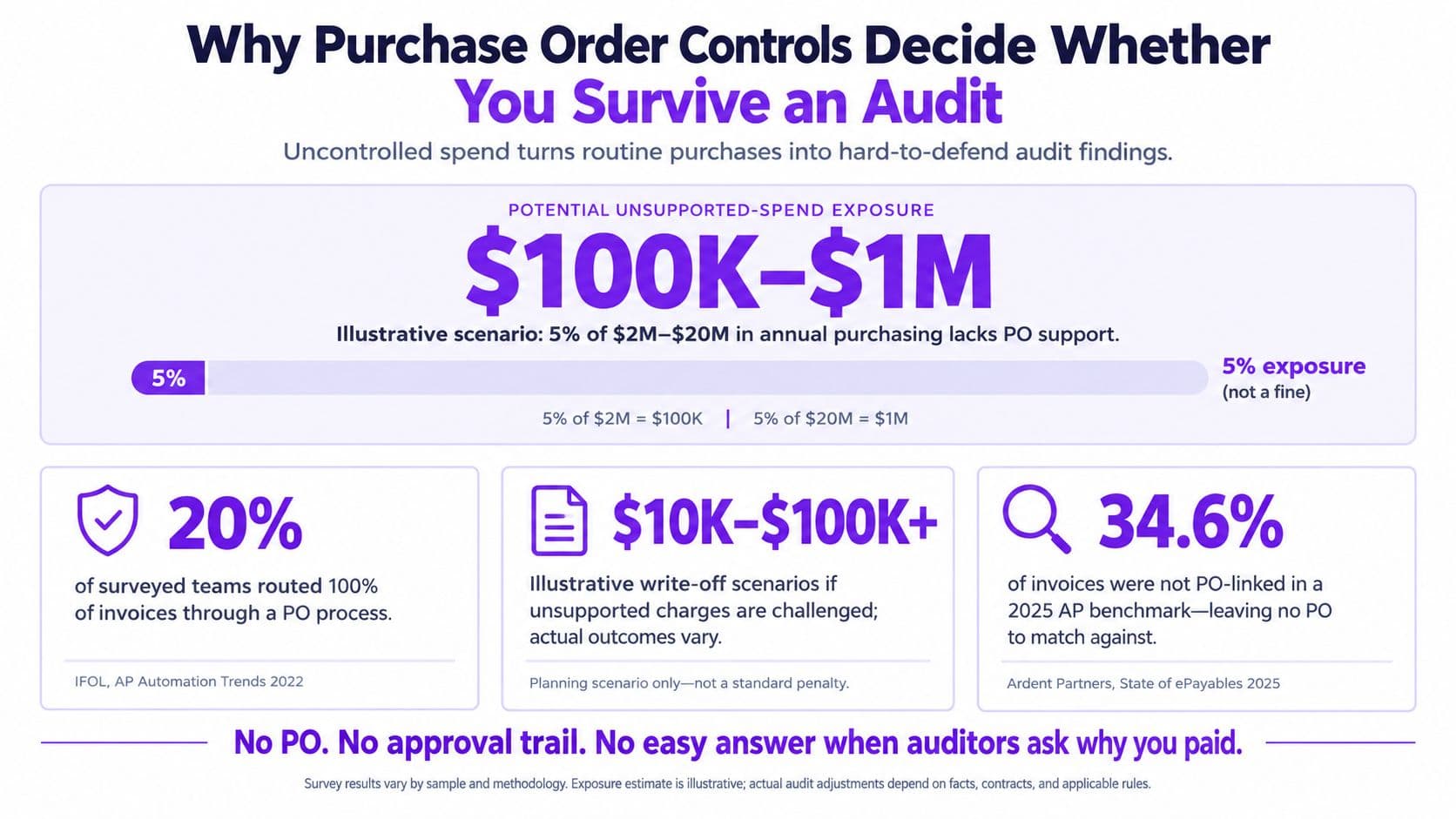
A PO process needs to deliver four outcomes:
- Stop unauthorized spend. Require the right approver to sign off before someone makes a commitment on the company's behalf.
- Connect budget to bill. Preserve a traceable record from the original request through the supplier invoice and general-ledger coding.
- Defend against duplicate payments and fraud. Validate the supplier, the approved terms, and evidence of receipt before paying.
- Produce audit-ready evidence. Keep approval, vendor, delivery, and payment records together so your team can explain what happened without rebuilding the history from email.
Payment fraud makes that last point more than a documentation preference. The 2024 AFP Payments Fraud and Control Survey found that 80% of organizations experienced attempted or actual payment fraud in 2023, and 30% of affected organizations couldn't recover the funds. The survey's payment-fraud findings support a practical rule: no one person should control the request, receipt confirmation, and payment approval. See how segregation of duties strengthens financial controls.
Four control outcomes, one connected record
Consider a SaaS renewal approved by email but never recorded in the purchasing workflow. The invoice arrives after the service period starts, and the finance team has no clear owner, approved budget, or renewal terms to compare against. The result can be a delayed close, a misclassified expense, or an audit adjustment. A PO won't solve every accounting issue, but a complete record makes it easier to identify where the process failed and who must resolve it.
The value of the control isn't the number of forms you create. It's whether you can show that the right person approved a commitment, the vendor delivered what was agreed, and the final bill received a defensible accounting treatment.
The Purchase Order Lifecycle From Requisition to Payment
A purchase order is a uniquely numbered commercial document that records the buyer, supplier, goods or services, quantities, prices, delivery and payment terms, and accounting information. Once the supplier accepts it, the PO documents the commitment before delivery. The complete process then connects that commitment to receipt, invoice review, and payment.
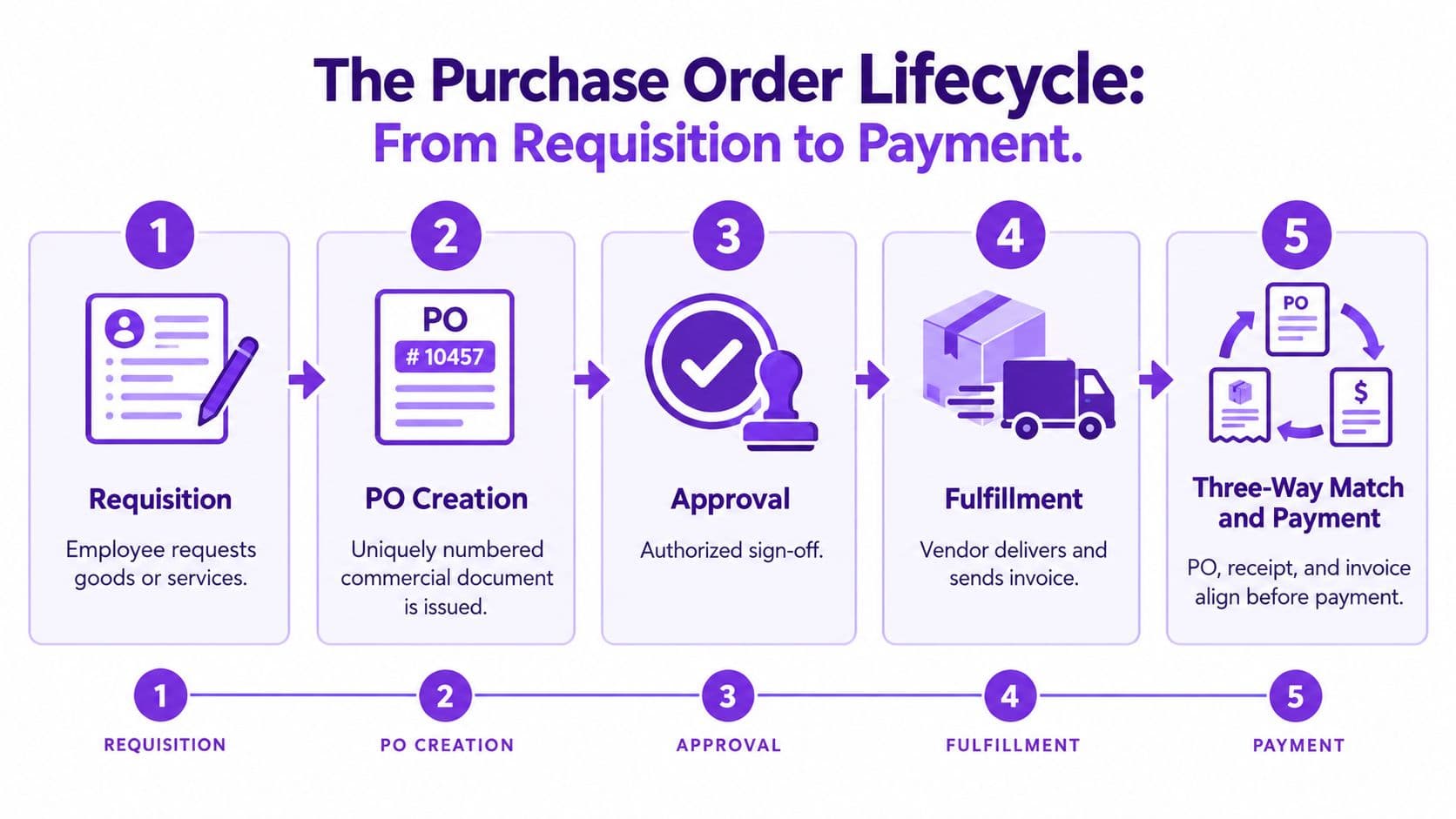
The eight stages and their owners
| Stage | Document produced | Typical owner | Control evidence |
|---|---|---|---|
| Need identification | Purchase request or intake record | Requester | Business purpose and requested timing |
| Requisition | Purchase requisition | Requester | Vendor, description, estimated cost, cost center |
| Approval | Approved requisition | Budget owner or authorized approver | Approval identity, timestamp, budget decision |
| PO creation and issuance | Numbered purchase order | Buyer or finance team | Approved terms and PO number |
| Supplier acceptance | Supplier confirmation | Buyer or contract owner | Accepted price, scope, and delivery or service dates |
| Receipt recording | Goods receipt, approved timesheet, or milestone acceptance | Receiving team or service owner | Evidence that goods arrived or services were delivered |
| Invoice review and matching | Validated supplier invoice | Accounts payable (AP) | PO, receipt, and invoice comparison |
| Payment release | Payment authorization and ledger record | AP and authorized payment approver | Resolved exceptions and payment record |
The PO's role isn't to replace the contract or invoice. It's the reference that lets your team check whether the invoice reflects an approved commitment and whether the company received what it agreed to buy. For service firms, receipt evidence can be an approved timesheet, a milestone sign-off, or confirmation that a monthly service was delivered.
Electronic workflows make the approval trail easier to search and retain. APQC reports that top-performing organizations approve 98% of purchase orders electronically, compared with slightly more than half among bottom performers (APQC electronic PO approval benchmark). Configure the workflow to capture the requester, approver, timestamp, budget, and policy decision, rather than relying on an approval buried in someone's inbox.
A connected handoff also makes invoice review less dependent on manual follow-up. For practical ways to improve your accounts payable process, start by documenting who owns each record and what evidence must exist before the next person acts.
Use this visual as a process map alongside the table:
Three-Way Matching, Tolerance Rules, and Exception Ownership
Three-way matching compares the PO, receiving record, and supplier invoice before payment. The check should cover supplier identity, PO number, description, quantity, unit price, tax, currency, service period, and total. A clean match supports payment; a variance goes to an exception queue for review.
Set tolerance rules before you automate. Supplier identity and bank-detail changes should receive human verification, not a routine variance allowance. For price and quantity, define a controlled percentage or absolute tolerance that fits your contracts and materiality policy. Every exception needs a named owner, supporting documentation, and an accounting decision.
Route variances instead of forcing a match
| Variance type | Suggested tolerance | Action when exceeded | Owner |
|---|---|---|---|
| Supplier identity or bank details | No automatic tolerance | Verify changes through an approved process and pause payment | Vendor-master owner |
| Unit price | Defined contract-based limit | Confirm an amendment, correct the invoice, or document an approved variance | Buyer or contract owner |
| Quantity or delivery | Match accepted quantities; allow documented partial receipts | Record what arrived and hold or split the unmatched amount | Receiving owner |
| Service period | Must agree with the PO or approved contract period | Confirm service delivery and determine the correct expense or accrual period | Service owner and controller |
| Tax, currency, or total | Apply the documented terms and accounting rules | Investigate calculation, coding, or invoice errors | AP and finance |
For a concrete example, suppose a PO covers a service at $2,146, but the invoice is $2,150 because the unit price is $4 higher. If the service period also ends one day later than the PO states, AP shouldn't approve the total without review. The buyer confirms whether the price change was authorized; the service owner verifies the extra day; and finance documents whether the invoice needs correction, an approved variance, or a period adjustment. The amounts here illustrate the control mechanics, not a benchmark.
Practical rule: A match is not a green light when the underlying approval or receipt evidence is missing.
For a deeper explanation of the control, use this guide to three-way match. Separate the requester, approver, receiver, and payment roles so one person can't create a purchase, confirm a fictitious delivery, and authorize the payment.
Matching Your PO Process to QuickBooks, Xero, and NetSuite
Don't choose accounting software based on a PO feature label. Test the actual workflow your team will use: Can a requester submit a purchase? Can an approver review it before commitment? Can AP connect the bill to the PO and evidence of receipt? Can the system flag exceptions and preserve the audit trail?
| Platform | Practical fit | What to test before relying on it |
|---|---|---|
| QuickBooks Online | Smaller firms with a straightforward purchasing process | PO creation, approval controls, bill conversion, and whether the workflow requires an add-on |
| Xero | Firms that want a simple purchasing workflow within an integrated accounting setup | Approval limits, purchase-to-bill handoff, tracking categories, and integration requirements |
| NetSuite | Businesses with more complex purchasing, entities, and financial workflows | Approval routing, entity-level controls, matching configuration, and reporting across the process |
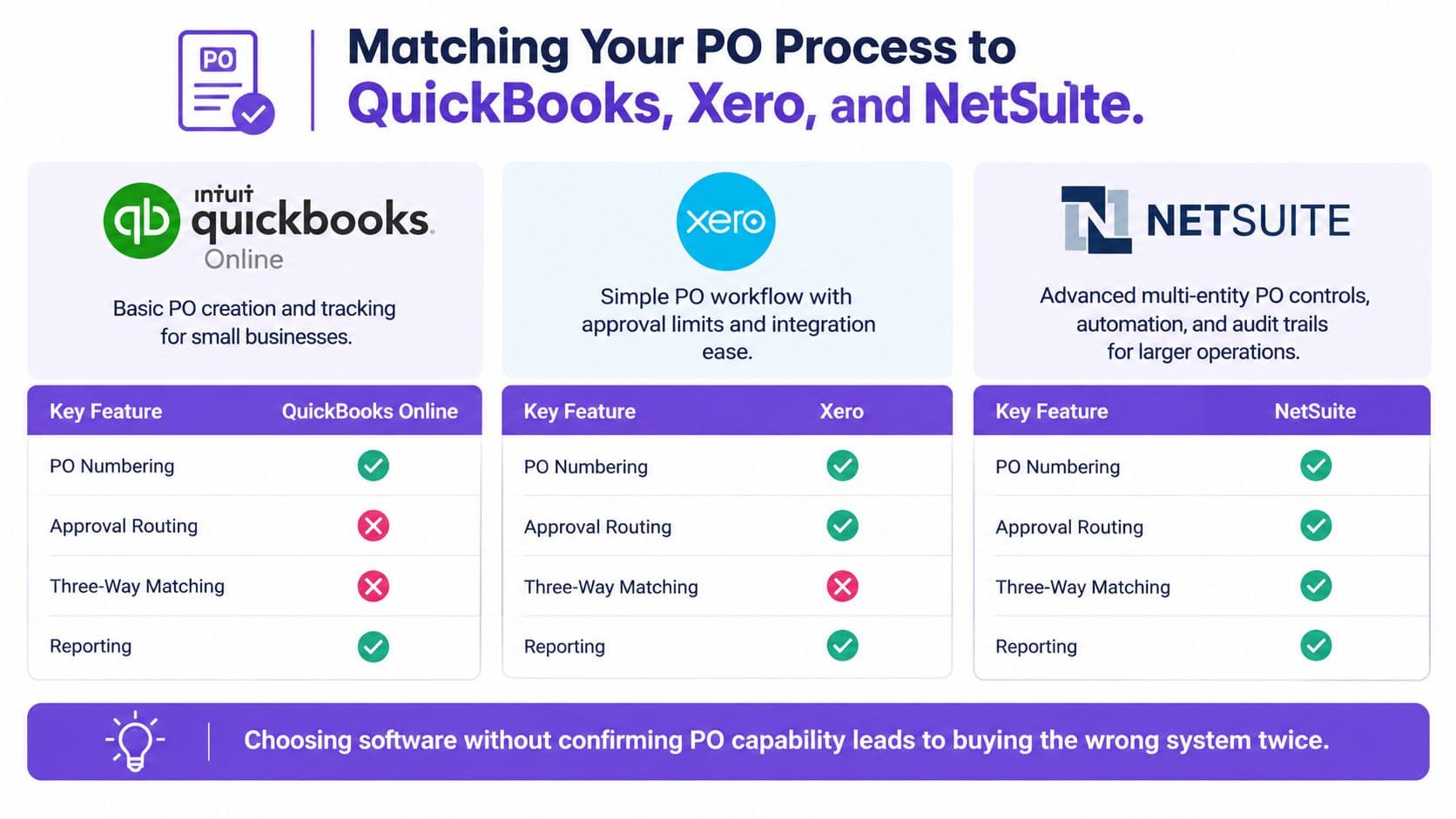
For a smaller services firm where the owner approves purchases, keep the design simple: one intake path, clear approval authority, and a documented link from the approved PO to the bill. A growing agency with department budgets should test whether approvals follow the budget owner and whether project or cost-center coding flows into reporting. A SaaS company preparing for an audit should assess the broader finance stack, including multi-entity needs, revenue recognition, and stock-based compensation, rather than treating a PO module as the answer to every accounting requirement.
Software capabilities change by edition, configuration, and integrations. Confirm them in your own environment before committing to a process. If you're weighing broader system architecture, this UI Lib ERP comparison helps frame the differences between cloud and on-premise approaches.
The right setup is the one your team can operate consistently. Use QuickBooks accounts payable automation guidance to assess where automation fits, then keep human review for unusual vendors, unclear receipt evidence, and exceptions outside delegated authority.
When You Actually Need a PO and When You Don't
A blanket PO mandate sounds like strong control. In practice it produces paperwork without adding protection. As noted earlier, only a small share of AP teams require POs for every invoice, and the same research points to recurring subscriptions, payroll, taxes, utilities, emergency purchases, and small-dollar expenses as the categories where universal mandates break down. Design controls around the commitment, not the document.
Use a decision rule your team can follow
Require a PO before committing to a new vendor, contractor engagement, capital purchase, or cloud-infrastructure commitment that needs budget-owner approval. For a recurring subscription, an approved contract with a named owner does the job; add a PO when the commitment's size, terms, or renewal risk warrant it. Payroll and tax payments belong under their own established controls, not a PO for each payment.
Set thresholds from cash exposure, not convention
Base your dollar thresholds on approval structure and cash exposure. One workable example: require a PO above $1,000, and run a monthly review of purchases below $250. Those are policy examples, not universal benchmarks. Document who can approve exceptions, then check monthly whether spend is routing around the rule.
Control the no-PO path too
Purchases without a PO still need accountability. Require every invoice to name the vendor, business purpose, cost center, approver, service period, and receipt or completion evidence. At month-end, AP should flag delivered but unbilled services so accruals land in the right period and close doesn't stall on reconstructed approvals.
A workable policy tells employees which commitments need pre-approval and what evidence covers the rest. Paper volume is not control.
Red Flags That Mean Your PO Process Is Broken
A purchasing policy is broken when employees routinely commit money outside it, or when AP has to reconstruct the approval after the invoice arrives. A 2020 Levvel Research survey found that 30% of organizations used POs rarely or not at all, while 84% considered requisition management an important eProcurement capability, showing a gap between stated priorities and daily practice (Levvel procurement research).
Look for these warning signs:
- Subscriptions hit expense without an owner. Finance can't confirm who approved the service, whether it's still needed, or which team owns the cost.
- Duplicate vendor records exist. AP may process separate records for the same supplier, complicating invoice review and increasing the risk of duplicate payment.
- Service receipts are missing. A signed contract doesn't prove that a contractor completed the billed work or that a monthly service was delivered.
- Auto-renewals arrive as surprises. The business pays under old terms because no one owns the contract dates or renewal decision.
- Year-end service costs land in the wrong period. An invoice received after year-end can relate to services already delivered, so AP needs evidence of the service period and an accrual decision.
- A new invoice doesn't match the approved scope. A buyer or contract owner must verify the change before AP releases payment.
Take a $14,400 annual SaaS renewal billed under an expired PO and coded as software when the product supports marketing. The classification can distort CAC analysis during fundraising, while the expired authorization leaves finance without current renewal approval. Treat this as an illustrative scenario, not a survey result.
The fix isn't to add a new form for every expense. Assign an owner to each commitment, keep vendor records clean, and require evidence that explains what the company bought, received, and paid for.
KPIs, Dashboards, and a 90-Day Implementation Roadmap
Measure whether your process works, not just whether the policy exists. Put electronic approval rate, PO-to-invoice match rate, exception rate by category, and average requisition-to-approval time on a weekly finance dashboard. Use the figures to find bottlenecks and off-process spending; don't set unsupported targets and call them benchmarks.
Build the controls in sequence
| Phase | Days | Deliverable | Owner |
|---|---|---|---|
| Policy and authority | 1-30 | PO policy, dollar thresholds, approval matrix, exception owners | Controller or finance lead |
| Vendor and workflow setup | 31-60 | Clean vendor list, configured PO module, approver routing rules | AP lead and system administrator |
| Matching and measurement | 61-90 | Three-way matching rules, KPI dashboard, parallel validation records | Controller and AP lead |
Start with the rules, because software can't decide who has authority or what counts as acceptable receipt evidence. Then clean the vendor master, configure the workflow in QuickBooks, Xero, NetSuite, or your connected purchasing tool, and test routing before directing all purchases through it.
Run a parallel review while the team validates the new matching rules. Compare system decisions with manual reconciliation, document false matches and missed exceptions, and correct the configuration before relying on automated payment decisions. For a practical companion on how to implement business processes, focus on assigning owners and keeping the evidence alongside the policy.
Processing capacity gives you another reason to standardize invoice inputs. IOFM benchmarking of more than 300 AP professionals reported that top-performing departments process about 575 invoices per full-time employee per month, compared with 350 for average departments (IOFM invoice-processing benchmark). At 1,050 invoices per month, the average rate implies 3 AP FTEs: 1,050 ÷ 350 = 3. At the top-performing rate, the same workload implies about 1.83 FTEs: 1,050 ÷ 575 ≈ 1.83, a difference of about 1.17 FTEs in capacity. That calculation isn't a staffing instruction. It shows why clean PO numbers, complete receipt evidence, and exception queues matter. Connect the workflow to invoice-processing automation, then review the results before changing staffing or payment rules.
Your Next Step Toward a Controlled PO Process
Turn the policy into five actions your team can verify:
- Write a one-page PO policy. Define which commitments need pre-approval, who can approve them, and what exceptions require.
- Clean the vendor master. Remove duplicate or incomplete records and assign an owner to vendor changes.
- Enable three-way matching. Configure your current accounting or purchasing system to compare the PO, receipt, and invoice.
- Name an exception owner. Document tolerance rules and who resolves price, quantity, supplier, and service-period variances.
- Publish a weekly dashboard. Track approval, matching, exceptions, and cycle time so the process stays visible.
Match the implementation effort to the work you need done. A Starter engagement can focus on the policy and vendor master; Growth can support the matched workflow; Scale can build the dashboard and an investor-ready finance package. Jumpstart Partners provides outsourced controller and bookkeeping services for growing businesses using platforms including QuickBooks, Xero, and NetSuite.
Choose one upcoming purchasing cycle and test the policy before rolling it out broadly. Make sure each commitment has an owner, each invoice has a documented path to approval, and every exception ends with a recorded decision.
Jumpstart Partners helps SaaS companies, agencies, and other growing businesses set up PO controls, accounts payable workflows, and close-ready financial records. Visit Jumpstart Partners to discuss your current process and book a consultation focused on the controls your business needs.