Financial Operations
Mastering the Trial Balance: A Founder's Guide to Financial Accuracy
A founder-friendly guide explaining what is trial balance, how to prepare it, and how to troubleshoot common issues for accurate books.
ByJumpstart Partners, CPA, QuickBooks ProAdvisor
··14 min readWhen your financial reports hit your desk, do you trust them implicitly? If your cash flow forecasts feel like a guess, or you dread investor due diligence, the problem often starts with a single, overlooked report: the trial balance.
For founders and CEOs of growing businesses, an unbalanced trial balance is more than an accounting headache. It's a critical early warning that your entire financial data system is compromised. It means your strategic decisions on hiring, marketing spend, and product investment are based on flawed information.
Think of it as the pre-flight check for your company's financials. If the numbers don't align here, the income statement and balance sheet you rely on are fundamentally unreliable. Getting this right isn't just about clean books; it's about gaining the confidence to make bold, data-backed decisions to scale your company.

This guide will walk you through what a trial balance is, why it's a non-negotiable step for SaaS and service firms, and how to use it to ensure your financial house is in order.
What Is a Trial Balance, and Why Does It Matter for CEOs?
Before you ever share a financial statement with an investor, a lender, or even your leadership team, your books need to pass a critical internal stress test. That test is the trial balance.
It’s not a formal report you’d put in a board deck. Think of it as an internal quality check—a quick but vital step to confirm your entire accounting system is built on a solid foundation. Its one and only job is to prove the most fundamental rule of double-entry bookkeeping: your total debits must equal your total credits.
Imagine your accounting system as a perfectly balanced scale. Every transaction—from a sales invoice to a software subscription payment—adds weight to both sides. The trial balance is the moment you step back and confirm that scale is perfectly level. If it's not, something is wrong, and you cannot trust the final reports.
"A trial balance is your first, best indicator that your books are mathematically sound. For founders, it's the checkpoint that separates messy data from decision-grade financial intelligence. Without a balanced trial balance, you're flying blind." — Ben Wann, CPA, Finance Expert
This report pulls the final balance from every single account in your general ledger—Cash, Accounts Receivable, Deferred Revenue, you name it—and lists them in two simple columns: one for debits and one for credits.
For high-growth SaaS and service companies, an accurate trial balance is the bedrock for:
- A Faster Month-End Close: Catching errors here is the key to achieving a swift 5-day close. According to OpenView's 2024 SaaS Benchmarks, top-quartile companies close their books in under a week, giving them faster access to data for strategic decisions.
- Investor-Ready Financials: A clean, balanced report is non-negotiable for due diligence. It’s one of the first things investors and auditors look at to verify the integrity of your financial operations.
- Trusted Strategic Data: When your trial balance is correct, you can actually trust the resulting income statement and balance sheet. That trust is what allows you to make critical calls on hiring, marketing spend, and product investment with real confidence.
Getting this report right is the first step toward generating financials you can use to run and scale your business. This guide on What Is Trial Balance in Accounting offers another helpful breakdown.
The Three Trial Balances in Your Accounting Cycle
The term “trial balance” is a bit of a misnomer. It’s not a single, one-and-done report. Think of it as a series of checkpoints that evolve as you work through your monthly close process. For a founder, understanding these three distinct stages turns a static accounting task into a dynamic view of your company’s financial health.
This visual timeline shows exactly where the trial balance fits in. It’s the critical link between the raw transaction data in your general ledger and the polished financial statements you rely on for strategic decisions.
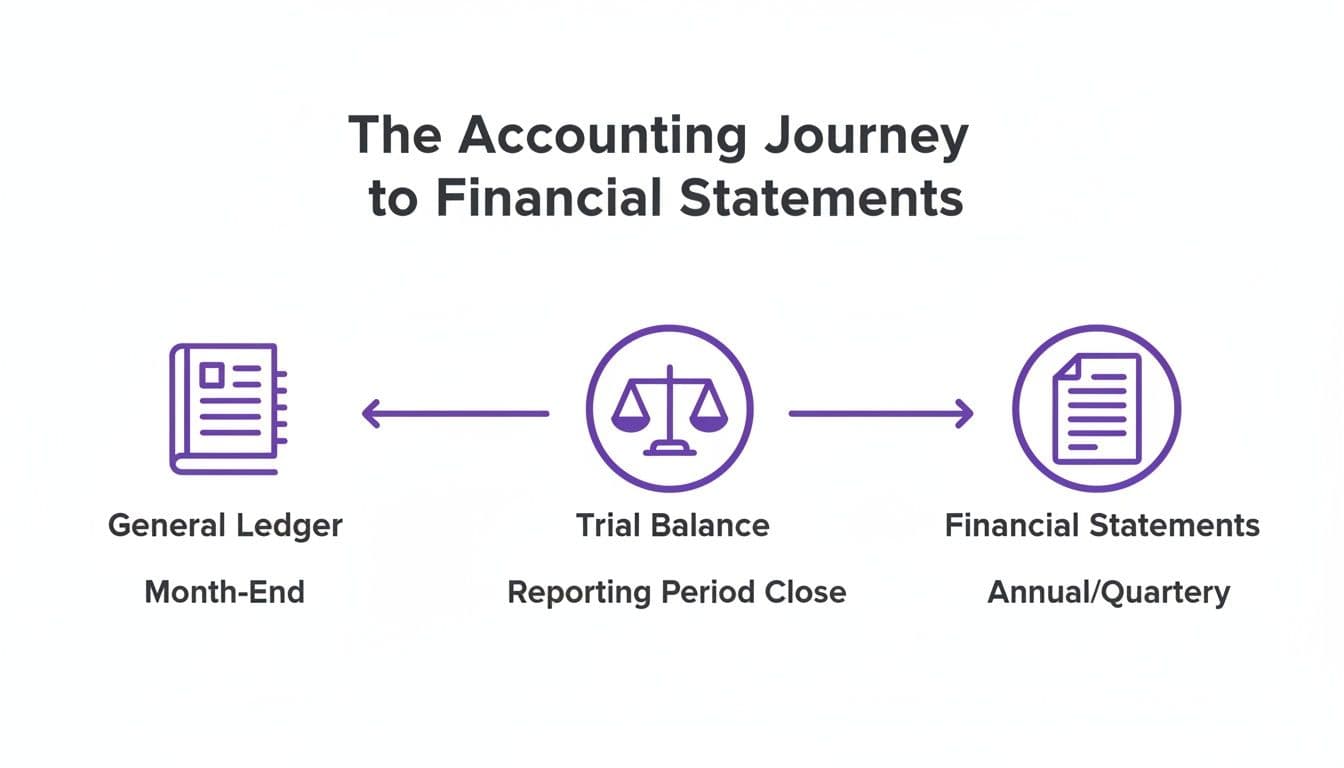
Essentially, the trial balance is your central quality control step. It confirms the numbers pulled from your ledger are mathematically sound before you build an income statement or balance sheet from them.
| Trial Balance Type | Purpose | When It's Used |
|---|---|---|
| Unadjusted | A raw, preliminary check to confirm basic debits and credits from daily business activities are in balance. | After all routine transactions for the period are posted, but before adjusting entries. |
| Adjusted | The most critical version for decision-making. It reflects the true financial picture after accruals and deferrals. | After all adjusting entries (e.g., accrued expenses, deferred revenue recognition) have been made. |
| Post-Closing | A final check to ensure all temporary accounts (revenue, expenses) are zeroed out and the books are ready for the next period. | After the income statement and balance sheet are created and closing entries are posted. |
The adjusted trial balance is where the real work happens, and it's the version that matters most for decision-making. These aren’t your daily transactions; they are period-end adjustments for things like:
- Accrued Expenses: Recognizing expenses you’ve incurred but haven’t paid yet, like employee salaries for the last week of the month.
- Deferred Revenue: Properly accounting for cash you’ve received upfront but haven’t earned yet—a critical step for any SaaS or service firm.
This version provides the true, accurate financial picture you need for reliable reporting. It's a key financial document for corporate accountant auditor insight because it reflects economic reality, not just cash movement.
A Worked Example: Trial Balance for a SaaS Company
Theory is one thing, but seeing a trial balance in action makes its value tangible. Let's translate this from an abstract accounting concept to a concrete financial tool for a hypothetical $2.4M ARR SaaS company. This isn't just a list; it’s the complete financial DNA of your business at a specific moment.
Sample Adjusted Trial Balance (As of Jan 31, 2026)
This table shows a snapshot of the general ledger, organized into debit and credit columns.
| Account Name | Debit ($) | Credit ($) |
|---|---|---|
| Cash | 1,200,000 | |
| Accounts Receivable | 150,000 | |
| Prepaid Expenses | 50,000 | |
| Fixed Assets | 250,000 | |
| Accumulated Depreciation | 75,000 | |
| Accounts Payable | 60,000 | |
| Deferred Revenue | 600,000 | |
| Common Stock | 700,000 | |
| Retained Earnings | 215,000 | |
| Subscription Revenue | 200,000 | |
| Salaries & Wages | 110,000 | |
| Marketing & Sales Expense | 50,000 | |
| R&D Expense | 40,000 | |
| Total | $1,850,000 | $1,850,000 |
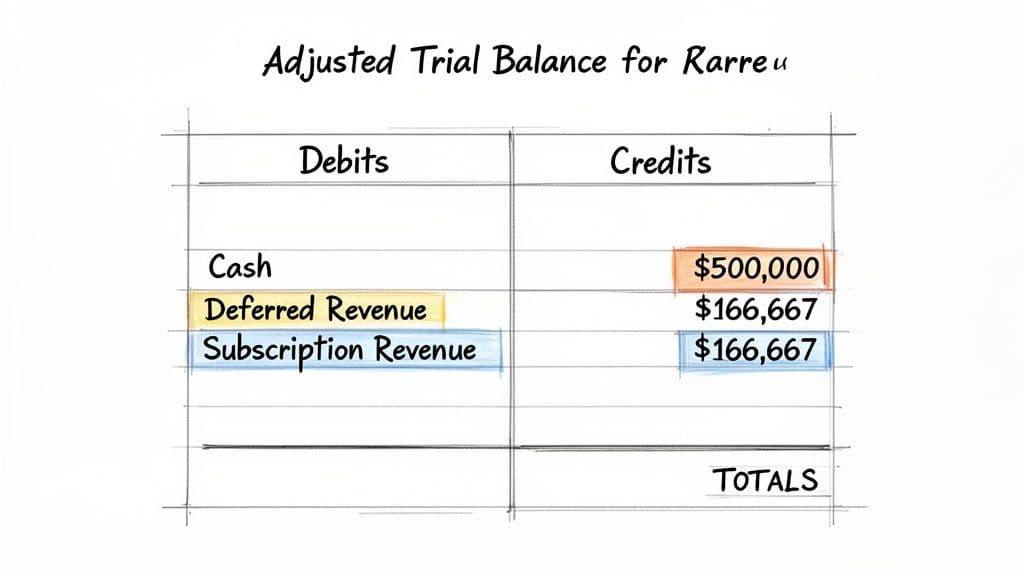
The single most important detail is the bottom line: the total debits and credits match perfectly. This is the mathematical proof that your books are sound and your accounting equation (Assets = Liabilities + Equity) is intact.
Deeper Dive: Key SaaS Accounts Explained
Let's break down a few lines crucial for any SaaS founder. The nuances of subscription models make these accounts non-negotiable for accurate financial reporting, especially under ASC 606.
- Deferred Revenue ($600,000 Credit): This is cash you’ve already collected from customers for services you haven't delivered yet. It is a liability because you owe that service. As you deliver on your promise each month, you recognize a portion as earned revenue.
- Subscription Revenue ($200,000 Credit): This is the slice of deferred revenue you've officially earned this month. For a $2.4M ARR company, this figure represents the monthly recognized revenue ($2,400,000 / 12 months).
- Accounts Receivable ($150,000 Debit): This is revenue you’ve earned and invoiced, but the cash hasn't hit your bank account yet. It’s an asset because it represents a future cash inflow you are entitled to.
Seeing these accounts side-by-side demonstrates the power of a trial balance. It connects cash collection (Deferred Revenue) with revenue recognition (Subscription Revenue), giving you a complete picture that a simple cash statement would miss. For more on this, explore our guide on accounting for SaaS.
Red Flags: When Your Trial Balance Is Off
That sinking feeling when your bookkeeper says the trial balance is off—it’s a guaranteed sign that something in your general ledger is broken. For a founder, hunting for that one bad entry feels like a time-sucking distraction from running the business.

Instead of randomly digging through hundreds of transactions, an experienced controller uses a methodical process. A few quick calculations can often pinpoint the exact type of error, saving hours of frustrating work.
Your Troubleshooting Checklist: Actionable Next Steps
If your trial balance is off, take these steps immediately:
- Calculate the Difference: Find the exact difference between the total debits and credits.
- Divide by 9: Is the difference perfectly divisible by 9? If yes, you almost certainly have a transposition error (e.g., typing $87 instead of $78) or a slide error (e.g., typing $1,000 instead of $100.00). This simple math trick turns a day-long search into a targeted fix. For example, if the difference is $540 ($600 - $60), it's divisible by 9.
- Search for the Exact Amount: If the difference isn't divisible by 9, search your general ledger for a transaction that exactly matches the difference. This often points to a single-sided entry where the corresponding debit or credit was missed.
- Divide by 2: If you find a transaction for half the difference, it's likely a debit was posted as a credit or vice-versa. For example, if the difference is $2,000, look for a $1,000 transaction posted to the wrong column.
You can learn more about how accurate trial balances impact valuations in this detailed analysis from Paro.ai. For a deeper dive into finding these issues, see our guide on how to reconcile bank accounts.
Common Misconception: A Balanced Trial Balance Is Not an Accurate One
This is a critical warning. A balanced trial balance does not guarantee your books are accurate. It only confirms that your debits equal your credits.
It's a mathematical check, not a strategic one. A trial balance will never catch a misclassified expense. If your bookkeeper codes a $15,000 software subscription under 'Office Supplies' instead of 'Software Expense,' the debits and credits still balance perfectly.
But now, your financial statements are dangerously misleading. Your gross margin looks artificially high, and your customer acquisition costs appear lower than they truly are. This is precisely why expert human oversight is non-negotiable—a machine checks the math, but an expert checks the meaning.
Automating Your Trial Balance with Expert Oversight
As a founder, your time is your most critical asset. Manually hunting for a transposition error in a sprawling spreadsheet isn't just frustrating—it’s a catastrophic waste of that asset. That’s low-leverage work pulling you from the things that actually grow your business: sales, product, and strategy.
The modern approach for high-growth companies is to fuse powerful automation with targeted human expertise. This isn't about replacing people with software; it's about eliminating robotic tasks so your financial experts can focus on strategy and analysis.
The Power and Limits of Automation
Today's accounting platforms like QuickBooks, NetSuite, and Xero are brilliant at automatically generating a trial balance. This single step wipes out the most common manual errors.
However, automation is only half the battle. Software executes commands with perfect precision, but it has zero judgment.
Automation ensures your trial balance is mathematically balanced. Expert oversight ensures it’s strategically correct. They are not the same thing.
A machine can’t interpret a complex new sales contract to figure out the right revenue recognition schedule. It won’t flag an unusual expense and question whether it was classified correctly. This is where automation hits its wall—and where significant financial risks hide in plain sight.
The Role of an Expert Controller
This gap is exactly where an outsourced controller becomes a game-changer. Their job isn't to do manual data entry. Instead, they provide the critical oversight that transforms raw data into financial intelligence you can trust.
An expert controller’s role is to:
- Validate the Automated Report: They scan the software-generated trial balance for anomalies and unreasonable figures a machine would never question.
- Prepare Complex Adjusting Entries: They handle the nuanced accounting that software can’t, like calculating accrued liabilities or adjusting for deferred revenue based on specific contract milestones.
- Ensure Compliance: They make sure your accounts are structured correctly for accounting standards like ASC 606, which is non-negotiable for SaaS and service companies.
- Analyze the Final Numbers: Once the trial balance is adjusted and correct, they interpret the data to spot trends, check key metrics, and provide you with insights to run the business.
This combination of disciplined software workflows and CPA-reviewed close steps is how teams shorten month-end without skipping reconciliations. Jumpstart Partners scopes controller-led finance ops for founder-led B2B AI SaaS teams after the Finance Ops Diagnostic.
Frequently Asked Questions About the Trial Balance
As a founder, you have enough on your plate without getting bogged down in accounting jargon. To cut through the noise, here are straight answers to the most common questions we hear from leaders about the trial balance.
Does a balanced trial balance mean my books are perfect?
No. This is a critical—and dangerous—misconception. A balanced trial balance only confirms that your total debits equal your total credits.
Think of it as a spell-checker, not a logic checker. A balanced report will not catch these costly errors:
- Misclassified Expenses: Booking a $10,000 software cost under ‘Marketing Expense’ still balances, but it distorts your key metrics.
- Duplicate Payments: Accidentally paying the same invoice twice creates two valid, balanced entries. Your books will balance, but you just threw cash away.
- Omitted Transactions: If a transaction is never entered, the trial balance will never know it existed.
A balanced report is the first step, not the final destination. Professional review is essential to ensure the numbers are also correct, complete, and strategically sound.
How often should I run a trial balance?
Every single month. No exceptions.
Preparing a trial balance is a core discipline of the month-end close. A monthly cadence is the non-negotiable standard for any company that wants to be investor-ready and make timely, data-driven decisions. This regular rhythm lets you spot and fix errors quickly, before they snowball into massive, expensive cleanup projects that destroy trust in your financials.
My software does this automatically. Why do I need an expert?
Your accounting software automates the calculation, but it cannot perform the analysis. This is the fundamental difference between a tool and a strategist.
An expert controller provides the judgment, context, and critical thinking that software lacks. They are the human intelligence layer on top of the machine.
An expert prepares critical adjusting entries for complex items like deferred revenue, validates that transactions are classified correctly, and interprets the final report to give you strategic insights. The software is a powerful calculator; the expert ensures the calculation produces genuine financial intelligence you can act on.
Jumpstart Partners offers controller-led finance ops for founder-led B2B AI SaaS teams—monthly close, reporting, and billing support scoped after the Finance Ops Diagnostic.