Financial Operations
Accounts Payable Outsourcing Services: Complete Guide 2026
Discover how accounts payable outsourcing services can streamline your business finances. Expert guide for growing companies.
ByJumpstart Partners, CPA, QuickBooks ProAdvisor
··14 min readAccounts payable outsourcing services stopped being a niche back-office fix a long time ago. One market estimate places the category at USD 624.05 million in 2024 and projects it to reach USD 1,052.49 million by 2032, while another values it at about USD 4.5 billion in 2024 with growth to USD 8 billion by 2032. The exact size depends on methodology, but the direction is clear. AP outsourcing is now a real operating model for founders and finance leaders who need to cut invoice work without losing control.
If you're running a SaaS company, agency, or professional services firm in the $500K to $20M revenue range, AP usually becomes painful right when your business starts to look healthy. Invoices pile up, approvals stall, vendors chase your team, and the person “handling AP” is often also doing bookkeeping, bill pay, and ad hoc admin. That's where the blended model matters most, because the win isn't just lower cost. It's cleaner process, faster approvals, and fewer mistakes when the business is already stretched.
Table of Contents
- Why Accounts Payable Outsourcing Has Become Mainstream
- What Accounts Payable Outsourcing Specifically Includes
- The Real Cost Comparison In-House vs Outsourced AP
- Automation Plus Outsourcing The Blended Model That Works
- Implementation Timeline and Transition Process
- How to Evaluate and Select an AP Outsourcing Provider
- Scaling Finance Operations from $500K to $20M Revenue
Why Accounts Payable Outsourcing Has Become Mainstream
The market moved because the work never stopped growing
The AP outsourcing market has clearly crossed the line from experiment to operating norm. One independent estimate puts the global market at USD 624.05 million in 2024, rising to USD 666.29 million in 2025 and reaching USD 1,052.49 million by 2032 at a 6.75% CAGR (market estimate). Other analyses put the industry much higher, including about USD 4.5 billion in 2024 and USD 6.85 billion in 2024, which shows how differently firms define scope and service bundles. The useful takeaway for you isn't the exact forecast, it's that AP outsourcing now sits in a multi-billion-dollar global category.
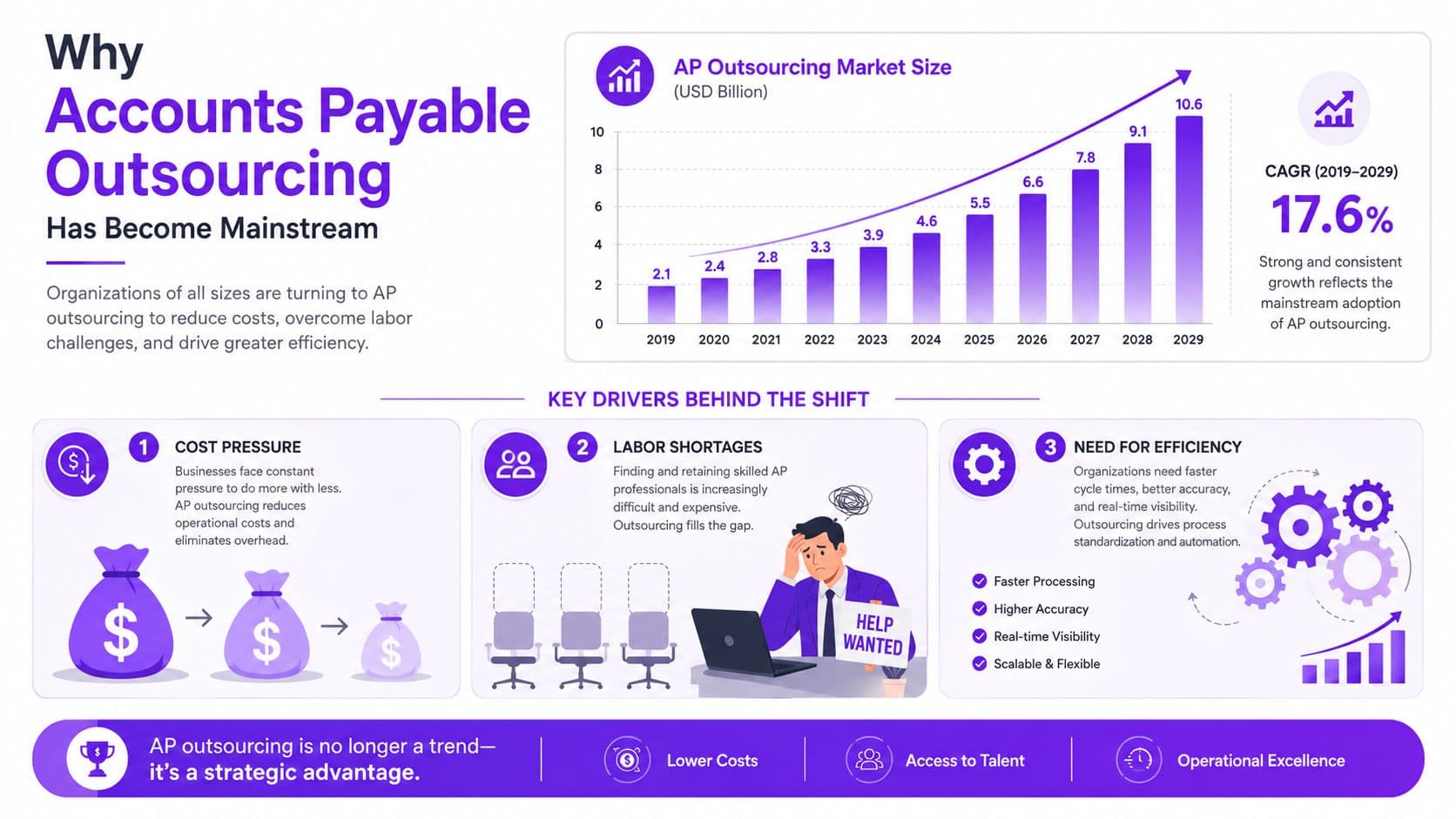
The reason is simple. Finance teams are being asked to process more invoices with tighter controls and fewer people, while founders want better visibility and lower overhead. In one industry source, companies outsourcing finance and accounting functions achieve 30% to 40% average cost savings, and accounts payable/receivable are among the biggest savings areas (finance outsourcing statistics). The same source says 54% of organizations that outsource any finance work outsource accounts payable, which tells you AP is often the first finance process companies are willing to hand off.
Practical rule: outsource AP when your team is spending time on repetitive invoice handling instead of cash planning, vendor management, or closing the books.
Why it shows up first in growing companies
For businesses at your stage, AP is usually the first finance function that breaks under growth because it's repetitive, deadline-driven, and visible to vendors. It also doesn't require a full-time controller-level hire to improve, which makes it a natural entry point for outsourced finance operations. A company processing hundreds of invoices each month can get trapped in a cycle of late approvals, rushed payments, and more corrections, all of which create more internal work.
That's why AP outsourcing shows up in the same conversations as the first finance hire. If you're deciding between another generalist employee and a specialized provider, the provider often wins when the issue is process volume rather than strategic judgment. If you want a broader view of how AP fits into outsourced finance, the finance and accounting outsourcing landscape is the right place to compare the options.
What Accounts Payable Outsourcing Specifically Includes
The AP workflow moves as a chain, not a single task
Modern AP outsourcing services cover the full sequence from invoice arrival to payment and reporting. The provider typically handles invoice intake and capture, validation and coding, two-way or three-way matching, approval routing, exception resolution, payment execution, and reporting (AP provider workflow). That matters because AP problems usually show up between handoffs, not inside one isolated task.
A SaaS company processing 100 invoices a month can feel the change quickly. In-house, someone opens emails, downloads attachments, keys in data, chases approvers, fixes mismatches, and answers vendor questions. With outsourcing, the provider centralizes intake, pushes invoices through a defined approval path, and tracks status inside your accounting or ERP stack. That does not remove human oversight. It removes the repetitive work that slows the process and pulls finance time away from higher-value tasks.
What stays with you
You should keep the decisions that affect policy, risk, and relationship control. That includes budget approval, payment authorization for large amounts, and strategic vendor relationships. Providers can route, validate, and execute within your rules, but you still own the rules. If that split is unclear, the model becomes harder to manage fast.
Your team should approve policy. The provider should execute process.
A useful way to think about it is by responsibility rather than job title:
| AP Activity | Usually Outsourced | Usually Kept In-House |
|---|---|---|
| Invoice capture and coding | Yes | No |
| Matching and exception tracking | Yes | No |
| Routine approval routing | Yes | Sometimes |
| Payment execution | Yes | Sometimes for high-value items |
| Vendor relationship strategy | No | Yes |
| Budget sign-off | No | Yes |
The blended model also connects AP to your accounting software and payment rails. Providers commonly integrate with ERP or accounting platforms and support payment methods such as ACH and virtual cards, which gives you centralized control and cleaner visibility across the workflow (provider capabilities). If you want a process reference point, the AP process improvement guide helps map where bottlenecks usually appear.
The Real Cost Comparison In-House vs Outsourced AP
The cost gap is not subtle. Sage reports outsourced processing typically costs about $2 to $6 per invoice, compared with $10 to $30 for manual internal processing (Sage AP outsourcing). Other practitioner guides place outsourced service tiers around $1.50 to $5.00 per invoice. That spread exists because volume, complexity, and exception handling change the economics, but the direction stays the same.
A worked example for 150 invoices a month
If you process 150 invoices monthly, your in-house cost is not just salary. You also pay for software, training, manager review, error correction, and the time spent chasing approvals. An outsourced model often lands in the $500 to $1,500 monthly range depending on scope (small business AP benchmark). That means the comparison is really between a fully loaded internal process and a bundled external service.
Here's a practical range view:
| Monthly Invoice Volume | In-House Cost (Monthly) | Outsourced Cost (Monthly) | Monthly Savings |
|---|---|---|---|
| 50 | $500 to $1,500 | $200 to $400 | $100 to $1,300 |
| 100 | $1,000 to $3,000 | $500 to $1,000 | $0 to $2,500 |
| 150 | $1,500 to $4,500 | $500 to $1,500 | $0 to $4,000 |
| 250 | $2,500 to $7,500 | $500 to $1,500+ | Larger, depending on scope |
The exact break-even depends on your invoice mix, but the pattern is easy to see. Once you're above simple, low-volume AP, manual processing gets expensive fast. An internal clerk may look cheaper on paper, but once you factor turnover, supervision, and rework, the economics shift toward outsourcing. If you want pricing context beyond AP alone, the outsourced accounting pricing guide helps you compare fixed-fee services with staff cost.
What the hidden cost usually is
The biggest hidden cost is management time. Every exception, vendor complaint, and late payment pulls a founder, finance manager, or operations lead into a task that has no strategic upside. That lost time is often the primary reason AP feels expensive before anyone looks at the invoice.
Automation Plus Outsourcing The Blended Model That Works
The worst mistake is treating automation and outsourcing as a binary choice. The better model is simple, automation handles the repeatable work, and the provider handles the human edge cases. That means invoice capture, matching, and approval routing get standardized, while exceptions, vendor communication, and complex approvals stay under tighter oversight.
This is why automation alone doesn't end the staffing problem. Someone still has to chase missing backup, resolve mismatched invoices, answer supplier questions, and make sure the process holds up under audit. In other words, software reduces labor, but it doesn't eliminate accountability. That's why modern AP outsourcing services increasingly bundle process automation with a managed team instead of selling data entry by itself (blended model guidance).
Questions that expose whether a provider is real
Ask these in every vendor demo:
- Touchless processing rate: How much of the invoice flow runs without manual intervention?
- Exception handling: Who owns mismatches, missing POs, and urgent payments?
- AI roadmap: What part of the workflow is automated today, and what's next?
- Vendor communication: Does your team speak to suppliers directly when something breaks?
- ERP integration: How tightly does the process connect to QuickBooks, Xero, or NetSuite?
If a provider can't answer those questions clearly, the service is probably just outsourced labor with a prettier pitch. You want a partner that combines software, rules, and human judgment. That's also why Jumpstart Partners' accounts payable automation content is relevant if you're comparing software-led and managed-service options. A provider that only talks about unit price is missing the real operating design.
Implementation Timeline and Transition Process
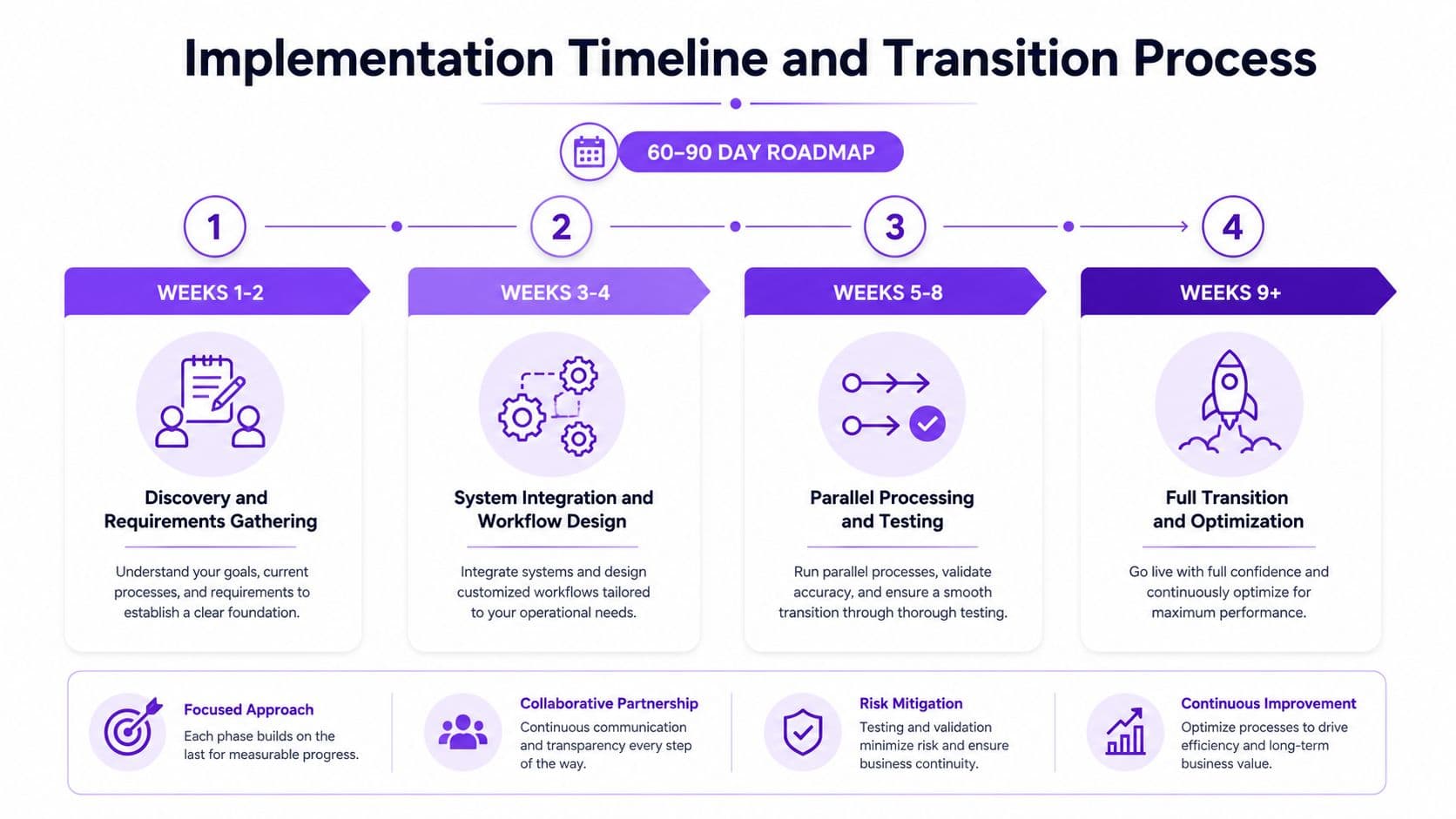
A clean AP transition usually takes 60 to 90 days, and the first two weeks matter more than anticipated. If the process starts with vague expectations, it gets messy by the time invoices hit the queue. The provider should leave discovery with a documented approval map, a list of exception types, and a clear definition of who signs off on what.
What each phase should produce
| Phase | Weeks | Owner | Deliverables |
|---|---|---|---|
| Discovery and requirements gathering | 1 to 2 | Your team and provider | Approval matrix, invoice volumes, exception list |
| System integration and workflow design | 3 to 4 | Provider | ERP connection, routing rules, payment workflow |
| Parallel processing and testing | 5 to 8 | Provider with your review | Sample invoices, reconciliation checks, error log |
| Full transition and optimization | 9 to 12 | Shared | Live processing, issue review, process tuning |
The biggest failure points are predictable. Teams skip documentation of approval workflows, leave exception handling undefined, and under-communicate with vendors during the handoff. Those gaps create delays and confusion even when the technology works. If you're transitioning from DIY bookkeeping, the AP automation guide for small businesses is a useful reference for the setup stage.
What smooth looks like
A good rollout looks boring. Invoices land in the right queue, exceptions get routed the same day, and vendors don't have to ask three times for status. A bad rollout looks like constant rework, repeated coding errors, and your internal team stepping in to rescue every exception.
How to Evaluate and Select an AP Outsourcing Provider
Security and integration matter, but they're not enough. You need a provider that can run your process without creating friction for your team or your vendors. That starts with proof, not promises.
What the shortlist should include
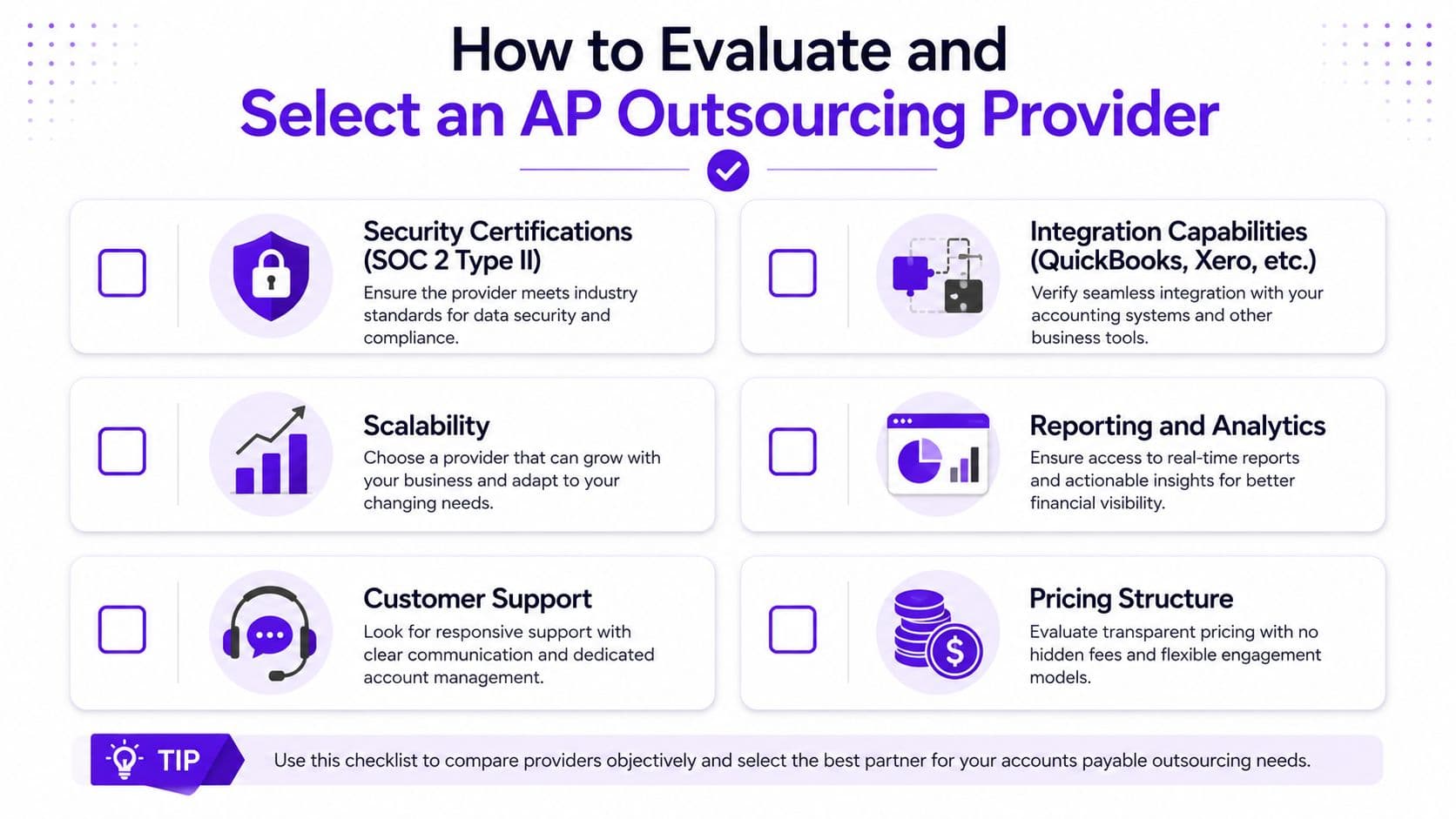
Look for SOC 2 Type II controls, integration with QuickBooks, Xero, or NetSuite, transparent pricing, SLA-backed accuracy and turnaround, reporting that's audit-ready, and references from businesses close to your size and complexity. If a provider claims broad compatibility but can't show a live workflow, that's a warning sign. If they can't explain how AP data is stored, reviewed, and approved, keep looking.
Here's the evaluation lens I use:
- Security posture: Ask for the control framework, not just a reassurance.
- Integration fit: Make them show how invoices, approvals, and payment status move through your stack.
- Exception handling: Ask who resolves a mismatch at 4 p.m. on a payment day.
- Reporting: Confirm you'll get clear logs for invoice status, approvals, and payment history.
- Support model: Find out whether you get one contact or a rotating queue.
A few red flags show up fast. Vague pricing structures usually hide change-order risk. No clear exception process means your team will do the messy work later. Large time-zone gaps can slow urgent payments and damage vendor relationships. Weak audit-ready reporting creates pain when a lender, investor, or auditor asks for support.
If the provider can't explain how they handle exceptions, you're buying delay, not control.
Jumpstart Partners is one option in this space, because it offers AP and payments system setup as part of its outsourced finance stack, alongside bookkeeping and controller services for growing businesses. For a deeper strategic take on choosing finance operations partners, the importance of automation in scaling a talent marketplace is a useful adjacent read, especially if your business is weighing where software ends and managed operations begin.
Scaling Finance Operations from $500K to $20M Revenue
At the lower end of your revenue range, AP outsourcing is often the first step away from founder-led bookkeeping. As you scale into agency, SaaS, or e-commerce complexity, the right move is usually to separate transaction processing, month-end close, and financial oversight instead of expecting one person to do everything. AP outsourcing fits that structure because it takes repetitive payment work off the core finance path.
For SaaS companies, AP outsourcing pairs well with controller support once vendor spend, software bills, and approval chains start to fragment. For digital agencies, it helps when subcontractor invoices, project costs, and client reimbursements need cleaner tracking. For e-commerce businesses, the pressure usually comes from supplier volume and the need for faster payment control. The pattern is the same, you don't want invoice handling to consume the same person who should be managing cash visibility and reporting.
If you're deciding whether to hire or outsource, start with the work, not the org chart. When AP is mostly repetitive and exception-heavy, outsourcing comes first. When you need policy design, forecasting, and board-ready reporting, bring in outsourced controller support or a senior in-house finance leader. That sequencing keeps headcount aligned with actual complexity.
If you want a practical next step, document your current AP flow, total your monthly invoices, and calculate your real processing cost with rework included. Then compare that number against a provider quote and the time your team gets back. That's the decision that matters.
Jumpstart Partners helps growing SaaS, agency, and professional services firms build cleaner finance operations with outsourced bookkeeping, controller support, and AP/payment system setup. If your invoices are slowing down close, cash visibility, or vendor payments, visit Jumpstart Partners to review the right setup for your business and request a consultation.