Financial Operations
8 AP Automation Best Practices for 2026
Implement these 8 AP automation best practices for SaaS & agencies. Improve cash flow, cut costs, and get investor-ready with our expert guide for 2026.
ByJumpstart Partners, CPA, QuickBooks ProAdvisor
··20 min readManual AP is expensive, slow, and hard to control. According to a 2024 Corpay benchmark, companies using AP automation best practices cut invoice cost from an average of $12 to under $3, with leading implementations reaching $2.81 per invoice, while also reducing invoice cycle time by 50 to 70 percent and moving processing into a 3 to 5 day range instead of 10 to 15 days ([Corpay benchmark summary in verified data]). If you process 200 invoices a month, the math is simple: at $12 per invoice, you spend $2,400 a month, or $28,800 a year. At $2.81 per invoice, you spend $562 a month, or $6,744 a year. That's a yearly gap of $22,056 before you count error reduction, faster closes, or better cash planning.
For a SaaS company, agency, or professional services firm between $500K and $20M in revenue, this isn't a back-office cleanup project. It's margin protection. It's also control. AP automation done right gives you cleaner approvals, fewer exceptions, and better visibility into what's due and when.
If you're still forwarding invoices by email, chasing approvals in Slack, and keying data into QuickBooks or Xero by hand, you're burning cash. A 2023 survey cited by Stampli found that only 17.7% of businesses had fully automated AP, which means most firms still have room to gain an advantage by fixing the basics first (Stampli's AP automation market article).
If you want a practical view of where supplier payment automation fits into the bigger finance stack, review Zaro's solution for supplier payments.
Table of Contents
- 1. Invoice Processing Automation and OCR
- 2. Three-Way Invoice Matching and Automated Reconciliation
- 3. AP Workflow Automation and Approval Routing
- 4. Vendor Master Data Management and Duplicate Prevention
- 5. Early Payment Discounts and Dynamic Discounting Capture
- 6. Electronic Payment Methods and Fraud Prevention
- 7. Real-Time AP Reporting and KPI Dashboards for Cash Flow Visibility
- 8. Vendor Performance Management and Strategic Sourcing Integration
- AP Automation: 8 Best Practices Comparison
- Your Next Step From AP Chaos to Controlled Cash Flow
1. Invoice Processing Automation and OCR
If your team still types invoice data by hand, fix that first. Everything else in AP automation depends on reliable invoice capture.
A strong OCR and invoice capture setup pulls header and line-item data from PDFs, emailed invoices, and scans, then pushes that data into your accounting system with minimal touch. For fast-growing agencies and SaaS businesses, that matters because the workload rises faster than headcount. The right system lets one AP function handle growth without turning month-end into a mess.
A practical benchmark comes from Vic.ai's guidance: you should target 95%+ accuracy in header and line-item extraction when evaluating OCR and machine learning invoice capture tools, and you should pair that with two-way ERP integration, single-channel invoice submission, and ongoing monitoring after go-live (Vic.ai best practices guide). If a platform can't reliably hit that level in your environment, it will just shift the work downstream into exception handling.
What good implementation looks like
Start narrow. Pick your top vendors by invoice volume and run a pilot before you roll it across the whole business.
- Standardize intake: Require vendors to submit invoices through one email inbox or portal. Don't let invoices arrive through personal inboxes, Slack threads, and text messages.
- Push data into your ledger fast: Connect capture directly to your accounting stack. If you need a primer, review Jumpstart Partners' guide to accounts payable automation.
- Set exception rules early: Route unusual invoices for review, especially non-standard formats, credits, and large one-off bills.
Bill.com, Stampli, and Coupa all offer invoice capture workflows. In practice, the right choice depends less on feature lists and more on how cleanly the tool fits your ERP, approval structure, and vendor mix.
Here's a simple worked example. Assume your business processes 120 invoices a month and your AP specialist spends an average of 8 minutes manually entering each one. That's 960 minutes, or 16 hours a month, on data entry alone. If OCR eliminates most of that typing and leaves only review time on exceptions, you free up meaningful finance capacity without hiring.
A quick product walkthrough helps if your team hasn't seen modern AP capture in action:
Practical rule: Don't buy OCR to “automate AP.” Buy it to remove manual rekeying, standardize intake, and make every later control more reliable.
2. Three-Way Invoice Matching and Automated Reconciliation
Most payment errors happen because companies approve invoices without checking them against what was ordered and what was received. That's sloppy AP.
Three-way matching fixes it. The system compares the purchase order, the receipt or service confirmation, and the invoice before release. For service businesses, this often means adapting the “receipt” step into a project owner signoff, milestone confirmation, or contract-backed validation instead of a warehouse receipt.
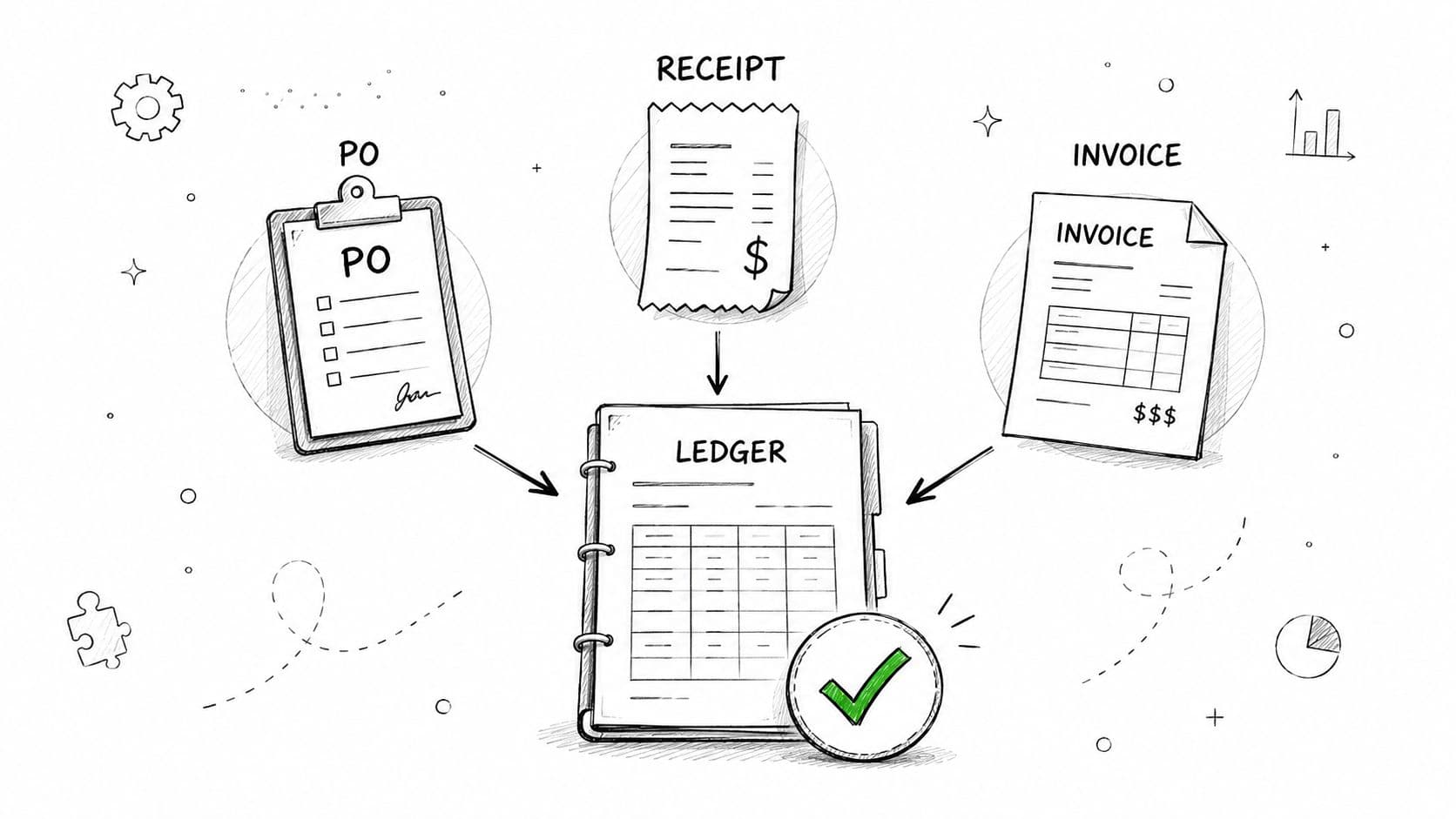
In 2022, Vic.ai reported that companies following all 13 core AP automation best practices achieved an 85% straight-through processing rate, compared with 35% for companies following fewer than six practices ([reported in the verified data]). Matching is one of the controls that separates a disciplined AP operation from a partially automated mess.
Where founders usually get this wrong
They skip the PO discipline. Then AP inherits the confusion.
If your procurement or department leads don't create accurate POs before work starts, the matching engine can't help you. Bill.com, Coupa, and NetSuite all support matching workflows, but software won't fix weak operating habits.
- Use two-way matching first: For lower-risk recurring vendors, start with PO plus invoice.
- Reserve three-way matching for risk: Apply full matching to larger, variable, or high-error vendors.
- Audit exceptions monthly: Patterns matter. The same vendor disputes often point to a contract problem, not an AP problem.
If your team needs stronger close discipline around cash and payables, this becomes part of a broader finance hygiene issue. A useful adjacent process is bank reconciliation discipline.
Worked example. Say your agency receives a monthly software invoice for $4,800, but the approved PO is $4,200 because seats were supposed to be reduced. Without matching, you overpay by $600. Multiply that by recurring vendor slippage across a year and you can see why finance leaders insist on this control.
Match before approval. If the supporting documents don't line up, the invoice doesn't get paid.
3. AP Workflow Automation and Approval Routing
Approval routing is where many AP projects fail. Companies automate invoice capture, then leave approvals sitting in inboxes, chat threads, and verbal signoffs. That's not automation. That's a digital version of chaos.
Automated workflows route invoices based on amount, department, vendor, entity, or cost code. They also create an audit trail. For investor-backed companies and firms preparing for audits, that trail matters as much as speed.
According to a 2023 Gartner report referenced in the verified data, 74% of finance leaders prioritize automation as a strategic driver, citing a 40% average improvement in cash flow visibility and a 30% reduction in month-end closing time. That should tell you how leaders are thinking about AP now. It's not clerical efficiency. It's financial operating advantage.
Build routing around your real org chart
Your routing rules should match how spending decisions happen.
A recurring SaaS vendor bill should not take the same path as a large contractor invoice tied to a client project. Bill.com, Stampli, and NetSuite all let you design amount-based and role-based workflows. Use them.
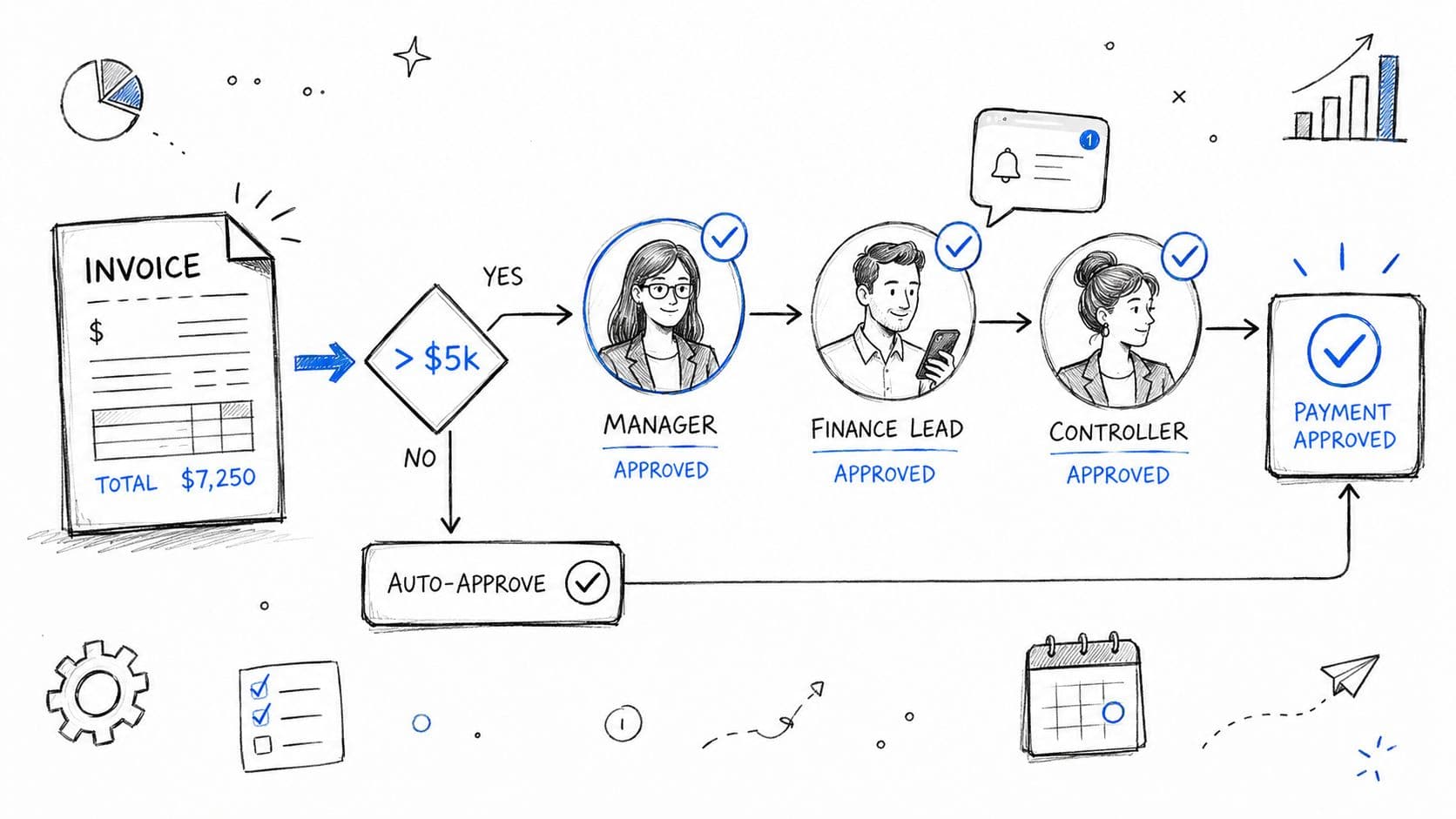
- Define approval thresholds: Small recurring bills should move fast. High-risk or high-value invoices should require more scrutiny.
- Enforce segregation of duties: The person requesting spend should not be the only approver and should not control payment release.
- Escalate stalled approvals: If an invoice sits too long, route it upward automatically.
If you're mapping an end-to-end finance workflow, this AP automation implementation guide is a practical companion resource.
For companies that also automate adjacent finance operations, product automation solutions can help connect approval logic across tools.
Here's the worked logic. If your controller approves invoices over $5,000 and your department heads approve invoices under that amount, don't let the AP clerk decide by memory. Put the threshold into the system. Every manual approval decision you leave undefined creates inconsistency and control risk.
4. Vendor Master Data Management and Duplicate Prevention
Bad vendor data poisons the whole AP system. Duplicate vendor records, outdated bank details, inconsistent naming, and missing tax information lead directly to duplicate payments, failed payments, and fraud exposure.
This is why vendor master data management belongs high on your AP automation priority list. If your system contains “Acme LLC,” “ACME, Inc,” and “Acme Marketing,” you don't have three vendors. You have one vendor and a control problem.
Clean data first, then scale automation
Bank of America, Corpay, and Vic.ai all emphasize tighter controls around supplier authentication, problem-source tracking, exception review, and specific workflows, as summarized in the verified data based on the NetSuite resource. The point is simple: more automation on top of bad vendor data makes mistakes happen faster.
Your policy should be strict.
- Use one vendor creation workflow: No side-door setup through email requests.
- Require tax and payment documentation: Don't activate a vendor without complete records.
- Review duplicate signals quarterly: Compare tax IDs, addresses, and payment methods.
For a growing professional services firm, this often shows up after acquisitions, rebrands, or rapid hiring. One team enters a vendor for software subscriptions. Another creates the same vendor for project expenses. A third uses a different spelling for international billing. AP then loses visibility into total spend and approval history.
Worked example. Suppose the same vendor exists twice and each record carries a recurring monthly invoice for $1,250. If both records get paid for three months before someone catches it, you've leaked $3,750. That's not a software problem. That's a data governance problem.
Clean vendor master data isn't administrative overhead. It's the control layer that keeps automation from paying the wrong party at scale.
5. Early Payment Discounts and Dynamic Discounting Capture
Most companies talk about AP automation as a cost-saving tool. Strong operators also use it as a yield tool.
When invoice terms include an early payment discount, your system should identify the opportunity, calculate the payable date, and tell you whether the savings justify using cash sooner. That requires linking AP to cash forecasting, not treating AP as a standalone workflow.
A useful framing from the Concur article in the verified data is that finance leaders should measure invoice processing time, cost per invoice, exception rate, and touchless processing together instead of treating automation as a binary yes-or-no decision (Concur's AP automation guide). That same mindset applies to discount capture. Don't chase every discount blindly. Compare the savings against your cash needs and control priorities.
Use a simple financial filter
If a vendor offers 2/10 Net 30 on a $10,000 invoice, paying within 10 days saves you $200. That's real money. But only take it if your short-term cash position supports it.
Founders often miss the operational side. Discount capture only works when invoice receipt, approval routing, and payment execution are all tight. If approvals drag, the discount expires before finance can act.
- Store terms in vendor records: Don't rely on AP staff to remember special payment windows.
- Tie AP to your cash forecast: A discount that creates payroll stress isn't a win.
- Automate low-risk decisions: Small invoices with attractive terms should route and pay fast.
This matters even more in businesses with uneven collections. Agencies often wait on client receipts. SaaS firms may be growing fast but still managing burn. Dynamic discounting works best when your AP system is connected to a rolling cash view and your team knows which vendors are strategic.
A clean AP function doesn't just avoid mistakes. It captures optionality.
6. Electronic Payment Methods and Fraud Prevention
If you're still printing checks as a default payment method, you're adding cost, delay, and risk for no good reason.
Electronic payments improve control when they're set up correctly. ACH handles recurring domestic vendors efficiently. Wires are for higher-value or time-sensitive transactions. Card payments can make sense for selected spend categories if fees and controls are managed tightly. The point is to use the right rail for the right vendor, then lock the process down.
By 2025, 58% of firms using AI-driven matching and coding reduced exception rates by over 60%, while 99.8% of automated transactions were processed without human intervention, according to milestone data in the verified set. That doesn't mean you remove human oversight from payment release. It means you design human review around risk, not routine.
Fraud controls that belong in every rollout
Electronic payments reduce some risks and create others. Vendor impersonation and bank change fraud are real, and manual override paths are where they usually slip through.
- Verify bank changes outside email: Confirm through an independent contact method before updating payment instructions.
- Require dual approval for sensitive payments: Especially for wires and unusual one-time disbursements.
- Separate setup from release: The person changing vendor banking shouldn't be the same person releasing funds.
If you're evaluating ACH options and banking workflows, this ACH payment processor guide is a useful reference.
The underserved point from the verified data is important: more automation is not always the right answer when vendor data is weak, approval chains are complex, or non-PO invoices dominate. In those cases, keep strict manual review paths for higher-risk payments. That's disciplined automation, not half-finished automation.
Worked example. If a fraudulent bank change redirects a single $18,000 vendor payment, your AP process has already failed. A two-minute callback verification is cheaper than the recovery effort that follows.
7. Real-Time AP Reporting and KPI Dashboards for Cash Flow Visibility
If you can't see upcoming AP by due date, you don't control cash flow. You react to it.
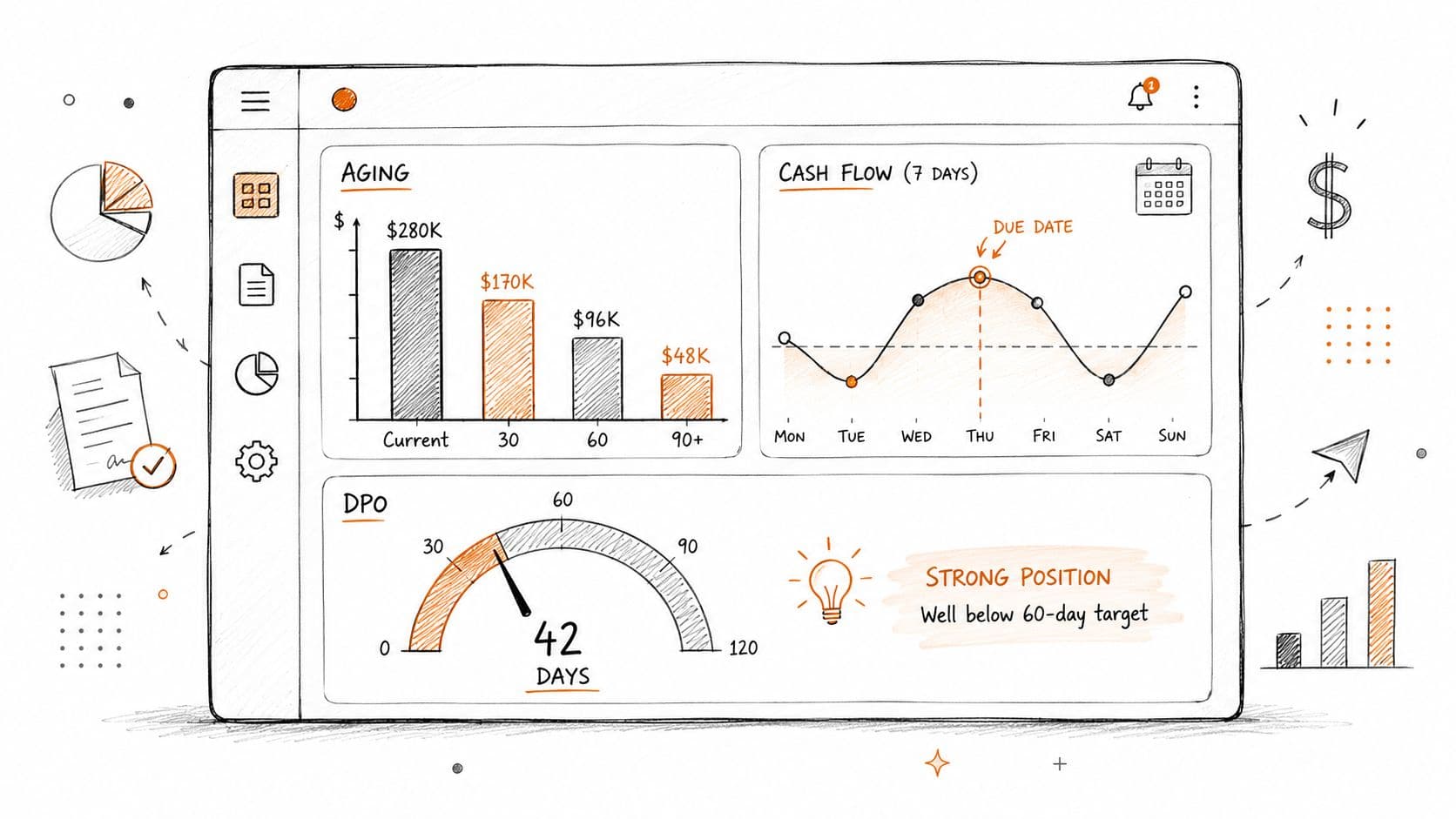
Real-time dashboards should show open invoices, aging, payment timing, exception queues, and upcoming cash requirements. For founders and CEOs, this turns AP from a clerical function into a planning tool. You can decide what to pay now, what to hold to terms, and where approval delays are distorting your cash picture.
Historically, enterprise adoption of AP automation best practices increased 210% between 2018 and 2023, according to the verified data. That acceleration happened because finance leaders want visibility, not just speed. They want to know what's coming before the bank balance forces the conversation.
The KPIs that actually matter
Many teams fixate on touchless rate because it sounds modern. That's incomplete. You need a dashboard that combines processing speed, cost, exceptions, and payment timing.
A practical starting point is a weekly and 13-week cash view that pulls in AP obligations by due date. If you need a framework, these cash flow forecasting best practices line up well with AP dashboard design.
- Track invoice cycle time: Slow approvals delay both vendor payments and cash planning.
- Track cost per invoice: It tells you whether automation is improving economics.
- Track exception rate: Exceptions are where labor and risk pile up.
- Track payment timing by vendor group: Critical suppliers should never be managed the same way as replaceable vendors.
A worked example makes this practical. Assume you have $90,000 due over the next two weeks, but your dashboard shows $25,000 belongs to low-priority vendors on standard terms and $20,000 is stuck in approval. Now you know what to escalate, what to hold, and what threatens operations.
The dashboard isn't for AP. It's for management. If leadership can't use it to make a payment timing decision, it's not built well enough.
8. Vendor Performance Management and Strategic Sourcing Integration
The last step is where AP stops being purely operational and starts driving purchasing decisions.
Vendor performance management means tracking who invoices accurately, who causes exceptions, who delivers on time, who follows terms, and who creates friction. Once you have that data, you can consolidate spend, renegotiate terms, and tighten sourcing choices. For agencies and SaaS companies, this often reveals too many small vendors, too many one-off tools, and too little discipline around renewals.
By 2024, the global AP automation market reached $12.4 billion, with North America accounting for 42% of total adoption, according to the verified data. Companies aren't investing at that level just to move invoices faster. They're using AP data to improve purchasing quality and financial control.
Turn AP data into vendor strategy
Start with your highest-spend vendors and your noisiest vendors. They are rarely the same group, and both matter.
Coupa and SAP Ariba support supplier scorecards and sourcing workflows. Even if you're not on an enterprise stack, you can still build a practical review structure inside your finance process.
- Tier your vendors: Strategic, preferred, transactional, and risk vendors should not be managed the same way.
- Score invoice quality: Vendors that constantly submit incorrect or incomplete invoices create hidden processing costs.
- Feed results into renewals: If a vendor creates chronic exceptions, use that in negotiation or replacement decisions.
Here's the worked logic. Suppose one vendor sends clean monthly invoices that route and pay with almost no intervention, while another requires repeated coding fixes, approval chases, and credit memo follow-up. Even if list pricing is similar, the total operating cost is not. AP data gives procurement and leadership a factual basis for choosing the better partner.
The strongest ap automation best practices don't end at payment. They influence who you buy from in the first place.
AP Automation: 8 Best Practices Comparison
| Solution | 🔄 Implementation Complexity | 💡 Resource Requirements | ⚡ Speed / Efficiency | ⭐ Effectiveness / Quality | 📊 Ideal Use Cases |
|---|---|---|---|---|---|
| Invoice Processing Automation & OCR | Medium, integrations + 4–8 week vendor onboarding | Moderate, OCR licenses, config, occasional manual review | ⚡ High, cuts processing from days to hours | ⭐ High (accuracy depends on image quality; target 98%+) | High-volume invoice environments (SaaS, agencies) requiring faster invoice-to-pay cycles |
| Three‑Way Invoice Matching & Automated Reconciliation | High, needs clean PO/receipt data and cross‑team coordination | Moderate–High, ERP/procurement integration, exception workflows | ⚡ Moderate‑High, reduces reconciliation time 60–70% | ⭐ Very High, prevents duplicates/fraud; saves 2–5% of AP spend | PO-driven procurement, multi‑entity operations, compliance‑sensitive firms |
| AP Workflow Automation & Approval Routing | Medium, requires mapping approval rules and escalation paths | Low–Moderate, workflow config, approver training, mobile setup | ⚡ High, approval cycles shrink from days/weeks to hours | ⭐ High, enforces segregation of duties and audit trails | Growing teams with distributed approvers and SOC 2/ audit requirements |
| Vendor Master Data Management & Duplicate Prevention | High, legacy cleanup and ongoing governance (6–12 months) | High, data audits, fuzzy matching tools, onboarding processes | ⚡ Moderate, reduces rework and duplicate payment risk | ⭐ High, improves payment accuracy and fraud prevention | Organizations with long vendor histories or frequent duplicate payments |
| Early Payment Discounts & Dynamic Discounting Capture | Medium, integrates discounts with cash forecasts and rules | Moderate, forecasting, decision rules, discount automation | ⚡ Variable, saves 1–3% when liquidity permits | ⭐ Moderate‑High, effective if forecasting and liquidity are accurate | Cash-available firms seeking incremental AP savings; vendors offering standard discounts |
| Electronic Payment Methods (ACH/Wire/Card) & Fraud Prevention | Medium, bank setups, positive pay, MFA, controls | Moderate, bank fees, validation, TMS/treasury integration | ⚡ High, faster settlement vs. checks (ACH 1–2 days) | ⭐ High, lowers check costs and reduces fraud exposure | Companies replacing checks, processing high payment volumes, needing stronger controls |
| Real‑Time AP Reporting & KPI Dashboards | Medium, requires accounting system integration and data hygiene | Moderate, dashboard tools, data feeds, user training | ⚡ High, enables faster, informed cash decisions | ⭐ High, improves forecasting and investor readiness | VC‑backed SaaS/agencies needing 4–13 week cash visibility and KPI reporting |
| Vendor Performance Management & Strategic Sourcing Integration | High, cross‑functional data integration and governance | High, analytics, contract mgmt, procurement resources | ⚡ Moderate, delivers medium‑term efficiency and cost savings | ⭐ High, drives consolidation, accountability, and measurable savings | Organizations aiming to consolidate suppliers, negotiate volume discounts, or improve vendor quality |
Your Next Step From AP Chaos to Controlled Cash Flow
The companies that get AP right don't start by chasing “touchless” as a vanity metric. They start by removing obvious waste, tightening controls, and building a system leadership can trust. That means standardizing invoice intake, enforcing matching, automating routing, cleaning vendor data, using the right payment methods, and tracking the relevant metrics.
The benchmark data is clear. Corpay's 2024 benchmark in the verified data shows that companies using AP automation best practices can push invoice cost below $3 and cut cycle time sharply. The same benchmark also reports up to 99.95% data accuracy in fully adopted environments and more than $47,000 in annual error detection and correction savings per client when automation is implemented correctly. Those aren't cosmetic gains. They affect margin, reporting quality, and the confidence you bring into lender, board, and investor conversations.
If you run a business in the $500K to $20M range, your roadmap should be practical and ordered.
First, centralize invoice intake and fix OCR capture. Second, build approval routing that matches your real org chart. Third, lock down vendor master data and payment controls. Fourth, add dashboards that show due dates, exceptions, and short-term cash impact. Then use AP data to improve vendor terms and vendor selection.
Don't skip steps. A lot of AP projects fail because teams buy software before they define process rules. The result is a shinier version of the same confusion. Your software stack should reflect your operating policy, not replace it.
One more point deserves blunt treatment. Founders often assume AP automation is “for later,” after revenue grows more. That's backwards. You implement these controls before scale exposes the cracks. If your company is adding entities, hiring department heads, preparing for diligence, or trying to improve cash discipline, AP automation belongs on the near-term list.
Jumpstart Partners is one option if you want help turning this into a working system. Based on the publisher information provided, the firm offers outsourced controller and bookkeeping services for growing businesses and also handles fixed-fee AP automation projects. If you want to move fast, start with an audit of your current AP process against the eight practices above, identify the biggest leak, and fix that first.
If your AP process still depends on inboxes, spreadsheets, and memory, it's time to replace it with a system you can scale. Jumpstart Partners works with SaaS companies, agencies, and other growing businesses to tighten controls, improve cash visibility, and build finance operations that hold up under growth, audits, and investor scrutiny.