Financial Operations
ARR vs Revenue Explained for SaaS Founders and Finance Teams
ARR vs revenue confuses even seasoned founders. Learn definitions, calculations, and when to use each metric for SaaS reporting and fundraising.
ByJumpstart Partners, CPA, QuickBooks ProAdvisor
··21 min readYou're probably living this right now. Your dashboard says ARR is healthy. Your bank balance says hiring needs to wait. Your P&L says revenue is lower than the sales team thinks it “should” be. Then an investor, lender, or board member asks a simple question: “What's your revenue?”
If you answer with ARR, you lose credibility fast.
That mistake shows up constantly in companies between early traction and real scale. A founder closes several annual contracts, sees a bigger recurring run-rate, and starts talking as if that number is earned revenue. It isn't. ARR, GAAP revenue, and cash are three different lenses. If you use the wrong one, you'll overestimate runway, misread growth quality, and walk into diligence with numbers that don't tie.
For SaaS founders, agency owners, and hybrid service firms, this isn't a technical accounting debate. It affects fundraising, pricing, comp plans, board reporting, and whether your finance team can explain the business in plain English. It also affects how you implement ASC 606 revenue recognition, because contract value, recognized revenue, and collected cash move on different timelines.
Table of Contents
- Introduction Why Confusing ARR and Revenue Costs You Credibility
- What ARR Really Measures and What GAAP Revenue Measures
- ARR vs Revenue Head to Head Comparison
- How to Calculate ARR and Recognize Revenue Correctly
- When to Use ARR vs Revenue in SaaS Finance and Investor Reporting
- Red Flags and Misconceptions That Distort Your Numbers
- Your Next Steps to Reconcile ARR and Revenue With Confidence
Introduction Why Confusing ARR and Revenue Costs You Credibility
A founder signs two new annual software deals in the last week of the month. Sales celebrates. The CRM shows momentum. ARR jumps immediately because the recurring contract base is larger.
But the month-end financials don't show that same jump in revenue. Cash may or may not have arrived yet. If one customer prepaid, cash went up before revenue fully did. If another customer signed but hasn't paid, ARR moved before cash did. If both contracts included onboarding work, some amounts belong in revenue but not in ARR.
That's where sloppy reporting starts.
The real problem is decision quality
When you confuse ARR with revenue, you don't just misuse a metric. You make bad operating decisions.
- Runway gets distorted because ARR is not cash.
- Board decks get messy because GAAP revenue and KPI dashboards don't reconcile.
- Fundraising gets harder because investors expect you to know the difference between contracted run-rate and earned revenue.
- Agencies and hybrid firms get especially exposed because service revenue can make total revenue look strong while recurring revenue remains thin.
You need three lenses, not one
This is the clean way to think about arr vs revenue:
| Lens | What it tells you | Where founders misuse it |
|---|---|---|
| ARR | Contracted recurring run-rate | Treating it like earned revenue |
| GAAP Revenue | What you actually earned in the period | Using it alone to judge recurring quality |
| Cash | What hit the bank | Assuming collections equal performance |
Practical rule: If your three numbers don't tell a consistent story, your reporting isn't ready for diligence.
Founders who master this don't just sound sharper. They forecast better, spot weak retention earlier, and stop making hiring or spending decisions off a number that was never built for that purpose.
What ARR Really Measures and What GAAP Revenue Measures
A founder closes a $120,000 annual deal on the last day of the quarter and then tells the board, "We added $120,000 in revenue." That statement is wrong on all three finance lenses. You added contracted run-rate. You have earned little to none of that revenue yet. You may not have collected the cash either.
ARR measures the recurring contract base, annualized. It is a run-rate KPI built to show the size of your subscription engine if current recurring contracts stay in force for the next 12 months. It excludes one-time implementation, consulting, setup fees, and other non-recurring items, as Stripe explains in its guide to annual recurring revenue.
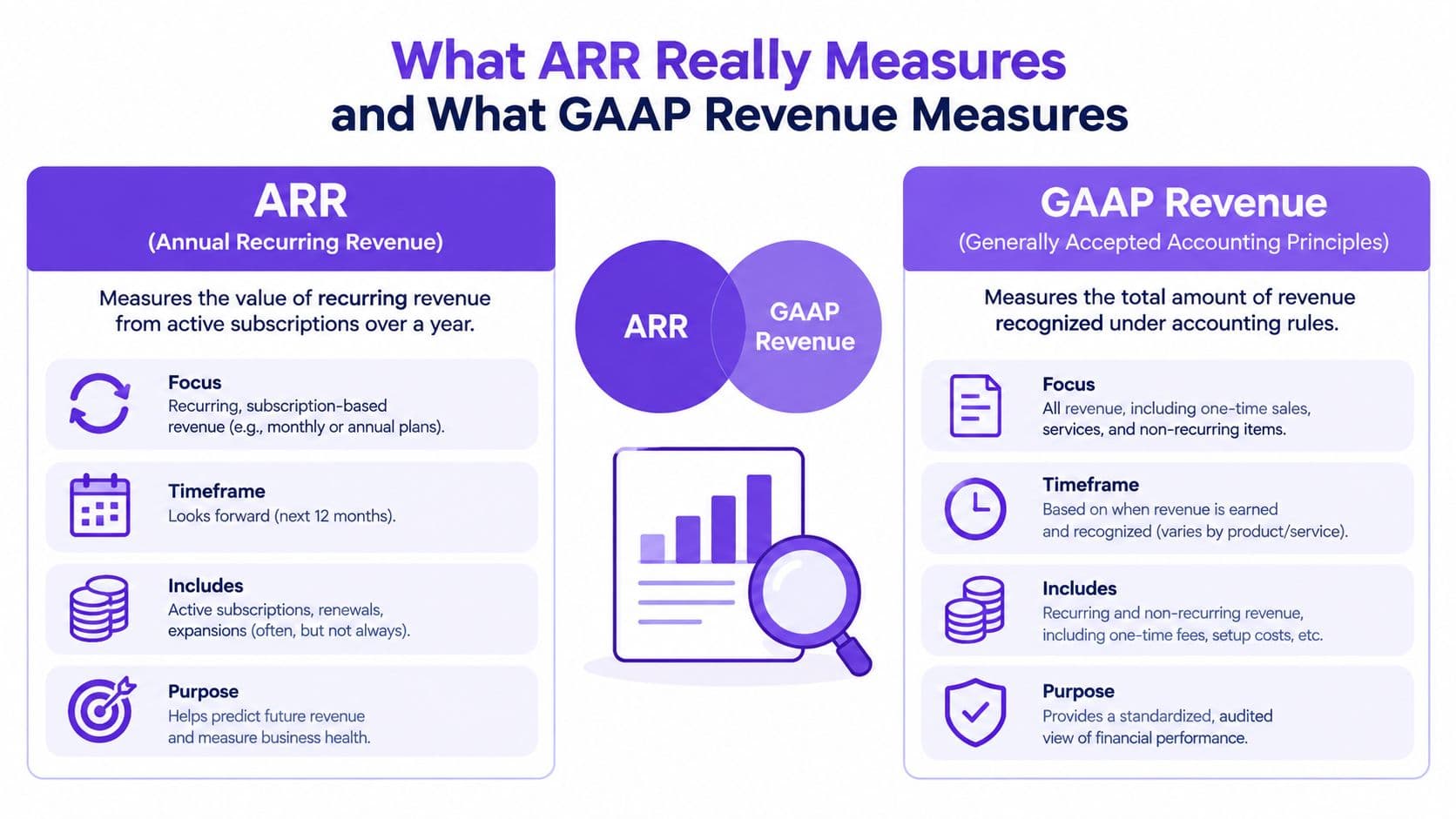
ARR is a point-in-time run-rate
ARR is a snapshot, not a period result.
A simple formula works for many SaaS companies: recurring monthly revenue multiplied by 12, adjusted for annual contracts, upgrades, downgrades, and churn. Some finance teams tighten the definition further and include only committed recurring subscription amounts. The exact policy matters less than consistency. Your board and your investors need one ARR definition, applied the same way every month.
If your team still needs the baseline framework, this guide to annual recurring revenue lays out the metric cleanly.
The key point is this: ARR tells you what is under recurring contract now. It does not tell you what you earned this month. It does not tell you what hit the bank.
GAAP revenue measures what you earned in the period
GAAP revenue answers a narrower and more disciplined question. What did you earn during the reporting period based on service delivery and accounting rules?
For a subscription business, that usually means recognizing subscription revenue ratably over the contract term unless the facts require a different treatment. It also means recognizing implementation, services, usage fees, and other elements based on how those obligations are delivered and priced. Revenue is a flow measure. ARR is a stock measure.
Here is the clean comparison:
| Item | ARR Treatment | GAAP Revenue Treatment |
|---|---|---|
| Annual subscription contract for $100,000 | Counts as $100,000 ARR when active | Recognized over time as service is delivered |
| One-time implementation fee | Excluded | Included when recognized under GAAP |
| Consulting project | Excluded | Included when recognized under GAAP |
| Usage overages | Usually excluded from ARR | Included in revenue when recognized |
A $100,000 annual subscription signed on January 1 adds $100,000 to ARR immediately. January GAAP revenue is roughly one-twelfth of the subscription amount if service starts right away, plus any other amounts that qualify for recognition in that month. Cash could be zero, $100,000, or something in between depending on billing and collections.
ARR shows contracted recurring run-rate. GAAP revenue shows earned performance. Cash shows liquidity. If you use one number to answer all three questions, you will misread the business.
Hybrid businesses get misled fastest
This gap gets wider in SaaS companies with services attached.
If you sell onboarding, migrations, advisory work, hardware, or variable usage, GAAP revenue can rise while ARR barely moves. That can make the business look healthier than the recurring base is. The opposite problem happens too. ARR can look strong while revenue lags because large deals signed late in the quarter have barely started to earn out.
Founders get in trouble here during fundraising. Investors use ARR to judge recurring scale and retention quality. Auditors, lenders, and serious finance buyers use GAAP revenue to judge financial accuracy. Your cash balance decides whether you can hire, spend, and survive.
Treat these as three separate lenses and your reporting gets sharper fast. Treat them as synonyms and your numbers stop making sense the moment growth, churn, services, or billing timing enters the picture.
ARR vs Revenue Head to Head Comparison
A founder closes a $120,000 annual deal on the last day of the quarter and tells the board, "We added $120,000 in revenue." That statement is wrong in two directions. ARR went up by $120,000. GAAP revenue for that quarter barely moved. Cash might still be sitting in accounts receivable.
That is why you need three lenses, not one. ARR shows contracted run-rate. GAAP revenue shows what you have earned. Cash shows what you can spend.
Here is the side-by-side view.
| Criteria | ARR | GAAP Revenue |
|---|---|---|
| What it answers | How large is the recurring subscription base right now? | How much revenue did you earn during the period? |
| Primary lens | Contracted run-rate | Accounting performance |
| Timing | Point-in-time snapshot | Period-based measurement |
| Based on | Recurring subscription value under active contracts | Revenue recognized under GAAP |
| Includes services, setup, and one-time fees | No | Yes, when recognition rules are met |
| Can rise before delivery starts | Yes | No |
| Useful in fundraising | Yes, for recurring scale, retention, and growth quality | Yes, to support financial credibility and diligence |
| Useful for audits, lending, and tax work | No, not on its own | Yes |
| Best use in forecasting | Forward recurring base and retention trends | Historical performance, margin analysis, and close accuracy |
| GAAP status | Non-GAAP operating metric | Required accounting metric |
ARR and revenue diverge fastest in three situations.
First, late-quarter sales. If you sign a large annual contract on March 28, ARR reflects the full recurring value right away. March revenue only includes the service delivered in March. Founders who present that ARR jump as "revenue growth" lose credibility fast.
Second, churn and contraction. A company can post decent revenue for a quarter while the recurring base is shrinking, because revenue still recognizes existing contracts until those contracts roll off. ARR exposes that weakness sooner.
Third, services-heavy periods. Implementation fees, migration work, and advisory projects can lift revenue while ARR stays flat. That is fine if services are strategic. It is a problem if you start calling service revenue "growth" in a SaaS fundraising story.
Here's the explainer if your team still mixes monthly and annual concepts in reporting:
Which number belongs in which conversation
Use the metric that matches the decision.
- Investor updates: Lead with ARR, then reconcile to revenue and explain retention. Investors want to know whether recurring contracts are expanding or eroding.
- Board decks: Show ARR, GAAP revenue, and cash together. A board that sees only one lens will misread the business.
- Audit, tax, lender, and legal reviews: Use GAAP revenue and full financial statements.
- Operating reviews: Use all three. ARR tells you where the base is headed. Revenue tells you what you earned. Cash tells you whether payroll is safe.
If your team still annualizes subscriptions inconsistently, standardize the inputs first with a clear monthly recurring revenue framework.
Use ARR to discuss recurring scale. Use GAAP revenue to discuss earned results. Use cash to make spending decisions.
Where founders usually go wrong
The common mistake is not tracking ARR. The mistake is acting like ARR, revenue, and cash are interchangeable.
A $2 million ARR company can still miss payroll if collections slip. A revenue beat can hide churn if services carried the quarter. A strong cash month can mask weak retention if customers prepaid before renewing at lower values.
Treat ARR vs revenue as a lens problem, not a vocabulary problem. Once you separate contracted run-rate, earned revenue, and cash, your reporting gets sharper and your decisions get better.
How to Calculate ARR and Recognize Revenue Correctly
A founder closes a $120,000 annual contract on the last day of the month, collects the cash, and tells the board ARR, revenue, and cash all jumped by $120,000. Two-thirds of that statement is wrong.
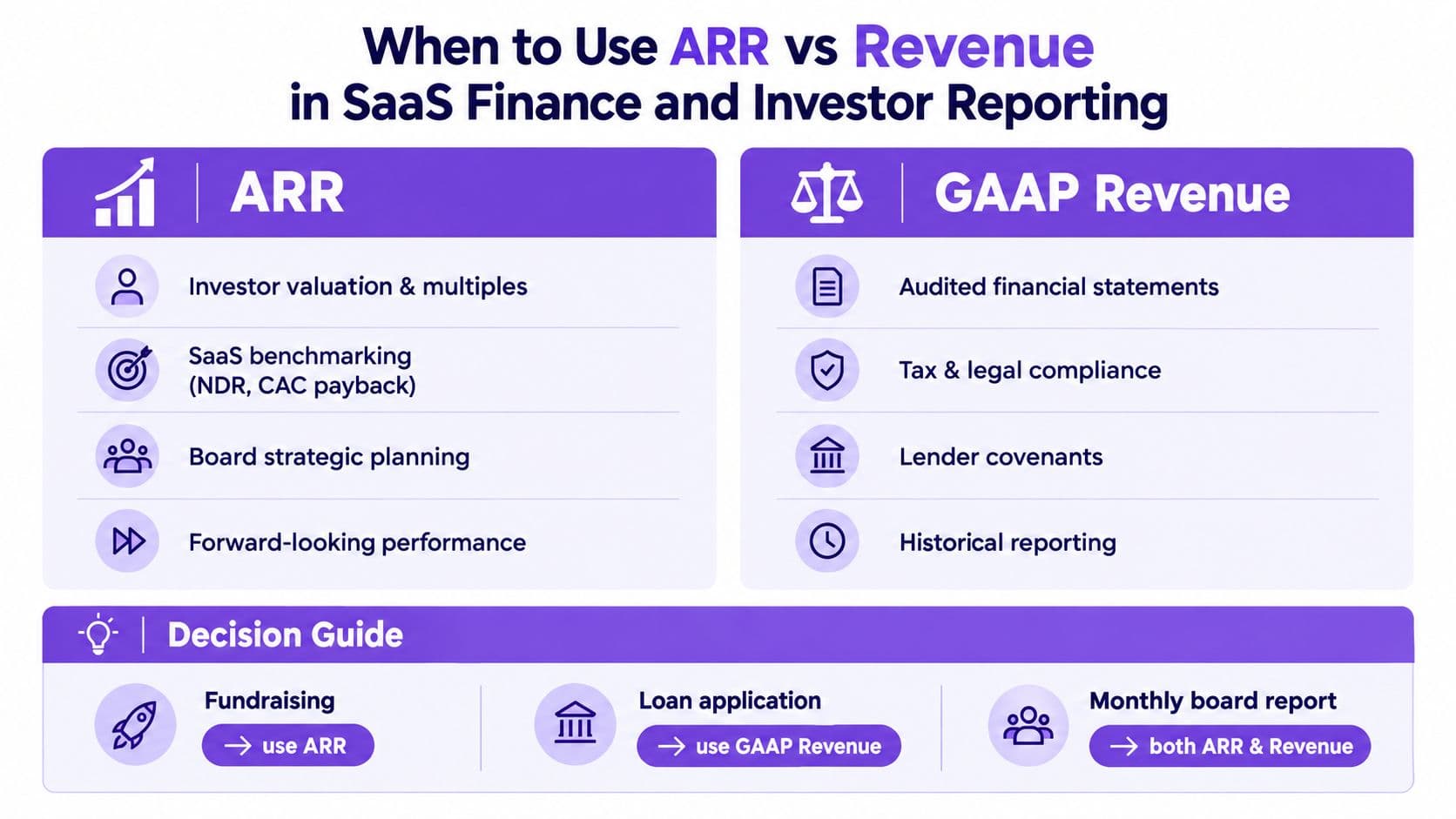
You need three separate calculations. ARR measures contracted run-rate. Revenue measures what you earned under GAAP. Cash measures what hit the bank. If you blur those lenses, your forecast, board deck, and fundraising story all get weaker.
Calculate ARR from recurring contract value
Start with the recurring subscription amount at the current run-rate, then annualize it.
If a customer pays $1,000 per month on a recurring plan, that contract adds $12,000 of ARR. If your active recurring base is $10,000 of MRR, your ARR is $120,000.
Then track what changed during the period.
| ARR Movement Category | Annualized Amount |
|---|---|
| New ARR | $24,000 |
| Expansion ARR | $12,000 |
| Contraction ARR | ($6,000) |
| Churn ARR | ($10,000) |
Net ARR movement is $20,000. If beginning ARR was $120,000, ending ARR is $140,000.
That breakdown matters. A founder who reports only ending ARR can hide a churn problem behind a few large expansions.
If your team wants another practical walkthrough, this guide on how to calculate ARR with examples is a useful companion for building the model.
Recognize revenue based on service delivery
Revenue follows the service period, not the invoice date and not the cash receipt date.
Take a $12,000 annual subscription billed upfront. On activation, ARR increases by $12,000. Cash increases by $12,000 if the customer prepays. Revenue does not increase by $12,000 on day one. You record deferred revenue, then recognize about $1,000 per month as you deliver the subscription term.
A simple month-one view looks like this:
- Contract value: $12,000 annual subscription
- ARR on activation: $12,000
- Cash collected on activation: $12,000
- Revenue recognized in month one: about $1,000
- Deferred revenue after month one: about $11,000
That is the core mistake founders make. They treat a signed contract like earned revenue and treat collected cash like proof of performance. GAAP does not allow that. For a practical workflow, document your 606 revenue recognition process for SaaS and use it every month.
Normalize multi-year contracts before they hit ARR
Do not stuff the full value of a multi-year deal into ARR.
A $300,000 contract over three years is not $300,000 of ARR. It is $100,000 of ARR, because ARR reflects one year of recurring run-rate. Revenue is still recognized across the service period. Cash depends on billing terms. You might bill all of it upfront, annually, or quarterly. Each outcome changes cash timing without changing the underlying ARR logic.
Founders overstate growth during fundraising. A big multi-year booking can make contracted value look stronger than the actual annual recurring base.
Use a monthly close sequence that ties all three lenses together
Run the process in this order:
- Update active contracts in your billing system and CRM.
- Separate recurring subscriptions from services, implementation, and usage-based fees.
- Calculate ARR movements for new, expansion, contraction, and churn.
- Post invoices, collections, and deferred revenue activity.
- Recognize monthly revenue under your ASC 606 policy.
- Reconcile contract data, billing, deferred revenue, and the general ledger before sharing numbers externally.
If those steps do not tie, stop reporting and fix the inputs. Clean SaaS reporting is not about smarter formulas. It is about forcing contracted run-rate, earned revenue, and cash to reconcile every month.
When to Use ARR vs Revenue in SaaS Finance and Investor Reporting
A founder sends a board deck showing ARR up sharply. The income statement shows slower revenue growth. Cash is down because a few large renewals slipped and collections lagged. None of those numbers is wrong. The problem is using one lens to answer three different questions.
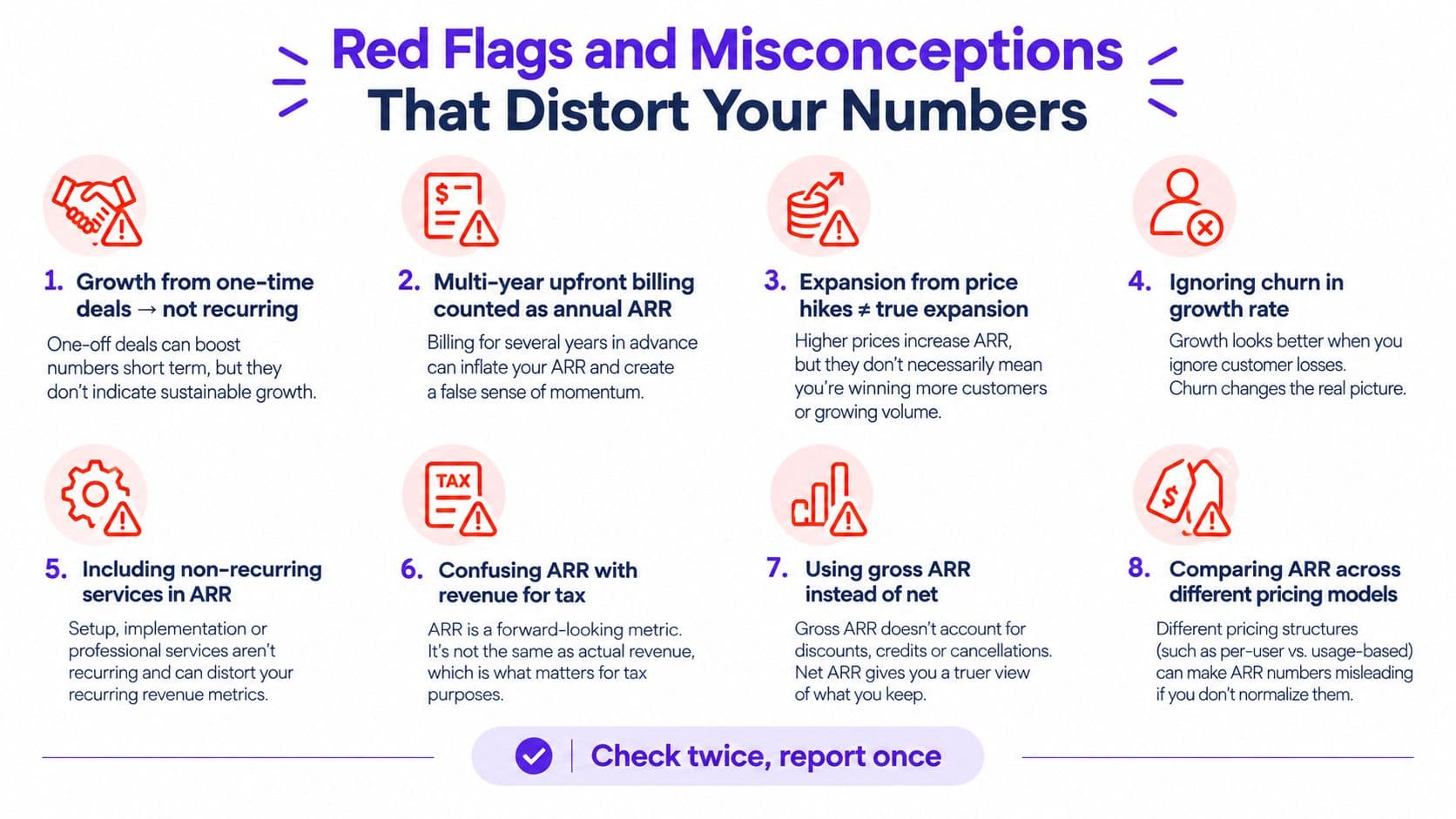
ARR measures contracted recurring run-rate. GAAP revenue measures what you earned in the period. Cash measures what hit the bank. If you mix them, you confuse investors, banks, and your own team.
Use ARR for growth, segmentation, and valuation conversations
ARR belongs in board reporting, fundraising, and internal growth reviews because it shows the size and direction of the recurring base. It answers the questions founders need during scale.
- Is recurring run-rate growing fast enough?
- Did growth come from new logos, expansion, or pricing?
- Are churn and contraction eating the base underneath headline bookings?
- Are billing frequency differences being normalized correctly?
ARR is the right lens when you want to show subscription momentum across monthly and annual contracts. It is also the easiest number to misuse. If you run a hybrid model, keep services, implementation, and variable usage out of ARR unless they are recurring. If your team needs a cleaner policy for separating subscription metrics from accounting treatment, use this guide to accounting for SaaS.
Use GAAP revenue for financial statements and performance reviews
Revenue belongs in your P&L, lender package, tax workpapers, and margin analysis. It shows what your company earned under ASC 606 during the period.
This matters in every company between $500K and $20M. A founder may close a large annual prepaid contract in March, count the full run-rate in ARR immediately, collect the cash upfront, and still recognize only one month of subscription revenue in March. If your board deck celebrates the contract but your financials do not tie to the story, you look careless.
ARR shows the engine capacity. Revenue shows the output recognized this month, this quarter, and this year.
Use cash for runway, collections risk, and operating decisions
Cash gets ignored until it becomes the only number that matters.
A business can post strong ARR, clean revenue growth, and still create a financing problem. Annual prepaids can temporarily inflate cash. Slow-paying customers can leave revenue intact while liquidity tightens. A renewal-heavy quarter can keep ARR stable while collections slip and burn worsens.
Founders should review cash with the same discipline they use for ARR movements. If receivables are stretching, your runway changed even if churn did not.
Match the metric to the audience
For most SaaS companies in this range, the reporting stack should look like this:
| Report | Primary Lens | Why |
|---|---|---|
| Board deck | ARR, revenue, cash | Shows growth, earned results, and liquidity together |
| Investor update | ARR first, revenue second | Frames recurring momentum, then ties it to financial performance |
| Bank package | Revenue and cash | Shows repayment capacity and operating stability |
| Internal KPI dashboard | ARR movements, collections, cash | Helps you catch churn, billing issues, and runway risk early |
Use all three lenses every month. ARR can overstate strength during big bookings. Revenue can understate momentum during rapid expansion. Cash can overstate health after a prepaid quarter. Strong finance reporting does not pick one winner. It reconciles contracted run-rate, earned revenue, and cash so each number answers the right question.
Red Flags and Misconceptions That Distort Your Numbers
A founder tells investors the company is at $3 million ARR. The income statement shows $2.1 million of revenue. The bank balance is tightening anyway. If you cannot explain that gap in one minute, your numbers lose credibility fast.
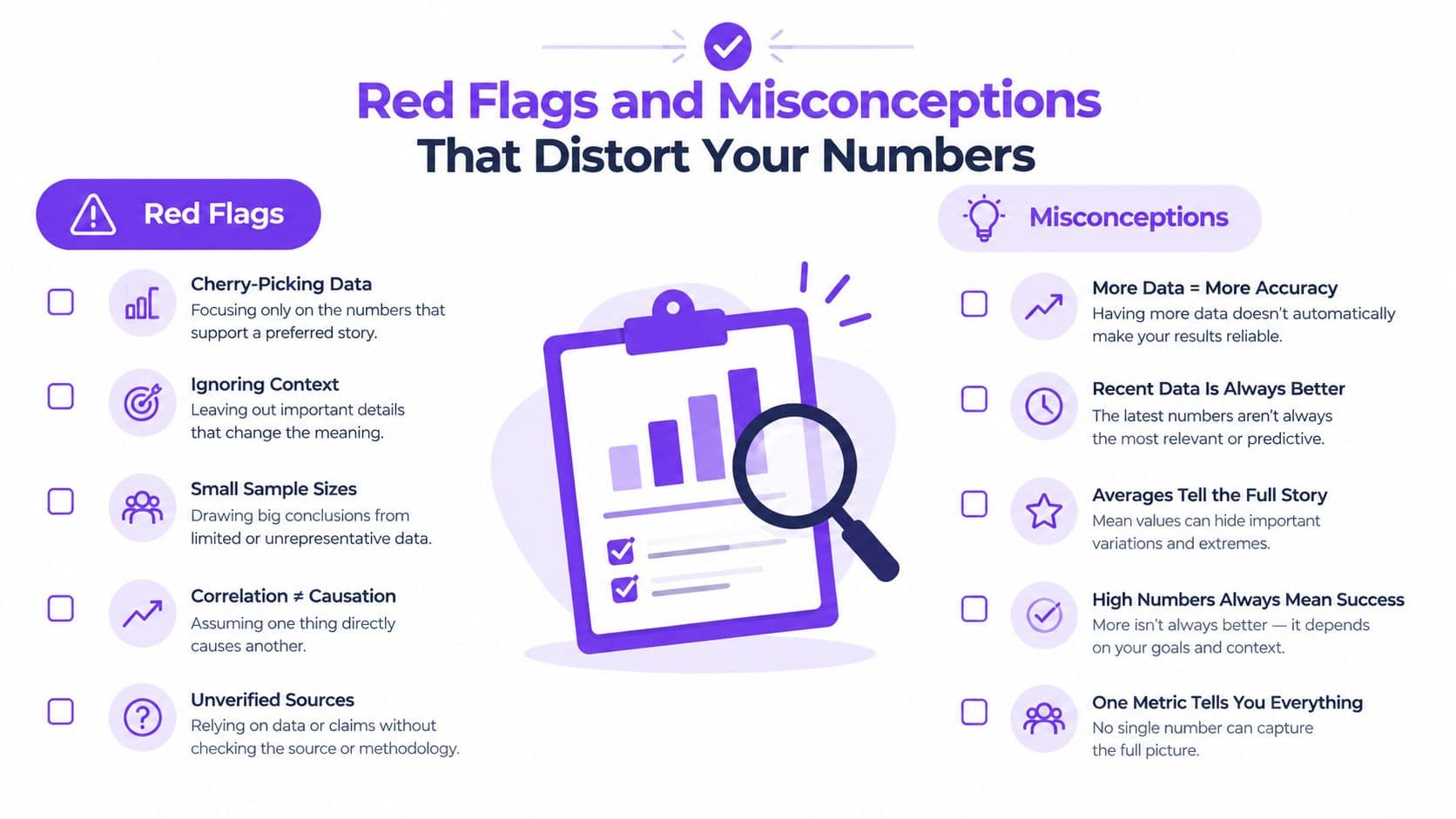
The problem is not the gap itself. The problem is using one lens to answer three different questions. ARR measures contracted run-rate. Revenue measures what you earned under GAAP. Cash measures what hit the bank. Founders get in trouble when they present one of those numbers as a substitute for the other two.
Misconception one says ARR proves business quality
ARR proves you sold recurring contracts. It does not prove those contracts are durable, profitable, or clean.
A weak ARR number often looks strong on the surface because the company included borderline items that do not behave like core subscription revenue. Common examples are usage spikes mistaken for recurring expansion, add-ons with weak renewal rates, and multi-year contract value reported as if it were one year of recurring revenue. If $400,000 of your reported $2 million ARR comes from products that renew at half the rate of your core plan, you do not have $2 million of equal-quality ARR. You have a quality problem hiding inside a growth metric.
Misconception two says ARR and revenue should line up
They should reconcile logically. They should not match mechanically.
In a stable company with no churn, no expansions, no contractions, no services, and no billing quirks, ARR and annualized revenue can look similar. That is not how real SaaS companies operate. Growth creates timing gaps. Churn creates step-downs in ARR before the revenue impact fully rolls through. Annual prepaids create deferred revenue. Services and implementation fees lift revenue without touching ARR.
If your team keeps asking why ARR is ahead of revenue, ask a better question: is the difference coming from normal timing, or from bad classification?
Red flags to review every month
- Services are carrying the P and L: Revenue is up, but subscription ARR is flat or shrinking.
- Expansion is hiding churn: Net ARR grows while logo retention or gross retention gets worse.
- Total contract value is being labeled as ARR: A three-year $300,000 deal is reported as $300,000 ARR instead of $100,000.
- Bookings are being treated like earned revenue: Sales celebrates the signed deal before delivery starts and finance never corrects the story.
- Deferred revenue does not roll cleanly: Billings, revenue recognition, and balance sheet movements do not tie.
- Cash collections are being used to defend revenue quality: A prepaid quarter looks healthy even though renewals or retention are weakening.
One more red flag matters in fundraising. If your board deck, CRM, billing system, and general ledger all show different recurring revenue numbers, investors will assume your controls are weak. They will be right.
Monthly controller test: Trace one customer from signed contract, to invoice, to cash, to deferred revenue, to recognized revenue, and back to ARR. If that path breaks, your reporting is not investor-ready.
Your Next Steps to Reconcile ARR and Revenue With Confidence
You don't fix arr vs revenue confusion with better definitions. You fix it with a monthly operating discipline.
The monthly checklist
Run this every close:
- Pull active recurring contracts from Stripe, HubSpot, Salesforce, or your billing platform.
- Separate recurring from non-recurring items. Subscription fees stay in ARR. Setup, implementation, consulting, and project work do not.
- Roll forward ARR by movement type so new, expansion, contraction, and churn are visible.
- Update deferred revenue schedules for annual and upfront-billed contracts.
- Recognize GAAP revenue based on delivery and your ASC 606 policy.
- Compare cash collections to billings and receivables so runway planning isn't built on a misleading bookings story.
- Publish all three views together for leadership: ARR, GAAP revenue, and cash.
When to bring in controller support
If your team is still doing contract math in spreadsheets, if your billing system and general ledger don't tie, or if investors keep asking follow-up questions your reports can't answer, you're past the point of DIY finance.
A good controller process should produce a clean close, a deferred revenue rollforward, and an investor-ready bridge between KPI reporting and the financial statements. That can be built internally, through a fractional controller, or through a specialized outsourced team. One option in this range is Jumpstart Partners, which handles outsourced controller work, ASC 606 workflows, and KPI reporting for growing SaaS and hybrid businesses.
If your legal and finance workflows intersect around contracts, renewals, or obligations, it also helps to browse legal AI models that support contract review and policy workflows.
The decision rule is simple. Use ARR to understand recurring scale. Use GAAP revenue to report earned performance. Use cash to make survival decisions. If your reporting doesn't separate those three, fix that before your next board meeting, fundraise, or hiring plan.
Jumpstart Partners helps SaaS, agency, and services founders build clean ARR reporting, ASC 606 revenue recognition workflows, and investor-ready financials that reconcile. If you want tighter month-end closes, clearer cash visibility, and reporting that holds up in diligence, visit Jumpstart Partners.