Financial Operations
Bookkeeper vs CPA: Who Should Own the Close
Bookkeeper vs CPA, explained for $500K–$20M SaaS and agencies: roles, real costs, ASC 606 ownership, and when to add a controller.
ByJumpstart Partners, CPA, QuickBooks ProAdvisor
··17 min readThe usual bookkeeper vs CPA advice tells you to hire a bookkeeper for daily transactions and a CPA for tax season. That leaves the most dangerous job unfilled: the person who reviews the books, approves the close, and explains the numbers when an investor challenges them.
If you run a SaaS company, digital agency, or professional services firm, don't hire by title first. Identify whether you're missing reliable records, technical accounting judgment, or close ownership. Buying more transaction processing won't fix an unreviewed revenue schedule.
Table of Contents
- Bookkeeper vs CPA at a Glance
- Pay Licenses and What Each Role Signs
- Who Stays Accountable After Automation
- Annual Cost of Each Finance Setup
- When SaaS and Agencies Should Escalate
- Red Flags in the Engagement Letter
- Staff the Close Before You Raise
Bookkeeper vs CPA at a Glance
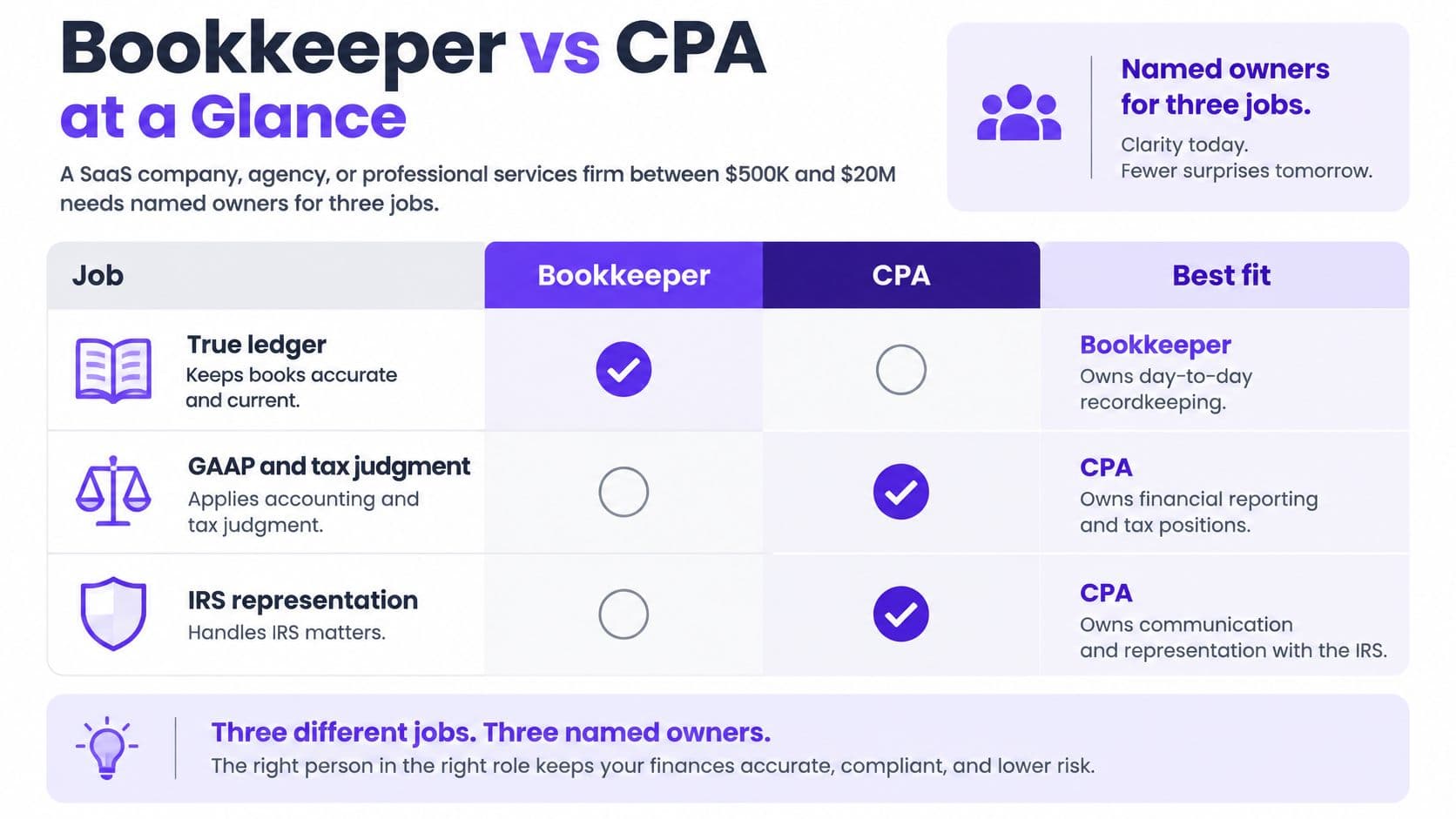
Start with the empty owner, not the candidate's résumé. Your finance setup needs someone accountable for a true ledger, someone qualified to approve accounting and tax judgments, and someone authorized to handle IRS representation.
| Role | Core job | Monthly deliverable | Credential bar | Does not own |
|---|---|---|---|---|
| Bookkeeper | Post, classify, and reconcile transactions | Reconciled ledger, routine P&L and balance sheet, exception log | Some college is typical; a PTIN is required for paid federal return preparation | GAAP policy and unlimited IRS audit representation based on bookkeeping credentials alone |
| CPA | Review statements, tax positions, and GAAP judgments | Financial-statement presentation, technical memos, and tax deliverables within scope | State license, Uniform CPA Examination, ethics, and continuing education; unlimited IRS representation rights | Day-to-day posting unless the engagement includes it |
| Outsourced controller | Own the close, reporting package, and escalations | Approved close checklist, cash and runway view, KPI commentary | Confirm the reviewer's qualifications; a controller engagement isn't an audit | Tax filing strategy and an auditor's opinion unless separately engaged |
| Accounting software | Code, match, and draft | Suggested categories, bank matches, draft schedules | No professional license | A signed close or accountability for an incorrect ARR number |
The distinction is operational, not hierarchical. A good bookkeeper isn't an inadequate CPA, and a tax CPA isn't automatically your monthly controller.
Use this role map to separate preparation from judgment.
Buy a reconciled ledger, not a transaction allowance
The U.S. Bureau of Labor Statistics describes bookkeeping work as computing, classifying, and recording financial data, checking postings, and identifying discrepancies. For your business, that means more than matching bank-feed transactions.
Require supporting schedules for cash, receivables, payables, payroll, deferred revenue, and material accruals. Every unresolved difference needs an account, dollar value, aging, and named owner. Otherwise, your attractive dashboard is sitting on unfinished accounting.
Software can draft the books. It can't provide professional sign-off or accept responsibility for the accounting judgment behind them.
A controller's close approval means the reporting package has passed your agreed internal review. It doesn't mean an independent auditor has issued an opinion. Likewise, a CPA's license doesn't mean the engagement includes monthly review, tax filing, and representation.
For a useful credential-level reference, the CPA and bookkeeper differences from HireAccountants help distinguish the roles. Use that distinction to write responsibilities into your engagement, not to assume every licensed professional offers the same service.
Put actual names beside each responsibility in the table. The row without a named accountable person is the seat you fill first.
Pay Licenses and What Each Role Signs
The pay gap reflects different work. According to the Bureau of Labor Statistics occupational data, median annual pay in May 2024 was $81,680 for accountants and auditors and $49,210 for bookkeeping, accounting, and auditing clerks, a difference of $32,470, or about 66%; both occupations held approximately 1.6 million U.S. jobs in 2024.
The arithmetic is straightforward: $81,680 minus $49,210 equals $32,470; dividing that difference by $49,210 gives approximately 66%. These are occupation medians, not a promise that every CPA earns more than every bookkeeper, and they're not outsourced-service quotes.
| Work you're buying | What you should expect |
|---|---|
| Transaction integrity | Accurate classifications, reconciliations, and source records |
| Accounting judgment | Documented treatment of material transactions and financial-statement presentation |
| Licensed professional services | An explicitly scoped engagement with an appropriately licensed professional |
| Internal close approval | Evidence that preparation, review, and release responsibilities were completed |
Pay for judgment where judgment is required
Bookkeeping clerks typically need some college education but no degree. Their core work is computing, classifying, and recording. Accountants examine statements, evaluate controls, and address reporting and compliance issues.
That distinction matters when your founder dashboard says revenue increased but the deferred-revenue schedule doesn't reconcile. Posting the subscription invoice is one task. Deciding how the contract should affect recognized revenue is another.
The BLS profile of accountants and auditors explains the higher-level analysis and professional requirements associated with accounting work, including CPA licensure. A CPA must pass the Uniform CPA Examination and meet applicable education, experience, character, ethics, and continuing-education requirements.
A bookkeeper doesn't need a CPA license for ordinary transaction work. But don't turn that into permission to delegate technical policy to whoever happens to maintain QuickBooks.
Distinguish internal approval from assurance
A CPA reviewing your revenue memo isn't automatically performing a formal financial-statement review engagement. A controller approving your management package isn't issuing an audit opinion. Specify the service, the reviewer, and the deliverable instead of using “CPA-reviewed” as an undefined quality label.
If your immediate problem is tax planning rather than monthly reporting, clarify what a tax accountant does before expanding the bookkeeping scope.
The efficient operating pair is clear: the bookkeeper maintains complete, timely source records; the CPA reviews material judgments, tax positions, presentation, and compliance exposure. Don't pay licensed judgment rates for routine posting, and don't buy routine posting when you need licensed judgment.
Who Stays Accountable After Automation
Automation makes undifferentiated data entry less valuable and competent review more valuable. If your provider's main selling point is that someone manually categorizes transactions, you're evaluating yesterday's workflow.
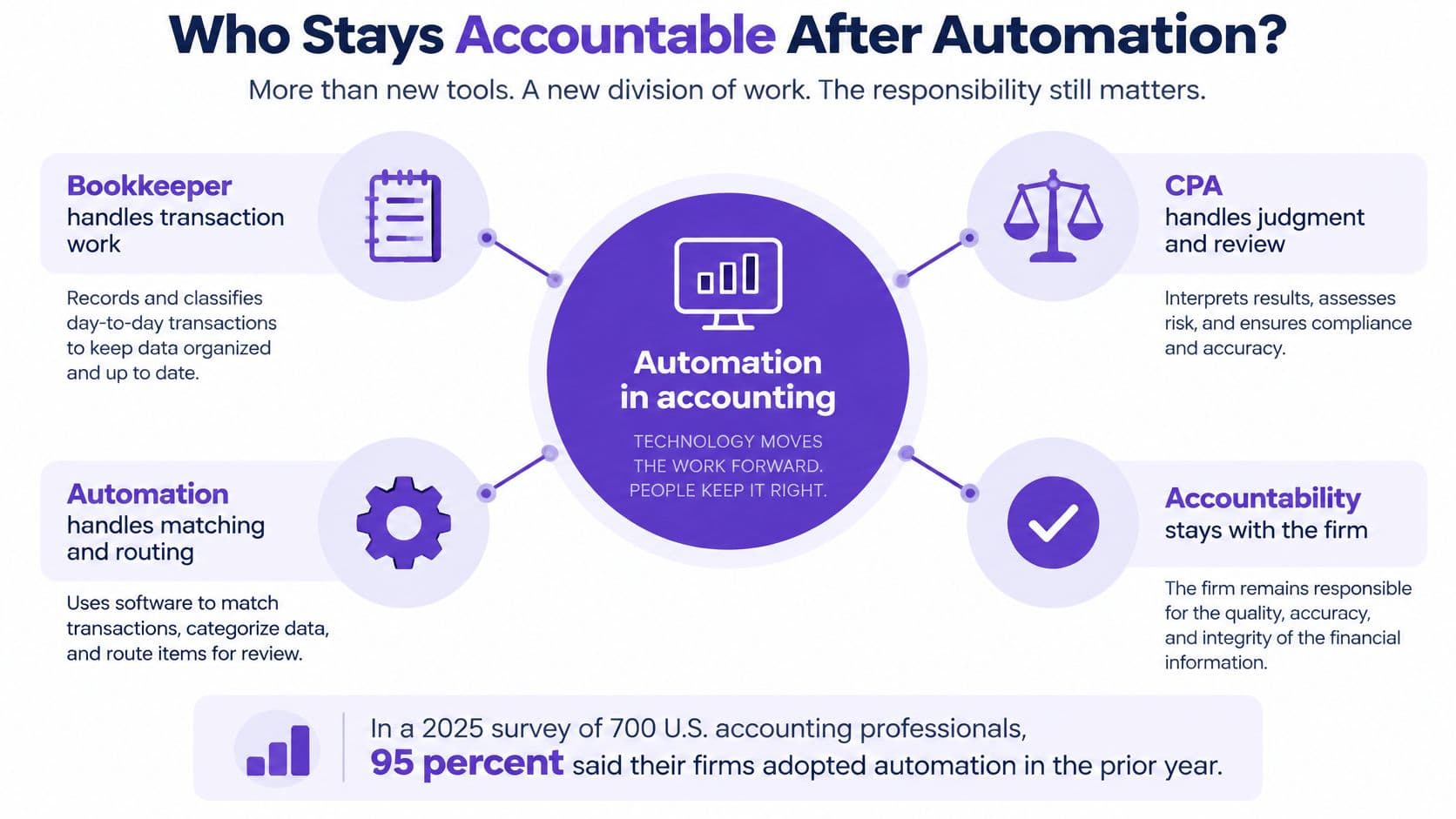
The CPA.com 2025 AI in Accounting Report discusses a 2025 survey of 700 U.S. accounting professionals in which 95% said their firms had adopted automation during the prior year. Reported applications included payroll processing at 47%, accounts payable and receivable at 46%, and transaction processing at 43%.
Use automation to divide work intelligently, not to remove the reviewer.
Require controls around every automated handoff
For a SaaS stack using Stripe, a general ledger, and payroll software, require:
- An audit trail: Trace each payout through gross customer charges, fees, refunds, and the resulting ledger entries.
- Separate approval and reconciliation: Don't let the person releasing payments act as the only reviewer of those payments.
- An exception queue: Set a written dollar threshold, assign owners, and escalate unusual transactions regardless of size.
- Restricted access: Limit permissions for vendor changes, payroll edits, manual journals, and report release.
- A technical escalation path: Route unfamiliar revenue terms, tax treatments, and covenant questions to the designated CPA.
For payroll-specific controls, Benely's guide to payroll fraud prevention is a useful companion when separating employee changes, payment approval, and reconciliation.
Keep interpretation with people
Software can match a Stripe payout. It can't accept professional responsibility for whether implementation is a separate performance obligation or whether a credit belongs in your ARR movement report.
Megan Weis, CPA, MBA, who leads Personiv's Finance & Accounting Outsourcing offering, describes the distinction plainly in Personiv's bookkeeping and accounting guide:
“Accounting turns the information from the ledger into statements that reveal the bigger picture of the business, and the path the company is progressing on.”
Your financial close automation design should therefore specify what happens after a tool flags a discrepancy. An alert without an owner is unfinished work, not a control.
This video provides another way to consider the accounting workflow.
Automation may post. A human controller reviews. A qualified CPA approves technical policy. Name the controller who answers when an investor asks why reported ARR changed, and make sure that person can trace the answer to contracts and approved schedules.
Annual Cost of Each Finance Setup
Separate bookkeeping, tax preparation, and monthly close ownership before comparing fees. A low monthly price tells you very little until you know which responsibilities remain with you.
The bookkeeping and tax stack below is an illustrative budget, not a market quote. The Ignition bands are survey benchmarks, while our controller retainer is a defined service price.
| Setup | Monthly | Annual | Included | Still uncovered |
|---|---|---|---|---|
| Bookkeeper only, illustrative | $2,000 | $24,000 | Reconciled books and routine statements | Tax controversy, ASC 606 policy, investor package |
| Bookkeeper plus tax CPA, illustrative | About $2,500 blended | $30,000 | Books plus a $6,000 tax engagement | A named reviewer for judgments between tax seasons |
| Light bookkeeping, lower Ignition band | $250–$499 | $3,000–$5,988 | Entry-level monthly service; 29% of surveyed firms | A complete growth-company close unless explicitly scoped |
| Light bookkeeping, upper Ignition band | $500–$749 | $6,000–$8,988 | Small-firm bookkeeping and accounting; 27% of surveyed firms | Technical accounting and board reporting unless explicitly scoped |
| Controller-led Finance Ops | $2,500 | $30,000 | Close, management reporting, billing and cash review, monthly finance meeting | Fundraising strategy, tax filing, and an audit opinion |
| Finance Ops Plus | Custom | Custom | Usage billing, multi-system reporting, board package, weekly routine if needed | The same tax and audit exclusions |
In the illustrative bookkeeping stack, $2,000 × 12 = $24,000, and adding a $6,000 tax engagement produces $30,000 in annual spending; the IRS guidance on paid preparers explains why return preparation and professional representation must remain distinct responsibilities.
According to the Ignition survey reported by Ledgerbrook, 29% of 219 U.S. accounting firms surveyed in 2025 charged $250–$499 monthly for bookkeeping and accounting services, while 27% charged $500–$749. Annualizing those bands produces the totals in the table.
Compare the uncovered work
Treat the lower survey bands as a starting point for light-service comparisons, not as evidence that a provider will manage a multi-system SaaS close. The survey prices don't establish whether an engagement includes deferred-revenue schedules, client margin reporting, or investor commentary.
Jumpstart Partners' Controller-led Finance Ops core retainer is $2,500 monthly, after scope is confirmed, or $30,000 annually. Compared with the illustrative bookkeeping-only budget, the calculation is ($2,500 − $2,000) × 12 = $6,000 in additional annual spending.
That step-up buys close ownership, a management package, billing and cash review, and a monthly operating meeting. It doesn't buy tax filing or an audit opinion. Nor should you automatically add the controller fee to an existing bookkeeping bill without checking overlapping responsibilities.
For heavier usage billing or board reporting, Finance Ops Plus is custom-priced. We offer complimentary ROI assessments to test whether controller support makes financial sense for your situation.
Use this small-business accountant cost guide to compare scope alongside price. A sensible budget identifies both what you're buying and who owns everything excluded.
When SaaS and Agencies Should Escalate
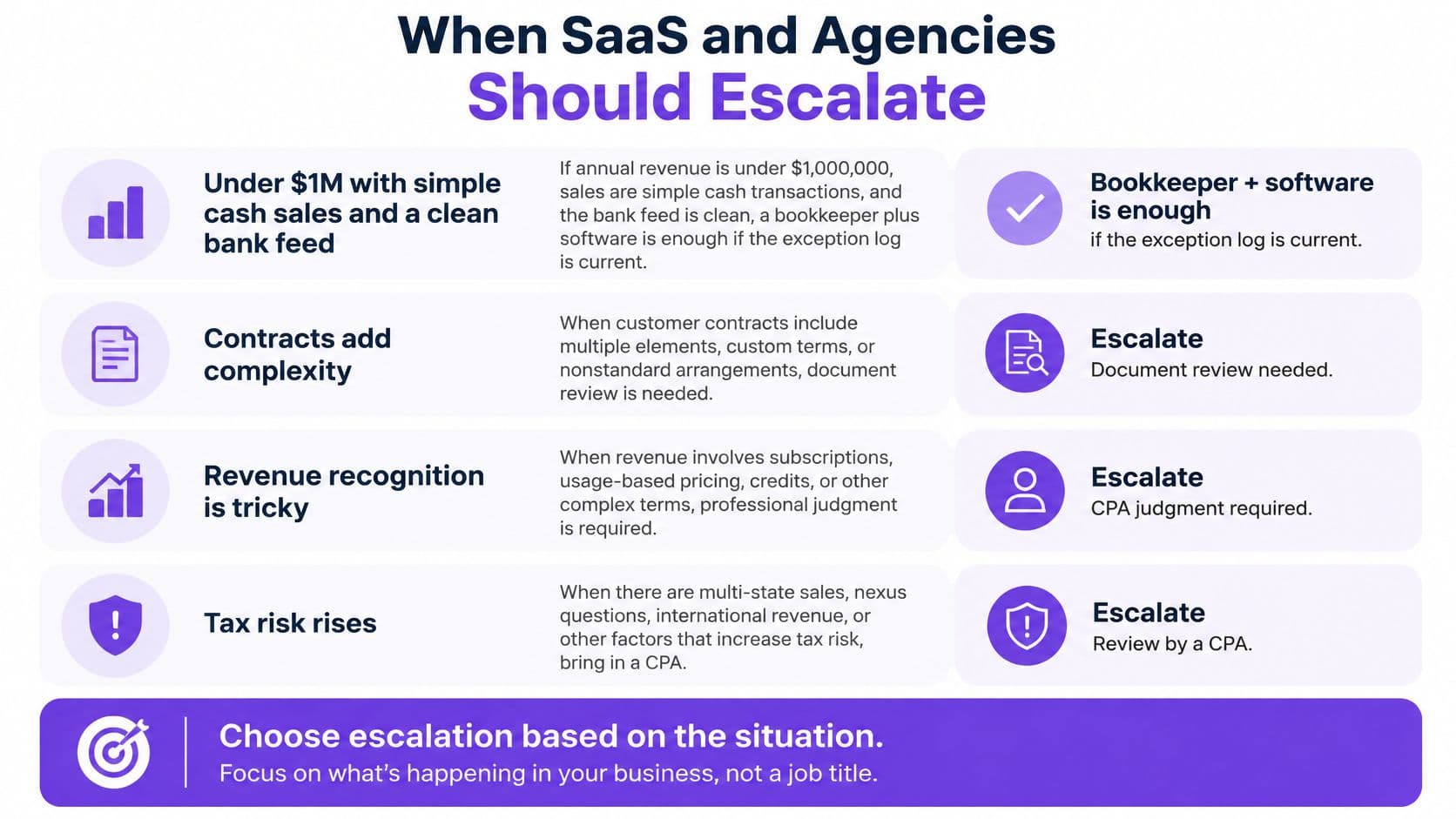
A subscription invoice isn't automatically revenue. For a bundled SaaS contract, the right hiring trigger is the accounting judgment required to separate and recognize the deliverables.
Using the contract example supported by Cohen & Company's SaaS revenue-recognition guidance, assume $120,000 of annual consideration is allocated to $100,000 of SaaS access and $20,000 of distinct implementation, completed on March 31. Recognize the implementation when completed and the subscription over 12 months, producing $100,000 ÷ 12 = $8,333.33 monthly, subject to rounding.
| Obligation | Recognition | Amount |
|---|---|---|
| Implementation, distinct | March 31, one time | $20,000 |
| SaaS access | $8,333.33 per month for 12 months, with rounding adjustment | $100,000 |
| Total contract | Recognized across the applicable delivery periods | $120,000 |
Escalate the policy, not every journal entry
Under ASC 606, allocate the transaction price using the obligations' stand-alone selling prices. Whether implementation is distinct requires assessment of the actual contract and service, not just an invoice line labeled onboarding.
If implementation isn't distinct and is integral to the subscription, recognize the combined consideration with the related subscription service. Don't recognize the entire contract upfront merely because you collected the cash.
Keep routine posting with the bookkeeper after the policy is approved. Require CPA review of the policy memo, including the contract evidence, allocation method, recognition pattern, and treatment of modifications.
Use these situations to decide when to add oversight.
Match the hire to the business event
For a business below $1 million with simple cash sales, treat bookkeeper-plus-software as a hiring rule of thumb, not a legal threshold. It's enough for routine operations when reconciliations are complete, exceptions are current, and specialist tax support remains available.
An agency has a different escalation point. Say your hypothetical monthly statements show $180,000 revenue − $145,000 expenses = $35,000 profit. That total doesn't tell you whether an over-serviced retainer client is consuming the profit from your other accounts.
Assign project coding and source records to the bookkeeper. Assign client-margin interpretation, staffing implications, and corrective action to the controller. Don't hire a tax specialist to solve missing project reporting.
For subscription businesses, accounting for SaaS also requires consistent definitions across billing, recognized revenue, and recurring-revenue metrics. An investor shouldn't receive an ARR bridge that uses a different customer population from your billing records.
When fundraising, lender reporting, or diligence begins, add a controller-owned reporting release. Our handoff packages P&L, cash, runway, ARR movement, and commentary into one approved operating view.
That reporting handoff isn't fundraising strategy. Finance Ops Plus excludes fundraising strategy, tax filing, and an audit opinion. Keep the tax CPA, and engage an appropriately qualified independent auditor when an opinion is required.
Red Flags in the Engagement Letter
Say your $2 million agency receives an audit notice about payroll classification and deductible expenses. The bookkeeper who prepared the return can't assume responsibility for every stage of the defense merely because they know your ledger.
The IRS guide to preparer credentials states that attorneys, CPAs, and enrolled agents have unlimited representation rights, including audits, collections, and appeals. A PTIN alone doesn't provide that authority.
Stop before signing these promises
- Audit defense without a qualified representative: Confirm who will represent your company and whether the engagement and applicable licensing rules cover the work.
- No monthly close checklist: You won't know which accounts were prepared, reviewed, or left unresolved.
- Bank-only reconciliation: Your cash balance can tie while deferred revenue, payroll liabilities, and receivables remain wrong.
- No owner for revenue policy: The preparer ends up making technical decisions by default.
- Transaction count as the only quality measure: A high processing volume says nothing about unresolved exceptions.
- Investor-ready statements without review points: Nobody has defined what evidence supports release or who approves the package.
- One fee supposedly covering everything: Separate transaction processing, return preparation, controversy, assurance, and fundraising work before accepting the claim.
Don't reject a provider because the engagement excludes something. Reject an engagement that hides the exclusion or leaves you unable to identify the responsible professional.
Verify the preparer, not just the brand
The IRS PTIN requirements generally require anyone paid to prepare or substantially assist with a federal return to obtain a PTIN and renew it annually. A CPA's final review doesn't automatically remove that requirement from another compensated preparer's substantial work.
Check the signing preparer's identity and credentials, and confirm that the return includes the required signature and PTIN. Then distinguish that filing responsibility from ongoing technical accounting review.
When comparing online bookkeeping services, insist on clear handoffs rather than an undefined full-service label. A clean engagement tells you where the bookkeeper stops and who accepts the next responsibility.
Send these questions to your current preparer this week:
- Who prepares our return?
- Whose PTIN appears on it?
- Who can represent our company in an IRS dispute?
- Who signs off on our revenue-recognition memo?
Staff the Close Before You Raise
Don't replace your accounting stack before assigning responsibility. A new tool won't resolve a disagreement about who approves deferred revenue or releases the board package.
Start this month's operating routine
- Fill every owner gap. Name the people responsible for ledger preparation, software output review, technical accounting, tax preparation, and IRS defense.
- Map the broken handoffs. Follow billing to cash, inspect deferred revenue and payroll, and identify the spreadsheet that still produces ARR.
- Assign the close sequence. Put names beside reconciliations, accruals, review, and sign-off before changing tools.
- Keep effective preparation. Retain the bookkeeper when the ledger is timely and supported; add CPA review for the revenue memo and return.
- Add a controller for coordination. Make the hire when nobody owns the close, financing is approaching, or you can't explain cash and ARR in one sitting.
Add ownership without a full reset
Our engagements are CPA-led and work alongside your existing founder, operations lead, CPA, or bookkeeper. You don't need to discard useful people and systems to establish a reviewed monthly routine.
The Controller-led Finance Ops retainer includes monthly close ownership, management reporting, billing, revenue and cash review, AI cost and margin review, process cleanup and automation, named review points, a monthly finance operating meeting, and board-package support. Tax filing, an audit opinion, and fundraising strategy remain separate.
Our diagnostic runs for five business days and ends with a written workflow map before either side commits to a retainer. That gives you a concrete basis for deciding whether the missing seat is preparation, review, or close ownership.
Jumpstart Partners offers CPA-led controller support that works with your existing finance team rather than forcing a reset. If close ownership is your empty row, visit Jumpstart Partners to book a complimentary ROI assessment and test whether controller support fits your business. Either way, send the preparer and representation questions above to your current tax professional this week.