Financial Operations
Bookkeeping and Accounting for Small Business: A 2026 Guide
Master bookkeeping and accounting for small business with workflows, KPIs, software picks, and clear signals for when to outsource. Built for founders.
ByJumpstart Partners, CPA, QuickBooks ProAdvisor
··17 min read60% of small business owners spend more than 10 hours a month on bookkeeping, and that's before tax prep or payroll gets layered on top. If you're running a SaaS company, agency, or e-commerce brand, that isn't “admin,” it's a drain on management time, cash visibility, and decision quality. Bookkeeping and accounting for small business is a control system, and if you treat it like a chore, you'll pay for it with bad decisions.
Founders usually discover this the hard way. The books are late, bank balances don't match reality, revenue recognition is messy, and nobody can answer a simple question about runway or client profitability without opening twelve tabs and hoping the spreadsheet still works. Meanwhile, 45% of U.S. small businesses outsource their bookkeeping, 64.4% use accounting software, and 50% still rely on manual methods or spreadsheets, which tells you the market has already split between owners who want control and owners who need control plus speed (BusinessDasher research on accounting statistics).
Professional support is not just about cleanliness, either. Intuit's SMB research found that companies using professional accounting services saw an 11.5% increase in revenue per year, and that figure rises to 12.8% for medium-sized firms (Intuit SMB economy report). That is the key point. Good books don't just help you file taxes, they help you make decisions while there's still time to change the outcome.
Table of Contents
- The Real Cost of Getting Bookkeeping Wrong
- Bookkeeping vs Accounting and Why Founders Confuse Them
- Foundational Setup That Has to Happen Before You Record Anything
- The Monthly and Quarterly Workflow That Keeps Books Clean
- KPIs and Reports That Drive Decisions
- Choosing Between DIY, Hybrid, and Outsourced Finance
- Case Examples from SaaS, E-commerce, and Agencies
- Red Flags, Transition Steps, and What to Do This Week
The Real Cost of Getting Bookkeeping Wrong
The biggest bookkeeping mistake isn't a miscategorized Uber receipt. It's letting the function consume founder attention while still producing numbers you can't trust. 60% of small business owners spend more than 10 hours per month on bookkeeping tasks, and 21% say they do not know enough about bookkeeping (BusinessDasher research). That combination is expensive, because time lost to cleanup is time not spent on pricing, hiring, collections, and sales.
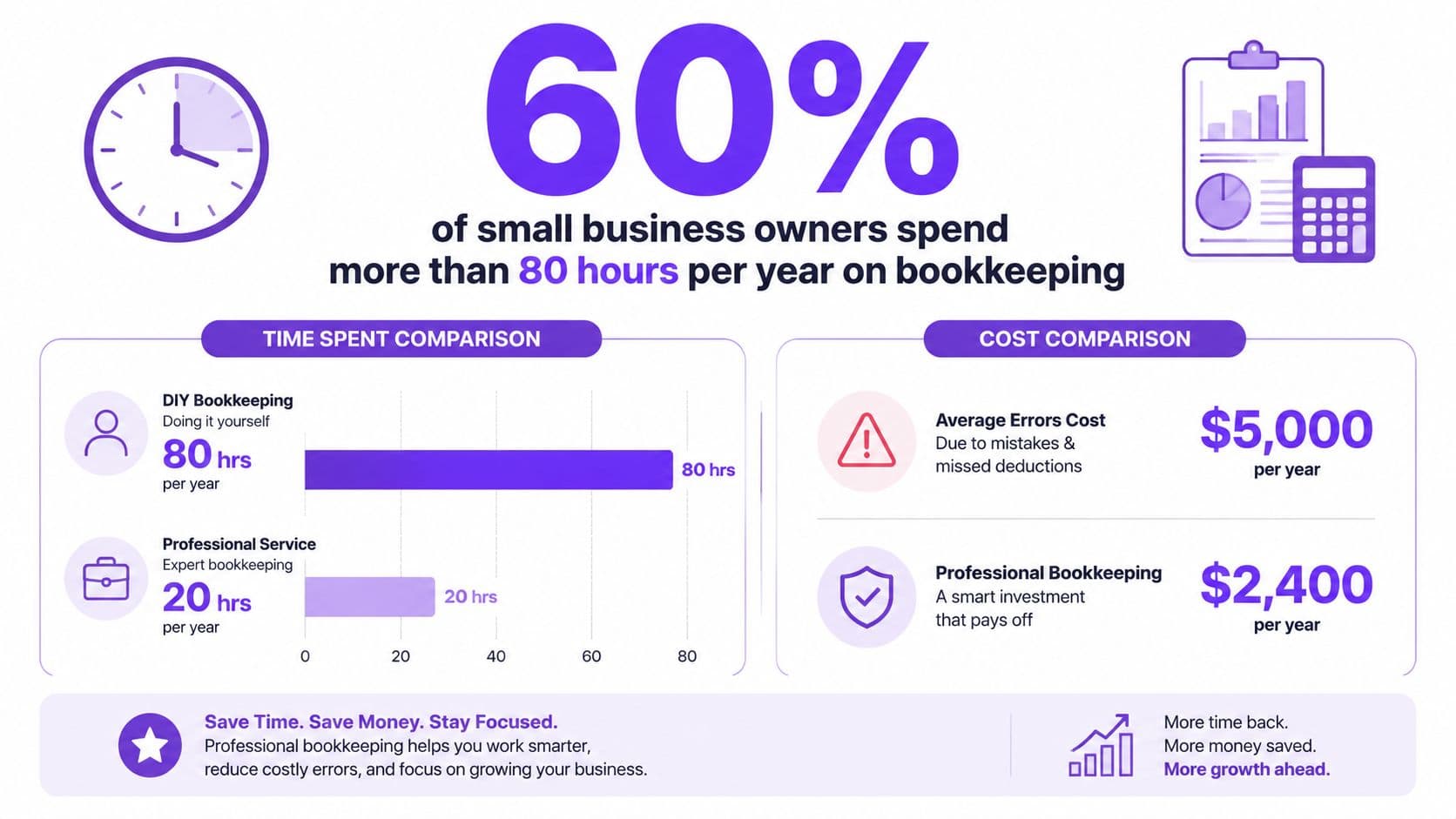
The cost goes beyond hours. Intuit's SMB research ties professional accounting services to an 11.5% annual revenue increase for companies using them, which is why I don't treat bookkeeping as compliance work, I treat it as an operating tool (Intuit SMB economy report). If your books are late, you're not just behind on reporting. You're behind on decision-making.
Practical rule: If the books don't tell you where cash went, which customers or channels are profitable, and what obligations are coming next, they're not books. They're a history project.
There's also a hidden funding cost. Sloppy books delay diligence, slow lender reviews, and make investor conversations harder than they need to be. I've seen founders lose weeks because a simple revenue or expense question required a forensic cleanup instead of a clean report. The internal benchmark you should care about is whether your finance stack supports the business you're building, not the business you had when you were still under a million in revenue. For a useful perspective on this tradeoff, start with the cost of accounting for a small business.
Bookkeeping vs Accounting and Why Founders Confuse Them
Founders confuse bookkeeping and accounting because they want one system to do two jobs. Bookkeeping is the control layer. Accounting is the interpretation layer. If you treat them as the same thing, you end up with books that are technically posted but useless for cash decisions, financing conversations, or clean monthly review.
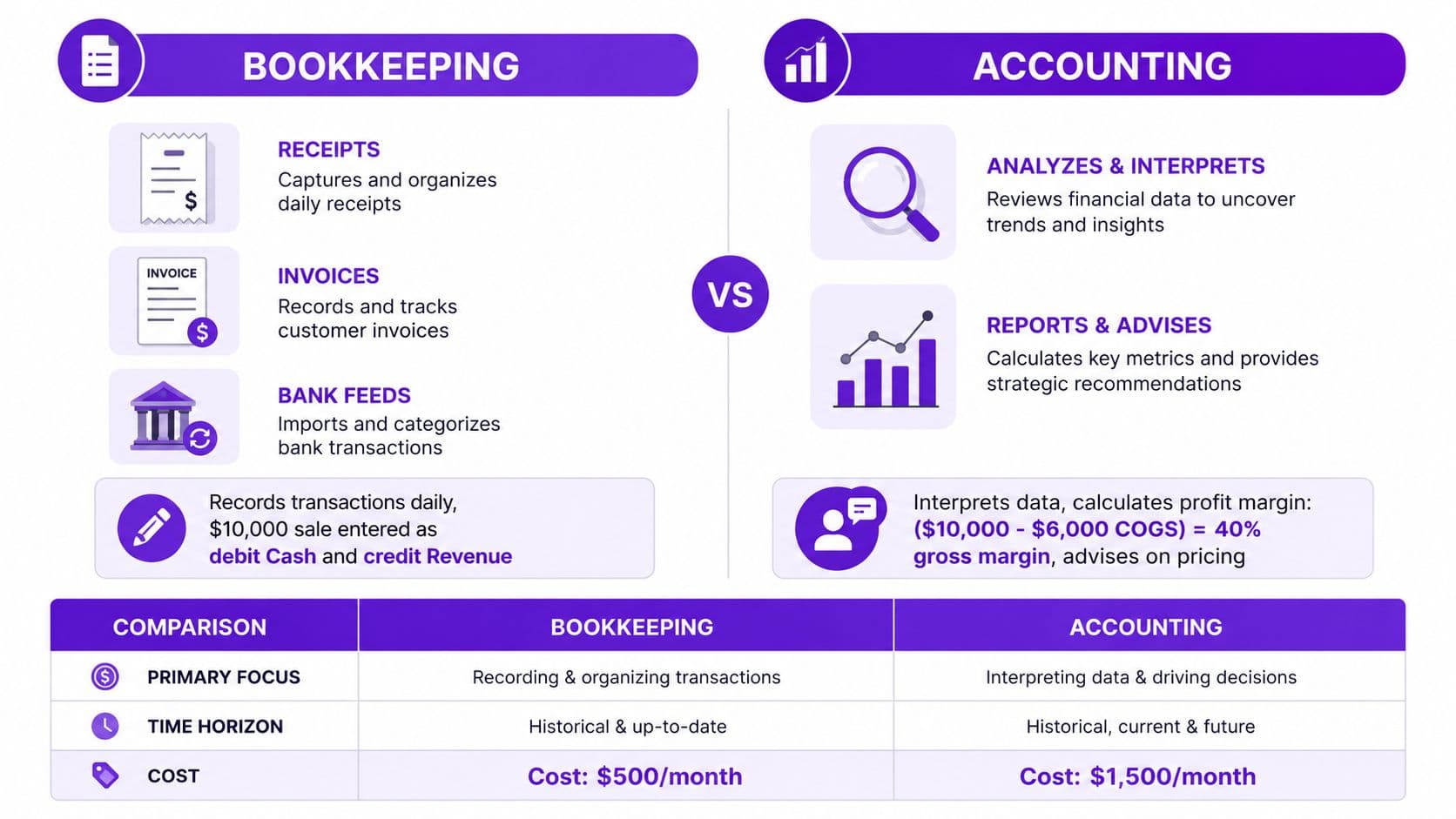
A bookkeeper records the transaction correctly, matches it to the bank feed, and ties it to a receipt or invoice. An accountant takes that clean record and turns it into margin analysis, tax planning, and reporting a CEO can use. I treat bookkeeping as an operating tool rather than compliance work, because the ledger should tell you where cash went, what is still owed, and which parts of the business are carrying the load.
The split matters even more once you cross a real operating threshold. A $10,000 annual SaaS contract does not belong in revenue the day cash hits the bank if you are reporting properly. Under accrual accounting and ASC 606, that cash sits in deferred revenue and is recognized over the service period, which gives you a truthful view of earned revenue instead of a one-month spike that distorts the rest of the quarter. Bookkeeping records the cash receipt and liability correctly, and accounting turns that into monthly performance, gross margin, and renewal insight.
If your business has subscriptions, retainers, inventory, financing talks, or investor reporting on the horizon, cash-basis bookkeeping stops being enough. That is the point where accrual reporting becomes the control system, because it shows obligations, earned revenue, and timing mismatches that cash basis hides. Founders who wait too long usually discover the problem during diligence, after the chart of accounts, revenue recognition, and monthly reporting all need cleanup at once. For a direct comparison of role boundaries, see bookkeeper versus controller.
A bookkeeper should own transaction capture, reconciliation, categorization, and routine reporting. A controller or CPA should own revenue recognition, close discipline, tax posture, financial review, and investor-ready packages. That division keeps the books clean and keeps senior finance work focused on judgment, not data entry.
An accountant's job is to make the books decision-useful. If the report cannot support pricing, hiring, or fundraising, the work is unfinished.
Foundational Setup That Has to Happen Before You Record Anything
A clean close starts before the first entry hits the ledger. If you book transactions on top of mixed cash, personal spend, and a weak chart of accounts, every month after that becomes cleanup. The setup is tedious, but it prevents broken books from becoming a cash problem later.
Start with clean cash separation
Open a dedicated business bank account and keep business and personal activity apart. Coursera on small business accounting makes the same basic point, and it matters because you cannot reconcile revenue, payroll, owner draws, or contractor spend with any confidence when personal charges are mixed in. If business expenses are still running through a personal card, fix that first and stop the bleed.
Choose your accounting method early
Cash basis works for some simple service businesses. Accrual is the right call once you have subscriptions, retainers, prepaids, deferred revenue, inventory, or financing conversations ahead of you Xero small business bookkeeping guide. Cash-basis bookkeeping eventually stops answering the questions founders need answered, especially when revenue timing, obligations, and collections start pulling in different directions. That is the point where accrual reporting, ASC 606 discipline, and investor-ready packages stop being optional because the books need to show what is earned, what is owed, and what is still sitting in cash.
Map the chart of accounts to the business model
Build the chart of accounts around how the company makes money, not around generic categories. A SaaS chart should surface MRR, ARR, deferred revenue, and CAC buckets. An e-commerce chart needs COGS, inventory, refunds, and ad spend. An agency should be organized around project revenue, labor, subcontractors, utilization, and work-in-progress. If you need a clear definition of the structure itself, what a chart of accounts is is the right reference point.
| Chart of Accounts Differences by Business Model | SaaS | E-commerce | Agency |
|---|---|---|---|
| Revenue logic | Recurring subscriptions, contract terms | Product sales, returns, discounts | Project fees, retainers, milestones |
| Core cost buckets | Hosting, support, onboarding, CAC | COGS, shipping, inventory, refunds | Labor, subcontractors, tools, WIP |
| Cash visibility focus | Deferred revenue, runway | Inventory turns, margin by channel | Utilization, collections, labor leverage |
Connect the stack before volume grows
Payment processors, payroll tools, commerce platforms, and expense systems need to feed one ledger from day one. QuickBooks, Xero, NetSuite, Stripe, Shopify, Gusto, or BambooHR should sit inside one reporting rhythm, not as disconnected islands that only get checked when something breaks. For ecommerce reconciliation processes and tools, the workflow has to match the ledger every time, or your margin and cash numbers drift apart. Keep the structure tight, and the monthly close gets faster instead of messier.
The Monthly and Quarterly Workflow That Keeps Books Clean
Clean books come from cadence, not heroics. If your team waits until the end of the quarter to touch the ledger, the close becomes a crime scene. If you touch it weekly and close it on a schedule, it becomes a control process.
Use a close calendar that people can actually follow
Weekly, you should post revenue and bills, then verify that cash movement matches source documents. Mid-month, you should run vendor payments and payroll on a predictable schedule so liabilities don't pile up unnoticed. Month-end is where reconciliation happens, bank activity is matched, and adjustments get posted before statements go out. Quarterly, you review tax exposure, runway, and the KPI pack.
| 5-Day Close Rhythm | Owner | Output |
|---|---|---|
| Day 1, cut off activity | Controller | All source documents collected, no late postings |
| Days 2 to 3, reconcile cash | Bookkeeper | Bank and card activity matched to books |
| Day 4, post adjustments | Accountant or controller | Accruals, prepaids, deferrals, and corrections |
| Day 5, finalize reports | Finance lead | Statements and KPI pack delivered |
Investigate the same red flags every month
Certain transactions deserve suspicion every single close. Duplicate charges, missing invoices, uncoded deposits, unapproved refunds, and anything sitting in suspense accounts should get reviewed before statements are finalized. The reason is simple, unreconciled items distort accounts receivable, accounts payable, and cash flow, which means leadership starts making decisions against the wrong picture. If you need an operational reference for e-commerce-heavy reconciliation, SelfServe's reconciliation process and tools is a useful guide.
Keep the records, don't trust memory
For tax and audit support, documentation needs to be retained for at least six years from the tax year, according to CustomCPA's guidance on bookkeeping support documents (CustomCPA small business bookkeeping). Receipts, invoices, bank statements, payroll records, and support for journal entries all belong in the file, not in someone's inbox. If you want month-end reporting that doesn't collapse under scrutiny, monthly financial reporting should be tied to this cadence, not treated as a separate project.
KPIs and Reports That Drive Decisions
A clean set of KPIs does one job, it tells you whether the business is generating cash, buying growth efficiently, and protecting margin before the month is over. Founders do not need more dashboards. They need fewer numbers, reviewed with discipline, so bookkeeping works like a control system instead of a compliance chore.
Start with cash, then unit economics, then operations
Cash tells you whether you can fund the next quarter. Unit economics tell you whether growth is worth buying. Operations tell you whether the business is getting better or just getting larger.
- Cash block: runway, burn, and accounts receivable aging.
- Unit economics block: gross margin, CAC payback, and LTV:CAC.
- Operations block: gross margin by client or channel, utilization, and net revenue retention.
A SaaS operator with $1.2M ARR and $420K CAC spend has a 3.4:1 LTV:CAC ratio if LTV is $14.4K. That is a stronger signal than vanity revenue because it connects acquisition cost to customer value. For benchmark context, OpenView's 2024 SaaS Benchmarks remains a useful reference point for founders checking whether their economics look healthy relative to market norms.
Cash-basis reporting stops being enough once the business has recurring revenue, meaningful deferred revenue, inventory, or financing conversations on the table. At that point, accrual reporting, ASC 606 treatment, and an investor-ready reporting package are required because timing, not just totals, starts driving decisions. If you are already comparing finance support options, Jumpstart Partners' guide to finance and accounts outsourcing is the right place to evaluate when outside help makes sense.
Translate the same dashboard by business model
An e-commerce brand at $2M in revenue should watch contribution margin, refund rates, and inventory pressure more closely than ARR-style metrics. A $1.5M agency should care more about utilization, realization, and gross margin by client than about subscription math. If the dashboard does not match the business model, it becomes decoration.
| KPI Benchmarks by Business Model | SaaS Target | E-commerce Target | Agency Target |
|---|---|---|---|
| Gross margin | High and stable recurring margin profile | Tight margin after COGS and shipping | Margin protected after labor and subcontractors |
| CAC payback | Short enough to support reinvestment | Not the primary lens | Not the primary lens |
| LTV:CAC | Strong multiple, backed by retention | Use with caution, channel-specific | Use with caution, client-specific |
| Utilization | Not central | Not central | High enough to support profit |
| AR aging | Tight collection cycle | Tight collection cycle | Tight collection cycle |
Put competitor pricing next to margin and cash
Your finance dashboard should not sit in a vacuum. Pricing moves from competitors change win rates, discounting, and margin structure, so keep MyMentions guide to price tracking in the operating workflow when price pressure starts to show up. One view for margin, one view for market pricing, and one view for cash creates a decision system founders can use instead of a backward-looking report.
If your team still leans on cash-basis books after revenue, complexity, or financing stage has crossed the line, the reporting will lag reality and the wrong calls will follow. That is the point where the close process has to produce accrual KPIs, customer economics, and lender or investor packages on a fixed cadence.
Choosing Between DIY, Hybrid, and Outsourced Finance
DIY bookkeeping works until it doesn't. Hybrid finance works when you need more control but not a full department. Fully outsourced finance works when the business has outgrown founder-led accounting and needs a close process, reporting discipline, and investor-readiness without hiring an in-house team.
Compare the operating models against reality
| Finance Operating Model Comparison | DIY | Hybrid | Outsourced |
|---|---|---|---|
| Typical monthly cost | About $50/month for software stack | About $4K to $6K/month in-house stack | About $2K to $8K/month tiered plan |
| Founder time on finance | High | Moderate | Low |
| Audit readiness | Weak | Solid with the right controller | Strong if the process is disciplined |
| Five-day close | Rare | Achievable | Standard target |
| Best fit | Very early, simple books | Growing firms needing oversight | Scaling firms needing speed and control |
Use the trigger points, not emotion
Move from DIY to hybrid when revenue passes a point where clean monthly reporting matters more than saving software fees. The first audit, the first lender review, or the first fundraising process are hard trigger points because you need clean accrual logic and fast answers, not just organized cash records. Move from hybrid to fully outsourced when you're preparing for Series A, managing multiple entities, or paying international contractors and the reporting surface area becomes too broad for part-time coverage.
Rule of thumb: If the close depends on founder memory, your finance model is already too small for the business.
If you're trying to decide when to bring in a fractional CFO, Capstacker's guide on the timing is a sensible outside reference. It's the right question once bookkeeping, controller work, and strategic finance are starting to blur together. For teams weighing the broader handoff, finance and accounts outsourcing is the operational move that usually follows.
Case Examples from SaaS, E-commerce, and Agencies
A SaaS company at $3M ARR came to the table with books that were technically current but operationally useless. Cash was recorded, expenses were coded, and the founder still couldn't explain deferred revenue, monthly recognition, or what the next investor would ask for. A controller-level cleanup added accrual logic, built an investor-ready package, and locked in a five-day close, which is where the company finally stopped arguing with its numbers.
A DTC brand crossing $1.5M on Shopify and Stripe had the opposite problem. The books were full of sales, but COGS mapping, inventory movement, and refund reconciliation were breaking margin visibility. The fix was simple in concept and painful in execution, automate AP, connect the e-commerce stack correctly, and stop treating refunds as a separate afterthought. Once the books reflected inventory and returns properly, the owner could see margin pressure by channel instead of guessing.
An agency at $2M had plenty of revenue and almost no clarity on client profitability. Some accounts looked good on invoices alone, but time tracking and project-based accounting showed a meaningful spread between top and bottom clients, including a 22-point margin gap. Once WIP reporting and labor allocation were in place, the team stopped rewarding busy work and started pricing around real contribution.
The common thread is simple. Clean books are not the finish line, they're the point where management can finally see what's working.
Red Flags, Transition Steps, and What to Do This Week
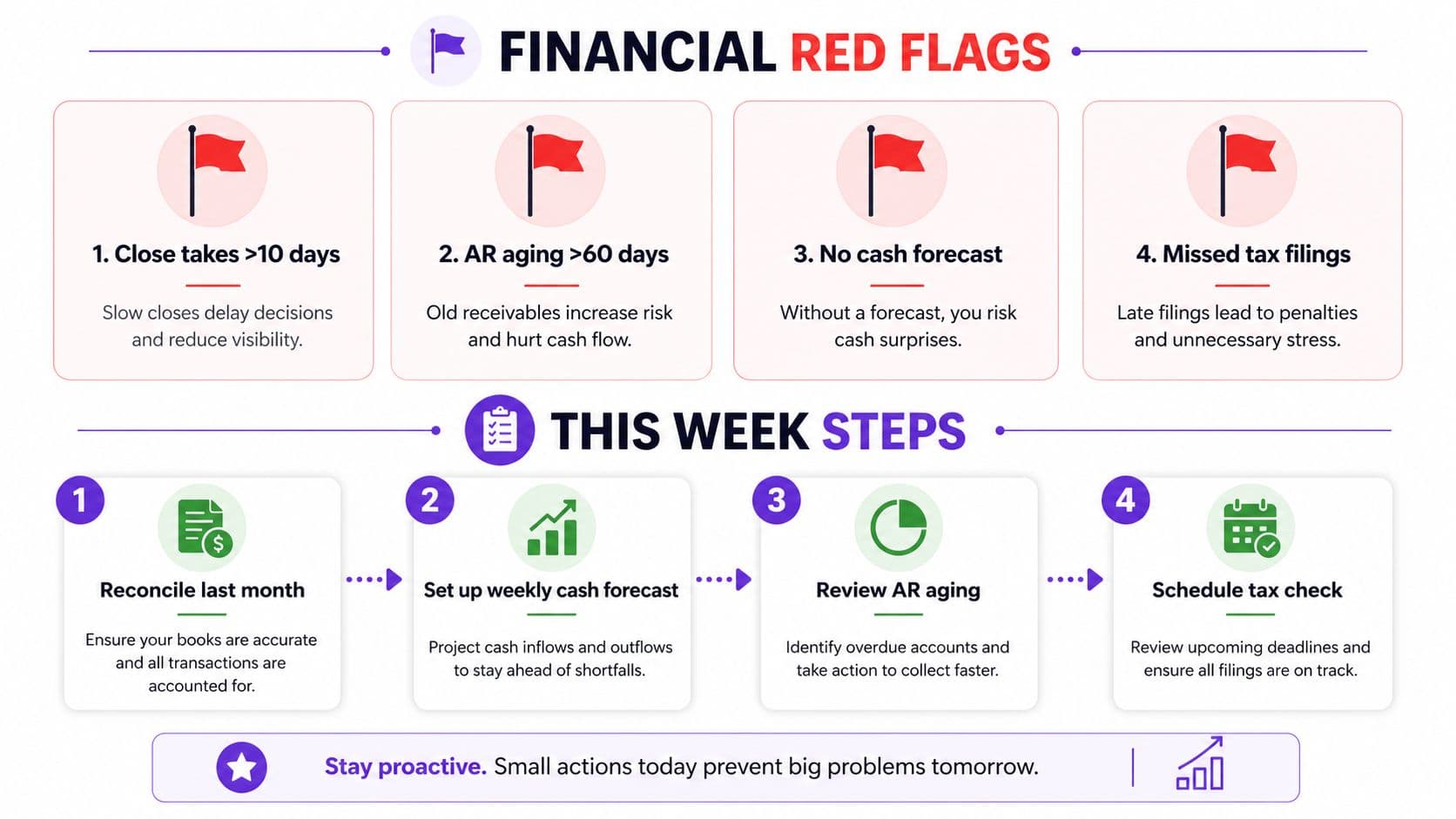
If your close takes more than 10 days, AR aging is over 60 days, you don't have a cash forecast, tax filings are getting missed, or spreadsheets have replaced the general ledger, the books are no longer supporting the business. At that point, waiting is a mistake. The cleanup only gets more expensive.
Use a 30, 60, 90 transition plan
In the first 30 days, clean up the ledger, rebuild the chart of accounts, and separate anything that was mixed between personal and business activity. In days 31 to 60, wire up the integrations, define the close calendar, and standardize the KPI pack. In days 61 to 90, produce the audit or investor-ready package and lock the cash forecast into your operating rhythm.
This week, do three things. Reconcile the last month. Review your AR aging. Decide whether your current finance setup is built for the business you have now, not the one you had last year.
If you want a controller who treats bookkeeping as a cash control system, not an admin task, Jumpstart Partners offers outsourced bookkeeping, month-end close, investor-ready reporting, and fixed-fee cleanup work for SaaS, agencies, and other growing companies. Book a free books review, or use Jumpstart Partners to ask about a QuickBooks cleanup or a 13-week cash flow sprint that gets your finance stack back under control.