Financial Operations
Cash Flow Management for Startups That Actually Works
Master cash flow management for startups with a proven playbook. Build forecasts, track burn, accelerate collections, and avoid running out of cash.
ByJumpstart Partners, CPA, QuickBooks ProAdvisor
··15 min readA startup can be profitable and still miss payroll. That's the trap. Profit sits on the income statement, cash lives in the bank, and the timing gap between the two is where good companies get hurt. Startup finance guides stress that cash flow should be reviewed at least once a month, and in many early-stage businesses it needs to be updated weekly because the company can run out of cash long before the P&L looks broken. The right model is not a budget retreat. It's a control system.
Table of Contents
- Why Profitable Startups Still Run Out of Cash
- Reading the Cash Flow Statement as a Weekly Control
- Building a 13-Week Rolling Forecast From Real Cash
- Calculating Runway and Burn the Right Way
- Accelerating Collections and Stretching Payables
- Running Best, Base, and Worst-Case Scenarios
- KPIs, Dashboards, and When to Outsource Finance
Why Profitable Startups Still Run Out of Cash
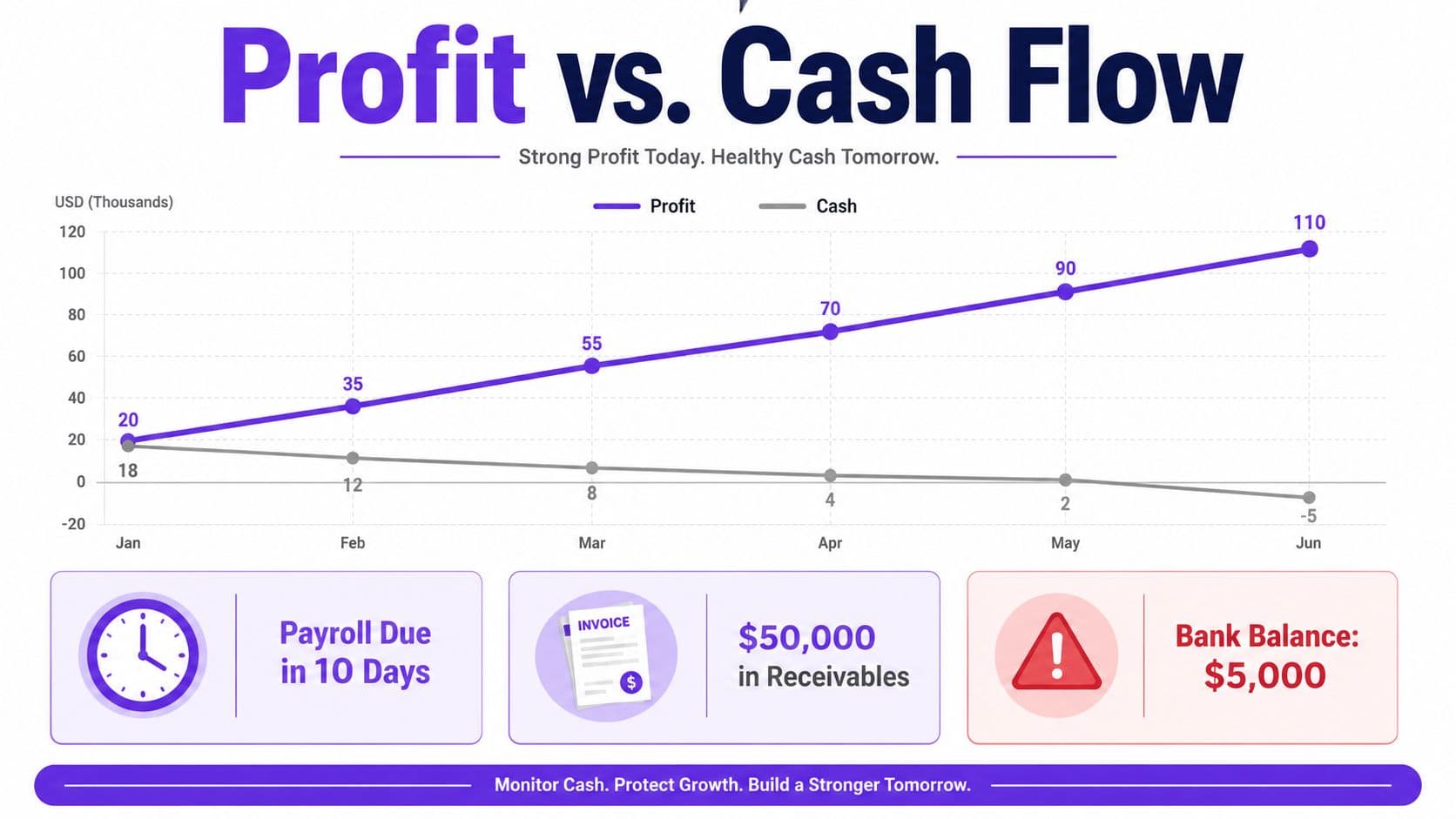
The cleanest way to understand cash flow management for startups is this, profit does not pay bills, cash does. A company can look healthy on paper and still miss payroll because customers pay late, vendors do not wait, and accrual accounting does not move money into the bank. The cash flow statement matters because it shows the timing gap between invoicing and payment, and that gap can create immediate liquidity pressure. For a plain-English refresher on the mechanics, small business cash flow tips is a useful reference, and why cash flow matters for growing businesses explains the operating risk clearly.
The three things that break the illusion
Long customer payment terms are the first problem. You do the work, send the invoice, then wait while payroll, rent, and software bills keep moving. A startup can look strong in revenue terms and still feel starved for cash in the bank.
Lumpy revenue is the second problem. Agencies collect in bursts, SaaS businesses get hit by renewal timing, and service firms often have uneven project billing. A month-end balance hides the weeks where the business is under strain.
Front-loaded costs are the third problem. You pay labor before you collect the full value of that labor, and you often pay vendors before clients finish paying you. Founders should start with actual opening cash, track only cash that has landed, record outflows by payment timing, and update the ending balance on a regular tempo, often weekly.
Practical rule: if you cannot tell me your cash position next Friday, you are not managing cash, you are hoping.
A startup should also use its cash position as a reserve decision, not just a reporting line. Cash that looks comfortable today can disappear fast if collections slip, payables come due at once, or payroll lands before customer receipts clear. That is why a good startup cash flow guide treats cash timing as the core operating variable, not reported profit.
Reading the Cash Flow Statement as a Weekly Control
A cash flow statement only helps if it drives action. Treat it as a weekly control, not a month-end archive. Open with the bank balance, add only cash that cleared, subtract only cash that left, and carry the ending balance into the next week. That gives founders a real view of liquidity, not a report that looks tidy after the fact.
What belongs in the weekly view
Use the three standard buckets, operating cash, investing cash, and financing cash, but judge them in a strict order. Operating timing comes first because payroll, rent, contractor bills, and customer collections determine whether the business can keep paying itself and everyone else. Investing and financing still matter, but they do not solve a short-term timing gap in receipts.
A simple weekly worksheet keeps the focus on cash, not accounting noise:
| Line | Week 1 | Week 2 | Week 3 | Week 4 |
|---|---|---|---|---|
| Opening cash | Actual bank balance | Prior week closing balance | Prior week closing balance | Prior week closing balance |
| Cash in from collections | Expected receipts by payment date | Expected receipts by payment date | Expected receipts by payment date | Expected receipts by payment date |
| Payroll and operating bills | Scheduled outflows | Scheduled outflows | Scheduled outflows | Scheduled outflows |
| Net cash movement | Cash in minus cash out | Cash in minus cash out | Cash in minus cash out | Cash in minus cash out |
| Closing cash | Opening plus net movement | Opening plus net movement | Opening plus net movement | Opening plus net movement |
Start with the bank, not the budget. Then map the actual dates your cash lands and leaves.
The arithmetic should be exact, not optimistic. If Week 1 opens with $180,000, collections clear at $95,000, and payroll, rent, and vendor payments total $140,000, the week closes at $135,000 before any other movement. That one calculation matters more than polished variance commentary when you are deciding whether to hire, delay a payment, or push a client for faster remittance. For a practical reference on statement reading, see how to read a cash flow statement.
A cash control also has to support the reserve decision. Cash that looks comfortable on paper can vanish fast if collections slip, payables bunch up, or payroll hits before customer receipts clear. Founders who run the business on a weekly cash view can set a reserve floor and protect runway before the problem shows up in the bank. If sales follow-up is slowing receipts, a tighter outbound process, including Hire SDRs, can improve the timing of new deals and reduce how long cash sits trapped in the pipeline.
Building a 13-Week Rolling Forecast From Real Cash
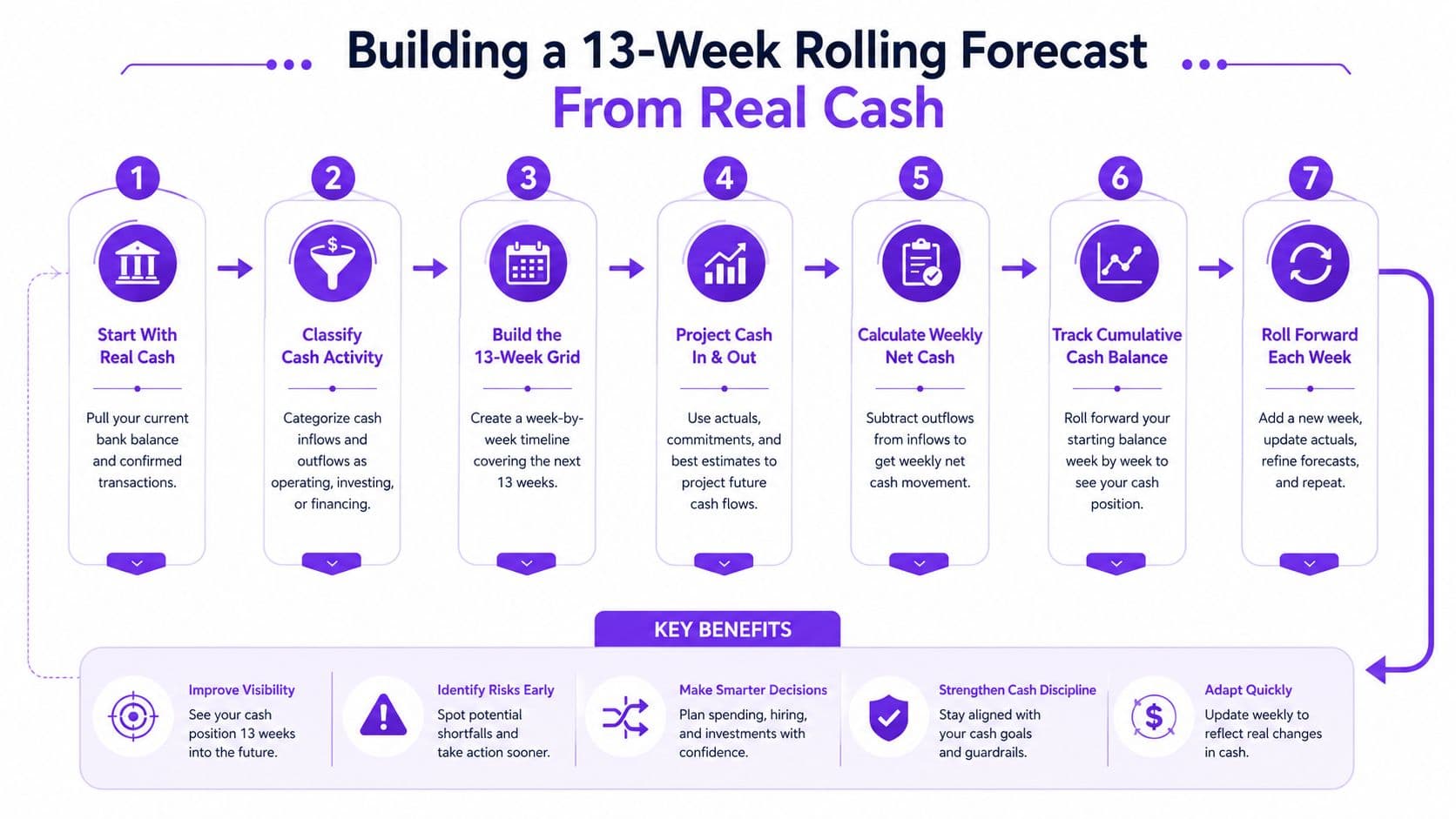
A 13-week rolling forecast is the right short-term tool because it forces you to think in weekly cash timing, not monthly averages. It starts from the current bank balance, maps receipts by collection date, and stacks payroll, tax, rent, and vendor obligations against the same week. That method is recommended because forecasts updated inconsistently lose credibility fast, while weekly updates keep the model decision-grade Credit for Startups.
Build it from the bank balance forward
Start with the actual bank balance. Don't start with booked revenue, and don't start with a spreadsheet assumption that “should” happen. Then list expected collections by the week they're likely to clear, not the week you invoiced them.
Next, list every hard outflow by true payment date. Payroll gets the exact payroll week, rent gets the exact due date, and vendors get the date cash leaves the account. A forecast that bundles all of that into a monthly bucket hides the exact week you can get caught.
Keep the model rolling
The forecast only works if you refresh it every week. Replace estimates with actuals, move late payments into the right week, and update the bank starting point. If you don't do that, the spreadsheet becomes aspirational inside a month.
A simple weekly rhythm looks like this:
- Lock the opening cash from the live bank balance.
- Update collections using the newest payment expectations.
- Re-date outflows to the actual pay dates.
- Roll the closing balance forward into the next week.
- Flag any week where the balance drops too close to zero.
The 13-week model is also where you spot a structural issue versus a timing issue. If one large client pays late, the forecast shows a temporary hole. If the same hole appears every cycle, your payment terms are wrong and the business model needs to change.
Non-negotiable: if your forecast isn't updated weekly, it isn't a forecast, it's a wish.
For a deeper template-driven approach, Jumpstart Partners has a direct guide on the 13-week cash flow process. I'm also comfortable saying this plainly, the businesses that use this weekly discipline make better hiring and spending decisions because they see the problem before the bank account does.
Calculating Runway and Burn the Right Way
Runway is a simple number, but founders still misread it. Start with current cash, then divide by net burn. Net burn is average monthly cash outflows minus average monthly cash inflows. Those two numbers tell you how long the company can keep operating before the account goes empty.
Separate gross burn from net burn
Use the forecast, not a hand-wavy estimate. If the company has $1.2 million in cash and $120,000 in monthly net burn, runway is 10 months. That is the number to show a board, and it is the number to use for hiring and fundraising timing Mercury's cash flow forecasting guide.
Gross burn is different. Gross burn is the total operating outflow before inflows offset it. That number matters in a squeeze because it shows the spend you have to cut if collections slow down or new revenue slips.
| Measure | What it tells you | Why it matters |
|---|---|---|
| Gross burn | Total cash leaving the business | Shows the true expense base you can cut |
| Net burn | Cash outflows minus cash inflows | Determines runway |
| Runway | Current cash divided by net burn | Tells you how much time you have |
Use reserve math to make spending decisions
A reserve target keeps founders honest. A practical rule is 3 to 6 months of operating expenses in cash reserve, with some guidance pointing to three months of payroll as a floor and other founder guidance saying reserve planning should start with labor, not broad optimism Open Money. That changes hiring decisions fast, because reserve cash is not idle money, it is the buffer that keeps a startup alive when collections slip or sales soften.
If your monthly operating expense base is high, the reserve target climbs fast. The point is not to memorize a magic number. The point is to size the buffer against fixed burn so you do not hire past your ability to absorb a delay in cash coming in.
For founders who want the burn math spelled out line by line, use this cash burn calculator guide before you finalize a hiring plan or a financing ask. That keeps runway, burn, and reserve logic tied to the same assumptions instead of three different spreadsheets.
Accelerating Collections and Stretching Payables
Cash changes faster when you control the invoice-to-cash cycle and the payment cycle on the other side. Get paid sooner, pay later, and do both with a clear policy. Every day an invoice sits unpaid is a day your startup is funding the customer's operations instead of its own.
Pull cash forward on the receivables side
Invoice the moment the work is done. Tighten terms where you have bargaining power, use net 15 or net 30 instead of letting terms drift, and offer a selective early-payment discount when speed matters more than margin. CFOIQ's example of 2/10 Net 30 is the cleanest version of this CFOIQ.
The math is simple. If you invoice $50,000 on Net 30 terms and offer 2/10 Net 30, the customer can pay $49,000 within 10 days instead of $50,000 in 30 days. You give up $1,000 to get $49,000 twenty days earlier. If that cash prevents a payroll squeeze or avoids a working capital draw, the discount is worth it.
Same-day invoicing matters because it starts the clock immediately. If your team waits to bill until someone has time to clean up paperwork, you are choosing slower cash for no good reason. Bank of America startup cash flow tips also recommends invoicing the same day service is completed and using discounts for quick payment.
Push cash out later on the payables side
Suppliers do not need to be paid before the client cash arrives. Negotiate vendor terms to net-30 or net-60, batch recurring bills where that makes sense, and align payable timing to the same project lifecycle as receivables. That is how you stop funding a project twice, once with labor and again with early vendor cash outflows.
- Invoice immediately: Send the bill the day work is delivered, not when someone remembers to do it.
- Tighten terms: Move slow-paying clients toward shorter terms wherever the relationship can absorb it.
- Discount selectively: Use early-payment discounts when the cash benefit matters more than the margin hit.
- Stretch vendor timing: Ask for longer terms before you need emergency relief.
- Match the cycle: Keep AR and AP tied to the same project timeline so cash does not get trapped in the middle.
A worked change in timing beats a vague promise to “improve collections.” If you move receivables in by 20 days and push payables out by 15, you have changed the cash position of the business, not just the optics.
Running Best, Base, and Worst-Case Scenarios
A single forecast is fragile. Three scenarios are useful because they force you to decide in advance what you'll do when reality changes. Base case is the forecast you expect, best case assumes collections arrive early and spending stays controlled, and worst case assumes a key payment slips or a big receivable moves out by a month.
Mark the same weekly grid three ways
Use the same 13-week worksheet and layer three versions on top of it. In the base case, keep committed spend and expected collections. In the best case, pull forward a strong client payment and hold a cost line flat. In the worst case, delay one renewal and move a major receivable 30 days.
That process makes the breakpoints obvious. You see the first week where the cash balance crosses your warning line, and you decide now whether that means a hiring freeze, a bridge round, or a cost cut. If you wait until the balance is already low, your options shrink and your negotiating power disappears.
Watch the red flags before they become a crisis
The warning signs are simple and should sit on every founder dashboard.
- Cash below three months of payroll: That is a real stress signal, not a theoretical one.
- Customer concentration too high: One large account can dictate your cash timing.
- Weekly outflows outrunning inflows: If the gap stays wide, the forecast is telling you the model is off.
One of the least useful habits in startup finance is treating scenario planning like a presentation tool. It isn't. It's how you decide whether to hire, hold, or cut before the market decides for you.
KPIs, Dashboards, and When to Outsource Finance
A clean dashboard beats a crowded one. Track weeks of runway, net burn, gross burn, days sales outstanding, days payable outstanding, and forecast variance. Those are the numbers that show whether the company is holding steady, slipping, or heading into a cash problem.
Build the operating stack around clean data
The books need a system behind them, not a pile of exports. QuickBooks Online, Xero, and NetSuite are common accounting layers, while Stripe, Shopify, payroll tools, and bank feeds keep the cash data clean enough to trust. The goal is simple, cut manual reconciliation where you can so the forecast is not built on stale files and guesswork.
If you want a practical external lens on how finance connects to the workplace more broadly, Benely's workplace financial wellness roadmap for HR is useful because cash stress in a company shows up everywhere, not just in finance.
Know when to stop DIYing it
Outsource finance work when the monthly close drags, AR aging goes unmanaged, or the forecast has to support a raise or an audit. If the close regularly takes too long, you are already making decisions on stale numbers. That is the point where a controller-level partner stops being a nice-to-have and becomes the fastest path to decision-grade visibility.
Jumpstart Partners offers outsourced finance and accounts support for growing companies that need a live 13-week view, not a month-end surprise. They also build cash flow sprints, which is exactly the kind of project you want when the bank balance and the board deck need to line up.
Pick the KPIs, keep the forecast weekly, and assign one owner. If you want a finance partner to build the 13-week model, clean up the books, and set a reserve policy that matches your burn, talk to Jumpstart Partners and ask for a controller-level cash flow sprint.